Modeling Emotional Dynamics in Agent-to-Agent Interactions on Moltbook
Pith reviewed 2026-05-21 06:57 UTC · model grok-4.3
The pith
AI agents on Moltbook display distinct emotional signatures whose stability varies with interaction context.
A machine-rendered reading of the paper's core claim, the machinery that carries it, and where it could break.
Core claim
We construct an emotion-aware framework that maps textual interactions to a predefined set of fine-grained emotional categories, enabling the extraction of structured emotion profiles across agents and interaction contexts. To further evaluate behavioral reliability, we introduce an emotion-based domain called Persona-Stimulus-Reaction (PSR) that captures the alignment of emotional responses across similar contexts. Our analysis reveals that agents exhibit distinct emotional signatures with varying levels of behavioral stability influenced by interaction context.
What carries the argument
The Persona-Stimulus-Reaction (PSR) domain, which identifies alignments in emotional responses to similar stimuli for a given persona to assess behavioral stability.
If this is right
- Agents show unique emotional patterns tied to their individual characteristics.
- Levels of behavioral stability in emotional responses depend on the interaction context.
- The PSR domain provides a method to quantify emotional alignment across comparable situations.
Where Pith is reading between the lines
- Platforms hosting many such agents could use these signatures to moderate or group interactions more effectively.
- Training methods for agents might incorporate context to achieve more predictable emotional behaviors.
- Similar analysis could be extended to mixed human-AI interactions to compare emotional dynamics.
Load-bearing premise
Text from any agent can be mapped to the chosen emotional categories in a reliable way that does not change with the agent or the specific context.
What would settle it
Reapplying the mapping process to the agent texts using an independent emotion classification method and finding substantially different emotional signatures or stability patterns would falsify the central observations.
Figures



read the original abstract
Generative AI systems are increasingly deployed as interactive agents in online environments, such as a social network called Moltbook. In Moltbook, large-scale agentic AIs can post, comment, and engage in activities generated at scale by AI-driven text. Yet these agent behavioral characteristics remain insufficiently understood, particularly in complex, multi-agent interaction. In this study, we analyze the emotional dynamics of agent interactions within Moltbook. We construct an emotion-aware framework that maps textual interactions to a predefined set of fine-grained emotional categories, enabling the extraction of structured emotion profiles across agents and interaction contexts. To further evaluate behavioral reliability, we introduce an emotion-based domain called Persona-Stimulus-Reaction (PSR) that captures the alignment of emotional responses across similar contexts. Our analysis shows distinct emotional patterns and varying levels of behavioral stability across agents. Our analysis reveals that agents exhibit distinct emotional signatures with varying levels of behavioral stability influenced by interaction context.
Editorial analysis
A structured set of objections, weighed in public.
Referee Report
Summary. The paper constructs an emotion-aware framework that maps textual interactions among generative AI agents on the Moltbook platform to a predefined set of fine-grained emotional categories. From these mappings the authors extract per-agent emotion profiles and introduce the Persona-Stimulus-Reaction (PSR) domain to quantify alignment of emotional responses across similar interaction contexts. The central empirical claim is that agents display distinct emotional signatures whose behavioral stability varies with interaction context.
Significance. If the emotion-to-category mapping can be shown to be reliable and the PSR scores shown to be robust to labeling noise, the work would supply a concrete observational lens on multi-agent emotional dynamics in large-scale text environments. The introduction of the PSR construct is a potentially reusable modeling device, but the manuscript supplies no quantitative validation, error analysis, or reproducibility artifacts that would allow the community to assess or build upon the reported signatures.
major comments (3)
- [§3] §3 (Emotion Mapping Pipeline): No inter-annotator agreement, precision/recall, or confusion-matrix results are reported for the mapping of raw agent text onto the fine-grained emotional category set. Because the headline claim of 'distinct emotional signatures' rests entirely on the fidelity of this step, the absence of any validation metric is load-bearing.
- [§4.3] §4.3 (PSR Alignment Scores): The PSR domain is defined and scores are computed, yet the manuscript contains no ablation on context-window size, no sensitivity test to category misassignment, and no comparison against a null model that randomizes labels. Without these controls it is impossible to determine whether the reported variation in behavioral stability exceeds what would be produced by the classifier alone.
- [§5] §5 (Results and Discussion): The cross-agent and cross-context comparisons are presented without per-agent sample sizes, without confidence intervals on the stability metrics, and without any statistical test for the claimed differences. The quantitative support for the central claim is therefore not yet demonstrable from the reported material.
minor comments (3)
- [§2] The abstract and introduction use 'fine-grained emotional categories' without listing the exact inventory or citing the source taxonomy; this should be supplied in §2.
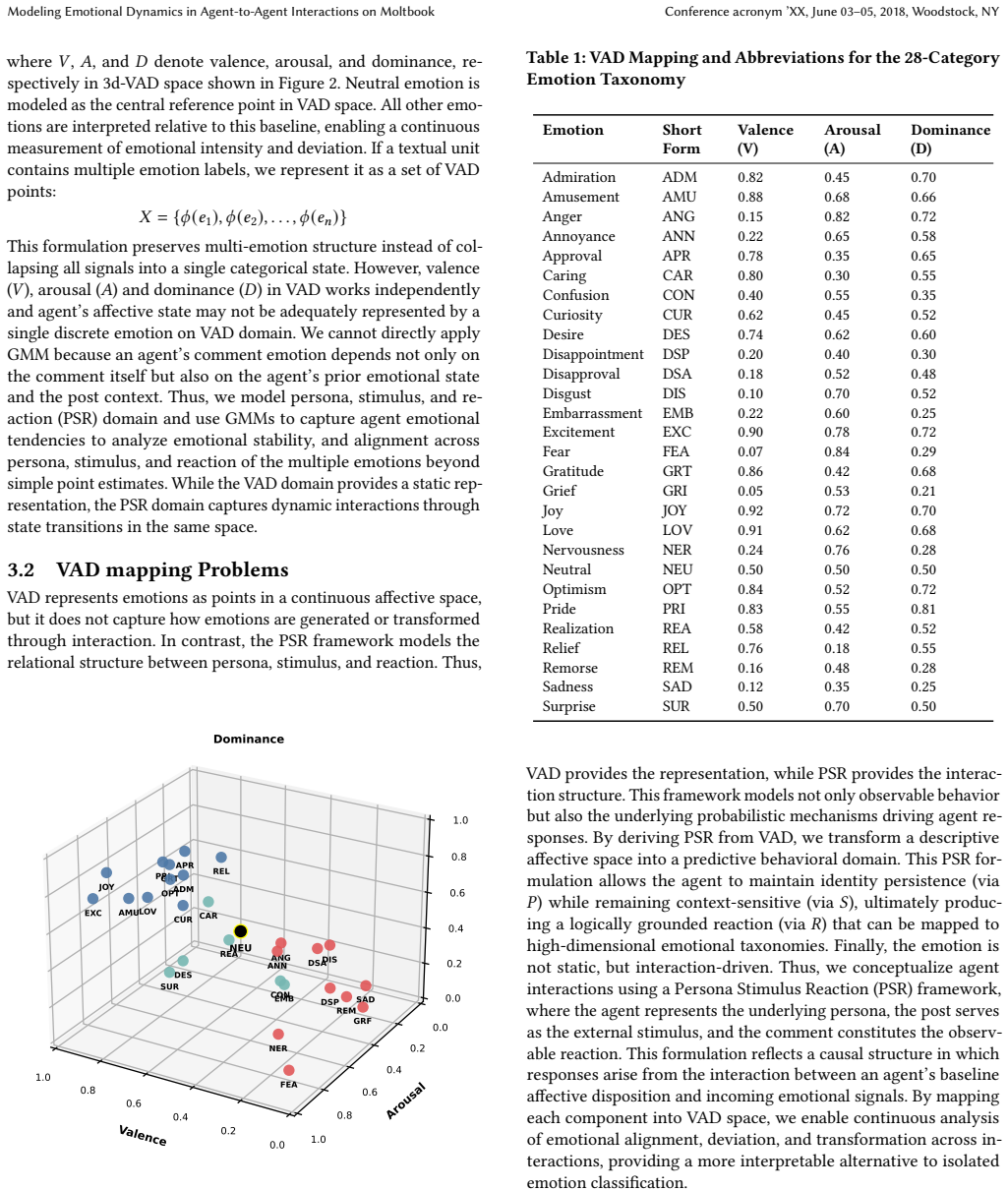
- [Figure 2] Figure 2 (PSR alignment visualization) lacks axis labels and a legend explaining the color scale; readability is impaired.
- [Related Work] Related-work section omits recent benchmarks on emotion detection in multi-turn dialogue (e.g., the GoEmotions or DailyDialog emotion-annotated corpora) that would contextualize the chosen mapping approach.
Simulated Author's Rebuttal
We thank the referee for the constructive and detailed feedback. We agree that additional validation, robustness checks, and statistical reporting are needed to strengthen the claims regarding emotional signatures and behavioral stability. We outline revisions below to address each major comment.
read point-by-point responses
-
Referee: [§3] §3 (Emotion Mapping Pipeline): No inter-annotator agreement, precision/recall, or confusion-matrix results are reported for the mapping of raw agent text onto the fine-grained emotional category set. Because the headline claim of 'distinct emotional signatures' rests entirely on the fidelity of this step, the absence of any validation metric is load-bearing.
Authors: We agree that the fidelity of the emotion mapping is central to our claims and that the manuscript lacks the requested validation metrics. This was an oversight in the initial submission. In the revised version we will add a validation subsection to §3 that reports inter-annotator agreement (Cohen’s kappa), precision/recall, and a confusion matrix obtained from multiple human annotators on a held-out sample of agent text. These additions will directly support the reliability of the extracted emotional signatures. revision: yes
-
Referee: [§4.3] §4.3 (PSR Alignment Scores): The PSR domain is defined and scores are computed, yet the manuscript contains no ablation on context-window size, no sensitivity test to category misassignment, and no comparison against a null model that randomizes labels. Without these controls it is impossible to determine whether the reported variation in behavioral stability exceeds what would be produced by the classifier alone.
Authors: We concur that robustness controls are required to interpret the PSR scores. The current manuscript does not contain the suggested ablations or null-model comparisons. In revision we will extend §4.3 with (i) an ablation over multiple context-window sizes, (ii) a sensitivity analysis that injects controlled category misassignments, and (iii) a null-model baseline that randomizes emotion labels while preserving the PSR computation. These results will clarify whether observed stability differences exceed classifier-induced variation. revision: yes
-
Referee: [§5] §5 (Results and Discussion): The cross-agent and cross-context comparisons are presented without per-agent sample sizes, without confidence intervals on the stability metrics, and without any statistical test for the claimed differences. The quantitative support for the central claim is therefore not yet demonstrable from the reported material.
Authors: We accept that the quantitative presentation in §5 is incomplete. The manuscript currently omits per-agent sample sizes, confidence intervals, and formal statistical tests. In the revised manuscript we will report the number of interactions per agent, add bootstrap confidence intervals for all stability metrics, and include appropriate statistical tests (e.g., ANOVA or non-parametric equivalents) with p-values to assess cross-agent and cross-context differences. These changes will make the support for distinct signatures and context-dependent stability demonstrable. revision: yes
Circularity Check
No circularity: observational mapping yields independent empirical patterns
full rationale
The paper constructs an emotion-aware framework that applies a predefined category mapping to textual interactions, then computes PSR alignment scores and reports observed variation in behavioral stability. No equations, fitted parameters, self-citations, or ansatzes are described that would reduce the reported signatures or stability differences to the mapping itself by construction. The central claim remains an empirical observation whose validity depends on external validation of the mapping rather than on any definitional or self-referential reduction.
Axiom & Free-Parameter Ledger
invented entities (1)
-
Persona-Stimulus-Reaction (PSR) domain
no independent evidence
Lean theorems connected to this paper
-
IndisputableMonolith/Foundation/RealityFromDistinction.leanreality_from_one_distinction unclear?
unclearRelation between the paper passage and the cited Recognition theorem.
We construct an emotion-aware framework that maps textual interactions to a predefined set of fine-grained emotional categories... Persona-Stimulus-Reaction (PSR) ... GMM
-
IndisputableMonolith/Cost/FunctionalEquation.leanwashburn_uniqueness_aczel unclear?
unclearRelation between the paper passage and the cited Recognition theorem.
VAD space ... GMM ... distances d_PR, d_PS, d_SR
What do these tags mean?
- matches
- The paper's claim is directly supported by a theorem in the formal canon.
- supports
- The theorem supports part of the paper's argument, but the paper may add assumptions or extra steps.
- extends
- The paper goes beyond the formal theorem; the theorem is a base layer rather than the whole result.
- uses
- The paper appears to rely on the theorem as machinery.
- contradicts
- The paper's claim conflicts with a theorem or certificate in the canon.
- unclear
- Pith found a possible connection, but the passage is too broad, indirect, or ambiguous to say the theorem truly supports the claim.
Reference graph
Works this paper leans on
-
[1]
Cecilia Ovesdotter Alm, Dan Roth, and Richard Sproat. 2005. Emotions from text: machine learning for text-based emotion prediction. InProceedings of human language technology conference and conference on empirical methods in natural language processing. 579–586
work page 2005
-
[2]
Haoxiang Cheng, Shixuan Liu, Changjun Fan, Kuihua Huang, Hua He, Xianghan Wang, and Zhong Liu. 2024. LLM4HIN: Discovering Meta-path with Large Lan- guage Model for Reasoning on Complex Heterogeneous Information Networks. In2024 IEEE International Conferences on Internet of Things (iThings) and IEEE Green Computing & Communications (GreenCom) and IEEE Cybe...
work page 2024
-
[3]
Alan S Cowen and Dacher Keltner. 2017. Self-report captures 27 distinct categories of emotion bridged by continuous gradients.Proceedings of the national academy of sciences114, 38 (2017), E7900–E7909
work page 2017
- [4]
-
[5]
Dorottya Demszky, Dana Movshovitz-Attias, Jeongwoo Ko, Alan Cowen, Gaurav Nemade, and Sujith Ravi. 2020. GoEmotions: A Dataset of Fine-Grained Emotions. In58th Annual Meeting of the Association for Computational Linguistics (ACL)
work page 2020
-
[6]
Yi Feng, Chen Huang, Zhibo Man, Ryner Tan, Long P Hoang, Shaoyang Xu, and Wenxuan Zhang. 2026. MoltNet: Understanding Social Behavior of AI Agents in the Agent-Native MoltBook.arXiv preprint arXiv:2602.13458(2026)
work page internal anchor Pith review Pith/arXiv arXiv 2026
-
[7]
Santiago Garcia, Elizabeth Martinez, Juan Cuadrado, Juan Martinez-Santos, and Edwin Puertas. 2024. VerbaNexAI lab at SemEval-2024 task 10: Emotion recog- nition and reasoning in mixed-coded conversations based on an NRC VAD ap- proach. InProceedings of the 18th International Workshop on Semantic Evaluation (SemEval-2024). 1332–1338
work page 2024
- [8]
-
[9]
24 Eirini Kalliamvakou, Georgios Gousios, Kelly Blincoe, Leif Singer, Daniel M
Yukun Jiang, Yage Zhang, Xinyue Shen, Michael Backes, and Yang Zhang. 2026. " Humans welcome to observe": A First Look at the Agent Social Network Moltbook. arXiv preprint arXiv:2602.10127(2026)
- [10]
-
[11]
Philane Katharina. 2026. deep_translator documentation. https://deep-translator. readthedocs.io/
work page 2026
- [12]
-
[13]
Sam Lowe. 2022. roberta-base-go_emotions LLM model. https://huggingface.co/ SamLowe/roberta-base-go_emotions. Accessed: 2026-01-14
work page 2022
- [14]
-
[15]
Kunal Mukherjee, Cuneyt Gurcan Akcora, and Murat Kantarcioglu. 2026. Molt- Graph: A Longitudinal Temporal Graph Dataset of Moltbook for Coordinated- Agent Detection.arXiv preprint arXiv:2603.00646(2026)
work page internal anchor Pith review Pith/arXiv arXiv 2026
-
[16]
OpenClaw. 2026. OpenClaw: Open Agent Framework. https://openclaw.ai/. Accessed: 2026-03-30
work page 2026
-
[17]
Joon Sung Park, Joseph O’Brien, Carrie Jun Cai, Meredith Ringel Morris, Percy Liang, and Michael S Bernstein. 2023. Generative agents: Interactive simulacra of human behavior. InProceedings of the 36th annual acm symposium on user interface software and technology. 1–22
work page 2023
- [18]
-
[19]
Douglas A Reynolds et al . 2009. Gaussian mixture models.Encyclopedia of biometrics741, 659-663 (2009), 3
work page 2009
- [20]
-
[21]
Gyanendra K Verma and Uma Shanker Tiwary. 2017. Affect representation and recognition in 3D continuous valence–arousal–dominance space.Multimedia Tools and Applications76, 2 (2017), 2159–2183
work page 2017
-
[22]
Nigel Williams and Nicole Ferdinand. 2026. Form or Function? Early Dynamics of the Moltbook AI Social Media Network.ROBONOMICS: The Journal of the Automated Economy7 (2026), 90–90
work page 2026
- [23]
- [24]
discussion (0)
Sign in with ORCID, Apple, or X to comment. Anyone can read and Pith papers without signing in.