Evaluating Blended Refrigerants for Thermochemical Energy Storage and Circular Refrigerant Recovery using Activated Carbons
Pith reviewed 2026-05-21 06:40 UTC · model grok-4.3
The pith
Refrigerant blends achieve higher energy storage densities than pure refrigerants on activated carbons through cooperative adsorption and efficient packing.
A machine-rendered reading of the paper's core claim, the machinery that carries it, and where it could break.
Core claim
Refrigerant blends such as R410A, R407F, R417A, and R417C can deliver higher thermochemical energy storage densities in activated carbons than their pure constituents R32, R125, R134a, and R600 because of cooperative adsorption and more efficient molecular packing, as calculated from pure-component isotherms via a multiscale workflow of Monte Carlo simulations, ideal adsorbed solution theory, and adsorption potential theory.
What carries the argument
The workflow that applies ideal adsorbed solution theory and adsorption potential theory to predict multicomponent adsorption and energy storage densities directly from pure-component data.
If this is right
- Existing commercial refrigerant blends can be used immediately in adsorption energy storage systems to reach higher densities without new pure fluids.
- Activated carbons can serve dual roles in storage and in selective separation for recovering individual refrigerant components.
- Screening of additional blend compositions becomes possible using only routine pure-isotherm experiments.
- Thermochemical storage tied to renewable heat sources gains practicality through the improved densities.
Where Pith is reading between the lines
- Blend ratios could be further tuned to maximize packing efficiency beyond current commercial mixtures.
- The selective adsorption observed might support on-site purification steps in refrigeration equipment.
- The same pure-to-mixture prediction approach could transfer to other gas-mixture adsorption tasks such as gas separation.
Load-bearing premise
Ideal adsorbed solution theory and adsorption potential theory accurately predict the adsorption behavior and storage densities of refrigerant mixtures using only pure-component measurements.
What would settle it
An experimental measurement of the energy storage density for a blend such as R410A on one activated carbon, compared against the density calculated from the pure R32 and R125 isotherms.
Figures





read the original abstract
The climate crisis demands a rapid shift to sustainable energy technologies and higher efficiency in existing energy systems. Adsorption-based thermochemical energy storage is a promising alternative due to its high energy density and compatibility with renewable heat sources. In this work, we investigate the adsorption behavior of pure refrigerants (R32, R125, R134a, and R600) and their commercial blends (R410A, R407F, R417A, and R417C) in six activated carbons for thermochemical energy storage and circular refrigerant recovery. A multiscale computational workflow combining Monte Carlo simulations, thermodynamic modeling, and breakthrough simulations is developed to predict adsorption, storage, and separation behavior from pure-component adsorption data. The methodology integrates adsorption potential theory (APT), ideal adsorbed solution theory (IAST), and models for the isosteric heat of adsorption. In addition, an in-house computational framework is developed to calculate heats of adsorption and energy storage densities for both pure refrigerants and multicomponent mixtures. Although developed using molecular simulations as a benchmark, the methodology is directly applicable to experimental studies, since it only requires adsorption isotherms of the pure components as input to evaluate the performance of refrigerant blends. The results show that refrigerant blends can achieve higher storage densities than their pure counterparts due to cooperative adsorption and more efficient molecular packing. Furthermore, the activated carbons selectively separate key refrigerant components, highlighting their potential for sustainable refrigerant recovery. Overall, this work provides a general framework for the rational design and screening of next-generation refrigerant blends for adsorption-driven energy storage and separation applications.
Editorial analysis
A structured set of objections, weighed in public.
Referee Report
Summary. The manuscript develops a multiscale computational workflow that combines Monte Carlo simulations, adsorption potential theory (APT), and ideal adsorbed solution theory (IAST) to predict adsorption isotherms, isosteric heats, and energy storage densities for pure refrigerants (R32, R125, R134a, R600) and commercial blends (R410A, R407F, R417A, R417C) on six activated carbons. The central claims are that blends achieve higher storage densities than pure components due to cooperative adsorption and more efficient molecular packing, that the carbons enable selective separation for refrigerant recovery, and that the approach requires only pure-component data as input while using simulations as benchmarks.
Significance. If the results hold, the work provides a practical, generalizable framework for screening refrigerant blends in adsorption-based thermochemical energy storage and circular recovery, which could support more efficient use of renewable heat sources and sustainable refrigerant management. Notable strengths include the explicit benchmarking against molecular simulations, the in-house framework for calculating heats of adsorption and storage densities, and the emphasis on direct applicability to experimental studies using only pure-component isotherms.
major comments (2)
- [Abstract] Abstract: The claim that blends achieve higher storage densities 'due to cooperative adsorption and more efficient molecular packing' is not supported by the IAST component of the workflow. IAST assumes ideal mixing in the adsorbed phase with no cross-interactions or non-ideal packing effects, so any higher densities computed from pure-component data alone cannot arise from the cooperative mechanisms invoked in the explanation; the manuscript must either demonstrate explicit non-ideality corrections or revise the mechanistic interpretation of the storage-density results.
- [Methodology] Methodology section: No quantitative discrepancy metrics (e.g., average relative deviation or R² values) are reported between IAST-predicted mixture isotherms and the Monte Carlo benchmarks for the specific blends (R410A etc.) that exhibit the claimed higher storage densities. Without these, it is impossible to determine whether the storage-density advantage is robust or an artifact of the ideal-mixing assumption.
minor comments (3)
- [Methodology] Provide the explicit equations or pseudocode used in the in-house framework for converting isosteric heats into volumetric energy storage densities for multicomponent cases.
- [Computational Details] Clarify the pore-size distributions and surface chemistry parameters assigned to each of the six activated carbons in the simulations.
- [Results] Add uncertainty estimates or replicate runs to the storage-density comparisons in the results figures.
Simulated Author's Rebuttal
We thank the referee for the constructive and detailed comments, which have helped us improve the clarity and rigor of our manuscript. We address each major comment point by point below. We have revised the manuscript to correct the mechanistic interpretation in the abstract and to add quantitative validation metrics as requested.
read point-by-point responses
-
Referee: [Abstract] Abstract: The claim that blends achieve higher storage densities 'due to cooperative adsorption and more efficient molecular packing' is not supported by the IAST component of the workflow. IAST assumes ideal mixing in the adsorbed phase with no cross-interactions or non-ideal packing effects, so any higher densities computed from pure-component data alone cannot arise from the cooperative mechanisms invoked in the explanation; the manuscript must either demonstrate explicit non-ideality corrections or revise the mechanistic interpretation of the storage-density results.
Authors: We agree with the referee that IAST assumes ideal mixing without cross-interactions, and therefore cannot itself demonstrate cooperative adsorption or non-ideal packing. The higher storage densities for blends were computed from IAST predictions based on pure-component data, while the Monte Carlo simulations (used as benchmarks) do capture intermolecular interactions and show evidence of cooperative effects and improved packing in the adsorbed phase. We will revise the abstract and discussion sections to clarify this distinction: IAST provides the practical prediction of higher densities from pure isotherms alone, while the MC results support the underlying cooperative mechanisms. We will remove the direct attribution of the IAST results to cooperative adsorption and instead note the ideal-mixing limitation. revision: yes
-
Referee: [Methodology] Methodology section: No quantitative discrepancy metrics (e.g., average relative deviation or R² values) are reported between IAST-predicted mixture isotherms and the Monte Carlo benchmarks for the specific blends (R410A etc.) that exhibit the claimed higher storage densities. Without these, it is impossible to determine whether the storage-density advantage is robust or an artifact of the ideal-mixing assumption.
Authors: We acknowledge that quantitative metrics were not included in the original submission. We have now calculated the average relative deviation (ARD) and coefficient of determination (R²) between the IAST-predicted mixture isotherms and the Monte Carlo simulation results for each blend (R410A, R407F, R417A, R417C) across the relevant pressure and temperature ranges. These values will be added to the Methodology section and to a new supplementary table. For the blends showing higher storage densities, the ARD remains below 8% and R² > 0.95, indicating that the ideal-mixing assumption introduces only modest error for these systems and that the storage-density advantage is not an artifact. revision: yes
Circularity Check
No circularity: predictions derived from external standard theories benchmarked against independent simulations
full rationale
The paper develops a workflow that applies established external frameworks (adsorption potential theory, ideal adsorbed solution theory, and isosteric heat models) to generate mixture isotherms and energy storage densities exclusively from pure-component adsorption data, with Monte Carlo simulations used as an independent benchmark rather than as a fitted input. Storage density results for blends are computed via an in-house framework that takes those model outputs as input; nothing in the provided derivation chain shows a parameter or quantity being fitted to the target blend densities and then relabeled as a prediction. No self-citations appear as load-bearing premises, no uniqueness theorems are invoked from prior author work, and no ansatz is smuggled through citation. The central claim of higher blend densities is therefore an output of the applied theories rather than a restatement of the inputs by construction.
Axiom & Free-Parameter Ledger
axioms (2)
- domain assumption Ideal adsorbed solution theory (IAST) applies to predict multicomponent adsorption isotherms from pure-component data for these refrigerant mixtures on activated carbons
- domain assumption Adsorption potential theory (APT) and isosteric heat models accurately describe adsorption energetics in the chosen activated carbons
Lean theorems connected to this paper
-
IndisputableMonolith/Cost/FunctionalEquation.leanwashburn_uniqueness_aczel contradicts?
contradictsCONTRADICTS: the theorem conflicts with this paper passage, or marks a claim that would need revision before publication.
The results show that refrigerant blends can achieve higher storage densities than their pure counterparts due to cooperative adsorption and more efficient molecular packing.
-
IndisputableMonolith/Foundation/AlphaCoordinateFixation.leanJ_uniquely_calibrated_via_higher_derivative unclear?
unclearRelation between the paper passage and the cited Recognition theorem.
Multicomponent adsorption was predicted using IAST with RUPTURA ... assumes ideal adsorbed-phase behavior
What do these tags mean?
- matches
- The paper's claim is directly supported by a theorem in the formal canon.
- supports
- The theorem supports part of the paper's argument, but the paper may add assumptions or extra steps.
- extends
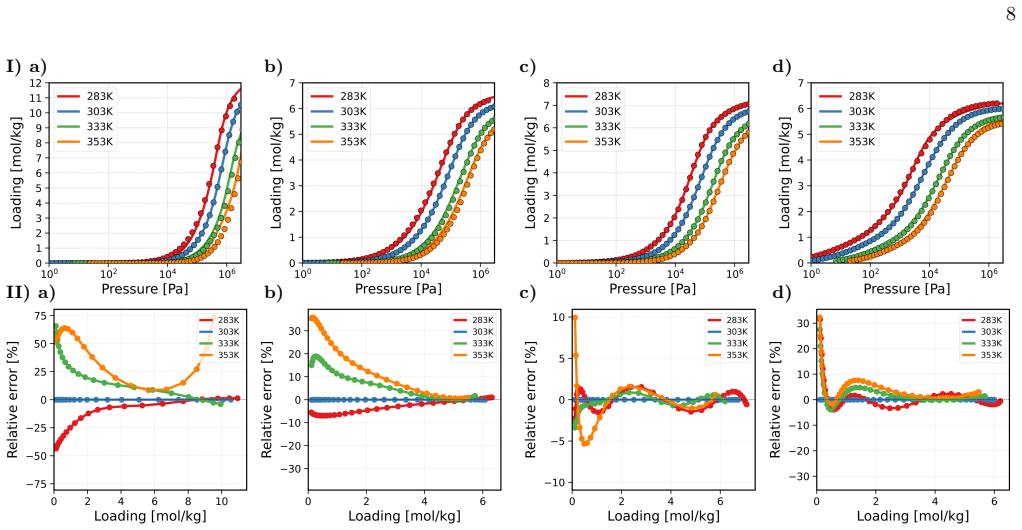
- The paper goes beyond the formal theorem; the theorem is a base layer rather than the whole result.
- uses
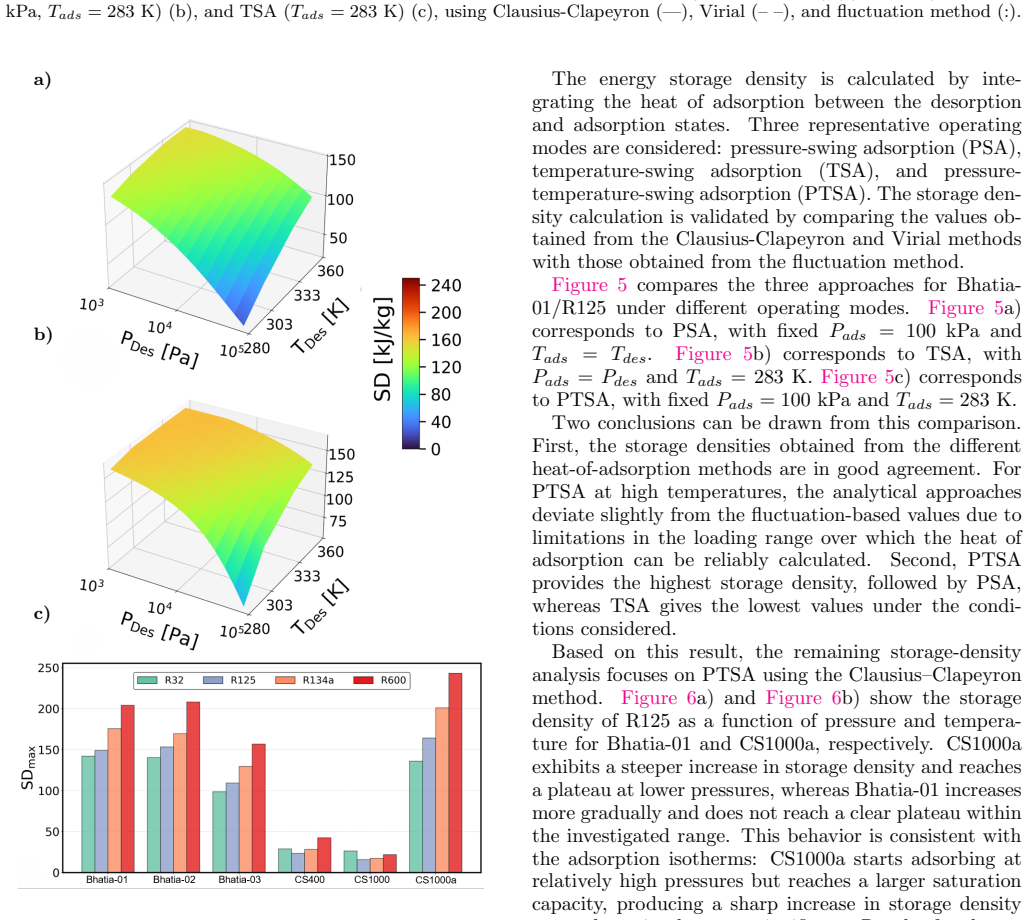
- The paper appears to rely on the theorem as machinery.
- contradicts
- The paper's claim conflicts with a theorem or certificate in the canon.
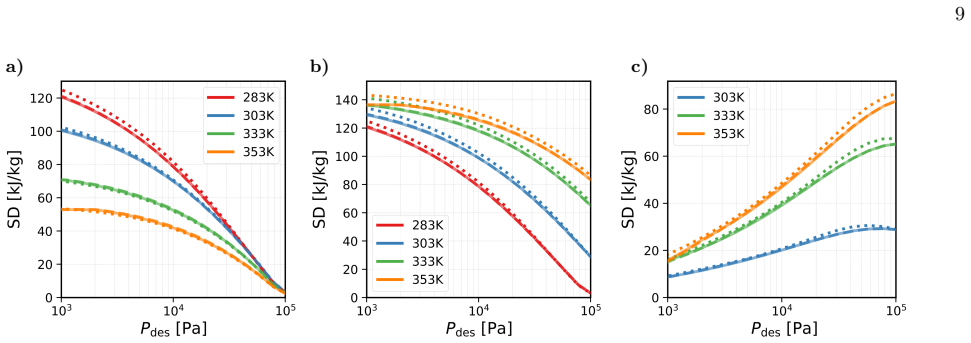
- unclear
- Pith found a possible connection, but the passage is too broad, indirect, or ambiguous to say the theorem truly supports the claim.
Reference graph
Works this paper leans on
-
[1]
United Nations, The paris agreement (2015)
work page 2015
-
[2]
A. Vuppaladadiyam, E. Antunes, S. S. V. Vuppaladadiyam, Z. T. Baig, A. Subiantoro, G. Lei, S. Leu, A. K. Sarmah, and H. Duan, Progress in the development and use of refrigerants and unintended environmental consequences, Science of The Total Environment 823, 153670 (2022)
work page 2022
-
[3]
EERA, Policy brief Fossil fuel and GHG emissions reduction through integrating industrial TES Thermal Energy System Integration, Tech. Rep. (2023)
work page 2023
-
[4]
M. Islam and B. B. Saha, Harnessing waste palm-based activated carbon/difluoromethane pair for sustainable low-emission cooling systems, Journal of Environmental Chemical Engineering 12, 10.1016/j.jece.2024.114869 (2024)
-
[5]
R. M. Madero-Castro, A. Luna-Triguero, C. Gonz´ alez-Gal´ an, J. Vicent-Luna, and S. Calero, Alcohol-based adsorption heat pumps using hydrophobic metal-organic frameworks, Journal of Materials Chemistry A 12, 3434 (2023)
work page 2023
-
[6]
M. De Lange, K. J. Verouden, T. J. Vlugt, J. Gascon, and F. Kapteijn, Adsorption-Driven Heat Pumps: The Potential of Metal–Organic Frameworks, Chemical Reviews 115, 12205 (2015)
work page 2015
-
[7]
Z. Yang, M. Sultan, K. Thu, and T. Miyazaki, Experimental investigation and thermodynamic modeling of adsorption equilibria of MSC30 with R32 for supercritical adsorption cooling systems, International Journal of Heat and Mass Transfer 219, 124873 (2024)
work page 2024
-
[8]
X. Xia, Z. Liu, and S. Li, Adsorption characteristics and cooling/heating performance of COF-5, Applied Thermal Engi- neering 176, 115442 (2020)
work page 2020
-
[9]
S. Yagnamurthy, D. Rakshit, S. Jain, K. A. Rocky, M. A. Islam, and B. B. Saha, Adsorption of difluoromethane onto activated carbon based composites: Thermophysical properties and adsorption characterization, International Journal of Heat and Mass Transfer 171, 121112 (2021)
work page 2021
-
[10]
Y. Peng, F. Zhang, X. Zheng, H. Wang, C. Xu, Q. Xiao, Y. Zhong, and W. Zhu, Comparison Study on the Adsorption of CFC-115 and HFC-125 on Activated Carbon and Silicalite-1, Industrial & Engineering Chemistry Research 49, 10009 (2010)
work page 2010
-
[11]
A. A. Askalany, M. Salem, I. M. Ismail, A. H. H. Ali, and M. G. Morsy, Experimental study on adsorption–desorption characteristics of granular activated carbon/R134a pair, International Journal of Refrigeration 35, 494 (2012)
work page 2012
-
[12]
J. Vicent-Luna and A. Luna-Triguero, Adsorption Characteristics of Refrigerants for Thermochemical Energy Storage in Metal–Organic Frameworks, ACS Applied Engineering Materials 2, 542 (2024)
work page 2024
-
[13]
B. B. Saha, A. Chakraborty, S. Koyama, S. H. Yoon, I. Mochida, M. Kumja, C. Yap, and K. C. Ng, Isotherms and thermodynamics for the adsorption of n-butane on pitch based activated carbon, International Journal of Heat and Mass Transfer 51, 1582 (2008). 16
work page 2008
-
[15]
Y. Yasaka, S. Karkour, K. Shobatake, N. Itsubo, and F. Yakushiji, Life-Cycle Assessment of Refrigerants for Air Condi- tioners Considering Reclamation and Destruction, Sustainability (Switzerland) 15, 10.3390/su15010473 (2023)
-
[16]
Z. Chen, P. Purohit, F. Bai, T. Gasser, Y. He, L. H¨ oglund-Isaksson, P. Jiang, J. Wu, and J. Hu, Sustainable Management of Banked Fluorocarbons as a Cost-Effective Climate Action, Environmental Science and Technology 59, 16356 (2025)
work page 2025
-
[17]
D. K. Wanigarathna, J. Gao, and B. Liu, Metal organic frameworks for adsorption-based separation of fluorocompounds: a review, Materials Advances 1, 310 (2020)
work page 2020
-
[18]
C. Lehmann, S. Beckert, R. Gl¨ aser, O. Kolditz, and T. Nagel, Assessment of adsorbate density models for numerical simulations of zeolite-based heat storage applications, Applied Energy 185, 1965 (2017)
work page 1965
-
[19]
A. Risti´ c, F. Fischer, A. Hauer, and N. Zabukovec Logar, Improved performance of binder-free zeolite Y for low-temperature sorption heat storage, Journal of Materials Chemistry A 6, 11521 (2018)
work page 2018
-
[20]
R. Madero-Castro, A. Luna-Triguero, A. S lawek, J. Vicent-Luna, and S. Calero, On the Use of Water and Methanol with Zeolites for Heat Transfer, ACS Sustainable Chemistry and Engineering 11, 4317 (2023)
work page 2023
-
[21]
R. E. Critoph and L. Turner, Heat transfer in granular activated carbon beds in the presence of adsorbable gases, Inter- national Journal of Heat and Mass Transfer 38, 1577 (1995)
work page 1995
-
[22]
J. Xiao, L. Tong, C. Deng, P. B´ enard, and R. Chahine, Simulation of heat and mass transfer in activated carbon tank for hydrogen storage, International Journal of Hydrogen Energy 35, 8106 (2010)
work page 2010
-
[23]
R. M. Madero-Castro, J. M. Vicent-Luna, X. Peng, and S. Calero, Adsorption of Linear Alcohols in Amorphous Activated Carbons: Implications for Energy Storage Applications, ACS Sustainable Chemistry & Engineering 10, 6509 (2022)
work page 2022
-
[24]
R. P. Ribeiro, J. E. Sosa, J. M. Ara´ ujo, A. B. Pereiro, and J. P. Mota, Vacuum swing adsorption for R-32 recovery from R-410A refrigerant blend, International Journal of Refrigeration 150, 253 (2023)
work page 2023
-
[25]
J. Sosa, C. Malheiro, R. P. Ribeiro, P. J. Castro, M. M. Pi˜ neiro, J. M. Ara´ ujo, F. Plantier, J. P. Mota, and A. B. Pereiro, Adsorption of fluorinated greenhouse gases on activated carbons: evaluation of their potential for gas separation, Journal of Chemical Technology and Biotechnology 95, 1892 (2020)
work page 2020
-
[26]
J. Sosa, C. Malheiro, P. Castro, R. Ribeiro, M. M. Pi˜ neiro, F. Plantier, J. Mota, J. M. Ara´ ujo, and A. B. Pereiro, Supporting Information: Exploring the Potential of Metal–Organic Frameworks for the Separation of Blends of Fluorinated Gases with High Global Warming Potential, Global Challenges 7, 10.1002/gch2.202200107 (2023)
-
[27]
J. Sosa, R. P. Ribeiro, I. Matos, M. Bernardo, I. Fonseca, J. P. Mota, J. Ara´ ujo, and A. B. Pereiro, Exploring the potential of biomass-derived carbons for the separation of fluorinated gases with high global warming potential, Biomass and Bioenergy 188, 10.1016/j.biombioe.2024.107323 (2024)
-
[28]
M. M. El-Sharkawy, A. A. Askalany, K. Harby, and M. S. Ahmed, Adsorption isotherms and kinetics of a mixture of Pentafluoroethane, 1,1,1,2-Tetrafluoroethane and Difluoromethane (HFC-407C) onto granular activated carbon, Applied Thermal Engineering 93, 988 (2016)
work page 2016
-
[29]
A. A. Askalany, B. B. Saha, and I. M. Ismail, Adsorption isotherms and kinetics of HFC410A onto activated carbons, Applied Thermal Engineering 72, 237 (2014)
work page 2014
-
[30]
A. A. Askalany and B. B. Saha, Highly porous activated carbon based adsorption cooling system employing difluoromethane and a mixture of pentafluoroethane and difluoromethane, Heat and Mass Transfer 2016 53:1 53, 107 (2016)
work page 2016
-
[31]
D. Dubbeldam, A. Torres-Knoop, and K. Walton, MONTE CARLO CODES, TOOLS AND ALGORITHMS: On the inner workings of Monte Carlo codes, Molecular Simulation 39, 1253 (2013)
work page 2013
-
[32]
E. J. Garc´ ıa, D. Bahamon, and L. F. Vega, Systematic Search of Suitable Metal–Organic Frameworks for Thermal Energy- Storage Applications with Low Global Warming Potential Refrigerants, ACS Sustainable Chemistry & Engineering9, 3157 (2021)
work page 2021
-
[33]
S. Cai, S. Tian, Y. Lu, G. Wang, Y. Pu, and K. Peng, Molecular Simulations of Adsorption and Energy Storage of R1234yf, R1234ze(z), R134a, R32, and their Mixtures in M-MOF-74 (M = Mg, Ni) Nanoparticles, Scientific Reports10, 7265 (2020)
work page 2020
-
[34]
S. Hu, S. Cai, Y. Ren, E. Huo, J. Song, L. Zhang, and L. Yu, Molecular simulations of increased thermal energy storage in metal–organic heat carriers with R1234ze(E)/R32 mixtures combined with IRMOF-1, Applied Thermal Engineering 258, 124701 (2025)
work page 2025
-
[35]
J. I. Beltr´ an-Larrotta, J. C. Moreno-Piraj´ an, and L. Giraldo, New perspectives on the models of porous carbon, Compu- tational and Structural Biotechnology Journal 29, 156 (2025)
work page 2025
-
[36]
A. A. Elhussien, I. Abdulazeez, H. Alasiri, and W. A. Fouad, Exploring zeolite potential for hydrofluorocarbon capture and recycling: Insights from molecular simulations, Microporous and Mesoporous Materials 384, 113442 (2025)
work page 2025
-
[37]
F. Stavarache, A. Luna-Triguero, S. Calero, and J. Vicent-Luna, Adapted thermodynamical model for the prediction of adsorption in nanoporous materials, Chemical Engineering Journal 496, 10.1016/j.cej.2024.153480 (2024)
-
[38]
H. Lucassen, A. Luna-Triguero, and J. M. Vicent-Luna, Mixture adsorption thermodynamics (2026)
work page 2026
-
[39]
P. Iacomi and P. L. Llewellyn, pyGAPS: a Python-based framework for adsorption isotherm processing and material characterisation, Adsorption 25, 1533 (2019)
work page 2019
-
[40]
M. Hassan, S. Yoon, Y. Chen, P. Kim, H. Yun, H. T. Kwon, Y. S. Bae, C. Y. Yoo, D. Y. Koh, C. S. Hong, K. B. Lee, and Y. G. Chung, AIM: A user-friendly GUI workflow program for isotherm fitting, mixture prediction, isosteric heat of adsorption estimation, and breakthrough simulation, Computer Physics Communications 319, 10.1016/j.cpc.2025.109944 (2026)
-
[41]
D. Dubbeldam, S. Calero, T. J. H. Vlugt, D. E. Ellis, and R. Q. Snurr, RASPA 2.0: Molecular Software Package for Adsorption and Diffusion in (Flexible) Nanoporous Materials , Tech. Rep. (2020). 17
work page 2020
- [42]
-
[43]
O. A. A. M. Ibrahim, S. A. Kadhim, K. A. Hammoodi, A. M. Ashour, A. Bouabidi, F. L. Rashid, and R. Sathyamurthy, Hydrocarbon refrigerants as sustainable alternatives to high-GWP refrigerants: a systematic review of R600 and R600a, Journal of Thermal Analysis and Calorimetry 2025 150:21 150, 17185 (2025)
work page 2025
-
[44]
The Engineering Toolbox, Gases - Explosion and Flammability Concentration Limits
-
[45]
NIST, Chemistry WebBook, SRD 69
-
[46]
T. X. Nguyen, N. Cohaut, J.-S. Bae, and S. K. Bhatia, New method for atomistic modeling of the microstructure of activated carbons using hybrid reverse monte carlo simulation, Langmuir 24, 7912 (2008)
work page 2008
-
[47]
A. H. Farmahini and S. K. Bhatia, Effect of structural anisotropy and pore-network accessibility on fluid transport in nanoporous ti3sic2 carbide-derived carbon, Carbon 103, 16 (2016)
work page 2016
-
[48]
A. H. Farmahini, G. Opletal, and S. K. Bhatia, Structural modelling of silicon carbide-derived nanoporous carbon by hybrid reverse monte carlo simulation, The Journal of Physical Chemistry C 117, 14081 (2013)
work page 2013
-
[49]
S. K. Jain, R. J.-M. Pellenq, J. P. Pikunic, and K. E. Gubbins, Molecular modeling of porous carbons using the hybrid reverse monte carlo method, Langmuir 22, 9942 (2006)
work page 2006
-
[50]
S. K. Jain, K. E. Gubbins, R. J.-M. Pellenq, and J. P. Pikunic, Molecular modeling and adsorption properties of porous carbons, Carbon 44, 2445 (2006), carbon for Energy Storage and Environment Protection
work page 2006
-
[51]
X. Peng and S. Jain, Understanding the Influence of Pore Heterogeneity on Water Adsorption in Realistic Molecular Models of Activated Carbons, The Journal of Physical Chemistry C 122, 28702 (2018)
work page 2018
-
[52]
R. Thyagarajan and D. Sholl, A Database of Porous Rigid Amorphous Materials, Chemistry of Materials 32, 8020 (2020)
work page 2020
-
[53]
X. Peng, J. Vicent-Luna, and Q. Jin, Separation of CF4/N2, C2F6/N2, and SF6/N2 Mixtures in Amorphous Activated Carbons Using Molecular Simulations, ACS Applied Materials & Interfaces 12, 20044 (2020)
work page 2020
-
[54]
ApX Machine Learning, Regression Model Evaluation Metrics
-
[55]
A. Hauer, Beurteilung fester adsorbenzien auf der basis der adsorptionsgleichgewichte f¨ ur energetische anwendungen in offenen systemen, Chemie Ingenieur Technik 82, 1075 (2010)
work page 2010
-
[56]
A. Torres-Knoop, A. Poursaeidesfahani, T. J. Vlugt, and D. Dubbeldam, Behavior of the Enthalpy of Adsorption in Nanoporous Materials Close to Saturation Conditions, Journal of Chemical Theory and Computation 13, 3326 (2017)
work page 2017
-
[57]
MATLAB, Piecewise Cubic Hermite Interpolating Polynomial (PCHIP)
-
[58]
K. Heinselman, C. M. Quine, K. Hurst, J. Cho, M. B. Wenny, J. A. Mason, G. Verma, S. Ma, D. Compton, N. P. Stadie, D. Sengupta, T. Islamoglu, O. K. Farha, C. Zlotea, A. Agafonov, M. Asgari, A. Al-Shakhs, D. Lozano-Castello, D. Fairen- Jimenez, H. Furukawa, Y. Yabuuchi, D. P. Broom, M. J. Benham, J. A. Villajos, R. Balderas-Xicoht´ encatl, I. Fackelmann, M...
-
[59]
Brownlee, A Gentle Introduction to the BFGS Optimization Algorithm (2021)
J. Brownlee, A Gentle Introduction to the BFGS Optimization Algorithm (2021)
work page 2021
-
[60]
A. Nuhnen and C. Janiak, A practical guide to calculate the isosteric heat/enthalpy of adsorption via adsorption isotherms in metal–organic frameworks, MOFs, Dalton Transactions 49, 10295 (2020)
work page 2020
-
[61]
S. Gooijer, S. Capelo-Avil´ es, S. Sharma, S. Giancola, J. R. Gal´ an-Mascaros, T. J. Vlugt, D. Dubbeldam, J. M. Vicent-Luna, and S. Calero, TAMOF-1 for capture and separation of the main flue gas components, Journal of Materials Chemistry A 13, 16879 (2025)
work page 2025
-
[62]
W. Queen, M. Hudson, E. D. Bloch, J. A. Mason, M. I. Gonzalez, J. S. Lee, D. Gygi, J. D. Howe, K. Lee, T. A. Darwish, M. James, V. K. Peterson, S. J. Teat, B. Smit, J. B. Neaton, J. R. Long, and C. M. Brown, Comprehensive study of carbon dioxide adsorption in the metal–organic frameworks M ¡sub¿2¡/sub¿ (dobdc) (M = Mg, Mn, Fe, Co, Ni, Cu, Zn), Chem. Sci. ...
work page 2014
- [63]
-
[64]
C. Gonz´ alez-Gal´ an, R. Madero-Castro, A. Luna-Triguero, J. Vicent-Luna, and S. Calero, Understanding the role of open metal sites in MOFs for the efficient separation of benzene/cyclohexane mixtures, Separation and Purification Technology 348, 127606 (2024)
work page 2024
-
[65]
M. C. Bessa, A. Luna-Triguero, J. M. Vicent-Luna, P. Carmo, M. N. Tsampas, A. M. Ribeiro, A. Rodrigues, S. Calero, and A. Ferreira, An Efficient Strategy for Electroreduction Reactor Outlet Fractioning into Valuable Products, Industrial and Engineering Chemistry Research 62, 8847 (2023)
work page 2023
-
[66]
S. Gooijer, S. Capelo-Avil´ es, S. Sharma, S. Giancola, J. R. Gal´ an-Mascaros, T. J. H. Vlugt, D. Dubbeldam, J. M. Vicent- Luna, and S. Calero, Supporting Information: TAMOF-1 for Capture and Separation of the main Flue Gas Components , Tech. Rep. (2025). 18 Supplementary Material for Evaluating Blended Refrigerants for Thermochemical Energy Storage and ...
work page 2025
-
[67]
Data Preparation: The data-preparation procedure depends on the type of input. When adsorption points are provided, the code creates a new list of points that is used to calculate the heat of adsorption. This new list incorporates the numerical constraint imposed by the Clausius–Clapeyron equation, which requires temperature– pressure points corresponding...
work page 1915
-
[68]
The resulting parameters are reported in Table S4-Table S9
Dual-site Sips parameters Based on Table S3, the equilibrium simulation points from GCMC were fitted using the dual-site Sips adsorption model (Equation 1). The resulting parameters are reported in Table S4-Table S9. qsat is given in mol/kg, b in Pa−1, and υ is dimensionless. The fitted adsorption isotherm models and equilibrium simulation points are visu...
work page 2057
-
[69]
Adsorption Potential Theory For the adsorption potential theory (APT), the adsorption model at 303 K is used as reference. In Figure S5, the GCMC adsorption isotherms are compared with APT predictions for all activated carbons at 283 K and 333 K, including the relative error of the loadings. I) a) b) c) d) II) a) b) c) d) III) a) b) c) d) IV) a) b) c) d) ...
-
[70]
Isosteric heat of adsorption In Figure S6, the sensitivities of the Clausius-Clapeyron and Virial methods are tested by varying the type of adsorption model, temperature range, and number of temperatures. In conclusion, the number of adsorption isotherms measured at distinct temperatures exerts a negligible influence, while the temperature range has a sig...
-
[71]
I) a) b) c) d) II) a) b) c) d) III) a) b) c) d) IV) a) b) c) d) Figure S7
Storage Density In Figure S7, the three-dimensional representations of the energy storage density associated with the pressure- temperature swing process are presented for an adsorption pressure of Pads = 105 Pa. I) a) b) c) d) II) a) b) c) d) III) a) b) c) d) IV) a) b) c) d) Figure S7. 3D storage density of Bhatia-01 (I), Bhatia-02 (II), Bhatia-03 (III) ...
-
[72]
Table S10 reports the maximum achievable loading and the corresponding maximum pressure
Maximum Storage Density A limitation of the storage density is the loading range of the isosteric heat of adsorption. Table S10 reports the maximum achievable loading and the corresponding maximum pressure. Consequently, this pressure defines the upper bound of the pressure range over which the storage density can be reliably predicted. Activated-carbon R...
-
[73]
Isosteric heat of adsorption a) b) c) d) Figure S10. Isosteric heat of adsorption for the mixtures in Bhatia-01 (a), Bhatia-02 (b), Bhatia-03 (c) and CS1000a (d). Clausius-Clapeyron for mixtures (Equation 12) a) b) c) d) Figure S11. Isosteric heat of adsorption for the mixtures in Bhatia-01 (a), Bhatia-02 (b), Bhatia-03 (c) and CS1000a (d). Linear mixing ...
-
[74]
Validation Storage density In Figure S12, the Clausius-Clapeyron mixing rule, the linear mixing rule, and the fluctuation-based method are compared based on storage density, demonstrating good agreement among the approaches. a) b) c) d) Figure S12. Storage density validation for refrigerant mixtures R407F, R410A, R417A, and R417C at 283-353 K using the fl...
-
[75]
I) a) b) c) d) II) a) b) c) d) III) a) b) c) d) IV) a) b) c) d) Figure S13
Storage density 3D Plots In Figure S13, the three-dimensional representations of the storage density associated with the pressure-temperature swing process are presented for an adsorption pressure of Pads = 105 Pa. I) a) b) c) d) II) a) b) c) d) III) a) b) c) d) IV) a) b) c) d) Figure S13. 3D storage density of Bhatia-01 (I), Bhatia-02 (II), Bhatia-03 (II...
-
[76]
Table S11 reports the maximum achievable loading and the corresponding maximum pressure
Maximum Storage Density for mixtures A limitation of the storage density is the loading range of the isosteric heat of adsorption. Table S11 reports the maximum achievable loading and the corresponding maximum pressure. Consequently, this pressure defines the upper bound of the pressure range over which the storage density can be reliably predicted. Activ...
work page 2006
discussion (0)
Sign in with ORCID, Apple, or X to comment. Anyone can read and Pith papers without signing in.