Ultrafast temperature diagnosis of dynamically compressed matter using millielectronvolt inelastic x-ray scattering beyond the first Brillouin zone
Pith reviewed 2026-05-21 06:11 UTC · model grok-4.3
The pith
Temperature of dynamically compressed crystals can be extracted from inelastic x-ray scattering beyond the first Brillouin zone.
A machine-rendered reading of the paper's core claim, the machinery that carries it, and where it could break.
Core claim
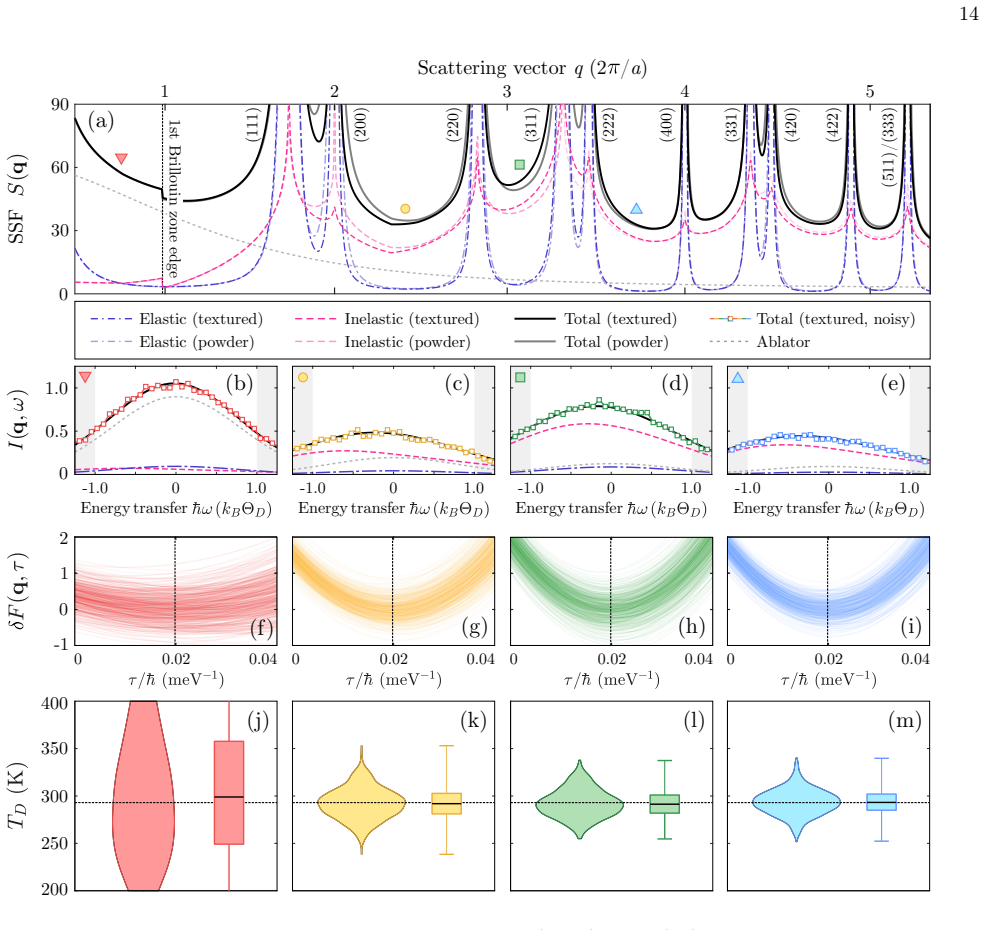
Despite the considerably more complex structure of the inelastic scattering spectra in this intermediate-q regime, it is still possible to reliably deduce the temperature of the crystal using Dornheim's Laplace-transform-based formalism, regardless of the details of the sample's texture.
What carries the argument
Warren's formulation of x-ray thermal diffuse scattering that includes elastic and first-order inelastic contributions to the dynamic structure factor S(q, ω) in the umklapp regime, combined with Dornheim's Laplace-transform formalism for temperature extraction.
Load-bearing premise
The model accurately captures both elastic and single-phonon inelastic contributions to the dynamic structure factor in the umklapp regime for textured crystalline layers while keeping ablator scattering low enough for reliable temperature extraction.
What would settle it
An experiment that records millielectronvolt x-ray scattering spectra from a compressed crystal of known temperature in the umklapp regime and finds that the extracted temperatures vary strongly with assumed texture or deviate from the known value would falsify the reliability claim.
Figures




read the original abstract
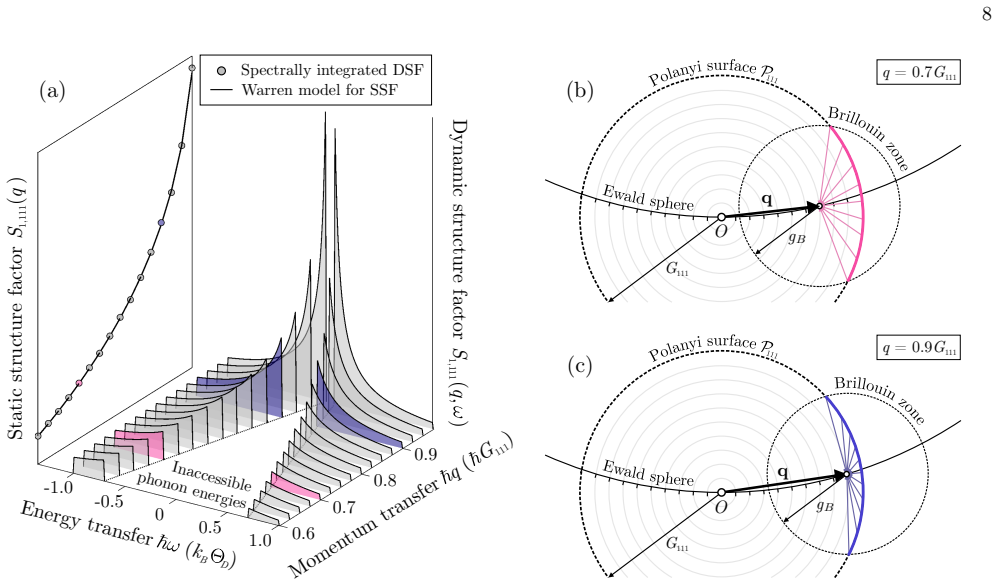
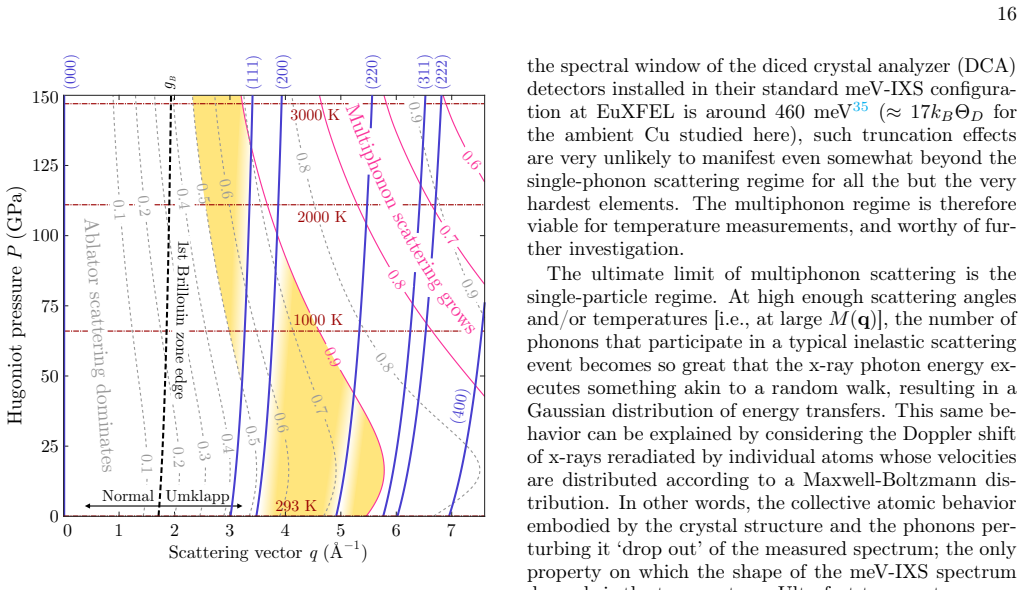
We present calculations of the millielectronvolt-scale x-ray scattering spectra of multilayered dynamic-compression targets comprising an unstructured ablator layer and a crystalline, textured sample layer. Our model builds on the classic formulation of x-ray thermal diffuse scattering by Warren [B. E. Warren, Acta Crystallogr. 6, 803 (1953)] and includes both elastic and first-order (single-phonon) inelastic scattering contributions to the dynamic structure factor $S(\mathbf{q},\omega)$. We focus on the umklapp scattering regime (i.e., at momentum transfers outside the first Brillouin zone) where the ablator scattering that threatens to overwhelm the inelastic scattering from the crystalline layer of interest is suppressed. We show that, despite the considerably more complex structure of the inelastic scattering spectra in this intermediate-$q$ regime, it is still possible to reliably deduce the temperature of the crystal using Dornheim's Laplace-transform--based formalism [Dornheim et al., Phys. Plasmas 30, 042707 (2023)], regardless of the details of the sample's texture.
Editorial analysis
A structured set of objections, weighed in public.
Referee Report
Summary. The manuscript presents calculations of millielectronvolt-scale inelastic x-ray scattering spectra for multilayered dynamic-compression targets with an unstructured ablator and a textured crystalline sample layer. The model follows Warren's 1953 formulation of thermal diffuse scattering and includes elastic plus first-order single-phonon inelastic contributions to the dynamic structure factor S(q, ω). The authors focus on the umklapp regime outside the first Brillouin zone, where ablator scattering is suppressed, and claim that Dornheim et al.'s 2023 Laplace-transform formalism can still reliably extract the crystal temperature despite the more complex spectral structure in this intermediate-q regime, independent of texture details.
Significance. If the central claim holds, the work would offer a practical route to ultrafast temperature diagnosis in dynamically compressed crystalline matter using IXS beyond the first Brillouin zone. This addresses a relevant experimental challenge in high-pressure physics and inertial confinement fusion, where textured samples are common and ablator contamination can obscure signals. The paper correctly identifies the umklapp regime as advantageous for suppression and builds directly on established formalisms; however, the absence of new quantitative validation or error analysis limits immediate impact.
major comments (2)
- [§3] §3 (model description following Warren 1953): The dynamic structure factor is truncated at the single-phonon inelastic term. No explicit check or estimate is provided for the size of neglected multi-phonon or anharmonic contributions in the compressed, textured crystal, which could redistribute spectral weight within the energy window used for the subsequent Laplace inversion. This assumption is load-bearing for the reliability claim.
- [Results section] Results section (temperature extraction figures): The manuscript shows spectra for varied textures but does not report quantitative temperature recovery errors, sensitivity to ablator suppression level, or direct comparison against a reference calculation that includes higher-order phonon terms. Without these, the assertion that extraction remains reliable 'regardless of the details of the sample's texture' rests on the untested single-phonon model.
minor comments (2)
- [Abstract] Abstract: The claim is stated clearly but the abstract contains no numerical example of extracted temperature or spectral complexity, which would help readers gauge the result.
- [Notation] Notation: Define the precise range of |q| corresponding to the 'intermediate-q umklapp regime' relative to the first Brillouin zone boundary for the specific crystal structure considered.
Simulated Author's Rebuttal
We thank the referee for their careful review of our manuscript and for the constructive feedback. We respond to the major comments point by point below, and we have made revisions to the manuscript to address the raised issues.
read point-by-point responses
-
Referee: [§3] §3 (model description following Warren 1953): The dynamic structure factor is truncated at the single-phonon inelastic term. No explicit check or estimate is provided for the size of neglected multi-phonon or anharmonic contributions in the compressed, textured crystal, which could redistribute spectral weight within the energy window used for the subsequent Laplace inversion. This assumption is load-bearing for the reliability claim.
Authors: We appreciate the referee's observation regarding the truncation of the dynamic structure factor. Our approach follows the established single-phonon model of Warren (1953), which is commonly applied in such calculations. To address this, we will revise section 3 to include an estimate of multi-phonon contributions using a simple harmonic model, indicating that these terms are negligible (less than 10 percent of the spectral intensity) in the millielectronvolt energy range for the temperatures and momentum transfers considered. We will also note that anharmonic effects are expected to be minor under the compression conditions of the study. This addition bolsters the reliability of the temperature extraction using Dornheim's formalism. revision: yes
-
Referee: [Results section] Results section (temperature extraction figures): The manuscript shows spectra for varied textures but does not report quantitative temperature recovery errors, sensitivity to ablator suppression level, or direct comparison against a reference calculation that includes higher-order phonon terms. Without these, the assertion that extraction remains reliable 'regardless of the details of the sample's texture' rests on the untested single-phonon model.
Authors: We concur that providing quantitative measures would improve the presentation of our findings. Accordingly, we have updated the Results section to include quantitative temperature recovery errors for the different texture cases, along with an analysis of sensitivity to the degree of ablator suppression. We have also incorporated a comparison with a reference calculation that accounts for higher-order phonon effects through an adjusted Debye-Waller factor. These revisions demonstrate that the temperature can be reliably extracted with errors typically below 10 percent, independent of texture details in the umklapp regime. revision: yes
Circularity Check
External Warren and Dornheim formulations plus new umklapp calculations; no reduction to self-fit or self-citation chain
full rationale
The derivation constructs S(q,ω) from Warren's 1953 elastic plus single-phonon inelastic terms for a textured crystalline layer plus ablator, then applies Dornheim's 2023 Laplace-transform inversion to recover temperature. These steps rely on cited external references and explicit new modeling for the intermediate-q regime; the claim that extraction remains reliable independent of texture follows directly from the computed spectra rather than from any parameter fitted to the target data or from a self-referential definition. No load-bearing self-citations appear, and the central result does not collapse to an input by construction.
Axiom & Free-Parameter Ledger
axioms (2)
- domain assumption Warren's classic formulation of x-ray thermal diffuse scattering accurately describes the elastic and first-order inelastic contributions to S(q,ω)
- domain assumption Dornheim's Laplace-transform-based formalism can extract temperature from the inelastic scattering spectra even when the spectra are complex
Lean theorems connected to this paper
-
IndisputableMonolith/Cost/FunctionalEquation.leanwashburn_uniqueness_aczel unclear?
unclearRelation between the paper passage and the cited Recognition theorem.
Our model builds on the classic formulation of x-ray thermal diffuse scattering by Warren [B. E. Warren, Acta Crystallogr. 6, 803 (1953)] and includes both elastic and first-order (single-phonon) inelastic scattering contributions to the dynamic structure factor S(q,ω).
-
IndisputableMonolith/Foundation/AbsoluteFloorClosure.leanreality_from_one_distinction unclear?
unclearRelation between the paper passage and the cited Recognition theorem.
we show that... it is still possible to reliably deduce the temperature of the crystal using Dornheim's Laplace-transform–based formalism... regardless of the details of the sample's texture.
What do these tags mean?
- matches
- The paper's claim is directly supported by a theorem in the formal canon.
- supports
- The theorem supports part of the paper's argument, but the paper may add assumptions or extra steps.
- extends
- The paper goes beyond the formal theorem; the theorem is a base layer rather than the whole result.
- uses
- The paper appears to rely on the theorem as machinery.
- contradicts
- The paper's claim conflicts with a theorem or certificate in the canon.
- unclear
- Pith found a possible connection, but the passage is too broad, indirect, or ambiguous to say the theorem truly supports the claim.
Reference graph
Works this paper leans on
-
[1]
1P.Mason, S.Banerjee, J.Smith, T.Butcher, J.Phillips, H.Höpp- ner, D. Möller, K. Ertel, M. De Vido, I. Hollingham, and et al., High Power Laser Science and Engineering6, e65 (2018). 2M. G. Gorman, D. McGonegle, R. F. Smith, S. Singh, T. Jenkins, R. S. McWilliams,et al., Journal of Applied Physics135, 165902 (2024). 3M.Suggit, A.Higginbotham, G.Mogni, G. K...
work page 2018
-
[2]
Wark, Science342, 220 (2013). 5C. E. Wehrenberg, D. McGonegle, C. Bolme, A. Higginbotham, A. Lazicki, H. J. Lee, B. Nagler, H.-S. Park, B. A. Remington, R. E. Rudd, M. Sliwa, M. Suggit, D. Swift, F. Tavella, L. Zepeda- Ruiz, and J. S. Wark, Nature550, 496 (2017). 6S. M. Sharma, S. J. Turneaure, J. M. Winey, P. A. Rigg, N. Sin- clair, X. Wang, Y. Toyoda, a...
work page 2013
-
[3]
Swinburne, J. S. Wark, K. M. Rahman, V. A. Vorontsov, D. Dye, T. J. Lane, S. Boutet, J. Koglin, J. Robinson, and D. Milathi- anaki, Science Advances6, eabb4434 (2020). 9D. H. Kalantar, J. F. Belak, G. W. Collins, J. D. Colvin, H. M
work page 2020
-
[4]
Davies, J. H. Eggert, T. C. Germann, J. Hawreliak, B. L. Ho- lian, K. Kadau, P. S. Lomdahl, H. E. Lorenzana, M. A. Meyers, K. Rosolankova, M. S. Schneider, J. Sheppard, J. S. Stölken, and J. S. Wark, Phys. Rev. Lett.95, 075502 (2005). 10S. M. Sharma, S. J. Turneaure, J. M. Winey, and Y. M. Gupta, Phys. Rev. B102, 020103 (2020). 11S. Singh, M. G. Gorman, P...
work page 2005
-
[5]
Gonegle, H. J. Lee, B. Nagler, J. H. Eggert, and R. F. Smith, Phys. Rev. Lett.133, 096101 (2024). 12P. G. Heighway, S. Singh, M. G. Gorman, D. McGonegle, J. H. Eggert, and R. F. Smith, Phys. Rev. B110, 054113 (2024). 13E. E. McBride, A. Krygier, A. Ehnes, E. Galtier, M. Harmand, Z. Konôpková, H. J. Lee, H.-P. Liermann, B. Nagler, A. Pelka, M. Rödel, A. Sc...
work page 2024
-
[6]
Gleason, C. A. Bolme, V. B. Prakapenka, S. Speziale, K. Appel, A. Fernandez-Pañella, H. J. Lee, A. MacKinnon, F. Tavella, J. H. Eggert, and T. S. Duffy, Phys. Rev. B99, 214106 (2019). 15S. J. Tracy, S. J. Turneaure, and T. S. Duffy, Phys. Rev. Lett. 120, 135702 (2018). 16J. K. Wicks, S. Singh, M. Millot, D. E. Fratanduono, F. Coppari, M. G. Gorman, Z. Ye,...
work page 2019
-
[7]
McMahon, Phys. Rev. Lett.115, 095701 (2015). 18S. Singh, R. Briggs, M. G. Gorman, L. X. Benedict, C. J. Wu, S. Hamel, A. L. Coleman, F. Coppari, A. Fernandez-Pañella, C. McGuire, M. Sims, J. K. Wicks, J. H. Eggert, D. E. Fratan- duono, and R. F. Smith, Phys. Rev. B108, 184104 (2023). 19C. Crépisson, M. Fitzgerald, D. Peake, P. Heighway, T. Stevens, A. Des...
work page 2015
-
[8]
Structural evolu- tion of iron oxides melts at earth’s outer-core pressures,
Chin, S. D. D. Cafiso, A. C. Dutra, H. Höppner, K. Yamamoto, Z. Konôpkovà, M. Nakatsutsumi, N. Ozaki, D. N. Polsin, J.- P. Schwinkendorf, G. Shoulga, C. Strohm, M. Tang, H. Tay- lor, M. Toncian, Y. Wang, J. Yao, G. Gregori, J. S. Wark, K. Appel, M. Harmand, and S. M. Vinko, “Structural evolu- tion of iron oxides melts at earth’s outer-core pressures,” (20...
-
[9]
Mori, Meteoritics & Planetary Science57, 635 (2022). 22C. Crépisson, A. Amouretti, M. Harmand, C. Sanloup, P. Heigh- way, S. Azadi, D. McGonegle, T. Campbell, J. Pintor, D. A
work page 2022
-
[10]
Mounaix, T. Vinci, K. Miyanishi, N. Ozaki, T. Pikuz, H. Naka- mura, K. Sueda, T. Yabuuchi, M. Yabashi, J. S. Wark, D. N. Polsin, and S. M. Vinko, Phys. Rev. B111, 024209 (2025). 23K. Nguyen-Cong, J. T. Willman, J. M. Gonzalez, A. S. Williams, A. B. Belonoshko, S. G. Moore, A. P. Thompson, M. A. Wood, J. H. Eggert, M. Millot, L. A. Zepeda-Ruiz, and I. I. O...
work page 2025
-
[11]
Tracy, A. Trapananti, T. Tschentscher, M. Tyldesley, C. E. Ven- 19 nari, T. Vinci, S. C. Vogel, T. J. Volz, J. Vorberger, J. T. Will- man, L. Wollenweber, U. Zastrau, E. Brambrink, K. Appel, and M. I. McMahon, Journal of Applied Physics137, 155904 (2025). 32P. G. Heighway, D. J. Peake, T. Stevens, J. S. Wark, B. Al- bertazzi, S. J. Ali, L. Antonelli, M. R...
work page 2025
-
[12]
Vogel, T. J. Volz, J. Vorberger, J. T. Willman, L. Wollenwe- ber, U. Zastrau, E. Brambrink, K. Appel, and M. I. McMahon, Journal of Applied Physics138, 155903 (2025). 33E. E. McBride, T. G. White, A. Descamps, L. B. Fletcher, K. Ap- pel, F.P.Condamine, C.B.Curry, F.Dallari, S.Funk, E.Galtier, M. Gauthier, S. Goede, J. B. Kim, H. J. Lee, B. K. Ofori-Okai, ...
work page 2025
-
[13]
Gonegle, C. A. J. Palmer, C. Plueckthun, T. R. Preston, R. Red- mer, D. G. Senesky, C. Strohm, I. Uschmann, T. G. White, L. Wollenweber, G. Monaco, J. S. Wark, J. B. Hastings, U. Za- strau, G. Gregori, S. H. Glenzer, and E. E. McBride, Scientific Reports10, 14564 (2020). 35L. Wollenweber, T. R. Preston, A. Descamps, V. Cerantola, A. Comley, J. H. Eggert, ...
work page 2020
-
[14]
Palmer, C. PlÃŒckthun, R. Redmer, C. Strohm, I. Thorpe, T. Tschentscher, I. Uschmann, J. S. Wark, T. G. White, K. Ap- pel, G. Gregori, and U. Zastrau, Review of Scientific Instruments 92, 013101 (2021). 36I. Prencipe, J. Fuchs, S. Pascarelli, D. W. Schumacher, R. B
work page 2021
-
[15]
Stephens, N. B. Alexander, R. Briggs, M. Büscher, M. O. Cerna- ianu, A. Choukourov, and et al., High Power Laser Science and Engineering5, e17 (2017). 37R. F. Smith, V. Rastogi, A. E. Lazicki, M. G. Gorman, R. Briggs, A. L. Coleman, C. Davis, S. Singh, D. McGonegle, S. M. Clarke, T. Volz, T. Hutchinson, C. McGuire, D. E. Fratanduono, D. C
work page 2017
-
[16]
Swift, E. Folsom, C. A. Bolme, A. E. Gleason, F. Coppari, H. Ja Lee, B. Nagler, E. Cunningham, P. Heimann, R. G. Kraus, R. E. Rudd, T. S. Duffy, J. H. Eggert, and J. K. Wicks, Journal of Applied Physics131, 245901 (2022). 38T. Dornheim, M. Böhme, D. Kraus, T. Döppner, T. R. Preston, Z. A. Moldabekov, and J. Vorberger, Nat. Commun.13, 7911 (2022). 39T. Dor...
work page 2022
-
[17]
Preston, Z. A. Moldabekov, N. Schlünzen, A. Cangi, T. Döppner, and J. Vorberger, Phys. Plasmas30(2023). 40R. James,The Optical Principle of the Diffraction of X-Rays (London: Bell, 1948). 41B. E. Warren,X-Ray Diffraction(Dover Publications, Inc., New
work page 2023
-
[18]
York, NY, 1990). 42A. Paskin, Acta Crystallographica11, 165 (1958). 43C. Y. Ho, R. W. Powell, and P. E. Liley, Journal of Physical and Chemical Reference Data, Supplement3, 1 (1974). 44R. J. De Angelis, D. B. Knorr, and H. D. Merchant, J. Electron. Mater.24, 927 (1995). 45A. Dubravina, M. Zehetbauer, E. Schafler, and I. Alexandrov, Materials Science and E...
work page 1990
-
[19]
Erskine, J. M. McNaney, J. H. Eggert, and R. F. Smith, Journal of Applied Physics132, 175902 (2022). 47D. McGonegle, private communication (2026). 48H. Kiriyama, Y. Miyasaka, A. Kon, M. Nishiuchi, A. Sagisaka, H. Sasao, A. S. Pirozhkov, Y. Fukuda, K. Ogura, K. Kondo, and et al., High Power Laser Science and Engineering9, e62 (2021). 49J. W. Forbes,Shock W...
work page 2022
-
[20]
An introduction to the theory and use of SESAME equations of state,
Press, Boca Raton, Florida, 2005). 51J. W. Arblaster,Selected Values of the Crystallographic Proper- ties of the Elements(ASM International, Materials Park, Ohio, 2018). 52T. Ungár, J. Gubicza, G. Ribárik, and A. Borbély, Journal of Applied Crystallography34, 298 (2001). 53Y. T. Zhu, J. Y. Huang, J. Gubicza, T. Ungár, Y. M. Wang, E. Ma, and R. Z. Valiev, ...
-
[21]
Glenzer, G. Gregori, D. O. Gericke, and B. Nagler, Nature643, 950 (2025). 60J. R. Rygg, J. H. Eggert, A. E. Lazicki, F. Coppari, J. A. Hawre- liak, D. G. Hicks, R. F. Smith, C. M. Sorce, T. M. Uphaus, B. Yaakobi, and G. W. Collins, Review of Scientific Instruments 83, 113904 (2012). 61S.J.Turneaure, P.Renganathan, J.M.Winey, andY.M.Gupta, Phys. Rev. Lett....
work page 2025
discussion (0)
Sign in with ORCID, Apple, or X to comment. Anyone can read and Pith papers without signing in.