Adaptive Multi-Fidelity Structural Optimization under Fluid-Structure Interaction
Pith reviewed 2026-05-21 05:56 UTC · model grok-4.3
The pith
An adaptive surrogate for fluid loads reduces structural optimization cost by 80 percent while keeping final designs within 2.3 percent of full high-fidelity accuracy.
A machine-rendered reading of the paper's core claim, the machinery that carries it, and where it could break.
Core claim
The central claim is that an adaptive multi-fidelity framework, which incrementally updates a non-intrusive surrogate for fluid-induced loads via nearest-neighbor search and radial interpolation and employs an adaptive Gaussian process to predict surrogate error, permits risk-aware selection between surrogate and full coupled FSI evaluations. This yields an 80 percent reduction in computational cost for shape optimization of a flexible panel under shock loading while the final design remains within 2.3 percent of the result from fully high-fidelity optimization. The approach is supported by a theoretical argument on a simplified model problem showing that the leading-order error is a monoton
What carries the argument
The adaptive surrogate for fluid loads based on nearest-neighbor search and radial interpolation, updated incrementally, together with an adaptive Gaussian process regression model that predicts surrogate error to enable safe skipping of high-fidelity fluid evaluations.
If this is right
- The surrogate accuracy improves automatically as design points cluster near the optimum, reducing the fraction of full fluid solves needed.
- No separate offline training phase is required.
- The underlying high-fidelity structural model is retained for every design evaluation.
- The final reported design is always obtained from a complete high-fidelity FSI analysis.
- A simplified model problem shows that the leading-order error grows monotonically yet remains bounded with increasing fluid added mass.
Where Pith is reading between the lines
- The same incremental surrogate-plus-uncertainty approach could be applied to other expensive physics couplings, such as aeroelastic optimization of wings, where one solver dominates runtime.
- If the Gaussian process error predictions remain reliable on problems with more design variables, the fraction of skipped high-fidelity calls could rise further.
- The hybrid Lagrangian-Eulerian load transfer and local basis decomposition for surface orientation may need additional checks when shape changes become very large.
Load-bearing premise
The surrogate model and its Gaussian-process uncertainty estimates remain accurate enough throughout the optimization to allow many high-fidelity fluid evaluations to be skipped without producing a noticeably inferior final design.
What would settle it
Run the same flexible-panel shape optimization once with the full adaptive method and once with high-fidelity fluid analysis required at every step; if the reported 80 percent cost reduction disappears or the final objective value differs by more than 2.3 percent, the central claim is falsified.
Figures







read the original abstract
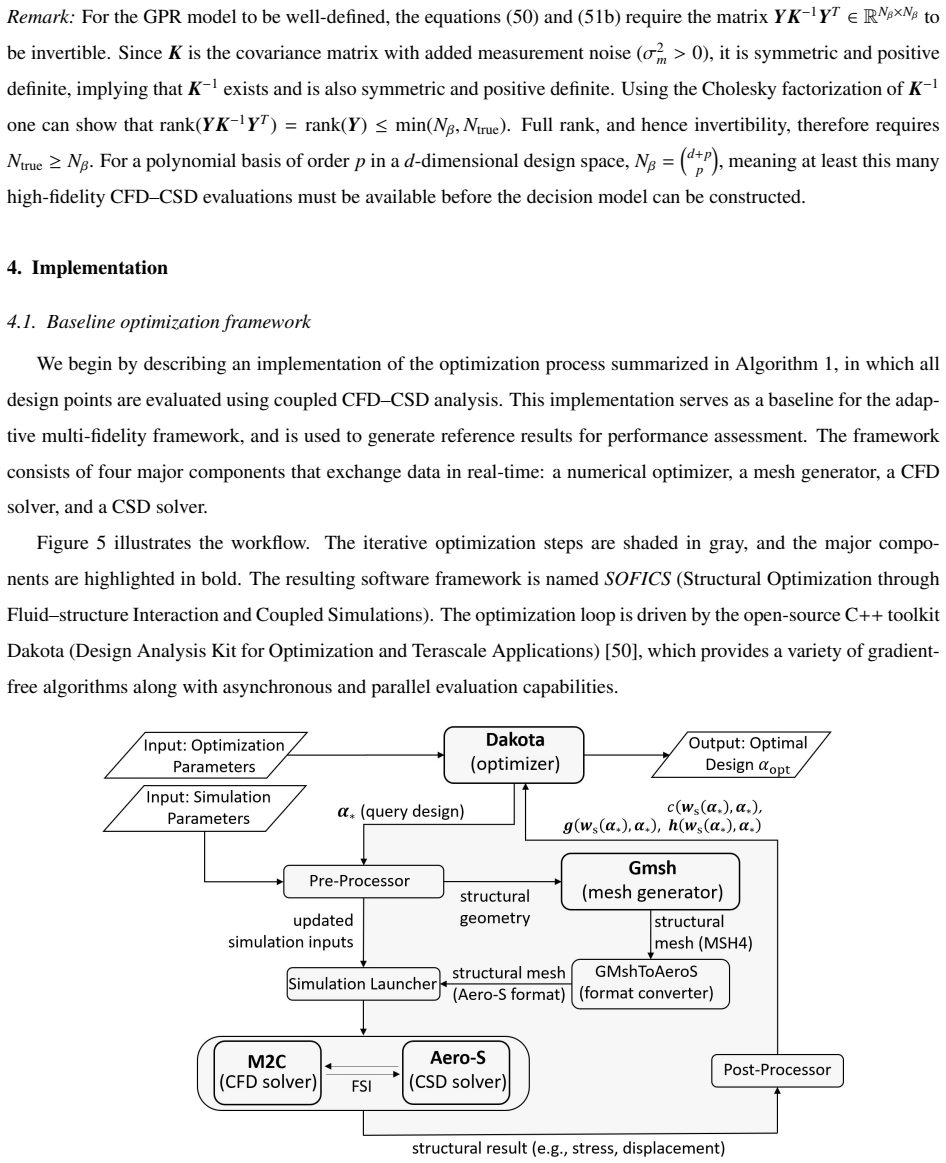
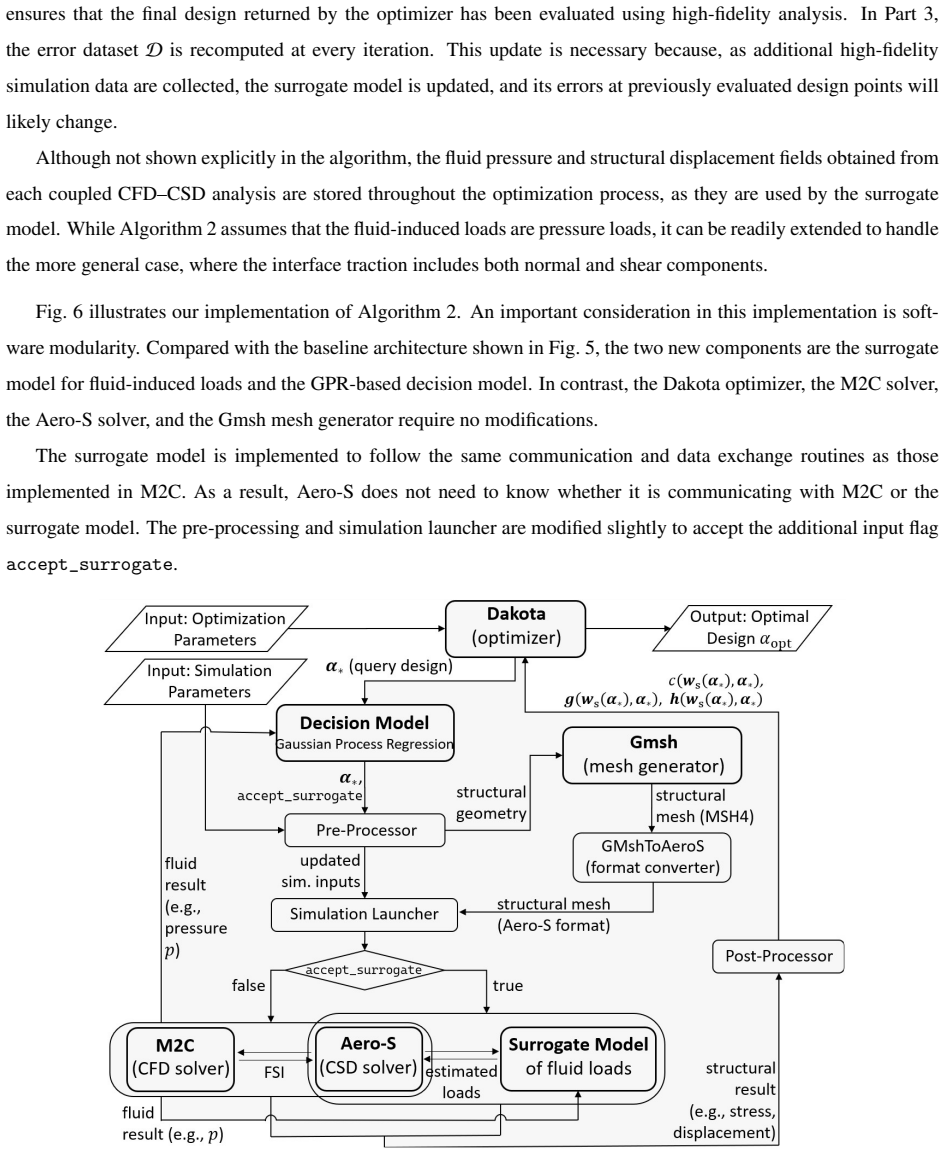
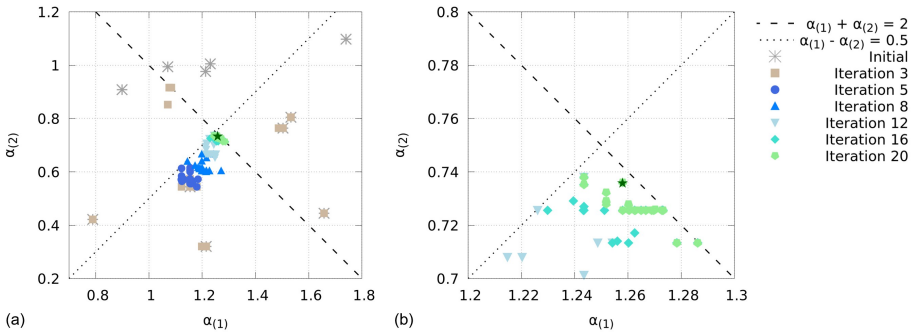
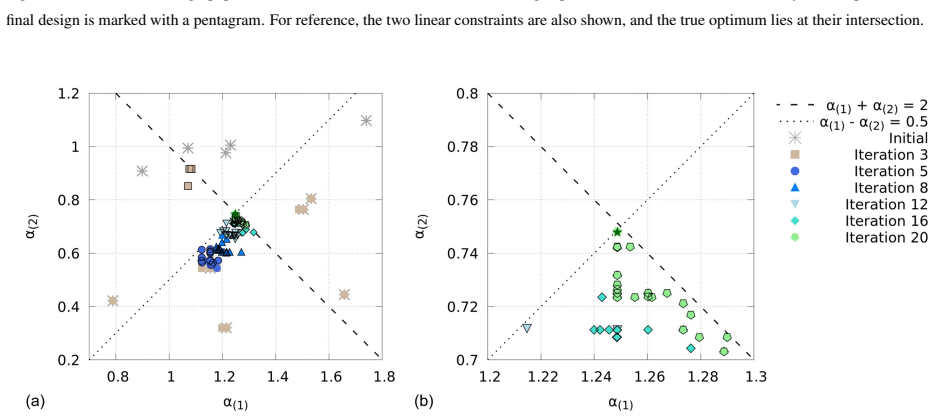
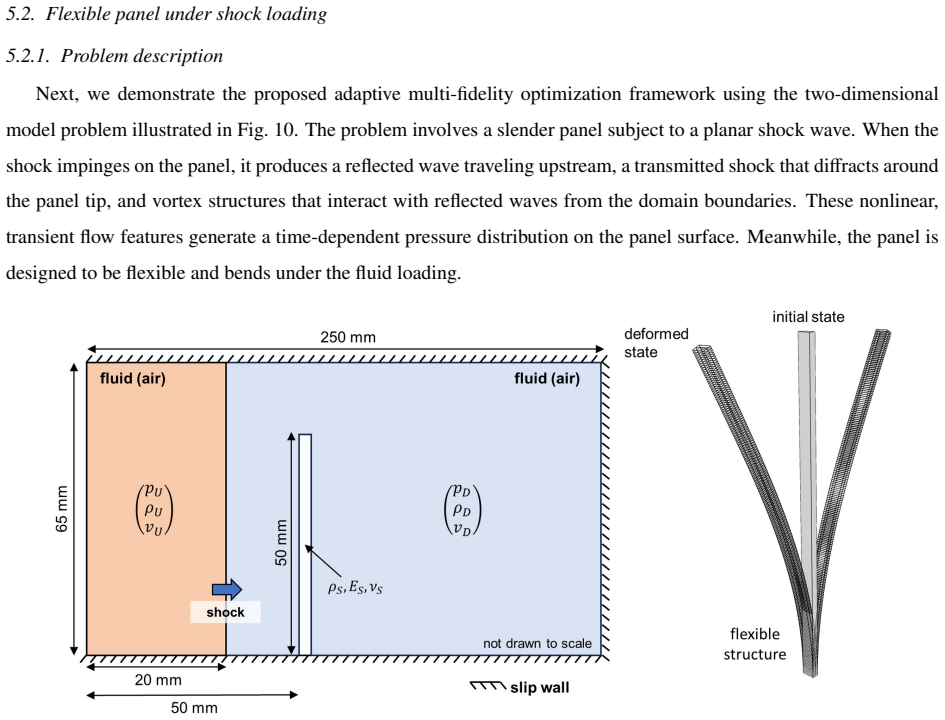
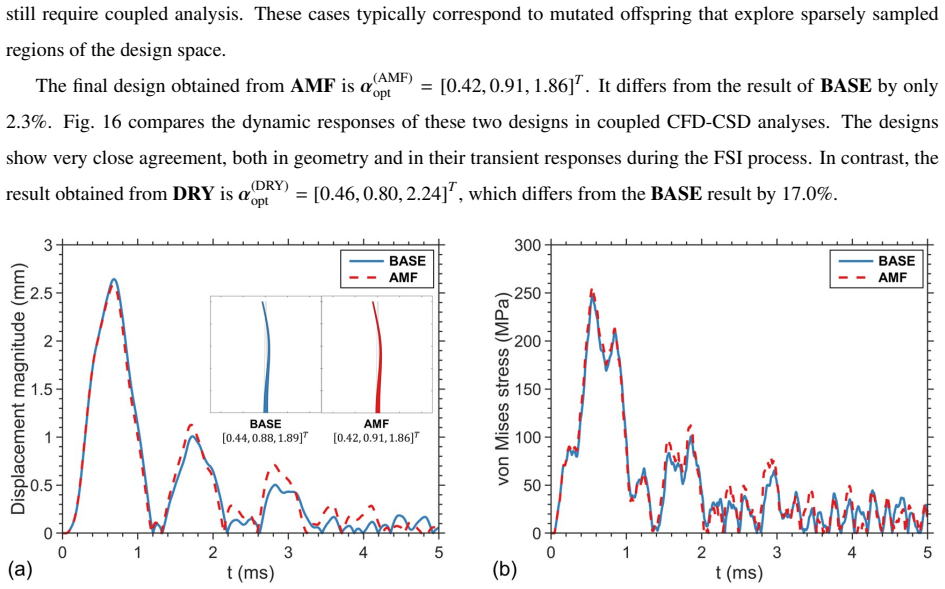
The design of structures and vehicles subject to fluid-structure interaction (FSI) often requires high-fidelity coupled analysis. While the design variables pertain to the structure, the computational cost is dominated by the fluid solver, making iterative optimization prohibitively expensive. This paper presents an adaptive multi-fidelity optimization method combining high-fidelity FSI analysis with a lightweight surrogate for fluid-induced loads and a decision model that selects between surrogate and high-fidelity fluid evaluations. During optimization, completed FSI analyses incrementally update a non-intrusive surrogate model based on nearest-neighbor search and radial interpolation. A hybrid Lagrangian-Eulerian mapping function is developed to transfer fluid loads between structural designs. The evolution of surface orientation is handled by decomposing the traction vectors into local orthonormal bases. An adaptive Gaussian process regression model is employed to predict surrogate error and quantify uncertainty, allowing risk-aware selection of when coupled analysis is required. As design evaluations cluster near the optimum, the accuracy of the surrogate model naturally improves, thereby reducing the reliance on the fluid solver. It requires no offline training, preserves the high-fidelity structural model in all design evaluations, and ensures that the final design is evaluated by high-fidelity FSI analysis. The fundamental idea is justified theoretically using a simplified model problem, which shows that the leading-order error is a monotonically increasing, concave, and bounded function of the fluid added mass. The framework is demonstrated on two benchmark problems. For shape optimization of a flexible panel under shock loading, results show an $80\%$ reduction in computational cost while maintaining accuracy within $2.3\%$ of fully high-fidelity FSI optimization.
Editorial analysis
A structured set of objections, weighed in public.
Referee Report
Summary. The paper proposes an adaptive multi-fidelity optimization framework for structural design under fluid-structure interaction (FSI). It combines high-fidelity coupled FSI analysis with an incrementally updated non-intrusive surrogate for fluid-induced loads (nearest-neighbor search plus radial interpolation), a hybrid Lagrangian-Eulerian load-transfer mapping that decomposes tractions into local orthonormal bases, and an adaptive Gaussian process regression model that predicts surrogate error to enable risk-aware selection between surrogate and high-fidelity fluid evaluations. A theoretical argument on a simplified model shows that the leading-order error is monotonically increasing, concave, and bounded in fluid added mass. The method requires no offline training, preserves the high-fidelity structural model at every design point, and guarantees that the final optimum is evaluated with full high-fidelity FSI. Benchmark results on shape optimization of a flexible panel under shock loading report an 80% reduction in computational cost while remaining within 2.3% of the fully high-fidelity optimum.
Significance. If the benchmark claims hold under detailed scrutiny, the approach could meaningfully lower the barrier to performing structural optimization in FSI-dominated regimes (e.g., aerospace panels, flexible aircraft). Strengths include the incremental surrogate update that improves automatically as designs cluster near the optimum, the absence of any offline training requirement, and the explicit guarantee that the reported optimum is always high-fidelity. The simplified-model error analysis provides a useful, if limited, theoretical anchor for the uncertainty-driven skipping strategy.
major comments (2)
- [§5] §5 (flexible-panel benchmark results): the stated 80% cost reduction and 2.3% accuracy figures are presented without error bars, iteration histories, or tabulated comparisons against the pure high-fidelity baseline; these omissions prevent assessment of whether the adaptive GP uncertainty model reliably prevented premature skipping of fluid solves during early iterations when geometry changes are largest.
- [§3.2–3.3] §3.2–3.3 (surrogate construction and decision rule): the nearest-neighbor + radial-interpolation surrogate together with the adaptive GP error predictor is described at a high level, but no explicit threshold or risk metric is given for deciding when to invoke the high-fidelity fluid solver; without this, it is impossible to verify that the “safe skipping” claim is robust to the monotonicity and boundedness properties asserted in the simplified-model analysis.
minor comments (2)
- [§3.1] The hybrid Lagrangian-Eulerian mapping is introduced without an accompanying equation or pseudocode block; adding a compact algorithmic description would improve reproducibility.
- [Figures 4–6] Figure captions for the optimization convergence plots should explicitly state the number of high-fidelity versus surrogate evaluations performed in each run.
Simulated Author's Rebuttal
We thank the referee for the constructive comments. We address each major comment below and will revise the manuscript accordingly to improve transparency and verifiability of the results.
read point-by-point responses
-
Referee: [§5] §5 (flexible-panel benchmark results): the stated 80% cost reduction and 2.3% accuracy figures are presented without error bars, iteration histories, or tabulated comparisons against the pure high-fidelity baseline; these omissions prevent assessment of whether the adaptive GP uncertainty model reliably prevented premature skipping of fluid solves during early iterations when geometry changes are largest.
Authors: We agree that additional detail is needed to allow assessment of the adaptive strategy. In the revised manuscript we will add a table of per-iteration high-fidelity versus surrogate counts, convergence histories for both the adaptive and pure high-fidelity runs, and error bars (or sensitivity ranges) on the reported cost and accuracy metrics. These additions will show that the GP uncertainty model avoided premature skipping while geometry changes remained large. revision: yes
-
Referee: [§3.2–3.3] §3.2–3.3 (surrogate construction and decision rule): the nearest-neighbor + radial-interpolation surrogate together with the adaptive GP error predictor is described at a high level, but no explicit threshold or risk metric is given for deciding when to invoke the high-fidelity fluid solver; without this, it is impossible to verify that the “safe skipping” claim is robust to the monotonicity and boundedness properties asserted in the simplified-model analysis.
Authors: We acknowledge that the precise risk metric and threshold are not stated explicitly. The revised sections 3.2–3.3 will define the decision rule as skipping the high-fidelity fluid solve when the GP predictive standard deviation falls below a fixed fraction of the current objective value (the exact fraction used in the experiments will be reported). A short paragraph will also connect this rule to the monotonicity and boundedness results from the simplified model to substantiate the robustness claim. revision: yes
Circularity Check
No significant circularity detected
full rationale
The paper presents an adaptive multi-fidelity optimization framework whose central elements (incremental nearest-neighbor/radial surrogate updates, hybrid load mapping, adaptive GP error model, and risk-aware switching) are constructed as independent algorithmic components. The theoretical justification rests on a separate simplified model problem whose error properties (monotonic, concave, bounded in added mass) are derived directly rather than fitted to the target optimization results. Validation occurs via explicit benchmark comparisons that report concrete cost and accuracy deltas against fully high-fidelity runs, with the final design always evaluated at high fidelity. No load-bearing step reduces by the paper's own equations or self-citation to a tautological redefinition or pre-fitted parameter presented as a prediction.
Axiom & Free-Parameter Ledger
Lean theorems connected to this paper
-
IndisputableMonolith/Cost/FunctionalEquation.leanwashburn_uniqueness_aczel unclear?
unclearRelation between the paper passage and the cited Recognition theorem.
leading-order error is a monotonically increasing, concave, and bounded function of the fluid added mass
-
IndisputableMonolith/Foundation/BranchSelection.leanbranch_selection unclear?
unclearRelation between the paper passage and the cited Recognition theorem.
normalized distance-based interpolation scheme ... convex combination
What do these tags mean?
- matches
- The paper's claim is directly supported by a theorem in the formal canon.
- supports
- The theorem supports part of the paper's argument, but the paper may add assumptions or extra steps.
- extends
- The paper goes beyond the formal theorem; the theorem is a base layer rather than the whole result.
- uses
- The paper appears to rely on the theorem as machinery.
- contradicts
- The paper's claim conflicts with a theorem or certificate in the canon.
- unclear
- Pith found a possible connection, but the passage is too broad, indirect, or ambiguous to say the theorem truly supports the claim.
Reference graph
Works this paper leans on
- [1]
- [2]
-
[3]
R. Kano, K. Ryuzono, S. Date, Y . Abe, T. Okabe, Structural optimization of composite aircraft wing considering fluid–structure interaction and damage tolerance assessment using continuum damage mechanics, Aerospace Science and Technology (2025) 110652
work page 2025
- [4]
-
[5]
A. L. Marsden, Optimization in cardiovascular modeling, Annual review of fluid mechanics 46 (1) (2014) 519– 546
work page 2014
-
[6]
C. Long, A. Marsden, Y . Bazilevs, Shape optimization of pulsatile ventricular assist devices using fsi to minimize thrombotic risk, Computational Mechanics 54 (4) (2014) 921–932
work page 2014
-
[7]
W. Ma, X. Zhao, C. Gilbert, K. Wang, Computational analysis of bubble–structure interactions in near-field underwater explosion, International Journal of Solids and Structures 242 (2022) 111527. 38
work page 2022
-
[8]
A. Narkhede, S. Islam, X. Sun, K. Wang, Fluid–structure coupled simulation framework for lightweight ex- plosion containment structures under large deformations, International Journal of Impact Engineering (2025) 105238doi:10.1016/j.ijimpeng.2025.105238
- [9]
-
[10]
M.-L. Cerquaglia, D. Thomas, R. Boman, V . Terrapon, J.-P. Ponthot, A fully partitioned lagrangian framework for fsi problems characterized by free surfaces, large solid deformations and displacements, and strong added- mass effects, Computer Methods in Applied Mechanics and Engineering 348 (2019) 409–442
work page 2019
-
[11]
K. Wang, A. Rallu, J.-F. Gerbeau, C. Farhat, Algorithms for interface treatment and load computation in embed- ded boundary methods for fluid and fluid–structure interaction problems, International Journal for Numerical Methods in Fluids 67 (9) (2011) 1175–1206. arXiv:https://onlinelibrary.wiley.com/doi/pdf/10.1002/fld.2556, doi:https://doi.org/10.1002/fl...
-
[12]
D. Kamensky, M.-C. Hsu, D. Schillinger, J. A. Evans, A. Aggarwal, Y . Bazilevs, M. S. Sacks, T. J. Hughes, An immersogeometric variational framework for fluid–structure interaction: Application to bioprosthetic heart valves, Computer methods in applied mechanics and engineering 284 (2015) 1005–1053
work page 2015
-
[13]
S. Cao, A. Main, K. G. Wang, Robin-neumann transmission conditions for fluid-structure coupling: embedded boundary implementation and parameter analysis, International Journal for Numerical Methods in Engineering 115 (5) (2018) 578–603
work page 2018
-
[14]
J. A. González, K. Park, Three-field partitioned analysis of fluid–structure interaction problems with a consistent interface model, Computer Methods in Applied Mechanics and Engineering 414 (2023) 116134
work page 2023
-
[15]
B. A. Miller, J. J. McNamara, Efficient fluid-thermal-structural time marching with computational fluid dynam- ics, AIAA Journal 56 (9) (2018) 3610–3621
work page 2018
- [16]
-
[17]
V . Gravemeier, S. M. Civaner, W. A. Wall, A partitioned-monolithic finite element method for thermo-fluid– structure interaction, Computer Methods in Applied Mechanics and Engineering 401 (2022) 115596
work page 2022
-
[18]
N. V . Queipo, R. T. Haftka, W. Shyy, T. Goel, R. Vaidyanathan, P. K. Tucker, Surrogate-based analysis and optimization, Progress in aerospace sciences 41 (1) (2005) 1–28. 39
work page 2005
-
[19]
B. Liu, Q. Zhang, G. G. Gielen, A gaussian process surrogate model assisted evolutionary algorithm for medium scale expensive optimization problems, IEEE Transactions on Evolutionary Computation 18 (2) (2013) 180–192
work page 2013
- [20]
-
[21]
M. Yoshimura, K. Shimoyama, T. Misaka, S. Obayashi, Topology optimization of fluid problems using genetic algorithm assisted by the kriging model, International Journal for Numerical Methods in Engineering 109 (4) (2017) 514–532
work page 2017
-
[22]
M. C. Wu, D. Kamensky, C. Wang, A. J. Herrema, F. Xu, M. S. Pigazzini, A. Verma, A. L. Marsden, Y . Bazilevs, M.-C. Hsu, Optimizing fluid–structure interaction systems with immersogeometric analysis and surrogate mod- eling: Application to a hydraulic arresting gear, Computer Methods in Applied Mechanics and Engineering 316 (2017) 668–693
work page 2017
-
[23]
A. F. Ribeiro, D. Casalino, C. Ferreira, Free wake panel method simulations of a highly flexible wing in flutter and gusts, Journal of Fluids and Structures 121 (2023) 103955
work page 2023
- [24]
-
[25]
L. Ma, Y . Hu, J. Zheng, G. Deng, Y . Chen, Failure analysis for cylindrical explosion containment vessels, Engineering Failure Analysis 17 (5) (2010) 1221–1229
work page 2010
-
[26]
M. J. Zahr, C. Farhat, Progressive construction of a parametric reduced-order model for pde-constrained opti- mization, International Journal for Numerical Methods in Engineering 102 (5) (2015) 1111–1135
work page 2015
- [27]
-
[28]
T. Lieu, C. Farhat, M. Lesoinne, Reduced-order fluid/structure modeling of a complete aircraft configuration, Computer Methods in Applied Mechanics and Engineering 195 (41) (2006) 5730–5742, john H. Argyris Memo- rial Issue. Part II. doi:https://doi.org/10.1016/j.cma.2005.08.026. URLhttps://www.sciencedirect.com/science/article/pii/S0045782505005153
-
[29]
D. Xiao, P. Yang, F. Fang, J. Xiang, C. C. Pain, I. M. Navon, Non-intrusive reduced order modelling of fluid– structure interactions, Computer Methods in Applied Mechanics and Engineering 303 (2016) 35–54
work page 2016
-
[30]
X. Guo, W. Li, F. Iorio, Convolutional neural networks for steady flow approximation, in: Proceedings of the 22nd ACM SIGKDD international conference on knowledge discovery and data mining, 2016, pp. 481–490. 40
work page 2016
- [31]
-
[32]
O. Obiols-Sales, A. Vishnu, N. Malaya, A. Chandramowliswharan, Cfdnet: A deep learning-based accelerator for fluid simulations, in: Proceedings of the 34th ACM international conference on supercomputing, 2020, pp. 1–12
work page 2020
-
[33]
D. Kochkov, J. A. Smith, A. Alieva, Q. Wang, M. P. Brenner, S. Hoyer, Machine learning–accelerated computa- tional fluid dynamics, Proceedings of the National Academy of Sciences 118 (21) (2021) e2101784118
work page 2021
- [34]
- [35]
- [36]
-
[37]
M. A. Bouhlel, S. He, J. R. Martins, Scalable gradient–enhanced artificial neural networks for airfoil shape design in the subsonic and transonic regimes, Structural and Multidisciplinary Optimization 61 (4) (2020) 1363– 1376
work page 2020
-
[38]
Y . S. Ong, P. B. Nair, A. J. Keane, Evolutionary optimization of computationally expensive problems via surro- gate modeling, AIAA journal 41 (4) (2003) 687–696
work page 2003
- [39]
-
[40]
R. B. Gramacy, H. K. Lee, Adaptive design and analysis of supercomputer experiments, Technometrics 51 (2) (2009) 130–145
work page 2009
-
[41]
R. Sanchez, T. Albring, R. Palacios, N. R. Gauger, T. D. Economon, J. J. Alonso, Coupled adjoint-based sen- sitivities in large-displacement fluid-structure interaction using algorithmic differentiation, International Journal for Numerical Methods in Engineering 113 (7) (2018) 1081–1107
work page 2018
-
[42]
J. Hron, S. Turek, A monolithic fem/multigrid solver for an ale formulation of fluid-structure interaction with applications in biomechanics, in: Fluid-Structure Interaction: Modelling, Simulation, Optimisation, Springer, 2006, pp. 146–170. 41
work page 2006
-
[43]
O. Colomés, F. Verdugo, I. Akkerman, A monolithic finite element formulation for the hydroelastic analysis of very large floating structures, International Journal for Numerical Methods in Engineering 124 (3) (2023) 714–751
work page 2023
-
[44]
C. A. Felippa, K.-C. Park, C. Farhat, Partitioned analysis of coupled mechanical systems, Computer methods in applied mechanics and engineering 190 (24-25) (2001) 3247–3270
work page 2001
-
[45]
C. Farhat, A. Rallu, K. Wang, T. Belytschko, Robust and provably second-order explicit-explicit and implicit- explicit staggered time-integrators for highly non-linear compressible fluid-structure interaction problems, Inter- national Journal for Numerical Methods in Engineering 84 (1) (2010) 73–107. doi:10.1002/nme.2883
-
[46]
X. Zhao, W. Ma, S. Islam, A. Narkhede, K. Wang, M2c: An open-source software for multiphysics simulation of compressible multi-material flows and fluid-structure interactions, Computer Physics Communications 321 (2026) 110023. doi:10.1016/j.cpc.2026.110023. URLhttps://doi.org
-
[47]
AeroS (2024). [link]. URLhttps://github.com/anarkh97/aero-s-foam
work page 2024
-
[48]
M. P. Païdoussis, Fluid-Structure Interactions: Slender Structures and Axial Flow, V olume 1, 2nd Edition, Aca- demic Press/Elsevier, Amsterdam; Boston; Heidelberg; London; New York; Oxford, 2013, second edition, revised and updated
work page 2013
-
[49]
C. K. Williams, C. E. Rasmussen, Gaussian processes for machine learning, V ol. 2, MIT press Cambridge, MA, 2006
work page 2006
-
[50]
B. M. Adams, W. J. Bohnhoff, K. R. Dalbey, M. S. Ebeida, J. P. Eddy, M. S. Eldred, R. W. Hooper, P. D. Hough, K. T. Hu, J. D. Jakeman, et al., Dakota, a multilevel parallel object-oriented framework for design optimization, parameter estimation, uncertainty quantification, and sensitivity analysis: Version 6.16 user’s manual, Tech. rep., Sandia National L...
-
[51]
A. Main, X. Zeng, P. Avery, C. Farhat, An enhanced FIVER method for multi-material flow prob- lems with second-order convergence rate, Journal of Computational Physics 329 (2017) 141–172. doi:10.1016/j.jcp.2016.10.028
-
[52]
C. Geuzaine, J.-F. Remacle, Gmsh: A 3-d finite element mesh generator with built-in pre-and post-processing facilities, International journal for numerical methods in engineering 79 (11) (2009) 1309–1331
work page 2009
-
[53]
J. Giordano, G. Jourdan, Y . Burtschell, M. Medale, D. Zeitoun, L. Houas, Shock wave impacts on deforming panel, an application of fluid-structure interaction, Shock Waves 14 (1) (2005) 103–110. 42
work page 2005
-
[54]
A. Narkhede, N. Eilers, E. Rivas, K. Wang, Multi-fidelity structural optimization for shock-driven fluid–structure interaction problems, in: AIAA SciTech Forum and Exposition, American Institute of Aeronautics and Astro- nautics, 2026. 43
work page 2026
discussion (0)
Sign in with ORCID, Apple, or X to comment. Anyone can read and Pith papers without signing in.