The chemo-dynamical complexity of {ω} Centauri: different kinematics for different populations
Pith reviewed 2026-05-21 06:21 UTC · model grok-4.3
The pith
In ω Centauri, aluminum-rich stars sit closer to the center and move on more radial orbits than aluminum-poor stars.
A machine-rendered reading of the paper's core claim, the machinery that carries it, and where it could break.
Core claim
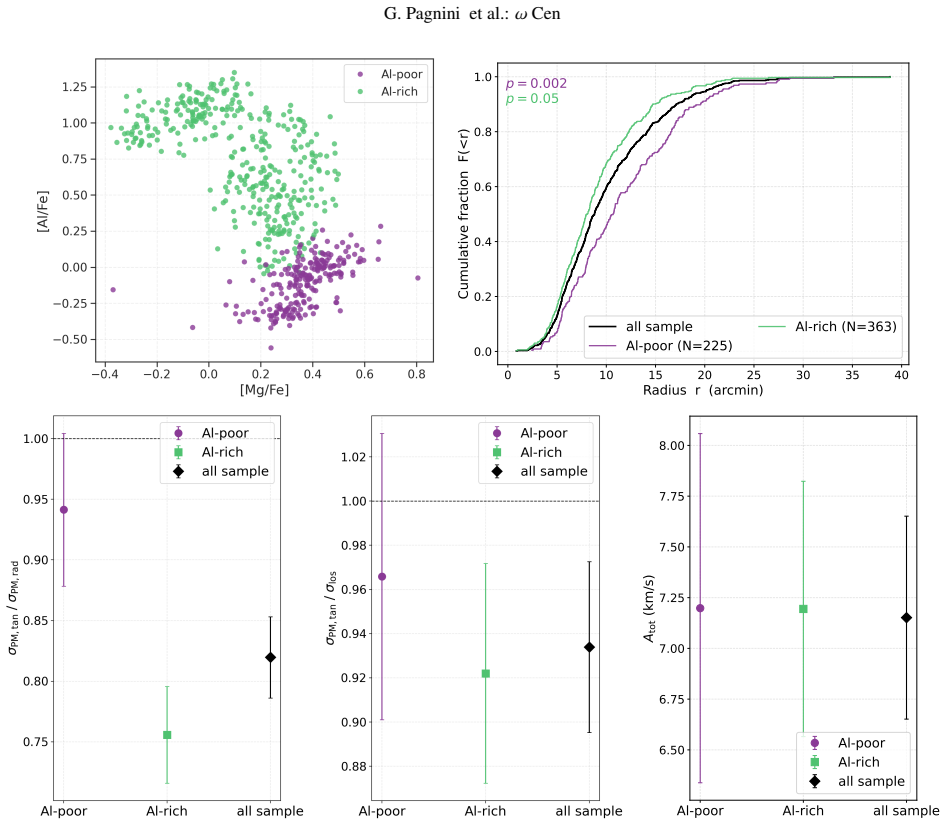
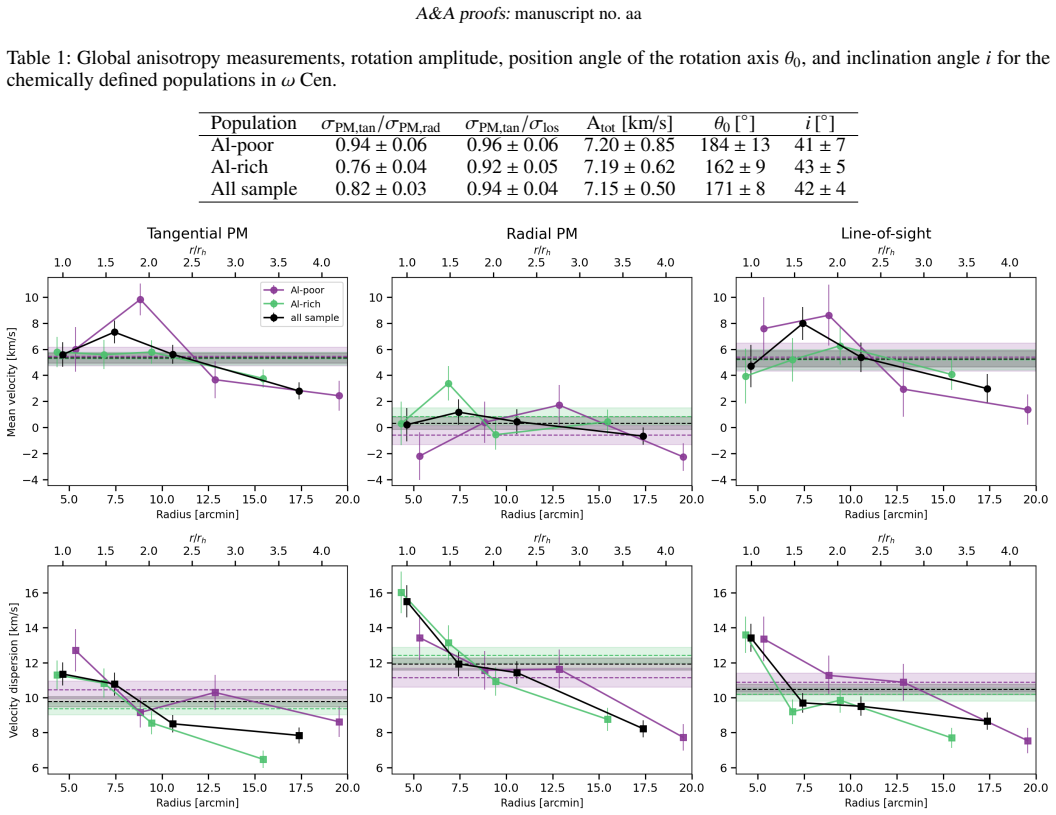
A Gaussian Mixture Model in eight-dimensional abundance space applied to APOGEE DR17 red-giant stars identifies five chemical components that naturally separate into an aluminum-rich family and an aluminum-poor family. The aluminum-rich stars are more centrally concentrated and display stronger radial velocity anisotropy, whereas the aluminum-poor stars remain nearer to isotropy across the probed radial range. The two families nevertheless share a common rotation pattern. These chemo-dynamical differences are measured from the inner regions out to approximately four half-light radii and represent the first such link between detailed chemical tagging and internal kinematics in ω Centauri.
What carries the argument
Gaussian Mixture Model in eight-dimensional chemical-abundance space that partitions stars into components subsequently grouped by aluminum enrichment to expose spatial and kinematic contrasts.
If this is right
- The spatial concentration and orbital anisotropy of the aluminum-rich family imply that these stars formed in a denser, more centrally located environment than the aluminum-poor family.
- Shared rotation between the families indicates they experienced at least one common dynamical phase after their separate chemical enrichment.
- The radial profiles extending to four half-light radii show that the kinematic differences persist into the cluster outskirts.
- A formation path combining hierarchical assembly inside a dwarf-galaxy potential with later centrally concentrated star formation accounts for both the chemical and dynamical observations.
Where Pith is reading between the lines
- Similar chemical-tagging plus kinematic analysis could be applied to other massive clusters suspected of ex-situ origins to test whether the same two-family pattern appears.
- If the aluminum-rich stars formed later and more centrally, their orbits may have been affected by subsequent dynamical friction or relaxation that the aluminum-poor stars avoided.
- The observed chemo-dynamical split supplies a concrete observational target for simulations that model both merger-driven accretion and in-situ star formation within the same cluster.
Load-bearing premise
The five chemical groups returned by the mixture model reflect genuinely separate stellar populations with distinct formation histories rather than arising from measurement noise or model choice.
What would settle it
Re-running the mixture model on the identical APOGEE sample while varying the number of components or inflating abundance errors so that the radial anisotropy and concentration differences between the aluminum-rich and aluminum-poor families disappear.
Figures


read the original abstract
The origin of {\omega} Centauri remains one of the key open problems in stellar dynamics and chemical evolution. Its large abundance spreads and multiple populations suggest a formation history more complex than that of a typical globular cluster. We investigate whether the chemical sub-populations identified in APOGEE DR17 also exhibit distinct spatial and kinematic signatures. We analyse a sample of APOGEE DR17 red-giant stars using a Gaussian Mixture Model in an eight-dimensional chemical-abundance space. The resulting chemical components are combined with Gaia proper motions and APOGEE line-of-sight velocities to derive intrinsic mean velocities and velocity dispersions in all three observable directions. We measure both global kinematic quantities and radial profiles for each chemically defined group, extending from the inner regions to ~ 4 half-light radii. The Gaussian Mixture Model identifies five chemical components, which, when examined through their radial cumulative distributions, naturally group into two broader families characterised by lower and higher aluminium enrichment. The two families differ significantly in their spatial and kinematic properties: the Al-rich stars are more centrally concentrated and exhibit stronger radial anisotropy than the Al-poor stars, which remain closer to isotropy over the radial range probed. Despite these significant differences, the two populations share a common rotation pattern. This work represents the first chemo-dynamical study of {\omega} Cen linking detailed chemical tagging to internal kinematics from the inner regions to the cluster outskirts. A formation path involving both hierarchical assembly within a dwarf-galaxy potential and centrally concentrated, chemically enriched star formation offers a natural explanation for the observed chemo-dynamical complexity.
Editorial analysis
A structured set of objections, weighed in public.
Referee Report
Summary. The manuscript applies a Gaussian Mixture Model (GMM) to eight-dimensional APOGEE DR17 abundance data for red-giant stars in ω Centauri, identifying five chemical components. These are manually grouped post-hoc into two Al-rich and Al-poor families on the basis of mean aluminium abundance. Combining the assignments with Gaia proper motions and APOGEE line-of-sight velocities, the authors derive mean velocities, dispersions, and anisotropy profiles in radial bins out to ~4 half-light radii. They report that the Al-rich family is more centrally concentrated and shows stronger radial anisotropy, while the Al-poor family remains closer to isotropy, although both families share a common rotation pattern. The results are interpreted as evidence for a complex formation history involving both hierarchical assembly and centrally concentrated, chemically enriched star formation.
Significance. If the five-component decomposition is shown to be robust against abundance uncertainties and model-complexity choices, the work would provide one of the first direct links between detailed chemical tagging and spatially resolved kinematics across the full radial extent of ω Centauri. This would strengthen the case for a dwarf-galaxy progenitor and supply quantitative constraints on the relative spatial and orbital properties of the chemically distinct populations.
major comments (2)
- [§3] §3 (GMM analysis): The manuscript reports a single run of the GMM with K=5 but provides no BIC/AIC values, cross-validation scores, or stability tests under realistic abundance perturbations. Because the subsequent manual grouping into Al-rich/Al-poor families and all kinematic contrasts are derived directly from these component labels, the absence of such validation leaves open whether the reported differences in central concentration and radial anisotropy are stable or sensitive to the particular decomposition.
- [§4] §4 (kinematic profiles): The radial anisotropy and cumulative-distribution profiles for the two families are computed after hard assignment to the grouped families. No propagation of the GMM posterior probabilities into the velocity-dispersion or anisotropy uncertainties is described; this omission is load-bearing for the claim that the Al-rich family exhibits 'stronger radial anisotropy' while the Al-poor family remains 'closer to isotropy'.
minor comments (2)
- [Abstract] The abstract states that the components 'naturally group' into two families; a brief statement of the quantitative criterion (e.g., a threshold in mean [Al/Fe]) would remove ambiguity.
- [§2] Notation for the three velocity components (radial, tangential, line-of-sight) should be defined once at first use and used consistently in all figures and tables.
Simulated Author's Rebuttal
We thank the referee for their constructive and detailed report. The comments highlight important points regarding the robustness of our Gaussian Mixture Model (GMM) decomposition and the treatment of assignment uncertainties in the kinematic analysis. We have revised the manuscript to incorporate additional validation metrics and to propagate posterior probabilities into the derived kinematic profiles and uncertainties. Our point-by-point responses follow.
read point-by-point responses
-
Referee: [§3] §3 (GMM analysis): The manuscript reports a single run of the GMM with K=5 but provides no BIC/AIC values, cross-validation scores, or stability tests under realistic abundance perturbations. Because the subsequent manual grouping into Al-rich/Al-poor families and all kinematic contrasts are derived directly from these component labels, the absence of such validation leaves open whether the reported differences in central concentration and radial anisotropy are stable or sensitive to the particular decomposition.
Authors: We agree that explicit validation of the GMM choice strengthens the analysis. In the revised manuscript we now report BIC and AIC values for K = 2 to 8, which indicate that K = 5 is preferred. We have also added a stability test in which the eight-dimensional abundance vectors are perturbed 100 times by drawing from the reported APOGEE uncertainties; each perturbed catalogue is re-fit with the GMM. The resulting component centroids, particularly in [Al/Fe], remain consistent to within 0.05 dex, preserving the same post-hoc grouping into Al-rich and Al-poor families. Five-fold cross-validation scores are likewise reported and support K = 5. These additions demonstrate that the reported spatial and kinematic differences are insensitive to the precise decomposition within the range of abundance uncertainties. revision: yes
-
Referee: [§4] §4 (kinematic profiles): The radial anisotropy and cumulative-distribution profiles for the two families are computed after hard assignment to the grouped families. No propagation of the GMM posterior probabilities into the velocity-dispersion or anisotropy uncertainties is described; this omission is load-bearing for the claim that the Al-rich family exhibits 'stronger radial anisotropy' while the Al-poor family remains 'closer to isotropy'.
Authors: We acknowledge the value of propagating the full GMM posteriors. The revised analysis now weights each star by its posterior probability of belonging to the Al-rich or Al-poor family when computing velocity dispersions, anisotropy parameters, and their uncertainties in each radial bin. Uncertainties are estimated via bootstrap resampling that respects the posterior weights. The updated profiles confirm that the Al-rich family remains more radially anisotropic than the Al-poor family at >2σ significance across the radial range, while both families share the same mean rotation. The relevant text, equations, and figures have been updated to reflect this weighted approach. revision: yes
Circularity Check
No significant circularity: independent chemistry and kinematics measurements
full rationale
The paper applies a standard Gaussian Mixture Model to external APOGEE DR17 abundances in eight-dimensional space to define chemical components, then measures spatial distributions and kinematics separately using Gaia proper motions combined with APOGEE line-of-sight velocities. The reported differences in central concentration and radial anisotropy between the manually grouped Al-rich and Al-poor families are direct empirical measurements on these independently assigned groups, not quantities that reduce by construction to the GMM fit parameters or any self-citation. No uniqueness theorems, ansatzes, or renamings of known results are invoked to force the chemo-dynamical distinctions. The derivation chain remains self-contained against external data benchmarks.
Axiom & Free-Parameter Ledger
free parameters (1)
- Number of GMM components =
5
axioms (1)
- domain assumption Velocity distributions within each chemically defined group are Gaussian
Reference graph
Works this paper leans on
- [1]
-
[2]
2019, ApJ, 886, 57 Alvarez Garay, D
Alfaro-Cuello, M., Kacharov, N., Neumayer, N., et al. 2019, ApJ, 886, 57 Alvarez Garay, D. A., Mucciarelli, A., Bellazzini, M., Lardo, C., & Ventura, P. 2024, A&A, 681, A54
work page 2019
- [3]
-
[4]
I., Vesperini, E., & Dalessandro, E
Aros, F. I., Vesperini, E., & Dalessandro, E. 2025, A&A, 699, A44
work page 2025
-
[5]
2010, in Society of Photo-Optical In- strumentation Engineers (SPIE) Conference Series, V ol
Bacon, R., Accardo, M., Adjali, L., et al. 2010, in Society of Photo-Optical In- strumentation Engineers (SPIE) Conference Series, V ol. 7735, Ground-based and Airborne Instrumentation for Astronomy III, ed. I. S. McLean, S. K. Ram- say, & H. Takami, 773508
work page 2010
- [6]
- [7]
-
[8]
R., Piotto, G., Anderson, J., et al
Bedin, L. R., Piotto, G., Anderson, J., et al. 2004, ApJ, 605, L125
work page 2004
- [9]
- [10]
- [11]
-
[12]
Bellini, A., Bedin, L. R., Piotto, G., et al. 2010, AJ, 140, 631
work page 2010
- [13]
-
[14]
Bellini, A., Milone, A. P., Anderson, J., et al. 2017, ApJ, 844, 164
work page 2017
- [15]
- [16]
- [17]
- [18]
- [19]
- [20]
- [21]
-
[22]
R., Sollima, A., Pancino, E., et al
Ferraro, F. R., Sollima, A., Pancino, E., et al. 2004, ApJ, 603, L81
work page 2004
-
[23]
Foreman-Mackey, D., Hogg, D. W., Lang, D., & Goodman, J. 2013, PASP, 125, 306 Gaia Collaboration, Brown, A. G. A., Vallenari, A., et al. 2018, A&A, 616, A1 Gaia Collaboration, Brown, A. G. A., Vallenari, A., et al. 2021, A&A, 649, A1
work page 2013
-
[24]
G., Carretta, E., & Bragaglia, A
Gratton, R. G., Carretta, E., & Bragaglia, A. 2012, A&A Rev., 20, 50
work page 2012
-
[25]
2016, MNRAS, 461, 3620 Häberle, M., Neumayer, N., Clontz, C., et al
Guillard, N., Emsellem, E., & Renaud, F. 2016, MNRAS, 461, 3620 Häberle, M., Neumayer, N., Clontz, C., et al. 2025, ApJ, 983, 95
work page 2016
-
[26]
Hilker, M., Kayser, A., Richtler, T., & Willemsen, P. 2004, A&A, 422, L9
work page 2004
-
[27]
Johnson, C. I. & Pilachowski, C. A. 2010, ApJ, 722, 1373
work page 2010
-
[28]
2018, Monthly Notices of the Royal Astronomical Society, 473, 5591
Kamann, S., Husser, T.-O., Dreizler, S., et al. 2018, Monthly Notices of the Royal Astronomical Society, 473, 5591
work page 2018
- [29]
-
[30]
I., Baumgardt, H., Cabrera-Ziri, I., et al
Leitinger, E. I., Baumgardt, H., Cabrera-Ziri, I., et al. 2025, A&A, 694, A184 Lloyd Evans, T. 1977, MNRAS, 181, 591
work page 2025
-
[31]
Majewski, S. R., Patterson, R. J., Dinescu, D. I., et al. 2000, in Liege Inter- national Astrophysical Colloquia, V ol. 35, Liege International Astrophysical Colloquia, ed. A. Noels, P. Magain, D. Caro, E. Jehin, G. Parmentier, & A. A. Thoul, 619
work page 2000
-
[32]
Marcolini, A., Sollima, A., D’Ercole, A., Gibson, B. K., & Ferraro, F. R. 2007, MNRAS, 382, 443
work page 2007
- [33]
- [34]
-
[35]
Marino, A. F., Milone, A. P., Renzini, A., et al. 2019, MNRAS, 487, 3815
work page 2019
-
[36]
Mason, A. C., Schiavon, R. P., Kamann, S., et al. 2026, MNRAS, 547, stag433
work page 2026
- [37]
- [38]
-
[39]
1997, AJ, 114, 1087 Mészáros, S., Masseron, T., Fernández-Trincado, J
Mayor, M., Meylan, G., Udry, S., et al. 1997, AJ, 114, 1087 Mészáros, S., Masseron, T., Fernández-Trincado, J. G., et al. 2021, MNRAS, 505, 1645
work page 1997
- [40]
- [41]
-
[42]
S., Neumayer, N., Clontz, C., et al
Nitschai, M. S., Neumayer, N., Clontz, C., et al. 2023, ApJ, 958, 8
work page 2023
- [43]
-
[44]
Norris, J. E. & Da Costa, G. S. 1995, ApJ, 447, 680
work page 1995
-
[45]
Pagnini, G., Di Matteo, P., Haywood, M., et al. 2025, A&A, 693, A155
work page 2025
-
[46]
R., Bellazzini, M., Piotto, G., & Zoccali, M
Pancino, E., Ferraro, F. R., Bellazzini, M., Piotto, G., & Zoccali, M. 2000, ApJ, 534, L83
work page 2000
-
[47]
Pancino, E., Galfo, A., Ferraro, F. R., & Bellazzini, M. 2007, ApJ, 661, L155
work page 2007
-
[48]
Pechetti, R., Kamann, S., Krajnovi´c, D., et al. 2024, MNRAS, 528, 4941
work page 2024
-
[49]
Persson, S. E., Frogel, J. A., Cohen, J. G., Aaronson, M., & Matthews, K. 1980, ApJ, 235, 452
work page 1980
-
[50]
A., Seitzer, P., Arnold, R., et al
Reijns, R. A., Seitzer, P., Arnold, R., et al. 2006, A&A, 445, 503
work page 2006
-
[51]
Romano, D., Matteucci, F., Tosi, M., et al. 2007, MNRAS, 376, 405
work page 2007
-
[52]
Schiavon, R. P., Phillips, S. G., Myers, N., et al. 2024, MNRAS, 528, 1393
work page 2024
- [53]
-
[54]
Suntzeff, N. B. & Kraft, R. P. 1996, AJ, 111, 1913
work page 1996
-
[55]
Tailo, M., Di Criscienzo, M., D’Antona, F., Caloi, V ., & Ventura, P. 2016, MN- RAS, 457, 4525
work page 2016
-
[56]
Tiongco, M. A., Vesperini, E., & Varri, A. L. 2019, MNRAS, 487, 5535
work page 2019
-
[57]
Tsuchiya, T., Dinescu, D. I., & Korchagin, V . I. 2003, ApJ, 589, L29
work page 2003
-
[58]
Tsuchiya, T., Korchagin, V . I., & Dinescu, D. I. 2004, MNRAS, 350, 1141 van de Ven, G., van den Bosch, R. C. E., Verolme, E. K., & de Zeeuw, P. T. 2006, A&A, 445, 513 van Leeuwen, F., Le Poole, R. S., Reijns, R. A., Freeman, K. C., & de Zeeuw, P. T. 2000, A&A, 360, 472
work page 2004
- [59]
-
[60]
Vernekar, N., Lucatello, S., Kuzma, P., & Spina, L. 2025, A&A, 696, A168
work page 2025
-
[61]
Vesperini, E., Hong, J., Giersz, M., & Hypki, A. 2021, MNRAS, 502, 4290
work page 2021
-
[62]
Villanova, S., Geisler, D., Gratton, R. G., & Cassisi, S. 2014, ApJ, 791, 107
work page 2014
- [63]
-
[64]
Wang, Z., Seth, A. C., Clontz, C., et al. 2026, arXiv e-prints, arXiv:2603.01041 Article number, page 10 of 14 G. Pagnini et al.:ωCen 0.4 0.2 0.0 0.2 0.4 0.6 0.8 [Mg/Fe] 0.50 0.25 0.00 0.25 0.50 0.75 1.00 1.25 [Al/Fe] Components Component 0 Component 1 Component 2 Component 3 Component 4 1.8 1.6 1.4 1.2 1.0 0.8 [Fe/H] Fig. A.1: Alternative representation ...
discussion (0)
Sign in with ORCID, Apple, or X to comment. Anyone can read and Pith papers without signing in.