Long-Time Stability Analysis for Stochastic Evolution Equations with Multiplicative Noise
Pith reviewed 2026-05-21 06:09 UTC · model grok-4.3
The pith
Explicit conditions tie stochastic equation stability to the principal eigenvalue of the governing operator.
A machine-rendered reading of the paper's core claim, the machinery that carries it, and where it could break.
Core claim
For a class of linear stochastic evolution equations in a Hilbert space driven by multiplicative noise, the authors give explicit sufficient conditions, expressed through the principal eigenvalue of the governing operator together with the drift coefficient and noise intensity, that guarantee both p-th moment exponential stability and almost sure exponential stability. They clarify the direct relationship between these two forms of stability and illustrate the conditions on several stochastic partial differential equations. A fully discrete spectral Galerkin spatial discretization paired with the implicit Euler-Maruyama time scheme is proved to inherit the same stability properties, and the
What carries the argument
The principal eigenvalue of the governing linear operator, which supplies explicit thresholds when combined with the drift coefficient and the intensity of the multiplicative noise.
If this is right
- When the principal eigenvalue lies below a threshold set by the drift and noise intensity, p-th moment exponential stability holds.
- Almost sure exponential stability follows under related but separate conditions involving the same quantities.
- The two stability notions are connected by an explicit implication that the paper derives.
- A spectral Galerkin plus implicit Euler-Maruyama discretization preserves both forms of stability.
- The criteria apply directly to several standard stochastic partial differential equations.
Where Pith is reading between the lines
- The same spectral test could be tried on semilinear equations where the linear part still dominates the long-time behavior.
- Modelers in applied fields could use the thresholds to choose noise levels that guarantee desired long-term decay.
- Because the discrete scheme inherits stability, long-time numerical experiments on these equations become more reliable.
Load-bearing premise
The linear operator that governs the deterministic part possesses a principal eigenvalue that combines with the drift and noise intensity to produce usable stability thresholds.
What would settle it
A concrete counter-example consisting of one stochastic evolution equation in which the principal eigenvalue, drift, and noise satisfy the stated inequality yet the solution is observed to lose exponential stability in the p-th moment would refute the sufficient conditions.
Figures



read the original abstract
In this paper, we study the long-time stability behavior of a class of linear stochastic evolution equations in a Hilbert space with multiplicative noise. Explicit sufficient conditions for $p$-th moment and almost sure exponential stability are established, highlighting the interplay between the principal eigenvalue of the governing operator, the drift coefficient, and the noise intensity. The relationship between these two notions of stability is also clarified. Applications to several stochastic partial differential equations are presented. In addition, a fully discrete spectral Galerkin method together with the implicit Euler--Maruyama scheme is shown to preserve these stability properties at the discrete level. Finally, numerical simulations are provided to confirm the theoretical results.
Editorial analysis
A structured set of objections, weighed in public.
Referee Report
Summary. The paper studies long-time stability of linear stochastic evolution equations with multiplicative noise in a Hilbert space. It establishes explicit sufficient conditions for p-th moment exponential stability and almost sure exponential stability in terms of the principal eigenvalue of the governing operator, the drift coefficient, and the noise intensity. The relationship between these two stability notions is clarified. The results are applied to several stochastic partial differential equations. A fully discrete spectral Galerkin method combined with the implicit Euler-Maruyama scheme is shown to preserve the stability properties, and numerical simulations are provided to confirm the theoretical findings.
Significance. If the central claims hold, the work supplies concrete, checkable thresholds for stability in infinite-dimensional stochastic systems, which is valuable for both theoretical analysis and applications in physics and engineering. The explicit linkage to the principal eigenvalue and the preservation of stability under discretization are notable strengths, as they enable direct verification and reliable numerical approximation without hidden constants.
minor comments (3)
- [§2.2] §2.2: The definition of the principal eigenvalue λ1 should be recalled explicitly (including its variational characterization) before it is used to derive the stability thresholds, to improve readability for readers who may not have the background reference at hand.
- [Theorem 3.1] Theorem 3.1: The statement of the sufficient condition for p-moment stability would benefit from a short remark clarifying whether the bound on the noise intensity is sharp or merely sufficient; this would help readers assess the result's tightness.
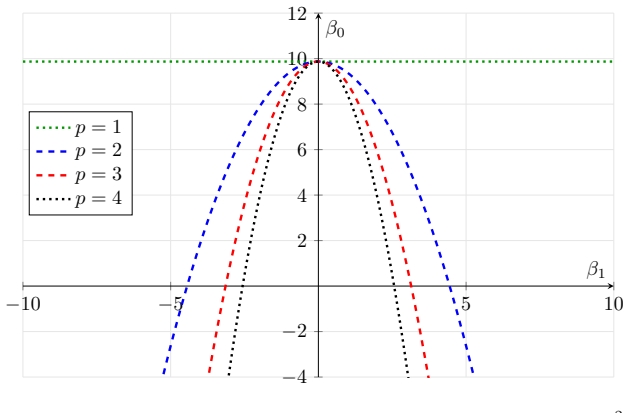
- [§5] §5 (Numerical simulations): The captions of Figures 1 and 2 should list the specific values of p, the spatial discretization parameter N, and the time step Δt used in each run, to facilitate exact reproduction of the plots.
Simulated Author's Rebuttal
We thank the referee for the positive evaluation of our work on long-time stability for linear stochastic evolution equations with multiplicative noise. The recognition of the explicit stability thresholds, the clarification of the relationship between moment and almost-sure stability, and the preservation result under spectral Galerkin plus implicit Euler-Maruyama discretization is appreciated. We are pleased with the recommendation for minor revision.
Circularity Check
No significant circularity
full rationale
The paper derives explicit sufficient conditions for p-th moment and almost sure exponential stability by relating the principal eigenvalue of the governing operator to the drift coefficient and multiplicative noise intensity through standard Itô estimates and semigroup bounds. These steps rely on the paper's stated assumptions about the linear operator and do not reduce the target stability conclusions to fitted parameters, self-definitions, or self-citation chains by construction. The derivations remain independent of the final stability claims, with applications and discretizations following the same explicit thresholds without internal reductions to inputs.
Axiom & Free-Parameter Ledger
axioms (2)
- domain assumption The linear operator on the Hilbert space possesses a principal eigenvalue that governs the deterministic growth rate
- standard math The multiplicative noise satisfies standard measurability and integrability conditions allowing application of Itô calculus in infinite dimensions
Lean theorems connected to this paper
-
IndisputableMonolith/Foundation/AbsoluteFloorClosure.leanreality_from_one_distinction unclear?
unclearRelation between the paper passage and the cited Recognition theorem.
Explicit sufficient conditions for p-th moment and almost sure exponential stability are established, highlighting the interplay between the principal eigenvalue of the governing operator, the drift coefficient, and the noise intensity.
-
IndisputableMonolith/Cost/FunctionalEquation.leanwashburn_uniqueness_aczel unclear?
unclearRelation between the paper passage and the cited Recognition theorem.
Lemma 2.2 ... Itô formula ... d∥y(t)∥p_H = ...
What do these tags mean?
- matches
- The paper's claim is directly supported by a theorem in the formal canon.
- supports
- The theorem supports part of the paper's argument, but the paper may add assumptions or extra steps.
- extends
- The paper goes beyond the formal theorem; the theorem is a base layer rather than the whole result.
- uses
- The paper appears to rely on the theorem as machinery.
- contradicts
- The paper's claim conflicts with a theorem or certificate in the canon.
- unclear
- Pith found a possible connection, but the passage is too broad, indirect, or ambiguous to say the theorem truly supports the claim.
Reference graph
Works this paper leans on
- [1]
-
[2]
P. Cannarsa, P. Martinez and J. Vancostenoble. Global Carleman estimates for degenerate parabolic operators with applications. Memoirs of the American Mathematical Society, 239(1133) (2016)
work page 2016
- [3]
- [4]
-
[5]
T. Caraballo and K. Liu. On exponential stability criteria of stochastic partial differential equations. Stochastic Processes and Their Applications, 83(2), 289–301 (1999)
work page 1999
-
[6]
T. Caraballo, K. Liu and X. Mao. On stabilization of partial differential equations by noise. Nagoya Mathematical Journal, 161, 155–170 (2001)
work page 2001
-
[7]
T. Caraballo and J. Real. On the pathwise exponential stability of non-linear stochastic partial differential equations. Stochastic Analysis and Applications, 12(5), 517–525 (1994)
work page 1994
-
[8]
P. L. Chow. Explosive solutions of stochastic reaction–diffusion equations in meanL p-norm. Journal of Differential Equations, 250(5), 2567–2580 (2011)
work page 2011
-
[9]
P. L. Chow. Stability of nonlinear stochastic-evolution equations. Journal of Mathematical Analysis and Applications, 89(2), 400–419 (1982)
work page 1982
-
[10]
G. Da Prato and J. Zabczyk. Stochastic equations in infinite dimensions. Cambridge University Press, Cambridge (2014)
work page 2014
-
[11]
X. L. Ding and D. Wang. Stability theory of stochastic evolution equations with multiplicative fractional Brownian motions in Hilbert spaces. Chaos, Solitons & Fractals, 187, 115435 (2024)
work page 2024
-
[12]
M. M. El-Borai, O. L. Moustafa and H. M. Ahmed. Asymptotic stability of some stochastic evolution equations. Applied Mathematics and Computation, 144(2–3), 273–286 (2003)
work page 2003
-
[13]
K.-J. Engel and R. Nagel. One-parameter semigroups for linear evolution equations. Springer, New York (2000)
work page 2000
-
[14]
W. Grecksch and P. E. Kloeden. Time-discretised Galerkin approximations of parabolic stochastic PDEs. Bulletin of the Australian Mathematical Society, 54(1), 79–85 (1996). 26
work page 1996
-
[15]
U. G. Haussmann. Asymptotic stability of the linear Itˆ o equation in infinite dimensions. Journal of Mathematical Analysis and Applications, 65(1), 219–235 (1978)
work page 1978
-
[16]
Stability for the stochastic heat equation with multiplicative noise via finite-dimensional feedback
V. Hern´ andez-Santamar´ ıa, K. Le Balc’h and L. Peralta. Stability for the stochastic heat equation with multiplicative noise via finite-dimensional feedback. arXiv preprint arXiv:2604.08683 (2026)
work page internal anchor Pith review Pith/arXiv arXiv 2026
-
[17]
D. J. Higham. Mean-square and asymptotic stability of the stochastic theta method. SIAM Journal on Numerical Analysis, 38(3), 753–769 (2000)
work page 2000
-
[18]
D. J. Higham, X. Mao and A. M. Stuart. Strong convergence of Euler-type methods for nonlinear stochastic differential equations. SIAM Journal on Numerical Analysis, 40(3), 1041–1063 (2002)
work page 2002
-
[19]
D. J. Higham, X. Mao and C. Yuan. Almost sure and moment exponential stability in the numerical simulation of stochastic differential equations. SIAM Journal on Numerical Analysis, 45(2), 592–609 (2007)
work page 2007
-
[20]
Y. Hu. Some recent progress on stochastic heat equations. Acta Mathematica Scientia, 39(3), 874–914 (2019)
work page 2019
-
[21]
Y. Hu, J. Huang, D. Nualart and S. Tindel. Stochastic heat equations with general multiplicative Gaussian noises: H¨ older continuity and intermittency. (2015)
work page 2015
- [22]
-
[23]
A. Jentzen and P. E. Kloeden. Taylor approximations for stochastic partial differential equations. SIAM, Philadelphia (2011)
work page 2011
-
[24]
A. Jentzen and P. E. Kloeden. The numerical approximation of stochastic partial differential equations. Milan Journal of Mathematics, 77, 205–244 (2009)
work page 2009
-
[25]
R. Khasminskii and V. Mandrekar. On the stability of solutions of stochastic evolution equations. In: The Dynkin Festschrift: Markov Processes and their Applications, pp. 185–197. Birkh¨ auser Boston (1994)
work page 1994
-
[26]
P. E. Kloeden and S. Shott. Linear-implicit strong schemes for Itˆ o-Galerkin approximations of stochastic PDEs. International Journal of Stochastic Analysis, 14(1), 47–53 (2001)
work page 2001
-
[27]
R. Kruse. Strong and weak approximation of semilinear stochastic evolution equations. Springer, Berlin (2014)
work page 2014
-
[28]
R. Kruse. Optimal error estimates of Galerkin finite element methods for stochastic partial differential equations with multiplicative noise. IMA Journal of Numerical Analysis, 34(1), 217–251 (2014)
work page 2014
-
[29]
A. Lang, A. Petersson and A. Thalhammer. Mean-square stability analysis of approximations of stochastic differential equations in infinite dimensions. BIT Numerical Mathematics, 57(4), 963–990 (2017)
work page 2017
-
[30]
K. Liu. Sensitivity to small delays of pathwise stability for stochastic retarded evolution equations. Journal of Theoretical Probability, 31(3), 1625–1646 (2018)
work page 2018
-
[31]
G. J. Lord, C. E. Powell and T. Shardlow. An introduction to computational stochastic PDEs. Cambridge University Press, Cambridge (2014)
work page 2014
-
[32]
L. Lorenzi and A. Rhandi. Semigroups of bounded operators and second-order elliptic and parabolic partial differential equations. CRC Press (2021)
work page 2021
-
[33]
Q. L¨ u and X. Zhang. Mathematical theory for stochastic distributed parameter control systems. Springer Nature Switzerland AG, Cham (2021)
work page 2021
-
[34]
G. Lv, H. Gao and J. Wei. Polynomial stability of stochastic heat equations. Communications on Pure and Applied Analysis, 22(9), 2878–2893 (2023). 27
work page 2023
-
[35]
G. Lv, J. Wei and G. Zou. Noise and stability in reaction-diffusion equations. Mathematical Control and Related Fields, 12, 147–168 (2022)
work page 2022
-
[36]
X. Mao. Almost sure exponential stability in the numerical simulation of stochastic differential equations. SIAM Journal on Numerical Analysis, 53(1), 370–389 (2015)
work page 2015
-
[37]
X. Mao. Stochastic differential equations and applications. Horwood Publishing, Chichester (2008)
work page 2008
-
[38]
C. Mueller. On the support of solutions to the heat equation with noise. Stochastics and Stochastic Reports 37(4), 225–245 (1991)
work page 1991
-
[39]
A. Pazy. Semigroups of linear operators and applications to partial differential equations. Springer, New York (2012)
work page 2012
-
[40]
C. Pr´ evˆ ot and M. R¨ ockner. A concise course on stochastic partial differential equations. Springer, Berlin Heidelberg (2007)
work page 2007
- [41]
-
[42]
J. B. Walsh. An introduction to stochastic partial differential equations. In: ´Ecole d’ ´Et´ e de Probabilit´ es de Saint Flour XIV-1984, Springer, Berlin (1986)
work page 1984
-
[43]
B. Xie. The moment and almost surely exponential stability of stochastic heat equations. Proceedings of the American Mathematical Society, 136(10), 3627–3634 (2008)
work page 2008
-
[44]
X. Yang and Y. Hu. Long time stability and numerical stability of implicit schemes for stochastic heat equations. SIAM Journal on Numerical Analysis, 63(1), 396–421 (2025)
work page 2025
-
[45]
X. Yang, Z. Yang and C. Zhang. Stochastic heat equation: numerical positivity and almost surely expo- nential stability. Computers & Mathematics with Applications, 119, 312–318 (2022)
work page 2022
-
[46]
X. Yang and Q. Zhu. pth moment exponential stability of stochastic partial differential equations with Poisson jumps. Asian Journal of Control, 16(5), 1482–1491 (2014). 28
work page 2014
discussion (0)
Sign in with ORCID, Apple, or X to comment. Anyone can read and Pith papers without signing in.