Group-Aware Matrix Estimation and Latent Subspace Recovery
Pith reviewed 2026-05-21 06:06 UTC · model grok-4.3
The pith
Group-aware nuclear-norm penalties recover distinct low-rank structures within overlapping data subgroups.
A machine-rendered reading of the paper's core claim, the machinery that carries it, and where it could break.
Core claim
GAME minimizes a sum of nuclear norms, each taken over the submatrix of rows belonging to one meta-category, subject to a data-fidelity constraint on the observed entries. Because the penalties overlap, information flows across related groups while the common basis preserves local latent structure. Finite-sample theory bounds the Frobenius error of the completed matrix and the sine-angle distance of each group-specific subspace; both rates improve with higher within-group sampling density and greater overlap among categories.
What carries the argument
Overlapping nuclear-norm penalties applied to category-specific submatrices, which simultaneously enforce local low-rankness and permit information sharing across groups in one shared basis.
If this is right
- Reconstruction error decreases as overlap among groups increases, because the shared penalties transfer strength across categories.
- Subgroup-specific subspace estimates converge at rates that depend explicitly on each group's rank and its sampling density.
- Performance gains are largest under structured missingness, where entire subgroups are observed more sparsely than others.
- The estimator remains convex and therefore computationally tractable even when the number of overlapping categories grows.
Where Pith is reading between the lines
- The recovered per-group subspaces could be used downstream to test whether two meta-categories truly share the same latent factors or require separate bases.
- If group labels contain noise, the method may still outperform global estimators provided the overlap penalties are sufficiently strong.
- The same overlapping-penalty idea might apply to tensor completion when modes carry multiple overlapping labels.
- In practice one could first cluster rows coarsely to define the meta-categories and then run GAME to refine the latent geometry.
Load-bearing premise
Rows are known to belong to overlapping meta-categories whose signals are each approximately low-rank in a shared coordinate system.
What would settle it
A controlled experiment in which subgroups possess truly distinct low-rank factors but GAME shows no improvement over a single global nuclear-norm estimator on held-out reconstruction error or subspace alignment.
Figures




read the original abstract
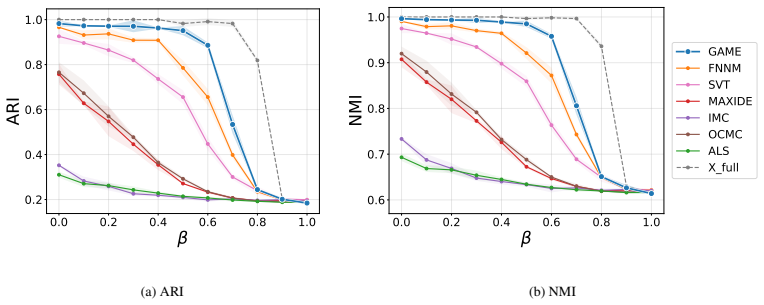
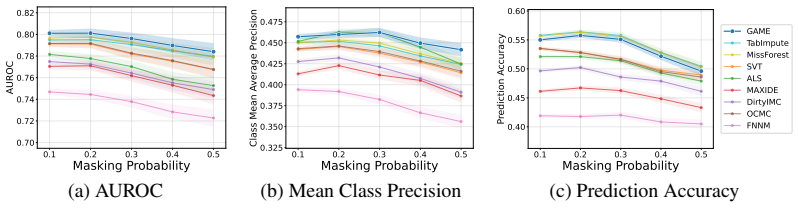
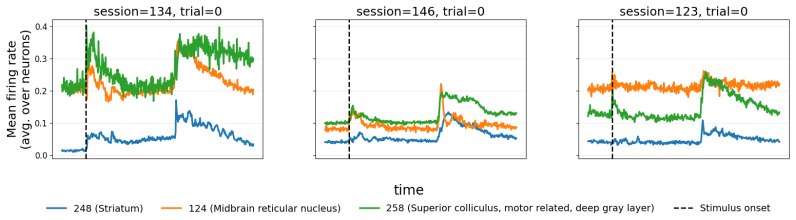
Modern matrix completion problems often involve heterogeneous data whose rows simultaneously belong to many meta-categories, such as demographic and age groups in recommendation systems, or region and recording session labels in neural electrophysiological experiments. Standard low-rank estimators impose a single global latent geometry, which can recover average structure but may smooth away subgroup-specific variation, especially when observations are unevenly distributed across groups. We introduce Group-Aware Matrix Estimation (GAME), a convex estimator for overlapping subgroup-wise low-rank matrix estimation. GAME regularizes category-specific submatrices through overlapping nuclear-norm penalties, allowing related groups to borrow information while preserving local latent structure in a shared coordinate system. We provide finite-sample guarantees for both reconstruction error and subgroup-specific subspace recovery, showing how performance depends on sampling density, subgroup rank, and overlap structure. Experiments on synthetic, recommendation, ecological, and neuroscience datasets show that GAME is most beneficial in structured missingness regimes, where subgroup-aware regularization improves both reconstruction accuracy and latent subspace fidelity. Across these benchmarks, GAME is competitive or best among global low-rank, side-information, and modern imputation baselines, with the largest gains when subgroups exhibit distinct low-rank structure.
Editorial analysis
A structured set of objections, weighed in public.
Referee Report
Summary. The paper introduces Group-Aware Matrix Estimation (GAME), a convex estimator for overlapping subgroup-wise low-rank matrix estimation. GAME applies overlapping nuclear-norm penalties to category-specific submatrices to allow information borrowing across related groups while preserving local latent structure in a shared coordinate system. Finite-sample guarantees are provided for reconstruction error and subgroup-specific subspace recovery, with explicit dependence on sampling density, subgroup rank, and overlap structure. Experiments across synthetic, recommendation, ecological, and neuroscience datasets demonstrate that GAME is competitive or superior to global low-rank, side-information, and modern imputation baselines, with largest gains under structured missingness.
Significance. If the finite-sample bounds and subspace recovery results hold under the stated assumptions, the work offers a principled convex extension of nuclear-norm regularization to heterogeneous group-structured data. This addresses a practical gap where global low-rank models smooth away subgroup variation. The explicit scaling with overlap structure and the reproducible experimental protocol on four distinct data classes are notable strengths.
major comments (1)
- The finite-sample guarantees for subspace recovery are central to the contribution, yet the abstract and stated claims leave the precise role of the overlap parameter in the bound implicit; a concrete statement of how the overlap enters the error term (e.g., via a covering number or incoherence condition) is needed to confirm the claimed improvement over non-overlapping baselines.
minor comments (2)
- Notation for the group indicator matrices and the shared coordinate system should be introduced with a single consolidated table or diagram early in the methods section to improve readability for readers unfamiliar with overlapping group penalties.
- The experimental section would benefit from reporting the effective rank and overlap statistics (e.g., average number of groups per row) for each real-world dataset so that the dependence of performance on these quantities can be directly compared to the theoretical predictions.
Simulated Author's Rebuttal
We thank the referee for the positive assessment, detailed summary, and recommendation for minor revision. The single major comment is constructive and we address it directly below, agreeing that greater explicitness will strengthen the presentation of the finite-sample results.
read point-by-point responses
-
Referee: The finite-sample guarantees for subspace recovery are central to the contribution, yet the abstract and stated claims leave the precise role of the overlap parameter in the bound implicit; a concrete statement of how the overlap enters the error term (e.g., via a covering number or incoherence condition) is needed to confirm the claimed improvement over non-overlapping baselines.
Authors: We agree that the abstract and high-level claims would benefit from a more concrete statement of the overlap dependence. In the current manuscript the dependence is derived in the proof of the subspace recovery result (Theorem 4.3 and its supporting lemmas in Section 4.2): the overlap parameter enters the error bound through the covering number of the union of the subgroup subspaces and an adapted incoherence condition that accounts for shared latent directions across overlapping groups. This produces an explicit multiplicative improvement factor relative to the non-overlapping case. We will revise the abstract to read “... with explicit dependence on sampling density, subgroup rank, and overlap structure, where greater overlap tightens the subspace recovery error via a reduced covering number of the joint subspace,” and we will add a short remark immediately after the statement of Theorem 4.3 that isolates this factor. These changes will make the improvement over non-overlapping baselines fully transparent without altering any technical claims. revision: yes
Circularity Check
No significant circularity detected
full rationale
The paper introduces GAME as a convex optimization problem that extends nuclear-norm regularization to overlapping group-specific submatrices, with finite-sample bounds derived from standard convex analysis and concentration inequalities. No step reduces a claimed prediction or guarantee to a fitted parameter by construction, nor does any load-bearing premise collapse to a self-citation whose validity is assumed without external verification. The derivation chain relies on established matrix completion theory applied to the new overlapping penalty structure, remaining self-contained against external benchmarks.
Axiom & Free-Parameter Ledger
axioms (2)
- domain assumption Rows belong to known overlapping meta-categories whose submatrices are approximately low-rank
- domain assumption Overlapping nuclear-norm penalties preserve local latent structure in a shared coordinate system
Reference graph
Works this paper leans on
-
[1]
Wainwright, Martin J. , year=. High-Dimensional Statistics: A Non-Asymptotic Viewpoint , publisher=
- [2]
-
[3]
PeerJ Computer Science , volume=
Advancing healthcare through multimodal data fusion: a comprehensive review of techniques and applications , author=. PeerJ Computer Science , volume=. 2024 , publisher=
work page 2024
-
[4]
Strategies for handling missing data in electronic health record derived data , author=. Egems , volume=
-
[5]
Bioinformatics and biology insights , volume=
Multi-omics data integration, interpretation, and its application , author=. Bioinformatics and biology insights , volume=. 2020 , publisher=
work page 2020
-
[6]
An international laboratory for systems and computational neuroscience , author=. Neuron , volume=. 2017 , publisher=
work page 2017
-
[7]
SIAM Journal on Matrix Analysis and Applications , volume=
Schubert varieties and distances between subspaces of different dimensions , author=. SIAM Journal on Matrix Analysis and Applications , volume=. 2016 , publisher=
work page 2016
-
[8]
Nuclear norm penalization and optimal rates for noisy low rank matrix completion , author=. 2016 , eprint=
work page 2016
-
[9]
Noisy low-rank matrix completion with general sampling distribution , volume=
Klopp, Olga , year=. Noisy low-rank matrix completion with general sampling distribution , volume=. Bernoulli , publisher=. doi:10.3150/12-bej486 , number=
-
[10]
doi:10.5281/zenodo.7525805 , url =
Mary Clapp and Stefan Kahl and Erik Meyer and Megan McKenna and Holger Klinck and Gail Patricelli , title =. doi:10.5281/zenodo.7525805 , url =
-
[11]
BirdSet: A Large-Scale Dataset for Audio Classification in Avian Bioacoustics , author=. 2025 , eprint=
work page 2025
- [13]
-
[14]
Spike sorting biases and information loss in a detailed cortical model , author=. BioRxiv , pages=. 2024 , publisher=
work page 2024
-
[15]
Towards a" universal translator" for neural dynamics at single-cell, single-spike resolution , author=. Advances in Neural Information Processing Systems , volume=
-
[16]
Nature Reviews Neuroscience , volume=
Reconstructing computational system dynamics from neural data with recurrent neural networks , author=. Nature Reviews Neuroscience , volume=. 2023 , publisher=
work page 2023
-
[17]
2019 International Joint Conference on Neural Networks (IJCNN) , pages=
Decoding neural responses in mouse visual cortex through a deep neural network , author=. 2019 International Joint Conference on Neural Networks (IJCNN) , pages=. 2019 , organization=
work page 2019
-
[18]
What, if anything, is the true neurophysiological significance of “rotational dynamics”? , author=. bioRxiv , pages=. 2019 , publisher=
work page 2019
-
[19]
Nature Reviews Genetics , volume=
Tackling the widespread and critical impact of batch effects in high-throughput data , author=. Nature Reviews Genetics , volume=. 2010 , publisher=
work page 2010
-
[20]
A test metric for assessing single-cell RNA-seq batch correction , author=. Nature methods , volume=. 2019 , publisher=
work page 2019
-
[21]
A benchmark of batch-effect correction methods for single-cell RNA sequencing data , author=. Genome biology , volume=. 2020 , publisher=
work page 2020
-
[22]
Advances in Neural Information Processing Systems , volume=
Three-dimensional spike localization and improved motion correction for Neuropixels recordings , author=. Advances in Neural Information Processing Systems , volume=
-
[23]
Annual review of neuroscience , volume=
Computation through neural population dynamics , author=. Annual review of neuroscience , volume=. 2020 , publisher=
work page 2020
-
[24]
Neural population dynamics during reaching , author=. Nature , volume=. 2012 , publisher=
work page 2012
-
[25]
The Thirteenth International Conference on Learning Representations , year=
Multi-session, multi-task neural decoding from distinct cell-types and brain regions , author=. The Thirteenth International Conference on Learning Representations , year=
-
[26]
Creimbo: Cross-regional ensemble interactions in multi-view brain observations , author=. 2025 , organization=
work page 2025
-
[27]
PLoS computational biology , volume=
Predicting synchronous firing of large neural populations from sequential recordings , author=. PLoS computational biology , volume=. 2021 , publisher=
work page 2021
-
[28]
Exploiting correlations across trials and behavioral sessions to improve neural decoding , author=. Neuron , year=
-
[29]
Normalized Mutual Information to evaluate overlapping community finding algorithms
Normalized mutual information to evaluate overlapping community finding algorithms , author=. arXiv preprint arXiv:1110.2515 , year=
work page internal anchor Pith review Pith/arXiv arXiv
-
[30]
Journal of classification , volume=
Comparing partitions , author=. Journal of classification , volume=. 1985 , publisher=
work page 1985
-
[31]
Proximal Splitting Methods in Signal Processing , author=. 2010 , eprint=
work page 2010
-
[32]
Low-rank Tensor Learning with Nonconvex Overlapped Nuclear Norm Regularization , author=. 2022 , eprint=
work page 2022
-
[33]
Adaptive Proximal Average Approximation for Composite Convex Minimization , author=. 2017 , month=. doi:10.1609/aaai.v31i1.10873 , abstractNote=
-
[34]
and Goebel, Rafal and Lucet, Yves and Wang, Xianfu , title =
Bauschke, Heinz H. and Goebel, Rafal and Lucet, Yves and Wang, Xianfu , title =. SIAM Journal on Optimization , volume =. 2008 , doi =. https://doi.org/10.1137/070687542 , abstract =
-
[35]
Low-Rank Covariance Completion for Graph Quilting with Applications to Functional Connectivity , author=. 2024 , eprint=
work page 2024
-
[36]
Graph quilting: graphical model selection from partially observed covariances , author=. 2023 , eprint=
work page 2023
-
[37]
An ADMM Algorithm for a Generic _0 Sparse Overlapping Group Lasso Problem , author=. 2023 , eprint=
work page 2023
-
[38]
An ADMM approach for multi-response regression with overlapping groups and interaction effects , author=. 2023 , eprint=
work page 2023
-
[39]
Journal of Machine Learning Research , year =
Rahul Mazumder and Trevor Hastie and Robert Tibshirani , title =. Journal of Machine Learning Research , year =
-
[40]
Matrix Completion and Low-Rank SVD via Fast Alternating Least Squares , author=. 2014 , eprint=
work page 2014
-
[41]
Journal of Machine Learning Research , volume=
Integrative generalized convex clustering optimization and feature selection for mixed multi-view data , author=. Journal of Machine Learning Research , volume=
-
[42]
Mathematical Programming , volume=
The direct extension of ADMM for multi-block convex minimization problems is not necessarily convergent , author=. Mathematical Programming , volume=. 2016 , publisher=
work page 2016
-
[43]
Journal of the Operations Research Society of China , volume=
On the sublinear convergence rate of multi-block ADMM , author=. Journal of the Operations Research Society of China , volume=. 2015 , publisher=
work page 2015
-
[44]
Journal of Scientific Computing , volume=
Parallel multi-block ADMM with O (1/k) convergence , author=. Journal of Scientific Computing , volume=. 2017 , publisher=
work page 2017
-
[45]
Journal of Machine Learning Research , volume=
Low-rank tensor learning with nonconvex overlapped nuclear norm regularization , author=. Journal of Machine Learning Research , volume=
-
[46]
arXiv preprint arXiv:2407.13731 , year=
Predictive Low Rank Matrix Learning under Partial Observations: Mixed-Projection ADMM , author=. arXiv preprint arXiv:2407.13731 , year=
-
[47]
ScLRTC: imputation for single-cell RNA-seq data via low-rank tensor completion , author=. BMC genomics , volume=. 2021 , publisher=
work page 2021
-
[48]
IEEE Journal of Biomedical and Health Informatics , volume=
NMFLRR: clustering scRNA-seq data by integrating nonnegative matrix factorization with low rank representation , author=. IEEE Journal of Biomedical and Health Informatics , volume=. 2021 , publisher=
work page 2021
-
[49]
IEEE Journal of Selected Topics in Signal Processing , volume=
An overview of low-rank matrix recovery from incomplete observations , author=. IEEE Journal of Selected Topics in Signal Processing , volume=. 2016 , publisher=
work page 2016
-
[50]
Better Approximation and Faster Algorithm Using the Proximal Average , url =
Yu, Yao-Liang , booktitle =. Better Approximation and Faster Algorithm Using the Proximal Average , url =
-
[51]
Steinmetz, Nicholas A. and Aydin, Cengiz and Lebedeva, Alexandra and Okun, Michael and Pachitariu, Marius and Bauza, Marius and Beau, Maxime and Bhagat, Jai and B. Neuropixels 2.0: A miniaturized high-density probe for stable, long-term brain recordings , journal =. 2021 , volume =. doi:10.1126/science.abf4588 , pmid =
-
[52]
Foundations and Trends® in Optimization , title =. 2014 , volume =. doi:10.1561/2400000003 , issn =
-
[53]
Convergence of multi-block Bregman ADMM for nonconvex composite problems , author=. 2015 , eprint=
work page 2015
-
[54]
Penalized matrix decomposition for denoising, compression, and improved demixing of functional imaging data , author=. 2018 , eprint=
work page 2018
-
[55]
Comparing high-dimensional neural recordings by aligning their low-dimensional latent representations , author=. 2022 , eprint=
work page 2022
-
[56]
Wang, Jiuzhou and Lock, Eric F , title =. Biometrics , volume =. 2024 , month =. doi:10.1093/biomtc/ujad002 , url =
-
[57]
Dimensionality reduction beyond neural subspaces with slice tensor component analysis , author =. Nature Neuroscience , year =. doi:10.1038/s41593-024-01626-2 , url =
-
[58]
Yu, Byron M. and Cunningham, John P. and Santhanam, Gopal and Ryu, Stephen I. and Shenoy, Krishna V. and Sahani, Maneesh , title =. Journal of Neurophysiology , year =. doi:10.1152/jn.90941.2008 , url =
-
[59]
and Collins, Jasmine and Jozefowicz, Rafal and Stavisky, Sergey D
Pandarinath, Chethan and O'Shea, Daniel J. and Collins, Jasmine and Jozefowicz, Rafal and Stavisky, Sergey D. and Kao, Jonathan C. and Trautmann, Eric M. and Kaufman, Matthew T. and Ryu, Stephen I. and Hochberg, Leigh R. and Henderson, Jaimie M. and Shenoy, Krishna V. and Abbott, L. F. and Sussillo, David , title =. Nature Methods , year =. doi:10.1038/s4...
-
[60]
and Kepecs, Adam and Mainen, Zachary F
Kobak, Dmitry and Brendel, Wieland and Constantinidis, Christos and Feierstein, Claudia E. and Kepecs, Adam and Mainen, Zachary F. and Qi, Xue‑Lian and Romo, Ranulfo and Uchida, Naoshige and Machens, Christian K. , title =. eLife , year =. doi:10.7554/eLife.10989 , url =
-
[61]
and Kim, Tony Hyun and Wang, Forea and Vyas, Saurabh and Ryu, Stephen I
Williams, Alex H. and Kim, Tony Hyun and Wang, Forea and Vyas, Saurabh and Ryu, Stephen I. and Shenoy, Krishna V. and Schnitzer, Mark J. and Kolda, Tamara G. and Ganguli, Surya , title =. Neuron , year =. doi:10.1016/j.neuron.2018.05.015 , url =
-
[62]
Journal of Machine Learning Research , year =
Steven Diamond and Stephen Boyd , title =. Journal of Machine Learning Research , year =
-
[63]
Susu Chen and Yi Liu and Ziyue Aiden Wang and Jennifer Colonell and Liu D. Liu and Han Hou and Nai-Wen Tien and Tim Wang and Timothy Harris and Shaul Druckmann and Nuo Li and Karel Svoboda , keywords =. Brain-wide neural activity underlying memory-guided movement , journal =. 2024 , issn =. doi:https://doi.org/10.1016/j.cell.2023.12.035 , url =
-
[64]
A Singular Value Thresholding Algorithm for Matrix Completion , journal =
Cai, Jian-Feng and Cand\`. A Singular Value Thresholding Algorithm for Matrix Completion , journal =. 2010 , doi =. https://doi.org/10.1137/080738970 , abstract =
-
[65]
F. Maxwell Harper and Joseph A. Konstan , title =. ACM Transactions on Interactive Intelligent Systems (TiiS) , volume =. 2015 , month = dec, doi =
work page 2015
-
[66]
Exact Matrix Completion via Convex Optimization , author=. 2008 , eprint=
work page 2008
-
[67]
Low-rank Matrix Completion using Alternating Minimization , author=. 2012 , eprint=
work page 2012
- [68]
-
[69]
Matrix Completion with Noisy Side Information , url =
Chiang, Kai-Yang and Hsieh, Cho-Jui and Dhillon, Inderjit S , booktitle =. Matrix Completion with Noisy Side Information , url =
-
[70]
Inductive Matrix Completion: No Bad Local Minima and a Fast Algorithm , author=. 2022 , eprint=
work page 2022
-
[71]
Speedup Matrix Completion with Side Information: Application to Multi-Label Learning , url =
Xu, Miao and Jin, Rong and Zhou, Zhi-Hua , booktitle =. Speedup Matrix Completion with Side Information: Application to Multi-Label Learning , url =
-
[72]
Restricted strong convexity and weighted matrix completion: Optimal bounds with noise , author=. 2011 , eprint=
work page 2011
-
[73]
and Ravikumar, Pradeep and Wainwright, Martin J
Negahban, Sahand N. and Ravikumar, Pradeep and Wainwright, Martin J. and Yu, Bin , year=. A Unified Framework for High-Dimensional Analysis of M -Estimators with Decomposable Regularizers , volume=. Statistical Science , publisher=. doi:10.1214/12-sts400 , number=
-
[74]
One-sided Matrix Completion from Two Observations Per Row , author=. 2023 , eprint=
work page 2023
-
[75]
G.A. Watson , abstract =. Characterization of the subdifferential of some matrix norms , journal =. 1992 , issn =. doi:https://doi.org/10.1016/0024-3795(92)90407-2 , url =
-
[76]
A fast iterative shrinkage-thresholding algorithm for linear inverse problems,
Beck, Amir and Teboulle, Marc , title =. SIAM Journal on Imaging Sciences , volume =. 2009 , doi =. https://doi.org/10.1137/080716542 , abstract =
-
[77]
Inpainting the Neural Picture: Inferring Unrecorded Brain Area Dynamics from Multi-Animal Datasets , author=. 2025 , eprint=
work page 2025
-
[78]
Learning Neural Representations of Human Cognition across Many fMRI Studies , author=. 2017 , eprint=
work page 2017
-
[79]
Glowinski, Roland and Marrocco, Antoinette , journal=. Sur l’approximation, par
-
[80]
Computers & Mathematics with Applications , volume=
A dual algorithm for the solution of nonlinear variational problems via finite element approximation , author=. Computers & Mathematics with Applications , volume=
-
[81]
Foundations and Trends in Machine Learning , volume=
Distributed optimization and statistical learning via the alternating direction method of multipliers , author=. Foundations and Trends in Machine Learning , volume=
discussion (0)
Sign in with ORCID, Apple, or X to comment. Anyone can read and Pith papers without signing in.