Convergence of post-Newtonian for quasi-circular non-precessing comparable mass ratios BBHs
Pith reviewed 2026-05-21 06:17 UTC · model grok-4.3
The pith
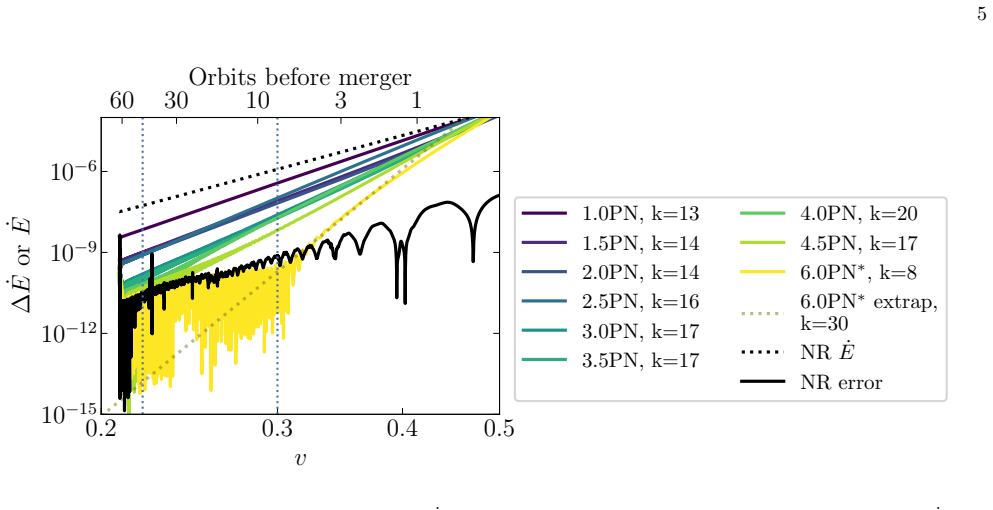
Higher post-Newtonian orders keep reducing the gap to numerical relativity in binary black hole energy flux up to orbital velocity 0.45.
A machine-rendered reading of the paper's core claim, the machinery that carries it, and where it could break.
Core claim
For orbital velocities v ≲ 0.45, successively higher post-Newtonian orders reduce the discrepancy between the PN energy flux at future null infinity and the corresponding numerical relativity result, with the incomplete 6PN expression giving the smallest residual among the orders tested. The improvement is non-monotonic, exhibiting local extrema near 2.5PN and 4PN. As v approaches ∼0.5 near the innermost circular orbit, further PN orders cease to improve the agreement, signalling the breakdown of convergence.
What carries the argument
Gauge-consistent comparison of PN and NR energy flux after calibrating intrinsic PN parameters by a fit to the early-inspiral NR waveform, performed inside a common BMS frame at future null infinity.
If this is right
- The first local minimum in the PN–NR residual cannot be used to select the optimal truncation order of the series.
- High-order PN calculations beyond 5PN remain worthwhile because they demonstrably tighten the match up to v ≲ 0.45.
- The accuracy demands placed on numerical relativity waveforms for validating future PN terms become clearer.
- Near the innermost circular orbit at v ∼ 0.5 the PN series loses its ability to track the numerical flux, so hybrid models must switch earlier than the radius of convergence would suggest.
Where Pith is reading between the lines
- Waveform models for current detectors may need to blend PN and NR descriptions at lower velocities than the 0.45 threshold found here.
- Repeating the test for spinning or eccentric binaries would map how the radius of convergence depends on spin and eccentricity.
- The observed non-monotonic pattern hints that resummation methods could extend the useful range of PN expressions closer to merger.
Load-bearing premise
Fitting the free parameters of the PN model to the numerical waveform in the early inspiral produces a calibration that remains unbiased and does not artificially improve or hide the convergence behavior at later times and higher velocities.
What would settle it
A complete 6PN or 6.5PN energy-flux calculation that shows a larger mismatch with the same NR data at v = 0.40 than the 5PN result would falsify the claim of continued improvement.
Figures

read the original abstract
Post-Newtonian (PN) theory provides the analytic foundation for modeling the early inspiral of binary black holes. However, as an asymptotic series, successive PN orders do not necessarily improve agreement with the full nonlinear dynamics. While this has been explored in the extreme-mass-ratio limit, comparable-mass systems most relevant to current observations have not been benchmarked as systematically at high PN order. We study the convergence of the PN series for non-spinning and quasi-circular systems by comparing the PN energy flux at future null infinity to a long, high-accuracy numerical relativity (NR) simulation. To enable a gauge-consistent comparison, we place both descriptions in the same BMS frame and calibrate the intrinsic PN parameters by fitting to the NR waveform in the early inspiral. We find that for orbital velocities $v\lesssim0.45$, higher PN orders continue to reduce the PN--NR flux discrepancy, with (incomplete) 6PN providing the best agreement among the orders considered. The improvement with PN order is non-monotonic with local extrema around 2.5PN and 4PN. This implies that the optimal truncation order of the PN series cannot be identified from the first local minimum in the energy flux residuals, contrary to suggestions in earlier work. As $v$ approaches $\sim 0.5$ near the innermost circular orbit, higher PN orders no longer improve the agreement between NR and PN, indicating a loss of convergence. These results motivate continued high-order PN calculations and clarify the NR accuracy needed to validate them.
Editorial analysis
A structured set of objections, weighed in public.
Referee Report
Summary. The paper studies the convergence of the post-Newtonian (PN) series for the energy flux of quasi-circular, non-spinning binary black holes with comparable masses. After placing PN and a long, high-accuracy NR simulation in the same BMS frame and calibrating intrinsic PN parameters by fitting to the NR waveform in the early inspiral, the authors report that for orbital velocities v ≲ 0.45 higher PN orders (up to incomplete 6PN) continue to reduce the PN–NR flux discrepancy, with non-monotonic improvement featuring local extrema near 2.5PN and 4PN. They conclude that the first local minimum in residuals does not mark optimal truncation and that convergence is lost near v ∼ 0.5.
Significance. If the central claim holds after addressing calibration concerns, the work supplies a valuable benchmark for the practical range of PN approximations in comparable-mass systems, directly relevant to gravitational-wave modeling. The use of a consistent BMS frame and a long high-accuracy NR run are clear strengths that enable a controlled comparison.
major comments (1)
- [methods section on fitting and BMS-frame comparison] The calibration of intrinsic PN parameters to early-inspiral NR data (described in the methods section on gauge-consistent comparison and fitting) is load-bearing for the convergence claims at v ≲ 0.45. Because the fit occurs where the series is already expected to be accurate, it may absorb unknown higher-order coefficients or residual gauge differences that would otherwise appear at larger velocities. The manuscript does not report the magnitude of the fitted corrections nor present a control comparison with unfitted coefficients, leaving open the possibility that the reported non-monotonic improvement and superiority of 6PN are partly artifacts of the calibration procedure.
minor comments (2)
- [results section on flux comparison] Details on error bars, exact fitting windows, and the quantitative definition of flux residuals (e.g., how the discrepancy is integrated or averaged) are not fully specified, which makes it difficult to assess the statistical significance of the local extrema around 2.5PN and 4PN.
- [abstract and § on PN orders] The abstract and main text should clarify whether the 6PN result is strictly incomplete and, if so, which terms are missing, to allow readers to judge the precise order being tested.
Simulated Author's Rebuttal
We thank the referee for their careful reading of the manuscript and for highlighting the strengths of the BMS-frame alignment and the long high-accuracy NR simulation. We address the single major comment below and have revised the manuscript accordingly.
read point-by-point responses
-
Referee: [methods section on fitting and BMS-frame comparison] The calibration of intrinsic PN parameters to early-inspiral NR data (described in the methods section on gauge-consistent comparison and fitting) is load-bearing for the convergence claims at v ≲ 0.45. Because the fit occurs where the series is already expected to be accurate, it may absorb unknown higher-order coefficients or residual gauge differences that would otherwise appear at larger velocities. The manuscript does not report the magnitude of the fitted corrections nor present a control comparison with unfitted coefficients, leaving open the possibility that the reported non-monotonic improvement and superiority of 6PN are partly artifacts of the calibration procedure.
Authors: We agree that the calibration step is central to the comparison and thank the referee for the opportunity to strengthen the presentation. The fit adjusts only the initial orbital frequency and phase (intrinsic parameters) to enforce BMS-frame consistency in the early inspiral; it does not introduce or absorb any higher-order PN coefficients, which remain fixed at each truncation order. In the revised manuscript we now report the magnitude of these corrections explicitly (they are at the level of a few parts in 10^4). We have also added a short sensitivity study showing that modest variations in the fit window leave the non-monotonic residual pattern and the ordering of the PN truncations unchanged at v ≲ 0.45. A direct unfitted comparison would mix residual gauge mismatch into the flux difference, defeating the controlled test of PN convergence that the BMS alignment was designed to enable. We therefore view the calibration as necessary rather than artifact-inducing, but we have clarified this reasoning in the text. revision: yes
Circularity Check
Fitting intrinsic PN parameters to early-inspiral NR data biases the claimed convergence test at higher velocities
specific steps
-
fitted input called prediction
[Abstract]
"To enable a gauge-consistent comparison, we place both descriptions in the same BMS frame and calibrate the intrinsic PN parameters by fitting to the NR waveform in the early inspiral. We find that for orbital velocities v≲0.45, higher PN orders continue to reduce the PN--NR flux discrepancy, with (incomplete) 6PN providing the best agreement among the orders considered."
The intrinsic parameters are fitted directly to early-inspiral NR data. The claimed reduction in flux discrepancy with increasing PN order is then measured using those same fitted parameters at higher velocities. Because the fit can absorb unknown higher-order or gauge effects in an order-dependent way, the reported improvement with PN order is not an independent verification of the series but is statistically influenced by the calibration to the input NR data.
full rationale
The paper's central result—that higher PN orders (up to incomplete 6PN) reduce PN–NR flux discrepancy for v ≲ 0.45—is obtained only after calibrating intrinsic PN parameters by a fit to the NR waveform in the early inspiral. This fit is performed precisely where the PN series is already expected to be accurate, allowing order-dependent adjustments to absorb discrepancies that would otherwise appear at larger v. The subsequent comparison of residuals at higher velocities therefore depends on the fitted inputs rather than constituting an independent test of the unfitted PN series. No control comparison with unfitted coefficients is reported, so the observed non-monotonic improvement and superiority of 6PN reduce, at least in part, to the calibration procedure itself.
Axiom & Free-Parameter Ledger
free parameters (1)
- intrinsic PN parameters
axioms (1)
- domain assumption BMS frame alignment between PN and NR descriptions is accurate and sufficient for flux comparison
Lean theorems connected to this paper
-
IndisputableMonolith/Cost/FunctionalEquation.leanwashburn_uniqueness_aczel unclear?
unclearRelation between the paper passage and the cited Recognition theorem.
We study the convergence of the PN series for non-spinning and quasi-circular systems by comparing the PN energy flux at future null infinity to a long, high-accuracy numerical relativity (NR) simulation. ... calibrate the intrinsic PN parameters by fitting to the NR waveform in the early inspiral.
-
IndisputableMonolith/Foundation/RealityFromDistinction.leanreality_from_one_distinction unclear?
unclearRelation between the paper passage and the cited Recognition theorem.
The improvement with PN order is non-monotonic with local extrema around 2.5PN and 4PN.
What do these tags mean?
- matches
- The paper's claim is directly supported by a theorem in the formal canon.
- supports
- The theorem supports part of the paper's argument, but the paper may add assumptions or extra steps.
- extends
- The paper goes beyond the formal theorem; the theorem is a base layer rather than the whole result.
- uses
- The paper appears to rely on the theorem as machinery.
- contradicts
- The paper's claim conflicts with a theorem or certificate in the canon.
- unclear
- Pith found a possible connection, but the passage is too broad, indirect, or ambiguous to say the theorem truly supports the claim.
Reference graph
Works this paper leans on
-
[1]
NR waveform and energy flux We use a NR waveform computed using Cauchy- characteristic evolution (CCE) [22, 23] as the reference waveform. The Cauchy evolution is performed using the Spectral Einstein Code (SpEC) [24] and the CCE evo- lution is performed using the SpECTRE code [25]. The resulting waveform is given directly at future null infinity I +, alo...
-
[2]
Theorbitaldynamicsand gravitational-wave phase are modeled using the TaylorT1 approximant
PN waveform and energy flux For the PN waveforms, we also consider quasi-circular, non-spinning binaries characterized by the total massM andmassratio q = m1/m2 ≥ 1. Theorbitaldynamicsand gravitational-wave phase are modeled using the TaylorT1 approximant. In this approach, one writes the binary’s binding energy E, gravitational-wave energy flux to null i...
-
[3]
Comparing NR and PN energy flux The energy flux atI + is invariant under rotations, but not under boosts, spatial translations, or proper BMS supertranslations. These transformations change the la- beling of the constant-retarded-time cross sections ofI +, and hence modify the flux as a function of retarded time. To make meaningful comparisons between PN ...
-
[4]
L. Santamaria et al.,Matching post-Newtonian and numerical relativity waveforms: systematic errors and a new phenomenological model for non-precessing black hole binaries,Phys. Rev. D82(2010) 064016 [1005.3306]
work page internal anchor Pith review Pith/arXiv arXiv 2010
-
[5]
Suitability of post-Newtonian/numerical-relativity hybrid waveforms for gravitational wave detectors
I. MacDonald, S. Nissanke, H.P. Pfeiffer and H.P. Pfeiffer, Suitability of post-Newtonian/numerical-relativity hybrid waveforms for gravitational wave detectors,Class. Quant. Grav.28(2011) 134002 [1102.5128]
work page internal anchor Pith review Pith/arXiv arXiv 2011
-
[6]
M. Boyle,Uncertainty in hybrid gravitational waveforms: Optimizing initial orbital frequencies for binary black-hole simulations,Phys. Rev.D84(2011) 064013 [1103.5088]
work page internal anchor Pith review Pith/arXiv arXiv 2011
-
[7]
Suitability of hybrid gravitational waveforms for unequal-mass binaries
I. MacDonald, A.H. Mroue, H.P. Pfeiffer, M. Boyle, L.E. Kidder, M.A. Scheel et al.,Suitability of hybrid gravitational waveforms for unequal-mass binaries,Phys. Rev.D87(2013) 024009 [1210.3007]
work page internal anchor Pith review Pith/arXiv arXiv 2013
-
[8]
Surrogate model of hybridized numerical relativity binary black hole waveforms
V. Varma, S.E. Field, M.A. Scheel, J. Blackman, L.E. Kidder and H.P. Pfeiffer,Surrogate model of hybridized numerical relativity binary black hole waveforms,Phys. Rev.D99(2019) 064045 [ 1812.07865]
work page internal anchor Pith review Pith/arXiv arXiv 2019
- [9]
-
[10]
Mitman et al.,Fixing the BMS frame of numerical relativity waveforms with BMS charges,Phys
K. Mitman et al.,Fixing the BMS frame of numerical relativity waveforms with BMS charges,Phys. Rev. D 106(2022) 084029 [2208.04356]
-
[11]
Numerical relativity surrogate model with memory effects and post-Newtonian hybridization,
J. Yoo et al.,Numerical relativity surrogate model with memory effects and post-Newtonian hybridization,Phys. Rev. D108(2023) 064027 [2306.03148]
- [12]
-
[13]
D. Sun and L.C. Stein,Parameter matching between horizon quasi-local and point-particle definitions at 1PN for quasi-circular and non spinning BBH systems in harmonic gauge,2510.25618
-
[14]
T. Futamase and B.F. Schutz,Newtonian and post-Newtonian approximations are asymptotic to general relativity,Phys. Rev. D28(1983) 2363
work page 1983
-
[15]
C. Bender and S. Orszag,Advanced Mathematical Methods for Scientists and Engineers: Asymptotic Methods and Perturbation Theory, Advanced Mathematical Methods for Scientists and Engineers, Springer (1999)
work page 1999
-
[16]
N. Yunes and E. Berti,Accuracy of the post-Newtonian approximation: Optimal asymptotic expansion for quasicircular, extreme-mass ratio inspirals,Phys. Rev. D 77(2008) 124006 [0803.1853]
work page internal anchor Pith review Pith/arXiv arXiv 2008
-
[17]
L.E. Simone, E. Poisson and C.M. Will,Headon collision of compact objects in general relativity: Comparison of postNewtonian and perturbation approaches,Phys. Rev. D52(1995) 4481 [gr-qc/9506080]
work page internal anchor Pith review Pith/arXiv arXiv 1995
-
[18]
R. Fujita,Gravitational Waves from a Particle in Circular Orbits around a Schwarzschild Black Hole to the 22nd Post-Newtonian Order,Prog. Theor. Phys.128 (2012) 971 [1211.5535]
work page internal anchor Pith review Pith/arXiv arXiv 2012
-
[19]
R. Fujita,Gravitational Waves from a Particle in Circular Orbits around a Rotating Black Hole to the 11th Post-Newtonian Order,PTEP2015(2015) 033E01 [1412.5689]
work page internal anchor Pith review Pith/arXiv arXiv 2015
-
[20]
E. Poisson,Gravitational radiation from a particle in circular orbit around a black hole. 6. Accuracy of the postNewtonian expansion,Phys. Rev. D52(1995) 5719 [gr-qc/9505030]
work page internal anchor Pith review Pith/arXiv arXiv 1995
-
[21]
N. Sago, R. Fujita and H. Nakano,Accuracy of the Post-Newtonian Approximation for Extreme-Mass Ratio Inspirals from Black-hole Perturbation Approach,Phys. Rev. D93(2016) 104023 [1601.02174]
work page internal anchor Pith review Pith/arXiv arXiv 2016
-
[22]
The general relativistic two body problem
T. Damour,The general relativistic two body problem, 1312.3505. 8
work page internal anchor Pith review Pith/arXiv arXiv
-
[23]
High-accuracy comparison of numerical relativity simulations with post-Newtonian expansions
M. Boyle, D.A. Brown, L.E. Kidder, A.H. Mroue, H.P. Pfeiffer, M.A. Scheel et al.,High-accuracy comparison of numerical relativity simulations with post-Newtonian expansions,Phys. Rev. D76(2007) 124038 [0710.0158]
work page internal anchor Pith review Pith/arXiv arXiv 2007
-
[24]
Moreschi,Supercenter of Mass System at Future Null Infinity,Class
O.M. Moreschi,Supercenter of Mass System at Future Null Infinity,Class. Quant. Grav.5(1988) 423
work page 1988
-
[25]
ImprovedCauchy-characteristicevolutionsystemforhigh- precision numerical relativity waveforms,
J. Moxon, M.A. Scheel and S.A. Teukolsky,Improved Cauchy-characteristic evolution system for high-precision numerical relativity waveforms,Phys. Rev. D102(2020) 044052 [2007.01339]
-
[26]
SpECTRE Cauchy-characteristic evolution system for rapid, precise waveform extraction,
J. Moxon, M.A. Scheel, S.A. Teukolsky, N. Deppe, N. Fischer, F. Hébert et al.,SpECTRE Cauchy-characteristic evolution system for rapid, precise waveform extraction,Phys. Rev. D107(2023) 064013 [2110.08635]
-
[27]
“The Spectral Einstein Code.” http://www.black-holes.org/SpEC.html
-
[28]
N. Deppe, W. Throwe, L.E. Kidder, N.L. Vu, F. Hébert, J. Moxon et al., “SpECTRE v2023.05.16.” https://spectre-code.org, 5, 2023. 10.5281/zenodo.7942177
-
[29]
The SXS collaboration catalog of gravitational waveforms
SXS Collaboration, “The SXS collaboration catalog of gravitational waveforms.” http://www.black-holes.org/waveforms
-
[30]
M. Boyle et al.,The SXS Collaboration catalog of binary black hole simulations,Class. Quant. Grav.36(2019) 195006 [1904.04831]
-
[31]
The SXS collaboration’s third catalog of binary black hole simulations,
M.A. Scheel et al.,The SXS collaboration’s third catalog of binary black hole simulations,Class. Quant. Grav.42 (2025) 195017 [2505.13378]
-
[32]
M. Ruiz, R. Takahashi, M. Alcubierre and D. Nunez, Multipole expansions for energy and momenta carried by gravitational waves,Gen. Rel. Grav.40(2008) 2467 [0707.4654]
work page internal anchor Pith review Pith/arXiv arXiv 2008
-
[33]
D. Trestini,Schott term in the binding energy for compact binaries on circular orbits at fourth post-Newtonian order,Phys. Rev. D112(2025) 024076 [2504.13245]
-
[34]
Angular velocity of gravitational radiation from precessing binaries and the corotating frame
M. Boyle,Angular velocity of gravitational radiation from precessing binaries and the corotating frame,Phys. Rev. D87(2013) 104006 [1302.2919]
work page internal anchor Pith review Pith/arXiv arXiv 2013
-
[35]
Ap- proximate helical symmetry in compact binaries,
A. Khairnar, L.C. Stein and M. Boyle,Approximate helical symmetry in compact binaries,Phys. Rev. D111 (2025) 024072 [2410.16373]
-
[36]
M. Boyle, D. Iozzo, L. Stein, A. Khairnar, H. Rüter, M. Scheel et al., “scri.” https://github.com/moble/scri, Nov., 2023. 10.5281/zenodo.4041971
-
[37]
Nonlocal-in-time action for the fourth post-Newtonian conservative dynamics of two-body systems
T. Damour, P. Jaranowski and G. Schäfer, Nonlocal-in-time action for the fourth post-Newtonian conservative dynamics of two-body systems,Phys. Rev. D 89(2014) 064058 [1401.4548]
work page internal anchor Pith review Pith/arXiv arXiv 2014
-
[38]
L. Bernard, L. Blanchet, G. Faye and T. Marchand, Center-of-Mass Equations of Motion and Conserved Integrals of Compact Binary Systems at the Fourth Post-Newtonian Order,Phys. Rev. D97(2018) 044037 [1711.00283]
work page internal anchor Pith review Pith/arXiv arXiv 2018
-
[39]
Post-Newtonian Theory for Gravitational Waves
L. Blanchet,Post-Newtonian Theory for Gravitational Waves,Living Rev. Rel.17(2014) 2 [1310.1528]
work page internal anchor Pith review Pith/arXiv arXiv 2014
-
[40]
L. Blanchet, G. Faye, Q. Henry, F. Larrouturou and D. Trestini,Gravitational-Wave Phasing of Quasicircular Compact Binary Systems to the Fourth-and-a-Half Post-Newtonian Order,Phys. Rev. Lett.131(2023) 121402 [2304.11185]
-
[41]
Energy and angular momentum flow into a black hole in a binary
K. Alvi,Energy and angular momentum flow into a black hole in a binary,Phys. Rev. D64(2001) 104020 [gr-qc/0107080]
work page internal anchor Pith review Pith/arXiv arXiv 2001
-
[42]
L. Blanchet, G. Faye, B.R. Iyer and S. Sinha,The Third post-Newtonian gravitational wave polarisations and associated spherical harmonic modes for inspiralling compact binaries in quasi-circular orbits,Class. Quant. Grav.25(2008) 165003 [0802.1249]
work page internal anchor Pith review Pith/arXiv arXiv 2008
-
[43]
G. Faye, S. Marsat, L. Blanchet and B.R. Iyer,The third and a half post-Newtonian gravitational wave quadrupole mode for quasi-circular inspiralling compact binaries, Class. Quant. Grav.29(2012) 175004 [1204.1043]
work page internal anchor Pith review Pith/arXiv arXiv 2012
-
[44]
G. Faye, L. Blanchet and B.R. Iyer,Non-linear multipole interactions and gravitational-wave octupole modes for inspiralling compact binaries to third-and-a-half post-Newtonian order,Class. Quant. Grav.32(2015) 045016 [1409.3546]
work page internal anchor Pith review Pith/arXiv arXiv 2015
-
[45]
L. Blanchet, G. Faye, Q. Henry, F. Larrouturou and D. Trestini,Gravitational-wave flux and quadrupole modes from quasicircular nonspinning compact binaries to the fourth post-Newtonian order,Phys. Rev. D108 (2023) 064041 [2304.11186]
-
[46]
M. Favata,Post-Newtonian corrections to the gravitational-wave memory for quasi-circular, inspiralling compact binaries,Phys. Rev. D80(2009) 024002 [0812.0069]
work page internal anchor Pith review Pith/arXiv arXiv 2009
-
[47]
K. Cunningham, C. Kavanagh, A. Pound, D. Trestini, N. Warburton and J. Neef,Gravitational memory: new results from post-Newtonian and self-force theory,Class. Quant. Grav.42(2025) 135009 [2410.23950]
-
[48]
D. Sun, “NRPNHybridization.” https://github.com/dongzesun/NRPNHybridization
-
[49]
W.H. Press, S.A. Teukolsky, W.T. Vetterling and B.P. Flannery,Numerical Recipes: The Art of Scientific Computing, Cambridge University Press, 3 ed. (2007)
work page 2007
-
[50]
K. Mitman, L.C. Stein, M. Boyle, N. Deppe, L.E. Kidder, H.P. Pfeiffer et al.,Length dependence of waveform mismatch: a caveat on waveform accuracy,Class. Quant. Grav.42(2025) 117001 [2502.14025]
-
[51]
L. Blanchet, D. Langlois and E. Ligout,Innermost stable circular orbit of arbitrary-mass compact binaries at fourth post-Newtonian order,Phys. Rev. D112(2025) 064025 [2505.01278]
- [52]
-
[53]
Khalil,Gravitational spin-orbit dynamics at the fifth-and-a-half post-Newtonian order,Phys
M. Khalil,Gravitational spin-orbit dynamics at the fifth-and-a-half post-Newtonian order,Phys. Rev. D104 (2021) 124015 [2110.12813]
- [54]
-
[55]
Second maya catalog of binary black hole numerical relativity waveforms,
D. Ferguson et al.,Second MAYA catalog of binary black hole numerical relativity waveforms,Phys. Rev. D112 (2025) 044043 [2309.00262]
discussion (0)
Sign in with ORCID, Apple, or X to comment. Anyone can read and Pith papers without signing in.