Multi-scale flow analysis for scale-aware urban-canopy models
Pith reviewed 2026-05-21 02:57 UTC · model grok-4.3
The pith
Urban canopy models in weather forecasts lose accuracy when grid resolution approaches a morphology-dependent heterogeneity scale identified from campus simulations.
A machine-rendered reading of the paper's core claim, the machinery that carries it, and where it could break.
Core claim
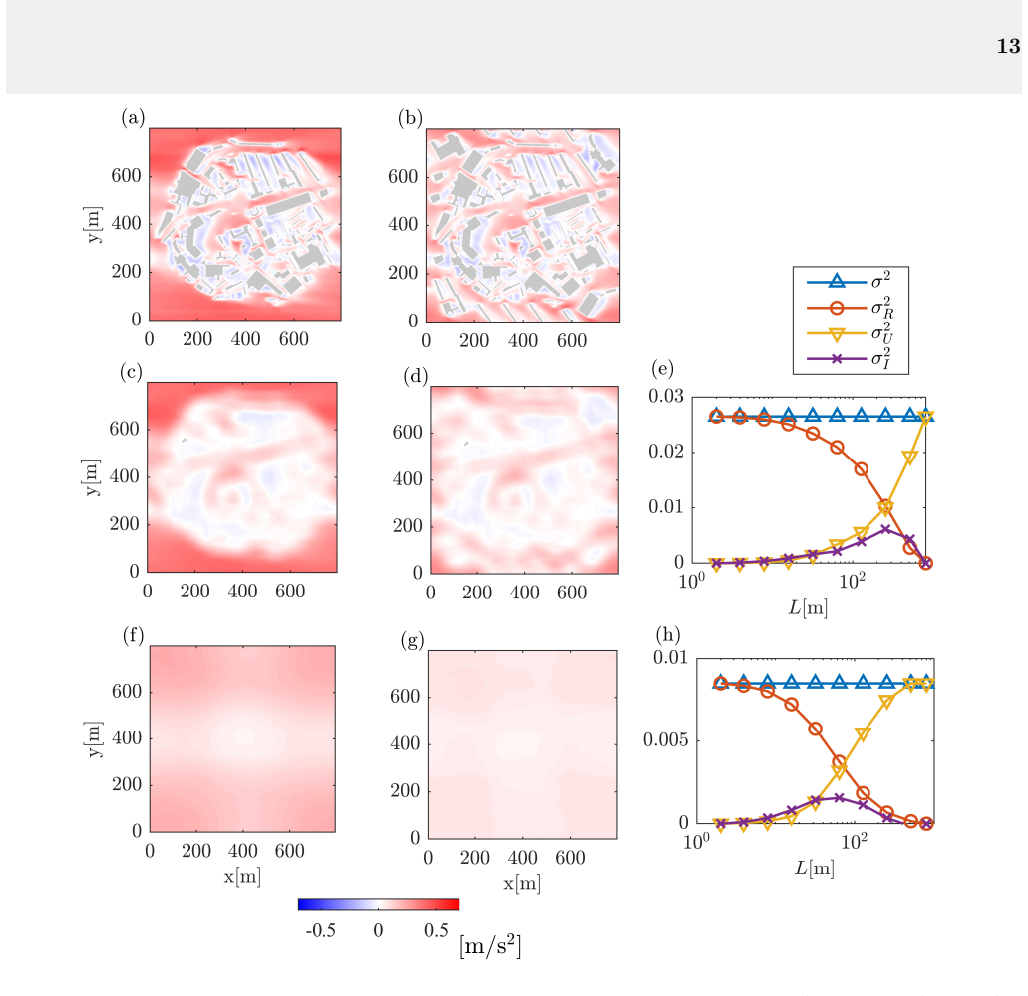
Applying multi-scale coarse-graining to building-resolving LES of the Bristol campus in original and infilled morphologies shows that a morphology-dependent heterogeneity scale emerges where resolved and unresolved variability are comparable, at roughly 256 m for the original layout and 64 m for the modified case, and that distributed drag and turbulent-stress parameterisations derived from idealised geometries maintain fidelity only when resolution lies well above this scale.
What carries the argument
Multi-scale coarse-graining framework applied to LES velocity and stress fields to quantify how flow heterogeneity evolves with filter scale and morphology.
If this is right
- Idealised-geometry parameterisations remain usable only at resolutions substantially coarser than the heterogeneity scale where horizontal transport stays negligible.
- Parameterisation error grows rapidly once resolution nears the heterogeneity scale because of rising filter-to-filter morphological variability.
- Realistic urban layouts with open-space contrasts impose stricter resolution limits on existing parameterisations than idealised cuboid arrays.
- Urban canopy models can be made scale-aware by relating their coefficients directly to the local ratio of grid size to morphology-specific heterogeneity length.
Where Pith is reading between the lines
- Repeating the coarse-graining analysis on LES of other cities could show whether heterogeneity scales follow predictable patterns tied to building density or street layout.
- NWP codes could incorporate local morphology statistics at each grid cell to adjust or switch urban parameterisations as resolution changes.
- The same filtering approach might apply to partially resolved forests or complex terrain to create consistent scale-aware surface schemes across different land types.
Load-bearing premise
The coarse-graining procedure applied to the LES data accurately reproduces the effective filtering that an NWP model grid performs at hectometric resolution.
What would settle it
Running the urban parameterisations on filtered LES fields at resolutions near 256 m and 64 m for both campus layouts and checking whether the error in predicted drag and stresses rises sharply once resolution approaches the identified heterogeneity scale.
Figures





read the original abstract
As Numerical Weather Prediction (NWP) models approach hectometric resolution, they increasingly enter a regime where urban heterogeneity is only partially resolved and the assumptions underlying conventional urban canopy models (UCMs) become questionable. To address this scale gap, we apply a multi-scale coarse-graining framework (van Reeuwijk and Huang 2025, Boundary-Layer Meteorology) to building-resolving Large-Eddy Simulations (LES) of the University of Bristol campus. Two related morphologies are considered: an original layout with large open-space contrasts and a modified configuration with these regions infilled. By systematically filtering the LES fields, we quantify how flow heterogeneity evolves with resolution and identify a characteristic urban length scale at which resolved and unresolved variability are comparable. This scale is strongly morphology-dependent, with values of about 256 m for the original layout and 64 m for the modified case, showing that neighbourhood-scale organisation can remain important at resolutions relevant to next-generation NWP. We then perform an a priori assessment of distributed drag and turbulent-stress parameterisations. Parameterisations derived from idealised geometries perform reasonably well only at sufficiently coarse resolutions, where horizontal transport is negligible and the flow appears approximately homogeneous. At finer resolutions, their fidelity degrades rapidly because of increasing heterogeneity and filter-to-filter variability in morphology, with stronger limitations in realistic layouts than in idealised cuboid arrays. Overall, the results show that the applicability of urban parameterisations depends critically on the relationship between model resolution and a morphology-dependent heterogeneity scale, providing a systematic route for developing scale-aware UCMs for high-resolution NWP.
Editorial analysis
A structured set of objections, weighed in public.
Referee Report
Summary. The manuscript applies a multi-scale coarse-graining framework to building-resolving LES of two University of Bristol campus morphologies (original layout with large open-space contrasts and a modified infilled configuration). It identifies morphology-dependent heterogeneity scales (~256 m original, ~64 m infilled) at which resolved and unresolved flow variability become comparable, then performs an a priori assessment showing that distributed drag and turbulent-stress parameterisations derived from idealised geometries perform adequately only at coarse resolutions where the flow appears homogeneous, with rapid degradation at finer scales due to increasing heterogeneity and filter variability. The central claim is that UCM applicability depends critically on the relationship between model resolution and this morphology-dependent scale, providing a systematic route for scale-aware UCMs in hectometric NWP.
Significance. If the results hold, the work supplies a quantitative, morphology-aware criterion for the validity of conventional UCMs as NWP models enter the hectometric regime. The explicit comparison between realistic campus layouts and the demonstration that neighbourhood-scale organisation can persist at resolutions relevant to next-generation NWP models offers a practical framework for future parameterisation development. The a priori tests on real morphologies rather than idealised arrays add concrete evidence of when and why standard approaches fail.
major comments (2)
- [Methods (multi-scale coarse-graining) and Results (heterogeneity scale identification)] The central claim that the extracted heterogeneity scales correctly indicate when UCM assumptions break for NWP rests on the multi-scale coarse-graining framework producing an effective filter equivalent to an actual NWP grid at the same nominal resolution. The manuscript applies the van Reeuwijk and Huang (2025) operator to LES fields but provides no direct comparison to the resolved/unresolved partition that would arise inside a finite-volume or finite-difference NWP solver with its specific advection, diffusion, and turbulence closures. This equivalence is load-bearing for the a priori assessment and the claimed route to scale-aware UCMs.
- [Results (a priori assessment of distributed drag and turbulent-stress parameterisations)] In the parameterization assessment, the claim that idealised-geometry models perform 'reasonably well only at sufficiently coarse resolutions' is supported by the observed degradation, yet the manuscript does not report quantitative error metrics, confidence intervals, or sensitivity to filter choice across the 256 m / 64 m scales. Without these, the strength of the conclusion that fidelity degrades 'rapidly' because of heterogeneity remains difficult to judge.
minor comments (2)
- [Abstract] The abstract introduces 'filter-to-filter variability in morphology' without defining the set of filters employed; a short clarification or reference to the relevant methods subsection would improve readability.
- [Methods] Notation for the heterogeneity scale (e.g., how it is extracted from the filtered fields) should be introduced explicitly in the main text rather than relying solely on the 2025 framework citation.
Simulated Author's Rebuttal
We thank the referee for the constructive review and positive assessment of the work's significance. We address each major comment below and indicate the revisions we will make.
read point-by-point responses
-
Referee: The central claim that the extracted heterogeneity scales correctly indicate when UCM assumptions break for NWP rests on the multi-scale coarse-graining framework producing an effective filter equivalent to an actual NWP grid at the same nominal resolution. The manuscript applies the van Reeuwijk and Huang (2025) operator to LES fields but provides no direct comparison to the resolved/unresolved partition that would arise inside a finite-volume or finite-difference NWP solver with its specific advection, diffusion, and turbulence closures. This equivalence is load-bearing for the a priori assessment and the claimed route to scale-aware UCMs.
Authors: We agree that the equivalence between the applied coarse-graining operator and the implicit filtering in a specific NWP discretization is an important assumption. The van Reeuwijk and Huang (2025) operator is formulated to represent volume averaging over a grid cell, but we acknowledge that advection schemes, subgrid closures, and numerical dissipation in operational NWP models could alter the resolved/unresolved partition. In the revised manuscript we will add an explicit discussion in the Methods section on the operator's assumptions and limitations, and we will qualify the claims to note that the framework provides a systematic a priori route rather than an exact surrogate for any particular NWP solver. A direct head-to-head comparison with an NWP code would require additional simulations beyond the present scope and is suggested as future work. revision: partial
-
Referee: In the parameterization assessment, the claim that idealised-geometry models perform 'reasonably well only at sufficiently coarse resolutions' is supported by the observed degradation, yet the manuscript does not report quantitative error metrics, confidence intervals, or sensitivity to filter choice across the 256 m / 64 m scales. Without these, the strength of the conclusion that fidelity degrades 'rapidly' because of heterogeneity remains difficult to judge.
Authors: We thank the referee for highlighting this gap. The present text describes the degradation qualitatively. We will revise the Results section to report quantitative error metrics (e.g., normalized mean absolute error and root-mean-square error for drag and stress predictions) at each nominal resolution. We will also include sensitivity tests to filter width and location, together with error bars derived from the variability across multiple filter positions to quantify uncertainty. revision: yes
Circularity Check
Central heterogeneity scale extraction rests on authors' 2025 self-cited coarse-graining framework
specific steps
-
self citation load bearing
[Abstract]
"we apply a multi-scale coarse-graining framework (van Reeuwijk and Huang 2025, Boundary-Layer Meteorology) to building-resolving Large-Eddy Simulations (LES) of the University of Bristol campus. ... identify a characteristic urban length scale at which resolved and unresolved variability are comparable. This scale is strongly morphology-dependent, with values of about 256 m for the original layout and 64 m for the modified case"
The morphology-dependent heterogeneity scale (central to the claim that UCM applicability depends on resolution vs. this scale) is obtained directly by applying the cited multi-scale coarse-graining framework. Because the framework is from the same authors' prior work and is not independently re-derived or validated against NWP numerics in this manuscript, the key result on scale-aware UCMs reduces to load-bearing self-citation.
full rationale
The paper applies the multi-scale coarse-graining framework from van Reeuwijk and Huang (2025) to LES data to extract morphology-dependent heterogeneity scales (~256 m and ~64 m) and assess UCM parameterisation fidelity. This framework is not re-derived here, so the load-bearing step identifying when resolved/unresolved variability becomes comparable depends on the prior self-citation. However, the present work adds independent content through new LES cases (Bristol campus, infilled vs original), quantitative filter-to-filter variability results, and a priori parameterisation tests. No self-definitional, fitted-input, or ansatz-smuggling circularity occurs; the derivation chain remains externally falsifiable via the LES data itself. This yields a low-to-moderate circularity score.
Axiom & Free-Parameter Ledger
axioms (1)
- domain assumption The multi-scale coarse-graining framework of van Reeuwijk and Huang 2025 correctly represents sub-grid variability for urban flows.
Lean theorems connected to this paper
-
IndisputableMonolith/Foundation/RealityFromDistinction.leanreality_from_one_distinction unclear?
unclearRelation between the paper passage and the cited Recognition theorem.
By systematically filtering the LES fields, we quantify how flow heterogeneity evolves with resolution and identify a characteristic urban length scale ℓ at which resolved and unresolved variability are comparable. This scale is strongly morphology-dependent, with values of about 256 m for the original layout and 64 m for the modified case
-
IndisputableMonolith/Cost/FunctionalEquation.leanwashburn_uniqueness_aczel unclear?
unclearRelation between the paper passage and the cited Recognition theorem.
the multi-resolution planar-averaging framework of van Reeuwijk and Huang (2025b). The framework uses convolution filters to derive coarse-grained fields
What do these tags mean?
- matches
- The paper's claim is directly supported by a theorem in the formal canon.
- supports
- The theorem supports part of the paper's argument, but the paper may add assumptions or extra steps.
- extends
- The paper goes beyond the formal theorem; the theorem is a base layer rather than the whole result.
- uses
- The paper appears to rely on the theorem as machinery.
- contradicts
- The paper's claim conflicts with a theorem or certificate in the canon.
- unclear
- Pith found a possible connection, but the passage is too broad, indirect, or ambiguous to say the theorem truly supports the claim.
Reference graph
Works this paper leans on
-
[1]
Auerswald T, Klippel K, Thomas TG,et al.2024
LES of wind-induced pressures and flow structures around tandem buildings.Journal of Wind Engineering and Industrial Aerodynamics269: 106 304, doi: 10.1016/j.jweia.2025.106304. Auerswald T, Klippel K, Thomas TG,et al.2024. Effect of flow variability on dispersion of continuous and puff releases in a regular street network.Boundary-Layer Meteorology190: 20...
-
[2]
org/view/journals/mwre/139/12/mwr-d-10-05013.1.xml
Operational convective-scale numerical weather prediction with the cosmo model: Description and sensitivities.Monthly Weather Review139(12): 3887 – 3905, doi: 10.1175/MWR-D-10-05013.1, URLhttps://journals.ametsoc. org/view/journals/mwre/139/12/mwr-d-10-05013.1.xml. Barlow JF
-
[3]
com/science/article/pii/S2212095514000558
Progress in observing and modelling the urban boundary layer.Urban Climate10: 216–240, doi:https://doi.org/ 10.1016/j.uclim.2014.03.011, URLhttps://www.sciencedirect. com/science/article/pii/S2212095514000558. ICUC8: The 8th International Conference on Urban Climate and the 10th Symposium on the Urban Environment. Bi D, Carpentieri M, Placidi M, Robins A
-
[4]
Bryan GH, Wyngaard JC, Fritsch JM
Turbulence characteristics across a range of idealized urban canopy geometries.Boundary-Layer Meteorology 182: 275–307, doi:10.1007/s10546-021-00658-6, URLhttps:// centaur.reading.ac.uk/99701/. Bryan GH, Wyngaard JC, Fritsch JM
-
[5]
Resolution requirements for the simulation of deep moist convection. Monthly Weather Review131(10): 2394 – 2416, doi: 10.1175/1520-0493(2003)131⟨2394:RRFTSO⟩2.0.CO;2, URL https://journals.ametsoc.org/view/journals/mwre/131/10/ 1520-0493_2003_131_2394_rrftso_2.0.co_2.xml. Cheng WC, Yang Y
-
[6]
Atmosphere15(9), URLhttps://www.mdpi.com/2073-4433/15/ 9/1089
Comparing large-eddy simulation and gaussian plume model to sensor measurements of an urban smoke plume. Atmosphere15(9), URLhttps://www.mdpi.com/2073-4433/15/ 9/1089. Coburn M, Xie ZT, Herring SJ
work page 2073
-
[7]
Numerical simulations of boundary-layer airflow over pitched-roof buildings.Boundary-Layer Meteorology185: 415–442, doi: 10.1007/s10546-022-00738-1, URLhttps://doi.org/10.1007/ s10546-022-00738-1. Coceal O, Belcher SE
-
[8]
03.40, URLhttps://rmets.onlinelibrary.wiley.com/doi/abs/ 10.1256/qj.03.40
A canopy model of mean winds through urban areas.Quarterly Journal of the Royal Meteorological Society130(599): 1349–1372, doi:https://doi.org/10.1256/qj. 03.40, URLhttps://rmets.onlinelibrary.wiley.com/doi/abs/ 10.1256/qj.03.40. Coceal O, Thomas TG, Castro IP, Belcher SE
-
[9]
Boundary-Layer Meteorology121(3): 491–519
Mean flow and turbulence statistics over groups of urban-like cubical obstacles. Boundary-Layer Meteorology121(3): 491–519. Ding SS, Placidi M, Carpentieri M,et al.2023. Neutrally- and stably-stratified boundary layers adjustments to a step change in surface roughness.Experiments in Fluids64: 86, doi: 10.1007/s00348-023-03626-7, URLhttps://doi.org/10.1007...
-
[10]
Giometto M, Christen A, Meneveau C, Fang J, Krafczyk M, Parlange M
Turbulence in plant canopies.Annual Review of Fluid Mechanics32(Volume 32, 2000): 519– 571, doi:https://doi.org/10.1146/annurev.fluid.32.1.519, URL ©2025 Royal Meteorological SocietyPrepared usingqjrms4.cls 21 https://www.annualreviews.org/content/journals/10.1146/ annurev.fluid.32.1.519. Giometto M, Christen A, Meneveau C, Fang J, Krafczyk M, Parlange M
-
[11]
A simple energy balance model for regular building arrays.Boundary-Layer Meteorology116(3): 423– 443, doi:10.1007/s10546-004-7956-x, URLhttps://doi.org/10. 1007/s10546-004-7956-x. Kusaka H, Ikeda R, Sato T, Iizuka S, Boku T
-
[12]
A simple single- layer urban canopy model for atmospheric models: Comparison with multi-layer and slab models.Boundary-Layer Meteorology 101(3): 329–358, doi:10.1023/A:1019207923078, URLhttps:// doi.org/10.1023/A:1019207923078. Lean HW, Theeuwes NE, Baldauf M, Barkmeijer J, Bessardon G, Blunn L, Bojarova J, Boutle IA, Clark PA, Demuzere M, Dueben P, Frogn...
-
[13]
wiley.com/doi/abs/10.1002/qj.4858
The hectometric modelling challenge: Gaps in the current state of the art and ways forward towards the implementation of 100- m scale weather and climate models.Quarterly Journal of the Royal Meteorological Society150(765): 4671–4708, doi:https:// doi.org/10.1002/qj.4858, URLhttps://rmets.onlinelibrary. wiley.com/doi/abs/10.1002/qj.4858. Lipson MJ, Grimmo...
-
[14]
wiley.com/doi/abs/10.1002/qj.4589
Evaluation of 30 urban land surface models in the Urban- PLUMBER project: Phase 1 results.Quarterly Journal of the Royal Meteorological Society150(758): 126–169, doi:https:// doi.org/10.1002/qj.4589, URLhttps://rmets.onlinelibrary. wiley.com/doi/abs/10.1002/qj.4589. Lu J, Nazarian N, Hart MA, Krayenhoff ES, Martilli A
-
[15]
A one-dimensional urban flow model with an eddy-diffusivity mass- flux (EDMF) scheme and refined turbulent transport (MLUCM v3.0).Geoscientific Model Development17(7): 2525–2545, doi: 10.5194/gmd-17-2525-2024, URLhttps://gmd.copernicus.org/ articles/17/2525/2024/. Ludwig S, Plein M, Barlow JF, Escobar-Ruiz V, Grimmond S, Matthews J, van Reeuwijk M, Zeeman...
-
[16]
doi:10.5281/zenodo.15537606, URLhttps: //doi.org/10.5281/zenodo.15537606
Street-level weather station network in Bristol, UK: Station documentation (1.0). doi:10.5281/zenodo.15537606, URLhttps: //doi.org/10.5281/zenodo.15537606. Macdonald R, Griffiths R, Hall D
-
[17]
An urban surface exchange parameterisation for mesoscale models.Boundary- Layer Meteorology104: 261–304, doi:10.1023/A:1016099921195. Masson V, Heldens W, Bocher E, Bonhomme M, Bucher B, Burmeister C, de Munck C, Esch T, Hidalgo J, Kanani- S¨ uhring F, Kwok YT, Lemonsu A, L´ evy JP, Maronga B, Pavlik D, Petit G, See L, Schoetter R, Tornay N, Votsis A, Zeidler J
-
[18]
Urban Climate31: 100 536, doi:https://doi.org/10.1016/j.uclim
City-descriptive input data for urban climate models: Model requirements, data sources and challenges. Urban Climate31: 100 536, doi:https://doi.org/10.1016/j.uclim. 2019.100536, URLhttps://www.sciencedirect.com/science/ article/pii/S2212095518303663. Nazarian N, Krayenhoff ES, Martilli A
-
[19]
A one- dimensional model of turbulent flow through “urban” canopies (MLUCM v2.0): updates based on large-eddy simulation.Geoscientific Model Development13(3): 937–953, doi:10.5194/gmd-13-937-2020, URLhttps: //gmd.copernicus.org/articles/13/937/2020/. Nepf HM
-
[20]
Owens SO, Majumdar D, Wilson CE, Bartholomew P, van Reeuwijk M
Flow and transport in regions with aquatic vegetation.Annual Review of Fluid Mechanics 44(Volume 44, 2012): 123–142, doi:https://doi.org/ 10.1146/annurev-fluid-120710-101048, URLhttps: //www.annualreviews.org/content/journals/10.1146/ annurev-fluid-120710-101048. Owens SO, Majumdar D, Wilson CE, Bartholomew P, van Reeuwijk M
-
[21]
A conservative immersed boundary method for the multi-physics urban large-eddy simulation model uDALES v2.0.EGUsphere2024: 1–33, doi:10.5194/ egusphere-2024-96, URLhttps://egusphere.copernicus.org/ preprints/2024/egusphere-2024-96/. Pope SB. 2000.Turbulent flows. Cambridge University Press, doi: 10.1017/CBO9780511840531. ©2025 Royal Meteorological Society...
-
[22]
A Dynamic Urban Canopy Parameterization for Mesoscale Models Based on Computational Fluid Dynamics Reynolds-Averaged Navier-Stokes Microscale Simulations.Boundary-Layer Meteorology137(3): 417–439, doi: 10.1007/s10546-010-9538-4. Schlichting H, Gersten K. 2017.Boundary-layer theory. Springer Berlin, Heidelberg, ISBN 978-3-662-52917-1, doi: 10.1007/978-3-66...
-
[23]
Suter I, Grylls T, S¨ utzl BS, Owens SO, Wilson CE, van Reeuwijk M
Local climate zones for urban temperature studies.Bulletin of the American Meteorological Society93(12): 1879 – 1900, doi:10.1175/BAMS-D-11-00019.1, URLhttps://journals.ametsoc.org/view/journals/bams/93/ 12/bams-d-11-00019.1.xml. Suter I, Grylls T, S¨ utzl BS, Owens SO, Wilson CE, van Reeuwijk M
-
[24]
copernicus.org/articles/15/5309/2022/
uDALES 1.0: a large-eddy simulation model for urban environments.Geoscientific Model Development15(13): 5309–5335, doi:10.5194/gmd-15-5309-2022, URLhttps://gmd. copernicus.org/articles/15/5309/2022/. S¨ utzl BS, Rooney GG, Finnenkoetter A, Bohnenstengel SI, Grimmond S, van Reeuwijk M
-
[25]
The benefits of the Met Office variable resolution NWP model for forecasting convection. Meteorological Applications20(4): 417–426, doi:https://doi.org/ 10.1002/met.1300, URLhttps://rmets.onlinelibrary.wiley. com/doi/abs/10.1002/met.1300. Uno I, Cai XM, Steyn DG, Emori S
-
[26]
A simple extension of the louis method for rough surface layer modelling.Bound.-Layer Meteorol.76: 395–409. van Reeuwijk M, Huang J. 2025a. Dataset for ”multi-scale analysis of flow over heterogeneous urban environments” . doi:10. 5281/zenodo.17102845, URLhttps://doi.org/10.5281/zenodo. 17102845. van Reeuwijk M, Huang J. 2025b. Multi-scale Analysis of Flo...
-
[27]
An eddy-viscosity subgrid-scale model for turbulent shear flow: Algebraic theory and applications.Physics of Fluids16(10): 3670–3681, doi:10.1063/1.1785131, URLhttps: //doi.org/10.1063/1.1785131. Xie ZT, Coceal O, Castro IP
-
[28]
©2025 Royal Meteorological SocietyPrepared usingqjrms4.cls
Urban neighbourhood classification and multi-scale heterogeneity analysis of Greater London.Environment and Planning B: Urban Analytics and City Science50(6): 1534–1558, doi:10.1177/23998083221140890. ©2025 Royal Meteorological SocietyPrepared usingqjrms4.cls
discussion (0)
Sign in with ORCID, Apple, or X to comment. Anyone can read and Pith papers without signing in.