Deep Learning Surrogates for Emulating Stochastic Climate Tipping Dynamics
Pith reviewed 2026-05-21 07:11 UTC · model grok-4.3
The pith
A modified Temporal Fusion Transformer emulates stochastic ocean tipping with 465x speedup while preserving differentiability.
A machine-rendered reading of the paper's core claim, the machinery that carries it, and where it could break.
Core claim
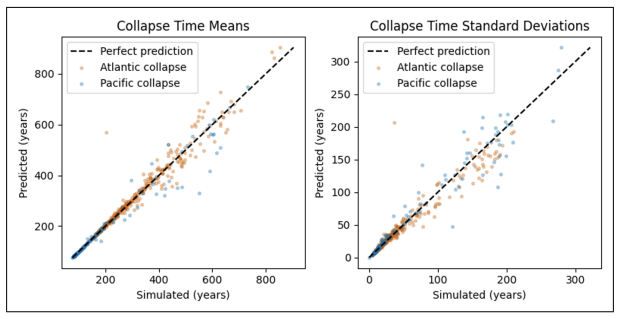
The central claim is that modifications to the Temporal Fusion Transformer architecture and objective function enable the model to faithfully reproduce the stochastic timing of tipping events from non-stationary multivariate time series of ocean transport. The surrogate anticipates collapse timings to high fidelity, captures uncertainty across ensemble predictions, achieves a 465x computational speedup over the numerical simulator, and remains differentiable with respect to parameters and initial conditions.
What carries the argument
The dynamics-informed Temporal Fusion Transformer with modifications to architecture and objective function for predicting tipping from multivariate non-stationary time series.
If this is right
- Large-scale ensemble runs become feasible for quantifying uncertainty in collapse timing.
- Gradient-based optimization and sensitivity analysis can now be performed directly on tipping behavior.
- Similar surrogates could accelerate exploration of parameter spaces in other Earth system models.
- Forecasts of tipping events can extend across thousands of time steps at reduced computational cost.
Where Pith is reading between the lines
- Differentiability could support inverse modeling to infer unobserved initial conditions from real ocean observations.
- The approach might extend to coupled tipping elements, such as interactions between ocean circulation and ice sheets.
- Real-time early-warning systems for climate shifts could incorporate such lightweight surrogates for continuous monitoring.
Load-bearing premise
The modifications to the TFT architecture and objective function are sufficient to faithfully reproduce the stochastic timing of tipping events from the underlying non-stationary multivariate time series without introducing systematic bias in the predicted collapse distributions.
What would settle it
Generate a new ensemble of collapse times from the original numerical simulator on held-out initial conditions and parameters, then compare the full distribution of predicted timings and variances against those produced by the surrogate.
Figures


read the original abstract
This work explores a dynamics-informed Temporal Fusion Transformer (TFT) as a data-driven surrogate for computationally intensive Earth system simulations. Focusing on multivariate time series describing global ocean transport, we demonstrate the surrogate's ability to forecast tip events across thousands of time steps. The data involve up to 21 non-stationary time series in addition to static covariates describing free parameters and initial conditions. Modifications to the architecture and objective function yield a surrogate that anticipates the timing of Atlantic and Pacific collapses to high fidelity and captures the stochastic uncertainty in transition timing across ensemble predictions. The learned surrogate achieves a 465x computational speedup over the numerical simulator while maintaining differentiability with respect to parameters and initial conditions.
Editorial analysis
A structured set of objections, weighed in public.
Referee Report
Summary. The manuscript proposes a dynamics-informed Temporal Fusion Transformer (TFT) as a data-driven surrogate for emulating stochastic tipping dynamics in multivariate time series from global ocean transport Earth system simulations. It claims to forecast Atlantic and Pacific collapse events over thousands of time steps with high fidelity, capture stochastic uncertainty in transition timing across ensembles, achieve a 465x computational speedup, and maintain differentiability with respect to parameters and initial conditions.
Significance. If the central claims regarding fidelity and unbiased uncertainty capture are substantiated, the work could enable much faster ensemble simulations and sensitivity analyses for climate tipping points, which are otherwise computationally prohibitive. The differentiability and speedup are notable strengths that could support integration into optimization or adjoint-based methods in Earth system modeling.
major comments (2)
- [Abstract] Abstract: The abstract asserts 'high fidelity' timing predictions and capture of 'stochastic uncertainty in transition timing' without providing any quantitative metrics (e.g., MAE or RMSE on collapse times, statistical distances between predicted and simulated timing distributions, or ensemble coverage rates). This absence is load-bearing for the central claim of faithful emulation of the underlying stochastic dynamics.
- [Methods] Methods (TFT modifications and objective function): The architecture changes (attention, static covariates for parameters/initial conditions) and custom loss are presented as sufficient to reproduce non-stationary stochastic timing from the 21-variable series without systematic bias in collapse distributions. However, no explicit validation (e.g., Kolmogorov-Smirnov tests, quantile comparisons, or ablation on the loss weighting) is described to rule out distortion of heavy-tailed or non-stationary transition statistics, which directly risks the weakest assumption identified in the stress-test note.
minor comments (1)
- [Abstract] The 465x speedup figure would be more informative if accompanied by details on the hardware configuration used for both the original simulator and surrogate inference.
Simulated Author's Rebuttal
We thank the referee for the constructive and detailed comments on our manuscript. We address each major comment below and outline the revisions we will make to strengthen the presentation of our results while preserving the core contributions.
read point-by-point responses
-
Referee: [Abstract] Abstract: The abstract asserts 'high fidelity' timing predictions and capture of 'stochastic uncertainty in transition timing' without providing any quantitative metrics (e.g., MAE or RMSE on collapse times, statistical distances between predicted and simulated timing distributions, or ensemble coverage rates). This absence is load-bearing for the central claim of faithful emulation of the underlying stochastic dynamics.
Authors: We agree that the abstract would be strengthened by the inclusion of specific quantitative metrics supporting the claims of high-fidelity timing predictions and stochastic uncertainty capture. In the revised manuscript we will add concise numerical results to the abstract, including MAE and RMSE on predicted collapse times relative to the simulator, as well as a statistical distance (e.g., Wasserstein or Kolmogorov-Smirnov) between the predicted and simulated timing distributions across ensembles. These additions will make the central claims directly quantifiable without altering the abstract's length or focus. revision: yes
-
Referee: [Methods] Methods (TFT modifications and objective function): The architecture changes (attention, static covariates for parameters/initial conditions) and custom loss are presented as sufficient to reproduce non-stationary stochastic timing from the 21-variable series without systematic bias in collapse distributions. However, no explicit validation (e.g., Kolmogorov-Smirnov tests, quantile comparisons, or ablation on the loss weighting) is described to rule out distortion of heavy-tailed or non-stationary transition statistics, which directly risks the weakest assumption identified in the stress-test note.
Authors: We acknowledge that additional explicit statistical validations would help readers confirm that the modified TFT and custom loss faithfully reproduce the non-stationary and potentially heavy-tailed transition statistics. While the manuscript already reports ensemble-level timing distributions and qualitative agreement with the simulator, we will add in the revised Methods and Results sections: (i) Kolmogorov-Smirnov tests and quantile-quantile comparisons between predicted and simulated collapse-time distributions, (ii) an ablation study isolating the contribution of the custom loss weighting, and (iii) a brief discussion clarifying how these checks address potential distortions in non-stationary statistics. We believe these additions directly mitigate the concern without requiring new experiments. revision: yes
Circularity Check
No significant circularity: empirical surrogate trained on external simulation outputs
full rationale
The paper presents a data-driven Temporal Fusion Transformer surrogate trained on outputs from a numerical Earth system simulator. Performance claims (speedup, fidelity on collapse timing, uncertainty capture) are evaluated against held-out simulation ensembles rather than reducing to the model's own fitted parameters or self-citations by construction. No load-bearing self-citation chains, uniqueness theorems, or ansatzes imported from prior author work appear in the provided abstract or description; the central results remain falsifiable against independent simulator runs.
Axiom & Free-Parameter Ledger
free parameters (1)
- TFT architecture hyperparameters and loss weighting
axioms (1)
- domain assumption Neural networks with attention mechanisms can approximate the mapping from multivariate non-stationary time series plus static covariates to future tipping-event distributions.
Lean theorems connected to this paper
-
IndisputableMonolith/Cost/FunctionalEquation.leanwashburn_uniqueness_aczel unclear?
unclearRelation between the paper passage and the cited Recognition theorem.
Modifications to the architecture and objective function yield a surrogate that anticipates the timing of Atlantic and Pacific collapses to high fidelity and captures the stochastic uncertainty in transition timing across ensemble predictions.
What do these tags mean?
- matches
- The paper's claim is directly supported by a theorem in the formal canon.
- supports
- The theorem supports part of the paper's argument, but the paper may add assumptions or extra steps.
- extends
- The paper goes beyond the formal theorem; the theorem is a base layer rather than the whole result.
- uses
- The paper appears to rely on the theorem as machinery.
- contradicts
- The paper's claim conflicts with a theorem or certificate in the canon.
- unclear
- Pith found a possible connection, but the passage is too broad, indirect, or ambiguous to say the theorem truly supports the claim.
Reference graph
Works this paper leans on
-
[1]
Overshooting tipping point thresholds in a changing climate
Paul DL Ritchie et al. “Overshooting tipping point thresholds in a changing climate”. In: Nature592.7855 (2021), pp. 517–523
work page 2021
-
[2]
Critical slowing down indicators
Fahimeh Nazarimehr et al. “Critical slowing down indicators”. In:Europhysics Letters132.1 (2020), p. 18001
work page 2020
-
[4]
Early warning of climate tipping points
Timothy M Lenton. “Early warning of climate tipping points”. In:Nature climate change1.4 (2011), pp. 201–209
work page 2011
-
[5]
Atlantic pycnocline theory scrutinized using a coupled climate model
Anders Levermann and Johannes Jakob Fürst. “Atlantic pycnocline theory scrutinized using a coupled climate model”. In:Geophysical research letters37.14 (2010)
work page 2010
-
[6]
Jennifer Sleeman et al.Using Artificial Intelligence to aid Scientific Discovery of Climate Tipping Points. Feb. 2023.DOI:10.48550/arXiv.2302.06852
-
[7]
Jennifer Sleeman et al.A Generative Adversarial Network for Climate Tipping Point Discovery (TIP-GAN). Feb. 2023.DOI:10.48550/arXiv.2302.10274
-
[8]
Tipping point detection and early warnings in climate, ecological, and human systems
Vasilis Dakos et al. “Tipping point detection and early warnings in climate, ecological, and human systems”. In:Earth System Dynamics15.4 (2024), pp. 1117–1135
work page 2024
-
[9]
Soft-DTW: a differentiable loss function for time-series
Marco Cuturi and Mathieu Blondel. “Soft-DTW: a differentiable loss function for time-series”. In:Proceedings of the 34th International Conference on Machine Learning - Volume 70. ICML’17. Sydney, NSW, Australia: JMLR.org, 2017, pp. 894–903
work page 2017
-
[10]
Thermohaline convection with two stable regimes of flow
Henry Stommel. “Thermohaline convection with two stable regimes of flow”. In:Tellus13.2 (1961), pp. 224–230
work page 1961
-
[11]
LC Jackson. “Shutdown and recovery of the AMOC in a coupled global climate model: the role of the advective feedback”. In:Geophysical Research Letters40.6 (2013), pp. 1182–1188
work page 2013
-
[12]
The effect of Indian Ocean surface freshwater flux biases on the multi-stable regime of the AMOC
Henk A Dijkstra and René M van Westen. “The effect of Indian Ocean surface freshwater flux biases on the multi-stable regime of the AMOC”. In:Tellus, Series A: Dynamic Meteorology and Oceanography76.1 (2024), pp. 90–100
work page 2024
-
[13]
Closure of the meridional overturning circulation through Southern Ocean upwelling
John Marshall and Kevin Speer. “Closure of the meridional overturning circulation through Southern Ocean upwelling”. In:Nature geoscience5.3 (2012), pp. 171–180
work page 2012
-
[14]
Anand Gnanadesikan et al. “Tipping Points in Overturning Circulation Mediated by Ocean Mixing and the Configuration and Magnitude of the Hydrological Cycle: A Simple Model”. In:Journal of Physical Oceanography54 (Apr. 2024).DOI:10.1175/JPO-D-23-0161.1
-
[15]
Flux correction and overturning stability: Insights from a dynamical box model
Anand Gnanadesikan, Richard Kelson, and Michaela Sten. “Flux correction and overturning stability: Insights from a dynamical box model”. In:Journal of Climate31.22 (2018), pp. 9335– 9350
work page 2018
-
[16]
Thomas M. Bury et al. “Deep learning for early warning signals of tipping points”. In: Proceedings of the National Academy of Sciences118.39 (2021), e2106140118.DOI: 10. 1073/pnas.2106140118 . eprint: https://www.pnas.org/doi/pdf/10.1073/pnas. 2106140118.URL:https://www.pnas.org/doi/abs/10.1073/pnas.2106140118
-
[17]
Smita Deb et al. “Machine learning methods trained on simple models can predict critical tran- sitions in complex natural systems”. In:Royal Society Open Science9 (Feb. 2022), p. 211475. DOI:10.1098/rsos.211475
-
[18]
Early Predictor for the Onset of Critical Transitions in Networked Dynamical Systems
Zijia Liu et al. “Early Predictor for the Onset of Critical Transitions in Networked Dynamical Systems”. In:Physical Review X14 (July 2024).DOI:10.1103/PhysRevX.14.031009
-
[19]
Towards neural Earth system modelling by integrating artificial intelligence in Earth system science
Christopher Irrgang et al. “Towards neural Earth system modelling by integrating artificial intelligence in Earth system science”. In:Nature Machine Intelligence3 (Aug. 2021), pp. 667– 674.DOI:10.1038/s42256-021-00374-3
-
[20]
Bridging Idealized and Operational Models: An Explainable AI Frame- work for Earth System Emulators
A. Behnoudfar et al. “Bridging Idealized and Operational Models: An Explainable AI Frame- work for Earth System Emulators”. In:arXiv preprint arXiv:2510.13030(2025).URL: https: //arxiv.org/abs/2510.13030
-
[21]
Scalable Spatiotemporal Graph Neural Networks
Andrea Cini et al. “Scalable Spatiotemporal Graph Neural Networks”. In:Proceedings of the AAAI Conference on Artificial Intelligence37 (June 2023), pp. 7218–7226.DOI: 10.1609/ aaai.v37i6.25880
work page 2023
-
[22]
METRO: a generic graph neural network framework for multivariate time series forecasting
Yue Cui et al. “METRO: a generic graph neural network framework for multivariate time series forecasting”. In:Proceedings of the VLDB Endowment15 (Feb. 2022), pp. 224–236. DOI:10.14778/3489496.3489503
-
[23]
Multi-channel fusion graph neural network for multivariate time series forecasting
Yanzhe Chen and Zongxia Xie. “Multi-channel fusion graph neural network for multivariate time series forecasting”. In:Journal of Computational Science64 (2022), p. 101862.ISSN: 1877-7503.DOI: https : / / doi . org / 10 . 1016 / j . jocs . 2022 . 101862.URL: https : //www.sciencedirect.com/science/article/pii/S1877750322002216. 11
work page 2022
-
[26]
Connecting the Dots: Multivariate Time Series Forecasting with Graph Neural Networks
Zonghan Wu et al. “Connecting the Dots: Multivariate Time Series Forecasting with Graph Neural Networks”. In:Proceedings of the 26th ACM SIGKDD International Conference on Knowledge Discovery & Data Mining. KDD ’20. Virtual Event, CA, USA: Association for Computing Machinery, 2020, pp. 753–763.ISBN: 9781450379984.DOI: 10.1145/3394486. 3403118.URL:https://...
-
[27]
2021.DOI:10.48550/arXiv.2104.14917
Fuxian Li et al.Dynamic Graph Convolutional Recurrent Network for Traffic Prediction: Benchmark and Solution. 2021.DOI:10.48550/arXiv.2104.14917
-
[28]
Guojun Liang et al. “Dynamic Causal Explanation Based Diffusion-Variational Graph Neural Network for Spatiotemporal Forecasting”. In:IEEE transactions on neural networks and learning systemsPP (July 2024).DOI:10.1109/TNNLS.2024.3415149
-
[29]
June 2022.DOI:10.48550/arXiv.2206.13816
Junchen Ye et al.Learning the Evolutionary and Multi-scale Graph Structure for Multivariate Time Series Forecasting. June 2022.DOI:10.48550/arXiv.2206.13816
-
[30]
Causal Discovery and Forecasting in Nonstationary Environments with State-Space Models
Biwei Huang et al. “Causal Discovery and Forecasting in Nonstationary Environments with State-Space Models”. In:Proceedings of the 36th International Conference on Machine Learning (ICML). V ol. 97. PMLR, 2019
work page 2019
-
[31]
Xin Li et al. “Higher-order Granger reservoir computing: Simultaneously achieving scalable complex structures inference and accurate dynamics prediction”. In:Nature Communications 15 (Mar. 2024), p. 2506.DOI:10.1038/s41467-024-46852-1
-
[32]
Thomas Kipf et al.Neural Relational Inference for Interacting Systems. Feb. 2018.DOI: 10.48550/arXiv.1802.04687
work page internal anchor Pith review Pith/arXiv arXiv doi:10.48550/arxiv.1802.04687 2018
-
[33]
Discrete Graph Structure Learning for Forecasting Multi- ple Time Series
Chao Shang, Jie Chen, and Jinbo Bi. “Discrete Graph Structure Learning for Forecasting Multi- ple Time Series”. In:ArXivabs/2101.06861 (2021).URL: https://api.semanticscholar. org/CorpusID:231632580
-
[34]
July 2020.DOI:10.48550/arXiv.2007.00267
Elena Saggioro et al.Reconstructing regime-dependent causal relationships from observational time series. July 2020.DOI:10.48550/arXiv.2007.00267
-
[35]
Causal structure learning for high-dimensional non-stationary time series
Siya Chen, HaoTian Wu, and Guang Jin. “Causal structure learning for high-dimensional non-stationary time series”. In:Knowledge-Based Systems295 (July 2024), p. 111868.DOI: 10.1016/j.knosys.2024.111868
-
[36]
doi: 10.1609/aaai.v35i12.17325
Haoyi Zhou et al. “Informer: Beyond Efficient Transformer for Long Sequence Time-Series Forecasting”. In:Proceedings of the AAAI Conference on Artificial Intelligence35 (May 2021), pp. 11106–11115.DOI:10.1609/aaai.v35i12.17325
-
[37]
FEDformer: Frequency Enhanced Decomposed Transformer for Long- term Series Forecasting
Tian Zhou et al. “FEDformer: Frequency Enhanced Decomposed Transformer for Long- term Series Forecasting”. In:International Conference on Machine Learning. PMLR. 2022, pp. 27268–27286
work page 2022
-
[38]
Are Transformers Effective for Time Series Forecasting?
Ailing Zeng et al. “Are Transformers Effective for Time Series Forecasting?” In:Proceedings of the AAAI Conference on Artificial Intelligence37 (June 2023), pp. 11121–11128.DOI: 10.1609/aaai.v37i9.26317
-
[39]
Model scale versus domain knowledge in statistical forecasting of chaotic systems
William Gilpin. “Model scale versus domain knowledge in statistical forecasting of chaotic systems”. In:Physical Review Research(2023).URL: https://api.semanticscholar. org/CorpusID:258352864
work page 2023
-
[40]
Robustness of LSTM neural networks for multi-step forecasting of chaotic time series
Matteo Sangiorgio and Fabio Dercole. “Robustness of LSTM neural networks for multi-step forecasting of chaotic time series”. In:Chaos, Solitons & Fractals139 (Oct. 2020), p. 110045. DOI:10.1016/j.chaos.2020.110045
-
[41]
Inferring the dynamics of oscillatory systems using recurrent neural networks
Rok Cestnik and Markus Abel. “Inferring the dynamics of oscillatory systems using recurrent neural networks”. In:Chaos: An Interdisciplinary Journal of Nonlinear Science29 (June 2019), p. 063128.DOI:10.1063/1.5096918. 12
-
[42]
Gonzalo Uribarri and Gabriel Mindlin. “Dynamical time series embeddings in recurrent neural networks”. In:Chaos, Solitons & Fractals154 (Nov. 2021), p. 111612.DOI: 10.1016/j. chaos.2021.111612
work page doi:10.1016/j 2021
-
[43]
Jaideep Pathak et al. “Model-Free Prediction of Large Spatiotemporally Chaotic Systems from Data: A Reservoir Computing Approach”. In:Physical Review Letters120 (Jan. 2018).DOI: 10.1103/PhysRevLett.120.024102
-
[44]
Deep learning for predicting the occurrence of tipping points
Chengzuo Zhuge, Jiawei Li, and Wei Chen. “Deep learning for predicting the occurrence of tipping points”. In:Royal Society Open Science12.7 (2025), p. 242240.DOI: 10.1098/ rsos.242240 . eprint: https://royalsocietypublishing.org/doi/pdf/10.1098/ rsos . 242240.URL: https : / / royalsocietypublishing . org / doi / abs / 10 . 1098 / rsos.242240
work page 2025
-
[45]
Daniel Köglmayr and C. Räth. “Extrapolating tipping points and simulating non-stationary dynamics of complex systems using efficient machine learning”. In:Scientific Reports14 (Jan. 2024).DOI:10.1038/s41598-023-50726-9
-
[46]
Shirin Panahi and Ying-Cheng Lai. “Adaptable reservoir computing: A paradigm for model- free data-driven prediction of critical transitions in nonlinear dynamical systems”. In:Chaos: An Interdisciplinary Journal of Nonlinear Science34 (May 2024).DOI: 10.1063/5.0200898
-
[47]
Journal of Mathematical Physics64(9), 091902 (2023) https://doi.org/10.1063/5
Dhruvit Patel and Edward Ott. “Using machine learning to anticipate tipping points and extrapolate to post-tipping dynamics of non-stationary dynamical systems”. In:Chaos: An Interdisciplinary Journal of Nonlinear Science33 (Feb. 2023), p. 023143.DOI: 10.1063/5. 0131787
work page doi:10.1063/5 2023
-
[48]
DyAt Nets: Dynamic Attention Networks for State Forecasting in Cyber-Physical Systems
Nikhil Muralidhar, Sathappan Muthiah, and Naren Ramakrishnan. “DyAt Nets: Dynamic Attention Networks for State Forecasting in Cyber-Physical Systems”. In:Proceedings of the Twenty-Eighth International Joint Conference on Artificial Intelligence, IJCAI-19. 2019, pp. 3180–3186.DOI:10.24963/ijcai.2019/441
-
[49]
Deep learning-based time series forecasting
Xiaobao Song et al. “Deep learning-based time series forecasting”. In:Artificial Intelligence Review58 (Nov. 2024).DOI:10.1007/s10462-024-10989-8
-
[50]
A Multiattention-Based Supervised Feature Selection Method for Multivariate Time Series
Li Cao et al. “A Multiattention-Based Supervised Feature Selection Method for Multivariate Time Series”. In:Computational intelligence and neuroscience(July 2021).DOI: 10.1155/ 2021/6911192
work page 2021
-
[51]
Multidimensional dynamic attention for multivariate time series forecasting
Sarah Almaghrabi et al. “Multidimensional dynamic attention for multivariate time series forecasting”. In:Applied Soft Computing167 (Oct. 2024), p. 112350.DOI: 10.1016/j.asoc. 2024.112350
-
[52]
A dual-stage attention-based recurrent neural network for time series prediction
Yao Qin et al. “A dual-stage attention-based recurrent neural network for time series prediction”. In:Proceedings of the 26th International Joint Conference on Artificial Intelligence. IJCAI’17. Melbourne, Australia: AAAI Press, 2017, pp. 2627–2633.ISBN: 9780999241103
work page 2017
-
[53]
Simba: Simplified mamba-based architecture for vision and multivariate time series
Badri Narayana Patro and Vijay Agneeswaran. “SiMBA: Simplified Mamba-Based Archi- tecture for Vision and Multivariate Time series”. In:ArXivabs/2403.15360 (2024).URL: https://api.semanticscholar.org/CorpusID:268666944
-
[54]
CMMamba: channel mixing Mamba for time series forecasting
Qiang Li et al. “CMMamba: channel mixing Mamba for time series forecasting”. In:Journal of Big Data11 (Oct. 2024).DOI:10.1186/s40537-024-01001-9
-
[55]
Temporal Fusion Transformers for interpretable multi-horizon time series forecasting
Bryan Lim et al. “Temporal Fusion Transformers for interpretable multi-horizon time series forecasting”. In:International Journal of Forecasting37 (June 2021).DOI: 10 . 1016 / j . ijforecast.2021.03.012
work page 2021
-
[56]
SegRNN: Segment Recurrent Neural Network for Long-Term Time- Series Forecasting
Shengsheng Lin et al. “SegRNN: Segment Recurrent Neural Network for Long-Term Time- Series Forecasting”. In:IEEE Internet of Things Journal13 (2023), pp. 9861–9871.URL: https://api.semanticscholar.org/CorpusID:261064627
work page 2023
-
[57]
iTransformer: Inverted Transformers Are Effective for Time Series Forecasting
Yong Liu et al. “iTransformer: Inverted Transformers Are Effective for Time Series Forecast- ing”. In:arXiv preprint arXiv:2310.06625(2023)
work page internal anchor Pith review Pith/arXiv arXiv 2023
-
[58]
Long-term forecasting with tide: Time-series dense encoder,
Abhimanyu Das et al. “Long-term Forecasting with TiDE: Time-series Dense Encoder”. In: ArXivabs/2304.08424 (2023).URL:https://arxiv.org/abs/2304.08424
-
[59]
Mamba: Linear-Time Sequence Modeling with Selective State Spaces
Albert Gu and Tri Dao. “Mamba: Linear-Time Sequence Modeling with Selective State Spaces”. In:ArXivabs/2312.00752 (2023).URL: https://api.semanticscholar.org/ CorpusID:265551773. 13
work page internal anchor Pith review Pith/arXiv arXiv 2023
-
[60]
Timexer: Empowering transformers for time series forecasting with exogenous variables
Yuxuan Wang et al. “Timexer: Empowering transformers for time series forecasting with exogenous variables”. In:Advances in Neural Information Processing Systems(2024)
work page 2024
-
[61]
Kolle et al.Climate data (30min resolution) from the climate station in The Jena Experiment
O. Kolle et al.Climate data (30min resolution) from the climate station in The Jena Experiment. 2021.URL:https://jexis.idiv.de/
work page 2021
-
[62]
George Datseris and Ulrich Parlitz. “Defining and Measuring Chaos”. In:Nonlinear Dynamics: A Concise Introduction Interlaced with Code. Cham: Springer International Publishing, 2022, pp. 37–52.ISBN: 978-3-030-91032-7.DOI: 10 . 1007 / 978 - 3 - 030 - 91032 - 7 _ 3.URL: https://doi.org/10.1007/978-3-030-91032-7_3. 14
discussion (0)
Sign in with ORCID, Apple, or X to comment. Anyone can read and Pith papers without signing in.