On m-partite oriented semiregular representations of finite groups
Pith reviewed 2026-05-21 02:44 UTC · model grok-4.3
The pith
Finite groups without m-HORs or m-POSRs for m at least 2 are completely classified.
A machine-rendered reading of the paper's core claim, the machinery that carries it, and where it could break.
Core claim
The main result is a complete classification of finite groups G without m-HORs or m-POSRs for m greater than or equal to 2. For each such m the groups that cannot be realized as the automorphism group of an m-partite oriented graph acting semiregularly on the m orbits of the partition are listed explicitly.
What carries the argument
An m-partite oriented graph whose automorphism group is isomorphic to G and acts semiregularly with the m orbits giving the partition.
If this is right
- For any m at least 2, every finite group outside the classified list of exceptions admits an m-POSR.
- The classification separates groups that admit a regular version (m-HOR) from those that do not.
- Setting m equal to 1 recovers the known classification of groups without ordinary oriented regular representations.
- The existence question for m-partite oriented semiregular representations is now settled for every finite group and every m at least 2.
Where Pith is reading between the lines
- The multipartite extension may supply new constructions for groups that lacked simple oriented representations when m equals 1.
- The semiregular action on exactly m orbits connects naturally to the study of orbital graphs and multipartite Cayley structures in permutation group theory.
- The classification could be used to test whether specific families such as symmetric or alternating groups appear among the exceptions for small m.
Load-bearing premise
The definitions of m-POSR and m-HOR correctly extend the original ORR framework to m at least 2 without introducing inconsistencies in the resulting classification.
What would settle it
An explicit m-partite oriented graph whose automorphism group is a group the classification claims has no m-POSR, or the inability to construct one for a group the classification claims does admit an m-POSR, would refute the result.
Figures


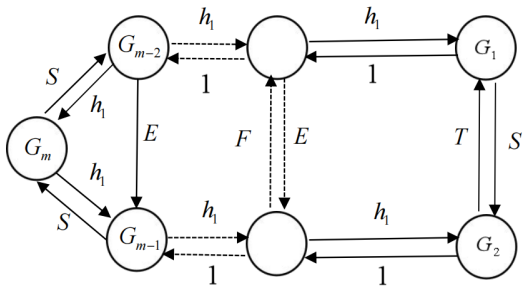
read the original abstract
The study of ORR was inspired by L\'{a}zsl\'{o} Babai in 1980 when he asked a question: Which [finite] groups admit an oriented graph as a DRR? And it has been solved by Joy Morris and Pablo Spiga through a series of papers in 2018. In this paper, we will extend the concept of ORR to $m$-partite oriented graphs for $m\geq 2$. We say that a finite group $G$ admits an \emph{$m$-partite oriented semiregular representation} ($m$-POSR) if there exists an $m$-partite oriented graph $\G$ such that its automorphism group is isomorphic to $G$ and acts semiregularly with the $m$ orbits giving the partition. Moreover, if $\G$ is regular, that is, each vertex has the same in- and out-valency, it can be viewed as the oriented version of an $m$-Haar graph of $G$ and we call $\G$ is an \emph{$m$-Haar oriented representation} ($m$-HOR) of $G$. Our main result is a complete classification of finite groups $G$ without $m$-HORs or $m$-POSRs for $m\geq 2$.
Editorial analysis
A structured set of objections, weighed in public.
Referee Report
Summary. The paper extends the oriented regular representation (ORR) framework of Morris and Spiga to m-partite oriented graphs for fixed m ≥ 2. It defines an m-POSR as an m-partite oriented graph whose automorphism group is isomorphic to G and acts semiregularly with the m parts as orbits; an m-HOR is the regular (constant in/out-valency) special case. The central claim is a complete classification of all finite groups G that admit neither an m-HOR nor an m-POSR.
Significance. The result generalizes the m=1 ORR classification by supplying explicit constructions of m-POSRs (and regular m-HORs) for all groups outside a short explicit list together with direct verification that the listed exceptions admit none. If the constructions and case analysis are correct, the work supplies a uniform, falsifiable description of which groups realize semiregular actions on m-partite oriented graphs, strengthening the link between group theory and oriented graph representations.
minor comments (3)
- [Introduction] §1 (Introduction): the sentence 'we will extend the concept' uses future tense; replace with present tense to match the completed-manuscript style used elsewhere.
- [Definition 2.3] Definition 2.3: the phrase 'acts semiregularly with the m orbits giving the partition' is slightly ambiguous about whether the partition is required to be the full set of orbits or merely a subset; add one clarifying sentence or parenthetical.
- [Theorem 4.1] Theorem 4.1 (main classification): the exceptional list for each m is stated without an accompanying table; a compact table summarizing the groups that lack both m-HOR and m-POSR for small m would improve readability.
Simulated Author's Rebuttal
We thank the referee for the detailed summary of our work extending the oriented regular representation framework to the m-partite setting and for the positive assessment of its significance. We appreciate the recommendation for minor revision and will incorporate any editorial improvements in the revised version.
Circularity Check
No significant circularity detected
full rationale
The paper defines m-POSR and m-HOR by extending the independent ORR framework of Morris and Spiga, then classifies groups via explicit constructions for all but a short explicit list of exceptions together with direct verification that those exceptions admit no such graphs. No step reduces a claimed prediction or classification result to a fitted parameter, self-definition, or load-bearing self-citation; the argument is self-contained case analysis resting on the stated semiregular-action and orbit-partition requirements.
Axiom & Free-Parameter Ledger
axioms (1)
- standard math Standard axioms of finite group theory and directed graph theory
Lean theorems connected to this paper
-
IndisputableMonolith/Foundation/AlexanderDuality.leanalexander_duality_circle_linking unclear?
unclearRelation between the paper passage and the cited Recognition theorem.
Definition 1.1 and Theorems 1.2-1.3: m-HOR / m-POSR via regular m-partite oriented graphs whose automorphism group is isomorphic to G and acts semiregularly with the m orbits giving the partition.
-
IndisputableMonolith/Cost/FunctionalEquation.leanwashburn_uniqueness_aczel unclear?
unclearRelation between the paper passage and the cited Recognition theorem.
Construction of m-Cayley digraphs Cay(G,(T_{i,j})_{m×m}) and reduction to elementary abelian 2-groups (Section 2, Lemma 3.1, Lemma 4.1).
What do these tags mean?
- matches
- The paper's claim is directly supported by a theorem in the formal canon.
- supports
- The theorem supports part of the paper's argument, but the paper may add assumptions or extra steps.
- extends
- The paper goes beyond the formal theorem; the theorem is a base layer rather than the whole result.
- uses
- The paper appears to rely on the theorem as machinery.
- contradicts
- The paper's claim conflicts with a theorem or certificate in the canon.
- unclear
- Pith found a possible connection, but the passage is too broad, indirect, or ambiguous to say the theorem truly supports the claim.
Reference graph
Works this paper leans on
-
[1]
Babai, Finite digraphs with given regular automorphism groups, Period
L. Babai, Finite digraphs with given regular automorphism groups, Period. Math. Hungar. 11 (1980), 257–270
work page 1980
- [2]
-
[3]
J. -L. Du, Y. -Q. Feng, S. Bang, On orientedm-semiregular representations of finite groups, J. Graph Theory, 107 (2024), 485–508
work page 2024
-
[4]
J. -L. Du, Y. -Q. Feng, P. Spiga, On Haar digraphical representations of groups, Discrete Math. 343 (2020), 112032: 1–6
work page 2020
-
[5]
J. -L. Du, Y. -Q. Feng, P. Spiga, Onn-partite digraphical representation of finite groups, J. Combin. Theory Ser. A 189 (2022), 105606: 1–13
work page 2022
-
[6]
J. -L. Du, Y. -Q. Feng, B. Xia, D.-W. Yang, The existence ofm-Haar graphical represen- tations, J. Combin. Theory Ser. A 218 (2026), 106096: 1–30
work page 2026
-
[7]
J. -L. Du, Y. S. Kwon, F.-G. Yin, Onm-partite oriented semiregular representations of finite groups generated by two elements, Discrete Math. 347 (2023), 114043:1–8
work page 2023
-
[8]
Godsil, GRR’s for non-solvable groups, in Algebraic Methods in Graph theory (Proc
C.D. Godsil, GRR’s for non-solvable groups, in Algebraic Methods in Graph theory (Proc. Conf. Szeged 1978 L. Lov´asz and V. T. Sos, eds), Coll. Math. Soc. J. Bolyai 25, North- Holland, Amsterdam, 1981, pp.221–239
work page 1978
-
[9]
D. Hetzel, ¨Uber regul¨are graphische Darstellung von aufl¨osbaren Gruppen, Technische Uni- versit¨ at, Berlin, 1976. (Diplomarbeit)
work page 1976
-
[10]
Imrich, Graphical regular representations of groups odd order, in: Combinatorics, Coll
W. Imrich, Graphical regular representations of groups odd order, in: Combinatorics, Coll. Math. Soc. J´ anos. Bolayi 18 (1976), 611–621. 13
work page 1976
- [11]
-
[12]
D. K¨onig, Theory of finite and infinite graphs, translated from the German by Richard McCoart, with a commentary by W. T. Tutte and a biographical sketch by T. Gallai, Birkhauser Boston, Inc., Boston, MA, 1990
work page 1990
-
[13]
W. Imrich, M.E. Watkins, On graphical regular representations of cyclic extensions of groups, Pac. J. Math. 55 (1974), 461–477
work page 1974
- [14]
- [15]
- [16]
-
[17]
L. A. Nowitz, M. E. Watkins, Graphical regular representations of non-abelian groups,I, Canad. J. Math. 24 (1972), 994–1008
work page 1972
-
[18]
L. A. Nowitz, M. E. Watkins, Graphical regular representations of non-abelian groups,II, Canad. J. Math. 24 (1972), 1009–1018
work page 1972
-
[19]
Spiga, Finite groups admitting an oriented regular representation, J
P. Spiga, Finite groups admitting an oriented regular representation, J. Combin. Theory Ser. A 153 (2018), 76–97. 14
work page 2018
discussion (0)
Sign in with ORCID, Apple, or X to comment. Anyone can read and Pith papers without signing in.