GSA-YOLO: A High-Efficiency Framework via Structured Sparsity and Adaptive Knowledge Distillation for Real-Time X-ray Security Inspection
Pith reviewed 2026-05-21 05:42 UTC · model grok-4.3
The pith
GSA-YOLO combines Group Lasso sparsity, head pruning, and adaptive distillation on YOLOv8n to raise X-ray detection accuracy at higher speed.
A machine-rendered reading of the paper's core claim, the machinery that carries it, and where it could break.
Core claim
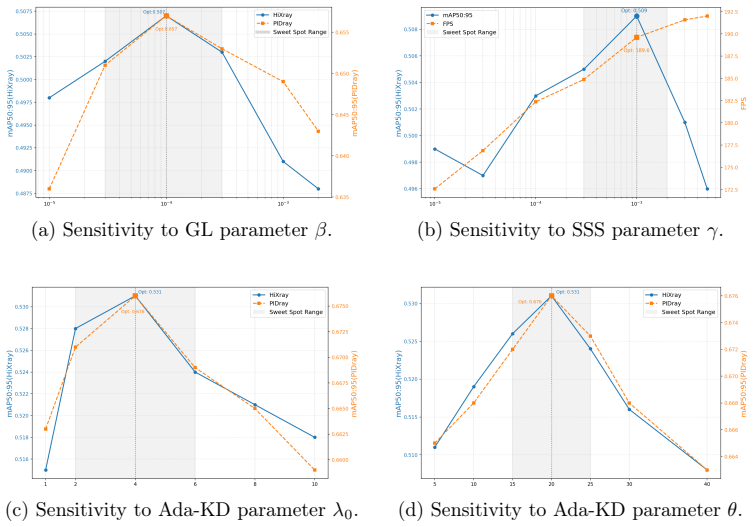
GSA-YOLO integrates Group Lasso on the neck for robust feature extraction, Sparse Structure Selection on the head for model slimming, and Adaptive Knowledge Distillation for accuracy recovery, yielding 189.62 FPS, a drop in computational cost from 8.7 G to 8.0 G, and mAP50:95 scores of 0.531 on HiXray and 0.679 on PIDray, each an improvement over the unmodified YOLOv8n baseline.
What carries the argument
Structured sparsity produced by Group Lasso applied to the neck together with Sparse Structure Selection on the head, followed by Adaptive Knowledge Distillation to restore performance on the YOLOv8n backbone.
If this is right
- X-ray security systems could process streams at nearly 190 frames per second on standard hardware while using fewer floating-point operations.
- The same pruning-plus-distillation recipe could be applied to other single-stage detectors when both latency and accuracy matter.
- Detection heads can be slimmed substantially without permanent accuracy loss if the distillation step is adapted to the remaining channels.
- Real-time prohibited-item alerts become feasible on edge devices placed at checkpoints.
Where Pith is reading between the lines
- The method might extend to other imaging modalities that share heavy occlusion and strict speed limits, such as baggage CT or industrial defect scanning.
- Further channel pruning could be explored by varying the Group Lasso penalty strength across different neck stages rather than applying it uniformly.
- A direct comparison against quantization-aware training would clarify whether sparsity or quantization delivers the larger efficiency gain for this task.
Load-bearing premise
The chosen mix of Group Lasso, Sparse Structure Selection, and Adaptive Knowledge Distillation will keep or improve robustness when the X-ray images contain occlusion levels, clutter patterns, or scanner hardware different from those in the HiXray and PIDray collections.
What would settle it
Running the model on a new X-ray test set collected from a different scanner model that contains higher average occlusion and reporting either lower mAP50:95 than the baseline or slower inference would falsify the central performance claim.
Figures




read the original abstract
X-ray security inspection requires accurate real-time detection of prohibited items, but existing models often struggle to balance the challenges of severe occlusion, complex clutter, and strict speed requirements. To overcome these challenges, this paper proposes GSA-YOLO, a novel lightweight framework built upon the YOLOv8n architecture, specifically engineered to enhance detection robustness and inference efficiency. GSA-YOLO strategically integrates structured sparsity and adaptive knowledge transfer through three core components: Group Lasso (GL) applied to the network neck for robust feature extraction; Sparse Structure Selection (SSS) applied to the detection head for significant model slimming; and an Adaptive Knowledge Distillation (Ada-KD) mechanism for comprehensive accuracy recovery. This integrated approach synergistically enhances feature representation while pruning redundant channels, maximizing model efficiency without sacrificing performance. Rigorous evaluations on the HiXray and PIDray datasets confirm GSA-YOLO's comprehensive capability, achieving a leading inference speed of 189.62 FPS, accompanied by a reduction in computational cost from 8.7G to 8.0G. Crucially, GSA-YOLO secures mAP50:95 results of 0.531 and 0.679 on HiXray and PIDray, demonstrating 2.4% and 1.8% improvements over the baseline, respectively. Compared to other models, GSA-YOLO exhibits enhanced accuracy while maintaining computational efficiency, making it a promising solution for practical X-ray security inspection.
Editorial analysis
A structured set of objections, weighed in public.
Referee Report
Summary. The paper proposes GSA-YOLO, a lightweight framework extending YOLOv8n for real-time X-ray security inspection. It applies Group Lasso regularization to the neck for robust feature extraction, Sparse Structure Selection to the detection head for model slimming, and Adaptive Knowledge Distillation to recover accuracy after pruning. On the HiXray and PIDray datasets, GSA-YOLO reports 189.62 FPS, FLOPs reduced from 8.7G to 8.0G, and mAP50:95 scores of 0.531 and 0.679 (improvements of 2.4% and 1.8% over the YOLOv8n baseline).
Significance. If the performance deltas are shown to arise specifically from the GL+SSS+Ada-KD pipeline under matched training conditions, the work supplies a concrete efficiency improvement for occlusion-heavy X-ray detection tasks. The reported speed-accuracy operating point is relevant for deployment in security screening pipelines.
major comments (2)
- [§4 Experiments and Table 2] §4 Experiments and Table 2: The 2.4% and 1.8% mAP50:95 gains over YOLOv8n are reported without stating that the baseline was retrained under identical optimizer, scheduler, augmentation, epoch count, and loss weighting. Because the FLOPs reduction is modest (8.7G to 8.0G), small hyper-parameter differences alone could produce the observed trade-off; explicit confirmation of matched training protocols is required to attribute the gains to the proposed components.
- [§3.2 and §3.3] §3.2 and §3.3: The Adaptive Knowledge Distillation mechanism is described at a high level but lacks the explicit loss formulation or schedule for the adaptation weights/temperature. Without these details, it is impossible to verify how accuracy is recovered after the Group Lasso and Sparse Structure Selection steps or to reproduce the exact contribution of Ada-KD.
minor comments (2)
- [§4] The results tables should report standard deviations or error bars across multiple random seeds for both mAP and FPS to allow assessment of statistical significance of the reported improvements.
- [§3.1] Implementation details for the Group Lasso regularization strength and Sparse Structure Selection thresholds should be listed explicitly (values, selection criteria) to support reproducibility.
Simulated Author's Rebuttal
We thank the referee for the constructive comments that highlight important aspects of reproducibility and clarity. We address each major comment below and will revise the manuscript accordingly to strengthen the presentation of our results.
read point-by-point responses
-
Referee: [§4 Experiments and Table 2] §4 Experiments and Table 2: The 2.4% and 1.8% mAP50:95 gains over YOLOv8n are reported without stating that the baseline was retrained under identical optimizer, scheduler, augmentation, epoch count, and loss weighting. Because the FLOPs reduction is modest (8.7G to 8.0G), small hyper-parameter differences alone could produce the observed trade-off; explicit confirmation of matched training protocols is required to attribute the gains to the proposed components.
Authors: We agree that explicit confirmation of matched training conditions is essential to attribute the observed gains specifically to the GL+SSS+Ada-KD pipeline. The YOLOv8n baseline was retrained from scratch under identical conditions to GSA-YOLO, including the same optimizer, learning-rate scheduler, augmentation pipeline, epoch count, batch size, and loss weighting. We will add a dedicated paragraph in §4 clarifying these matched protocols and will update the caption of Table 2 to state that all reported results use the same training configuration. revision: yes
-
Referee: [§3.2 and §3.3] §3.2 and §3.3: The Adaptive Knowledge Distillation mechanism is described at a high level but lacks the explicit loss formulation or schedule for the adaptation weights/temperature. Without these details, it is impossible to verify how accuracy is recovered after the Group Lasso and Sparse Structure Selection steps or to reproduce the exact contribution of Ada-KD.
Authors: We acknowledge that the current description of Ada-KD remains at a conceptual level. To enable verification and reproduction, we will expand §3.2 and §3.3 with the precise loss formulation (a weighted combination of detection loss and distillation loss), the functional form of the adaptive temperature schedule, and the rule used to adjust the adaptation weights during training. These additions will be accompanied by the corresponding equations and a brief pseudocode snippet. revision: yes
Circularity Check
No circularity: empirical measurements on fixed external datasets
full rationale
The paper proposes GSA-YOLO by combining Group Lasso on the neck, Sparse Structure Selection on the head, and Adaptive Knowledge Distillation for accuracy recovery on top of YOLOv8n. All reported outcomes (189.62 FPS, 8.7G to 8.0G FLOPs, mAP50:95 of 0.531/0.679 with +2.4%/+1.8% gains) are presented as direct measurements on the independent HiXray and PIDray datasets. No equations, parameters, or predictions are defined in terms of the target metrics themselves, no fitted inputs are relabeled as predictions, and no load-bearing steps reduce to self-citations or ansatzes imported from prior author work. The derivation chain consists of architectural modifications followed by standard training and evaluation; results remain falsifiable against external benchmarks and do not collapse to internal fits by construction.
Axiom & Free-Parameter Ledger
free parameters (3)
- Group Lasso regularization strength
- Sparse Structure Selection thresholds
- Adaptive Knowledge Distillation weights or temperature
axioms (2)
- domain assumption YOLOv8n is an appropriate starting architecture for X-ray prohibited-item detection
- domain assumption HiXray and PIDray datasets sufficiently represent real security inspection conditions
Lean theorems connected to this paper
-
IndisputableMonolith/Cost/FunctionalEquation.leanwashburn_uniqueness_aczel unclear?
unclearRelation between the paper passage and the cited Recognition theorem.
Group Lasso (GL) applied to the network neck... Sparse Structure Selection (SSS) applied to the detection head... Adaptive Knowledge Distillation (Ada-KD)
What do these tags mean?
- matches
- The paper's claim is directly supported by a theorem in the formal canon.
- supports
- The theorem supports part of the paper's argument, but the paper may add assumptions or extra steps.
- extends
- The paper goes beyond the formal theorem; the theorem is a base layer rather than the whole result.
- uses
- The paper appears to rely on the theorem as machinery.
- contradicts
- The paper's claim conflicts with a theorem or certificate in the canon.
- unclear
- Pith found a possible connection, but the passage is too broad, indirect, or ambiguous to say the theorem truly supports the claim.
Reference graph
Works this paper leans on
-
[1]
Kernel PCA for novelty detection
S. Akcay, T. Breckon, Towards automatic threat detection: a survey of advances of deep learning within X-ray security imaging, Pattern Recog- nition 122 (2022) 108245.doi:https://doi.org/10.1016/j.patcog. 2021.108245
-
[2]
J. Wu, X. Xu, J. Yang, Object detection and x-ray security imaging: A survey, IEEE Access 11 (2023) 45416–45441.doi:https://doi.org/ 10.1109/access.2023.3273736
-
[3]
unexpected item in the bagging area
L. D. Griffin, M. Caldwell, J. T. Andrews, H. Bohler, “unexpected item in the bagging area”: Anomaly detection in x-ray security images, IEEE Transactions on Information Forensics and Security 14 (6) (2018) 1539– 1553.doi:https://doi.org/10.1109/tifs.2018.2881700
-
[4]
Z. Wang, X. Wang, Y. Shi, H. Qi, M. Jia, W. Wang, Lightweight detec- tion method for x-ray security inspection with occlusion, Sensors 24 (3) (2024) 1002.doi:https://doi.org/10.3390/s24031002
-
[5]
Y. Li, S. Li, H. Du, L. Chen, D. Zhang, Y. Li, Yolo-acn: Focus- ing on small target and occluded object detection, IEEE access 8 (2020) 227288–227303.doi:https://doi.org/10.1109/access.2020. 3046515. 34
-
[6]
R. Laroca, E. Severo, L. A. Zanlorensi, L. S. Oliveira, G. R. Gonçalves, W. R. Schwartz, D. Menotti, A robust real-time automatic license plate recognition based on the yolo detector, in: 2018 international joint conference on neural networks (ijcnn), IEEE, 2018, pp. 1–10. doi:https://doi.org/10.1109/ijcnn.2018.8489629
-
[7]
T. Shao, D. Shin, Structured pruning for deep convolutional neural networks via adaptive sparsity regularization, in: 2022 IEEE 46th Annual Computers, Software, and Applications Conference (COMP- SAC), IEEE, 2022, p. 982–987.doi:https://doi.org/10.1109/ compsac54236.2022.00151. URLhttp://dx.doi.org/10.1109/compsac54236.2022.00151
-
[8]
Y. Li, S. Gu, C. Mayer, L. Van Gool, R. Timofte, Group sparsity: the hinge between filter pruning and decomposition for network compres- sion, in: Proceedings of the IEEE/CVF Conference on Computer Vision and Pattern Recognition (CVPR), 2020, pp. 8018–8027.doi:https: //doi.org/10.1109/cvpr42600.2020.00804
-
[9]
Z. Huang, N. Wang, Data-driven sparse structure selection for deep neural networks, in: V. Ferrari, M. Hebert, C. Sminchisescu, Y. Weiss (Eds.), Computer Vision – ECCV 2018, Vol. 11220, Springer Interna- tional Publishing, Cham, 2018, pp. 317–334.doi:https://doi.org/ 10.1007/978-3-030-01270-0_19
-
[10]
Distilling the Knowledge in a Neural Network
G. Hinton, O. Vinyals, J. Dean, Distilling the knowledge in a neural network (2015).doi:https://doi.org/10.48550/arXiv.1503.02531
work page internal anchor Pith review Pith/arXiv arXiv doi:10.48550/arxiv.1503.02531 2015
-
[11]
S. Zagoruyko, N. Komodakis, Paying more attention to attention: im- proving the performance of convolutional neural networks via attention transfer (2017).doi:https://doi.org/10.48550/arXiv.1612.03928
work page internal anchor Pith review Pith/arXiv arXiv doi:10.48550/arxiv.1612.03928 2017
-
[12]
F. Boutros, V. Štruc, N. Damer, Adadistill: adaptive knowledge distil- lation for deep face recognition, in: Computer Vision – ECCV 2024, Springer Nature Switzerland, 2025, pp. 163–182.doi:https://doi. org/10.1007/978-3-031-73001-6_10
-
[13]
Z. Zhu, Y. Zhu, H. Wang, N. Wang, J. Ye, X. Ling, Fdtnet: Enhancing frequency-aware representation for prohibited object detection from x- ray images via dual-stream transformers, Engineering Applications of 35 Artificial Intelligence 133 (2024) 108076.doi:https://doi.org/10. 1016/j.engappai.2024.108076
-
[14]
J. Ding, C. Ye, H. Wang, J. Huyan, M. Yang, W. Li, Foreign bodies detector based on detr for high-resolution x-ray images of textiles, IEEE TransactionsonInstrumentationandMeasurement72(2023)1–10.doi: https://doi.org/10.1109/TIM.2023.3246510
- [15]
-
[16]
A. Chang, Y. Zhang, S. Zhang, L. Zhong, L. Zhang, Detecting pro- hibited objects with physical size constraint from cluttered x-ray bag- gage images, Knowledge-Based Systems 237 (2022) 107916.doi:https: //doi.org/10.1016/j.knosys.2021.107916
-
[17]
T. Hassan, S. Akcay, M. Bennamoun, S. Khan, N. Werghi, A novel in- cremental learning driven instance segmentation framework to recognize highly cluttered instances of the contraband items, IEEE Transactions on Systems, Man, and Cybernetics: Systems 52 (11) (2021) 6937–6951. doi:https://doi.org/10.1109/TSMC.2021.3131421
-
[18]
C. Ma, L. Zhuo, J. Li, Y. Zhang, J. Zhang, Eaod-net: Effective anomaly object detection networks for x-ray images, IET Image Process- ing 16 (10) (2022) 2638–2651.doi:https://doi.org/10.1049/ipr2. 12514
-
[19]
Y. Wei, Y. Wang, H. Song, Cfpa-net: cross-layer feature fusion and parallel attention network for detection and classification of prohibited items in x-ray baggage images, in: 2021 IEEE 7th International Con- ference on Cloud Computing and Intelligent Systems (CCIS), IEEE, 2021, pp. 203–207.doi:https://doi.org/10.1109/CCIS53392.2021. 9754631
-
[20]
G. D. Raj, B. Prabadevi, Enhancing surface detection: a comprehensive analysis of various YOLO models, Heliyon 11 (3) (2025).doi:https: //doi.org/10.1016/j.heliyon.2025.e42433. 36
-
[21]
Y. Zhou, X. Xu, R. Wang, Ei-YOLO: efficiently improved YOLO on detection of prohibited items during security inspections, in: Pattern Recognition and Computer Vision, Springer Nature, Singapore, 2025, pp. 330–343.doi:https://doi.org/10.1007/978-981-97-8858-3_ 23
-
[22]
A. Wang, P. Yuan, H. Wu, Y. Iwahori, Y. Liu, Improved YOLOv8 for dangerous goods detection in X-ray security images, Electronics 13 (16) (2024) 3238.doi:https://doi.org/10.3390/electronics13163238
-
[23]
Y. LeCun, J. Denker, S. Solla, Optimal brain damage, in: Advances in Neural Information Processing Systems, Vol. 2, Morgan-Kaufmann, 1989, pp. 589–605.doi:https://doi.org/10.3156/jfuzzy.9.1_50_2
-
[24]
S. Han, H. Mao, W. J. Dally, Deep compression: compressing deep neural networks with pruning, trained quantization and huffman coding (2016).doi:10.48550/arXiv.1510.00149
work page internal anchor Pith review Pith/arXiv arXiv doi:10.48550/arxiv.1510.00149 2016
-
[25]
Z. Liu, J. Li, Z. Shen, G. Huang, S. Yan, C. Zhang, Learning efficient convolutional networks through network slimming, in: Proceedings of the IEEE International Conference on Computer Vision (ICCV), 2017, pp. 2736–2744.doi:https://doi.org/10.1109/iccv.2017.298
- [26]
-
[27]
K. Bui, F. Park, S. Zhang, Y. Qi, J. Xin, Structured sparsity of con- volutional neural networks via nonconvex sparse group regularization, Frontiers in Applied Mathematics and Statistics 6 (2021).doi:https: //doi.org/10.3389/fams.2020.529564
-
[28]
Y. Shao, K. Zhao, Z. Cao, Z. Peng, X. Peng, P. Li, Y. Wang, J. Ma, Mobileprune: neural network compression viaℓ0 sparse group lasso on the mobile system, Sensors 22 (11) (2022) 4081.doi:https://doi. org/10.3390/s22114081
-
[29]
M. Park, D. Kim, C. Park, Y. Park, G. E. Gong, W. W. Ro, S. Kim, Reprune: channel pruning via kernel representative selection, Proceed- 37 ings of the AAAI Conference on Artificial Intelligence 38 (13) (2024) 14545–14553.doi:https://doi.org/10.1609/aaai.v38i13.29370
- [30]
-
[31]
H. Zhang, L. Liu, Y. Huang, Z. Yang, X. Lei, B. Wen, Cakdp: category- aware knowledge distillation and pruning framework for lightweight 3D object detection, in: Proceedings of the IEEE/CVF Conference on Com- puter Vision and Pattern Recognition (CVPR), 2024, pp. 15331–15341. doi:https://doi.org/10.1109/CVPR52733.2024.01452
-
[32]
H. Song, J. Xie, Y. Duan, X. Xie, Y. Zhou, W. Wang, Cmkd-net: a cross-modal knowledge distillation method for remote sensing im- age classification, Advances in Space Research 75 (2025) 8515–8534. doi:https://doi.org/10.1016/j.asr.2024.12.XXX
-
[33]
H. Song, J. Xie, Liang, Y. Su, Y. Xiao, X. Zhang, Y. Ouyang, X. Li, S. Chen, Y. Li, Symmetrical learning and transferring: Efficient knowl- edge distillation for remote sensing image classification, Symmetry 17 (2025).doi:https://doi.org/10.3390/sym17010XXX
-
[34]
S. Umirzakova, S. Mardieva, S. Muksimova, J. Baltayev, Y. Im Cho, It- erativecontextualandadaptivestrategiesforenhancedmonoculardepth estimation, Engineering Applications of Artificial Intelligence 160 (2025) 111898.doi:https://doi.org/10.1016/j.engappai.2024.111898
-
[35]
R. Ma, Y. Zhang, B. Zhang, L. Fang, D. Huang, L. Qi, Learning at- tention in the frequency domain for flexible real photograph denois- ing, IEEE Transactions on Image Processing 33 (2024) 3707–3721. doi:https://doi.org/10.1109/tip.2024.3404253
- [36]
- [37]
-
[38]
C. Miao, L. Xie, F. Wan, C. Su, H. Liu, J. Jiao, Q. Ye, Sixray: a large- scale security inspection X-ray benchmark for prohibited item discovery in overlapping images, in: Proceedings of the IEEE/CVF Conference on Computer Vision and Pattern Recognition (CVPR), 2019, pp. 2119– 2128.doi:https://doi.org/10.1109/cvpr.2019.00222
-
[39]
R. Tao, Y. Wei, X. Jiang, H. Li, H. Qin, J. Wang, Y. Ma, L. Zhang, X. Liu, Towards real-world X-ray security inspection: a high-quality benchmark and lateral inhibition module for prohibited items detection (2021).doi:https://doi.org/10.1109/iccv48922.2021.01074
-
[40]
B. Wang, L. Zhang, L. Wen, X. Liu, Y. Wu, Towards real-world prohib- ited item detection: a large-scale X-ray benchmark (2021).doi:https: //doi.org/10.1109/iccv48922.2021.00536
-
[41]
S. Ren, K. He, R. Girshick, J. Sun, Faster r-cnn: towards real-time object detection with region proposal networks, in: Advances in Neural Information Processing Systems, Vol. 28, 2015, pp. 91–99.doi:https: //doi.org/10.1109/tpami.2016.2577031
-
[42]
J. Redmon, S. Divvala, R. Girshick, A. Farhadi, You only look once: unified, real-time object detection, in: Proceedings of the IEEE Confer- ence on Computer Vision and Pattern Recognition (CVPR), 2016, pp. 779–788.doi:https://doi.org/10.1109/cvpr.2016.91
-
[43]
YOLOv3: An Incremental Improvement
J. Redmon, A. Farhadi, Yolov3: an incremental improvement (2018). doi:https://doi.org/10.48550/arXiv.1804.02767
work page internal anchor Pith review Pith/arXiv arXiv doi:10.48550/arxiv.1804.02767 2018
-
[44]
T.-Y. Lin, P. Goyal, R. Girshick, K. He, P. Dollár, Focal loss for dense object detection, in: Proceedings of the IEEE international conference on computer vision, 2017, pp. 2980–2988.doi:https://doi.org/10. 1109/iccv.2017.324
work page 2017
-
[45]
G. Jocher, A. Stoken, J. Borovec, et al., ultralytics/yolov5: v3.0, Zenodo (2020).doi:https://doi.org/10.5281/zenodo.3983579. 39
- [46]
-
[47]
Y. Zhou, X. Feng, S. Tang, J. Yang, S. Chen, X. Meng, Z. Liang, R. Ma, L. Qi, Dual attention guided context-aware feature learning for residual unfilled grains detection on threshed rice panicles, Artificial Intelligence in Agriculture 16 (1) (2026) 514–528.doi:https://doi.org/10.1016/ j.aiia.2025.11.005
work page 2026
-
[48]
S. Luo, Y. Zhang, Z. Zhang, B. Guo, J. J. Lian, H. Jiang, S. Zou, W. Wang, Epdd-yolo: an efficient benchmark for pavement damage de- tection based on mamba-yolo, Measurement 253 (2025).doi:https: //doi.org/10.1016/j.measurement.2025.117638
-
[49]
X. Huang, Y. Zhang, Scanguard-YOLO: enhancing X-ray prohibited item detection with significant performance gains (2023).doi:https: //doi.org/10.3390/s24010102
-
[50]
H. Wang, R. Tao, W. Wang, Y. Wei, Pad-f: prior-aware debias- ing framework for long-tailed X-ray prohibited item detection (2024). doi:https://doi.org/10.48550/arXiv.2411.18078
-
[51]
L. Han, C. Ma, Y. Liu, J. Jia, J. Sun, Sc-YOLOv8: a security check model for the inspection of prohibited items in X-ray images, Electronics 12 (20) (2023) 4208.doi:https://doi.org/10.3390/ electronics12204208
work page 2023
-
[52]
J. Cani, C. Diou, S. Evangelatos, V. Argyriou, P. Radoglou- Grammatikis, P. Sarigiannidis, I. Varlamis, G. T. Papadopoulos, Illicit objectdetectioninX-rayimagingusingdeeplearningtechniques: acom- parative evaluation (2025).doi:https://doi.org/10.48550/arXiv. 2507.17508
work page internal anchor Pith review doi:10.48550/arxiv 2025
-
[53]
Y.-T. Zhou, K.-Y. Cao, D. Li, J.-C. Piao, Fine-YOLO: a simplified X- ray prohibited object detection network based on feature aggregation and normalized wasserstein distance (2024).doi:https://doi.org/ 10.3390/s24113588
-
[54]
M. Chen, Z. Zhang, N. Jiang, X. Li, X. Zhang, YOLO-SRW: an en- hanced YOLO algorithm for detecting prohibited items in X-ray security 40 images | IEEE journals & magazine | IEEE xplore (2025).doi:https: //doi.org/10.1109/access.2025.3560840
-
[55]
A. Haq, N. Suciati, N. D. Bui, ESI-YOLO: enhancing YOLOv8 with efficient multi-scale attention and wise-IoU for X-ray security inspec- tion, International Journal of Robotics and Control Systems 5 (3) (2025) 1770–1789.doi:https://doi.org/10.31763/ijrcs.v5i3.1983
- [56]
-
[57]
Q. Xiang, X. Wang, Lei, Y. Song, Dynamic bound adaptive gradient methods with belief in observed gradients, Pattern Recognition 168 (2025).doi:https://doi.org/10.1016/j.patcog.2025.111819
-
[58]
M. Q. Ibrahim, M. Qaraad, N. K. Hussein, M. A. Farag, D. Guino- vart, Secant optimization algorithm for efficient global optimiza- tion, Scientific Reports (2026) 1–50doi:https://doi.org/10.1038/ s41598-026-36691-z
work page 2026
-
[59]
N. K. Hussein, M. Qaraad, A. M. E. Najjar, M. A. Farag, M. A. El- hosseini, S. Mirjalili, D. Guinovart, Schrödinger optimizer: A quan- tum duality-driven metaheuristic for stochastic optimization and engi- neering challenges, Knowledge-Based Systems 328 (2025).doi:https: //doi.org/10.1016/j.knosys.2025.114273. 41
discussion (0)
Sign in with ORCID, Apple, or X to comment. Anyone can read and Pith papers without signing in.