A systematic study of CO/SiO absorption features in early-type galaxies using AKARI/IRC near-infrared spectra
Pith reviewed 2026-05-21 04:13 UTC · model grok-4.3
The pith
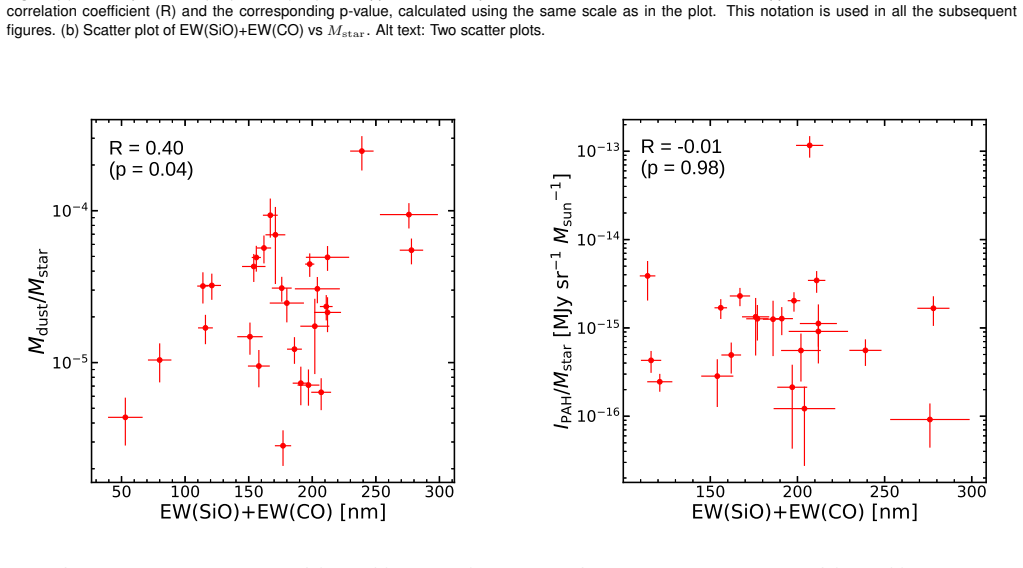
Dust mass in early-type galaxies correlates with the summed equivalent widths of SiO and CO absorption features from old stars.
A machine-rendered reading of the paper's core claim, the machinery that carries it, and where it could break.
Core claim
Analysis of AKARI near-infrared spectra reveals that the dust mass in early-type galaxies correlates with the summed equivalent widths of SiO and CO absorption features. This trend indicates that a significant fraction of dust originates from mass loss from evolved stars, supporting an internal production scenario. PAHs are detected but show no correlation with these features, instead correlating with hot and warm dust luminosities, suggesting an external origin associated with mergers.
What carries the argument
The correlation between dust mass and the summed equivalent widths of SiO and CO absorption features, which traces the contribution from old stellar populations.
Load-bearing premise
That the SiO and CO equivalent widths cleanly measure the properties of the old stellar population without contamination from dust, young stars, or AGN, and that the correlation directly implies the dust origin rather than being driven by other galaxy properties like mass or metallicity.
What would settle it
A larger sample of ETGs showing no correlation or a negative correlation between dust mass and the summed SiO and CO equivalent widths would falsify the internal production scenario.
Figures




read the original abstract
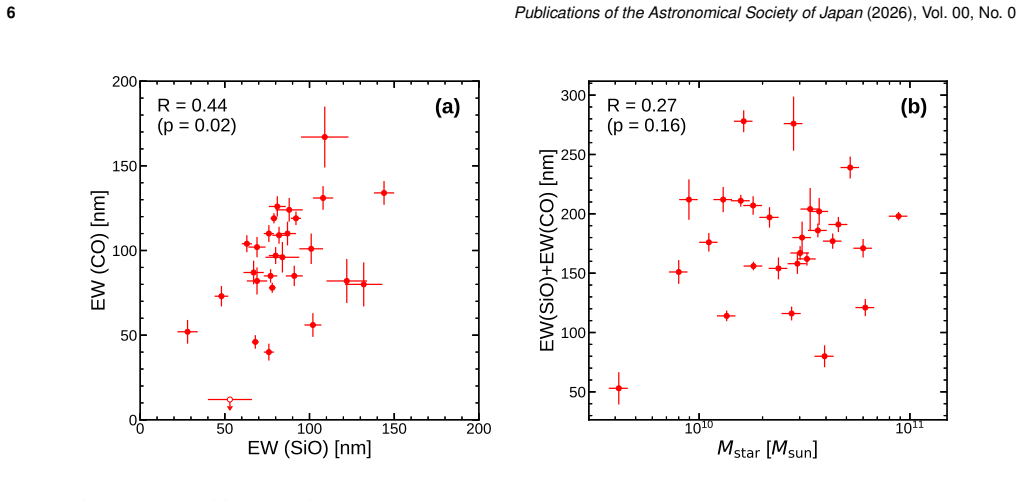
The origin of dust in early-type galaxies (ETGs) remains a long-standing question, with proposed sources being mass loss from evolved stars, galaxy mergers, or grain growth in the interstellar medium. To investigate the dominant source of dust in ETGs, we analyzed near-infrared spectra of 30 ETGs obtained with AKARI, focusing on the SiO and CO absorption features tracing the photospheres of old stellar populations. We also derived the dust mass using near- to far-infrared photometric data obtained by 2MASS, WISE, and AKARI. We find that the dust mass correlates with the summed equivalent widths of the SiO and CO absorption features. This trend suggests that a significant fraction of dust in ETGs may originate from mass loss from evolved stars, consistent with an internal production scenario. The dust mass shows no anti-correlation with diffuse X-ray luminosities, suggesting that dust in ETGs is not strongly interacting with X-ray plasma. Moreover, polycyclic aromatic hydrocarbons (PAHs) are detected in the near-infrared spectra. We find that the PAH intensity shows no correlation with the equivalent widths of SiO and CO, but correlates with the luminosity of hot and warm dust components. This suggests that PAHs may be of external origin associated with galaxy merger remnants, heated by the activities of galactic nuclei.
Editorial analysis
A structured set of objections, weighed in public.
Referee Report
Summary. The manuscript analyzes near-infrared spectra of 30 early-type galaxies from AKARI/IRC, measuring equivalent widths of SiO and CO absorption features as tracers of old stellar photospheres. Dust masses are derived from 2MASS, WISE, and AKARI photometry. The central result is a reported positive correlation between dust mass and the summed SiO+CO equivalent widths, interpreted as evidence that a significant fraction of dust originates from mass loss by evolved stars (internal production). Additional findings include no anti-correlation with diffuse X-ray luminosities and PAH intensity correlating with hot/warm dust luminosity but not with the absorption EWs, suggesting external origin for PAHs.
Significance. If the correlation is shown to be independent of stellar mass and metallicity, the result would provide direct observational support for internal dust production in ETGs, addressing a key open question in galaxy evolution. The systematic linkage of photospheric absorption features to dust content via multi-wavelength data is a methodological strength that could inform models of dust lifecycle in quiescent systems.
major comments (2)
- [Results (correlation analysis)] Results section (dust mass vs. summed EW correlation): The interpretation that the correlation supports internal dust production from evolved-star mass loss is weakened because no test rules out a secondary dependence on galaxy stellar mass or metallicity. Both quantities can scale with total stellar mass (more stars yield stronger absorption and more dust from any channel), so the trend is expected even in an external-dust scenario. A partial-correlation analysis controlling for K-band luminosity or [Fe/H] proxies, or plots of mass-normalized dust mass versus EWs, is required to establish discriminatory power.
- [Methods] Methods and sample description: The abstract and main text supply insufficient quantitative detail on sample selection criteria for the 30 ETGs, measurement uncertainties on the equivalent widths and dust masses, and the statistical significance (e.g., Spearman rank or p-value) of the reported correlation. These omissions make it impossible to evaluate whether post-hoc choices affect the central result.
minor comments (3)
- [Abstract] Abstract: Include the sample size (30) and a brief quantitative descriptor of the correlation strength for immediate context.
- [Figures and text] Figure captions and text: Ensure consistent terminology for PAH 'intensity' versus 'luminosity' and confirm that all correlation plots display error bars and fit uncertainties.
- [Introduction/Discussion] References: Add citations to prior works on dust origins in ETGs (e.g., merger vs. internal production debates) to better situate the new correlation result.
Simulated Author's Rebuttal
We thank the referee for the constructive and insightful comments, which have helped us identify areas where the manuscript can be clarified and strengthened. We respond to each major comment below, explaining our position and indicating the revisions we will make.
read point-by-point responses
-
Referee: Results section (dust mass vs. summed EW correlation): The interpretation that the correlation supports internal dust production from evolved-star mass loss is weakened because no test rules out a secondary dependence on galaxy stellar mass or metallicity. Both quantities can scale with total stellar mass (more stars yield stronger absorption and more dust from any channel), so the trend is expected even in an external-dust scenario. A partial-correlation analysis controlling for K-band luminosity or [Fe/H] proxies, or plots of mass-normalized dust mass versus EWs, is required to establish discriminatory power.
Authors: We thank the referee for highlighting this potential issue. We note, however, that the SiO and CO equivalent widths are measured on continuum-normalized spectra; as such, they quantify the intrinsic depth of the photospheric features and do not scale directly with total stellar luminosity or mass. The observed correlation between these normalized absorption strengths and total dust mass therefore indicates that systems showing stronger signatures of evolved stellar populations contain proportionally more dust, which is consistent with an internal origin via stellar mass loss rather than a simple scaling with galaxy size. To further address the referee’s concern and test robustness against stellar-mass dependence, we will add a partial-correlation analysis that controls for K-band luminosity (as a stellar-mass proxy) to the revised manuscript. revision: partial
-
Referee: Methods and sample description: The abstract and main text supply insufficient quantitative detail on sample selection criteria for the 30 ETGs, measurement uncertainties on the equivalent widths and dust masses, and the statistical significance (e.g., Spearman rank or p-value) of the reported correlation. These omissions make it impossible to evaluate whether post-hoc choices affect the central result.
Authors: We agree that additional quantitative information will improve transparency and allow readers to assess the robustness of the results. In the revised manuscript we will expand the sample-selection description to include explicit quantitative criteria (redshift range, magnitude limits, and morphological classification details). We will also report the formal uncertainties on the equivalent-width measurements (derived from the AKARI/IRC spectra) and on the dust-mass estimates (from the 2MASS/WISE/AKARI photometry). Finally, we will quote the Spearman rank correlation coefficient and its associated p-value for the dust-mass versus summed-EW relation. revision: yes
Circularity Check
No circularity: purely observational correlation between independently measured quantities
full rationale
The paper reports an empirical correlation between dust mass (derived from multi-band photometry) and summed equivalent widths of SiO and CO absorption features (measured directly from AKARI near-IR spectra). No equations, model fits, or self-citations are used to derive one quantity from the other; the trend is presented as an observational result. The interpretation linking the correlation to internal dust production is an inference, not a mathematical reduction that collapses to the input data by construction. This matches the default expectation of a non-circular observational study.
Axiom & Free-Parameter Ledger
axioms (1)
- domain assumption SiO and CO absorption features trace the photospheres of old stellar populations
Reference graph
Works this paper leans on
- [1]
- [2]
- [3]
- [4]
-
[5]
Cesetti, M., et al. 2009, A&A, 497, 41 Cutri R. M., et al. 2013, Explanatory Supplement to the AllWI SE Data Release Products
work page 2009
-
[6]
Davis, T. A. et al. 2013, MNRAS, 429, 534
work page 2013
- [7]
- [8]
- [9]
-
[10]
Draine, B. T. 2003, ARA&A, 41, 241
work page 2003
- [11]
- [12]
- [13]
-
[14]
Goudfrooij, P ., Hansen, L., Jorgensen, H. E., Norgaard-Nielsen, H. U. 1994, A&AS, 105, 341
work page 1994
-
[15]
Goulding, A. D., Greene, J. E., Ma, C.-P ., V eale, M., Bogdan, A., Nyland, K., Blakeslee, J. P ., et al. 2016, ApJ, 826, 167
work page 2016
- [16]
- [17]
-
[18]
H., Chester, T., Cutri, R., Schneider, S., Skrut skie, M., Huchra, J
Jarrett, T. H., Chester, T., Cutri, R., Schneider, S., Skrut skie, M., Huchra, J. P . 2000, AJ, 119, 2498
work page 2000
- [19]
-
[20]
Kaneda, H., Onaka, T., Sakon, I., Kitayama, T., Okada, Y ., Su zuki, T. 2008, ApJ, 684, 270
work page 2008
-
[21]
Kaneda, H., Ishihara, D., Onaka, T., Suzuki, T., Mori, T., Oy abu, S., Y amagishi, M. 2011, PASJ, 63, 601
work page 2011
-
[22]
Karakas, A. I. 2010, MNRAS, 403, 1413
work page 2010
- [23]
- [24]
-
[25]
R., Guhathakurta, P ., Kim, D.-W., Jura, M
Knapp, G. R., Guhathakurta, P ., Kim, D.-W., Jura, M. A. 1989, ApJS, 70, 329
work page 1989
- [26]
-
[27]
Kokusho, T., Kaneda, H., Bureau, M., Suzuki, T., Murata, K., Kondo, A., Y amagishi, M. 2017, A&A, 605, A74
work page 2017
- [28]
- [29]
- [30]
-
[31]
Markwardt, C. B. 2009, ASPC, 411, 251
work page 2009
-
[32]
Martini, P ., Dicken, D., & Storchi-Bergmann, T. 2013, ApJ, 766, 121
work page 2013
-
[33]
Mathews, W. G., & Brighenti, F. 2003, ApJ, 599, 992 Publications of the Astronomical Society of Japan (2026), Vol. 00, No. 0 9
work page 2003
-
[34]
Mori, T., Kaneda, H., Ishihara, D., Oyabu, S., Wada, T. 2011, PASP , 123, 942
work page 2011
- [35]
- [36]
- [37]
-
[38]
Origlia, L., Moorwood, A. F. M., Oliva, E. 1993, A&A, 280, 536
work page 1993
-
[39]
Rampazzo, R., Panuzzo, P ., V ega, O., Marino, A., Bressan, A. , Clemens, M. S. 2013, MNRAS, 432, 374
work page 2013
- [40]
-
[41]
Smith, M. W. L., et al. 2012, ApJ, 748, 123
work page 2012
- [42]
- [43]
-
[44]
Temi, P ., Brighenti, F., Mathews, W. G., Bregman, J. D. 2004, ApJS, 151, 237
work page 2004
-
[45]
Temi, P ., Brighenti, F., & Mathews, W. G. 2007, ApJ, 660, 1215
work page 2007
-
[46]
Temi, P ., Mathews, W. G., Brighenti, F., Bregman, J. D. 2003, ApJL, 585, L121
work page 2003
-
[47]
Trinchieri, G., Fabbiano, G., Canizares, C. R. 1986, ApJ, 31 0, 637
work page 1986
- [48]
-
[49]
Tsuji, T., 1978, PASJ, 30, 435 Y oung, L. M., Bureau, M., Cappellari, M. 2008, ApJ, 676, 317 Y oung, L. M., Bureau, M., Davis, T. A., Combes, F., McDermid, R. M.,
work page 1978
- [50]
discussion (0)
Sign in with ORCID, Apple, or X to comment. Anyone can read and Pith papers without signing in.