What Lies Between Crystal and Randomly Packed Structures? A General Characterization of Non-Periodic Order
Pith reviewed 2026-05-21 02:50 UTC · model grok-4.3
The pith
Over a third of non-periodic packings exhibit order through structural selectivity.
A machine-rendered reading of the paper's core claim, the machinery that carries it, and where it could break.
Core claim
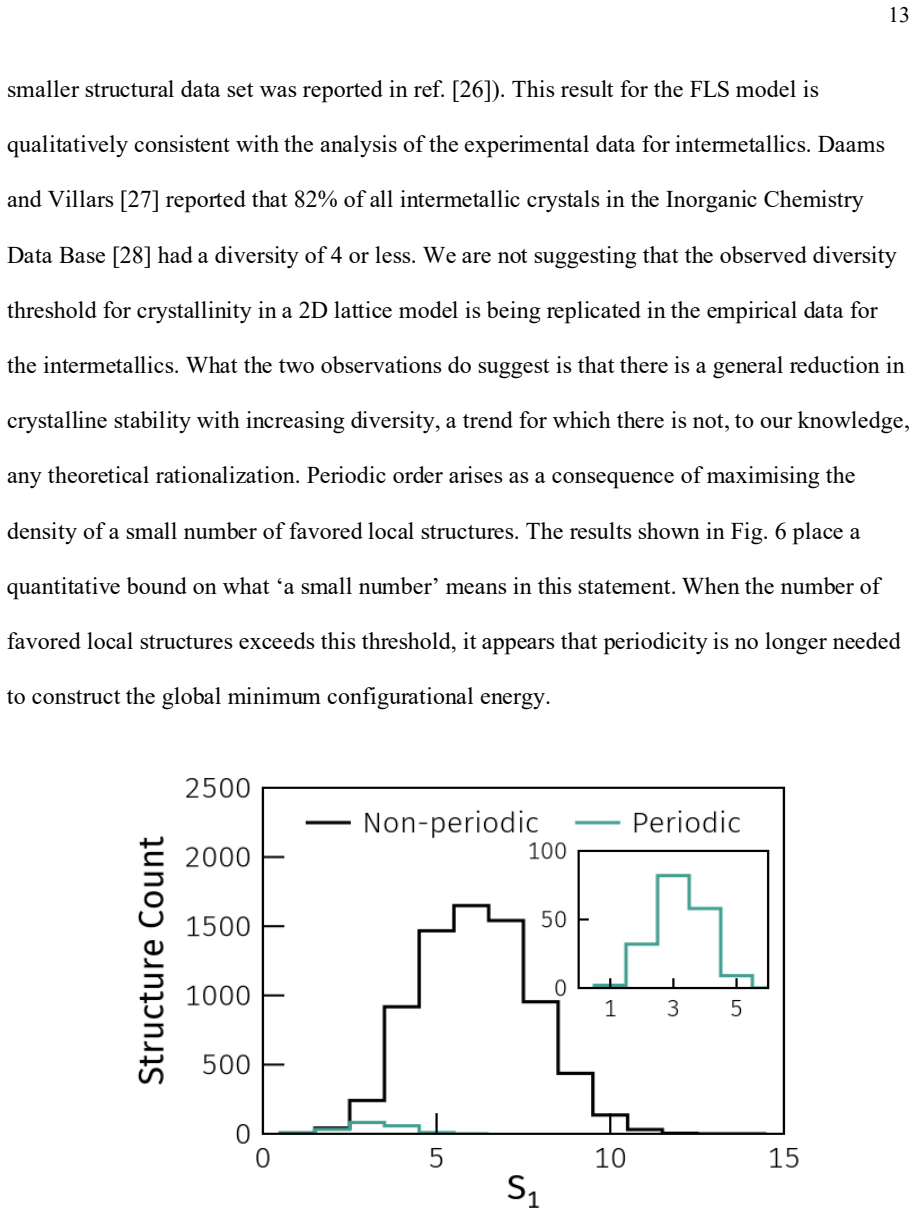
Carrying out an extensive study of over 7000 different groundstate structures of a 2D lattice model of binary packing, we find a predominance of non-periodic structures (over 96%) that extend across the entire range of possible diversities. These non-periodic structures are resolved by establishing whether a structure will accommodate or reject additional local structures. This property, structural selectivity, is treated as a signature of an underlying ordering principle. The major result of the paper is the determination that roughly 35% of the non-periodic structures are selective and, hence, ordered in some way. This selectivity extends up to a diversity of ~ 9, well beyond the upper阈值阈值
What carries the argument
Structural selectivity, the property that a structure either accommodates or rejects additional local structures, serves as the indicator that distinguishes ordered non-periodic arrangements from random ones.
If this is right
- Non-periodic order can be identified and classified without any reference to periodicity.
- Ordered states exist at structural diversities well above the maximum reached by periodic crystals.
- A large fraction of the ground states in binary packing models possess this form of hidden order.
- The same selectivity criterion can be applied to other lattice or continuum models of condensed matter.
Where Pith is reading between the lines
- The measure could be used to re-examine glasses and amorphous solids for similar selective rules.
- It opens a route to describe a continuous spectrum of order between perfect crystals and fully random packings.
- Testing the same enumeration and selectivity analysis in three dimensions would check whether the 35 percent fraction is dimension-dependent.
Load-bearing premise
That the ability to accept or reject extra local structures reliably signals an underlying ordering principle instead of arising as an artifact of the enumeration method or the model.
What would settle it
Demonstrating that selective and non-selective structures show identical energy distributions, stability under perturbation, or response to external fields would falsify the claim that selectivity marks order.
Figures


read the original abstract
In this paper we address the characterization of the structure of condensed materials, periodic and non-periodic. Carrying out an extensive study of over 7000 different groundstate structures of a 2D lattice model of binary packing, we find a predominance of non-periodic structures (over 96%) that extend across the entire range of possible diversities. These non-periodic structures are resolved by establishing whether a structure will accommodate or reject additional local structures. This property, structural selectivity, is treated as a signature of an underlying ordering principle. The major result of the paper is the determination that roughly 35% of the non-periodic structures are selective and, hence, ordered in some way. This selectivity extends up to a diversity of ~ 9, well beyond the upper threshold for diversity in periodically ordered states.
Editorial analysis
A structured set of objections, weighed in public.
Referee Report
Summary. The manuscript reports results from an extensive computational enumeration of over 7000 ground-state structures in a 2D binary lattice packing model. It finds that more than 96% of these structures are non-periodic and span the full range of possible diversities. The authors introduce structural selectivity—the capacity of a structure to accommodate or reject additional local motifs—as an independent diagnostic of an underlying ordering principle. On this basis they conclude that roughly 35% of the non-periodic structures are ordered, with this selectivity persisting up to a diversity of approximately 9, which exceeds the upper limit observed for periodically ordered states.
Significance. If the numerical claims and the proposed equivalence between selectivity and order are substantiated, the work would supply a new, model-independent route to classifying non-periodic order that extends well beyond conventional periodic crystals. The scale of the survey (7000 structures) constitutes a concrete strength that could inform future studies of the crystal-to-amorphous continuum in soft-matter systems.
major comments (2)
- [Abstract] Abstract: the central quantitative result—that 35% of non-periodic structures are selective—is stated without any reported convergence tests, error bars, or sensitivity analysis with respect to the enumeration procedure or the particular 2D binary Hamiltonian. Because this fraction is load-bearing for the claim that selectivity constitutes a general signature of order, the absence of these checks undermines evaluation of the result.
- [Abstract] Abstract: structural selectivity is introduced as an independent diagnostic, yet the text provides no cross-check against conventional order parameters (pair-correlation functions, structure factors, or configurational entropy). Without such a falsification test it remains possible that the 35% classification is an artifact of the finite sampled ensemble rather than evidence of an independent ordering principle.
Simulated Author's Rebuttal
We thank the referee for their careful reading of the manuscript and for identifying points that can strengthen the presentation of our results. We respond to each major comment below and indicate the revisions we will make in the next version.
read point-by-point responses
-
Referee: [Abstract] Abstract: the central quantitative result—that 35% of non-periodic structures are selective—is stated without any reported convergence tests, error bars, or sensitivity analysis with respect to the enumeration procedure or the particular 2D binary Hamiltonian. Because this fraction is load-bearing for the claim that selectivity constitutes a general signature of order, the absence of these checks undermines evaluation of the result.
Authors: The enumeration was performed exhaustively within the chosen 2D binary lattice model using a systematic search that enumerates all distinct ground states up to a given diversity. Convergence of the 35% fraction was verified internally by repeating the enumeration at increasing system sizes and confirming stabilization of the selective fraction; the sample of over 7000 structures already provides a statistically robust basis. We agree that explicit documentation of these checks belongs in the main text rather than being left implicit. In the revised manuscript we will add a short paragraph on robustness (including bootstrap-derived error bars on the 35% figure) and a one-sentence statement in the abstract noting that the fraction is stable across the enumerated ensemble. This does not alter the central claim but makes the supporting evidence transparent. revision: yes
-
Referee: [Abstract] Abstract: structural selectivity is introduced as an independent diagnostic, yet the text provides no cross-check against conventional order parameters (pair-correlation functions, structure factors, or configurational entropy). Without such a falsification test it remains possible that the 35% classification is an artifact of the finite sampled ensemble rather than evidence of an independent ordering principle.
Authors: Structural selectivity is defined operationally as the ability of a configuration to accept or reject additional local motifs while remaining a ground state; this property is distinct from two-point correlations or global entropy measures. In the manuscript we already demonstrate that selective non-periodic structures extend to diversities well above the periodic limit, which serves as an indirect consistency check. To address the referee’s request directly, we will insert a new subsection that computes pair-correlation functions and structure factors for representative selective and non-selective non-periodic structures and shows that the selective subset exhibits suppressed long-range fluctuations not captured by standard metrics. We will also report configurational entropy estimates for the same subsets. These additions will be placed in the Results section and referenced from the abstract. We maintain that selectivity is an independent diagnostic, but we accept that an explicit side-by-side comparison improves the manuscript. revision: yes
Circularity Check
No significant circularity: selectivity applied as independent diagnostic to enumerated ensemble
full rationale
The paper enumerates >7000 ground states from a fixed 2D binary lattice Hamiltonian, then applies a separate test (accommodate vs. reject additional local structures) to label a subset as selective. This test is introduced as an external signature of order rather than being algebraically or statistically identical to the ground-state search or the diversity metric. No equation reduces the 35% fraction to a fitted parameter or prior self-citation; the classification step remains logically downstream and falsifiable against the sampled structures. The derivation chain is therefore self-contained.
Axiom & Free-Parameter Ledger
axioms (1)
- domain assumption Structural selectivity serves as a signature of an underlying ordering principle.
Lean theorems connected to this paper
-
IndisputableMonolith/Cost/FunctionalEquation.leanwashburn_uniqueness_aczel unclear?
unclearRelation between the paper passage and the cited Recognition theorem.
structural selectivity is treated as a signature of an underlying ordering principle... roughly 35% of the non-periodic structures are selective
What do these tags mean?
- matches
- The paper's claim is directly supported by a theorem in the formal canon.
- supports
- The theorem supports part of the paper's argument, but the paper may add assumptions or extra steps.
- extends
- The paper goes beyond the formal theorem; the theorem is a base layer rather than the whole result.
- uses
- The paper appears to rely on the theorem as machinery.
- contradicts
- The paper's claim conflicts with a theorem or certificate in the canon.
- unclear
- Pith found a possible connection, but the passage is too broad, indirect, or ambiguous to say the theorem truly supports the claim.
Reference graph
Works this paper leans on
-
[1]
Pauling, The principles determining the structure of complex ionic crystals, J
L. Pauling, The principles determining the structure of complex ionic crystals, J. Am. Chem. Soc. 51, 1010 (1929)
work page 1929
-
[2]
W. H. Baur, E. T. Tillmanns and W. Hofmeister, Topological analysis of crystal structures. Acta Cryst., B39, 669-674 (1983)
work page 1983
-
[3]
S. V. Krivovichev, Topological complexity of crystal structures: quantitative approach. Acta. Cryst. A68, 393-398 (2012). 23
work page 2012
-
[4]
T. Matsumoto and H. Wondratschek, Possible super-lattices of extraordinary orbits in 3- dimensional space, Zeitschrift Krist. 150, 181-198 (1979)
work page 1979
-
[5]
S. V. Krivovichev, Structural complexity of minerals: information storage and processing in the material world, Mineral. Mag, 77, 275-326 (2013)
work page 2013
-
[6]
J. Kurchan and D. Levine, Order in glassy systems, J. Phys A 44, 035001 (2011)
work page 2011
-
[7]
S. Martiniani, P. M. Chaikin and D. Levine, Quantifying hidden order out of equilibrium, Phys. Rev. X 9, 011031 (2019)
work page 2019
-
[8]
I. M. Douglass, J. C. Dyre and L. Costigliola, Complexity scaling of liquid dynamics, Phys. Rev. Lett. 133, 068001 (2024)
work page 2024
-
[9]
I. Fraenkel, J. Kurchan and D. Levine, Information and configurational entropy in glassy systems, arXiv:2402.05081v1 [cond-mat.dis-nn] (2024)
-
[10]
D. Wei, J. Yang, M. Q. Jiang, L. H. Dai, Y. J. Wang, J. C. Dyre, I. Douglass, and P. Harrowell, Assessing the utility of structure in amorphous materials, J. Chem. Phys. 150, 114502 (2019)
work page 2019
-
[11]
L. Pi, F. Casanoves, and J. Di Rienzo, Quantifying Functional Biodiversity (Springer, Amsterdam, 2012)
work page 2012
-
[12]
Y. Q. Cheng and E. Ma, Atomic-level structure and structure-property relationship in metallic glass. Prog. Mater. Sci. 56, 379-473 (2011)
work page 2011
-
[13]
C. P. Royall and S. R. Williams, The role of local structure in dynamic arrest. Phys. Rep. 560, 1-75 (2015)
work page 2015
-
[14]
H. W. Sheng, W. K. Luo, F. M. Alamgir, J. M. Bai and E. Ma, Atomic packing and short- to-medium-range order in metallic glass. Nature 439, 419-425 (2006). 24
work page 2006
- [15]
-
[16]
M. Leocmach and H. Tanaka, Role of icosahedral and crystal-like order in the hard spheres glass transition. Nat. Comm. 3, 974 (2012)
work page 2012
-
[17]
Lorand, Aesthetic Order: The Philosophy of Order, Beauty and Art (Routledge, London, 2000)
R. Lorand, Aesthetic Order: The Philosophy of Order, Beauty and Art (Routledge, London, 2000)
work page 2000
-
[18]
W. Steurer, Quasicrystals: What do we know? What do we want to know? What can we know? Acta Cryst A74, 1-11 (2017)
work page 2017
-
[19]
Gähler, Matching rules for quasicrystals: the composition-decomposition methods, J
F. Gähler, Matching rules for quasicrystals: the composition-decomposition methods, J. Non-Cryst. Solids 153-154, 160-164 (1993). 20.W. Li, H. Park and M. Widom, Phase diagram of a random tiling quasicrystal, J. Stat. Phys. 66, 1- 68 (1992)
work page 1993
-
[20]
Gähler, Cluster coverings as an ordering principle for quasicrystals, Mater
F. Gähler, Cluster coverings as an ordering principle for quasicrystals, Mater. Sci Eng. 294-296, 199-204 (2000)
work page 2000
-
[21]
P. Ronceray and P. Harrowell, The variety of ordering transitions in liquids characterized by a locally favoured structure, Europhys. Lett. 96, 36005 (2011)
work page 2011
-
[22]
P. Ronceray and P. Harrowell, Favoured local structures in liquids and solids: a 3D lattice model, Soft Matter 11, 3322 (2015)
work page 2015
-
[23]
M. O. Hill, Diversity and evenness: a unifying notation and its consequences. Ecology 54, 427-432 (1973). 25
work page 1973
-
[24]
Renyi, On measures of entropy and information
A. Renyi, On measures of entropy and information. Proc. of the 4th Berkeley Symposium on Mathematical Statistics and Probability, ed. J. Neyman (University of California Press, 1961), pp. 547–561
work page 1961
-
[25]
Y. Wang and P. Harrowell, Structural diversity in condensed matter: a general characterization of crystals, amorphous solids and the structures between. J. Chem. Phys. 161, 074502 (2024)
work page 2024
-
[26]
J. L. C. Daams and P. Villars, Atomic environment classification of the tetragonal ‘intermetallic’ structure types, J. Alloys Comp. 252, 110-142 (1997)
work page 1997
-
[27]
G. Bergerhoff, R. Hundt, R. Sievers and I. D.Brown, The inorganic crystal structure data base. J. Chem. Inf. Comput. Sci. 23 (2): 66–6910 (1983)
work page 1983
-
[28]
B. Grünbaum and G. C. Shephard, Tilings and patterns (W.H. Freeman, New York, 1987)
work page 1987
-
[29]
C. Richard, M. Hoeffe, J. Hermisson and M. Baake, Random Tilings: Concepts and Examples, J. Phys. A: Math. Gen. 31, 6385-6408 (1998)
work page 1998
-
[30]
A. Widmer-Cooper and P. Harrowell, Structural phases in non-additive soft-disk mixtures: Glasses, substitutional order, and random tilings, J. Chem. Phys. 135, 224515 (2011)
work page 2011
- [31]
-
[32]
Penrose, Remarks on Tiling: details of a 1 + ε + ε 2-aperiodic set
R. Penrose, Remarks on Tiling: details of a 1 + ε + ε 2-aperiodic set. The Mathematics Long Range Aperiodic Order, NATO Adv. Sci. Inst. Ser. C. Math. Phys. Sci. 489: 467–497 (1997). 26
work page 1997
-
[33]
D. Smith, J. S. Myers, S. Craig and C. Goodman-Strauss, An aperiodic monotile. Comb. Theory 4(1). http://dx.doi.org/10.5070/C64163843 (2024)
-
[34]
D. Charrier and F. Alet, Phase diagram of an extended classical dimer model, Phys. Rev. B 82, 014429 (2010)
work page 2010
-
[35]
A. Laio and M. Parrinello, Escape from free energy minima, Proc. Nat. Acad. Sci. USA 99, 12562-12566 (2002)
work page 2002
discussion (0)
Sign in with ORCID, Apple, or X to comment. Anyone can read and Pith papers without signing in.