VBFDD-Agent for Electric Vehicle Battery Fault Detection and Diagnosis: Descriptive Text Modeling of Battery Digital Signals
Pith reviewed 2026-05-21 05:09 UTC · model grok-4.3
The pith
Transforming battery signals into natural language descriptions lets an LLM agent diagnose EV faults and recommend maintenance.
A machine-rendered reading of the paper's core claim, the machinery that carries it, and where it could break.
Core claim
VBFDD-Agent integrates descriptive battery-state texts, historical case retrieval, local maintenance manuals, and large language model reasoning to generate structured diagnostic results and maintenance recommendations for automotive-grade battery systems, extending traditional battery diagnosis from label prediction to interpretable and maintenance-oriented decision support.
What carries the argument
Descriptive text modeling that converts monitoring signals, statistical features, anomaly records, and state assessment results into structured natural language descriptions to build a language corpus for diagnosis.
Load-bearing premise
Converting battery monitoring signals and related data into structured natural language descriptions retains enough original information for an LLM to perform accurate fault diagnosis and generate useful maintenance advice.
What would settle it
Real-world application of the agent's recommendations to known battery faults that produces maintenance actions differing from those of standard diagnostic tools or expert review would disprove the accuracy and practical value claims.
Figures

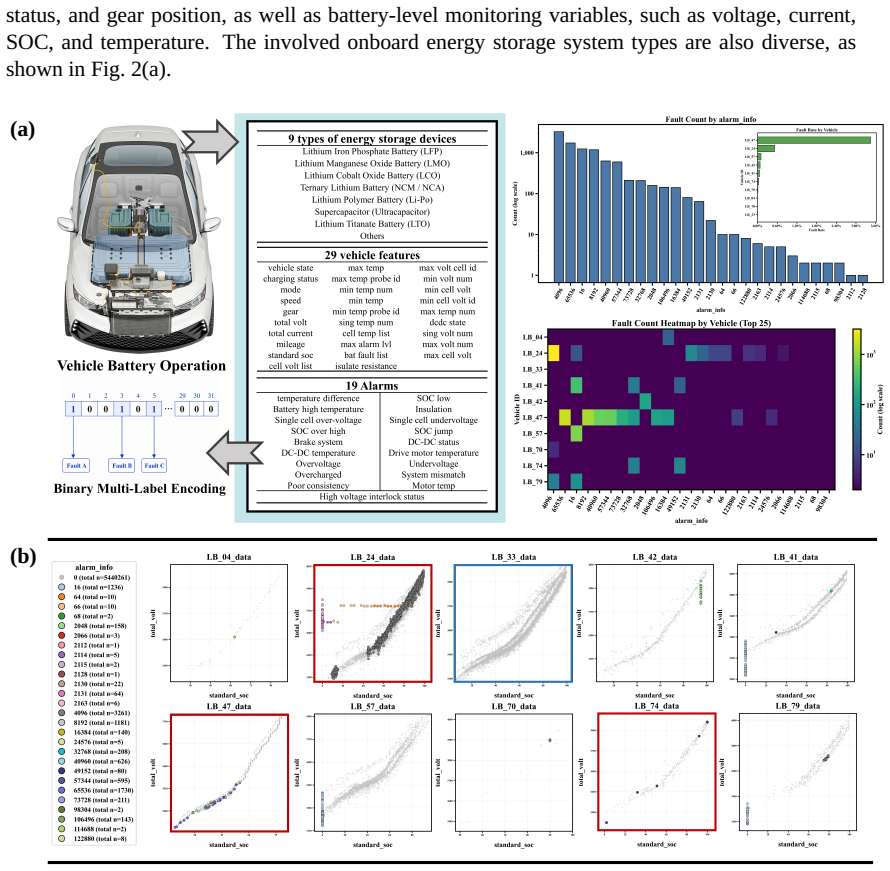
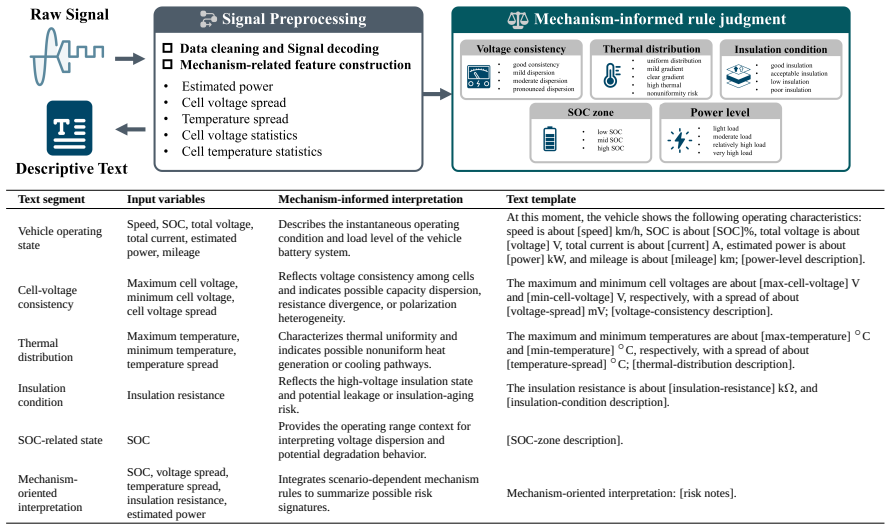

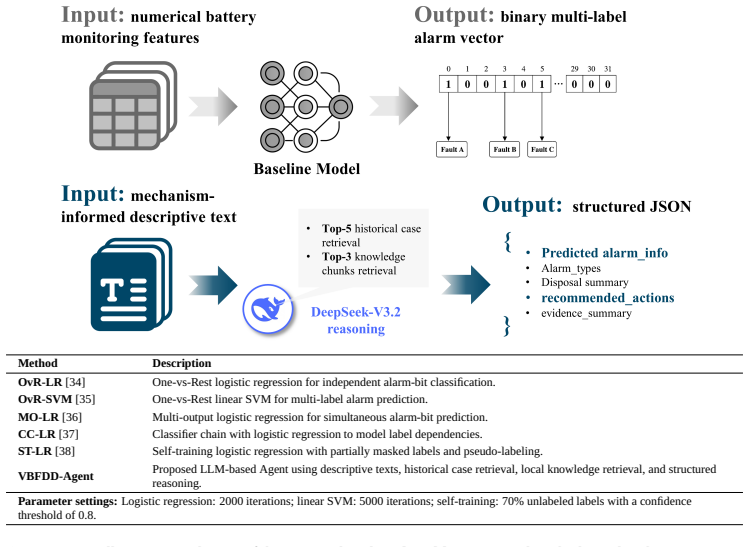
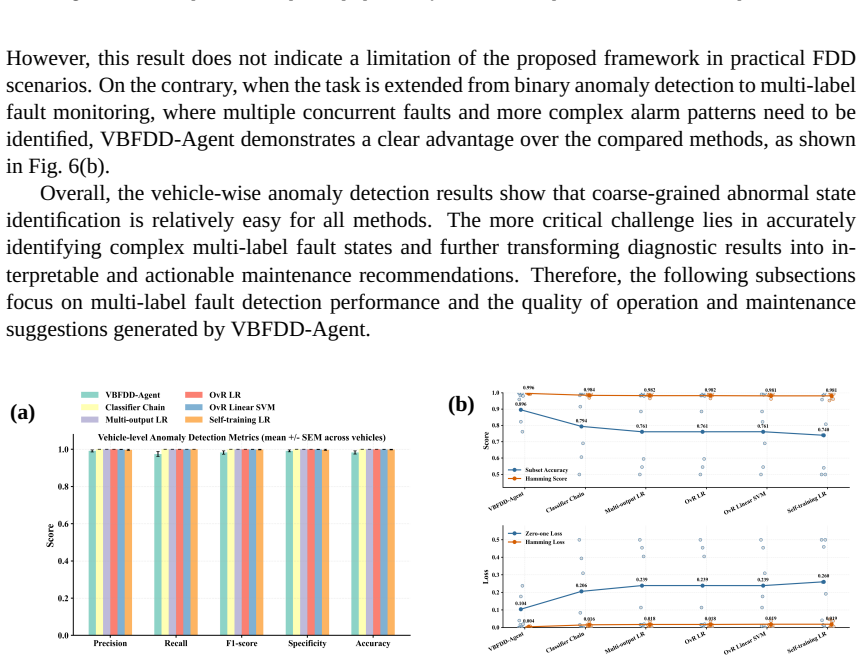


read the original abstract
With the rapid proliferation of electric vehicles, the safety and reliability of lithium-ion batteries have become critical concerns. Effective anomaly detection is essential for ensuring safe battery operation. However, as battery systems and operating scenarios become increasingly complex, battery fault diagnosis and maintenance require stronger cross-domain adaptability and human-AI collaboration. Traditional fault detection and diagnosis methods are usually designed for specific scenarios and predefined workflows, making them less effective in complex real-world applications. To address the scarcity of open-source battery fault report corpora and the lack of unified maintenance knowledge representation, this study proposes a descriptive text modeling approach for battery signal reports. Monitoring signals, statistical features, anomaly records, and state assessment results are transformed into structured and readable natural language descriptions, forming a language corpus for battery health diagnosis and maintenance. Based on this corpus, we propose VBFDD-Agent, a vehicle battery fault detection and diagnosis agent for automotive-grade battery systems. VBFDD-Agent integrates descriptive battery-state texts, historical case retrieval, local maintenance manuals, and large language model reasoning to generate structured diagnostic results and maintenance recommendations. Experiments show that the proposed framework can accurately perform anomaly monitoring based on descriptive textual representations and provide flexible, efficient, and actionable maintenance suggestions. Expert evaluation further confirms the practical value of the generated recommendations. Overall, VBFDD-Agent extends traditional battery diagnosis from label prediction to interpretable and maintenance-oriented decision support.
Editorial analysis
A structured set of objections, weighed in public.
Referee Report
Summary. The manuscript proposes a descriptive text modeling approach that converts EV battery monitoring signals, statistical features, anomaly records, and state assessments into structured natural language descriptions to form a corpus. It then introduces VBFDD-Agent, an LLM-based agent that combines this corpus with historical case retrieval, local maintenance manuals, and LLM reasoning to generate structured diagnostic results and maintenance recommendations. The authors claim that experiments demonstrate accurate anomaly monitoring based on textual representations and that expert evaluation confirms the practical value of the generated recommendations, extending traditional diagnosis toward interpretable, maintenance-oriented decision support.
Significance. If the central claims hold, the work could offer a novel way to improve cross-domain adaptability and human-AI collaboration in battery fault diagnosis by leveraging natural language representations and LLMs, addressing the scarcity of open-source battery fault report corpora. The shift from label prediction to actionable maintenance suggestions is potentially valuable for real-world automotive applications. However, the complete absence of quantitative metrics, datasets, baselines, or validation of the text transformation step makes it impossible to assess whether the approach actually preserves the precision needed for reliable fault detection.
major comments (3)
- Abstract and Experiments section: The central claim that 'experiments show that the proposed framework can accurately perform anomaly monitoring' is unsupported because no metrics (accuracy, precision, recall, F1), datasets, baselines, or error analysis are reported. This directly undermines evaluation of the core contribution.
- Descriptive text modeling approach (implied in the method description): The assumption that transforming quantitative signals, statistical features, and anomaly records into structured natural language 'preserves sufficient information' for accurate LLM-based diagnosis lacks any supporting validation such as mutual information scores, reconstruction fidelity, or ablation studies comparing text corpus performance against raw-signal baselines. Battery faults often hinge on precise numerical thresholds and temporal dynamics that summarization can distort.
- VBFDD-Agent integration (method and results): Reliance on external LLMs, historical cases, and manuals for reasoning is presented without details on prompt engineering, retrieval mechanisms, or how conflicts between sources are resolved, leaving the reproducibility and robustness of the diagnostic outputs unevaluable.
minor comments (2)
- The abstract and title use 'VBFDD-Agent' without expanding the acronym on first use.
- No discussion of potential limitations, such as LLM hallucination risks in safety-critical battery diagnosis or computational overhead of the text transformation pipeline.
Simulated Author's Rebuttal
We thank the referee for the constructive comments, which identify key areas where additional rigor can strengthen the presentation of our work. We respond to each major comment below, indicating revisions that will be incorporated in the next version of the manuscript.
read point-by-point responses
-
Referee: Abstract and Experiments section: The central claim that 'experiments show that the proposed framework can accurately perform anomaly monitoring' is unsupported because no metrics (accuracy, precision, recall, F1), datasets, baselines, or error analysis are reported. This directly undermines evaluation of the core contribution.
Authors: We agree that the experimental evaluation would be strengthened by quantitative metrics. The current manuscript emphasizes qualitative case studies and expert assessment of the maintenance recommendations to demonstrate interpretability and practical utility. In the revised version we will add a dedicated quantitative evaluation subsection that reports accuracy, precision, recall, and F1 on publicly available or synthetic battery signal datasets, includes baseline comparisons, and provides error analysis for the anomaly monitoring component. revision: yes
-
Referee: Descriptive text modeling approach (implied in the method description): The assumption that transforming quantitative signals, statistical features, and anomaly records into structured natural language 'preserves sufficient information' for accurate LLM-based diagnosis lacks any supporting validation such as mutual information scores, reconstruction fidelity, or ablation studies comparing text corpus performance against raw-signal baselines. Battery faults often hinge on precise numerical thresholds and temporal dynamics that summarization can distort.
Authors: The structured descriptive texts are explicitly designed to retain numerical precision and temporal ordering by embedding exact values and timestamps (e.g., 'cell voltage fell to 2.75 V at t=142 s, below the 3.0 V safety threshold'). This format is intended to avoid the information loss the referee correctly flags. We acknowledge the absence of formal validation in the submitted manuscript and will add an ablation study comparing text-based diagnosis performance against raw-signal baselines, together with a brief discussion of information retention, in the revised methods and experiments sections. revision: yes
-
Referee: VBFDD-Agent integration (method and results): Reliance on external LLMs, historical cases, and manuals for reasoning is presented without details on prompt engineering, retrieval mechanisms, or how conflicts between sources are resolved, leaving the reproducibility and robustness of the diagnostic outputs unevaluable.
Authors: We will expand the method section with concrete implementation details: the prompt templates used for each reasoning stage, the similarity metric and top-k selection procedure for historical-case retrieval, and the conflict-resolution policy (manual guidelines take precedence over LLM-generated suggestions when they conflict). These additions will make the agent workflow reproducible and allow readers to assess robustness. revision: yes
Circularity Check
No circularity: framework relies on external LLM reasoning and empirical validation
full rationale
The paper's derivation proceeds from signal-to-text transformation to corpus construction to VBFDD-Agent integration of historical cases, manuals, and LLM inference, followed by experimental validation and expert review. No equations, fitted parameters, or self-citations are shown to reduce the central claims to their own inputs by construction. The approach is presented as an applied pipeline whose accuracy is asserted via external benchmarks rather than internal redefinition or renaming of known results.
Axiom & Free-Parameter Ledger
axioms (1)
- domain assumption Large language models can perform accurate reasoning over descriptive natural language representations of battery signals to generate reliable diagnostic and maintenance outputs.
invented entities (1)
-
VBFDD-Agent
no independent evidence
Lean theorems connected to this paper
-
IndisputableMonolith/Cost/FunctionalEquation.leanwashburn_uniqueness_aczel unclear?
unclearRelation between the paper passage and the cited Recognition theorem.
Monitoring signals, statistical features, anomaly records, and state assessment results are transformed into structured and readable natural language descriptions, forming a language corpus for battery health diagnosis and maintenance.
-
IndisputableMonolith/Foundation/RealityFromDistinction.leanreality_from_one_distinction unclear?
unclearRelation between the paper passage and the cited Recognition theorem.
VBFDD-Agent integrates descriptive battery-state texts, historical case retrieval, local maintenance manuals, and large language model reasoning
What do these tags mean?
- matches
- The paper's claim is directly supported by a theorem in the formal canon.
- supports
- The theorem supports part of the paper's argument, but the paper may add assumptions or extra steps.
- extends
- The paper goes beyond the formal theorem; the theorem is a base layer rather than the whole result.
- uses
- The paper appears to rely on the theorem as machinery.
- contradicts
- The paper's claim conflicts with a theorem or certificate in the canon.
- unclear
- Pith found a possible connection, but the passage is too broad, indirect, or ambiguous to say the theorem truly supports the claim.
Reference graph
Works this paper leans on
-
[1]
Rui Xiong, Wanzhou Sun, Quanqing Y u, and Fengchun Sun. Research progress, challenges and prospects of fault diagnosis on battery system of electric vehicles.Applied Energy, 279:115855, 2020
work page 2020
-
[2]
Joey Chan, Te Han, and Ershun Pan. V ariational autoencoder-driven adversarial svdd for power battery anomaly detection on real industrial data.Journal of Energy Storage, 103:114267, 2024
work page 2024
-
[3]
Holger C Hesse, Michael Schimpe, Daniel Kucevic, and Andreas Jossen. Lithium-ion bat- tery storage for the grid—a review of stationary battery storage system design tailored for applications in modern power grids.Energies, 10(12):2107, 2017
work page 2017
-
[4]
Shiwen Zhao, Qiao Peng, Dajun Du, Minrui Fei, Chen Peng, Heng Li, Y ue Wu, Kang Li, and Kailong Liu. Enhancing safety of lithium-ion batteries in sustainable energy systems through intelligent minor short-circuits fault detection.Renewable and Sustainable Energy Reviews, 229:116576, 2026
work page 2026
-
[5]
Yiming Xu, Xiaohua Ge, Ruohan Guo, and Weixiang Shen. Recent advances in model- based fault diagnosis for lithium-ion batteries: A comprehensive review.Renewable and Sustainable Energy Reviews, 207:114922, 2025. 15
work page 2025
-
[6]
Mohammad Zamani Khaneghah, Mohamad Alzayed, and Hicham Chaoui. Fault detection and diagnosis of the electric motor drive and battery system of electric vehicles.Machines, 11(7):713, 2023
work page 2023
-
[7]
Xiaosong Hu, Kai Zhang, Kailong Liu, Xianke Lin, Satadru Dey, and Simona Onori. Ad- vanced fault diagnosis for lithium-ion battery systems: A review of fault mechanisms, fault features, and diagnosis procedures.IEEE Industrial Electronics Magazine, 14(3):65–91, 2020
work page 2020
-
[8]
Huayan Pu, Shouwei Teng, Dengyu Xiao, Lang Xu, Yi Qin, and Jun Luo. Compound fault diagnosis of rotating machine through label correlation modeling via graph convolutional neural network.IEEE Transactions on Instrumentation and Measurement, 73:1–10, 2023
work page 2023
-
[9]
Y uhai Wang, Junfu Li, Jingming Zhang, and Michael Pecht. Lithium-iron-phosphate battery electrochemical modelling under a wide range of ambient temperatures.Journal of Electro- analytical Chemistry, 882:115041, 2021
work page 2021
-
[10]
Bosong Zou, Lisheng Zhang, Xiaoqing Xue, Rui Tan, Pengchang Jiang, Bin Ma, Zehua Song, and Wei Hua. A review on the fault and defect diagnosis of lithium-ion battery for electric vehicles.Energies, 16(14):5507, 2023
work page 2023
-
[11]
Satadru Dey, Hector E Perez, and Scott J Moura. Model-based battery thermal fault di- agnostics: Algorithms, analysis, and experiments.IEEE Transactions on Control Systems Technology, 27(2):576–587, 2017
work page 2017
-
[12]
Xuning Feng, Caihao Weng, Minggao Ouyang, and Jing Sun. Online internal short circuit detection for a large format lithium ion battery.Applied energy, 161:168–180, 2016
work page 2016
-
[13]
Early warning of lithium battery progressive fault based on box plot
Min Xu, Xiao Y an, Wenheng Lin, Bixiong Huang, Ying Wang, Dong Dong, and Dongzheng Wang. Early warning of lithium battery progressive fault based on box plot. In2019 3rd International Conference on Electronic Information Technology and Computer Engineering (EITCE), pages 1072–1075. IEEE, 2019
work page 2019
-
[14]
Zhenpo Wang, Jichao Hong, Peng Liu, and Lei Zhang. V oltage fault diagnosis and prog- nosis of battery systems based on entropy and z-score for electric vehicles.Applied energy, 196:289–302, 2017
work page 2017
-
[15]
Y ang Zhao, Peng Liu, Zhenpo Wang, Lei Zhang, and Jichao Hong. Fault and defect diagnosis of battery for electric vehicles based on big data analysis methods.Applied Energy, 207:354– 362, 2017
work page 2017
-
[16]
Dickson NT How, MA Hannan, MS Hossain Lipu, and Pin Jern Ker. State of charge esti- mation for lithium-ion batteries using model-based and data-driven methods: A review.Ieee Access, 7:136116–136136, 2019
work page 2019
-
[17]
Martin Cunneen, Martin Mullins, Finbarr Murphy, Darren Shannon, Irini Furxhi, and Cian Ryan. Autonomous vehicles and avoiding the trolley (dilemma): vehicle perception, classifi- cation, and the challenges of framing decision ethics.Cybernetics and Systems, 51(1):59–80, 2020
work page 2020
-
[18]
Eeg-based taste perception classification using pca enhanced attention-tlstm neural network
Sagnik De, Prithwijit Mukherjee, Dipanjan Konar, and Anisha Halder Roy. Eeg-based taste perception classification using pca enhanced attention-tlstm neural network. In2023 4th International Conference on Communication, Computing and Industry 6.0 (C216), pages 01–06. IEEE, 2023. 16
work page 2023
-
[19]
Industrial artificial intelligence: a predic- tive agent concept for industry 4.0
Luis Alberto Cruz Salazar and Birgit V ogel-Heuser. Industrial artificial intelligence: a predic- tive agent concept for industry 4.0. In2022 IEEE 20th International Conference on Industrial Informatics (INDIN), pages 27–32. IEEE, 2022
work page 2022
-
[20]
Xiaosong Hu, Zhongwei Deng, Xianke Lin, Yi Xie, and Remus Teodorescu. Research direc- tions for next-generation battery management solutions in automotive applications.Renew- able and Sustainable Energy Reviews, 152:111695, 2021
work page 2021
-
[21]
Xueliang Y uan, Xin Liu, and Jian Zuo. The development of new energy vehicles for a sus- tainable future: A review.Renewable and Sustainable Energy Reviews, 42:298–305, 2015
work page 2015
-
[22]
Emma Schleiger, Claire Mason, Claire Naughtin, Andrew Reeson, and Cecile Paris. Collab- orative intelligence: A scoping review of current applications.Applied Artificial Intelligence, 38(1):2327890, 2024
work page 2024
-
[23]
Wei Xu, Gang Luo, Weiyu Meng, Xiaobing Zhai, Keli Zheng, Ji Wu, Y anrong Li, Abao Xing, Junrong Li, Zhifan Li, et al. Mragent: an llm-based automated agent for causal knowledge dis- covery in disease via mendelian randomization.Briefings in Bioinformatics, 26(2):bbaf140, 2025
work page 2025
-
[24]
Md Shahriar Nazim and Rajvikram Madurai Elavarasan. Extending battery lifecycles: A holistic review of second-life lithium-ion technology in sustainable energy systems from as- sessment to emerging trends.Renewable and Sustainable Energy Reviews, 233:116848, 2026
work page 2026
-
[25]
Industrial agent: A survey.Available at SSRN 5495908
Jinling Y u, Jiehan Zhou, Mingshan Xie, Feibin Zhang, and Xun Xu. Industrial agent: A survey.Available at SSRN 5495908
-
[26]
Industrial applications of agent technologies.Control engineering practice, 15(11):1364–1380, 2007
Vladimír Mařík and Jiří Lažansk `y. Industrial applications of agent technologies.Control engineering practice, 15(11):1364–1380, 2007
work page 2007
-
[27]
Modelling social action for ai agents.Artificial intelligence, 103(1- 2):157–182, 1998
Cristiano Castelfranchi. Modelling social action for ai agents.Artificial intelligence, 103(1- 2):157–182, 1998
work page 1998
-
[28]
Explainability for large language models: A survey
Haiyan Zhao, Hanjie Chen, Fan Y ang, Ninghao Liu, Huiqi Deng, Hengyi Cai, Shuaiqiang Wang, Dawei Yin, and Mengnan Du. Explainability for large language models: A survey. ACM Transactions on Intelligent Systems and Technology, 15(2):1–38, 2024
work page 2024
-
[29]
Xiao Zhou, Luoyi Sun, Dexuan He, Wenbin Guan, Ge Wang, Ruifen Wang, Lifeng Wang, Xi- aojun Y uan, Xin Sun, Y a Zhang, et al. Knowledge-enhanced pretraining for vision-language pathology foundation model on cancer diagnosis.Cancer Cell, 44(4):777–791, 2026
work page 2026
-
[30]
Y unfei Ma, Shuai Zheng, Zheng Y ang, Hongcheng Pan, and Jun Hong. A knowledge-graph enhanced large language model-based fault diagnostic reasoning and maintenance decision support pipeline towards industry 5.0.International Journal of Production Research, pages 1–22, 2025
work page 2025
-
[31]
Lin Lin, Sihao Zhang, Song Fu, and Yikun Liu. Fd-llm: Large language model for fault diagnosis of complex equipment.Advanced Engineering Informatics, 65:103208, 2025
work page 2025
-
[32]
Jie Wang, Tianrui Li, Y an Y ang, Shiqian Chen, and Wanming Zhai. Diagllm: multimodal reasoning with large language model for explainable bearing fault diagnosis.Science China Information Sciences, 68(6):160103, 2025. 17
work page 2025
-
[33]
Lei Ren, Haiteng Wang, Jiabao Dong, Zidi Jia, Shixiang Li, Y uqing Wang, Y uanjun Laili, Di Huang, Lin Zhang, Wenjun Wu, et al. Industrial foundation model: architecture, key tech- nologies, and typical applications.Scientia Sinica Informationis, 54(11):2606–2622, 2024
work page 2024
-
[34]
Swatac: A sentiment analyzer using one-vs-rest logistic regression
Y ousef Alhessi and Richard Wicentowski. Swatac: A sentiment analyzer using one-vs-rest logistic regression. InProceedings of the 9th International Workshop on Semantic Evaluation (SemEval 2015), pages 636–639, 2015
work page 2015
-
[35]
Jin-Hyuk Hong and Sung-Bae Cho. A probabilistic multi-class strategy of one-vs.-rest sup- port vector machines for cancer classification.Neurocomputing, 71(16-18):3275–3281, 2008
work page 2008
-
[36]
Hanen Borchani, Gherardo V arando, Concha Bielza, and Pedro Larranaga. A survey on multi- output regression.Wiley Interdisciplinary Reviews: Data Mining and Knowledge Discovery, 5(5):216–233, 2015
work page 2015
-
[37]
Classifier chains for multi- label classification.Machine learning, 85(3):333–359, 2011
Jesse Read, Bernhard Pfahringer, Geoff Holmes, and Eibe Frank. Classifier chains for multi- label classification.Machine learning, 85(3):333–359, 2011
work page 2011
-
[38]
Samet Oymak and Talha Cihad Gulcu. Statistical and algorithmic insights for semi- supervised learning with self-training.arXiv preprint arXiv:2006.11006, 2020
-
[39]
Y ushan Jiang, Wenchao Y u, Geon Lee, Dongjin Song, Kijung Shin, Wei Cheng, Y anchi Liu, and Haifeng Chen. Timexl: Explainable multi-modal time series prediction with llm-in-the- loop.Advances in Neural Information Processing Systems, 38:135431–135467, 2026. 18
work page 2026
discussion (0)
Sign in with ORCID, Apple, or X to comment. Anyone can read and Pith papers without signing in.