Mid-infrared single-photon sub-pixel temporal ghost imaging
Pith reviewed 2026-05-21 02:30 UTC · model grok-4.3
The pith
Sub-pixel temporal shifting decouples MIR ghost imaging resolution from modulation speed to reach 40 ps precision at 3.125 Gbps.
A machine-rendered reading of the paper's core claim, the machinery that carries it, and where it could break.
Core claim
The central claim is that a sub-pixel shifting strategy, implemented through fractional-bin temporal stepping of the optical gate combined with multi-shot pseudo-inverse reconstruction, decouples achievable temporal resolution from modulation speed and detector jitter, delivering 40 ps precision in mid-infrared single-photon computational temporal ghost imaging at a driving rate of only 3.125 Gbps while preserving single-photon sensitivity.
What carries the argument
Sub-pixel temporal shifting of the near-infrared pump gate in fractional time bins, followed by multi-shot fusion via pseudo-inverse reconstruction to recover the original MIR waveform from upconverted signals.
If this is right
- Room-temperature silicon detectors can capture ultrafast MIR signals that previously required cryogenic or high-speed infrared detectors.
- Temporal resolution can exceed both the electronic driving rate and the detector jitter limit.
- The same nonlinear structured detection plus sub-pixel fusion approach can be applied to other wavelengths where fast detectors are unavailable.
- Single-photon sensitivity is retained, enabling quantum-level MIR waveform measurements.
Where Pith is reading between the lines
- The decoupling of resolution from hardware speed could be tested in real-time sensing scenarios where the multi-shot requirement is relaxed by faster reconstruction algorithms.
- Analogous fractional-bin shifting might improve resolution in other computational imaging domains limited by modulator bandwidth.
- Integration with quantum optics setups could allow single-photon MIR state characterization without custom fast infrared hardware.
Load-bearing premise
The pseudo-inverse reconstruction from multiple fractionally shifted upconverted measurements accurately recovers the underlying MIR waveform without introducing significant temporal artifacts or fidelity loss.
What would settle it
A side-by-side measurement in which the reconstructed 40 ps waveform deviates markedly from a known reference MIR pulse shape obtained with a faster direct detector when the sub-pixel shifts are applied.
Figures


read the original abstract
Temporal ghost imaging (TGI) enables ultrafast temporal signal recovery using slow detectors, offering a promising route for high-speed mid-infrared (MIR) detection. However, conventional schemes remain limited in temporal resolution by the modulation bandwidth or pattern timescale, and are mostly confined to structured illumination. Here, we demonstrated a high-resolution MIR single-photon computational TGI system, which integrated nonlinear structured detection with sub-pixel temporal shifting. A pre-programmed near-infrared pump serves as a temporally optical gate to drive sum-frequency generation in a nonlinear crystal. Consequently, MIR waveforms at 3.4 $\mu$m were upconverted, and captured by a room-temperature silicon detector. We realized sub-pixel operation by fractional-bin temporal stepping of the gate and multi-shot fusion via pseudo-inverse reconstruction. The sub-pixel shifting strategy decouples the achievable resolution from modulation speed, enabling 40 ps temporal precision at a driving rate of only 3.125 Gbps. This performance surpasses both detector jitter and pattern-rate limits, while maintaining single-photon sensitivity. The presented paradigm establishes a versatile route for ultrafast MIR waveform reconstruction, opening new opportunities in high-resolution infrared sensing and quantum photonics.
Editorial analysis
A structured set of objections, weighed in public.
Referee Report
Summary. The manuscript demonstrates an experimental mid-infrared single-photon computational temporal ghost imaging system. A pre-programmed near-infrared pump acts as a temporal optical gate driving sum-frequency generation in a nonlinear crystal to upconvert 3.4 μm MIR waveforms for detection by a room-temperature silicon detector. Sub-pixel operation is realized via fractional-bin temporal stepping of the gate combined with multi-shot fusion using pseudo-inverse reconstruction, yielding a claimed 40 ps temporal precision at a 3.125 Gbps driving rate while preserving single-photon sensitivity.
Significance. If the reconstruction step is shown to be robust, the sub-pixel shifting approach would usefully decouple achievable temporal resolution from modulation bandwidth, offering a practical route to high-resolution MIR waveform recovery with standard detectors. The experimental realization of single-photon sensitivity in this regime is a concrete strength that could support applications in ultrafast infrared sensing and quantum photonics.
major comments (2)
- [Reconstruction and results sections] The manuscript provides no analysis of the measurement matrix condition number, noise propagation through the pseudo-inverse, or reconstruction error as a function of shift precision under Poisson statistics. This is load-bearing for the central 40 ps resolution claim, because the reported performance rests entirely on the multi-shot fusion step recovering sub-bin structure from noisy upconverted counts without introducing artifacts.
- [Abstract and Results] The abstract and results quote specific performance figures (40 ps resolution at 3.125 Gbps) without accompanying error bars, raw count data, or independent verification metrics for the reconstructed waveform. This leaves the accuracy of the sub-pixel recovery unquantified.
minor comments (1)
- [Methods] Notation for the fractional-bin shifts and the exact form of the pseudo-inverse operator should be defined explicitly with an equation to aid reproducibility.
Simulated Author's Rebuttal
We thank the referee for their careful reading of the manuscript and for highlighting the importance of demonstrating the robustness of the reconstruction. We appreciate the positive assessment of the experimental realization and single-photon sensitivity. We address the two major comments below by committing to specific additions that strengthen the support for the 40 ps resolution claim.
read point-by-point responses
-
Referee: The manuscript provides no analysis of the measurement matrix condition number, noise propagation through the pseudo-inverse, or reconstruction error as a function of shift precision under Poisson statistics. This is load-bearing for the central 40 ps resolution claim, because the reported performance rests entirely on the multi-shot fusion step recovering sub-bin structure from noisy upconverted counts without introducing artifacts.
Authors: We agree that quantitative analysis of the reconstruction is necessary to substantiate the sub-pixel performance. The manuscript currently emphasizes the experimental setup and results but does not include these metrics. In the revised manuscript we will add a dedicated subsection analyzing the condition number of the measurement matrix constructed from the fractional temporal shifts. We will also include Monte Carlo simulations of noise propagation through the pseudo-inverse under Poisson statistics matching the observed single-photon count rates, and we will plot reconstruction RMSE versus shift precision to confirm that artifacts remain below the reported 40 ps level. revision: yes
-
Referee: The abstract and results quote specific performance figures (40 ps resolution at 3.125 Gbps) without accompanying error bars, raw count data, or independent verification metrics for the reconstructed waveform. This leaves the accuracy of the sub-pixel recovery unquantified.
Authors: We accept that the quoted figures would be more convincing with statistical support. In the revision we will attach error bars to all reconstructed waveforms, obtained from the diagonal of the reconstruction covariance matrix and from repeated experimental trials. Raw detector count histograms for representative gates will be moved to the supplementary material. We will also add a cross-validation metric comparing reconstructions obtained with different shift step sizes to provide an internal consistency check on the sub-pixel accuracy. revision: yes
Circularity Check
No circularity: experimental demonstration with hardware-tied resolution
full rationale
The manuscript is an experimental demonstration of MIR single-photon TGI via nonlinear upconversion, fractional-bin gate shifts, and pseudo-inverse multi-shot fusion. The 40 ps precision claim is reported as measured hardware performance at 3.125 Gbps drive rate, not derived from any equation that reduces to its own inputs. No self-definitional, fitted-input, or self-citation load-bearing steps appear in the presented chain; reconstruction is a standard linear-algebra technique applied to acquired counts. The work remains self-contained against external benchmarks of detector jitter and pattern rate.
Axiom & Free-Parameter Ledger
axioms (1)
- domain assumption Sum-frequency generation in the nonlinear crystal faithfully transfers the temporal waveform of the MIR signal to the upconverted NIR light.
Reference graph
Works this paper leans on
-
[1]
3.4µm Structured illumination NIR EOM NIR SPCM 80 ps
-
[2]
3.4µm Structured illumination NIR AOM MIR detector 100 ns
-
[3]
2µm Structured illumination / NIR and MIR detectors 1 ns
-
[4]
1.55µm Structured illumination / NIR detectors 55 ps
-
[5]
In contrast, sub-pixel TGI reconstructed the waveforms with 40 ps resolution [Fig
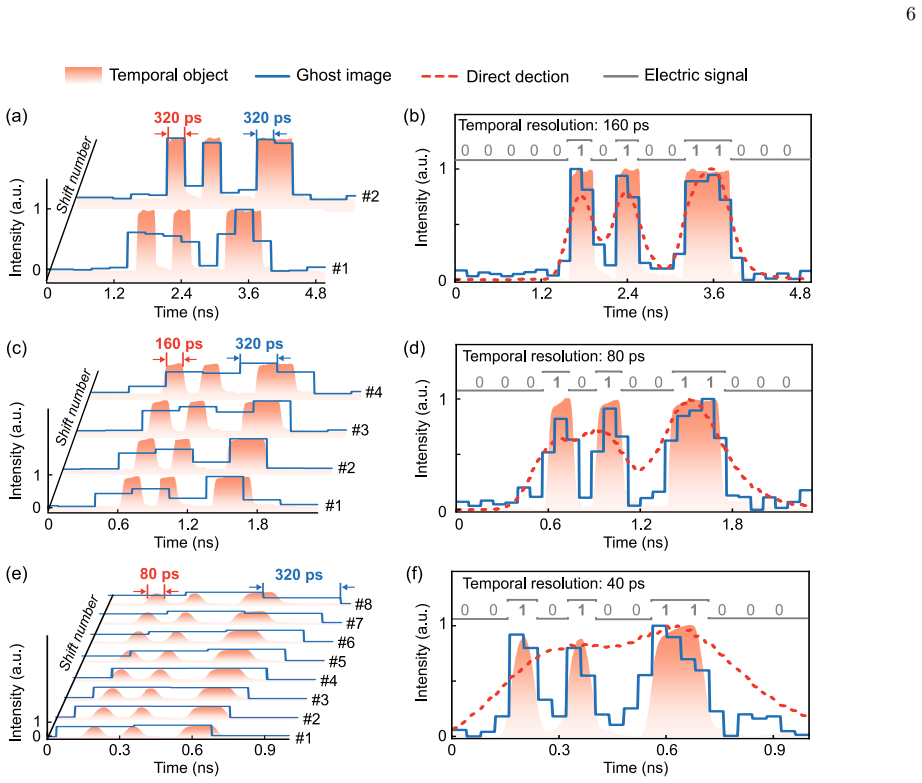
1.55µm Structured illumination / NIR detectors 360 ps TCSPC histograms became dominated by detector jitter and failed to resolve the binary structure. In contrast, sub-pixel TGI reconstructed the waveforms with 40 ps resolution [Fig. 5(f)], surpassing both the 717-ps jitter limit of the SPCM and the 320-ps modulation speed of the pump pattern. These resul...
-
[6]
K. L. Vodopyanov,Laser-based Mid-infrared Sources and Applications, Wiley, New York (2020)
work page 2020
-
[7]
J.-X. Cheng and X. S. Xie, “Vibrational spectroscopic imaging of living systems: An emerging platform for bi- ology and medicine,”Science350, aaa8870 (2015)
work page 2015
-
[8]
Illuminating life processes by vibrational probes,
N. Qian, Z. Zhao, E. El Khoury, X. Gao, C. Canela, Y. Shen, L. Shi, L. Shi, F. Hu, L. Wei, and W. Min, “Illuminating life processes by vibrational probes,”Nat. Methods22, 928 (2025)
work page 2025
-
[9]
Broadband thermal imaging using meta-optics,
L. Huang, Z. Han, A. Wirth-Singh, V. Saragadam, S. Mukherjee, J.E. Fr¨ och, Q.A.A. Tanguy, J. Rollag, R. Gib- son, J.R. Hendrickson, P.W.C. Hon, O. Kigner, Z. Cop- pens, K.F. B¨ ohringer, A. Veeraraghavan, and A. Majum- dar, “Broadband thermal imaging using meta-optics,” Nat. Commun.15, 1662 (2024)
work page 2024
-
[10]
Bidirectional mid-infrared communi- cations between two identical macroscopic graphene fi- bres,
B. Fang, S.C. Bodepudi, F. Tian, X. Liu, D. Chang, S. Du, J. Lv, J. Zhong, H. Zhu, H. Hu, Y. Xu, Z. Xu, W. Gao, and C. Gao, “Bidirectional mid-infrared communi- cations between two identical macroscopic graphene fi- bres,”Nat. Commun.11, 6368 (2020)
work page 2020
-
[11]
K. Zou, K. Pang, H. Song, J. Fan, Z. Zhao, H. Song, R. Zhang, H. Zhou, A. Minoofar, C. Liu, X. Su, N. Hu, A. McClung, M. Torfeh, A. Arbabi, M. Tur, and A. E. Will- ner, “High-capacity free-space optical communications using wavelength-and mode-division-multiplexing in the mid-infrared region,”Nat. Commun.13, 7662 (2022)
work page 2022
-
[12]
Y. Di, K. Ba, X. Wang, T. Lin, B. Wu, Y. Chen, and J. Wang, “Advanced architectures and emerging ma- terials for high-operating-temperature infrared photodi- odes,”Adv. Mater.,37, e08115 (2025)
work page 2025
-
[13]
High-speed long-wave infrared quantum-dot quantum cascade detector,
Z. Yang, Z. Wang, Z. Dai, Z. Shen, Q. Gong, and B. Chen, “High-speed long-wave infrared quantum-dot quantum cascade detector,”Infrared Phys. Technol., 150, 105914 (2025)
work page 2025
-
[14]
Room-temperature nine-µm- wavelength photodetectors and GHz-frequency hetero- dyne receivers,
D. Palaferri, Y. Todorov, A. Bigioli, A. Mottaghizadeh, D. Gacemi, A. Calabrese, A. Vasanelli, L. Li, A. G. Davies, E. H. Linfield, F. Kapsalidis, M. Beck, J. Faist, and C. Sirtori, “Room-temperature nine-µm- wavelength photodetectors and GHz-frequency hetero- dyne receivers,”Nature,556, 85 (2018)
work page 2018
-
[15]
Mid-infrared single photon detector with superconduc- tor Mo80Si20 nanowire,
Q. Chen, R. Ge, L. Zhang, F. Li, B. Zhang, F. Jin, H. Han, Y. Dai, G. He, Y. Fei, X. Wang, H. Wang, X. Jia, Q. Zhao, X. Tu, L. Kang, J. Chen, and P. Wu, “Mid-infrared single photon detector with superconduc- tor Mo80Si20 nanowire,”Sci. Bull.,66, 965 (2021)
work page 2021
-
[16]
G. G. Taylor, A. B. Walter, B. Korzh, B. Bumble, S. R. Patel, J. P. Allmaras, A. D. Beyer, R. O’Brient, M. D. Shaw, and E. E. Wollman, “Low-noise single-photon counting superconducting nanowire detectors at infrared wavelengths up to 29µm,”Optica,10, 1672 (2023)
work page 2023
-
[17]
Y. Pan, H. Zhou, X. Zhang, H. Yu, L. Zhang, M. Si, H. Li, L. You, and Z. Wang, “Mid-infrared Nb4N3-based su- perconducting nanowire single photon detectors for wave- lengths up to 10µm,”Opt. Express,30, 40044 (2022)
work page 2022
-
[18]
Single-photon detection enabled by negative differential conductivity in moir´ e su- perlattices,
K. Nowakowski, H. Agarwal, S. Slizovskiy, R. Smeyers, X. Wang, Z. Zheng, J. Barrier, D. Barcons Ruiz, G. Li, R. Bertini, M. Ceccanti, I. Torre, B. Jorissen, A. Reserbat- Plant´ ey, K. Watanabe, T. Taniguchi, L. Covaci, M. V. Miloˇ sevi´ c, V. Fal'ko, P. Jarillo-Herrero, R. Krishna Ku- mar, and F. H. L. Koppens, “Single-photon detection enabled by negative...
work page 2025
-
[19]
Ghost imaging in the time domain,
P. Ryczkowski, M. Barbier, A. T. Friberg, J. M. Dudley, and G. Genty, “Ghost imaging in the time domain,”Nat. Photonics,10, 167 (2016)
work page 2016
-
[20]
Differential ghost imaging in time domain,
Y. O-oka and S. Fukatsu, “Differential ghost imaging in time domain,”Appl. Phys. Lett.111, 061106 (2017)
work page 2017
-
[21]
Fourier-temporal ghost imag- ing,
W. W. Meng, D. F. Shi, K. Yuan, L. B. Zha, J. Huang, Y. J. Wang, and C. Y. Fan, “Fourier-temporal ghost imag- ing,”Opt. Lasers Eng.,134, 106294 (2020)
work page 2020
-
[22]
Magnified time-domain ghost imaging,
P. Ryczkowski, M. Barbier, A. T. Friberg, J. M. Dudley, and G. Genty, “Magnified time-domain ghost imaging,” APL Photonics,2, 046102 (2017)
work page 2017
-
[23]
Ghost imaging: from quantum to classical to computational,
B. I. Erkmen and J. H. Shapiro, “Ghost imaging: from quantum to classical to computational,”Adv. Opt. Pho- tonics2, 405 (2010)
work page 2010
-
[24]
Ghost imaging, development, and recent advances,
P. Li, X. Chen, X. Qiu, B. Chen, L. Chen, and B. Sun, “Ghost imaging, development, and recent advances,” Chin. Opt. Lett.22, 112701 (2024)
work page 2024
-
[25]
Application of space–time duality to ultrahigh-speed optical signal processing,
R. Salem, M. A. Foster, and A. L. Gaeta, “Application of space–time duality to ultrahigh-speed optical signal processing,”Adv. Opt. Photonics,5, 274 (2013)
work page 2013
-
[26]
Computational temporal ghost imaging,
E. Lantz, F. Devaux, P.-A. Moreau, and S. Denis, “Computational temporal ghost imaging,”Optica3, 698 (2016)
work page 2016
-
[27]
Y. K. Xu, S. H. Sun, W. T. Liu, G. Z. Tang, J. Y. Liu, and P. X. Chen, “Detecting fast signals beyond bandwidth of detectors based on computational temporal ghost imag- ing,”Opt. Express26, 99 (2018)
work page 2018
-
[28]
High-resolution ghost image and 9 ghost diffraction experiments with thermal light,
F. Ferri, D. Magatti, A. Gatti, M. Bache, E. Brambilla, and L. A. Lugiato, “High-resolution ghost image and 9 ghost diffraction experiments with thermal light,”Phys. Rev. Lett.,94, 183602 (2005)
work page 2005
-
[29]
Y. Wang, H. Chen, W. Jiang, X. Li, X. Meng, P. Tian, and B. Sun, “Optical encryption for visible light commu- nication based on temporal ghost imaging with a micro- LED,”Opt. Lasers Eng.,134, 106290 (2020)
work page 2020
-
[30]
L. He, B. Hu, Z. Bo, C. Zhang, X. Zhou, S. Han, H. Liang, and H. Wu, “Mid-infrared data encryption and transmission beyond detector bandwidth based on fre- quency down-conversion temporal ghost imaging,”APL Photonics,10, 056104 (2025)
work page 2025
-
[31]
X. Chen, M. Jin, H. Chen, Y. Wang, P. Qiu, X. Cui, B. Sun, and P. Tian, “Computational temporal ghost imag- ing for long-distance underwater wireless optical commu- nication,”Opt. Lett.,46, 1938 (2021)
work page 1938
-
[32]
Pump-Probe Ghost Imaging with SASE FELs,
D. Ratner, J. P. Cryan, T. J. Lane, S. Li, and G. Stu- pakov, “Pump-Probe Ghost Imaging with SASE FELs,” Phys. Rev. X,9, 011045 (2019)
work page 2019
-
[33]
Mid-infrared computational temporal ghost imaging,
H. Wu, B. Hu, L. Chen, F. Peng, Z. Wang, G. Genty, and H. Liang, “Mid-infrared computational temporal ghost imaging,”Light: Sci. Appl.13, 124 (2024)
work page 2024
-
[34]
Temporal ghost imaging using wave- length conversion and two-color detection,
H. Wu, P. Ryczkowski, A. T. Friberg, J. M. Dudley, and G. Genty, “Temporal ghost imaging using wave- length conversion and two-color detection,”Optica6, 902 (2019)
work page 2019
-
[35]
Mid-infrared single-photon computa- tional temporal ghost imaging,
W. Zhang, K. Huang, X. Wang, B. Sun, J. Fang, Y. Li, and H. Zeng, “Mid-infrared single-photon computa- tional temporal ghost imaging,”Laser Photonics Rev., 19, 2402180 (2025)
work page 2025
-
[36]
Prin- ciples and prospects for single-pixel imaging,
M. P. Edgar, G. M. Gibson, and M. J. Padgett, “Prin- ciples and prospects for single-pixel imaging,”Nat. Pho- tonics13, 13 (2019)
work page 2019
-
[37]
Advances and Challenges of Single- Pixel Imaging Based on Deep Learning,
K. Song, Y. Bian, D. Wang, R. Li, K. Wu, H. Liu, C. Qin, J. Hu, and L. Xiao, “Advances and Challenges of Single- Pixel Imaging Based on Deep Learning,”Laser Photonics Rev.19, 2401397 (2025)
work page 2025
-
[38]
Ultra-fast perovskite electro- optic modulator and multi-band transmission up to 300 Gbit s−1,
J. Mao, F. Uemura, S. A. Yazdani, Y. Yin, H. Sato, G.- W. Lu, and S. Yokoyama, “Ultra-fast perovskite electro- optic modulator and multi-band transmission up to 300 Gbit s−1,”Commun. Mater.,5, 114 (2024)
work page 2024
-
[39]
Compressive ultrafast pulse measurement via time-domain single-pixel imaging,
J. Zhao, J. Dai, B. Braverman, X. C. Zhang, and R. W. Boyd, “Compressive ultrafast pulse measurement via time-domain single-pixel imaging,”Optica8, 1176 (2021)
work page 2021
-
[40]
Adap- tive foveated single-pixel imaging with dynamic super- sampling,
D. B. Phillips, M. J. Sun, J. M. Taylor, M. P. Edgar, S. M. Barnett, G. M. Gibson, and M. J. Padgett, “Adap- tive foveated single-pixel imaging with dynamic super- sampling,”Sci. Adv.3, e1601782 (2017)
work page 2017
-
[41]
Subpixel-shift cyclic-Hadamard microscopic imaging using a pseudo- inverse-matrix procedure,
S. Tetsuno, K. Shibuya, and T. Iwata, “Subpixel-shift cyclic-Hadamard microscopic imaging using a pseudo- inverse-matrix procedure,”Opt. Express25, 3420 (2017)
work page 2017
-
[42]
Mid-infrared single-pixel imaging at the single- photon level,
Y. Wang, K. Huang, J. Fang, M. Yan, E. Wu, and H. Zeng, “Mid-infrared single-pixel imaging at the single- photon level,”Nat. Commun.14, 1073 (2023)
work page 2023
-
[43]
Super- resolution image reconstruction: a technical overview,
S. C. Park, M. K. Park, and M. G. Kang, “Super- resolution image reconstruction: a technical overview,” IEEE Signal Processing Magazine,20, 21 (2003)
work page 2003
-
[44]
Super-resolution single-photon imaging at 8.2 kilometers,
Z. P. Li, X. Huang, P. Y. Jiang, Y. Hong, C. Yu, Y. Cao, J. Zhang, F. Xu, and Jian-Wei Pan, “Super-resolution single-photon imaging at 8.2 kilometers,”Opt. Express 28, 4076 (2020)
work page 2020
-
[45]
Using slow frame rate imaging to extract fast receptive fields,
O. Mano, M. S. Creamer, C. A. Matulis, E. Salazar- Gatzimas, J. Chen, J. A. Zavatone-Veth, and D. A. Clark, “Using slow frame rate imaging to extract fast receptive fields,”Nat. Commun.10, 4979 (2019)
work page 2019
-
[46]
Z. S. Wan, Y. J. Shen, Z. Y. Wang, Z. J. Shi, Q. Liu, and X. Fu, “Divergence-degenerate spatial multiplexing towards future ultrahigh capacity, low error-rate optical communications,”Light: Sci. Appl.11, 144 (2022)
work page 2022
-
[47]
Highly sensitive mid-infrared upconversion detection based on external-cavity pump enhancement,
X. Liu, K. Huang, W. Zhang, B. Sun, J. Fang, Y. Liang and H. Zeng, “Highly sensitive mid-infrared upconversion detection based on external-cavity pump enhancement,” Adv. Photonics Nexus,3, 046002 (2024)
work page 2024
-
[48]
High-resolution time-correlated single- photon counting using electro-optic sampling,
B. Crockett, J. van Howe, N. Montaut, R. Morandotti, and J. Aza˜ na, “High-resolution time-correlated single- photon counting using electro-optic sampling,”Laser Photonics Rev.,16, 2100635 (2022)
work page 2022
-
[49]
L. Chen, D. Schwarzer, V. B. Verma, M. J. Stevens, F. Marsili, R. P. Mirin, S. W. Nam, and A. M. Wodtke, “Mid-infrared laser-induced fluorescence with nanosec- ond time resolution using a superconducting nanowire single-photon detector: New technology for molecular science,”Acc. Chem. Res.50, 1400 (2017)
work page 2017
-
[50]
Room- Temperature, High-SNR Upconversion Spectrometer in the 6-12µm Region,
P. J. Rodrigo, L. Høgstedt, S. M. M. Friis, L. R. Lindvold, P. Tidemand-Lichtenberg, and C. Pedersen, “Room- Temperature, High-SNR Upconversion Spectrometer in the 6-12µm Region,”Laser Photonics Rev.15, 2000443 (2021)
work page 2021
-
[51]
Zep- tojoule detection of terahertz pulses by parametric fre- quency upconversion,
D. J. J. Fandio, A. Vishnuradhan, E. K. Yalavarthi, W. Cui, N. Couture, A. Gamouras, and J.-M. M´ enard, “Zep- tojoule detection of terahertz pulses by parametric fre- quency upconversion,”Opt. Lett.,49, 1556 (2024)
work page 2024
-
[52]
B. Julsgaard, N. Von den Driesch, P. Tidemand- Lichtenberg, C. Pedersen, Z. Ikonic, and D. Buca, “Car- rier lifetime of GeSn measured by spectrally resolved picosecond photoluminescence spectroscopy,”Photonics Res.8, 788 (2020)
work page 2020
discussion (0)
Sign in with ORCID, Apple, or X to comment. Anyone can read and Pith papers without signing in.