Circuits of Quantum Hashing and Quantum Fourier Transform for a Cactus as a Qubit Connectivity Graph
Pith reviewed 2026-05-21 05:36 UTC · model grok-4.3
The pith
Quantum hashing and Fourier transform circuits can be built in O(n^3) time when qubits connect as a cactus graph.
A machine-rendered reading of the paper's core claim, the machinery that carries it, and where it could break.
Core claim
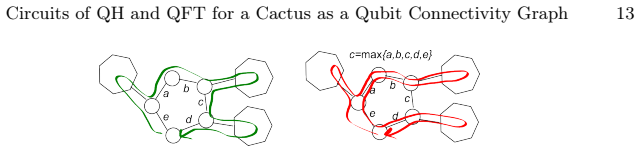
When the qubit connectivity graph is a cactus, the shortest non-simple 1-covering path can be found in O(n^3) time; this path is used as a subroutine to construct an optimized shallow circuit for quantum hashing (fingerprinting) and to improve the circuit for the Quantum Fourier Transform.
What carries the argument
The shortest non-simple 1-covering path in the cactus graph, which orders the applications of two-qubit gates to respect connectivity while keeping the circuit shallow.
If this is right
- Quantum hashing circuits become constructible in polynomial time on any device whose qubits form a cactus.
- The same path subroutine yields an improved circuit for the Quantum Fourier Transform under the same connectivity restriction.
- Circuit synthesis for other quantum algorithms can reuse the covering-path solution whenever the hardware graph is a cactus.
- Exponential-time search over gate orders is replaced by a deterministic cubic-time procedure for this graph class.
Where Pith is reading between the lines
- Hardware designers could deliberately arrange qubits into cactus-like trees of cycles to obtain the polynomial circuit-construction benefit.
- The covering-path technique might generalize to other sparse graphs that admit linear-time decompositions, such as outerplanar graphs.
- Empirical tests on quantum simulators could measure the actual reduction in two-qubit gate count or depth achieved by the cactus ordering.
Load-bearing premise
The qubit connectivity graph must be exactly a cactus so the polynomial covering-path subroutine applies directly.
What would settle it
A concrete cactus on n vertices for which every algorithm that produces the shortest non-simple 1-covering path requires more than cubic time, or a quantum circuit built from that path that fails to respect the two-qubit gate restrictions.
Figures




read the original abstract
We present a quantum circuit implementation of the quantum hashing algorithm (quantum fingerprinting) for a quantum device with restrictions on the application of two-qubit gates by a qubit connectivity graph. We present an optimization technique for the shallow circuit for quantum hashing in the case of a cactus as a qubit connectivity graph. The algorithm has $O(n^3)$ complexity to build the circuit, where $n$ is the number of qubits and $m$ is the number of connections (edges) in the graph. It is improvement compared to the existing exponential-time algorithm in the case of arbitrary graphs. The algorithm uses solution for the shortest non-simple 1-covering path problem as a subroutine. We present an $O(n^3)$-time solution for this graph-theory problem in the case of a cactus. This result can be interesting independently. The algorithm also used for improving of the quantum circuit for Quantum Fourier Transform.
Editorial analysis
A structured set of objections, weighed in public.
Referee Report
Summary. The manuscript presents an O(n^3)-time algorithm for constructing quantum circuits implementing quantum hashing (fingerprinting) and the Quantum Fourier Transform on devices whose qubit connectivity graph is a cactus. The construction reduces to solving the shortest non-simple 1-covering path problem on the cactus, for which the authors supply a dedicated polynomial-time subroutine that improves on the exponential-time methods known for arbitrary graphs.
Significance. If the claimed algorithm and its complexity analysis hold, the work supplies a concrete, polynomial-time method for producing shallow circuits under a restricted but structurally interesting connectivity model. The independent graph-theoretic result on 1-covering paths in cacti may be of separate interest to algorithm designers working on block-structured graphs.
major comments (2)
- [Abstract] Abstract: the central claim of an O(n^3)-time algorithm for the shortest non-simple 1-covering path problem is stated without any proof sketch, recurrence, or complexity argument. Because this complexity bound is the load-bearing improvement over exponential-time general-graph methods, the absence of even a high-level derivation prevents assessment of correctness.
- [Algorithm description / reduction section] The reduction from quantum-circuit construction to the covering-path instance is described only at a high level; no explicit mapping from gate sequence to path cover or analysis of how the cactus block structure is exploited appears in the provided description. This mapping is essential to the claimed circuit optimization.
minor comments (2)
- [Abstract] Abstract, final sentence: grammatical issues ('The algorithm also used for improving of the quantum circuit') should be corrected to 'The algorithm is also used to improve the quantum circuit'.
- [Abstract] The abstract mentions both n (qubits) and m (edges) yet states complexity as O(n^3); clarify whether the bound is strictly O(n^3) or involves m, and state the dependence explicitly.
Simulated Author's Rebuttal
We thank the referee for the careful review and constructive suggestions. We address each major comment below and outline the revisions we will make to strengthen the presentation.
read point-by-point responses
-
Referee: [Abstract] Abstract: the central claim of an O(n^3)-time algorithm for the shortest non-simple 1-covering path problem is stated without any proof sketch, recurrence, or complexity argument. Because this complexity bound is the load-bearing improvement over exponential-time general-graph methods, the absence of even a high-level derivation prevents assessment of correctness.
Authors: We agree that a high-level sketch of the O(n^3) argument is needed in the abstract to make the complexity claim assessable. In the revised manuscript we will add a concise description of the dynamic-programming recurrence that exploits the block-cut tree of the cactus, together with the O(n^3) bound that follows from processing each block in linear time after a quadratic preprocessing step on the cut vertices. revision: yes
-
Referee: [Algorithm description / reduction section] The reduction from quantum-circuit construction to the covering-path instance is described only at a high level; no explicit mapping from gate sequence to path cover or analysis of how the cactus block structure is exploited appears in the provided description. This mapping is essential to the claimed circuit optimization.
Authors: We accept that the reduction is currently presented at too high a level. The revised version will contain an explicit bijection between admissible two-qubit gate sequences on the cactus and non-simple 1-covering paths, together with a dedicated subsection that shows how the cactus block structure is used to decompose the path-finding problem into independent subproblems on each block while preserving the required gate ordering. revision: yes
Circularity Check
No significant circularity; explicit algorithmic construction
full rationale
The paper introduces a new O(n^3)-time algorithm for the shortest non-simple 1-covering path problem on cactus graphs and applies it as a subroutine to construct quantum circuits for hashing and QFT under the given connectivity restriction. This is a direct constructive result based on the block structure of cacti, with no equations, fitted parameters, or self-citations shown to reduce the central claim to its own inputs by definition. The derivation chain is self-contained as an independent graph-theoretic solution mapped to circuit depth optimization.
Axiom & Free-Parameter Ledger
axioms (1)
- domain assumption Quantum circuits are built from one- and two-qubit gates whose two-qubit gates are allowed only between adjacent vertices in the given connectivity graph.
Reference graph
Works this paper leans on
-
[1]
M. A Nielsen and I. L Chuang.Quantum computation and quantum information. Cambridge univ. press, 2010
work page 2010
-
[2]
F. Ablayev, M. Ablayev, J. Z. Huang, K. Khadiev, N. Salikhova, and D. Wu. On quantum methods for machine learning problems part i: Quantum tools.Big Data Mining and Analytics, 3(1):41–55, 2019
work page 2019
-
[3]
F. Ablayev, K. Khadiev, A. Vasiliev, and M. Ziiatdinov. Theory and applications of quantum hashing.Quantum Reports, 7(2), 2025
work page 2025
-
[4]
R¯ usin,š Freivalds. Fast probabilistic algorithms. InMathematical Foundations of Computer Science 1979, volume 74 ofLNCS, pages 57–69, 1979
work page 1979
-
[5]
A. Ambainis and N. Nahimovs. Improved constructions of quantum automata. Theoretical Computer Science, 410(20):1916–1922, 2009
work page 1916
-
[6]
Quantum fingerprinting.Physical Review Letters, 87(16):167902, 2001
Harry Buhrman, Richard Cleve, John Watrous, and Ronald De Wolf. Quantum fingerprinting.Physical Review Letters, 87(16):167902, 2001
work page 2001
-
[7]
F. Ablayev, A. Gainutdinova, M. Karpinski, C. Moore, and C. Pollett. On the com- putational power of probabilistic and quantum branching program.Information and Computation, 203(2):145–162, 2005
work page 2005
-
[8]
F. Ablayev and A. Vasiliev. Quantum hashing on the high-dimensional states. InInternational Conference on Micro-and Nano-Electronics 2021, volume 12157, pages 565–570. SPIE, 2022
work page 2021
-
[9]
François Le Gall. Exponential separation of quantum and classical online space complexity.Theory of Computing Systems, 45(2):188–202, 2009
work page 2009
-
[10]
F. Ablayev, M. Ablayev, K. Khadiev, N. Salihova, and A. Vasiliev. Quantum algorithms for string processing. InMesh Methods for Boundary-Value Problems and Applications, volume 141 ofLNCSE, 2022
work page 2022
-
[11]
Hybrid classical–quantum text search based on hashing.Mathematics, 12(12):1858, 2024
Farid Ablayev, Nailya Salikhova, and Marat Ablayev. Hybrid classical–quantum text search based on hashing.Mathematics, 12(12):1858, 2024
work page 2024
-
[12]
K. Khadiev and A. Khadieva. Quantum online streaming algorithms with loga- rithmic memory.International Journal of Theoretical Physics, 60:608–616, 2021
work page 2021
-
[13]
Kamil Khadiev and Aliya Khadieva. Quantum and classical log-bounded automata for the online disjointness problem.Mathematics, 10(1), 2022
work page 2022
-
[14]
A. Khadiev, K.and Khadieva, D. Kravchenko, I. Mannapov, A. Rivosh, and R.Yamilov. Quantumversusclassicalonlinestreamingalgorithmswithlogarithmic size of memory.Lobachevskii Journal of Mathematics, 44(2):687–698, 2023
work page 2023
-
[15]
K. Khadiev, A. Khadieva, M. Ziatdinov, I. Mannapov, D. Kravchenko, A. Rivosh, and R. Yamilov. Two-way and one-way quantum and classical automata with advice for online minimization problems.Theoretical Computer Science, 920:76– 94, 2022
work page 2022
-
[16]
K. Khadiev and A. Khadieva. Two-way quantum and classical automata with ad- vice for online minimization problems. InFormal Methods. FM 2019 International Workshops, pages 428–442, 2020. Circuits of QH and QFT for a Cactus as a Qubit Connectivity Graph 15
work page 2019
-
[17]
K. Khadiev and A. Khadieva. Two-way quantum and classical machines with small memory for online minimization problems. InInternational Conference on Micro- and Nano-Electronics 2018, volume 11022 ofProc. SPIE, page 110222T, 2019
work page 2018
-
[18]
K. Khadiev, A. Khadieva, and I. Mannapov. Quantum online algorithms with respect to space and advice complexity.Lobachevskii Journal of Mathematics, 39(9):1210–1220, 2018
work page 2018
-
[19]
Kamil Khadiev, Aliya Khadieva, and Alexander Knop. Exponential separation be- tween quantum and classical ordered binary decision diagrams, reordering method and hierarchies.Natural Computing, 22(4):723–736, 2023
work page 2023
-
[20]
A model of quantum communication device for quantum hashing
A Vasiliev. A model of quantum communication device for quantum hashing. In Journal of Physics: Conference Series, volume 681, page 012020, 2016
work page 2016
-
[21]
A. Gainutdinova and A. Yakaryılmaz. Nondeterministic unitary obdds. InCom- puter Science - Theory and Applications - CSR2017 Proceedings, volume 10304 of LNCS, pages 126–140, 2017
work page 2017
-
[22]
M. Ziiatdinov, F. Farsian, F. Schilliró, and S. Distefano. Comparing quantum machine learning approaches in astrophysics. InIEEE Quantum Software (QSW), World Congress on SERVICES, 7 2025
work page 2025
-
[23]
DO Akatev, AV Vasiliev, NM Shafeev, FM Ablayev, and AA Kalachev. Multiqudit quantum hashing and its implementation based on orbital angular momentum encoding.Laser Physics Letters, 19(12):125205, 2022
work page 2022
-
[24]
DA Turaykhanov, DO Akatev, AV Vasiliev, FM Ablayev, and AA Kalachev. Quan- tum hashing via single-photon states with orbital angular momentum.Physical Review A, 104(5):052606, 2021
work page 2021
-
[25]
S. ZD Plachta, M. Hiekkamäki, A. Yakaryılmaz, and R. Fickler. Quantum advan- tage using high-dimensional twisted photons as quantum finite automata.Quan- tum, 6:752, 2022
work page 2022
-
[26]
Experimen- tal demonstration advantage of photonic finite automata
Yuan-Yuan Zhao, Keren Li, Chao Li, Shenggen Zheng, and Zhixue He. Experimen- tal demonstration advantage of photonic finite automata. In2023 Asia Commu- nications and Photonics Conference/2023 International Photonics and Optoelec- tronics Meetings (ACP/POEM), pages 01–03. IEEE, 2023
work page 2023
-
[27]
Ville Bergholm, Juha J Vartiainen, Mikko Möttönen, and Martti M Salomaa. Quantum circuits with uniformly controlled one-qubit gates.Physical Review A—Atomic, Molecular, and Optical Physics, 71(5):052330, 2005
work page 2005
-
[28]
I Zinnatullin, K Khadiev, and A Khadieva. Efficient implementation of ampli- tude form of quantum hashing using state-of-the-art quantum processors.Russian Microelectronics, 52(Suppl 1):S390–S394, 2023
work page 2023
-
[29]
I. Zinnatullin, K. Khadiev, and I. Nikitin. Quantum random forest model predic- tion circuit gate complexity.Russian Microelectronics, 54(8):1449–1457, 2025
work page 2025
-
[30]
Kvantu algoritmu realiz¯ acija fizisk¯ a kvantu dator¯ a
M¯ artin,š K¯ alis. Kvantu algoritmu realiz¯ acija fizisk¯ a kvantu dator¯ a. Master’s thesis, University of Latvia, 2018
work page 2018
-
[31]
M. Ziiatdinov and A. Khadieva, A.and Yakaryılmaz. Gaps for shallow implemen- tation of quantum finite automata. InProceedings of AFL 2023, volume 386 of EPTCS, pages 269–280, 2023
work page 2023
-
[32]
M. Ziiatdinov, A. Khadieva, and K. Khadiev. Shallow implementation of quantum fingerprinting with application to quantum finite automata.Frontiers in Computer Science, 7:1519212, 2025
work page 2025
-
[33]
A. Khadieva, O Salehi, and A. Yakaryılmaz. A representative framework for im- plementing quantum finite automata on real devices. InProceedings of UCNC 2024, volume 14776 ofLNCS, pages 163–177. 2024
work page 2024
-
[34]
Quantum hashing algorithm implementation.arXiv preprint,
Aliya Khadieva. Quantum hashing algorithm implementation.arXiv preprint,
- [35]
-
[36]
K. Khadiev, A. Khadieva, Z. Chen, and J. Wu. Implementation of quantum fourier transform and quantum hashing for a quantum device with arbitrary qubits con- nection graphs.Quantum Information & Computation, 25(2025):509–541, 2025
work page 2025
-
[37]
Constant-depth algorithm for quantum hashing.Russian Microelec- tronics, 52(Suppl 1):S399–S402, 2023
A Vasiliev. Constant-depth algorithm for quantum hashing.Russian Microelec- tronics, 52(Suppl 1):S399–S402, 2023
work page 2023
-
[38]
K Khadiev, D Melnikova, K Altinbayev, and A Khadieva. Shallow circuit imple- mentation for the phase form of quantum hashing and local-sensitive hashing on ibmq noisy emulators.Russian Microelectronics, 53(8):1449–1457, 2025
work page 2025
-
[39]
John Current, Hasan Pirkul, and Erik Rolland. Efficient algorithms for solving the shortest covering path problem.Transportation Science, 28(4):317–327, 1994
work page 1994
- [40]
-
[41]
Quantum measurements and the Abelian Stabilizer Problem
A Yu Kitaev. Quantum measurements and the abelian stabilizer problem.arXiv preprint quant-ph/9511026, 1995
work page internal anchor Pith review Pith/arXiv arXiv 1995
-
[42]
Addition on a quantum computer.arXiv preprint quant- ph/0008033, 2000
Thomas G Draper. Addition on a quantum computer.arXiv preprint quant- ph/0008033, 2000
-
[43]
G. Brassard, P. Høyer, M. Mosca, and A. Tapp. Quantum amplitude amplification and estimation.Contemporary Mathematics, 305:53–74, 2002
work page 2002
-
[44]
Quantum algorithm for linear systems of equations.Physical review letters, 103(15):150502, 2009
Aram W Harrow, Avinatan Hassidim, and Seth Lloyd. Quantum algorithm for linear systems of equations.Physical review letters, 103(15):150502, 2009
work page 2009
-
[45]
Peter W Shor. Polynomial-time algorithms for prime factorization and discrete logarithms on a quantum computer.SIAM review, 41(2):303–332, 1999
work page 1999
-
[46]
F. Ablayev and A. Vasiliev. Quantum hashing and fourier transform. InJournal of Physics: Conf. Series, volume 1680, page 012001, 2020
work page 2020
-
[47]
B. Park and D. Ahn. Reducing cnot count in quantum fourier transform for the linear nearest-neighbor architecture.Scientific Reports, 13(1):8638, 2023
work page 2023
-
[48]
K. Khadiev, A. Khadieva, V. Sagitov, and K. Khasanov. Quantum circuit for quan- tum fourier transform for arbitrary qubit connectivity graphs. InLatin American Symposium on Theoretical Informatics (LATIN) 2026, 2026
work page 2026
- [49]
-
[50]
T.HCormen,C.ELeiserson,R.LRivest,andC.Stein.Introduction to Algorithms. McGraw-Hill, 2001
work page 2001
-
[51]
A. Ambainis and R. Freivalds. 1-way quantum finite automata: strengths, weak- nesses and generalizations. InFOCS’98, pages 332–341. IEEE, 1998
work page 1998
-
[52]
Improved constructions of quantum automata
Andris Ambainis and Nikolajs Nahimovs. Improved constructions of quantum automata. InTQC, volume 5106 ofLNCS, pages 47–56. Springer, 2008
work page 2008
-
[53]
F. Ablayev, A. Khasianov, and A. Vasiliev. On complexity of quantum branching programs computing equality-like boolean functions.ECCC, 2010
work page 2010
-
[54]
A. Ambainis and A. Yakaryılmaz. Superiority of exact quantum automata for promise problems.Information Processing Letters, 112(7):289–291, 2012
work page 2012
-
[55]
F. Ablayev, A. Gainutdinova, K. Khadiev, and A. Yakaryılmaz. Very narrow quan- tum OBDDs and width hierarchies for classical OBDDs.Lobachevskii Journal of Mathematics, 37(6):670–682, 2016
work page 2016
-
[56]
good” in the following sense. A set of parametersK={k1, . . . , kt}is called “good
A. Barenco, C. H. Bennett, R. Cleve, D. P. DiVincenzo, N. Margolus, P. Shor, T. Sleator, J. A. Smolin, and H. Weinfurter. Elementary gates for quantum com- putation.Physical review A, 52(5):3457, 1995. Circuits of QH and QFT for a Cactus as a Qubit Connectivity Graph 17 A Quantum Fingerprinting or Quantum Hashing Let us present some basic concepts of quan...
work page 1995
-
[57]
We constructg(x), that maps all acceptable inputs to0modulomand others to arbitrary non-zero (modulom) integers
-
[58]
After the necessary manipulations with the fingerprint, theH⊗log 2 t oper- ator is applied to the firstlog2 tqubits. This operation “collects” all cosine amplitudes at the all-zero state. That is, we obtain the state of the type |h′ σ⟩= 1 t tX i=1 cos 2πkig(σ) m |00. . .0⟩|0⟩+ 2tX i=2 αi|i⟩ 18 K.Khadiev and I. Valeev
-
[59]
Then we ac- cept the input if the outcome is the all-zero state
This state is measured on the standard computational basis. Then we ac- cept the input if the outcome is the all-zero state. This happens with the probability P raccept(σ) = 1 t2 tX i=1 cos 2πkig(σ) m !2 , which is1for the inputs, whose image is0 modmand is bounded byεfor the others. Dueto[31,32,30],thealgorithmcanbeimplementedusingtheshallowcircuit prese...
-
[60]
The angleξ r corresponds to the qubitqr associated with the vertexv
We assume that we havecR(u, v)procedure that applies the control rotation operatorCR y touas a control qubit andvas a target one. The angleξ r corresponds to the qubitqr associated with the vertexv. Additionally, we have sw ap(u, v)procedure that applies swap gate touandvqubits. Algorithm 1Implementation ofConstructForPath(P)procedure. Algo- rithm of cons...
discussion (0)
Sign in with ORCID, Apple, or X to comment. Anyone can read and Pith papers without signing in.