Polynomial diagrams for microstructure modelling
Pith reviewed 2026-05-21 03:57 UTC · model grok-4.3
The pith
Polynomial diagrams generalize power diagrams so cell boundaries become algebraic curves of any chosen degree.
A machine-rendered reading of the paper's core claim, the machinery that carries it, and where it could break.
Core claim
We formulate a framework of polynomial diagrams, which are a generalisation of power diagrams (PDs) and anisotropic power diagrams (APDs) allowing for boundaries between cells to be algebraic curves of a prescribed degree. We show that they arise naturally from rephrasing PDs (APDs) as first-degree (second-degree) instances of linear parametrised minimisation diagrams. We also develop an efficient GPU-accelerated framework for fitting polynomial diagrams to image data using Legendre polynomials and by maximising a regularised concave objective function adapted from classical logistic regression literature.
What carries the argument
Polynomial diagrams defined as instances of linear parametrised minimisation diagrams, which produce algebraic boundaries of any prescribed degree between cells.
Load-bearing premise
Microstructures in electron backscatter diffraction images of steel can be meaningfully represented and fitted by polynomial diagrams of a chosen degree arising from linear parametrised minimisation diagrams.
What would settle it
Fitting polynomial diagrams of degree three or higher to the same steel EBSD images produces no measurable improvement in boundary accuracy or objective value over degree-two anisotropic power diagrams.
Figures


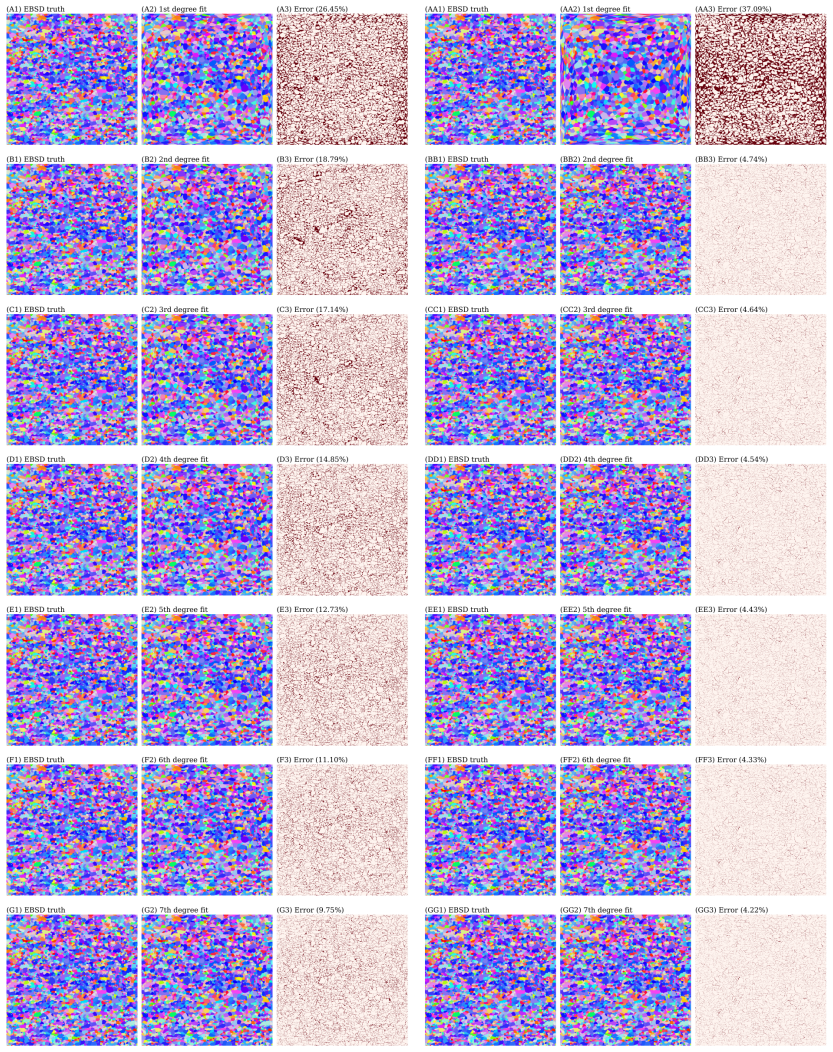
read the original abstract
We formulate a framework of polynomial diagrams, which are a generalisation of power diagrams (PDs) and anisotropic power diagrams (APDs) allowing for boundaries between cells to be algebraic curves of a prescribed degree. We show that they arise naturally from rephrasing PDs (APDs) as first-degree (second-degree) instances of linear parametrised minimisation diagrams. We also develop an efficient GPU-accelerated framework for fitting polynomial diagrams to image data using Legendre polynomials and by maximising a regularised concave objective function adapted from classical logistic regression literature. A largely self-contained analysis of the optimisation algorithm is also provided, including identification of scale and gauge invariances and the limiting objective function as the regularisation parameter vanishes. We apply the algorithm to fit polynomial diagrams to electron backscatter diffraction images of steel.
Editorial analysis
A structured set of objections, weighed in public.
Referee Report
Summary. The paper formulates polynomial diagrams as a generalization of power diagrams (PDs) and anisotropic power diagrams (APDs) in which cell boundaries are algebraic curves of a prescribed degree. These arise from rephrasing PDs and APDs as degree-1 and degree-2 cases of linear parametrised minimisation diagrams, extended via Legendre parametrisation. An efficient GPU-accelerated fitting procedure is developed that maximises a regularised concave objective adapted from logistic regression. The optimisation algorithm is analysed for scale and gauge invariances and the limiting objective as the regularisation parameter tends to zero. The method is applied to fitting electron backscatter diffraction (EBSD) images of steel microstructures.
Significance. If the central claims hold, the framework supplies a flexible, parametrised family of diagrams with algebraic boundaries of controllable degree together with a practical GPU fitting pipeline and a largely self-contained convergence analysis. These elements could be useful for microstructure modelling where grain boundaries deviate from the linear or quadratic cases already covered by PDs and APDs. The explicit treatment of invariances and the limiting objective is a clear strength that aids reproducibility and theoretical understanding.
major comments (2)
- [Application to EBSD images] Application section (EBSD steel images): the manuscript shows visual fits but supplies no quantitative metrics (pixel-wise error, Hausdorff distance on boundaries, or cross-validation scores) comparing polynomial diagrams of degree >2 against the APD (degree-2) baseline. Without such numbers or an ablation on degree and regularisation strength, it remains unclear whether the additional degrees reduce representation error on real data or merely increase parameter count.
- [Framework formulation] Framework formulation: the claim that boundaries are exactly algebraic curves of the prescribed degree relies on the Legendre parametrisation of the linear minimisation diagram; the manuscript should explicitly verify that the chosen basis and truncation enforce this degree exactly rather than approximately, especially when the regularised objective is maximised.
minor comments (2)
- [Notation and definitions] Clarify the precise definition and notation for 'linear parametrised minimisation diagrams' at first use, including how the parameters enter the minimisation.
- [Results figures] Figure captions in the results should state the polynomial degree, regularisation value, and data resolution for each displayed fit.
Simulated Author's Rebuttal
We thank the referee for the careful reading and constructive comments on the manuscript. We address each major comment below and have revised the paper accordingly to strengthen the presentation.
read point-by-point responses
-
Referee: [Application to EBSD images] Application section (EBSD steel images): the manuscript shows visual fits but supplies no quantitative metrics (pixel-wise error, Hausdorff distance on boundaries, or cross-validation scores) comparing polynomial diagrams of degree >2 against the APD (degree-2) baseline. Without such numbers or an ablation on degree and regularisation strength, it remains unclear whether the additional degrees reduce representation error on real data or merely increase parameter count.
Authors: We agree that quantitative metrics would provide stronger support for the utility of higher-degree diagrams. The original submission emphasised visual results to illustrate the method on EBSD data. In the revised manuscript we have added a quantitative comparison subsection that reports pixel-wise misclassification error and boundary Hausdorff distances for degrees 1, 2 and 3, together with an ablation table over degree and regularisation strength. These results indicate a modest but consistent improvement for degree 3 over the APD baseline on the steel images, with regularisation controlling parameter growth. revision: yes
-
Referee: [Framework formulation] Framework formulation: the claim that boundaries are exactly algebraic curves of the prescribed degree relies on the Legendre parametrisation of the linear minimisation diagram; the manuscript should explicitly verify that the chosen basis and truncation enforce this degree exactly rather than approximately, especially when the regularised objective is maximised.
Authors: The Legendre basis of order at most d spans all polynomials of degree ≤ d, so the resulting minimisation diagram yields cell boundaries that are exactly the zero loci of degree-d polynomials (i.e., algebraic curves of exact degree d). The regularisation term modifies only the objective landscape and does not change the functional form or degree of the boundaries. We have inserted a short clarifying remark and verification argument in Section 2.2 of the revised manuscript to make this explicit. revision: yes
Circularity Check
No significant circularity detected
full rationale
The paper introduces polynomial diagrams as a mathematical generalization of power diagrams (PDs) and anisotropic power diagrams (APDs) by rephrasing the latter as degree-1 and degree-2 cases of linear parametrised minimisation diagrams, then extends the construction to higher-degree algebraic boundaries via Legendre parametrisation. It develops a GPU-accelerated fitting procedure that maximises a regularised concave objective adapted from external logistic regression literature and supplies a self-contained analysis of scale/gauge invariances and the vanishing-regularisation limit. The method is applied to independent EBSD steel image data. No derivation step reduces a claimed prediction or result to a fitted parameter or prior self-citation by construction; all load-bearing components either rest on external literature or on direct fitting to outside data.
Axiom & Free-Parameter Ledger
free parameters (2)
- polynomial degree
- regularization parameter
axioms (1)
- domain assumption Polynomial diagrams arise naturally from rephrasing PDs and APDs as first-degree and second-degree instances of linear parametrised minimisation diagrams.
invented entities (1)
-
polynomial diagram
no independent evidence
Lean theorems connected to this paper
-
IndisputableMonolith/Cost/FunctionalEquation.leanwashburn_uniqueness_aczel unclear?
unclearRelation between the paper passage and the cited Recognition theorem.
We show that they arise naturally from rephrasing PDs (APDs) as first-degree (second-degree) instances of linear parametrised minimisation diagrams... maximising a regularised concave objective function adapted from classical logistic regression
-
IndisputableMonolith/Foundation/ArithmeticFromLogic.leanabsolute_floor_iff_bare_distinguishability unclear?
unclearRelation between the paper passage and the cited Recognition theorem.
the objective function Φ_G_ε is concave... strictly concave on the orthogonal complement of the gauge nullspace
What do these tags mean?
- matches
- The paper's claim is directly supported by a theorem in the formal canon.
- supports
- The theorem supports part of the paper's argument, but the paper may add assumptions or extra steps.
- extends
- The paper goes beyond the formal theorem; the theorem is a base layer rather than the whole result.
- uses
- The paper appears to rely on the theorem as machinery.
- contradicts
- The paper's claim conflicts with a theorem or certificate in the canon.
- unclear
- Pith found a possible connection, but the passage is too broad, indirect, or ambiguous to say the theorem truly supports the claim.
Reference graph
Works this paper leans on
-
[1]
Sparsistency for Inverse Optimal Transport , booktitle =
Francisco Andrade and Gabriel Peyr. Sparsistency for Inverse Optimal Transport , booktitle =
- [2]
-
[3]
International Conference on Machine Learning , pages=
Discrete probabilistic inverse optimal transport , author=. International Conference on Machine Learning , pages=. 2022 , organization=
work page 2022
-
[4]
Journal of Machine Learning Research , volume =
Ruilin Li and Xiaojing Ye and Haomin Zhou and Hongyuan Zha , title =. Journal of Machine Learning Research , volume =. 2019 , pages =
work page 2019
-
[5]
Asymptotic and computational analysis , pages=
How (un) stable are Vandermonde systems? , author=. Asymptotic and computational analysis , pages=. 2020 , publisher=
work page 2020
-
[6]
Approximation theory and approximation practice, extended edition , author=. 2019 , publisher=
work page 2019
-
[7]
Spettl, A. and Brereton, T. and Duan, Q. and Werz, T. and. Fitting. Philosophical Magazine , volume =. 2016 , doi =
work page 2016
-
[8]
Depriester, D. and Kubler, R. , TITLE =. Computer-Aided Design , VOLUME =. 2019 , PAGES =
work page 2019
-
[9]
Kuhn, J. and Schneider, M. and Sonnweber-Ribic, P. and B. Fast methods for computing centroidal. Computer Methods in Applied Mechanics and Engineering , volume=. 2020 , doi=
work page 2020
-
[10]
K\"uhn, M. and Steinhauser, M. O. , title =. Applied Physics Letters , volume =. 2008 , doi =
work page 2008
-
[11]
Philosophical Magazine , volume=
Laguerre tessellations and polycrystalline microstructures: a fast algorithm for generating grains of given volumes , author=. Philosophical Magazine , volume=. 2020 , doi=
work page 2020
-
[12]
Mechanics Research Communications , volume=
Geometric modelling of polycrystalline materials: Laguerre tessellations and periodic semi-discrete optimal transport , author=. Mechanics Research Communications , volume=. 2023 , doi =
work page 2023
-
[13]
David P. Bourne and Thomas O. Gallou\"et and Quentin M\'erigot and Andrea Natale , title =. hal-05008630 , year =
-
[14]
Bourne and Mason Pearce and Steven M
David P. Bourne and Mason Pearce and Steven M. Roper , title =. ESAIM: Mathematical Modelling and Numerical Analysis , volume =. 2025 , doi =
work page 2025
-
[15]
Microscopy and Microanalysis , author=
Reconstruction of Grains in Polycrystalline Materials From Incomplete Data Using. Microscopy and Microanalysis , author=. 2019 , pages=
work page 2019
-
[16]
A. Alpers and O. Furat and C. Jung and M. Neumann and C. Redenbach and A. Saken and V. Schmidt , title =. 2025 , journal =
work page 2025
-
[17]
Jocelyn Meyron , title =. Computer-Aided Design , doi =. 2019 , volume =
work page 2019
-
[18]
Plateau-Holleville, Cyprien and Stamm, Benjamin and Nivoliers, Vincent and Maria, Maxime and M. In Search of Empty Spheres:. ACM Transactions on Graphics (TOG) , volume=. 2025 , publisher=
work page 2025
-
[19]
Computer Methods in Applied Mechanics and Engineering , volume=
Generating high-fidelity microstructures of polycrystalline materials with prescribed higher-order texture tensors , author=. Computer Methods in Applied Mechanics and Engineering , volume=. 2026 , publisher=
work page 2026
-
[20]
Roters, Franz and Eisenlohr, Philip and Hantcherli, Luc and Tjahjanto, Denny Dharmawan and Bieler, Thomas R. and Raabe, Dierk , title =. Acta Materialia , year =
-
[21]
Anderson, M. P. and Srolovitz, D. J. and Grest, G. S. and Sahni, P. S. , title =. Acta Metallurgica , year =
- [22]
-
[23]
Moelans, Nele and Blanpain, Bart and Wollants, Patrick , title =. Calphad , year =
-
[24]
Hall, E. O. , title =. Proceedings of the Physical Society. Section B , year =
-
[25]
Optimal polyhedral description of
Quey, Romain and Renversade, Lo. Optimal polyhedral description of. Computer Methods in Applied Mechanics and Engineering , year =
-
[26]
Advanced Engineering Materials , year =
Lyckegaard, Allan and Lauridsen, Erik Mejdal and Ludwig, Wolfgang and Fonda, Richard Warren and Poulsen, Henning Friis , title =. Advanced Engineering Materials , year =
-
[27]
Computational Materials Science , year =
Fan, Zhigang and Wu, Yugong and Zhao, Xuanhe and Lu, Yuzhu , title =. Computational Materials Science , year =
-
[28]
Philosophical Magazine , year =
Alpers, Andreas and Fiedler, Maximilian and Gritzmann, Peter and Klemm, Fabian , title =. Philosophical Magazine , year =
-
[29]
Philosophical Magazine , year =
-
[30]
Data-driven selection of tessellation models describing polycrystalline microstructures , journal =. 2018 , volume =
work page 2018
-
[31]
Image Analysis and Stereology , year =
Altendorf, Hellen and Latourte, Felix and Jeulin, Dominique and Faessel, Matthieu and Saintoyant, Lucie , title =. Image Analysis and Stereology , year =
-
[32]
Computational Geometry , year =
Jung, Christian and Redenbach, Claudia , title =. Computational Geometry , year =
-
[33]
Philosophical Magazine , year =
Alpers, Andreas and Brieden, Andreas and Gritzmann, Peter and Lyckegaard, Allan and Poulsen, Henning Friis , title =. Philosophical Magazine , year =
-
[34]
Bachmann, Florian and Hielscher, Ralf and Schaeben, Helmut , title =. Ultramicroscopy , year =
-
[35]
van Laarhoven, Peter J. M. and Aarts, Emile H. L. , title =
-
[36]
Liu, Dong C. and Nocedal, Jorge , title =. Mathematical Programming , year =
-
[37]
Charlier, Benjamin and Feydy, Jean and Glaun. Kernel operations on the. Journal of Machine Learning Research , year =
-
[38]
Buze, M. and Feydy, J. and Roper, S. M. and Sedighiani, K. and Bourne, D. P. , title =. Computational Materials Science , year =
- [39]
-
[40]
Papadopoulou, Evanthia and Zavershynskyi, Maksym , title =. Algorithmica , year =
-
[41]
IEEE Transactions on Computers , year =
Lee, Der-Tsai , title =. IEEE Transactions on Computers , year =
-
[42]
ACM Computing Surveys , year =
Aurenhammer, Franz , title =. ACM Computing Surveys , year =
-
[43]
Journal of Machine Learning Research , year =
Rifkin, Ryan and Klautau, Aldebaro , title =. Journal of Machine Learning Research , year =
-
[44]
Blanchard, Pierre and Higham, Desmond J. and Higham, Nicholas J. , title =. IMA Journal of Numerical Analysis , year =
-
[45]
Boyd, Stephen and Vandenberghe, Lieven , title =
-
[46]
Hastie, Trevor and Tibshirani, Robert and Friedman, Jerome , title =
- [47]
- [48]
- [49]
- [50]
-
[51]
Advances in Neural Information Processing Systems , year =
Paszke, Adam and Gross, Sam and Massa, Francisco and Lerer, Adam and Bradbury, James and Chanan, Gregory and Killeen, Trevor and Lin, Zeming and Gimelshein, Natalia and Antiga, Luca and others , title =. Advances in Neural Information Processing Systems , year =
- [52]
-
[53]
SIAM Journal on Imaging Sciences , year =
Alpers, Andreas and Fiedler, Maximilian and Gritzmann, Peter and Klemm, Fabian , title =. SIAM Journal on Imaging Sciences , year =
-
[54]
Computational optimal transport , journal =
Peyr. Computational optimal transport , journal =. 2019 , volume =
work page 2019
-
[55]
Petrich, Lukas and Furat, Orkun and Wang, Mingyan and Krill III, Carl E. and Schmidt, Volker , title =. Frontiers in Materials , year =
discussion (0)
Sign in with ORCID, Apple, or X to comment. Anyone can read and Pith papers without signing in.