Towards compact high-frequency nonreciprocal devices using nanoplasma-switched time-varying metasurfaces
Pith reviewed 2026-05-21 02:26 UTC · model grok-4.3
The pith
Nanoplasma switches in time-varying metasurfaces enable nonreciprocal isolators at 100 GHz.
A machine-rendered reading of the paper's core claim, the machinery that carries it, and where it could break.
Core claim
Treating nanoplasma switches as ideal two-state time-modulated elements, the time-Floquet method permits the analytical design of time-varying metasurfaces that produce nonreciprocal transmission, as shown by an isolator at 100 GHz whose isolation performance is confirmed analytically and in full-wave simulations.
What carries the argument
The time-Floquet method applied to two-state time-modulated nanoplasma switches, which computes the resulting scattering parameters to enforce nonreciprocity.
If this is right
- Nonreciprocal effects become achievable at millimeter-wave frequencies well above the few-gigahertz limit of varactor-based modulators.
- Compact isolator designs for 100 GHz operation can be obtained directly from the analytical framework.
- The same method extends to other nonreciprocal functions such as frequency conversion in time-varying metasurfaces.
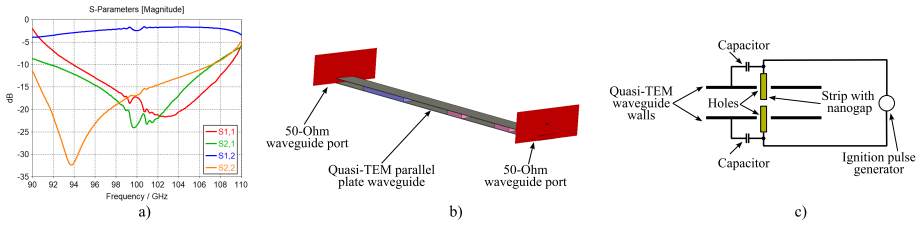
- Numerical results indicate that the isolator concept can be realized inside a parallel-plate waveguide.
Where Pith is reading between the lines
- The technique may scale to terahertz frequencies provided nanoplasma response times remain sufficiently short.
- Integration with existing metasurface fabrication methods could yield low-loss, chip-scale nonreciprocal components.
- Similar two-state modulation principles might be adapted to acoustic or optical wave systems for analogous nonreciprocal behavior.
Load-bearing premise
Nanoplasma switches behave as ideal two-state time-modulated elements whose response times are fast enough to support effective nonreciprocal operation at 100 GHz.
What would settle it
Full-wave simulation or measurement at 100 GHz in which forward and reverse transmission coefficients become equal instead of showing the predicted isolation ratio.
Figures
read the original abstract
Time-modulated systems have received growing interest in recent years. They allow us to tailor effects, such as frequency conversion, single-direction propagation, etc. For the microwave band, semiconductor elements, such as varactors, are usually used as time-modulated elements but their modulation frequency has been limited to the few-gigahertz range. Recent advances in nanoplasma switches, i.e., two-state electronic switches based on a gas discharge in a nanometer-scale gap, provide a new potential for developing time-modulated systems with high operating frequencies. Here, we develop an analytical framework based on the time-Floquet method for the design of nonreciprocal time-modulated devices based on two-state time-modulated elements, for instance, nanoplasma-based switches. A practical example of a microwave isolator operating at 100~GHz frequency is developed and studied both analytically and using full-wave simulations. A potential realization in a parallel-plate waveguide is also simulated numerically.
Editorial analysis
A structured set of objections, weighed in public.
Referee Report
Summary. The manuscript develops an analytical framework based on the time-Floquet method for nonreciprocal devices that employ two-state time-modulated elements, specifically nanoplasma switches. It presents a concrete design example of a 100 GHz isolator that is analyzed both analytically and through full-wave simulations, along with a numerical study of a potential parallel-plate waveguide realization.
Significance. If the modeling assumptions hold, the work could open a route to compact, high-frequency nonreciprocal components that exceed the modulation-frequency limits of conventional semiconductor varactors. The combination of a general Floquet-based design method with full-wave validation for a millimeter-wave isolator is a positive contribution to the time-modulated metasurface literature.
major comments (2)
- [Abstract and analytical framework description] The central claim of effective nonreciprocal operation at 100 GHz rests on treating the nanoplasma switches as ideal, instantaneous two-state modulators whose ionization and recombination dynamics are negligible compared with the ~10 ps RF period. No section quantifies measured or simulated turn-on/turn-off times, nor are finite transition dynamics incorporated into the Floquet expansion or the CST/HFSS models. If these times approach or exceed a few picoseconds, the effective modulation depth collapses and the predicted isolation vanishes.
- [Simulation results section] The full-wave simulations are presented as validation of the analytical isolator design, yet the manuscript provides no error bars, convergence checks, or direct comparison metrics (e.g., isolation in dB versus frequency) between the Floquet predictions and the numerical results. This weakens the support for the practical 100 GHz example.
minor comments (1)
- [Analytical framework] Notation for the time-modulated permittivity or conductivity of the nanoplasma element should be defined explicitly in the analytical framework before its use in the Floquet equations.
Simulated Author's Rebuttal
We thank the referee for the constructive comments on our manuscript. We address each major comment point by point below, indicating where revisions will be made.
read point-by-point responses
-
Referee: [Abstract and analytical framework description] The central claim of effective nonreciprocal operation at 100 GHz rests on treating the nanoplasma switches as ideal, instantaneous two-state modulators whose ionization and recombination dynamics are negligible compared with the ~10 ps RF period. No section quantifies measured or simulated turn-on/turn-off times, nor are finite transition dynamics incorporated into the Floquet expansion or the CST/HFSS models. If these times approach or exceed a few picoseconds, the effective modulation depth collapses and the predicted isolation vanishes.
Authors: We agree that the time-Floquet framework and the 100 GHz isolator example are developed under the assumption of ideal, instantaneous two-state modulation. The manuscript presents the general analytical method for such elements and uses nanoplasma switches as a motivating example capable of high-frequency operation. To address the concern, we will revise the abstract, introduction, and framework sections to explicitly state this modeling assumption and its validity condition (transition times much shorter than the RF period). We will also add a concise discussion referencing prior experimental literature on nanoplasma switching speeds to support the assumption for the presented design. revision: partial
-
Referee: [Simulation results section] The full-wave simulations are presented as validation of the analytical isolator design, yet the manuscript provides no error bars, convergence checks, or direct comparison metrics (e.g., isolation in dB versus frequency) between the Floquet predictions and the numerical results. This weakens the support for the practical 100 GHz example.
Authors: We acknowledge that the current manuscript lacks explicit quantitative comparisons and supporting details for the full-wave results. In the revised version, we will add direct side-by-side metrics and plots comparing isolation versus frequency from the Floquet analysis and the CST/HFSS simulations, include mesh convergence information, and report any relevant numerical tolerances to strengthen the validation of the 100 GHz example. revision: yes
Circularity Check
No significant circularity: established time-Floquet framework applied to new switch model
full rationale
The paper develops an analytical framework using the time-Floquet method for nonreciprocal devices based on two-state time-modulated elements such as nanoplasma switches, then presents a 100 GHz isolator example studied analytically and via full-wave simulations. This applies a standard existing technique to a novel element type without any reduction of the central results to parameters fitted inside the paper's own equations or to self-citation chains that bear the load of the uniqueness or derivation. The model assumptions (ideal instantaneous two-state behavior) are stated as inputs rather than derived from the outputs, and no predictions are shown to be equivalent to those inputs by construction. The derivation chain therefore remains self-contained against external benchmarks.
Axiom & Free-Parameter Ledger
axioms (1)
- domain assumption The time-Floquet method accurately captures scattering and nonreciprocal behavior in systems with periodic two-state time modulation.
Lean theorems connected to this paper
-
IndisputableMonolith/Foundation/ArithmeticFromLogic.leanLogicNat orbit and 8-tick periodicity unclear?
unclearRelation between the paper passage and the cited Recognition theorem.
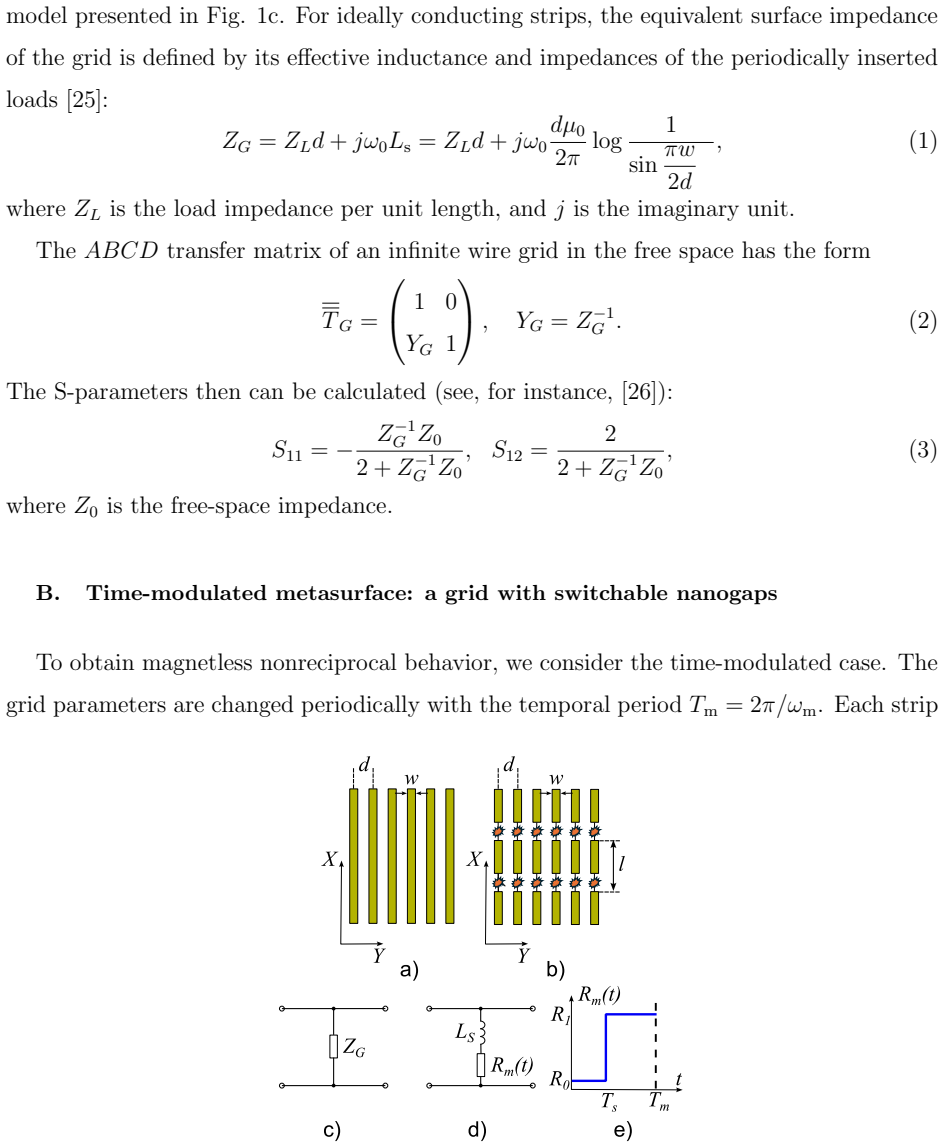
We develop an analytical framework based on the time-Floquet method for the design of nonreciprocal time-modulated devices based on two-state time-modulated elements... Rm(t) takes only two values – R0 and R1... Fourier series... ZR matrix
What do these tags mean?
- matches
- The paper's claim is directly supported by a theorem in the formal canon.
- supports
- The theorem supports part of the paper's argument, but the paper may add assumptions or extra steps.
- extends
- The paper goes beyond the formal theorem; the theorem is a base layer rather than the whole result.
- uses
- The paper appears to rely on the theorem as machinery.
- contradicts
- The paper's claim conflicts with a theorem or certificate in the canon.
- unclear
- Pith found a possible connection, but the passage is too broad, indirect, or ambiguous to say the theorem truly supports the claim.
Reference graph
Works this paper leans on
-
[1]
ω 0 +N ω m ,(12) where the grid inductanceL s is defined by (1). By combining the matrices Z R and Z L we obtain the 2(2N+ 1)×2(2N+ 1) transfer matrix T G for the time-modulated grid in the form T G = I 0 Y G I , Y G = Z R + Z L −1 ,(13) where Iis the (2N+ 1)×(2N+ 1) identity matrix. This matrix sets the relation between the harmonics of th...
-
[2]
For an incident wave with the frequencyω 0 in the ‘forward’ direction we wante f t (ω0) to be as close to 1 as possible, which is equivalent to low insertion loss of the isolator. For a time-modulated system, the energy in the general case is not conserved even in the absence of losses, so this coefficient may be larger than 1
-
[3]
For an incident wave with the frequencyω 0 in the ‘forward’ direction we wante f r (ω0) to be as close to 0 as possible, which means that no energy is reflected. Since the energy in this time-varying system is not generally conserved, we need to pose this goal in addition to goal 1
-
[4]
In our case, it is not important if this energy is reflected or absorbed
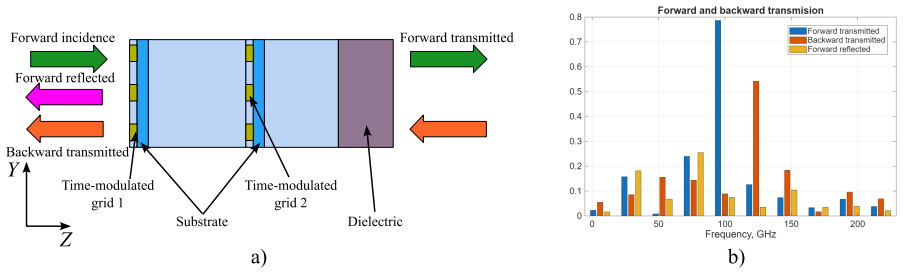
For an incident wave with the frequencyω 0 in the ‘backward’ direction we wante b t (ω0) to be as close to 0 as possible, which means that no energy at the frequencyω 0 can travel backward. In our case, it is not important if this energy is reflected or absorbed. 11 FIG. 2. a) A schematic view of a multi-layered isolator device; b) the amplitude ratio for...
-
[5]
All other coefficients of the vectors ef t, ef r, eb t may be arbitrary. All the frequency side harmonics can be efficiently filtered out by any known passive band-pass filter with the center frequencyω 0. We consider the following combination of the layers of different types in the order of increase of thez-coordinate (see Fig. 2a): 1) a time-modulated s...
-
[6]
an air gap; 4) a time-modulated strip grid; 5) a dielectric substrate (sapphire); 6) an air gap; 7) a dielectric slab (PTFE,ε= 2.1, losses are negligible). Sapphire was chosen because this material can form a nearly perfect dielectric substrate for nanofabrication; PTFE was chosen because of its very low dielectric losses. Two time-modulated grids are the...
-
[7]
A simulation domain enclosing one period of a strip grid in both directions on the grid plane was considered. Together with appropriate boundary conditions this allows sim- ulating an infinite plane grid for a fixed polarization of the incident waves. For the electric field parallel to theXaxis, Perfect Magnetic Conductor (PMC) boundary conditions on the ...
work page 2022
-
[8]
V. S. Asadchy, M. S. Mirmoosa, A. D´ ıaz-Rubio, S. Fan, and S. A. Tretyakov, Tutorial on electromagnetic nonreciprocity and its origins, Proceedings of the IEEE108, 1684 (2020)
work page 2020
- [9]
-
[10]
A. Nagulu and H. Krishnaswamy, Non-magnetic non-reciprocal microwave components — state of the art and future directions, IEEE Journal of Microwaves1, 447 (2021)
work page 2021
- [11]
-
[12]
D. L. Sounas, J. Soric, and A. Al` u, Broadband passive isolators based on coupled nonlinear resonances, Nature Electronics1, 113–119 (2018). 18
work page 2018
-
[13]
N. A. Estep, D. L. Sounas, J. Soric, and A. Al` u, Magnetic-free non-reciprocity and isola- tion based on parametrically modulated coupled-resonator loops, Nature Physics10, 923–927 (2014)
work page 2014
-
[14]
G. Wang and L. Lu, Topological microwave isolator with>100-dB isolation, Nature Photonics 19, 1064–1069 (2025)
work page 2025
-
[15]
S. Y. Elnaggar and G. N. Milford, Modeling space–time periodic structures with arbitrary unit cells using time periodic circuit theory, IEEE Transactions on Antennas and Propagation 68, 6636 (2020)
work page 2020
-
[16]
X. Wang, G. Ptitcyn, V. S. Asadchy, A. Diaz-Rubio, M. S. Mirmoosa, S. Fan, and S. A. Tretyakov, Nonreciprocity in bianisotropic systems with uniform time modulation, Physical Review Letters125, 266102 (2020)
work page 2020
-
[17]
N. Reiskarimian and H. Krishnaswamy, Magnetic-free non-reciprocity based on staggered com- mutation, Nature Communications7, 11217 (2016)
work page 2016
-
[18]
T. Dinc, M. Tymchenko, A. Nagulu, D. L. Sounas, A. Al` u, and H. Krishnaswamy, Synchronized conductivity modulation to realize broadband lossless magnetic-free non-reciprocity, Nature Communications8, 795 (2017)
work page 2017
-
[19]
G. Chaudhary and Y. Jeong, Frequency tunable impedance matching nonreciprocal band- pass filter using time-modulated quarter-wave resonators, IEEE Transactions on Industrial Electronics69, 8356 (2022)
work page 2022
-
[20]
G. Chaudhary and Y. Jeong, A magnetless filtering circulator with enhanced isolation band- width using mixed static and time-modulated resonators, AEU - International Journal of Electronics and Communications177, 155198 (2024)
work page 2024
-
[21]
J. B. Khurgin, Optical isolation by temporal modulation: Size, frequency, and power con- straints, ACS Photonics10, 1037 (2023)
work page 2023
-
[22]
M. S. Nikoo, A. Jafari, N. Perera, M. Zhu, G. Santoruvo, and E. Matioli, Nanoplasma-enabled picosecond switches for ultrafast electronics, Nature579, 534 (2020)
work page 2020
-
[23]
M. S. Nikoo, M. O. Dilmaghanian, F. Farzaneh, and E. Matioli, Nanoplasma-based millimeter- wave modulators on a single metal layer, IEEE Electron Device Letters43, 1355 (2022)
work page 2022
-
[24]
H. Zhao, R. Huang, F. Chen, Y. Wei, J. Zhao, M. Li, and J. Zhang, Ultrahigh speed on- chip micro/nano plasma devices: Switching speed and turn-on voltage optimization, IEEE Transactions on Electron Devices70, 4860 (2023). 19
work page 2023
-
[25]
W. Xu, J. Wu, and Z. Zheng, Electrode materials optimize operating voltage and switching speed in micro/nano plasma ultrafast devices, J. Phys. D: Appl. Phys.58, 055101 (2025)
work page 2025
-
[26]
H. Zhao, F. Chen, H. Wang, R. Huang, Y. Wei, L. Sun, M. Li, and J. Zhang, Nanoplasma devices for terahertz applications: Performance simulation and optimization (invited paper), in2024 IEEE International Symposium on Radio-Frequency Integration Technology (RFIT), edited by G. T. Rado and H. Suhl (Chengdu, China, 2024) pp. 1–3
work page 2024
-
[27]
H. Zhao, W. Tang, Y. Zheng, M. Nikoo, F. Chen, R. Huang, L. Sun, D. An, Z. Zhang, Z. Liu, M. Li, and J. Zhang, Single crystalline gan nanoplasma switches for sustainable picosecond electronics, IEEE Electron Device Letters46, 1393 (2025)
work page 2025
-
[28]
R. H. Fowler and L. Nordheim, Electron emission in intense electric fields, Proc. R. Soc. A 119, 173–181 (1928)
work page 1928
-
[29]
C. Simovski, M. Mirmoosa, M. Sidorenko, and S. Tretyakov, Electromagnetic time interfaces in wire media : Innovations for subwavelength imaging, Physical Review Research7, 1 (2025)
work page 2025
-
[30]
M. Sidorenko, S. Tretyakov, and C. Simovski, Time interfaces in nanoplasma-switched wire media, inEuCAP 2025 - 19th European Conference on Antennas and Propagation(IEEE, United States, 2025)
work page 2025
-
[31]
M. Sidorenko, S. Tretyakov, and C. Simovski, Temporal interface in wire media: Generation of multiple waves, Phys. Rev. B112, 235157 (2025)
work page 2025
-
[32]
Tretyakov,Analytical Modeling in Applied Electromagnetics(Artech House, Boston, 2003)
S. Tretyakov,Analytical Modeling in Applied Electromagnetics(Artech House, Boston, 2003)
work page 2003
-
[33]
Pozar,Microwave Engineering(John Wiley & Sons, Inc., Hoboken, 2012)
D. Pozar,Microwave Engineering(John Wiley & Sons, Inc., Hoboken, 2012)
work page 2012
-
[34]
A. Khomenko and S. Macheret, Diagnostics of small plasma discharges using probing in wide range of microwave frequencies, Applied Physics Letters116, 023501 (2020)
work page 2020
- [35]
-
[36]
H. G. Kim, J. Lee, and S. J. Hong, Impedance monitoring of capacitively coupled plasma based on the vacuum variable capacitor positions of impedance matching unit, Electronics 14, 2022 (2025)
work page 2022
- [37]
-
[38]
S. Elnaggar and G. Milford, Modeling space–time periodic structures with arbitrary unit cells using time periodic circuit theory, IEEE Transactions on Antennas and Propagation68, 6636 20 (2020)
work page 2020
-
[39]
X. Wang, G. Ptitcyn, V. Asadchy, A. Diaz-Rubio, M. Mirmoosa, S. Fan, and S. Tretyakov, Nonreciprocity in bianisotropic systems with uniform time modulation, Phys. Rev. Lett.125, 266102 (2020)
work page 2020
-
[40]
M. Movahediqomi, S. Tretyakov, V. Asadchy, and X. Wang, Stacked time-varying metasur- faces, Advanced Optical Materials14, e02831 (2026)
work page 2026
-
[41]
Y. Li, K. Duan, W. Zhao, J. Zhao, T. Jiang, K. Chen, and Y. Feng, Tunable and reversible nonreciprocal transmission with cascaded time-modulated metasurface, Laser & Photonics Reviews , e02026 (2025). 21
work page 2025
discussion (0)
Sign in with ORCID, Apple, or X to comment. Anyone can read and Pith papers without signing in.