Detection of a dark matter subhalo in the strongly lensed system PJ011646
Pith reviewed 2026-05-21 03:14 UTC · model grok-4.3
The pith
Strong lensing analysis of PJ011646 detects a dark matter subhalo of mass 2.78 times 10 to the 10 solar masses at 5.8 sigma significance.
A machine-rendered reading of the paper's core claim, the machinery that carries it, and where it could break.
Core claim
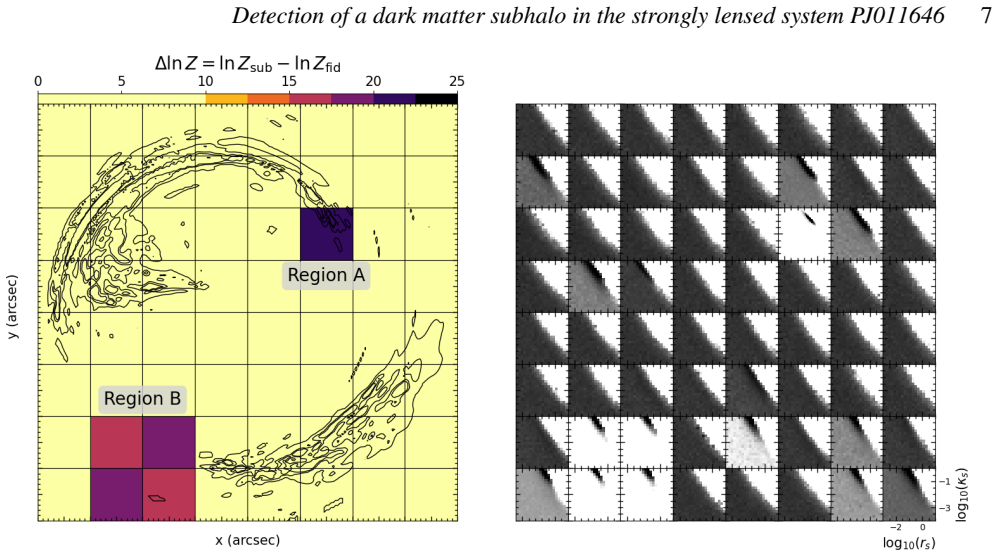
Using the best-fitting PL+MP macromodel, a grid-based search parametrizes a spherical NFW perturber and identifies a subhalo with M200 = 2.78_{-0.66}^{+0.43} times 10^{10} solar masses and c200 = 30_{-7}^{+5} that improves the evidence by Delta ln Z greater than 10 and reaches approximately 5.8 sigma significance; both candidate image-plane positions map to the same source-plane location, with follow-up analysis indicating one is physically real, and the enclosed projected mass is most tightly constrained at 3.57_{-0.14}^{+0.16} times 10^9 solar masses within 2 kpc.
What carries the argument
Grid-based image-plane search for a spherical NFW subhalo perturber, where improvement in Bayesian evidence above Delta ln Z of 10 flags a detection candidate relative to the PL+MP macromodel.
If this is right
- The inferred concentration matches expectations for a tidally stripped NFW subhalo.
- The projected mass is most tightly constrained within a 2 kpc radius.
- Grid cells with no detection set a 3-sigma minimum detectable mass limit of approximately 8 times 10^8 solar masses in the most sensitive arc regions.
- ALMA continuum imaging at sub-arcsecond resolution can test dark matter models by measuring subhalo abundances in this mass regime.
Where Pith is reading between the lines
- Repeating the grid search on additional strongly lensed systems with ALMA data could build a statistical sample of detected subhalos.
- If the detection holds, it supplies a concrete data point for comparing observed subhalo masses against predictions from cold dark matter simulations.
- Extending the same modeling pipeline to other interferometric datasets might reveal whether such subhalos appear at the expected rate.
Load-bearing premise
That an improvement in Bayesian evidence from adding a spherical NFW perturber on the grid corresponds to a physically real subhalo rather than a modeling artifact or degeneracy.
What would settle it
Higher-resolution imaging or multi-wavelength data that shows no lensing perturbation at the reported subhalo location in the image plane would falsify the detection.
Figures



read the original abstract
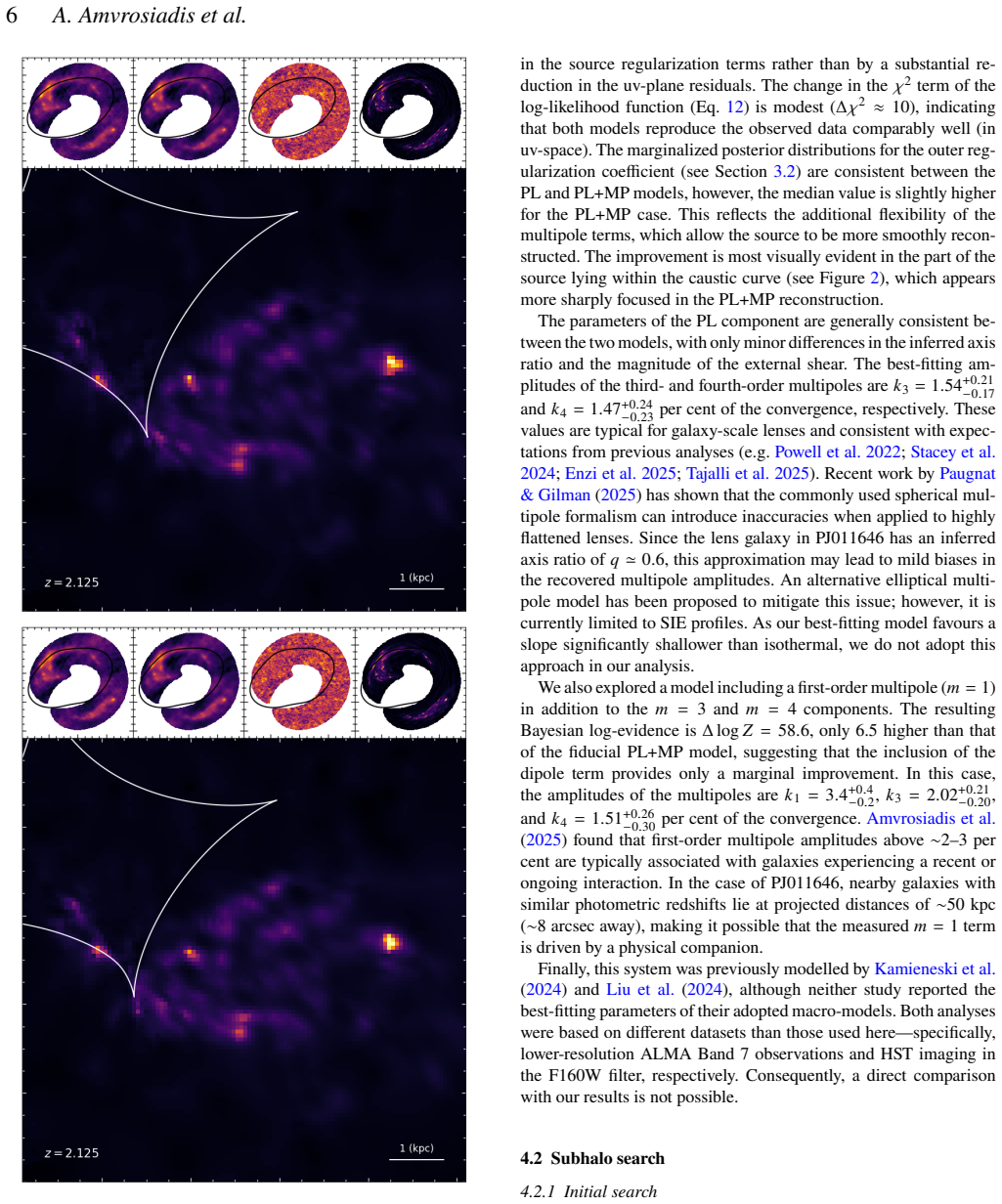
We present a strong lensing analysis of the system PJ011646 using high-resolution ($\sim$0.1 arcsec) Atacama Large Millimeter/submillimeter Array (ALMA) dust-continuum observations to test for the presence of dark matter substructures. The lens mass distribution is modelled with an elliptical power law and third- and fourth-order multipoles (PL+MP; $m=3,4$), plus external shear. The multipoles have amplitudes of $\simeq$1.5 per cent of the convergence, consistent with nearby early-type galaxies, and improve the fit by $\Delta\ln Z = 52.1$ relative to a pure PL model. Using this best-fitting macromodel, we perform a grid-based subhalo search in the image plane, parametrising the perturber as a spherical NFW. A subhalo in two locations in the image plane improves the fit by $\Delta\ln Z>10$. Both correspond to the same location in the source plane, so they are partially degenerate; follow-up analysis suggests that only one is physically real. This is a subhalo of mass $M_{200} = {2.78}_{-0.66}^{+0.43} \times 10^{10} \, M_\odot$ and concentration $c_{200} = 30_{-7}^{+5}$, detected at $\sim$5.8$\sigma$ significance (relative to the PL+MP). This concentration is consistent with that expected for a typical tidally stripped Navarro-Frenk-White subhalo. The enclosed projected mass is most tightly constrained within a radius of 2 kpc, where we infer $M_{\rm sub} = {3.57}_{-0.14}^{+0.16}\times 10^9 \, M_\odot$. From grid cells consistent with no detection ($\Delta \ln Z < 10$), we derive limits on the minimum subhalo mass that could have been detected at $3\sigma$ significance, finding $M_{200} \approx 8 \times 10^{8} \, M_\odot$ in the most sensitive regions of the lensed arcs. This demonstrates that ALMA continuum imaging at sub-arcsecond resolution can probe dark matter substructure in a mass regime where cold and warm dark matter models predict different abundances of subhalos.
Editorial analysis
A structured set of objections, weighed in public.
Referee Report
Summary. The paper claims a detection of a dark matter subhalo in the strongly lensed system PJ011646 from high-resolution ALMA dust-continuum imaging. The lens mass is modeled as an elliptical power-law plus m=3 and m=4 multipoles plus external shear (PL+MP), which improves the fit by ΔlnZ=52.1 over a pure PL model. A grid search over image-plane positions for a spherical NFW perturber finds two locations each yielding ΔlnZ>10 relative to the fixed PL+MP macromodel; both map to the same source-plane position and are partially degenerate. Post-hoc analysis designates one as physical, from which the authors report M200 = 2.78_{-0.66}^{+0.43} × 10^{10} M_⊙, c200 = 30_{-7}^{+5}, and ~5.8σ significance. The enclosed projected mass within 2 kpc is M_sub = 3.57_{-0.14}^{+0.16} × 10^9 M_⊙, and null-detection grid cells are used to set a minimum detectable mass limit of ~8 × 10^8 M_⊙ at 3σ in the most sensitive regions.
Significance. If the detection holds after addressing the modeling choices, the result is significant because it shows that sub-arcsecond ALMA continuum imaging can probe subhalos in the 10^9–10^{10} M_⊙ regime where CDM and WDM abundance predictions diverge. The reported concentration is stated to be consistent with a tidally stripped NFW profile, and the tight constraint on the projected mass within 2 kpc provides a falsifiable observable. The work adds a concrete data point to the small sample of subhalo detections in strong lenses and demonstrates a practical search strategy using grid-based evidence comparison.
major comments (2)
- [grid-based search and degeneracy discussion] Grid-based search and degeneracy discussion: the central claim rests on selecting one of two image-plane grid positions (both yielding ΔlnZ>10 and mapping to the identical source-plane coordinate) as physically real after follow-up analysis. It is not shown whether jointly re-optimizing the macromodel parameters (including the m=3,4 multipole amplitudes, which are already ~1.5% of convergence) together with the subhalo parameters would preserve the evidence increment or remove the distinction between the two positions. This modeling choice directly affects the reported M200, c200, and 5.8σ significance and is therefore load-bearing.
- [significance and evidence comparison] Section on significance and evidence comparison: the ~5.8σ detection significance is derived from the evidence ratio relative to the fixed PL+MP model, yet the partial degeneracy and post-search selection introduce a degree of freedom not accounted for in the quoted significance. A quantitative test (e.g., the change in ΔlnZ when macro parameters are varied jointly) is needed to confirm that the improvement cannot be reabsorbed by the macromodel.
minor comments (2)
- [abstract] The abstract states that both candidate positions correspond to the same source-plane location; the main text should include a quantitative measure of the source-plane separation (e.g., in arcseconds or kpc) to clarify the degree of degeneracy.
- [results] Notation: M_sub is used for the enclosed projected mass while M200 is used for the virial mass; a brief clarification in the text or a table footnote would prevent reader confusion.
Simulated Author's Rebuttal
We thank the referee for their thorough review and constructive comments, which help clarify the robustness of our subhalo detection. We respond point by point to the major comments and commit to revisions that directly address the concerns raised.
read point-by-point responses
-
Referee: Grid-based search and degeneracy discussion: the central claim rests on selecting one of two image-plane grid positions (both yielding ΔlnZ>10 and mapping to the identical source-plane coordinate) as physically real after follow-up analysis. It is not shown whether jointly re-optimizing the macromodel parameters (including the m=3,4 multipole amplitudes, which are already ~1.5% of convergence) together with the subhalo parameters would preserve the evidence increment or remove the distinction between the two positions. This modeling choice directly affects the reported M200, c200, and 5.8σ significance and is therefore load-bearing.
Authors: We agree that jointly re-optimizing the macromodel parameters together with the subhalo is a necessary check, as the current analysis fixes the PL+MP model to enable the grid search. In the revised manuscript we will perform this joint optimization for both candidate positions, allowing the multipole amplitudes and other macro parameters to vary freely. We will report the resulting ΔlnZ values, updated M200 and c200 constraints, and assess whether the distinction between the two image-plane positions is preserved or altered. This will confirm the load-bearing aspects of the modeling choice and strengthen the central claim. revision: yes
-
Referee: Section on significance and evidence comparison: the ~5.8σ detection significance is derived from the evidence ratio relative to the fixed PL+MP model, yet the partial degeneracy and post-search selection introduce a degree of freedom not accounted for in the quoted significance. A quantitative test (e.g., the change in ΔlnZ when macro parameters are varied jointly) is needed to confirm that the improvement cannot be reabsorbed by the macromodel.
Authors: The referee is correct that the quoted significance uses a fixed macromodel and that post-search selection of one position from two introduces an unaccounted degree of freedom. In the revision we will add a quantitative test by re-optimizing the full macromodel jointly with the subhalo and reporting the change in ΔlnZ relative to the original fixed case. This will demonstrate whether the evidence improvement can be reabsorbed. We will also expand the discussion of the partial degeneracy, detailing the physical criteria from the follow-up analysis that designate one position as real, and consider whether a more conservative significance accounting for the search and selection is warranted. revision: yes
Circularity Check
No significant circularity in data-driven subhalo detection
full rationale
The paper's central result is obtained by fitting an elliptical power-law plus multipole macromodel to ALMA continuum data, followed by a grid search that adds a spherical NFW perturber and computes the Bayesian evidence ratio ΔlnZ relative to the fixed macromodel. The reported M200, c200, and ~5.8σ significance are direct outputs of this fitting and model-comparison procedure applied to the observed images. No step reduces by construction to a self-defined quantity, a fitted input renamed as a prediction, or a load-bearing self-citation; the degeneracy discussion and post-hoc selection of one image-plane position are standard analysis choices that do not force the detection parameters to equal the inputs. The minimum-mass limits are likewise derived from null-grid cells on the same dataset and remain independent of the claimed detection.
Axiom & Free-Parameter Ledger
free parameters (3)
- subhalo M200
- subhalo c200
- multipole amplitudes
axioms (2)
- domain assumption The perturber can be modeled as a spherical NFW profile
- domain assumption The macromodel (PL+MP + shear) captures all large-scale structure without residual systematics that mimic a subhalo signal
Lean theorems connected to this paper
-
IndisputableMonolith/Foundation/RealityFromDistinction.leanreality_from_one_distinction unclear?
unclearRelation between the paper passage and the cited Recognition theorem.
grid-based subhalo search in the image plane, parametrising the perturber as a spherical NFW... ΔlnZ>10... M200 = 2.78... c200=30
-
IndisputableMonolith/Cost/FunctionalEquation.leanwashburn_uniqueness_aczel unclear?
unclearRelation between the paper passage and the cited Recognition theorem.
elliptical power law and third- and fourth-order multipoles (PL+MP; m=3,4)
What do these tags mean?
- matches
- The paper's claim is directly supported by a theorem in the formal canon.
- supports
- The theorem supports part of the paper's argument, but the paper may add assumptions or extra steps.
- extends
- The paper goes beyond the formal theorem; the theorem is a base layer rather than the whole result.
- uses
- The paper appears to rely on the theorem as machinery.
- contradicts
- The paper's claim conflicts with a theorem or certificate in the canon.
- unclear
- Pith found a possible connection, but the passage is too broad, indirect, or ambiguous to say the theorem truly supports the claim.
Reference graph
Works this paper leans on
-
[1]
The Formation of Dark Halos in a Universe Dominated by Cold Dark Matter. , keywords =. doi:10.1086/166213 , adsurl =
-
[2]
Dark matter and cosmic structure
Dark matter and cosmic structure. Annalen der Physik , keywords =. doi:10.1002/andp.201200212 , archivePrefix =. 1210.0544 , primaryClass =
work page internal anchor Pith review Pith/arXiv arXiv doi:10.1002/andp.201200212
-
[3]
Constraints on the properties of warm dark matter using the satellite galaxies of the Milky Way. , keywords =. doi:10.1088/1475-7516/2021/08/062 , archivePrefix =. 2011.08865 , primaryClass =
-
[4]
Constraints on the properties of MSM dark matter using the satellite galaxies of the Milky Way. , keywords =. doi:10.1093/mnras/staf1223 , archivePrefix =. 2408.16042 , primaryClass =
-
[5]
The clustering of galaxies in the completed SDSS-III Baryon Oscillation Spectroscopic Survey: cosmological analysis of the DR12 galaxy sample. , keywords =. doi:10.1093/mnras/stx721 , archivePrefix =. 1607.03155 , primaryClass =
work page internal anchor Pith review Pith/arXiv arXiv doi:10.1093/mnras/stx721
-
[6]
Halo concentration strengthens dark matter constraints in galaxy-galaxy strong lensing analyses. , keywords =. doi:10.1093/mnras/stab3527 , archivePrefix =. 2109.00018 , primaryClass =
-
[7]
Lopsidedness in early-type galaxies: the role of the m = 1 multipole in isophote fitting and strong lens modelling. , keywords =. doi:10.1093/mnras/staf857 , archivePrefix =. 2407.12983 , primaryClass =
-
[8]
Communications Physics , keywords =
Gravitational lensing reveals cool gas within 10-20 kpc around a quiescent galaxy. Communications Physics , keywords =. doi:10.1038/s42005-024-01778-4 , archivePrefix =. 2408.07984 , primaryClass =
-
[9]
The detailed structure and the onset of galaxy formation in low-mass gaseous dark matter haloes. , keywords =. doi:10.1093/mnras/staa2698 , archivePrefix =. 2004.06124 , primaryClass =
-
[10]
Formation of galaxies and large-scale structure with cold dark matter. , keywords =. doi:10.1038/311517a0 , adsurl =
-
[11]
Cold dark matter, the structure of galactic haloes and the origin of the Hubble sequence. , keywords =. doi:10.1038/317595a0 , adsurl =
-
[12]
Gravitational imaging through a triple source plane lens: revisiting the CDM-defying dark subhalo in SDSSJ0946+1006. , keywords =. doi:10.1093/mnras/stae514 , archivePrefix =. 2309.04535 , primaryClass =
-
[13]
Morphological analysis of massive early-type galaxies in the Virgo Cluster. , keywords =
-
[14]
Isophote shapes of elliptical galaxies. I. The data. , keywords =
-
[15]
Isophote shapes of elliptical galaxies. II. Correlations with global optical, radio and X-ray properties. , keywords =
-
[16]
Probing Dark Matter Substructures with Free-Form Modelling: A Case Study of the `Jackpot' Strong Lens. arXiv e-prints , keywords =. doi:10.48550/arXiv.2504.19177 , archivePrefix =. 2504.19177 , primaryClass =
-
[17]
Measuring the inclination and mass-to-light ratio of axisymmetric galaxies via anisotropic Jeans models of stellar kinematics. , keywords =. doi:10.1111/j.1365-2966.2008.13754.x , archivePrefix =. 0806.0042 , primaryClass =
-
[18]
Isophotal shapes of early-type galaxies to very faint levels
Isophotal Shapes of Early-type Galaxies to Very Faint Levels. , keywords =. doi:10.1088/0004-637X/787/2/102 , archivePrefix =. 1407.5120 , primaryClass =
work page internal anchor Pith review Pith/arXiv arXiv doi:10.1088/0004-637x/787/2/102
-
[19]
General multipoles and their implications for dark matter inference. , keywords =. doi:10.1093/mnras/stae1228 , archivePrefix =. 2403.08895 , primaryClass =
-
[20]
Detecting low-mass haloes with strong gravitational lensing I: the effect of data quality and lensing configuration. , keywords =. doi:10.1093/mnras/stab3537 , archivePrefix =. 2111.08718 , primaryClass =
-
[21]
Constraints on the density profiles of two detected subhaloes
Detecting low-mass haloes with strong gravitational lensing: II. Constraints on the density profiles of two detected subhaloes. , keywords =. doi:10.1051/0004-6361/202451546 , archivePrefix =. 2407.12910 , primaryClass =
-
[22]
A grand-design spiral galaxy with an ordered magnetic field at redshift 2.6 as resolved with ALMA and gravitational lensing. , keywords =. doi:10.1093/mnrasl/slaf030 , archivePrefix =. 2412.08705 , primaryClass =
-
[23]
Automated galaxy-galaxy strong lens modelling: No lens left behind. , keywords =. doi:10.1093/mnras/stac2639 , archivePrefix =. 2202.09201 , primaryClass =
-
[24]
Beyond the bulge-halo conspiracy? Density profiles of early-type galaxies from extended-source strong lensing. , keywords =. doi:10.1093/mnras/stad582 , archivePrefix =. 2207.04070 , primaryClass =
-
[25]
Strong gravitational lensing's 'external shear' is not shear. , keywords =. doi:10.1093/mnras/stae1375 , archivePrefix =. 2301.05244 , primaryClass =
-
[26]
Joint constraints on thermal relic dark matter from strong gravitational lensing, the Ly forest, and Milky Way satellites. , keywords =. doi:10.1093/mnras/stab1960 , archivePrefix =. 2010.13802 , primaryClass =
-
[27]
Constraining warm dark matter candidates including sterile neutrinos and light gravitinos with WMAP and the Lyman- forest. , keywords =. doi:10.1103/PhysRevD.71.063534 , archivePrefix =. astro-ph/0501562 , primaryClass =
work page internal anchor Pith review Pith/arXiv arXiv doi:10.1103/physrevd.71.063534
-
[28]
The Aquarius Project: the subhaloes of galactic haloes. , keywords =. doi:10.1111/j.1365-2966.2008.14066.x , archivePrefix =. 0809.0898 , primaryClass =
-
[29]
The overconcentrated dark halo in the strong lens SDSS J0946 + 1006 is a subhalo: evidence for self-interacting dark matter?. , keywords =. doi:10.1093/mnras/staf697 , archivePrefix =. 2411.08565 , primaryClass =
-
[30]
emcee: The MCMC Hammer. , keywords =. doi:10.1086/670067 , archivePrefix =. 1202.3665 , primaryClass =
work page internal anchor Pith review Pith/arXiv arXiv doi:10.1086/670067
-
[31]
The MASSIVE Survey. IX. Photometric Analysis of 35 High-mass Early-type Galaxies with HST WFC3/IR. , keywords =. doi:10.3847/1538-4357/aab1f3 , archivePrefix =. 1801.08245 , primaryClass =
work page internal anchor Pith review Pith/arXiv arXiv doi:10.3847/1538-4357/aab1f3
-
[32]
JWST lensed quasar dark matter survey IV: Stringent warm dark matter constraints from the joint reconstruction of extended lensed arcs and quasar flux ratios. arXiv e-prints , keywords =. doi:10.48550/arXiv.2511.07513 , archivePrefix =. 2511.07513 , primaryClass =
-
[33]
2007, , 374, 1413, 10.1111/j.1365-2966.2006.11246.x
Isophotal shapes of elliptical/lenticular galaxies from the Sloan Digital Sky Survey. , keywords =. doi:10.1111/j.1365-2966.2006.10545.x , archivePrefix =. astro-ph/0605319 , primaryClass =
-
[34]
Testing strong lensing subhalo detection with a cosmological simulation. , keywords =. doi:10.1093/mnras/stac2779 , archivePrefix =. 2202.10191 , primaryClass =
-
[35]
Unveiling lens light complexity with a novel multi-Gaussian expansion approach for strong gravitational lensing. , keywords =. doi:10.1093/mnras/stae1577 , archivePrefix =. 2403.16253 , primaryClass =
-
[36]
Not So Dark, Not So Dense: An Alternative Explanation for the Lensing Subhalo in SDSS J0946+1006. , keywords =. doi:10.3847/2041-8213/ae072d , archivePrefix =. 2506.07978 , primaryClass =
-
[37]
Detection of lensing substructure using ALMA observations of the dusty galaxy SDP.81
Detection of Lensing Substructure Using ALMA Observations of the Dusty Galaxy SDP.81. , keywords =. doi:10.3847/0004-637X/823/1/37 , archivePrefix =. 1601.01388 , primaryClass =
work page internal anchor Pith review Pith/arXiv arXiv doi:10.3847/0004-637x/823/1/37
-
[38]
The mass function of dark matter haloes. , keywords =. doi:10.1046/j.1365-8711.2001.04029.x , archivePrefix =. astro-ph/0005260 , primaryClass =
-
[39]
PASSAGES: The Wide-ranging, Extreme Intrinsic Properties of Planck-selected, Lensed Dusty Star-forming Galaxies. , keywords =. doi:10.3847/1538-4357/acf930 , archivePrefix =. 2301.09746 , primaryClass =
-
[40]
JWST Lensed Quasar Dark Matter Survey III: Dark Matter Sensitive Flux Ratios and Warm Dark Matter Constraint from the Full Sample. arXiv e-prints , keywords =. doi:10.48550/arXiv.2511.07765 , archivePrefix =. 2511.07765 , primaryClass =
-
[41]
Using Strong Lensing to Detect Subhalos with Steep Inner Density Profiles. arXiv e-prints , keywords =. doi:10.48550/arXiv.2510.17956 , archivePrefix =. 2510.17956 , primaryClass =
-
[42]
NAUTILUS: boosting Bayesian importance nested sampling with deep learning. , keywords =. doi:10.1093/mnras/stad2441 , archivePrefix =. 2306.16923 , primaryClass =
-
[43]
Galaxy mass modelling from multiwavelength JWST strong lens analysis: dark matter substructure, angular mass complexity, or both?. , keywords =. doi:10.1093/mnras/staf491 , archivePrefix =. 2410.12987 , primaryClass =
-
[44]
A Dense Dark Matter Core of the Subhalo in the Strong Lensing System JVAS B1938+666. , keywords =. doi:10.3847/2041-8213/ae047c , archivePrefix =. 2509.07808 , primaryClass =
-
[45]
The haloes of bright satellite galaxies in a warm dark matter universe. , keywords =. doi:10.1111/j.1365-2966.2011.20200.x , archivePrefix =. 1104.2929 , primaryClass =
-
[46]
The Mass-Concentration-Redshift Relation of Cold and Warm Dark Matter Halos
The mass-concentration-redshift relation of cold and warm dark matter haloes. , keywords =. doi:10.1093/mnras/stw1046 , archivePrefix =. 1601.02624 , primaryClass =
work page internal anchor Pith review Pith/arXiv arXiv doi:10.1093/mnras/stw1046
-
[47]
Nature Astronomy , year = 2024, month = sep, volume =
Detailed study of a rare hyperluminous rotating disk in an Einstein ring 10 billion years ago. Nature Astronomy , year = 2024, month = sep, volume =. doi:10.1038/s41550-024-02296-7 , adsurl =
-
[48]
The MASSIVE Survey. I. A Volume-limited Integral-field Spectroscopic Study of the Most Massive Early-type Galaxies within 108 Mpc. , keywords =. doi:10.1088/0004-637X/795/2/158 , archivePrefix =. 1407.1054 , primaryClass =
work page internal anchor Pith review Pith/arXiv arXiv doi:10.1088/0004-637x/795/2/158
-
[49]
Modelling high-resolution ALMA observations of strongly lensed dusty star-forming galaxies detected by Herschel. , keywords =. doi:10.1093/mnras/stac585 , archivePrefix =. 2111.09680 , primaryClass =
-
[50]
Astronomical Data Analysis Software and Systems XVI , year = 2007, series =
CASA Architecture and Applications. Astronomical Data Analysis Software and Systems XVI , year = 2007, series =
work page 2007
-
[51]
An unexpected high concentration for the dark substructure in the gravitational lens SDSSJ0946+1006. , keywords =. doi:10.1093/mnras/stab2247 , archivePrefix =. 2011.10627 , primaryClass =
-
[52]
High Significance Detection of the Dark Substructure in Gravitational Lens SDSS J0946+1006 by Image Pixel Supersampling. , keywords =. doi:10.3847/1538-4357/adb1b6 , archivePrefix =. 2408.11090 , primaryClass =
-
[53]
The Structure of Cold Dark Matter Halos
The Structure of Cold Dark Matter Halos. , keywords =. doi:10.1086/177173 , archivePrefix =. astro-ph/9508025 , primaryClass =
work page internal anchor Pith review Pith/arXiv arXiv doi:10.1086/177173
-
[54]
A Universal Density Profile from Hierarchical Clustering
A Universal Density Profile from Hierarchical Clustering. , keywords =. doi:10.1086/304888 , archivePrefix =. astro-ph/9611107 , primaryClass =
work page internal anchor Pith review Pith/arXiv arXiv doi:10.1086/304888
-
[55]
Adaptive Semi-linear Inversion of Strong Gravitational Lens Imaging
Adaptive semi-linear inversion of strong gravitational lens imaging. , keywords =. doi:10.1093/mnras/stv1455 , archivePrefix =. 1412.7436 , primaryClass =
work page internal anchor Pith review Pith/arXiv arXiv doi:10.1093/mnras/stv1455
-
[56]
Galaxy structure with strong gravitational lensing: decomposing the internal mass distribution of massive elliptical galaxies. , keywords =. doi:10.1093/mnras/stz2220 , archivePrefix =. 1901.07801 , primaryClass =
-
[57]
The Journal of Open Source Software , keywords =
PyAutoLens: Open-Source Strong Gravitational Lensing. The Journal of Open Source Software , keywords =. doi:10.21105/joss.02825 , archivePrefix =. 2106.01384 , primaryClass =
-
[59]
The Journal of Open Source Software , keywords =
PyAutoGalaxy: Open-Source Multiwavelength Galaxy Structure & Morphology. The Journal of Open Source Software , keywords =. doi:10.21105/joss.04475 , adsurl =
-
[60]
Scanning for dark matter subhaloes in Hubble Space Telescope imaging of 54 strong lenses. , keywords =. doi:10.1093/mnras/stad3694 , adsurl =
-
[61]
Sensitivity of strong lensing observations to dark matter substructure: a case study with Euclid. , keywords =. doi:10.1093/mnras/stad650 , archivePrefix =. 2211.15679 , primaryClass =
-
[62]
Angular complexity in strong lens substructure detection. , keywords =. doi:10.1093/mnras/stae153 , archivePrefix =. 2310.10714 , primaryClass =
-
[63]
Elliptical multipoles for gravitational lenses. , keywords =. doi:10.1103/d14h-f5mn , archivePrefix =. 2502.03530 , primaryClass =
-
[64]
The Structure and Star Formation History of Early-Type Galaxies in the UDF/GRAPES Survey
The Structure and Star Formation History of Early-Type Galaxies in the Ultra Deep Field/GRAPES Survey. , keywords =. doi:10.1086/497290 , archivePrefix =. astro-ph/0504264 , primaryClass =
work page internal anchor Pith review Pith/arXiv arXiv doi:10.1086/497290
-
[65]
Planck 2015 results. XIII. Cosmological parameters. , keywords =. doi:10.1051/0004-6361/201525830 , archivePrefix =. 1502.01589 , primaryClass =
work page internal anchor Pith review Pith/arXiv arXiv doi:10.1051/0004-6361/201525830 2015
-
[66]
Planck 2018 results. VI. Cosmological parameters. , keywords =. doi:10.1051/0004-6361/201833910 , archivePrefix =. 1807.06209 , primaryClass =
work page internal anchor Pith review Pith/arXiv arXiv doi:10.1051/0004-6361/201833910 2018
-
[67]
A novel approach to visibility-space modelling of interferometric gravitational lens observations at high angular resolution. , keywords =. doi:10.1093/mnras/staa2740 , archivePrefix =. 2005.03609 , primaryClass =
-
[68]
A lensed radio jet at milliarcsecond resolution I: Bayesian comparison of parametric lens models. , keywords =. doi:10.1093/mnras/stac2350 , archivePrefix =. 2207.03375 , primaryClass =
-
[69]
A million-solar-mass object detected at a cosmological distance using gravitational imaging. Nature Astronomy , keywords =. doi:10.1038/s41550-025-02651-2 , archivePrefix =. 2510.07382 , primaryClass =
-
[70]
The MASSIVE Survey. XVII. A Triaxial Orbit-based Determination of the Black Hole Mass and Intrinsic Shape of Elliptical Galaxy NGC 2693. , keywords =. doi:10.3847/1538-4357/ac58fd , archivePrefix =. 2111.13699 , primaryClass =
-
[71]
Triaxial Orbit-based Dynamical Modeling of Galaxies with Supermassive Black Holes and an Application to Massive Elliptical Galaxy NGC 1453. , keywords =. doi:10.3847/1538-4357/ac3e68 , archivePrefix =. 2111.06904 , primaryClass =
-
[72]
Low-mass halo perturbations in strong gravitational lenses at redshift z 0.5 are consistent with CDM. , keywords =. doi:10.1093/mnras/stz464 , archivePrefix =. 1811.03627 , primaryClass =
work page internal anchor Pith review Pith/arXiv arXiv doi:10.1093/mnras/stz464
-
[73]
Substructure detection reanalysed: dark perturber shown to be a line-of-sight halo. , keywords =. doi:10.1093/mnras/stac1967 , archivePrefix =. 2112.00749 , primaryClass =
-
[74]
Complex angular structure of three elliptical galaxies from high-resolution ALMA observations of strong gravitational lenses. , keywords =. doi:10.1051/0004-6361/202449710 , archivePrefix =. 2403.04850 , primaryClass =
-
[75]
A nuclear spiral in a dusty star-forming galaxy at z = 2.78. , keywords =. doi:10.1051/0004-6361/202452518 , archivePrefix =. 2412.03644 , primaryClass =
-
[76]
Investigation of mass substructure in gravitational lens system SDP.81 with ALMA long-baseline observations. arXiv e-prints , keywords =. doi:10.48550/arXiv.2508.02776 , archivePrefix =. 2508.02776 , primaryClass =
-
[77]
2007, , 374, 1413, 10.1111/j.1365-2966.2006.11246.x
A Bayesian analysis of regularized source inversions in gravitational lensing. , keywords =. doi:10.1111/j.1365-2966.2006.10733.x , archivePrefix =. astro-ph/0601493 , primaryClass =
-
[78]
Cosmology from gravitational lens time delays and Planck data
Cosmology from Gravitational Lens Time Delays and Planck Data. , keywords =. doi:10.1088/2041-8205/788/2/L35 , archivePrefix =. 1306.4732 , primaryClass =
work page internal anchor Pith review Pith/arXiv arXiv doi:10.1088/2041-8205/788/2/l35 2041
-
[79]
SHARP IX. The dense, low-mass perturbers in B1938+666 and J0946+1006: implications for cold and self-interacting dark matter. , keywords =. doi:10.1093/mnras/staf1357 , archivePrefix =. 2505.07944 , primaryClass =
-
[80]
The elliptical power law profile lens
The elliptical power law profile lens. , keywords =. doi:10.1051/0004-6361/201526773 , archivePrefix =. 1507.01819 , primaryClass =
work page internal anchor Pith review Pith/arXiv arXiv doi:10.1051/0004-6361/201526773
-
[81]
Strong Lensing by Galaxies. , keywords =. doi:10.1146/annurev-astro-081309-130924 , archivePrefix =. 1003.5567 , primaryClass =
work page internal anchor Pith review Pith/arXiv arXiv doi:10.1146/annurev-astro-081309-130924
discussion (0)
Sign in with ORCID, Apple, or X to comment. Anyone can read and Pith papers without signing in.