Gravitational wave detectability range informed by external messengers
Pith reviewed 2026-05-22 09:20 UTC · model grok-4.3
The pith
The Targeted Detectability Range provides a rapid estimate of gravitational-wave detectability for compact binary coalescences by using priors from associated external messengers such as gamma-ray bursts.
A machine-rendered reading of the paper's core claim, the machinery that carries it, and where it could break.
Core claim
The paper establishes the Targeted Detectability Range as an efficient metric that uses external messenger data to estimate the gravitational-wave detectability range for compact binary coalescences hypothesized to be associated with the messenger. By including constraints on sky localization, inclination angle, and component masses, the TDR offers a more precise alternative to averaged ranges. The work applies this to all short and long gamma-ray bursts from the first three observing runs and confirms its results through comparison with 90 percent exclusion distances from modeled targeted gravitational-wave searches.
What carries the argument
The Targeted Detectability Range (TDR), a detectability distance metric that incorporates priors from the external messenger on sky location, inclination bounds, and mass constraints to tailor the gravitational-wave sensitivity estimate.
If this is right
- Provides detectability ranges for all observed gamma-ray bursts during O1, O2, and O3.
- Requires minimal computational effort for evaluation.
- Shows consistency with results from targeted gravitational-wave searches.
- Aids in optimizing multi-messenger follow-up strategies and constraining transient origins.
Where Pith is reading between the lines
- The TDR could be implemented in real-time alert systems to prioritize observations of new transients.
- Applying the approach to neutrino detections would help identify potential compact binary sources among high-energy events.
- Future comparisons with actual gravitational-wave detections could refine association probabilities between messengers and mergers.
Load-bearing premise
The approach assumes the observed external messenger is physically associated with a compact binary coalescence, allowing its measured properties to be used as priors.
What would settle it
A gravitational-wave detection or non-detection from a gamma-ray burst at a distance that clearly contradicts the computed TDR would falsify the method's accuracy.
Figures

read the original abstract
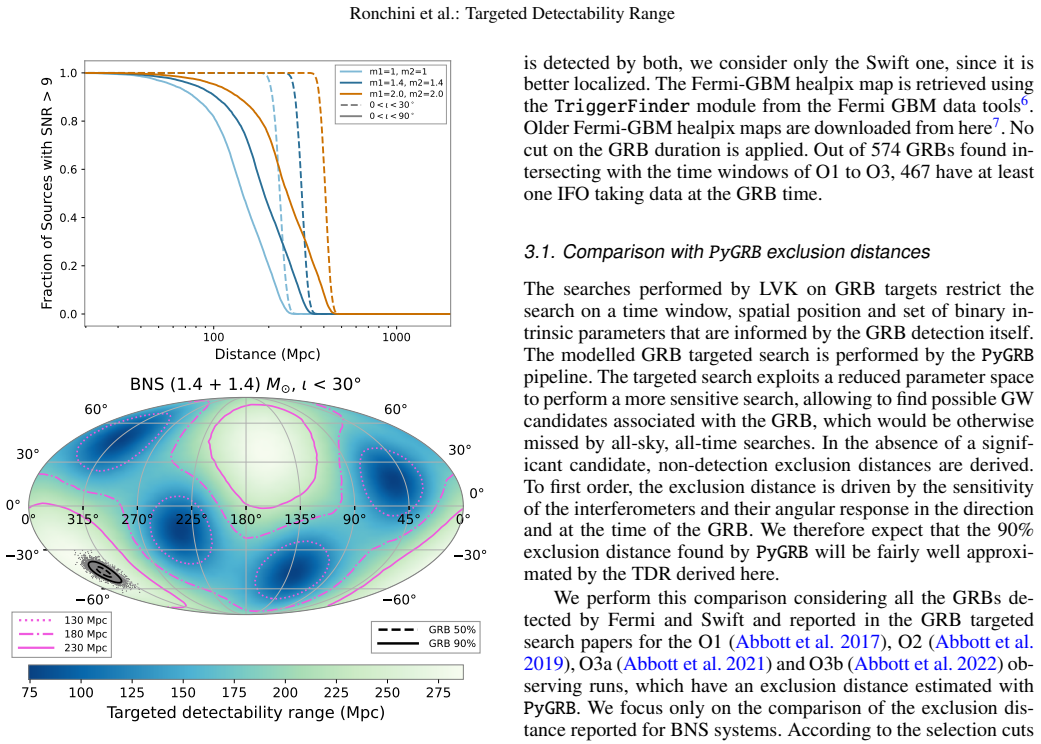
A rapid estimate of gravitational-wave (GW) detectability associated with astronomical transients is crucial for optimizing multi-messenger follow-up strategies and for constraining the physical origin of the transient itself. We introduce here the Targeted Detectability Range (TDR), designed to evaluate with minimal computational effort the detectability of compact binary coalescences under the hypothesis of association with an external messenger, such as an electromagnetic or neutrino signal. Unlike the standard GW range, which is based on averaged source parameters, the TDR incorporates prior information from observations of the external messenger, including sky localization, inclination constraints, and physically motivated bounds on component masses. We report the detectability range of all gamma-ray bursts, short and long duration, observed during the first three observing runs of the LIGO-Virgo-KAGRA collaboration. The method is validated by performing a systematic comparison with the 90$\%$ exclusion distances provided by modeled targeted GW searches.
Editorial analysis
A structured set of objections, weighed in public.
Referee Report
Summary. The manuscript introduces the Targeted Detectability Range (TDR) as a computationally lightweight metric for estimating the gravitational-wave detectability of compact binary coalescences conditioned on an explicit hypothesis of association with an external messenger (e.g., a gamma-ray burst). The TDR folds in observational priors on sky location, inclination-angle bounds, and physically motivated component-mass constraints derived from the external signal. The authors apply the method to all short and long GRBs observed during the first three LIGO-Virgo-KAGRA observing runs and validate the numerical outputs against the 90% exclusion distances reported by existing modeled targeted searches.
Significance. If the central construction holds, the TDR supplies a practical, low-effort tool for multi-messenger follow-up planning and for placing rapid constraints on the origin of transients. The explicit conditioning on the association hypothesis and the independent cross-check against targeted-search exclusion distances are clear strengths that reduce the risk of circularity.
major comments (1)
- [§4] §4 (validation section): the manuscript should specify the precise matching criteria used to pair each GRB with the corresponding targeted-search exclusion distance, including any cuts on sky-overlap or time coincidence; without this, it is unclear whether the reported agreement is robust to selection effects.
minor comments (2)
- [Abstract] The abstract and introduction should state the exact observing-run span (O1–O3) and confirm whether any O4 events are included for completeness.
- Define the acronym TDR at first use and ensure consistent notation for the inclination prior bounds throughout the text.
Simulated Author's Rebuttal
We thank the referee for their careful reading of the manuscript and for the positive assessment of the Targeted Detectability Range (TDR) approach. The single major comment is addressed below; we have incorporated the requested clarification into the revised manuscript.
read point-by-point responses
-
Referee: [§4] §4 (validation section): the manuscript should specify the precise matching criteria used to pair each GRB with the corresponding targeted-search exclusion distance, including any cuts on sky-overlap or time coincidence; without this, it is unclear whether the reported agreement is robust to selection effects.
Authors: We agree that an explicit statement of the matching procedure improves transparency. In the original text the pairing was performed by GRB trigger name and UTC time as listed in the LIGO-Virgo-KAGRA targeted-search publications (e.g., Abbott et al. 2017, 2019, 2021). A time-coincidence window of ±2 s around the GRB trigger was required, matching the window used in those searches; no additional sky-overlap cut was imposed because the exclusion distances already incorporate the GRB localization as a prior. To remove any ambiguity we have added a dedicated paragraph in §4 that states these criteria verbatim and notes that the comparison sample is therefore identical to the one used in the published targeted-search results. This change eliminates the possibility of hidden selection effects. revision: yes
Circularity Check
No significant circularity detected
full rationale
The TDR metric is defined by folding independent external-messenger priors (sky location, inclination bounds, mass constraints from GRBs) into a detectability calculation under an explicit association hypothesis. Validation is performed against 90% exclusion distances from existing modeled targeted searches, supplying an external numerical cross-check. No equation or step reduces a prediction to a fit on the same GW dataset, and no load-bearing claim rests on a self-citation chain. The derivation remains self-contained against external benchmarks.
Axiom & Free-Parameter Ledger
Lean theorems connected to this paper
-
IndisputableMonolith/Cost/FunctionalEquation.leanwashburn_uniqueness_aczel unclear?
unclearRelation between the paper passage and the cited Recognition theorem.
We introduce here the Targeted Detectability Range (TDR), designed to evaluate with minimal computational effort the detectability of compact binary coalescences under the hypothesis of association with an external messenger... incorporating prior information from observations of the external messenger, including sky localization, inclination constraints, and physically motivated bounds on component masses.
-
IndisputableMonolith/Foundation/DimensionForcing.leanalexander_duality_circle_linking unclear?
unclearRelation between the paper passage and the cited Recognition theorem.
the 90% exclusion distance found by PyGRB will be fairly well approximated by the TDR derived here... D_TDR_90 | ρ_cut=9
What do these tags mean?
- matches
- The paper's claim is directly supported by a theorem in the formal canon.
- supports
- The theorem supports part of the paper's argument, but the paper may add assumptions or extra steps.
- extends
- The paper goes beyond the formal theorem; the theorem is a base layer rather than the whole result.
- uses
- The paper appears to rely on the theorem as machinery.
- contradicts
- The paper's claim conflicts with a theorem or certificate in the canon.
- unclear
- Pith found a possible connection, but the passage is too broad, indirect, or ambiguous to say the theorem truly supports the claim.
Reference graph
Works this paper leans on
-
[1]
GW170817: Observation of Gravitational Waves from a Binary Neutron Star Inspiral
GW170817: Observation of Gravitational Waves from a Binary Neutron Star Inspiral. , keywords =. doi:10.1103/PhysRevLett.119.161101 , archivePrefix =. 1710.05832 , primaryClass =
work page internal anchor Pith review Pith/arXiv arXiv doi:10.1103/physrevlett.119.161101
-
[2]
Composition and thermodynamics of nuclear matter with light clusters
Composition and thermodynamics of nuclear matter with light clusters. , keywords =. doi:10.1103/PhysRevC.81.015803 , archivePrefix =. 0908.2344 , primaryClass =
work page internal anchor Pith review Pith/arXiv arXiv doi:10.1103/physrevc.81.015803
-
[3]
Multi-messenger Observations of a Binary Neutron Star Merger
Multi-messenger Observations of a Binary Neutron Star Merger. , keywords =. doi:10.3847/2041-8213/aa91c9 , archivePrefix =. 1710.05833 , primaryClass =
work page internal anchor Pith review Pith/arXiv arXiv doi:10.3847/2041-8213/aa91c9 2041
-
[4]
Metzger, Brian D. , date =. Kilonovae , url =. Living Reviews in Relativity , number =. 2019 , bdsk-url-1 =. doi:10.1007/s41114-019-0024-0 , id =
-
[5]
Short-hard gamma-ray bursts. , keywords =. doi:10.1016/j.physrep.2007.02.005 , archivePrefix =. astro-ph/0701748 , primaryClass =
work page internal anchor Pith review Pith/arXiv arXiv doi:10.1016/j.physrep.2007.02.005 2007
-
[6]
Abbott, B. P. and Abbott, R. and Abbott, T. D. and Abraham, S. and Acernese, F. and Ackley, K. and Adams, C. and Adya, V. B. and Affeldt, C. and Agathos, M. and Agatsuma, K. and Aggarwal, N. and Aguiar, O. D. and Aiello, L. and Ain, A. and Ajith, P. and Akutsu, T. and Allen, G. and Allocca, A. and Aloy, M. A. and Altin, P. A. and Amato, A. and Ananyeva, A...
-
[7]
Multi-messenger prospects for black hole - neutron star mergers in the O4 and O5 runs. , keywords =. doi:10.1051/0004-6361/202348384 , archivePrefix =. 2310.16894 , primaryClass =
-
[8]
Short-Duration Gamma-Ray Bursts
Short-Duration Gamma-Ray Bursts. , keywords =. doi:10.1146/annurev-astro-081913-035926 , archivePrefix =. 1311.2603 , primaryClass =
work page internal anchor Pith review Pith/arXiv arXiv doi:10.1146/annurev-astro-081913-035926
-
[9]
Off-axis emission of short -ray bursts and the detectability of electromagnetic counterparts of gravitational-wave-detected binary mergers. , keywords =. doi:10.1093/mnras/stx1683 , archivePrefix =. 1610.01157 , primaryClass =
work page internal anchor Pith review Pith/arXiv arXiv doi:10.1093/mnras/stx1683
-
[10]
Relativistic Shock Breakouts A Variety of Gamma-Ray Flares: From Low-luminosity Gamma-Ray Bursts to Type Ia Supernovae. , keywords =. doi:10.1088/0004-637X/747/2/88 , archivePrefix =. 1106.2556 , primaryClass =
work page internal anchor Pith review Pith/arXiv arXiv doi:10.1088/0004-637x/747/2/88
-
[11]
Signatures of magnetar central engines in short GRB lightcurves
Signatures of magnetar central engines in short GRB light curves. , keywords =. doi:10.1093/mnras/sts683 , archivePrefix =. 1301.0629 , primaryClass =
work page internal anchor Pith review Pith/arXiv arXiv doi:10.1093/mnras/sts683
-
[12]
Transient Events from Neutron Star Mergers
Transient Events from Neutron Star Mergers. , keywords =. doi:10.1086/311680 , archivePrefix =. astro-ph/9807272 , primaryClass =
work page internal anchor Pith review Pith/arXiv arXiv doi:10.1086/311680
-
[13]
Masses, Radii, and Equation of State of Neutron Stars
Masses, Radii, and the Equation of State of Neutron Stars. , keywords =. doi:10.1146/annurev-astro-081915-023322 , archivePrefix =. 1603.02698 , primaryClass =
work page internal anchor Pith review Pith/arXiv arXiv doi:10.1146/annurev-astro-081915-023322
-
[14]
Frontiers in Physics , year = 2020, month = oct, volume =
The Physics of Kilonovae. Frontiers in Physics , year = 2020, month = oct, volume =. doi:10.3389/fphy.2020.00355 , adsurl =
-
[15]
Search for Gravitational Waves Associated with Gamma-Ray Bursts during the First Advanced LIGO Observing Run and Implications for the Origin of GRB 150906B. , keywords =. doi:10.3847/1538-4357/aa6c47 , archivePrefix =. 1611.07947 , primaryClass =
work page internal anchor Pith review Pith/arXiv arXiv doi:10.3847/1538-4357/aa6c47
-
[16]
Search for Gravitational-wave Signals Associated with Gamma-Ray Bursts during the Second Observing Run of Advanced LIGO and Advanced Virgo. , keywords =. doi:10.3847/1538-4357/ab4b48 , archivePrefix =. 1907.01443 , primaryClass =
-
[17]
Search for Gravitational Waves Associated with Gamma-Ray Bursts Detected by Fermi and Swift during the LIGO-Virgo Run O3a. , keywords =. doi:10.3847/1538-4357/abee15 , archivePrefix =. 2010.14550 , primaryClass =
-
[18]
Search for Gravitational Waves Associated with Gamma-Ray Bursts Detected by Fermi and Swift during the LIGO-Virgo Run O3b. , keywords =. doi:10.3847/1538-4357/ac532b , archivePrefix =. 2111.03608 , primaryClass =
-
[19]
Remnant baryon mass outside of the black hole after a neutron star-black hole merger
Remnant baryon mass in neutron star-black hole mergers: Predictions for binary neutron star mimickers and rapidly spinning black holes. , keywords =. doi:10.1103/PhysRevD.98.081501 , archivePrefix =. 1807.00011 , primaryClass =
work page internal anchor Pith review Pith/arXiv arXiv doi:10.1103/physrevd.98.081501
-
[20]
A targeted coherent search for gravitational waves from compact binary coalescences
Targeted coherent search for gravitational waves from compact binary coalescences. , keywords =. doi:10.1103/PhysRevD.83.084002 , archivePrefix =. 1012.4939 , primaryClass =
work page internal anchor Pith review Pith/arXiv arXiv doi:10.1103/physrevd.83.084002
-
[21]
Updated universal relations for tidal deformabilities of neutron stars from phenomenological equations of state , author =. Phys. Rev. D , volume =. 2021 , month =. doi:10.1103/PhysRevD.103.063036 , url =
-
[22]
Tidal Love numbers of neutron stars
Tidal Love Numbers of Neutron Stars. , keywords =. doi:10.1086/533487 , archivePrefix =. 0711.2420 , primaryClass =
work page internal anchor Pith review Pith/arXiv arXiv doi:10.1086/533487
-
[23]
Relativistic tidal properties of neutron stars
Relativistic tidal properties of neutron stars. , keywords =. doi:10.1103/PhysRevD.80.084035 , archivePrefix =. 0906.0096 , primaryClass =
work page internal anchor Pith review Pith/arXiv arXiv doi:10.1103/physrevd.80.084035
-
[24]
Improved methods for detecting gravitational waves associated with short gamma-ray bursts
Improved methods for detecting gravitational waves associated with short gamma-ray bursts. , keywords =. doi:10.1103/PhysRevD.90.122004 , archivePrefix =. 1410.6042 , primaryClass =
work page internal anchor Pith review Pith/arXiv arXiv doi:10.1103/physrevd.90.122004
-
[25]
X-Pipeline: An analysis package for autonomous gravitational-wave burst searches
X-Pipeline: an analysis package for autonomous gravitational-wave burst searches. New Journal of Physics , keywords =. doi:10.1088/1367-2630/12/5/053034 , archivePrefix =. 0908.3665 , primaryClass =
work page internal anchor Pith review Pith/arXiv arXiv doi:10.1088/1367-2630/12/5/053034
-
[26]
Performance of an externally triggered gravitational-wave burst search
Performance of an externally triggered gravitational-wave burst search. , keywords =. doi:10.1103/PhysRevD.86.022003 , archivePrefix =. 1201.5599 , primaryClass =
work page internal anchor Pith review Pith/arXiv arXiv doi:10.1103/physrevd.86.022003
-
[27]
Properties of Relativistic Jets in Gamma-Ray Burst Afterglows. , keywords =. doi:10.1086/340094 , adsurl =
-
[28]
A Decade of Short-duration Gamma-Ray Burst Broadband Afterglows: Energetics, Circumburst Densities, and Jet Opening Angles. , keywords =. doi:10.1088/0004-637X/815/2/102 , archivePrefix =. 1509.02922 , primaryClass =
work page internal anchor Pith review Pith/arXiv arXiv doi:10.1088/0004-637x/815/2/102
-
[29]
Diversity of Kilonova Light Curves. , keywords =. doi:10.3847/1538-4357/ab61f6 , archivePrefix =. 1908.05815 , primaryClass =
-
[30]
and Wang, Yihan and Zhang, Bing , title =
Chen, Connery J. and Wang, Yihan and Zhang, Bing , title =. The Astrophysical Journal , abstract =. 2026 , month =. doi:10.3847/1538-4357/ae5535 , url =
-
[31]
Black Hole-Neutron Star Mergers and Short Gamma-ray Bursts: A Relativistic Toy Model to Estimate the Mass of the Torus. , keywords =. doi:10.1088/0004-637X/727/2/95 , archivePrefix =. 1007.4160 , primaryClass =
work page internal anchor Pith review Pith/arXiv arXiv doi:10.1088/0004-637x/727/2/95
-
[32]
Black Hole-Neutron Star Mergers: Disk Mass Predictions
Black-hole-neutron-star mergers: Disk mass predictions. , keywords =. doi:10.1103/PhysRevD.86.124007 , archivePrefix =. 1207.6304 , primaryClass =
work page internal anchor Pith review Pith/arXiv arXiv doi:10.1103/physrevd.86.124007
-
[33]
Numerical relativity simulations of prompt collapse mergers: Threshold mass and phenomenological constraints on neutron star properties after GW170817. , keywords =. doi:10.1103/PhysRevD.105.103022 , archivePrefix =. 2111.05183 , primaryClass =
-
[34]
Jet from Binary Neutron Star Merger with Prompt Black Hole Formation. , keywords =. doi:10.1103/PhysRevLett.134.211407 , archivePrefix =. 2410.10958 , primaryClass =
-
[35]
Prospects for optical detections from binary neutron star mergers with the next-generation multi-messenger observatories. , keywords =. doi:10.1051/0004-6361/202452863 , archivePrefix =. 2411.02342 , primaryClass =
-
[36]
The PyCBC search for gravitational waves from compact binary coalescence
The PyCBC search for gravitational waves from compact binary coalescence. Classical and Quantum Gravity , keywords =. doi:10.1088/0264-9381/33/21/215004 , archivePrefix =. 1508.02357 , primaryClass =
work page internal anchor Pith review Pith/arXiv arXiv doi:10.1088/0264-9381/33/21/215004
-
[37]
Designing a template bank to observe compact binary coalescences in Advanced LIGO's second observing run. arXiv e-prints , keywords =. doi:10.48550/arXiv.1705.01845 , archivePrefix =. 1705.01845 , primaryClass =
work page internal anchor Pith review Pith/arXiv arXiv doi:10.48550/arxiv.1705.01845
-
[38]
Setting the cornerstone for a family of models for gravitational waves from compact binaries: The dominant harmonic for nonprecessing quasicircular black holes , author =. Phys. Rev. D , volume =. 2020 , month =. doi:10.1103/PhysRevD.102.064001 , url =
-
[39]
Inspiral, merger, and ring-down of equal-mass black-hole binaries , author =. Phys. Rev. D , volume =. 2007 , month =. doi:10.1103/PhysRevD.75.124018 , url =
-
[40]
GWTC-4.0: Methods for Identifying and Characterizing Gravitational-wave Transients
GWTC-4.0: Methods for Identifying and Characterizing Gravitational-wave Transients. arXiv e-prints , keywords =. doi:10.48550/arXiv.2508.18081 , archivePrefix =. 2508.18081 , primaryClass =
work page internal anchor Pith review Pith/arXiv arXiv doi:10.48550/arxiv.2508.18081
-
[41]
Statistical Model for a Complete Supernova Equation of State
A statistical model for a complete supernova equation of state. , keywords =. doi:10.1016/j.nuclphysa.2010.02.010 , archivePrefix =. 0911.4073 , primaryClass =
work page internal anchor Pith review Pith/arXiv arXiv doi:10.1016/j.nuclphysa.2010.02.010 2010
-
[42]
Core-collapse supernova equations of state based on neutron star observations
Core-collapse Supernova Equations of State Based on Neutron Star Observations. , keywords =. doi:10.1088/0004-637X/774/1/17 , archivePrefix =. 1207.2184 , primaryClass =
work page internal anchor Pith review Pith/arXiv arXiv doi:10.1088/0004-637x/774/1/17
-
[43]
A kilonova following a long-duration gamma-ray burst at 350 Mpc. , keywords =. doi:10.1038/s41586-022-05390-w , archivePrefix =. 2204.10864 , primaryClass =
-
[44]
Heavy-element production in a compact object merger observed by JWST. , keywords =. doi:10.1038/s41586-023-06759-1 , archivePrefix =. 2307.02098 , primaryClass =
-
[45]
The Dynamics of Binary Neutron Star Mergers and GW170817. Annual Review of Nuclear and Particle Science , keywords =. doi:10.1146/annurev-nucl-013120-114541 , archivePrefix =. 2002.03863 , primaryClass =
-
[46]
Improving the NRTidal model for binary neutron star systems , author =. Phys. Rev. D , volume =. 2019 , month =. doi:10.1103/PhysRevD.100.044003 , url =
-
[47]
2015, PhR, 561, 1, doi: 10.1016/j.physrep.2014.09.008
Pawan Kumar and Bing Zhang , abstract =. The physics of gamma-ray bursts & relativistic jets , journal =. 2015 , note =. doi:https://doi.org/10.1016/j.physrep.2014.09.008 , url =
work page internal anchor Pith review doi:10.1016/j.physrep.2014.09.008 2015
-
[48]
International Journal of Modern Physics D , volume =
Ciolfi, Riccardo , title =. International Journal of Modern Physics D , volume =. 2018 , doi =. https://doi.org/10.1142/S021827181842004X , abstract =
-
[49]
2024, arXiv e-prints, arXiv:2411.04793, doi: 10.48550/arXiv.2411.04793
Rubin ToO 2024: Envisioning the Vera C. Rubin Observatory LSST Target of Opportunity program. arXiv e-prints , keywords =. doi:10.48550/arXiv.2411.04793 , archivePrefix =. 2411.04793 , primaryClass =
-
[50]
GW170817: Joint Constraint on the Neutron Star Equation of State from Multimessenger Observations
GW170817: Joint Constraint on the Neutron Star Equation of State from Multimessenger Observations. , keywords =. doi:10.3847/2041-8213/aaa402 , archivePrefix =. 1711.03647 , primaryClass =
work page internal anchor Pith review Pith/arXiv arXiv doi:10.3847/2041-8213/aaa402 2041
-
[51]
On the Origin of Black Hole Spin in High-mass X-Ray Binaries
On the Origin of Black Hole Spin in High-mass X-Ray Binaries. , keywords =. doi:10.3847/2041-8213/aaf97b , archivePrefix =. 1810.13016 , primaryClass =
work page internal anchor Pith review Pith/arXiv arXiv doi:10.3847/2041-8213/aaf97b 2041
-
[52]
Predicting the distributions of the main observables of Advanced LIGO
The origin of spin in binary black holes. Predicting the distributions of the main observables of Advanced LIGO. , keywords =. doi:10.1051/0004-6361/201936204 , archivePrefix =. 1906.12257 , primaryClass =
-
[53]
Most Black Holes Are Born Very Slowly Rotating. , keywords =. doi:10.3847/2041-8213/ab339b , archivePrefix =. 1907.03714 , primaryClass =
-
[54]
A Channel to Form Fast-spinning Black Hole-Neutron Star Binary Mergers as Multimessenger Sources. , keywords =. doi:10.3847/1538-4357/ac573f , archivePrefix =. 2201.09549 , primaryClass =
-
[55]
GWTC-4.0: Population Properties of Merging Compact Binaries
GWTC-4.0: Population Properties of Merging Compact Binaries. arXiv e-prints , keywords =. doi:10.48550/arXiv.2508.18083 , archivePrefix =. 2508.18083 , primaryClass =
work page internal anchor Pith review Pith/arXiv arXiv doi:10.48550/arxiv.2508.18083
-
[56]
The black hole spin in coalescing binary black holes and high-mass X-ray binaries. High-mass X-ray Binaries: Illuminating the Passage from Massive Binaries to Merging Compact Objects , year = 2019, editor =. doi:10.1017/S1743921318007469 , adsurl =
-
[57]
LSST: from Science Drivers to Reference Design and Anticipated Data Products
LSST: From Science Drivers to Reference Design and Anticipated Data Products. , keywords =. doi:10.3847/1538-4357/ab042c , archivePrefix =. 0805.2366 , primaryClass =
work page internal anchor Pith review Pith/arXiv arXiv doi:10.3847/1538-4357/ab042c
-
[58]
Space Telescopes and Instrumentation 2018: Ultraviolet to Gamma Ray , year = 2018, editor =
Einstein Probe: a lobster-eye telescope for monitoring the x-ray sky. Space Telescopes and Instrumentation 2018: Ultraviolet to Gamma Ray , year = 2018, editor =. doi:10.1117/12.2313358 , adsurl =
-
[59]
FINDCHIRP: an algorithm for detection of gravitational waves from inspiraling compact binaries
Allen, Bruce and Anderson, Warren G. and Brady, Patrick R. and Brown, Duncan A. and Creighton, Jolien D. E. FINDCHIRP: An Algorithm for detection of gravitational waves from inspiraling compact binaries. Phys. Rev. D. 2012. doi:10.1103/PhysRevD.85.122006. arXiv:gr-qc/0509116
work page internal anchor Pith review Pith/arXiv arXiv doi:10.1103/physrevd.85.122006 2012
-
[60]
Welch, P. , journal=. The use of fast Fourier transform for the estimation of power spectra: A method based on time averaging over short, modified periodograms , year=
-
[61]
Soni, S. and others. LIGO Detector Characterization in the first half of the fourth Observing run. Class. Quant. Grav. 2025. doi:10.1088/1361-6382/adc4b6. arXiv:2409.02831
-
[62]
Aartsen, M. G. and others , title =. ApJL , year =. doi:10.3847/2041-8213/ab9d24 , archivePrefix =
-
[63]
Abbasi, R. and others , title =. ApJ , year =. doi:10.3847/1538-4357/aca5fc , archivePrefix =
-
[64]
Abbasi, R. and others , title =. ApJ , year =. doi:10.3847/1538-4357/aceefc , archivePrefix =
-
[65]
Adrián-Martínez, S. and others , title =. J. Phys. G , year =. doi:10.1088/0954-3899/43/8/084001 , archivePrefix =
-
[66]
Aiello, S. and others , title =. JCAP , year =. doi:10.1088/1475-7516/2024/04/026 , archivePrefix =
-
[67]
Albert, A. and others , title =. Phys. Rev. D , year =. doi:10.1103/PhysRevD.96.022005 , archivePrefix =
-
[68]
Albert, A. and others , title =. Eur. Phys. J. C , year =. doi:10.1140/epjc/s10052-020-8015-6 , archivePrefix =
-
[69]
Albert, A. and others , title =. JCAP , year =. doi:10.1088/1475-7516/2023/04/004 , archivePrefix =
-
[70]
Kimura, S. S. and Murase, K. and M. ApJL , year =. doi:10.3847/2041-8213/aa8d14 , archivePrefix =
-
[71]
Binary neutron star mergers as potential sources for ultrahigh-energy cosmic rays and high-energy neutrinos , author =. Phys. Rev. D , volume =. 2025 , month =. doi:10.1103/zfp3-y9yw , url =
-
[72]
Handbook of X-ray and Gamma-ray Astrophysics , year = 2022, editor =
The Einstein Probe Mission. Handbook of X-ray and Gamma-ray Astrophysics , year = 2022, editor =. doi:10.1007/978-981-16-4544-0_151-1 , adsurl =
-
[73]
Sensitivity of the Advanced LIGO detectors at the beginning of gravitational wave astronomy , author =. Phys. Rev. D , volume =. 2016 , month =. doi:10.1103/PhysRevD.93.112004 , url =
-
[74]
Classical and Quantum Gravity , keywords =
LIGO detector characterization in the second and third observing runs. Classical and Quantum Gravity , keywords =. doi:10.1088/1361-6382/abfd85 , archivePrefix =. 2101.11673 , primaryClass =
discussion (0)
Sign in with ORCID, Apple, or X to comment. Anyone can read and Pith papers without signing in.