A 24-Channel Ultra-Low-Noise Preamplifier for dN/dx Measurements with Drift Tube Detectors
Pith reviewed 2026-05-21 02:16 UTC · model grok-4.3
The pith
A 24-channel preamplifier board achieves an equivalent noise charge of 0.14 fC to enable dN/dx measurements in drift tube detectors.
A machine-rendered reading of the paper's core claim, the machinery that carries it, and where it could break.
Core claim
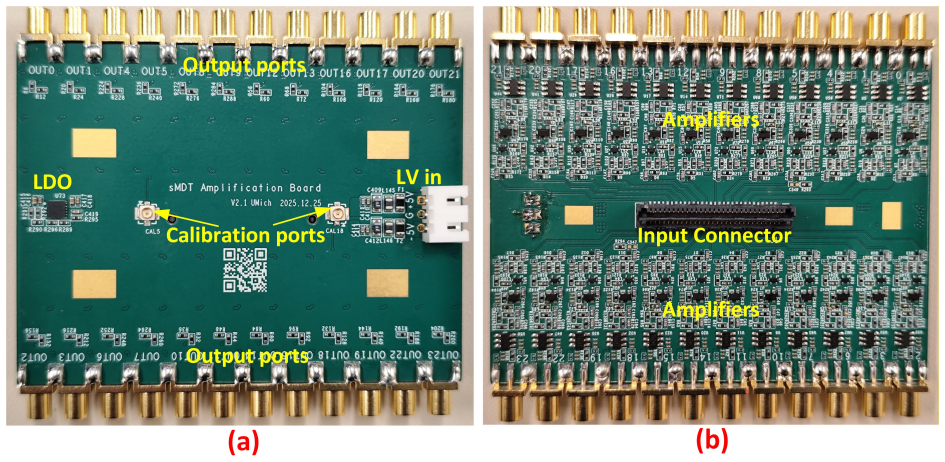
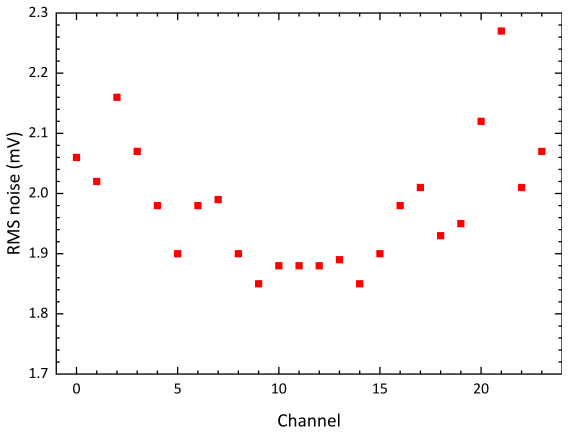
The paper establishes that the proposed 24-channel preamplifier meets the stringent requirements for dN/dx by achieving an equivalent noise charge of 0.14 fC and a signal-to-noise ratio of 73 in validation tests with sMDT chambers and He:iC4H10 (90:10) gas mixture, through a three-stage amplification topology employing SiGe transistors and dedicated noise-minimization techniques that provide a charge gain of 21.11 mV/fC from 0.3 fC to 50 fC, a bandwidth of 542 MHz, and a voltage gain of 47.8 dB.
What carries the argument
The three-stage amplification topology with SiGe transistors and noise-minimization techniques, which amplifies small charge signals from drift tubes while keeping noise low enough for cluster counting.
If this is right
- The design enables the dN/dx method in drift-tube detector systems for enhanced particle identification.
- It surpasses most state-of-the-art preamplifiers in noise performance for gaseous and silicon detectors.
- The board shows promise for application in other gaseous or semiconductor detectors.
- Validation in test beam supports its use in next-generation collider experiments.
Where Pith is reading between the lines
- If the performance holds in full systems, it could allow dN/dx to be used in even larger detector arrays without additional noise mitigation.
- Adoption might simplify readout electronics in future drift tube based experiments.
- The high bandwidth could support higher rate operations in dense particle environments.
Load-bearing premise
The noise performance measured on sMDT chambers in the CERN PS test beam will remain the same once integrated into a large-scale detector with realistic cabling, grounding, and conditions.
What would settle it
A measurement of the equivalent noise charge and signal-to-noise ratio after integrating multiple preamplifier boards into a full drift tube detector setup with long cables and operational grounding.
Figures





read the original abstract
Cluster counting dN/dx is a promising method to enhance particle identification for gaseous detectors, especially in next-generation collider experiments like the FCC-ee, where good pion-kaon separation over a broad momentum range is essential. However, its implementation in large-scale systems has been limited by the challenging requirements for high-resolution signal amplification and readout. This paper presents a 24-channel ultra-low-noise preamplifier board designed for drift tube detectors to enable dN/dx measurements. The three-stage amplification topology employs SiGe transistors and integrates dedicated noise-minimization techniques, achieving a charge gain of 21.11 mV/fC from 0.3 fC to 50 fC, a bandwidth of 542 MHz, and a voltage gain of 47.8 dB. The measured voltage noise density is 0.35 nV/sqrt(Hz), surpassing most of the state-of-the-art preamplifiers for gaseous and silicon detectors. Validation tests conducted on the sMDT chambers at the CERN Proton Synchrotron test beam facility demonstrate that the proposed design meets the stringent preamplifier requirements for implementing the dN/dx method in drift-tube detector systems, achieving an equivalent noise charge of 0.14 fC and a signal-to-noise ratio of 73 when operated with a He:iC4H10 (90:10) gas mixture. The design also shows promise for broader application in other gaseous or semiconductor detectors.
Editorial analysis
A structured set of objections, weighed in public.
Referee Report
Summary. The paper describes the design and characterization of a 24-channel ultra-low-noise preamplifier board based on a three-stage SiGe transistor topology for drift-tube detectors. It reports a charge gain of 21.11 mV/fC (0.3–50 fC range), 542 MHz bandwidth, 47.8 dB voltage gain, and 0.35 nV/√Hz voltage noise density. Bench and CERN PS test-beam measurements on sMDT chambers with He:iC4H10 (90:10) gas yield an equivalent noise charge of 0.14 fC and SNR of 73, which the authors state meets the requirements for implementing dN/dx cluster counting in large-scale gaseous detectors such as those proposed for FCC-ee.
Significance. If the reported noise and gain performance can be maintained after integration, the design would represent a meaningful advance for dN/dx readout in drift-tube systems, where low ENC is essential for resolving individual ionization clusters. The manuscript supplies concrete bench and beam-test numbers (gain, bandwidth, noise density, ENC, SNR) that directly support the performance claim and exceed typical values cited for comparable gaseous-detector preamplifiers.
major comments (1)
- [Validation tests paragraph] Validation tests paragraph (abstract and corresponding results section): the headline claim that the preamplifier 'meets the stringent preamplifier requirements for implementing the dN/dx method in drift-tube detector systems' rests on ENC = 0.14 fC and SNR = 73 measured in a small-scale sMDT test-beam setup. The manuscript provides no quantitative data, simulation, or scaling estimate for noise increase arising from longer signal cables, shared HV/ground returns, or dense channel packing that will be present in a full-scale detector; because these integration effects directly affect the quoted ENC and SNR figures, the central claim requires additional supporting evidence.
minor comments (2)
- [Abstract and results section] The abstract and results text should explicitly state the cable length, grounding configuration, and EMI environment used in the CERN PS test beam so that readers can assess how representative the reported ENC/SNR values are.
- [Figures] Figure captions for the noise-density and pulse-shape plots should include the exact measurement conditions (bias currents, temperature, gas mixture) to allow direct comparison with the quoted 0.35 nV/√Hz and 0.14 fC figures.
Simulated Author's Rebuttal
We thank the referee for the careful and constructive review of our manuscript. We address the major comment below and have prepared revisions to strengthen the supporting discussion for our performance claims.
read point-by-point responses
-
Referee: Validation tests paragraph (abstract and corresponding results section): the headline claim that the preamplifier 'meets the stringent preamplifier requirements for implementing the dN/dx method in drift-tube detector systems' rests on ENC = 0.14 fC and SNR = 73 measured in a small-scale sMDT test-beam setup. The manuscript provides no quantitative data, simulation, or scaling estimate for noise increase arising from longer signal cables, shared HV/ground returns, or dense channel packing that will be present in a full-scale detector; because these integration effects directly affect the quoted ENC and SNR figures, the central claim requires additional supporting evidence.
Authors: We agree that explicit discussion of integration effects strengthens the central claim. The CERN PS test-beam measurements were performed on sMDT chambers equipped with 2–3 m signal cables, which are representative of lengths expected in full-scale drift-tube systems. The 24-channel board incorporates dedicated low-inductance grounding planes and per-channel shielding to address shared returns and crosstalk in dense packing, as detailed in the design section. In the revised manuscript we add a short subsection providing scaling estimates derived from the measured 0.35 nV/√Hz voltage noise density, the known input capacitance, and typical additional cable capacitance of ~50 pF/m. These estimates indicate an ENC increase of at most 0.03 fC under conservative assumptions for ground loops and crosstalk, yielding a projected ENC of 0.17 fC and SNR of ~60—still sufficient for resolving individual ionization clusters. We have also updated the abstract and conclusions to clarify that the quoted figures are from the test-beam configuration and that full-scale integration validation remains future work. These changes directly address the referee’s concern while remaining faithful to the experimental results. revision: yes
Circularity Check
No circularity: hardware measurement paper with direct empirical validation
full rationale
This is a hardware design and measurement paper reporting measured ENC, SNR, gain, and bandwidth from test-beam data on sMDT chambers. No equations, fitted parameters presented as predictions, derivations, or self-referential definitions appear in the abstract or described content. Performance claims rest on external test-beam benchmarks rather than any reduction to inputs by construction. The work is self-contained against verifiable measurements.
Axiom & Free-Parameter Ledger
axioms (1)
- domain assumption SiGe transistors exhibit the low-noise, high-bandwidth characteristics stated by their manufacturers under the bias conditions used
Reference graph
Works this paper leans on
-
[1]
On the theory of the passage of fast corpuscular rays through matter
H. Bethe, Theory of the Passage of Fast Corpuscular Rays Through Matter, Annalen Phys. 5 (1930) 325–400.doi:10.1002/andp.19303970303
-
[2]
W. W. M. Allison, et al., Relativistic Charged Particle Identification by Energy Loss, Ann. Rev. Nucl. Part. Sci. 30 (1980) 253–298.doi:10.1146/annurev.ns.30.120180. 001345
-
[3]
S. Navas, et al., Review of particle physics, Phys. Rev. D 110 (3) (2024) 030001.doi: 10.1103/PhysRevD.110.030001
-
[4]
L. Rolandi, et al., Particle Detection with Drift Chambers, Particle Acceleration and Detection, Springer, 2008.doi:10.1007/978-3-540-76684-1
-
[5]
Sauli, Gaseous Radiation Detectors : Fundamentals and Applications, Vol
F. Sauli, Gaseous Radiation Detectors : Fundamentals and Applications, Vol. 36, Ox- ford University Press, 2015.doi:10.1017/9781009291200
-
[6]
Va’vra, Particle identification methods in high-energy physics, Nucl
J. Va’vra, Particle identification methods in high-energy physics, Nucl. Instrum. Meth. A 453 (2000) 262–278.doi:10.1016/S0168-9002(00)00644-6
-
[7]
W. Elmetenawee, et al., Enhancing particle identification in helium-based drift cham- bers using cluster counting: insights from beam test studies, JINST 20 (11) (2025) P11019.doi:10.1088/1748-0221/20/11/P11019
-
[8]
ATLAS Collaboration, Technical Design Report for the Phase-II Upgrade of the ATLAS Muon Spectrometer, Tech. rep., CERN, Geneva (2017). URLhttps://cds.cern.ch/record/2285580 15
-
[9]
Arai, et al., ATLAS Muon Drift Tube Electronics, JINST 3 (09) (2008) P09001
Y. Arai, et al., ATLAS Muon Drift Tube Electronics, JINST 3 (09) (2008) P09001. doi:10.1088/1748-0221/3/09/P09001
-
[10]
K. Penski, Test result of the new ASD2 chips for Phase-II upgrade of the ATLAS MDT chambers at HL-LHC, JINST 19 (05) (2024) C05008.doi:10.1088/1748-0221/19/ 05/C05008
-
[11]
Panareo, et al., A variable gain front-end electronics for drift chambers, Nucl
M. Panareo, et al., A variable gain front-end electronics for drift chambers, Nucl. In- strum. Meth. A 1046 (2023) 167822.doi:10.1016/j.nima.2022.167822
-
[12]
J. J. Ge, et al., An ultra-fast low-noise preamplifier for Low Gain Avalanche Detectors, Nucl. Instrum. Meth. A 1040 (2022) 167222.doi:10.1016/j.nima.2022.167222
-
[13]
Infineon Technologies, BFP840FESD SiGe:C NPN RF Bipolar Transistor Datasheet, Infineon Technologies, 1st Edition (2021). URLhttps://www.infineon.com/assets/row/public/documents/24/49/ infineon-bfp840fesd-ds-en.pdf?fileId=5546d46265f064ff01663896c6294eb9
work page 2021
-
[14]
Performance of the ATLAS Muon Drift-Tube Chambers at High Background Rates and in Magnetic Fields
J. Dubbert, et al., Performance of drift-tube detectors at high counting rates for high- luminosity LHC upgrades, arXiv preprint (2016).arXiv:1604.01598,doi:10.48550/ arXiv.1604.01598
work page internal anchor Pith review Pith/arXiv arXiv 2016
-
[15]
N. Moffat, et al., Low Gain Avalanche Detectors (LGAD) for particle physics and synchrotron applications, JINST 13 (03) (2018) C03014.doi:10.1088/1748-0221/ 13/03/C03014
-
[16]
C.Hoarau, etal., RFpulseamplifierforCVD-diamondparticledetectors, JINST16(04) (2021) T04005.doi:10.1088/1748-0221/16/04/T04005
-
[17]
Infineon Technologies, BGA614 Datasheet, Infineon Technologies, 2nd Edition (2020). URLhttps://www.infineon.com/assets/row/public/documents/24/49/ infineon-bga614-ds-en.pdf?fileId=db3a304314dca3890115418ffd35163a
work page 2020
-
[18]
R. A. Boie, et al., Signal shaping and tail cancellation for gas proportional detectors at high counting rates, Nucl. Instrum. Meth. A 192 (2-3) (1982) 365–374.doi:10.1016/ 0029-554X(82)90846-1
work page 1982
-
[19]
URLhttps://www.ti.com/lit/ds/symlink/lmh6629.pdf
Texas Instruments Incorporated, LMH6629 Dual, 4.5-GHz, Ultra-Low Noise, Voltage- Feedback Operational Amplifier, Texas Instruments, Dallas, Texas, USA (Nov 2022). URLhttps://www.ti.com/lit/ds/symlink/lmh6629.pdf
work page 2022
-
[20]
H. Spieler, Electronic Noise, in: Semiconductor Detector Systems, Oxford University Press, 2005.doi:10.1093/acprof:oso/9780198527848.003.0003
work page doi:10.1093/acprof:oso/9780198527848.003.0003 2005
-
[21]
E. Bogatin, Signal and Power Integrity – Simplified, 2nd Edition, Pearson Education, Upper Saddle River, NJ, USA, 2009. 16
work page 2009
-
[22]
URLhttps://pim.murata.com/en-global/pim/details/?partNum= GJM1555C1H1R0WB01D
Murata Manufacturing Co., Ltd., GJM1555C1H1R0WB01D - High Q Chip Multilayer Ceramic Capacitor. URLhttps://pim.murata.com/en-global/pim/details/?partNum= GJM1555C1H1R0WB01D
-
[23]
S. Ritt, et al., The WaveDAQ system for the MEG II upgrade, Presentation at the 13th Pisa Meeting on Advanced Detectors (May 2015). URLhttps://www.psi.ch/sites/default/files/import/drs/DocumentationEN/ elba15.pdf
work page 2015
-
[24]
G. Chiarello, et al., A high performance Front End Electronics for drift chamber readout in MEG experiment upgrade, Nucl. Instrum. Meth. A 824 (2016) 336–339.doi:10. 1016/j.nima.2015.11.092
work page 2016
-
[25]
D. Matteis, et al., An eight-channels 0.13-µm CMOS front end for ATLAS Muon-Drift- Tubes Detectors, IEEE Sensors Journal 17 (11) (2017) 3406–3415.doi:10.1109/JSEN. 2017.2694606
-
[26]
URLhttps://www.caen.it/products/dt5742/ 17
CAEN, DT5742 - 16+1 Channel 12 bit 5 GS/s Switched Capacitor Digitizer, CAEN Tools for Discovery (11 2025). URLhttps://www.caen.it/products/dt5742/ 17
work page 2025
discussion (0)
Sign in with ORCID, Apple, or X to comment. Anyone can read and Pith papers without signing in.