Graph Navier Stokes Networks
Pith reviewed 2026-05-21 05:10 UTC · model grok-4.3
The pith
Graph Navier Stokes Networks define a dynamic velocity field on graphs to balance convection and diffusion, reducing oversmoothing while improving accuracy on datasets with varying homophily.
A machine-rendered reading of the paper's core claim, the machinery that carries it, and where it could break.
Core claim
GNSN defines a dynamic velocity field on the graph to govern convection, enabling more efficient and direct message propagation. By adaptively balancing convection and diffusion, GNSN is able to efficiently handle datasets with varying levels of homophily and alleviates the oversmoothing problem that arises in deeper networks.
What carries the argument
The dynamic velocity field defined on graph edges that controls the convection component of message passing and is optimized jointly with the network weights.
If this is right
- Higher node classification accuracy than existing GNNs across twelve real-world datasets.
- Better handling of both homophilous and heterophilous graphs through automatic convection-diffusion balance.
- Reduced oversmoothing, allowing deeper architectures without feature collapse.
- More direct long-range message passing via the convection term rather than repeated diffusion steps.
Where Pith is reading between the lines
- The same velocity-field idea could extend to regression or link-prediction tasks where directional flow matters.
- If the velocity field remains stable, GNSN might serve as a drop-in replacement for diffusion layers in existing GNN libraries.
- Graphs with known physical flow interpretations, such as traffic or citation networks, could benefit from explicit convection modeling.
Load-bearing premise
A stable, optimizable velocity field can be defined on any graph structure without introducing numerical instabilities or needing heavy per-dataset retuning.
What would settle it
Training GNSN to large depth on a graph where node features become indistinguishable after few layers despite the velocity term, or observing divergence when the velocity field is learned on a sparse or irregular topology.
Figures





read the original abstract
Graph Neural Networks (GNNs) have emerged as a cornerstone of deep learning, with most existing methods rooted in graph signal processing and diffusion equations to model message passing. However, these approaches inherently suffer from the oversmoothing problem, where node features become indistinguishable as the network depth increases. Inspired by the Navier Stokes equations, we introduce Graph Navier Stokes Networks (GNSN), a novel architecture that transcends conventional diffusion-based message passing by incorporating convection into graph structures. GNSN defines a dynamic velocity field on the graph to govern convection, enabling more efficient and direct message propagation. By adaptively balancing convection and diffusion, GNSN is able to efficiently handle datasets with varying levels of homophily. Extensive evaluations across twelve real-world datasets demonstrate that GNSN consistently outperforms state-of-the-art baselines in classification accuracy. Moreover, experimental results further emphasize its effectiveness in alleviating the oversmoothing problem.
Editorial analysis
A structured set of objections, weighed in public.
Referee Report
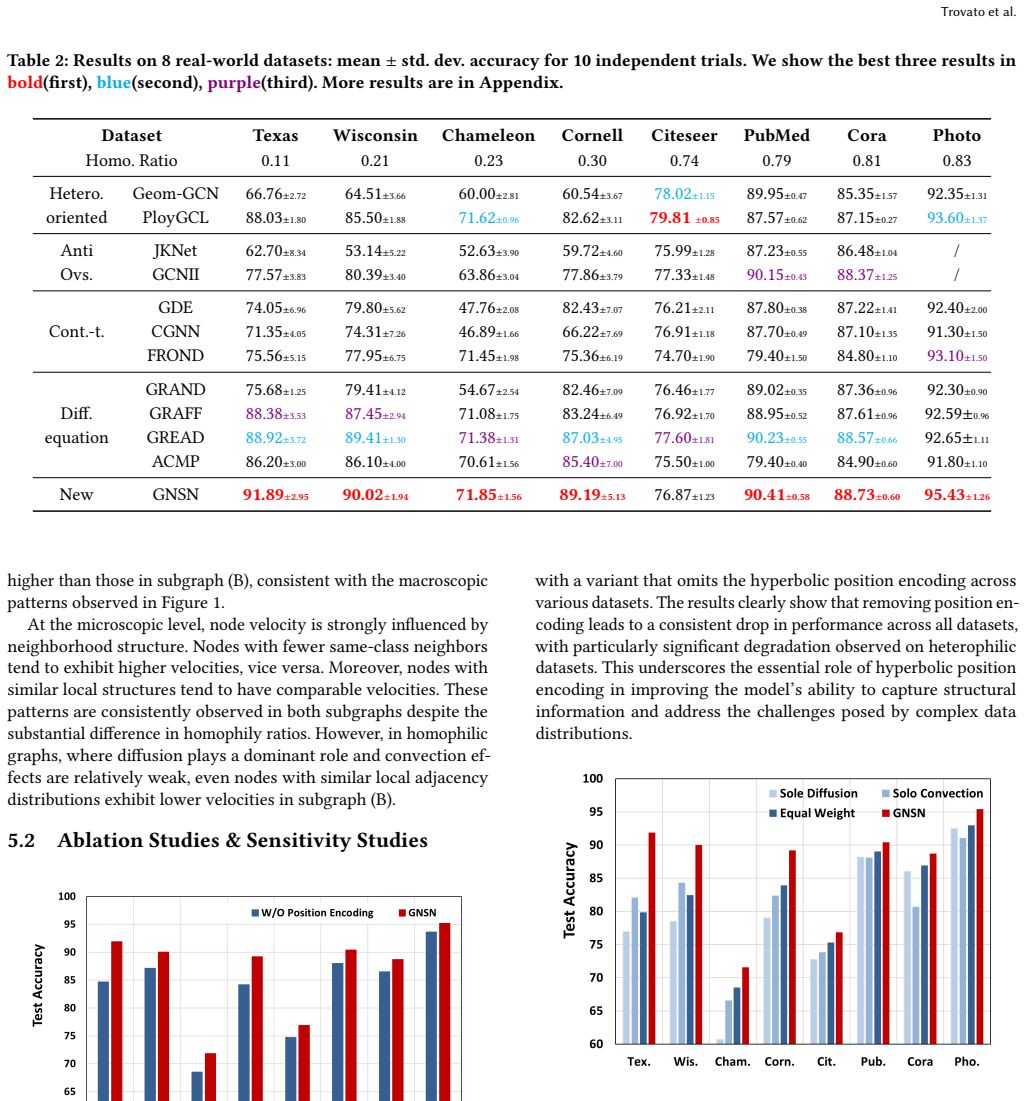
Summary. The paper introduces Graph Navier Stokes Networks (GNSN), a GNN architecture inspired by the Navier-Stokes equations that augments standard diffusion-based message passing with a convection term governed by a learned dynamic velocity field on the graph. By adaptively balancing convection and diffusion, GNSN is claimed to mitigate oversmoothing and improve performance on graphs with varying homophily. The central empirical claim is consistent outperformance over state-of-the-art baselines in node classification accuracy across twelve real-world datasets.
Significance. If the core technical claims hold, the work could provide a new direction for message-passing mechanisms in GNNs that move beyond pure diffusion models, with potential benefits for heterophilic graphs and deeper networks. The multi-dataset evaluation is a positive aspect, but the significance is limited by the absence of stability analysis for the velocity field and insufficient experimental controls.
major comments (3)
- [Abstract and §3] Abstract and §3 (method): The claim that a dynamic velocity field can be stably defined and optimized on arbitrary graph topologies is load-bearing for the central contribution, yet no CFL-style condition, divergence-free projection, or Lipschitz bound on the velocity update is provided. On graphs with heterogeneous degrees or low homophily, the discretization of the convection term risks exploding or vanishing velocities during message passing.
- [Abstract] Abstract: The reported outperformance on twelve datasets lacks any mention of error bars, statistical significance tests, baseline implementation details, or the precise form of the adaptive balance parameter. Without these, it is impossible to determine whether gains arise from the convection mechanism or from post-hoc fitting of the balance weight on evaluation sets.
- [§4] §4 (experiments): The adaptive balancing of convection and diffusion is presented as a general solution for varying homophily, but no ablation isolating the velocity field from the balance parameter is described. If performance reduces to per-dataset tuning of this parameter, the 'parameter-free' or 'adaptive without extensive tuning' assertion is undermined.
minor comments (2)
- [§3] Notation for the velocity field and its update rule should be introduced with explicit equations rather than descriptive text to allow reproducibility.
- [§3] The manuscript would benefit from a clear statement of the precise graph discretization of the Navier-Stokes convection term (e.g., how u·∇u is realized on edges).
Simulated Author's Rebuttal
We thank the referee for their constructive and detailed comments. We address each major comment point by point below, providing clarifications from the manuscript and indicating revisions where they strengthen the presentation without altering the core claims.
read point-by-point responses
-
Referee: [Abstract and §3] Abstract and §3 (method): The claim that a dynamic velocity field can be stably defined and optimized on arbitrary graph topologies is load-bearing for the central contribution, yet no CFL-style condition, divergence-free projection, or Lipschitz bound on the velocity update is provided. On graphs with heterogeneous degrees or low homophily, the discretization of the convection term risks exploding or vanishing velocities during message passing.
Authors: We thank the referee for raising this important point on stability. In §3, the velocity field is parameterized by a GNN with per-node normalization by the maximum degree, which empirically bounds the convection term and prevents explosion or vanishing during message passing. We include training curves and performance metrics across all twelve datasets (including low-homophily and heterogeneous-degree graphs) demonstrating stable optimization and inference. We agree a formal graph-theoretic CFL condition or divergence-free projection would add rigor; we have added a brief discussion of the Lipschitz bound induced by our normalization in the revised §3. A complete theoretical stability analysis remains an open direction for future work. revision: partial
-
Referee: [Abstract] Abstract: The reported outperformance on twelve datasets lacks any mention of error bars, statistical significance tests, baseline implementation details, or the precise form of the adaptive balance parameter. Without these, it is impossible to determine whether gains arise from the convection mechanism or from post-hoc fitting of the balance weight on evaluation sets.
Authors: We apologize for the brevity in the abstract. Section 4 reports mean node-classification accuracy with standard deviations computed over ten independent runs using different random seeds. Statistical significance is evaluated via paired t-tests against each baseline. All baselines follow the original authors' implementations and hyperparameter ranges, with selection performed exclusively on validation splits. The adaptive balance parameter is a per-layer scalar produced by a small auxiliary network and optimized jointly with the rest of the model parameters; it is never tuned post-hoc on test data. We have revised the abstract to reference error bars and the end-to-end learned balance mechanism. revision: yes
-
Referee: [§4] §4 (experiments): The adaptive balancing of convection and diffusion is presented as a general solution for varying homophily, but no ablation isolating the velocity field from the balance parameter is described. If performance reduces to per-dataset tuning of this parameter, the 'parameter-free' or 'adaptive without extensive tuning' assertion is undermined.
Authors: We agree that an explicit ablation clarifies the source of gains. We have added results in the revised §4 comparing the full adaptive model against a variant in which the convection-diffusion balance is fixed at 0.5 for all datasets and layers. The adaptive version yields statistically significant improvements, especially on heterophilic graphs, while the fixed-balance model already outperforms pure-diffusion baselines. Because the balance scalar is learned end-to-end from data without any dataset-specific hyperparameter search, the experiments support our claim of adaptivity without extensive per-dataset tuning. revision: yes
Circularity Check
No significant circularity; new architecture with empirical validation
full rationale
The paper proposes GNSN by adapting Navier-Stokes concepts to graphs via a dynamic velocity field and adaptive convection-diffusion balance. Claims rest on empirical outperformance across twelve datasets rather than any derivation that reduces by construction to fitted inputs or self-citations. No equations or steps in the abstract or description exhibit self-definitional loops, fitted parameters renamed as predictions, or load-bearing self-citations. The model is self-contained against external benchmarks.
Axiom & Free-Parameter Ledger
free parameters (1)
- convection-diffusion balance weight
axioms (1)
- domain assumption Graph structures admit a meaningful discrete approximation to continuous fluid flow governed by Navier-Stokes-like equations.
invented entities (1)
-
dynamic velocity field on graph
no independent evidence
Lean theorems connected to this paper
-
IndisputableMonolith/Foundation/AlexanderDuality.leanalexander_duality_circle_linking unclear?
unclearRelation between the paper passage and the cited Recognition theorem.
GNSN defines a dynamic velocity field on the graph to govern convection... adaptively balancing convection and diffusion
-
IndisputableMonolith/Cost/FunctionalEquation.leanwashburn_uniqueness_aczel unclear?
unclearRelation between the paper passage and the cited Recognition theorem.
velocity field u_G = (u_1, …, u_n) … u_i ≈ 1/L sum ||sum α h_j||
What do these tags mean?
- matches
- The paper's claim is directly supported by a theorem in the formal canon.
- supports
- The theorem supports part of the paper's argument, but the paper may add assumptions or extra steps.
- extends
- The paper goes beyond the formal theorem; the theorem is a base layer rather than the whole result.
- uses
- The paper appears to rely on the theorem as machinery.
- contradicts
- The paper's claim conflicts with a theorem or certificate in the canon.
- unclear
- Pith found a possible connection, but the passage is too broad, indirect, or ambiguous to say the theorem truly supports the claim.
Reference graph
Works this paper leans on
-
[1]
Sami Abu-El-Haija, Bryan Perozzi, Amol Kapoor, Nazanin Alipourfard, Kristina Lerman, Hrayr Harutyunyan, Greg Ver Steeg, and Aram Galstyan. 2019. Mixhop: Higher-order graph convolutional architectures via sparsified neighborhood mixing. Ininternational conference on machine learning. PMLR, 21–29
work page 2019
-
[2]
Ivana Balazevic, Carl Allen, and Timothy Hospedales. 2019. Multi-relational poincaré graph embeddings.Advances in Neural Information Processing Systems 32 (2019)
work page 2019
-
[3]
Deyu Bo, Xiao Wang, Chuan Shi, and Huawei Shen. 2021. Beyond low-frequency information in graph convolutional networks. InProceedings of the AAAI confer- ence on artificial intelligence, Vol. 35. 3950–3957
work page 2021
-
[4]
Cristian Bodnar, Francesco Di Giovanni, Benjamin Chamberlain, Pietro Lio, and Michael Bronstein. 2022. Neural sheaf diffusion: A topological perspective on heterophily and oversmoothing in gnns.Advances in Neural Information Processing Systems35 (2022), 18527–18541
work page 2022
-
[5]
John Charles Butcher. 1996. A history of Runge-Kutta methods.Applied numerical mathematics20, 3 (1996), 247–260
work page 1996
-
[6]
Manuel Calvo, Juan I Montijano, and Luis Randez. 1990. A fifth-order interpolant for the Dormand and Prince Runge-Kutta method.Journal of computational and applied mathematics29, 1 (1990), 91–100
work page 1990
-
[7]
Benjamin Chamberlain, James Rowbottom, Davide Eynard, Francesco Di Gio- vanni, Xiaowen Dong, and Michael Bronstein. 2021. Beltrami flow and neural diffusion on graphs.Advances in Neural Information Processing Systems34 (2021), 1594–1609
work page 2021
-
[8]
Ben Chamberlain, James Rowbottom, Maria I Gorinova, Michael Bronstein, Stefan Webb, and Emanuele Rossi. 2021. Grand: Graph neural diffusion. InInternational conference on machine learning. PMLR, 1407–1418
work page 2021
-
[9]
Ines Chami, Zhitao Ying, Christopher Ré, and Jure Leskovec. 2019. Hyperbolic graph convolutional neural networks.Advances in neural information processing systems32 (2019)
work page 2019
-
[10]
Deli Chen, Yankai Lin, Wei Li, Peng Li, Jie Zhou, and Xu Sun. 2020. Measuring and relieving the over-smoothing problem for graph neural networks from the topological view. InProceedings of the AAAI conference on artificial intelligence, Vol. 34. 3438–3445
work page 2020
-
[11]
Jingyu Chen, Runlin Lei, and Zhewei Wei. 2024. PolyGCL: GRAPH CON- TRASTIVE LEARNING via Learnable Spectral Polynomial Filters. InThe Twelfth International Conference on Learning Representations
work page 2024
-
[12]
Ming Chen, Zhewei Wei, Zengfeng Huang, Bolin Ding, and Yaliang Li. 2020. Simple and deep graph convolutional networks. InInternational conference on machine learning. PMLR, 1725–1735
work page 2020
-
[13]
Xinfu Chen. 1992. Generation and propagation of interfaces for reaction-diffusion equations.Journal of Differential equations96, 1 (1992), 116–141
work page 1992
- [14]
-
[15]
Jeongwhan Choi, Seoyoung Hong, Noseong Park, and Sung-Bae Cho. 2023. Gread: Graph neural reaction-diffusion networks. InInternational Conference on Machine Learning. PMLR, 5722–5747
work page 2023
-
[16]
Michaël Defferrard, Xavier Bresson, and Pierre Vandergheynst. 2016. Convolu- tional neural networks on graphs with fast localized spectral filtering.Advances in neural information processing systems29 (2016)
work page 2016
-
[17]
Yash Deshpande, Subhabrata Sen, Andrea Montanari, and Elchanan Mossel. 2018. Contextual stochastic block models.Advances in Neural Information Processing Systems31 (2018)
work page 2018
- [18]
-
[19]
James A Dix and AS Verkman. 2008. Crowding effects on diffusion in solutions and cells.Annu. Rev. Biophys.37, 1 (2008), 247–263
work page 2008
-
[20]
Bastian Epping, Alexandre René, Moritz Helias, and Michael T Schaub
- [21]
-
[22]
Zheng Fang, Qingqing Long, Guojie Song, and Kunqing Xie. 2021. Spatial- temporal graph ode networks for traffic flow forecasting. InProceedings of the 27th ACM SIGKDD conference on knowledge discovery & data mining. 364–373
work page 2021
-
[23]
Chen Gao, Yu Zheng, Nian Li, Yinfeng Li, Yingrong Qin, Jinghua Piao, Yuhan Quan, Jianxin Chang, Depeng Jin, Xiangnan He, et al. 2023. A survey of graph neural networks for recommender systems: Challenges, methods, and directions. ACM Transactions on Recommender Systems1, 1 (2023), 1–51
work page 2023
-
[24]
Johannes Gasteiger, Stefan Weißenberger, and Stephan Günnemann. 2019. Diffu- sion improves graph learning.Advances in neural information processing systems 32 (2019)
work page 2019
-
[25]
Justin Gilmer, Samuel S Schoenholz, Patrick F Riley, Oriol Vinyals, and George E Dahl. 2017. Neural message passing for quantum chemistry. InInternational conference on machine learning. PMLR, 1263–1272
work page 2017
-
[26]
Shurui Gui, Hao Yuan, Jie Wang, Qicheng Lao, Kang Li, and Shuiwang Ji. 2023. Flowx: Towards explainable graph neural networks via message flows.IEEE Transactions on Pattern Analysis and Machine Intelligence(2023)
work page 2023
-
[27]
Will Hamilton, Zhitao Ying, and Jure Leskovec. 2017. Inductive representation learning on large graphs.Advances in neural information processing systems30 (2017)
work page 2017
-
[28]
Fatma A Hashim, Reham R Mostafa, Abdelazim G Hussien, Seyedali Mirjalili, and Karam M Sallam. 2023. Fick’s Law Algorithm: A physical law-based algorithm for numerical optimization.Knowledge-Based Systems260 (2023), 110146
work page 2023
-
[29]
Weihua Hu, Matthias Fey, Marinka Zitnik, Yuxiao Dong, Hongyu Ren, Bowen Liu, Michele Catasta, and Jure Leskovec. 2020. Open graph benchmark: Datasets for machine learning on graphs.Advances in neural information processing systems 33 (2020), 22118–22133
work page 2020
-
[30]
Changqin Huang, Yi Wang, Yunliang Jiang, Ming Li, Xiaodi Huang, Shijin Wang, Shirui Pan, and Chuan Zhou. 2024. Flow2GNN: Flexible Two-Way Flow Mes- sage Passing for Enhancing GNNs Beyond Homophily.IEEE Transactions on Cybernetics(2024)
work page 2024
-
[31]
Dejun Jiang, Zhenxing Wu, Chang-Yu Hsieh, Guangyong Chen, Ben Liao, Zhe Wang, Chao Shen, Dongsheng Cao, Jian Wu, and Tingjun Hou. 2021. Could graph neural networks learn better molecular representation for drug discovery? A comparison study of descriptor-based and graph-based models.Journal of cheminformatics13 (2021), 1–23
work page 2021
-
[32]
Weiwei Jiang and Jiayun Luo. 2022. Graph neural network for traffic forecasting: A survey.Expert systems with applications207 (2022), 117921
work page 2022
-
[33]
Ming Jin, Guangsi Shi, Yuan-Fang Li, Bo Xiong, Tian Zhou, Flora D Salim, Liang Zhao, Lingfei Wu, Qingsong Wen, and Shirui Pan. 2025. Towards expressive spectral-temporal graph neural networks for time series forecasting.IEEE Trans- actions on Pattern Analysis and Machine Intelligence(2025)
work page 2025
- [34]
-
[35]
Nicolas Keriven. 2022. Not too little, not too much: a theoretical analysis of graph (over) smoothing.Advances in Neural Information Processing Systems35 (2022), 2268–2281
work page 2022
-
[36]
Ryuji Kimura. 2002. Numerical weather prediction.Journal of Wind Engineering and Industrial Aerodynamics90, 12-15 (2002), 1403–1414
work page 2002
-
[37]
Thomas N Kipf and Max Welling. 2016. Semi-supervised classification with graph convolutional networks.arXiv preprint arXiv:1609.02907(2016)
work page internal anchor Pith review Pith/arXiv arXiv 2016
-
[38]
Yann LeCun, Yoshua Bengio, and Geoffrey Hinton. 2015. Deep learning.nature 521, 7553 (2015), 436–444
work page 2015
-
[39]
Xiang Li, Renyu Zhu, Yao Cheng, Caihua Shan, Siqiang Luo, Dongsheng Li, and Weining Qian. 2022. Finding global homophily in graph neural networks when meeting heterophily. InInternational Conference on Machine Learning. PMLR, 13242–13256
work page 2022
-
[40]
Derek Lim, Felix Hohne, Xiuyu Li, Sijia Linda Huang, Vaishnavi Gupta, Omkar Bhalerao, and Ser Nam Lim. 2021. Large scale learning on non-homophilous graphs: New benchmarks and strong simple methods.Advances in Neural Infor- mation Processing Systems34 (2021), 20887–20902
work page 2021
-
[41]
Yi Lu, Yaran Chen, Dongbin Zhao, Bao Liu, Zhichao Lai, and Jianxin Chen
-
[42]
CNN-G: Convolutional neural network combined with graph for image segmentation with theoretical analysis.IEEE Transactions on Cognitive and Developmental Systems13, 3 (2020), 631–644
work page 2020
-
[43]
Sitao Luan, Chenqing Hua, Qincheng Lu, Jiaqi Zhu, Mingde Zhao, Shuyuan Zhang, Xiao-Wen Chang, and Doina Precup. 2022. Revisiting heterophily for graph neural networks.Advances in neural information processing systems35 (2022), 1362–1375
work page 2022
-
[44]
Tianze Luo, Zhanfeng Mo, and Sinno Jialin Pan. 2024. Learning Adaptive Mul- tiresolution Transforms via Meta-Framelet-based Graph Convolutional Network. InThe Twelfth International Conference on Learning Representations
work page 2024
-
[45]
Andrew Kachites McCallum, Kamal Nigam, Jason Rennie, and Kristie Seymore
-
[46]
Information Retrieval3 (2000), 127–163
Automating the construction of internet portals with machine learning. Information Retrieval3 (2000), 127–163
work page 2000
-
[47]
Yujie Mo, Feiping Nie, Ping Hu, Heng Tao Shen, Zheng Zhang, Xinchao Wang, and Xiaofeng Zhu. [n. d.]. Self-Supervised Heterogeneous Graph Learning: a Homophily and Heterogeneity View. InThe Twelfth International Conference on Learning Representations
-
[48]
Federico Monti, Davide Boscaini, Jonathan Masci, Emanuele Rodola, Jan Svoboda, and Michael M Bronstein. 2017. Geometric deep learning on graphs and manifolds using mixture model cnns. InProceedings of the IEEE conference on computer vision and pattern recognition. 5115–5124
work page 2017
-
[49]
Galileo Namata, Ben London, Lise Getoor, Bert Huang, and U Edu. 2012. Query- driven active surveying for collective classification. In10th international workshop on mining and learning with graphs, Vol. 8. 1
work page 2012
-
[50]
Maximillian Nickel and Douwe Kiela. 2017. Poincaré embeddings for learning hierarchical representations.Advances in neural information processing systems Graph Navier–Stokes Networks 30 (2017)
work page 2017
-
[51]
Bastien Pasdeloup, Vincent Gripon, Grégoire Mercier, Dominique Pastor, and Michael G Rabbat. 2017. Characterization and inference of graph diffusion processes from observations of stationary signals.IEEE transactions on Signal and Information Processing over Networks4, 3 (2017), 481–496
work page 2017
-
[52]
2018.Numerical heat transfer and fluid flow
Suhas Patankar. 2018.Numerical heat transfer and fluid flow. CRC press
work page 2018
-
[53]
Hongbin Pei, Bingzhe Wei, Kevin Chen-Chuan Chang, Yu Lei, and Bo Yang
- [54]
-
[55]
Jean Philibert. 2006. One and a half century of diffusion: Fick, Einstein before and beyond. (2006)
work page 2006
- [56]
-
[57]
Philip L Roe. 1986. Characteristic-based schemes for the Euler equations.Annual review of fluid mechanics18, 1 (1986), 337–365
work page 1986
-
[58]
Benedek Rozemberczki, Carl Allen, and Rik Sarkar. 2021. Multi-scale attributed node embedding.Journal of Complex Networks9, 2 (2021), cnab014
work page 2021
-
[59]
T Konstantin Rusch, Ben Chamberlain, James Rowbottom, Siddhartha Mishra, and Michael Bronstein. 2022. Graph-coupled oscillator networks. InInternational Conference on Machine Learning. PMLR, 18888–18909
work page 2022
-
[60]
Prithviraj Sen, Galileo Namata, Mustafa Bilgic, Lise Getoor, Brian Galligher, and Tina Eliassi-Rad. 2008. Collective classification in network data.AI magazine29, 3 (2008), 93–93
work page 2008
-
[61]
Xiaowen Shan, Xue-Feng Yuan, and Hudong Chen. 2006. Kinetic theory repre- sentation of hydrodynamics: a way beyond the Navier–Stokes equation.Journal of Fluid Mechanics550 (2006), 413–441
work page 2006
-
[62]
Oleksandr Shchur, Maximilian Mumme, Aleksandar Bojchevski, and Stephan Günnemann. 2018. Pitfalls of graph neural network evaluation.arXiv preprint arXiv:1811.05868(2018)
work page internal anchor Pith review Pith/arXiv arXiv 2018
-
[63]
Dingyuan Shi, Yongxin Tong, Zimu Zhou, Ke Xu, Zheng Wang, and Jieping Ye. [n. d.]. GRAPH-CONSTRAINED DIFFUSION FOR END-TO-END PATH PLANNING. InThe Twelfth International Conference on Learning Representations
-
[64]
Guangsi Shi, Daokun Zhang, Ming Jin, Shirui Pan, and Philip S Yu. 2024. To- wards complex dynamic physics system simulation with graph neural ordinary equations.Neural Networks176 (2024), 106341
work page 2024
- [65]
-
[66]
Susheel Suresh, Vinith Budde, Jennifer Neville, Pan Li, and Jianzhu Ma. 2021. Breaking the limit of graph neural networks by improving the assortativity of graphs with local mixing patterns. InProceedings of the 27th ACM SIGKDD conference on knowledge discovery & data mining. 1541–1551
work page 2021
-
[67]
Jie Tang, Jimeng Sun, Chi Wang, and Zi Yang. 2009. Social influence analysis in large-scale networks. InProceedings of the 15th ACM SIGKDD international conference on Knowledge discovery and data mining. 807–816
work page 2009
-
[68]
Geoffrey Ingram Taylor. 1953. Dispersion of soluble matter in solvent flowing slowly through a tube.Proceedings of the Royal Society of London. Series A. Mathematical and Physical Sciences219, 1137 (1953), 186–203
work page 1953
-
[69]
2024.Navier–Stokes equations: theory and numerical analysis
Roger Temam. 2024.Navier–Stokes equations: theory and numerical analysis. Vol. 343. American Mathematical Society
work page 2024
-
[70]
Matthew Thorpe, Tan Nguyen, Hedi Xia, Thomas Strohmer, Andrea Bertozzi, Stanley Osher, and Bao Wang. 2022. GRAND++: Graph neural diffusion with a source term.ICLR(2022)
work page 2022
-
[71]
Petar Velickovic, Guillem Cucurull, Arantxa Casanova, Adriana Romero, Pietro Lio, Yoshua Bengio, et al. 2017. Graph attention networks.stat1050, 20 (2017), 10–48550
work page 2017
-
[72]
JF Wang, J Periaux, and M Sefrioui. 2002. Parallel evolutionary algorithms for optimization problems in aerospace engineering.J. Comput. Appl. Math.149, 1 (2002), 155–169
work page 2002
-
[73]
Yuelin Wang, Kai Yi, Xinliang Liu, Yu Guang Wang, and Shi Jin. 2022. ACMP: Allen-cahn message passing with attractive and repulsive forces for graph neural networks. InThe Eleventh International Conference on Learning Representations
work page 2022
-
[74]
Felix Wu, Amauri Souza, Tianyi Zhang, Christopher Fifty, Tao Yu, and Kilian Weinberger. 2019. Simplifying graph convolutional networks. InInternational conference on machine learning. PMLR, 6861–6871
work page 2019
-
[75]
Hao Wu, Changhu Wang, Fan Xu, Jinbao Xue, Chong Chen, Xian-Sheng Hua, and Xiao Luo. [n. d.]. PURE: Prompt Evolution with Graph ODE for Out-of- distribution Fluid Dynamics Modeling. InThe Thirty-eighth Annual Conference on Neural Information Processing Systems
-
[76]
Shiwen Wu, Fei Sun, Wentao Zhang, Xu Xie, and Bin Cui. 2022. Graph neural networks in recommender systems: a survey.Comput. Surveys55, 5 (2022), 1–37
work page 2022
-
[77]
Zonghan Wu, Shirui Pan, Guodong Long, Jing Jiang, and Chengqi Zhang. 2019. Graph wavenet for deep spatial-temporal graph modeling.arXiv preprint arXiv:1906.00121(2019)
work page internal anchor Pith review Pith/arXiv arXiv 2019
-
[78]
Louis-Pascal Xhonneux, Meng Qu, and Jian Tang. 2020. Continuous graph neural networks. InInternational conference on machine learning. PMLR, 10432–10441
work page 2020
-
[79]
Keyulu Xu, Chengtao Li, Yonglong Tian, Tomohiro Sonobe, Ken-ichi Kawarabayashi, and Stefanie Jegelka. 2018. Representation learning on graphs with jumping knowledge networks. InInternational conference on machine learn- ing. PMLR, 5453–5462
work page 2018
-
[80]
Yujun Yan, Milad Hashemi, Kevin Swersky, Yaoqing Yang, and Danai Koutra
discussion (0)
Sign in with ORCID, Apple, or X to comment. Anyone can read and Pith papers without signing in.