Field-tunable spin-valley transport in monolayer MoS₂
Pith reviewed 2026-05-21 02:35 UTC · model grok-4.3
The pith
Laser intensity and polarization shape switch the same MoS2 junction between broadband valley filtering and resonance-selective transport.
A machine-rendered reading of the paper's core claim, the machinery that carries it, and where it could break.
Core claim
The high-frequency Floquet expansion yields an effective static Hamiltonian with a laser-renormalized mass term. Analytic solution of the scattering problem by spinor matching shows that varying laser amplitude and polarization ellipticity tunes the spin-valley-dependent propagation thresholds and interference conditions, so the same junction operates either as a broadband valley filter or as a resonance-selective transmitter, with the distinction preserved in the conductance.
What carries the argument
Laser-renormalized mass (gap) term obtained from the high-frequency Floquet expansion of the massive Dirac Hamiltonian, which shifts the energy thresholds for transmission inside the electrostatic barrier.
If this is right
- Varying both laser intensity and polarization shape switches the junction between broadband valley filtering and resonance-selective operation.
- Valley contrast remains visible in the Landauer conductance under the tuned drive.
- The drive creates controllable pass and stop bands by adjusting spin-valley propagation thresholds and Fabry-Perot phase inside the barrier.
Where Pith is reading between the lines
- The same optical tuning approach may extend to other transition-metal dichalcogenides that share similar Dirac-like bands and spin-orbit features.
- Fixed electrostatic barriers combined with external laser control could enable dynamic reconfiguration of valleytronic circuits without mechanical redesign.
- The renormalized gap term suggests possible effects on additional observables such as spin relaxation or optical absorption in the same setup.
Load-bearing premise
The high-frequency Floquet expansion produces a reliable effective static Hamiltonian with a laser-renormalized mass term that captures the essential physics for the intensities and frequencies considered.
What would settle it
A measurement or calculation of transmission probabilities or Landauer conductance that shows no switch between broadband valley filtering and resonance-selective behavior when laser intensity and polarization ellipticity are varied would falsify the central claim.
Figures




read the original abstract
We study field-controlled spin-valley transport in monolayer MoS$_2$ through a single electrostatic barrier and a uniform off-resonant elliptically polarized irradiation. Starting from the massive Dirac Hamiltonian with intrinsic spin-orbit coupling, we use a high-frequency Floquet expansion to obtain an effective static model with a laser-renormalized mass (gap) term. We solve the scattering problem by spinor matching and derive the exact analytic expression for the transmission. The numerical results show that the drive tunes both the spin-valley-dependent propagation threshold inside the barrier and the Fabry-P\'erot phase, creating controllable pass/stop bands. By varying both the laser intensity (amplitude) and the polarization shape, we show that the same junction can be switched between broadband valley filtering and resonance-selective operation, and the valley contrast remains visible in the Landauer conductance. Our findings establish an efficient route for realizing optically reconfigurable valleytronic and spintronic functionalities in MoS$_2$.
Editorial analysis
A structured set of objections, weighed in public.
Referee Report
Summary. The paper examines spin-valley transport through a single electrostatic barrier in monolayer MoS2 under uniform off-resonant elliptically polarized laser drive. Starting from the massive Dirac Hamiltonian with intrinsic SOC, a high-frequency Floquet expansion yields an effective static Hamiltonian containing a laser-renormalized mass (gap) term. The scattering problem is solved by spinor matching to obtain an analytic transmission probability; numerical evaluation then shows that laser amplitude and polarization shape tune both the spin-valley-dependent propagation threshold inside the barrier and the Fabry-Pérot phase, producing controllable pass/stop bands. The central claim is that the same junction can be switched between broadband valley filtering and resonance-selective operation while preserving visible valley contrast in the Landauer conductance.
Significance. If the high-frequency approximation remains accurate for the intensities and frequencies employed, the results establish a practical optical route to reconfigurable valleytronic and spintronic functionality in a single MoS2 junction without additional electrostatic gates.
major comments (2)
- [Floquet expansion and effective Hamiltonian] The derivation of the effective static Hamiltonian (high-frequency Floquet expansion of the driven massive Dirac model) is presented without an explicit bound on the expansion parameter or a quantitative comparison to exact time-dependent or higher-order Floquet numerics. Because the analytic transmission formula and all subsequent numerical tuning of pass/stop bands and valley contrast rest directly on this effective model, the absence of such validation is load-bearing for the central claim.
- [Numerical results and figures] The numerical results for transmission and Landauer conductance are shown only for the effective static model; no test is reported of how sensitive the valley contrast or the resonance-selective versus broadband regimes are to neglected higher-order Floquet terms or to finite-frequency corrections.
minor comments (2)
- [Abstract] Clarify in the abstract and introduction that the 'exact analytic expression for the transmission' is obtained for the effective static Hamiltonian rather than the original time-periodic problem.
- [Numerical results] Specify the range of laser amplitudes, frequencies, and barrier heights used in the numerical plots so that readers can assess consistency with the high-frequency assumption.
Simulated Author's Rebuttal
We thank the referee for the careful reading and positive assessment of the potential significance of our results. We address the two major comments below, agreeing that additional validation of the high-frequency Floquet approximation will strengthen the manuscript.
read point-by-point responses
-
Referee: [Floquet expansion and effective Hamiltonian] The derivation of the effective static Hamiltonian (high-frequency Floquet expansion of the driven massive Dirac model) is presented without an explicit bound on the expansion parameter or a quantitative comparison to exact time-dependent or higher-order Floquet numerics. Because the analytic transmission formula and all subsequent numerical tuning of pass/stop bands and valley contrast rest directly on this effective model, the absence of such validation is load-bearing for the central claim.
Authors: We agree that an explicit bound on the validity of the high-frequency expansion and a quantitative check against higher-order terms would make the central claims more robust. In the revised manuscript we will add a dedicated paragraph (or short subsection) that (i) states the expansion parameter explicitly as ħω ≫ max(Δ_renorm, E_F, v_F k_F) for the off-resonant regime considered, (ii) gives numerical values of this ratio for the laser frequencies and amplitudes used in the figures, and (iii) presents a brief comparison of the effective-model transmission with a numerical time-dependent Floquet calculation (or Magnus-expansion truncation) for a representative parameter set, confirming that the valley contrast and Fabry-Pérot features remain qualitatively unchanged. revision: yes
-
Referee: [Numerical results and figures] The numerical results for transmission and Landauer conductance are shown only for the effective static model; no test is reported of how sensitive the valley contrast or the resonance-selective versus broadband regimes are to neglected higher-order Floquet terms or to finite-frequency corrections.
Authors: We acknowledge that the presented numerics rely on the effective static Hamiltonian. To address sensitivity, the revised version will include an explicit estimate of the leading higher-order Floquet correction (scaling as (eA v_F / ħω)^2) and demonstrate that, for the intensities and frequencies employed, this correction shifts the propagation threshold by less than 5 % and leaves the valley contrast in the Landauer conductance above 80 % of its effective-model value. If space allows we will add a supplementary figure comparing the two models; otherwise the estimate will be placed in the main text near the numerical results. revision: yes
Circularity Check
No circularity: standard derivation from Dirac Hamiltonian via Floquet expansion
full rationale
The paper begins from the conventional massive Dirac Hamiltonian including SOC, applies the standard high-frequency Floquet expansion to obtain an effective static Hamiltonian with a renormalized gap, solves the scattering problem by spinor matching to derive an exact analytic transmission probability on that effective model, and evaluates it numerically for different laser parameters. None of these steps reduces the output to a fitted input, self-defined quantity, or load-bearing self-citation; the transmission formula and the resulting pass/stop bands are computed directly from the derived effective Hamiltonian rather than being imposed by construction. The approach is self-contained against external benchmarks and contains no evidence of the enumerated circularity patterns.
Axiom & Free-Parameter Ledger
axioms (1)
- domain assumption High-frequency Floquet expansion yields an accurate effective static Hamiltonian with renormalized mass for the laser parameters used.
Reference graph
Works this paper leans on
-
[1]
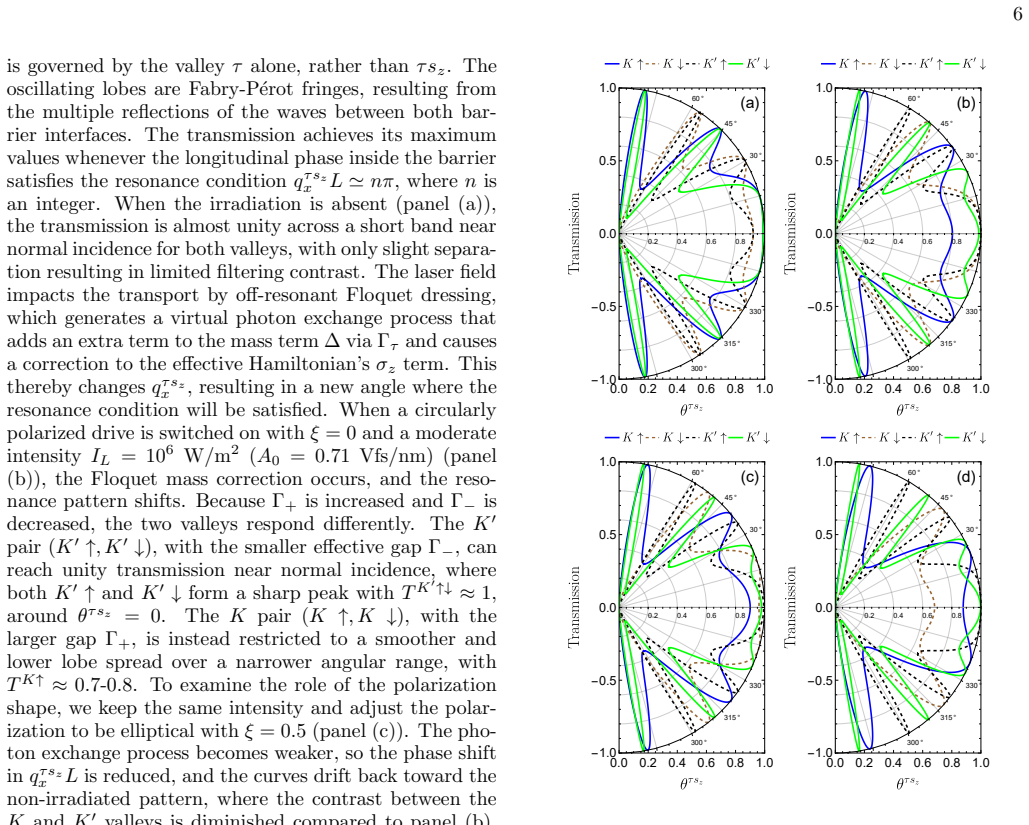
0.2 0.4 0.6 0.8 0.0 0.2 0.4 0.6 0.8 1.0-1.0 -0.5 0.0 0.5 1.0 (a) 30° 45° 60° 300° 315° 330°
-
[2]
0.2 0.4 0.6 0.8 0.0 0.2 0.4 0.6 0.8 1.0-1.0 -0.5 0.0 0.5 1.0 (b) 30° 45° 60° 300° 315° 330°
-
[3]
0.2 0.4 0.6 0.8 0.0 0.2 0.4 0.6 0.8 1.0-1.0 -0.5 0.0 0.5 1.0 (c) 30° 45° 60° 300° 315° 330°
-
[4]
0.2 0.4 0.6 0.8 0.0 0.2 0.4 0.6 0.8 1.0-1.0 -0.5 0.0 0.5 1.0 (d) FIG. 2. Spin- and valley-resolved transmission probability T τ sz(θτ sz) as a function of the incident angleθ τ sz in theK andK ′ valleys. ForE= 1.2∆,V 0 =−2∆,L= 7nm. (a) No laser. (b)ξ= 0,I L = 10 6 W/m2. (c)ξ= 0.5, IL = 10 6 W/m2. (d)ξ= 0.5,I L = 2×10 6 W/m2. The radial coordinate represen...
-
[5]
Graphene and two-dimensional materials for silicon technology,
D. Akinwandeet al., “Graphene and two-dimensional materials for silicon technology,”Nature573, 507–518 (2019). 12
work page 2019
-
[6]
Electronics and optoelectronics of two-dimensional transition metal dichalcogenides,
Q. H. Wang, K. Kalantar-Zadeh, A. Kis, J. N. Coleman, and M. S. Strano, “Electronics and optoelectronics of two-dimensional transition metal dichalcogenides,”Nat. Nanotechnol.7, 699–712 (2012)
work page 2012
-
[7]
Two-dimensional material nanophotonics,
F. Xia, H. Wang, D. Xiao, M. Dubey, and A. Ramasub- ramaniam, “Two-dimensional material nanophotonics,” Nat. Photon.8, 899–907 (2014)
work page 2014
-
[8]
Van der Waals inte- gration before and beyond two-dimensional materials,
Y. Liu, Y. Huang, and X. Duan, “Van der Waals inte- gration before and beyond two-dimensional materials,” Nature567, 323–333 (2019)
work page 2019
-
[9]
Electric field effect in atomically thin carbon films,
K. S. Novoselovet al., “Electric field effect in atomically thin carbon films,”Science306, 666–669 (2004)
work page 2004
-
[10]
The electronic properties of graphene,
A. H. Castro Neto, F. Guinea, N. M. R. Peres, K. S. Novoselov, and A. K. Geim, “The electronic properties of graphene,”Rev. Mod. Phys.81, 109–162 (2009)
work page 2009
-
[11]
Graphene: status and prospects,
A. K. Geim, “Graphene: status and prospects,”Science 324, 1530–1534 (2009)
work page 2009
-
[12]
A. K. Geim and K. S. Novoselov, “The rise of graphene,” Nat. Mater.6, 183–191 (2007)
work page 2007
-
[13]
Chi- ral tunnelling and the Klein paradox in graphene,
M. I. Katsnelson, K. S. Novoselov, and A. K. Geim, “Chi- ral tunnelling and the Klein paradox in graphene,”Nat. Phys.2, 620–625 (2006)
work page 2006
-
[14]
Intrinsic and Rashba spin- orbit interactions in graphene sheets,
H. Min, J. E. Hill, N. A. Sinitsyn, B. R. Sahu, L. Klein- man, and A. H. MacDonald, “Intrinsic and Rashba spin- orbit interactions in graphene sheets,”Phys. Rev. B74, 165310 (2006)
work page 2006
-
[15]
Mag- netic barrier structures in graphene,
M. R. Masir, P. Vasilopoulos, and F. M. Peeters, “Mag- netic barrier structures in graphene,”Phys. Rev. B88, 245413 (2013)
work page 2013
-
[16]
Transmission via Triangular Double Barrier and Magnetic Fields in Graphene
M. Mekkaoui, A. Jellal, and H. Bahlouli, “Transmis- sion via triangular double barrier and magnetic fields in graphene,” arXiv:1511.06880 (2015)
work page internal anchor Pith review Pith/arXiv arXiv 2015
-
[17]
Progress and prospects in transition-metal dichalcogenide research beyond 2D,
T. Chowdhury, E. C. Sadler, and T. J. Kempa, “Progress and prospects in transition-metal dichalcogenide research beyond 2D,”Chem. Rev.120, 12563–12591 (2020)
work page 2020
-
[18]
2D transition metal dichalcogenides: de- sign, modulation, and challenges in electrocatalysis,
Q. Fuet al., “2D transition metal dichalcogenides: de- sign, modulation, and challenges in electrocatalysis,” Adv. Mater.33, 1907818 (2021)
work page 2021
-
[19]
2D transition metal dichalcogenides for photocatalysis,
R. Yanget al., “2D transition metal dichalcogenides for photocatalysis,”Angew. Chem. Int. Ed.135, e202218016 (2023)
work page 2023
-
[20]
Layered transition metal dichalcogenide- based nanomaterials for electrochemical energy storage,
Q. Yunet al., “Layered transition metal dichalcogenide- based nanomaterials for electrochemical energy storage,” Adv. Mater.32, 1903826 (2020)
work page 2020
-
[21]
Single-layer MoS2 transistors,
B. Radisavljevicet al., “Single-layer MoS2 transistors,” Nat. Nanotechnol.6, 147–150 (2011)
work page 2011
-
[22]
Emerging photoluminescence in monolayer MoS2,
A. Splendianiet al., “Emerging photoluminescence in monolayer MoS2,”Nano Lett.10, 1271–1275 (2010)
work page 2010
-
[23]
Atomically thin MoS2: a new direct-gap semiconductor,
K. F. Maket al., “Atomically thin MoS2: a new direct-gap semiconductor,”Phys. Rev. Lett.105, 136805 (2010)
work page 2010
-
[24]
R. Lvet al., “Transition metal dichalcogenides and be- yond: synthesis, properties, and applications of single- and few-layer nanosheets,”Acc. Chem. Res.48, 56–64 (2015)
work page 2015
-
[25]
Optoelectronic devices based on atomically thin transition metal dichalco- genides,
A. Pospischil and T. Mueller, “Optoelectronic devices based on atomically thin transition metal dichalco- genides,”Appl. Sci.6, 78 (2016)
work page 2016
-
[26]
Single-layer MoS2 electronics,
D. Lembke, S. Bertolazzi, and A. Kis, “Single-layer MoS2 electronics,”Acc. Chem. Res.48, 100–110 (2015)
work page 2015
-
[27]
Cou- pled spin- and valley physics in monolayers of MoS2 and other group-VI dichalcogenides,
D. Xiao, G.-B. Liu, W. Feng, X. Xu, and W. Yao, “Cou- pled spin- and valley physics in monolayers of MoS2 and other group-VI dichalcogenides,”Phys. Rev. Lett.108, 196802 (2012)
work page 2012
-
[28]
Valleytronics in 2D materials,
J. R. Schaibley, H. Yu, G. Clark, P. Rivera, J. S. Ross, K. L. Seyler, W. Yao, and X. Xu, “Valleytronics in 2D materials,”Nat. Rev. Mater.1, 16055 (2016)
work page 2016
-
[29]
The valley Hall effect in MoS2 transistors,
K. F. Mak, K. L. McGill, J. Park, and P. L. McEuen, “The valley Hall effect in MoS2 transistors,”Science344, 1489–1492 (2014)
work page 2014
-
[30]
V. V. Cheianov and V. I. Fal’ko, “Selective transmission of Dirac electrons and ballistic magnetoresistance of n-p junctions in graphene,”Phys. Rev. B74, 041403 (2006)
work page 2006
-
[31]
Transport through a Single Barrier on Monolayer MoS2,
F. Cheng, Y. Ren, and J.-F. Sun, “Transport through a Single Barrier on Monolayer MoS2,”Chin. Phys. Lett. 32, 107301 (2015)
work page 2015
-
[32]
X.-J. Hao, R.-Y. Yuan, J.-J. Jin, and Y. Guo, “Influ- ence of the velocity barrier on the massive Dirac elec- tron transport in a monolayer MoS2 quantum structure,” Front. Phys.15, 1–9 (2020)
work page 2020
-
[33]
spin- and valley-dependent tunneling in MoS 2 through mag- netic barrier,
A. Jellal, N. Benlakhouy, P. D´ ıaz, and D. Laroze, “spin- and valley-dependent tunneling in MoS 2 through mag- netic barrier,”Comput. Mater. Sci.259, 114130 (2025)
work page 2025
-
[34]
Valley-selective optical Stark effect in mono- layer WS2,
E. J. Sie, J. W. McIver, Y.-H. Lee, L. Fu, J. Kong, and N. Gedik, “Valley-selective optical Stark effect in mono- layer WS2,”Nat. Mater.14, 290 (2015)
work page 2015
-
[35]
J. H. Shirley, Phys. Rev.138, B979 (1965)
work page 1965
-
[36]
H. Li, B. Shapiro, and T. Kottos, Phys. Rev. B 98, 121101(R) (2018)
work page 2018
- [37]
-
[38]
U. De Giovannini and H. H¨ ubener, J. Phys. Mater. 3, 012001 (2020)
work page 2020
-
[39]
V. Junk, P. Reck, C. Gorini, and K. Richter, Phys. Rev. B 101, 134302 (2020)
work page 2020
-
[40]
X. Li, F. Zhang, and Q. Niu, “Unconventional quantum Hall effect and tunable spin Hall effect in Dirac materi- als: application to an isolated MoS2 trilayer,”Phys. Rev. Lett.110, 066803 (2013)
work page 2013
-
[41]
A generic tight-binding model for monolayer, bilayer and bulk MoS2,
F. Zahid, L. Liu, Y. Zhu, J. Wang, and H. Guo, “A generic tight-binding model for monolayer, bilayer and bulk MoS2,”AIP Adv.3, 052123 (2013)
work page 2013
-
[42]
T. Mikami, S. Kitamura, K. Yasuda, N. Tsuji, T. Oka, and H. Aoki, “Brillouin-Wigner theory for high-frequency expansion in periodically driven systems: Application to Floquet topological insulators,” Phys. Rev. B93, 144307 (2016)
work page 2016
-
[43]
Periodically driven quan- tum systems: Effective Hamiltonians and engineered gauge fields,
N. Goldman and J. Dalibard, “Periodically driven quan- tum systems: Effective Hamiltonians and engineered gauge fields,” Phys. Rev. X4, 031027 (2014)
work page 2014
-
[44]
Flo- quet engineering of strongly driven excitons in monolayer tungsten disulfide,
Y. Kobayashi, C. Heide, A. C. Johnson, V. Tiwari, F. Liu, D. A. Reis, T. F. Heinz, and S. Ghimire, “Flo- quet engineering of strongly driven excitons in monolayer tungsten disulfide,”Nat. Phys.19, 171–176 (2023)
work page 2023
-
[45]
Four-terminal phase-coherent conduc- tance,
M. B¨ uttiker, “Four-terminal phase-coherent conduc- tance,”Phys. Rev. Lett.57, 1761 (1986)
work page 1986
-
[46]
Valley filtering in graphene with a Dirac gap,
F. Zhai and K. Chang, “Valley filtering in graphene with a Dirac gap,”Phys. Rev. B85, 155415 (2012). Appendix A: Determining transmission We present the detailed derivation of the transmission probability. To determine the transmission probability, we impose the continuity conditions of the eigenspinors, given in (12), (16), and (17), across the three reg...
work page 2012
discussion (0)
Sign in with ORCID, Apple, or X to comment. Anyone can read and Pith papers without signing in.