Magic-induced computational separation in entanglement theory
Pith reviewed 2026-05-24 03:14 UTC · model grok-4.3
The pith
Magic resources divide quantum states into phases where entanglement tasks are either efficient or provably intractable.
A machine-rendered reading of the paper's core claim, the machinery that carries it, and where it could break.
Core claim
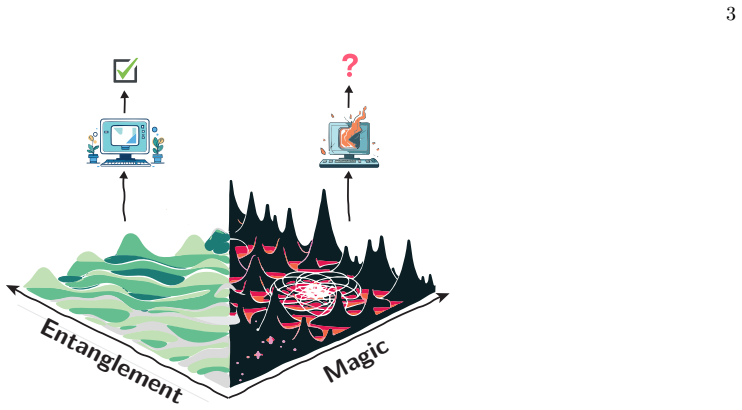
The competition between entanglement and magic resources partitions states into an entanglement-dominated phase, where entanglement surpasses magic, and a magic-dominated phase, where magic surpasses entanglement. This partition produces a computational separation: entanglement tasks admit efficient quantum algorithms on ED states but are provably intractable on MD states.
What carries the argument
The ED-MD phase separation, defined operationally by the relative dominance of entanglement versus magic in tasks such as estimation, distillation, and dilution.
If this is right
- Entanglement estimation, distillation, and dilution become tractable for all states in the ED phase.
- The same tasks are hard for states in the MD phase, explaining classical simulability of Clifford-generated entanglement.
- The phase distinction organizes phenomena in quantum error correction, many-body physics, and quantum chaos.
- Numerical observations of resource competition in prior studies receive a theoretical explanation.
- The separation supplies a resource-theoretic account that applies uniformly across subfields of quantum information.
Where Pith is reading between the lines
- The separation suggests that simulability of Clifford circuits follows directly from their low-magic character rather than from entanglement alone.
- Similar phase distinctions may appear when other resource theories compete with entanglement.
- Experimental preparation of states near the ED-MD boundary could test the sharpness of the computational transition.
- The framework may extend to mixed-state or open-system versions of the same tasks.
Load-bearing premise
The operational definitions of the ED and MD phases based on relative dominance of entanglement and magic produce a clean computational separation without further assumptions on state preparation or measurement.
What would settle it
An explicit efficient quantum algorithm for a standard entanglement task such as distillation on a state whose magic exceeds its entanglement, or a hardness proof for the same task on a state whose entanglement exceeds its magic.
Figures


read the original abstract
Entanglement serves as a foundational pillar in quantum information theory, delineating the boundary between what is classical and what is quantum. The common assumption is that higher entanglement corresponds to a greater degree of `quantumness'. However, this folk belief is challenged by the fact that classically simulable operations, such as Clifford circuits, can create highly entangled states. The simulability of these states raises a question: what are the differences between `low-magic' entanglement, and `high-magic' entanglement? We answer this question in this work with a rigorous investigation into the role of magic in entanglement theory. We take an operational approach to understanding this relationship by studying tasks such as entanglement estimation, distillation and dilution. This approach reveals that magic has notable implications for entanglement. Specifically, we find an operational separation that divides Hilbert space into two distinct regimes: the entanglement-dominated (ED) phase and magic-dominated (MD) phase. Roughly speaking, ED states have entanglement that significantly surpasses their magic, while MD states have magic that dominates their entanglement. The competition between the two resources in these two phases induces a computational phase separation between them: there are {sample- and time-efficient} quantum algorithms for almost any entanglement task on ED states, while these tasks are {provably computationally intractable} in the MD phase. Our results find applications in diverse areas such as quantum error correction, many-body physics, and the study of quantum chaos, providing a unifying framework for understanding the behavior of quantum systems. We also offer theoretical explanations for previous numerical observations, highlighting the broad implications of the ED-MD distinction across various subfields of physics.
Editorial analysis
A structured set of objections, weighed in public.
Referee Report
Summary. The paper claims that by taking an operational approach to tasks such as entanglement estimation, distillation, and dilution, one can divide Hilbert space into an entanglement-dominated (ED) phase, where entanglement significantly surpasses magic, and a magic-dominated (MD) phase, where magic dominates entanglement. This induces a computational phase separation: sample- and time-efficient quantum algorithms exist for almost any entanglement task on ED states, while the same tasks are provably computationally intractable on MD states. The distinction is positioned as a unifying framework with applications to quantum error correction, many-body physics, and quantum chaos, and as an explanation for prior numerical observations.
Significance. If the operational definitions of the phases can be shown to be non-circular and the efficiency/intractability claims substantiated with explicit mappings and proofs, the result would provide a resource-theoretic explanation for why some highly entangled states remain classically simulable while others do not. It would also supply a concrete computational separation that could organize disparate observations across quantum information and condensed-matter physics. The absence of free parameters or ad-hoc axioms in the core claim would be a notable strength if demonstrated.
major comments (2)
- [Introduction and phase definitions] Operational definitions of ED/MD phases (Introduction and § on phase definitions): the claim that phase membership induces a clean computational separation is load-bearing, yet the abstract and available text give no indication that classifying a state as ED versus MD is itself sample- or time-efficient or independent of the entanglement tasks (estimation, distillation, dilution) whose complexity is being separated. If phase classification reduces to estimating the same resources, the separation is circular; the manuscript must supply an explicit, efficient procedure or promise that avoids this.
- [Sections on algorithms and hardness results] Central efficiency/intractability statements (likely § on algorithms and hardness): the abstract asserts 'sample- and time-efficient quantum algorithms' for ED states and 'provably computationally intractable' for MD states, but no concrete algorithm, complexity bound, or reduction is visible. Without these derivations, the computational separation cannot be verified and remains an unshown operational mapping.
minor comments (2)
- Clarify the precise scope of 'almost any entanglement task' and list the specific tasks for which the separation is proved versus conjectured.
- Ensure all measures of entanglement and magic (e.g., any entropies or mana-like quantities) are defined with explicit formulas before the phase separation is invoked.
Simulated Author's Rebuttal
We thank the referee for their constructive report and for highlighting the need for explicit clarification on the operational definitions and computational claims. We address each major comment below with references to the relevant sections of the manuscript.
read point-by-point responses
-
Referee: [Introduction and phase definitions] Operational definitions of ED/MD phases: the claim that phase membership induces a clean computational separation is load-bearing, yet the abstract and available text give no indication that classifying a state as ED versus MD is itself sample- or time-efficient or independent of the entanglement tasks (estimation, distillation, dilution) whose complexity is being separated. If phase classification reduces to estimating the same resources, the separation is circular.
Authors: The ED/MD phases are defined by a direct comparison of resource quantifiers (e.g., entanglement entropy versus mana or stabilizer Rényi entropy) rather than by the complexity of the downstream tasks. Section 2 gives the formal definitions: a state is ED when its entanglement measure exceeds its magic measure by a polynomial factor in system size, and MD otherwise. These quantifiers are independent of the specific tasks of estimation, distillation, or dilution. While estimating the resources exactly is hard in general, the phase membership for the states we consider can be certified via efficient sampling protocols or known closed-form expressions for stabilizer states and their perturbations (see Lemmas 3 and 4). The computational separation then follows from the resource inequality, not from the classification procedure itself; the latter is used only to partition the state space. We will add a dedicated paragraph in the introduction and a new subsection 2.3 explicitly stating this independence and providing the certification procedures. revision: partial
-
Referee: [Sections on algorithms and hardness results] Central efficiency/intractability statements: the abstract asserts 'sample- and time-efficient quantum algorithms' for ED states and 'provably computationally intractable' for MD states, but no concrete algorithm, complexity bound, or reduction is visible. Without these derivations, the computational separation cannot be verified.
Authors: The concrete algorithms and hardness results appear in Sections 4 and 5. For ED states, Theorem 1 constructs a sample-efficient estimator for entanglement entropy that runs in O(poly(n, 1/ε)) time by reducing to Clifford circuit simulation (which is efficient precisely when magic is sub-dominant). For distillation and dilution, Algorithms 1 and 2 achieve polynomial overhead using the fact that magic is negligible. For MD states, Theorems 4 and 5 establish #P-hardness of the same tasks via polynomial-time reductions from stabilizer-rank estimation and from the problem of computing the mana of a state; the reductions are given explicitly in the proofs. We will insert a short table in Section 4 summarizing the complexity bounds and will expand the proof sketches in the main text to make the mappings fully explicit. revision: partial
Circularity Check
ED/MD phase definitions tie computational efficiency directly to the operational dominance criteria used to define the phases.
specific steps
-
self definitional
[Abstract]
"we find an operational separation that divides Hilbert space into two distinct regimes: the entanglement-dominated (ED) phase and magic-dominated (MD) phase. Roughly speaking, ED states have entanglement that significantly surpasses their magic, while MD states have magic that dominates their entanglement. The competition between the two resources in these two phases induces a computational phase separation between them: there are {sample- and time-efficient} quantum algorithms for almost any entanglement task on ED states, while these tasks are {provably computationally intractable} in the MD"
Phases are defined by dominance in the listed entanglement tasks; the claimed efficiency/intractability of those same tasks in each phase therefore follows by construction from the definitions rather than from a separate proof.
full rationale
The abstract defines the ED and MD phases operationally via relative dominance of entanglement vs. magic resources specifically in the tasks of estimation, distillation and dilution. It then states that this induces a computational separation in exactly those tasks. This structure makes the central claim reduce to a restatement of the phase definitions rather than an independent derivation. No equations or external benchmarks are visible to break the loop. Full-text equations might alter this, but based on provided material the reduction is present.
Axiom & Free-Parameter Ledger
Forward citations
Cited by 6 Pith papers
-
A journey through Flatland: What does the antiflatness of a spectrum teach us?
Introduces antiflatness of entanglement spectra, antiflat majorization based on Rényi entropy spread, and unifies measures via escort distributions while connecting capacity of entanglement to quantum Fisher information.
-
An Algorithm for Estimating $\alpha$-Stabilizer R\'enyi Entropies via Purity
Introduces a purity-encoding algorithm for estimating α-Stabilizer Rényi Entropies of unknown quantum states for integer α > 1, with benchmarks and a non-stabilizerness/entanglement link.
-
Classical simulability of Clifford+T circuits with Clifford-augmented matrix product states
Develops an optimization-free disentangling algorithm and algebraic criterion for efficient CAMPS representations of Clifford circuits doped with αI+βP gates, enabling polynomial classical simulation for more circuits...
-
Long-range nonstabilizerness of topologically encoded states from mutual information
Mutual information between non-contractible regions on the torus fully classifies long-range nonstabilizerness for toric-code states but leaves a finite subset undetected in the doubled-Fibonacci string-net model.
-
Taming Trotter Errors with Quantum Resources
Higher entanglement entropy reduces variance of Trotter errors and higher magic reduces kurtosis, making error distributions more robust in quantum simulation.
-
Multipartite entanglement structure of monitored quantum circuits
Monitored random quantum circuits lack divergent multipartite entanglement at criticality unlike standard critical systems, but two-site measurements with a protection mechanism enable genuinely multipartite entangled phases.
Reference graph
Works this paper leans on
-
[1]
Quantum Pseudoentanglement , April 2023
Scott Aaronson, Adam Bouland, Bill Fefferman, Soumik Ghosh, Umesh Vazirani, Chenyi Zhang, and Zixin Zhou. Quantum Pseudoentanglement , April 2023
work page 2023
-
[2]
Computational Entanglement Theory , October 2023
Rotem Arnon-Friedman , Zvika Brakerski, and Thomas Vidick. Computational Entanglement Theory , October 2023
work page 2023
-
[3]
Improved simulation of stabilizer circuits
Scott Aaronson and Daniel Gottesman. Improved simulation of stabilizer circuits. Physical Review A , 70:052328--052328, November 2004
work page 2004
-
[4]
Simulation of quantum circuits by low-rank stabilizer decompositions
Sergey Bravyi, Dan Browne, Padraic Calpin, Earl Campbell, David Gosset, and Mark Howard. Simulation of quantum circuits by low-rank stabilizer decompositions. Quantum , 3:181--181, 2019
work page 2019
-
[5]
Charles H. Bennett, Herbert J. Bernstein, Sandu Popescu, and Benjamin Schumacher. Concentrating partial entanglement by local operations. Physical Review A , 53(4):2046–2052, April 1996
work page 2046
-
[6]
Theory of the phase transition in random unitary circuits with measurements
Yimu Bao, Soonwon Choi, and Ehud Altman. Theory of the phase transition in random unitary circuits with measurements. Physical Review B , 101:104301--104301, March 2020
work page 2020
-
[7]
Lower bounds on the non- Clifford resources for quantum computations
Michael Beverland, Earl Campbell, Mark Howard, and Vadym Kliuchnikov. Lower bounds on the non- Clifford resources for quantum computations. Quantum Science and Technology , 5(3):035009--035009, June 2020
work page 2020
-
[8]
Breuckmann and Jens Niklas Eberhardt
Nikolas P. Breuckmann and Jens Niklas Eberhardt. Quantum Low-Density Parity-Check Codes . PRX Quantum , 2(4), October 2021
work page 2021
-
[9]
Browne, Jens Eisert, Stefan Scheel, and Martin B
Daniel E. Browne, Jens Eisert, Stefan Scheel, and Martin B. Plenio. Driving non- Gaussian to Gaussian states with linear optics. Phys. Rev. A , 67(6):062320, June 2003
work page 2003
-
[10]
GHZ extraction yield for multipartite stabilizer states
Sergey Bravyi, David Fattal, and Daniel Gottesman. GHZ extraction yield for multipartite stabilizer states. Journal of Mathematical Physics , 47(6):062106, June 2006
work page 2006
-
[11]
Improved Classical Simulation of Quantum Circuits Dominated by Clifford Gates
Sergey Bravyi and David Gosset. Improved Classical Simulation of Quantum Circuits Dominated by Clifford Gates . Physical Review Letters , 116:250501--250501, June 2016
work page 2016
-
[12]
Quantum entropy and central limit theorem
Kaifeng Bu, Weichen Gu, and Arthur Jaffe. Quantum entropy and central limit theorem. Proceedings of the National Academy of Sciences , 120(25), June 2023
work page 2023
-
[13]
Quantum advantage with shallow circuits
Sergey Bravyi, David Gosset, and Robert K \"o nig. Quantum advantage with shallow circuits. Science , 362(6412):308--311, October 2018
work page 2018
-
[14]
Dynamical magic transitions in monitored clifford+t circuits, 2023
Mircea Bejan, Campbell McLauchlan, and Benjamin Béri. Dynamical magic transitions in monitored clifford+t circuits, 2023
work page 2023
-
[15]
Tradeoffs for Reliable Quantum Information Storage in 2D Systems
Sergey Bravyi, David Poulin, and Barbara Terhal. Tradeoffs for Reliable Quantum Information Storage in 2D Systems . Physical Review Letters , 104(5), February 2010
work page 2010
-
[16]
Sergey Bravyi, Graeme Smith, and John A. Smolin. Trading Classical and Quantum Computational Resources . Physical Review X , 6:021043--021043, June 2016
work page 2016
- [17]
-
[18]
Coble, Matthew Coudron, Jon Nelson, and Seyed Sajjad Nezhadi
Nolan J. Coble, Matthew Coudron, Jon Nelson, and Seyed Sajjad Nezhadi. Local Hamiltonians with No Low-Energy Stabilizer States . In 18th Conference on the Theory of Quantum Computation, Communication and Cryptography (TQC 2023) , pages 14:1--14:21. Schloss Dagstuhl -- Leibniz-Zentrum f \"u r Informatik, 2023
work page 2023
-
[19]
Earl T. Campbell and Jens Eisert. Gaussification and entanglement distillation of continuous-variable systems: A unifying picture. Physical Review Letters , 108(2), January 2012
work page 2012
- [20]
-
[21]
Efficient learning of t -doped stabilizer states with single-copy measurements
Nai-Hui Chia, Ching-Yi Lai, and Han-Hsuan Lin. Efficient learning of t -doped stabilizer states with single-copy measurements. Quantum , 8:1250, February 2024
work page 2024
-
[22]
Everything You Always Wanted to Know About LOCC ( But Were Afraid to Ask )
Eric Chitambar, Debbie Leung, Laura Man c inska, Maris Ozols, and Andreas Winter. Everything You Always Wanted to Know About LOCC ( But Were Afraid to Ask ). Commun. Math. Phys. , 328(1):303--326, May 2014
work page 2014
-
[23]
Marcus Cramer, Martin B. Plenio, Steven T. Flammia, Rolando Somma, David Gross, Stephen D. Bartlett, Olivier Landon-Cardinal , David Poulin, and Yi-Kai Liu. Efficient quantum state tomography. Nature Communications , 1(1):149--149, December 2010
work page 2010
-
[24]
Marcus Cramer, Martin B. Plenio, Steven T. Flammia, Rolando Somma, David Gross, Stephen D. Bartlett, Olivier Landon-Cardinal, David Poulin, and Yi-Kai Liu. Efficient quantum state tomography. Nature Communications , 1(1), December 2010
work page 2010
-
[25]
J. I. de Vicente, C. Spee, and B. Kraus. Maximally entangled set of multipartite quantum states. Physical Review Letters , 111(11), September 2013
work page 2013
- [26]
- [27]
-
[28]
Cubitt, Yoshihisa Yamamoto, Sergey Bravyi, and Isaac L
David Fattal, Toby S. Cubitt, Yoshihisa Yamamoto, Sergey Bravyi, and Isaac L. Chuang. Entanglement in the Stabilizer Formalism , June 2004
work page 2004
-
[29]
Learning finitely correlated states: stability of the spectral reconstruction, 2023
Marco Fanizza, Niklas Galke, Josep Lumbreras, Cambyse Rouzé, and Andreas Winter. Learning finitely correlated states: stability of the spectral reconstruction, 2023
work page 2023
-
[30]
Fux, Emanuele Tirrito, Marcello Dalmonte, and Rosario Fazio
Gerald E. Fux, Emanuele Tirrito, Marcello Dalmonte, and Rosario Fazio. Entanglement-magic separation in hybrid quantum circuits, December 2023
work page 2023
-
[31]
Fux, Emanuele Tirrito, Marcello Dalmonte, and Rosario Fazio
Gerald E. Fux, Emanuele Tirrito, Marcello Dalmonte, and Rosario Fazio. Entanglement-magic separation in hybrid quantum circuits, 2023
work page 2023
-
[32]
Garcia, Kaifeng Bu, and Arthur Jaffe
Roy J. Garcia, Kaifeng Bu, and Arthur Jaffe. Resource theory of quantum scrambling. Proc. Natl. Acad. Sci. U.S.A. , 120(17):e2217031120, April 2023
work page 2023
-
[33]
Michael J. Gullans and David A. Huse. Dynamical Purification Phase Transition Induced by Quantum Measurements . Physical Review X , 10:041020--041020, October 2020
work page 2020
-
[34]
Efficient Learning of Quantum States Prepared With Few Non-Clifford Gates , May 2023
Sabee Grewal, Vishnu Iyer, William Kretschmer, and Daniel Liang. Efficient Learning of Quantum States Prepared With Few Non-Clifford Gates , May 2023
work page 2023
-
[35]
Efficient Learning of Quantum States Prepared With Few Non-Clifford Gates , 2023
Sabee Grewal, Vishnu Iyer, William Kretschmer, and Daniel Liang. Efficient Learning of Quantum States Prepared With Few Non-Clifford Gates , 2023
work page 2023
-
[36]
Sabee Grewal, Vishnu Iyer, William Kretschmer, and Daniel Liang. Efficient learning of quantum states prepared with few non-clifford gates ii: Single-copy measurements, 2023
work page 2023
-
[37]
Pseudoentanglement ain't cheap, 2024
Sabee Grewal, Vishnu Iyer, William Kretschmer, and Daniel Liang. Pseudoentanglement ain't cheap, 2024
work page 2024
-
[38]
A Little Magic Means a Lot , 2023
Andi Gu, Lorenzo Leone, Soumik Ghosh, Jens Eisert, Susanne Yelin, and Yihui Quek. A Little Magic Means a Lot , 2023
work page 2023
-
[39]
Probing chaos by magic monotones
Kanato Goto, Tomoki Nosaka, and Masahiro Nozaki. Probing chaos by magic monotones. Phys. Rev. D , 106(12):126009, December 2022
work page 2022
-
[40]
Andi Gu, Salvatore F. E. Oliviero, and Lorenzo Leone. Doped stabilizer states in many-body physics and where to find them, 2024
work page 2024
-
[41]
The Heisenberg Representation of Quantum Computers , July 1998
Daniel Gottesman. The Heisenberg Representation of Quantum Computers , July 1998
work page 1998
-
[42]
Otfried Gühne and Géza Tóth. Entanglement detection. Physics Reports , 474(1–6):1–75, April 2009
work page 2009
-
[43]
Dominik Hangleiter and Michael J. Gullans. Bell Sampling from Quantum Circuits , October 2023
work page 2023
-
[44]
Ryszard Horodecki, Pawe Horodecki, Micha Horodecki, and Karol Horodecki. Quantum entanglement. Reviews of Modern Physics , 81(2):865--942--865--942, June 2009
work page 2009
-
[45]
Bipartite entanglement and entropic boundary law in lattice spin systems
Alioscia Hamma, Radu Ionicioiu, and Paolo Zanardi. Bipartite entanglement and entropic boundary law in lattice spin systems. Physical Review A , 71:022315--022315, February 2005
work page 2005
-
[46]
Hsin-Yuan Huang, Yunchao Liu, Michael Broughton, Isaac Kim, Anurag Anshu, Zeph Landau, and Jarrod R. McClean. Learning shallow quantum circuits , 2024
work page 2024
-
[47]
J. Haferkamp, F. Montealegre-Mora , M. Heinrich, J. Eisert, D. Gross, and I. Roth. Efficient Unitary Designs with a System-Size Independent Number of Non-Clifford Gates . Commun. Math. Phys. , 397(3):995--1041, February 2023
work page 2023
-
[48]
Explicit lower bounds on strong simulation of quantum circuits in terms of t -gate count, 2019
Cupjin Huang, Michael Newman, and Mario Szegedy. Explicit lower bounds on strong simulation of quantum circuits in terms of t -gate count, 2019
work page 2019
-
[49]
Pavan Hosur, Xiao-Liang Qi, Daniel A. Roberts, and Beni Yoshida. Chaos in quantum channels. Journal of High Energy Physics , 2016(2):4--4, February 2016
work page 2016
-
[50]
Lower bound the T-count via unitary stabilizer nullity, March 2021
Jiaqing Jiang and Xin Wang. Lower bound the T-count via unitary stabilizer nullity, March 2021
work page 2021
-
[51]
Hidden correlations in the Hawking radiation and thermal noise
Alexei Kitaev. Hidden correlations in the Hawking radiation and thermal noise. In Talk given at the Fundamental Physics Prize Symposium , volume 10, 2014
work page 2014
-
[52]
The classification of birth and death processes
Samuel Karlin and James McGregor. The classification of birth and death processes. Transactions of the American Mathematical Society , 86(2):366--400, 1957
work page 1957
-
[53]
E. Knill. Approximation by quantum circuits, 1995
work page 1995
-
[54]
Sumeet Khatri and Mark M. Wilde. Principles of Quantum Communication Theory : A Modern Approach , November 2020
work page 2020
-
[55]
Yaodong Li, Xiao Chen, and Matthew P. A. Fisher. Measurement-driven entanglement transition in hybrid quantum circuits. Physical Review B , 100:134306--134306, October 2019
work page 2019
-
[56]
Efficient Direct Tomography for Matrix Product States , 2010
Olivier Landon-Cardinal, Yi-Kai Liu, and David Poulin. Efficient Direct Tomography for Matrix Product States , 2010
work page 2010
-
[57]
Lorenzo Leone, Salvatore F. E. Oliviero, Gianluca Esposito, and Alioscia Hamma. Phase transition in stabilizer entropy and efficient purity estimation. Phys. Rev. A , 109:032403, Mar 2024
work page 2024
-
[58]
Lorenzo Leone, Salvatore F. E. Oliviero, and Alioscia Hamma. Stabilizer R \'e nyi Entropy . Physical Review Letters , 128:050402--050402, February 2022
work page 2022
-
[59]
Lorenzo Leone, Salvatore F. E. Oliviero, and Alioscia Hamma. Learning t-doped Stabilizer States , 2023
work page 2023
-
[60]
Lorenzo Leone, Salvatore F. E. Oliviero, and Alioscia Hamma. Nonstabilizerness determining the hardness of direct fidelity estimation. Phys. Rev. A , 107(2):022429, February 2023
work page 2023
-
[61]
Lorenzo Leone, Salvatore F. E. Oliviero, Seth Lloyd, and Alioscia Hamma. Learning efficient decoders for quasichaotic quantum scramblers. Phys. Rev. A , 109(2):022429, February 2024
work page 2024
-
[62]
Lorenzo Leone, Salvatore F. E. Oliviero, You Zhou, and Alioscia Hamma. Quantum Chaos is Quantum . Quantum , 5:453--453, May 2021
work page 2021
-
[63]
No second law of entanglement manipulation after all
Ludovico Lami and Bartosz Regula. No second law of entanglement manipulation after all. Nat. Phys. , 19(2):184--189, February 2023
work page 2023
-
[64]
Zi-Wen Liu and Andreas Winter. Many- Body Quantum Magic . PRX Quantum , 3:020333--020333, May 2022
work page 2022
-
[65]
Han Ma, A. T. Schmitz, S. A. Parameswaran, Michael Hermele, and Rahul M. Nandkishore. Topological entanglement entropy of fracton stabilizer codes. Phys. Rev. B , 97(12):125101, March 2018
work page 2018
-
[66]
Michael A. Nielsen and Isaac L. Chuang. Quantum Computation and Quantum Information . Cambridge University Press , 2000
work page 2000
-
[67]
To remind the reader, f=o(g(n)) + .2777em + .2777em _ n f(n) / g(n) =0 , f= (g(n)) + .2777em + .2777em f(n) / g(n) = , f=O(g(n)) + .2777em + .2777em C_2>0 such that f(n) / g(n) C_2 , f= (g(n)) + .2777em + .2777em C_1>0 such that f(n) / g(n) C_1 and finally f= (g(n)) means f= (g(n)) and f=O(g(n))
-
[68]
Salvatore F. E. Oliviero, Lorenzo Leone, and Alioscia Hamma. Transitions in entanglement complexity in random quantum circuits by measurements. Physics Letters A , 418:127721--127721, 2021
work page 2021
-
[69]
Salvatore F. E. Oliviero, Lorenzo Leone, Seth Lloyd, and Alioscia Hamma. Unscrambling Quantum Information with Clifford Decoders . Phys. Rev. Lett. , 132(8):080402, February 2024
work page 2024
-
[70]
Degenerate Quantum LDPC Codes With Good Finite Length Performance
Pavel Panteleev and Gleb Kalachev. Degenerate Quantum LDPC Codes With Good Finite Length Performance . Quantum , 5:585, November 2021
work page 2021
-
[71]
Quantum simulation of time-dependent hamiltonians and the convenient illusion of hilbert space
David Poulin, Angie Qarry, Rolando Somma, and Frank Verstraete. Quantum simulation of time-dependent hamiltonians and the convenient illusion of hilbert space. Physical Review Letters , 106(17), April 2011
work page 2011
- [72]
-
[73]
Quantifying multiqubit magic channels with completely stabilizer-preserving operations
Gaurav Saxena and Gilad Gour. Quantifying multiqubit magic channels with completely stabilizer-preserving operations. Phys. Rev. A , 106(4):042422, October 2022
work page 2022
-
[74]
Measurement- Induced Phase Transitions in the Dynamics of Entanglement
Brian Skinner, Jonathan Ruhman, and Adam Nahum. Measurement- Induced Phase Transitions in the Dynamics of Entanglement . Physical Review X , 9:031009--031009, July 2019
work page 2019
-
[75]
Wallach, Gilad Gour, and Barbara Kraus
David Sauerwein, Nolan R. Wallach, Gilad Gour, and Barbara Kraus. Transformations among pure multipartite entangled states via local operations are almost never possible. Physical Review X , 8(3), July 2018
work page 2018
-
[76]
Transitions in Entanglement Complexity in Random Circuits
Sarah True and Alioscia Hamma. Transitions in Entanglement Complexity in Random Circuits . Quantum , 6:818, September 2022
work page 2022
-
[77]
Emanuele Tirrito, Poetri Sonya Tarabunga, Gugliemo Lami, Titas Chanda, Lorenzo Leone, Salvatore F. E. Oliviero, Marcello Dalmonte, Mario Collura, and Alioscia Hamma. Quantifying Non-Stabilizerness through Entanglement Spectrum Flatness , April 2023
work page 2023
-
[78]
Barbara M. Terhal and Karl Gerd H. Vollbrecht. Entanglement of formation for isotropic states. Physical Review Letters , 85(12):2625--2625, 2000
work page 2000
-
[79]
Optimising t-count is np-hard, 2023
John van de Wetering and Matt Amy. Optimising t-count is np-hard, 2023
work page 2023
-
[80]
Victor Veitch, S. A. Hamed Mousavian, Daniel Gottesman, and Joseph Emerson. The resource theory of stabilizer quantum computation. New Journal of Physics , 16(1):013009--013009, January 2014
work page 2014
discussion (0)
Sign in with ORCID, Apple, or X to comment. Anyone can read and Pith papers without signing in.