Electromagnetic duality degeneracy in dynamical black hole mergers
Pith reviewed 2026-05-21 06:40 UTC · model grok-4.3
The pith
Electromagnetic duality leaves spacetime dynamics unchanged in charged black hole mergers but rotates the polarization of emitted radiation by the duality angle.
A machine-rendered reading of the paper's core claim, the machinery that carries it, and where it could break.
Core claim
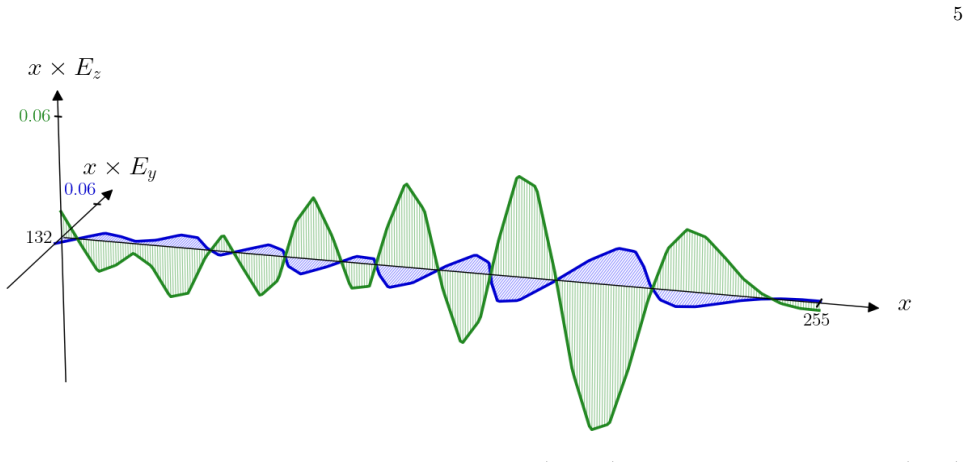
All dual configurations exhibit identical spacetime dynamics, while the emitted electromagnetic radiation is related by a rotation of its polarization equal to the duality angle.
What carries the argument
Electromagnetic duality rotation, which rotates electric and magnetic fields while preserving the stress-energy tensor and thus the spacetime geometry.
If this is right
- Spacetime geometry and gravitational waves remain identical across the entire duality family of charge configurations.
- The polarization of electromagnetic radiation emitted during merger is rotated by an angle equal to the duality rotation applied to the initial data.
- This degeneracy persists through the fully nonlinear, dynamical strong-gravity regime.
- A concrete mapping exists between dual configurations at the level of the emitted radiation.
Where Pith is reading between the lines
- Numerical studies of charged black hole mergers could be reduced to the purely electric case and then mapped to other duality angles.
- Similar dualities may organize solutions in other gravity theories coupled to vector fields.
- Future searches for electromagnetic counterparts to gravitational-wave events could treat electric and magnetic charge mixes as observationally equivalent in their gravitational signatures.
Load-bearing premise
That applying the duality rotation to initial data for electrically charged binaries produces exact dual solutions whose evolution remains duality-invariant throughout the fully nonlinear numerical evolution without code artifacts.
What would settle it
A numerical relativity run in which two duality-related configurations produce measurably different spacetime metrics or gravitational waveforms, or in which the electromagnetic radiation polarization fails to rotate by exactly the duality angle.
Figures




read the original abstract
Electromagnetic duality is a symmetry of the source-free Einstein-Maxwell equations that rotates electric and magnetic fields while leaving the stress-energy tensor invariant. We present the first fully nonlinear realization of this symmetry in dynamical strong-gravity regimes by performing numerical relativity simulations of charged black hole mergers across a continuous duality family. Starting from electrically charged binaries, we generate dyonic and magnetically charged configurations via duality rotations and evolve them within a common numerical framework. We find that all dual configurations exhibit identical spacetime dynamics, while the emitted electromagnetic radiation is related by a rotation of its polarization equal to the duality angle. Our results demonstrate a degeneracy of gravitational observables under electromagnetic duality and provide a concrete mapping between dual configurations at the level of radiation, establishing electromagnetic duality as an organizing principle for dynamical Einstein-Maxwell solutions.
Editorial analysis
A structured set of objections, weighed in public.
Referee Report
Summary. The manuscript reports the first fully nonlinear numerical relativity simulations of charged black hole mergers that realize electromagnetic duality. Starting from electrically charged binary initial data, duality rotations are applied to generate a continuous family of dyonic and magnetically charged configurations, which are then evolved in a common numerical framework. The central result is that all dual configurations produce identical spacetime dynamics, while the emitted electromagnetic radiation differs only by a polarization rotation equal to the duality angle, demonstrating degeneracy of gravitational observables under electromagnetic duality.
Significance. If the numerical results hold, the work establishes electromagnetic duality as a symmetry that organizes dynamical Einstein-Maxwell solutions in the strong-gravity regime, providing an explicit mapping between dual configurations at the level of radiation. A notable strength is the use of a single numerical infrastructure to evolve the entire duality family, together with the concrete demonstration that the stress-energy tensor invariance translates into identical metric evolution.
major comments (2)
- [§4] §4 (Numerical Methods and Evolution): The central claim that duality-rotated initial data evolve to identical spacetime metrics under the fully nonlinear Einstein-Maxwell system is load-bearing. The manuscript must demonstrate that the chosen formulation (BSSN or equivalent, with Maxwell constraints, gauge conditions, and dissipation) preserves the duality symmetry to within truncation error; explicit quantitative tests comparing metric components, curvature invariants, or apparent-horizon quantities between electric and magnetic endpoints are required to rule out accumulation of asymmetric truncation errors.
- [§5] §5 (Results): The assertion of identical spacetime dynamics is supported only by qualitative statements. Convergence tests or direct difference plots (e.g., ||g_{μν}(θ) − g_{μν}(0)|| for duality angle θ) should be added to show that any deviations scale with resolution and remain below the level needed to affect the degeneracy conclusion.
minor comments (2)
- [Abstract] Abstract: The phrase “identical spacetime dynamics” should be qualified as “identical to within numerical truncation error” to reflect the finite-precision nature of the simulations.
- [§2] §2 (Initial Data): Clarify how the duality rotation is applied to the electromagnetic constraints while preserving the Hamiltonian and momentum constraints to the required tolerance.
Simulated Author's Rebuttal
We thank the referee for the positive evaluation of our work and for the detailed comments that help clarify the presentation of our numerical results. We address each major comment below and have revised the manuscript to incorporate the requested quantitative evidence.
read point-by-point responses
-
Referee: [§4] §4 (Numerical Methods and Evolution): The central claim that duality-rotated initial data evolve to identical spacetime metrics under the fully nonlinear Einstein-Maxwell system is load-bearing. The manuscript must demonstrate that the chosen formulation (BSSN or equivalent, with Maxwell constraints, gauge conditions, and dissipation) preserves the duality symmetry to within truncation error; explicit quantitative tests comparing metric components, curvature invariants, or apparent-horizon quantities between electric and magnetic endpoints are required to rule out accumulation of asymmetric truncation errors.
Authors: We agree that explicit verification is necessary to substantiate the preservation of duality symmetry. In the revised manuscript we have added quantitative tests in §4 that directly compare the metric components, the Ricci scalar, and apparent-horizon quantities between the electric (θ=0) and magnetic (θ=π/2) endpoints. These comparisons are performed at multiple resolutions and demonstrate that any differences remain at the level of truncation error, decrease under refinement, and are consistent across the duality family. We have also confirmed that the Maxwell constraints and gauge conditions are preserved to the same accuracy for all duality angles. revision: yes
-
Referee: [§5] §5 (Results): The assertion of identical spacetime dynamics is supported only by qualitative statements. Convergence tests or direct difference plots (e.g., ||g_{μν}(θ) − g_{μν}(0)|| for duality angle θ) should be added to show that any deviations scale with resolution and remain below the level needed to affect the degeneracy conclusion.
Authors: We acknowledge that the original presentation of identical dynamics relied primarily on qualitative descriptions. The revised §5 now includes direct difference plots of the metric components and curvature invariants for a range of duality angles θ, together with convergence tests at three resolutions. The L2 norms of the differences ||g_{μν}(θ) − g_{μν}(0)|| are shown to scale with grid spacing and to remain orders of magnitude below the physical variations in the spacetime, thereby confirming that deviations do not affect the degeneracy conclusion. revision: yes
Circularity Check
No circularity: numerical verification of known duality symmetry
full rationale
The paper starts from electrically charged binary initial data, applies electromagnetic duality rotations to generate dyonic and magnetically charged configurations, and evolves all within the same numerical relativity code for the Einstein-Maxwell system. The reported outcome—that spacetime metrics remain identical while EM radiation polarization rotates by the duality angle—is a direct computational check that the known analytic invariance of the stress-energy tensor and field equations persists through fully nonlinear evolution. No parameters are fitted to a subset of results and then relabeled as predictions, no self-citation chain supplies a uniqueness theorem or ansatz, and the degeneracy is not a renaming of an existing empirical pattern but an explicit numerical demonstration. The derivation chain is therefore self-contained as an experiment confirming an external symmetry rather than reducing to its own inputs by construction.
Axiom & Free-Parameter Ledger
axioms (2)
- standard math Source-free Einstein-Maxwell equations are invariant under electromagnetic duality rotations that mix electric and magnetic fields while preserving the stress-energy tensor.
- domain assumption Numerical relativity simulations can evolve charged black hole initial data without introducing artifacts that break the duality symmetry.
Lean theorems connected to this paper
-
IndisputableMonolith/Foundation/RealityFromDistinction.leanreality_from_one_distinction unclear?
unclearRelation between the paper passage and the cited Recognition theorem.
Electromagnetic duality is a symmetry of the source-free Einstein–Maxwell equations that rotates electric and magnetic fields while leaving the stress–energy tensor invariant. ... all dual configurations exhibit identical spacetime dynamics, while the emitted electromagnetic radiation is related by a rotation of its polarization equal to the duality angle.
-
IndisputableMonolith/Cost/FunctionalEquation.leanwashburn_uniqueness_aczel unclear?
unclearRelation between the paper passage and the cited Recognition theorem.
We present the first fully nonlinear realization of this symmetry in dynamical strong-gravity regimes by performing numerical relativity simulations of charged black hole mergers across a continuous duality family.
What do these tags mean?
- matches
- The paper's claim is directly supported by a theorem in the formal canon.
- supports
- The theorem supports part of the paper's argument, but the paper may add assumptions or extra steps.
- extends
- The paper goes beyond the formal theorem; the theorem is a base layer rather than the whole result.
- uses
- The paper appears to rely on the theorem as machinery.
- contradicts
- The paper's claim conflicts with a theorem or certificate in the canon.
- unclear
- Pith found a possible connection, but the passage is too broad, indirect, or ambiguous to say the theorem truly supports the claim.
Reference graph
Works this paper leans on
-
[1]
J. D. Jackson,Classical Electrodynamics(Wiley, 1998)
work page 1998
-
[2]
L. D. Landau,TEXTBOOK ON THEORETICAL PHYSICS. VOL. 2: CLASSICAL FIELD THEORY. (IN GERMAN), edited by E. M. Lifshitz, H. G. Schopf, and P. Ziesche (1987)
work page 1987
-
[3]
S. Deser and C. Teitelboim, Duality Transformations of Abelian and Nonabelian Gauge Fields, Phys. Rev. D13, 1592 (1976)
work page 1976
-
[4]
M. K. Gaillard and B. Zumino, Duality Rotations for Interacting Fields, Nucl. Phys. B193, 221 (1981)
work page 1981
-
[5]
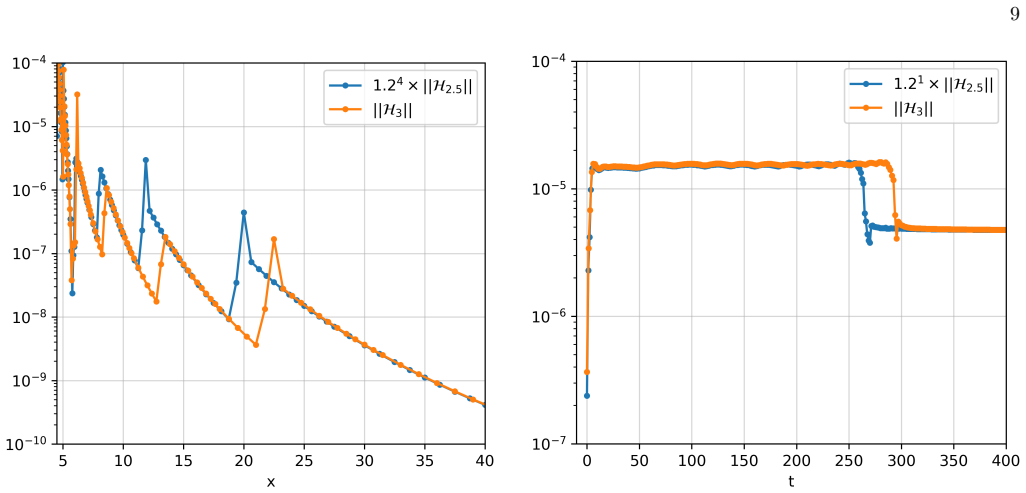
C. W. Misner, K. S. Thorne, and J. A. Wheeler,Gravi- tation(W. H. Freeman, San Francisco, 1973). 9 FIG. 5. The Hamiltonian constraintHas a function ofxat t= 0, for two different grid spacings on the coarsest mesh, h= 2.5 andh= 3. FIG. 6. The divergence of the electric fieldEas a function ofxatt= 0, for two different grid spacings on the coarsest mesh,h= 2...
work page 1973
-
[6]
H. Stephani, D. Kramer, M. A. H. MacCallum, C. Hoenselaers, and E. Herlt,Exact solutions of Ein- stein’s field equations, Cambridge Monographs on Math- ematical Physics (Cambridge Univ. Press, Cambridge, 2003)
work page 2003
-
[7]
G. W. Gibbons and D. A. Rasheed, Electric - magnetic duality rotations in nonlinear electrodynamics, Nucl. Phys. B454, 185 (1995), arXiv:hep-th/9506035
work page internal anchor Pith review Pith/arXiv arXiv 1995
-
[8]
T. Ortin,Gravity and Strings, 2nd ed., Cambridge Mono- graphs on Mathematical Physics (Cambridge University FIG. 7. Norm of the Hamiltonian constraintHas a function of time, for two different grid spacings on the coarsest mesh, h= 2.5 andh= 3. FIG. 8. Norm of the divergence of the electric fieldEas a function of time, for two different grid spacings on th...
work page 2015
- [9]
-
[10]
A. Bokuli´ c and C. A. R. Herdeiro, Exact multiblack hole spacetimes in Einstein-ModMax theory, Phys. Rev. D 111, 064046 (2025), arXiv:2501.04779 [gr-qc]
-
[11]
The Einstein-Maxwell system in 3+1 form and initial data for multiple charged black holes
M. Alcubierre, J. C. Degollado, and M. Salgado, The einstein-maxwell system in 3+1 form and initial data for multiple charged black holes, Physical Review D80, 104022 (2009), arXiv:0907.1151 [gr-qc]. 10 FIG. 9. Norm of the divergence of the magnetic fieldBas a function of time, for two different grid spacings on the coarsest mesh,h= 2.5 andh= 3
work page internal anchor Pith review Pith/arXiv arXiv 2009
-
[12]
Collisions of charged black holes
M. Zilh˜ ao, V. Cardoso, C. Herdeiro, L. Lehner, and U. Sperhake, Collisions of charged black holes, Phys. Rev. D 85, 124062 (2012)85, 124062 (2012), arXiv:1205.1063 [gr-qc]
work page internal anchor Pith review Pith/arXiv arXiv 2012
-
[13]
Collisions of oppositely charged black holes
M. Zilh˜ ao, V. Cardoso, C. Herdeiro, L. Lehner, and U. Sperhake, Collisions of oppositely charged black holes, Phys. Rev. D89, 044008 (2014), arXiv:1311.6483 [gr-qc]
work page internal anchor Pith review Pith/arXiv arXiv 2014
-
[14]
G. Bozzola and V. Paschalidis, Initial data for general rel- ativistic simulations of multiple electrically charged black holes with linear and angular momenta, Phys. Rev. D 99, 104044 (2019)99, 104044 (2019), arXiv:1903.01036 [gr- qc]
work page internal anchor Pith review Pith/arXiv arXiv 2019
-
[15]
G. Bozzola and V. Paschalidis, General relativistic sim- ulations of the quasi-circular inspiral and merger of charged black holes: Gw150914 and fundamental physics implications, Phys. Rev. Lett. 126, 041103 (2021)126, 041103 (2020), arXiv:2006.15764 [gr-qc]
-
[16]
G. Bozzola and V. Paschalidis, Numerical-relativity sim- ulations of the quasi-circular inspiral and merger of non- spinning, charged black holes: methods and comparison with approximate approaches, Phys. Rev. D 104, 044004 (2021)104, 044004 (2021), arXiv:2104.06978 [gr-qc]
-
[17]
Bozzola, Does charge matter in high-energy collisions of black holes?, Phys
G. Bozzola, Does charge matter in high-energy collisions of black holes?, Phys. Rev. Lett. 128, 071101, 2022128, 071101 (2022), arXiv:2202.05310 [gr-qc]
- [18]
-
[19]
G. Bozzola and V. Paschalidis, Can quasi-circular merg- ers of charged black holes produce extremal black holes?, Phys. Rev. D 108, 064010 (2023)108, 064010 (2023), arXiv:2309.04368 [gr-qc]
-
[20]
M. A. M. Smith, V. Paschalidis, and G. Bozzola, High- energy interactions of charged black holes in full gen- eral relativity i: Zoom-whirl orbits and universality with the irreducible mass 10.48550/ARXIV.2411.11960 (2024), arXiv:2411.11960 [gr-qc]
-
[21]
M. A. M. Smith, V. Paschalidis, and G. Boz- zola, High-energy interactions of charged black holes in full general relativity ii: Near-extremal merger remnants and universality with the irreducible mass 10.48550/ARXIV.2412.01881 (2024), arXiv:2412.01881 [gr-qc]
-
[22]
Testing the nonlinear stability of Kerr-Newman black holes
M. Zilh˜ ao, V. Cardoso, C. Herdeiro, L. Lehner, and U. Sperhake, Testing the nonlinear stability of kerr- newman black holes, Physical Review D90, 124088 (2014), arXiv:1410.0694 [gr-qc]
work page internal anchor Pith review Pith/arXiv arXiv 2014
-
[23]
Gourgoulhon, 3+1 formalism and bases of numerical relativity (2007)
E. Gourgoulhon, 3+1 formalism and bases of numerical relativity (2007)
work page 2007
-
[24]
T. W. Baumgarte,Numerical Relativity: Solving Ein- stein’s Equations on the Computer(Cambridge Univer- sity Press, 2010) p. 698
work page 2010
-
[25]
Alcubierre,Introduction to 3+1 numerical relativity (Oxford University Press, 2008) p
M. Alcubierre,Introduction to 3+1 numerical relativity (Oxford University Press, 2008) p. 444
work page 2008
-
[26]
M. Shibata and T. Nakamura, Evolution of three- dimensional gravitational waves: Harmonic slicing case, Physical Review D52, 5428 (1995)
work page 1995
-
[27]
T. W. Baumgarte and S. L. Shapiro, Numerical integra- tion of einstein’s field equations, Physical Review D59, 024007 (1998)
work page 1998
-
[28]
Beyond ideal MHD: towards a more realistic modeling of relativistic astrophysical plasmas
C. Palenzuela, L. Lehner, O. Reula, and L. Rez- zolla, Beyond ideal mhd: towards a more real- istic modeling of relativistic astrophysical plasmas, Mon.Not.Roy.Astron.Soc.394:1727-1740,2009394, 1727 (2008), arXiv:0810.1838 [astro-ph]
work page internal anchor Pith review Pith/arXiv arXiv 2008
-
[29]
S. S. Komissarov, Multi-dimensional numerical scheme for resistive relativistic mhd, Monthly Notices of the Royal Astronomical Society382, 995 (2007), arXiv:0708.0323 [astro-ph]
work page internal anchor Pith review Pith/arXiv arXiv 2007
-
[30]
Vacuum Electromagnetic Counterparts of Binary Black-Hole Mergers
P. M¨ osta, C. Palenzuela, L. Rezzolla, L. Lehner, S. Yoshida, and D. Pollney, Vacuum electromag- netic counterparts of binary black-hole merg- ers, Phys.Rev.D81:064017,201081, 064017 (2009), arXiv:0912.2330 [gr-qc]
work page internal anchor Pith review Pith/arXiv arXiv 2009
- [31]
-
[32]
A simple construction of initial data for multiple black holes
S. Brandt and B. Bruegmann, A simple con- struction of initial data for multiple black holes, Phys.Rev.Lett.78:3606-3609,199778, 3606 (1997), arXiv:gr-qc/9703066 [gr-qc]
work page internal anchor Pith review Pith/arXiv arXiv 1997
-
[33]
L. Werneck, S. Cupp, T. Assump¸ c˜ ao, S. R. Brandt, C.- H. Cheng, P. Diener, J. Doherty, Z. Etienne, R. Haas, T. P. Jacques, B. Karaka¸ s, K. Topolski, B.-J. Tsao, M. Alcubierre, D. Alic, G. Allen, M. Ansorg, M. Babiuc- Hamilton, L. Baiotti, W. Benger, E. Bentivegna, S. Bernuzzi, T. Bode, G. Bozzola, B. Brendal, B. Brueg- mann, M. Campanelli, F. Cipollet...
work page 2023
-
[34]
An Introduction to the Einstein Toolkit
M. Zilh˜ ao and F. L¨ offler, An Introduction to the Ein- stein Toolkit, Int. J. Mod. Phys. A28, 1340014 (2013), arXiv:1305.5299 [gr-qc]
work page internal anchor Pith review Pith/arXiv arXiv 2013
-
[35]
Evolutions in 3D numerical relativity using fixed mesh refinement
E. Schnetter, S. H. Hawley, and I. Hawke, Evolutions in 3- D numerical relativity using fixed mesh refinement, Class. Quantum Grav.21, 1465 (2004), arXiv:gr-qc/0310042
work page internal anchor Pith review Pith/arXiv arXiv 2004
-
[36]
J. Thornburg, A Fast Apparent-Horizon Finder for 3-Dimensional Cartesian Grids in Numerical Relativ- ity, Class. Quantum Grav.21, 743 (2004), arXiv:gr- qc/0306056
- [37]
-
[38]
Sperhake, Binary black-hole evolutions of excision and puncture data, Phys
U. Sperhake, Binary black-hole evolutions of excision and puncture data, Phys. Rev. D76, 104015 (2007), arXiv:gr- qc/0606079
-
[39]
Z. B. Etienne, Nrpypn: Validated post-newtonian expres- sions for binary black hole initial data (2023)
work page 2023
-
[40]
Bozzola, kuibit: Analyzing Einstein Toolkit simula- tions with Python, J
G. Bozzola, kuibit: Analyzing Einstein Toolkit simula- tions with Python, J. Open Source Softw.6, 3099 (2021), arXiv:2104.06376 [gr-qc]
-
[41]
H. Childs, E. Brugger, B. Whitlock, J. Meredith, S. Ah- ern, D. Pugmire, K. Biagas, M. C. Miller, C. Harri- son, G. H. Weber, H. Krishnan, T. Fogal, A. Sanderson, C. Garth, E. W. Bethel, D. Camp, O. Rubel, M. Du- rant, J. M. Favre, and P. Navratil, High Performance Visualization–Enabling Extreme-Scale Scientific Insight (2012)
work page 2012
-
[42]
https://github.com/jpmvferreira/dual-collision/
-
[43]
E. Newman and R. Penrose, An approach to gravita- tional radiation by a method of spin coefficients, Journal of Mathematical Physics3, 566 (1962)
work page 1962
discussion (0)
Sign in with ORCID, Apple, or X to comment. Anyone can read and Pith papers without signing in.