Dynamical Cluster Assembly Framework (D-CAF): The Link Between Star Cluster Formation and Expansion Rates
Pith reviewed 2026-05-21 06:26 UTC · model grok-4.3
The pith
The expansion of young stellar associations today still carries information about the dynamical state they reached while forming inside collapsing gas.
A machine-rendered reading of the paper's core claim, the machinery that carries it, and where it could break.
Core claim
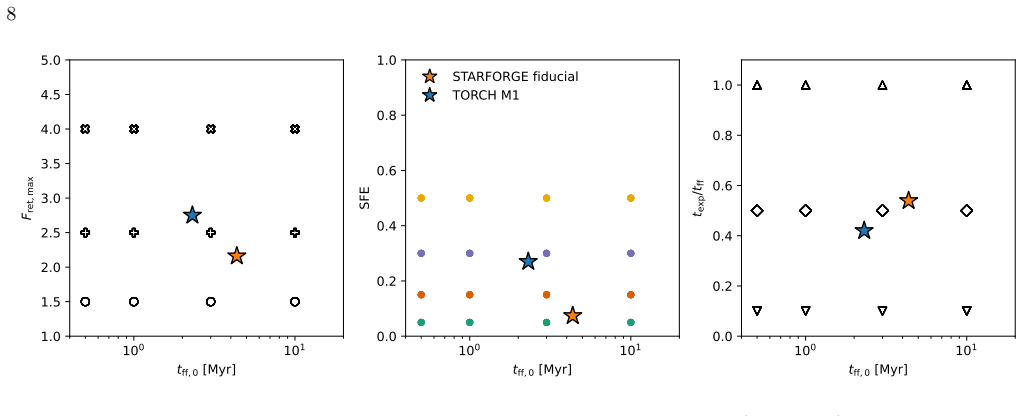
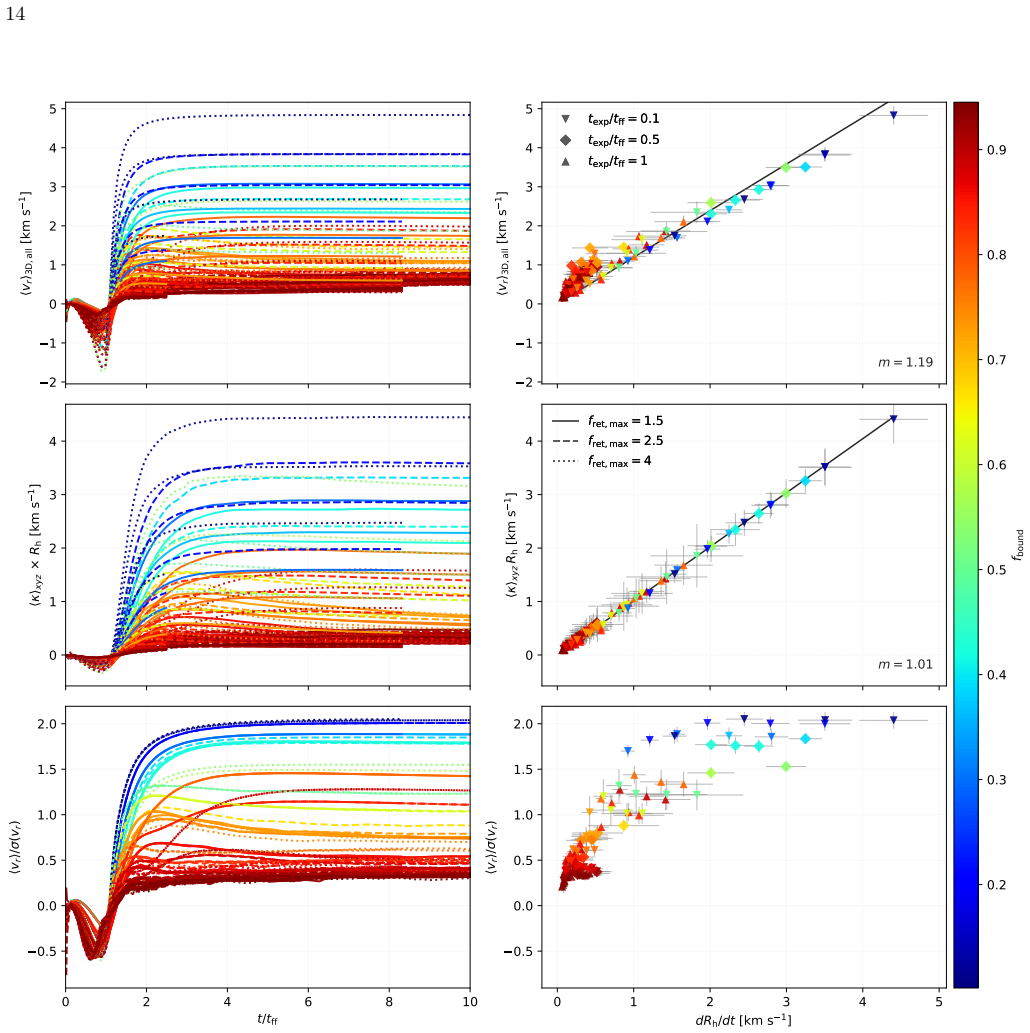
Across all explored MHD setups, the gas continues to collapse while stars are forming, increasing both the central concentration and velocity scale of the embedded stellar population before gas expulsion. Using a controlled grid of direct N-body simulations, this embedded evolution strongly regulates both the survival and later expansion of young stellar systems. In particular, gas contraction shortens the stellar crossing time prior to gas expulsion, making the same gas-removal timescale effectively more adiabatic for the stars. The present-day expansion of stellar associations still preserves information about the embedded dynamical state reached during formation: the expansion rate is set
What carries the argument
The Dynamical Cluster Assembly Framework (D-CAF), which imposes the global gas density evolution from MHD simulations as a time-varying background potential on stars that form gradually inside it, then evolves the resulting stellar population with direct N-body integration after gas removal.
If this is right
- The survival and expansion behavior of young stellar systems is controlled by the velocity field established before gas expulsion.
- Shorter crossing times caused by ongoing gas collapse make gas removal more adiabatic, reducing the fraction of internal kinetic energy that becomes expansion.
- When full kinematic data are available, certain commonly used expansion diagnostics directly measure the true physical expansion rate.
- Stellar kinematics can be inverted to place constraints on the dynamical conditions that prevailed during embedded star formation.
Where Pith is reading between the lines
- Models of how star clusters dissolve over time would need to start from the higher velocity scales produced by pre-expulsion gas contraction rather than from virial equilibrium at the moment of gas removal.
- Future surveys that combine proper motions and radial velocities for large samples of associations could map out the range of gas-expulsion timescales that actually occurred in nature.
- The framework suggests that the initial conditions for long-term cluster evolution carry a stronger memory of the embedded phase than is usually assumed in simple analytic treatments.
Load-bearing premise
The overall gas evolution taken from MHD simulations can be treated as an external, unchanging background potential for the stars without the stars' own gravity or feedback altering the gas flow on the same timescales.
What would settle it
A set of young stellar associations with measured present-day expansion velocities, independent estimates of their gas-expulsion timescales, and reconstructed embedded velocity scales that show no correlation between the predicted and observed expansion rates.
Figures






read the original abstract
We introduce the Dynamical Cluster Assembly Framework (D-CAF), an AMUSE-based framework designed to connect embedded star formation histories to the dynamical evolution of young stellar systems. We model star formation through the gradual formation of stars inside an evolving background potential, where the global gas evolution is extracted from realistic magneto-hydrodynamical (MHD) simulations. In this first work, we focus on the global evolution of the natal gas and its dynamical imprint on the stellar population. Across all explored MHD setups, we find that the gas continues to collapse while stars are forming, increasing both the central concentration and velocity scale of the embedded stellar population before gas expulsion. Using a controlled grid of direct $N$-body simulations, we show that this embedded evolution strongly regulates both the survival and later expansion of young stellar systems. In particular, gas contraction shortens the stellar crossing time prior to gas expulsion, making the same gas-removal timescale effectively more adiabatic for the stars. We find that the present-day expansion of stellar associations still preserves information about the embedded dynamical state reached during formation. The expansion rate is limited by the velocity scale reached before gas expulsion, while the efficiency with which this velocity field is transformed into expansion depends on the gas-expulsion timescale. Finally, we show that some commonly used expansion diagnostics can directly trace the physical expansion rate of young stellar systems when full kinematic information is available, opening the possibility of using stellar kinematics to constrain the dynamical conditions of embedded star formation.
Editorial analysis
A structured set of objections, weighed in public.
Referee Report
Summary. The manuscript introduces the Dynamical Cluster Assembly Framework (D-CAF) that couples global gas evolution extracted from standalone MHD simulations as a time-dependent external potential to direct N-body simulations of gradual star formation. Across the explored setups, gas continues to collapse during star formation, raising the embedded stellar central concentration and velocity scale; a controlled N-body grid then shows that this pre-expulsion state regulates post-gas-expulsion survival and expansion, with present-day expansion rates preserving information about the embedded dynamical conditions (expansion limited by pre-expulsion velocity scale, efficiency set by expulsion timescale).
Significance. If the central results hold, the work supplies a concrete dynamical link between embedded formation physics and observable kinematics of young stellar associations, opening a route to constrain formation conditions from present-day data. The controlled N-body grid and use of realistic MHD-derived potentials constitute a systematic strength that allows isolation of the embedded-phase imprint.
major comments (2)
- [Abstract and N-body grid section] Abstract and N-body grid description: the claims that embedded contraction shortens crossing times and regulates expansion rest on measured central concentration and velocity scale, yet no quantitative details are supplied on convergence tests, error bars, data exclusion, or the precise measurement procedure for these quantities. Without these, the support for the reported regulation of expansion cannot be verified.
- [Framework description] Framework description: the global gas density and potential evolution is imposed directly from standalone MHD runs as an external background. No test or estimate is provided showing that stellar feedback (winds, radiation, supernovae) does not appreciably modify the global collapse or expulsion timescale on the 0.1–1 Myr window; this decoupling is load-bearing for the claimed embedded dynamical state and the subsequent expansion results.
minor comments (1)
- [Abstract] Abstract: the phrase 'velocity scale' appears without an explicit definition or reference to the quantity plotted or tabulated; a one-sentence clarification would improve immediate readability.
Simulated Author's Rebuttal
We thank the referee for their constructive and detailed review. We address each major comment point by point below, indicating the changes we will make to the manuscript.
read point-by-point responses
-
Referee: [Abstract and N-body grid section] Abstract and N-body grid description: the claims that embedded contraction shortens crossing times and regulates expansion rest on measured central concentration and velocity scale, yet no quantitative details are supplied on convergence tests, error bars, data exclusion, or the precise measurement procedure for these quantities. Without these, the support for the reported regulation of expansion cannot be verified.
Authors: We agree that the manuscript would benefit from explicit documentation of these procedures. In the revised version we will insert a new subsection (likely in the N-body methods or results) that reports: (i) the convergence tests performed on the measured central concentration and velocity scale, (ii) the associated error bars and how they were computed, (iii) any data-exclusion criteria applied to the simulation outputs, and (iv) the precise algorithmic definition used to extract these quantities from the particle data. These additions will allow readers to reproduce and verify the claimed regulation of post-expulsion expansion. revision: yes
-
Referee: [Framework description] Framework description: the global gas density and potential evolution is imposed directly from standalone MHD runs as an external background. No test or estimate is provided showing that stellar feedback (winds, radiation, supernovae) does not appreciably modify the global collapse or expulsion timescale on the 0.1–1 Myr window; this decoupling is load-bearing for the claimed embedded dynamical state and the subsequent expansion results.
Authors: We acknowledge that the assumption of an unmodified global gas potential is central to the present framework. A fully self-consistent MHD+N-body run that includes stellar feedback lies outside the scope of this first paper. In the revision we will add a dedicated paragraph in the framework section that (a) cites existing literature on feedback timescales in comparable environments and (b) supplies order-of-magnitude estimates indicating that, for the densities and masses considered, global collapse and expulsion timescales remain largely unaffected over 0.1–1 Myr. We will also state this limitation explicitly and note that coupled feedback simulations are planned for follow-up work. revision: partial
Circularity Check
No significant circularity; derivation self-contained via external MHD inputs and N-body outcomes
full rationale
The paper extracts global gas evolution from standalone MHD simulations and imposes it as a time-dependent external potential on direct N-body stellar simulations. Reported results on embedded contraction shortening crossing times and regulating post-expulsion expansion are direct simulation outputs, not quantities defined in terms of parameters fitted to the target data or reduced by construction to inputs. No self-definitional steps, fitted predictions renamed as results, or load-bearing self-citations appear in the provided abstract and framework description. The central claim remains independent of the present paper's own fitted values and is externally falsifiable via the cited MHD runs.
Axiom & Free-Parameter Ledger
axioms (1)
- domain assumption Global gas evolution extracted from realistic MHD simulations can be used as an evolving background potential for star formation
Lean theorems connected to this paper
-
IndisputableMonolith/Cost/FunctionalEquation.leanwashburn_uniqueness_aczel unclear?
unclearRelation between the paper passage and the cited Recognition theorem.
We model star formation through the gradual formation of stars inside an evolving background potential, where the global gas evolution is extracted from realistic magneto-hydrodynamical (MHD) simulations... gas contraction shortens the stellar crossing time prior to gas expulsion
-
IndisputableMonolith/Foundation/DimensionForcing.leanalexander_duality_circle_linking unclear?
unclearRelation between the paper passage and the cited Recognition theorem.
We use the Plummer model to describe the gas structure... Rpl(t) = Rpl0 [1 - (t-t0)/τcol]^(1/2)
What do these tags mean?
- matches
- The paper's claim is directly supported by a theorem in the formal canon.
- supports
- The theorem supports part of the paper's argument, but the paper may add assumptions or extra steps.
- extends
- The paper goes beyond the formal theorem; the theorem is a base layer rather than the whole result.
- uses
- The paper appears to rely on the theorem as machinery.
- contradicts
- The paper's claim conflicts with a theorem or certificate in the canon.
- unclear
- Pith found a possible connection, but the passage is too broad, indirect, or ambiguous to say the theorem truly supports the claim.
Reference graph
Works this paper leans on
-
[1]
Expansion kinematics of young clusters. III. The kiloparsec sample
Armstrong, J. J., & Tan, J. C. 2026, Expansion Kinematics of Young Clusters. III. The Kiloparsec Sample, doi: 10.48550/arXiv.2604.08422
work page internal anchor Pith review Pith/arXiv arXiv doi:10.48550/arxiv.2604.08422 2026
-
[2]
Barnes, J., & Hut, P. 1986, Nature, 324, 446, doi: 10.1038/324446a0 24
-
[3]
Baumgardt, H., & Kroupa, P. 2007, MNRAS, 380, 1589, doi: 10.1111/j.1365-2966.2007.12209.x
-
[4]
The Monthly Notices of The Royal Astronomical Society , keywords =
Bressert, E., Bastian, N., Gutermuth, R., et al. 2010, MNRAS, 409, L54, doi: 10.1111/j.1745-3933.2010.00946.x
-
[5]
Bending, T. J. R. 2023, Monthly Notices of the Royal Astronomical Society, 527, 5448, doi: 10.1093/mnras/stad3367
-
[6]
Cournoyer-Cloutier, C., Tran, A., Lewis, S., et al. 2020,
work page 2020
-
[7]
Cournoyer-Cloutier, C., Sills, A., Harris, W. E., et al. 2024, The Astrophysical Journal, 977, 203, doi: 10.3847/1538-4357/ad90b3
-
[8]
Vesperini, E. 2023, Young, Wild and Free: The Early Expansion of Star Clusters, arXiv, doi: 10.48550/arXiv.2312.02263
-
[9]
E., Ercolano, B., & Bonnell, I
Dale, J. E., Ercolano, B., & Bonnell, I. A. 2013, MNRAS, 430, 234, doi: 10.1093/mnras/sts592
-
[10]
E., Ercolano, B., & Bonnell, I
Dale, J. E., Ercolano, B., & Bonnell, I. A. 2015, MNRAS, 451, 987, doi: 10.1093/mnras/stv913
-
[11]
2020, MNRAS, 499, 748, doi: 10.1093/mnras/staa2560
Dinnbier, F., & Walch, S. 2020, MNRAS, 499, 748, doi: 10.1093/mnras/staa2560
-
[12]
Elmegreen, B. G. 2007, ApJ, 668, 1064, doi: 10.1086/521327
-
[13]
2018, MNRAS, 476, 5341, doi: 10.1093/mnras/sty597
Dabringhausen, J. 2018, MNRAS, 476, 5341, doi: 10.1093/mnras/sty597
-
[14]
Farias, J. P., Offner, S. S. R., Grudi´ c, M. Y., Guszejnov, D., & Rosen, A. L. 2023, Mon. Not. R. Astron. Soc., 527, 6732, doi: 10.1093/mnras/stad3609
-
[15]
P., Smith, R., Fellhauer, M., et al
Farias, J. P., Smith, R., Fellhauer, M., et al. 2015, MNRAS, 450, 2451, doi: 10.1093/mnras/stv790
-
[16]
Farias, J. P., & Tan, J. C. 2023, Monthly Notices of the Royal Astronomical Society, 523, 2083, doi: 10.1093/mnras/stad1532
-
[17]
Farias, J. P., Tan, J. C., & Chatterjee, S. 2019, MNRAS, 483, 4999, doi: 10.1093/mnras/sty3470
-
[18]
Federrath, C., & Klessen, R. S. 2012, ApJ, 761, 156, doi: 10.1088/0004-637X/761/2/156
-
[19]
Fryxell, B., Olson, K., Ricker, P., et al. 2000, The Astrophysical Journal Supplement Series, 131, 273, doi: 10.1086/317361
-
[20]
Fujii, M., Iwasawa, M., Funato, Y., & Makino, J. 2007, Publ. Astron. Soc. Japan, 59, 1095, doi: 10.1093/pasj/59.6.1095
-
[21]
Fujii, M. S., & Zwart, S. P. 2011, Science, 334, 1380, doi: 10.1126/science.1211927
-
[22]
Geyer, M. P., & Burkert, A. 2001, MNRAS, 323, 988, doi: 10.1046/j.1365-8711.2001.04257.x
-
[23]
2007, , 374, 1413, 10.1111/j.1365-2966.2006.11246.x
Goodwin, S. P., & Bastian, N. 2006, MNRAS, 373, 752, doi: 10.1111/j.1365-2966.2006.11078.x Grudi´ c, M. Y., Diederik Kruijssen, J. M., Faucher-Gigu` ere, C. A., et al. 2021a, Mon. Not. R. Astron. Soc., 506, 3239, doi: 10.1093/mnras/stab1894 Grudi´ c, M. Y., Guszejnov, D., Hopkins, P. F., et al. 2018, Mon. Not. R. Astron. Soc., 481, 688, doi: 10.1093/mnras...
-
[24]
Guszejnov, D., Grudi´ c, M. Y., Hopkins, P. F., Offner, S. S. R., & Faucher-Gigu` ere, C.-A. A. 2021, Mon. Not. R. Astron. Soc., 502, 3646, doi: 10.1093/mnras/stab278
-
[25]
Guszejnov, D., Grudi´ c, M. Y., Offner, S. S. R., et al. 2022, Monthly Notices of the Royal Astronomical Society, 515, 4929, doi: 10.1093/mnras/stac2060
-
[26]
Guszejnov, D., Raju, A. N., Offner, S. S. R., et al. 2023, Mon. Not. R. Astron. Soc., 518, 4693, doi: 10.1093/mnras/stac3268
-
[27]
Hopkins, P. F. 2015, Mon. Not. R. Astron. Soc., 450, 53, doi: 10.1093/mnras/stv195
-
[28]
Hopkins, P. F., & Raives, M. J. 2016, Mon. Not. R. Astron. Soc., 455, 51, doi: 10.1093/mnras/stv2180
-
[29]
Kroupa, P. 2002, Science (80-. )., 295, 82, doi: 10.1126/SCIENCE.1067524
-
[30]
Kuhn, M. A., Hillenbrand, L. A., Sills, A., Feigelson, E. D., & Getman, K. V. 2019, The Astrophysical Journal, 870, 32, doi: 10.3847/1538-4357/aaef8c
-
[31]
Disentangling the independently controllable factors of variation by interacting with the world
Lada, C. J., & Lada, E. A. 2003, Annu. Rev. Astron. Astrophys., 41, 57, doi: 10.1146/annurev.astro.41.011802.094844
work page internal anchor Pith review Pith/arXiv arXiv doi:10.1146/annurev.astro.41.011802.094844 2003
-
[32]
J., Margulis, M., & Dearborn, D
Lada, C. J., Margulis, M., & Dearborn, D. 1984, ApJ, 285, 141, doi: 10.1086/162485
-
[33]
Lee, P. L., & Goodwin, S. P. 2016, MNRAS, 460, 2997, doi: 10.1093/mnras/stw988
-
[34]
MacLow, M.-M. 2004, Astrophys. Space Sci., 289, 323, doi: 10.1023/B:ASTR.0000014961.72318.7c
-
[35]
Moeckel, N., & Bate, M. R. 2010, MNRAS, 404, 721, doi: 10.1111/j.1365-2966.2010.16347.x
-
[36]
Parker, R. J., Goodwin, S. P., & Allison, R. J. 2011, MNRAS, 418, 2565, doi: 10.1111/j.1365-2966.2011.19646.x
-
[37]
Parker, R. J., Wright, N. J., Goodwin, S. P., & Meyer, M. R. 2014, MNRAS, 438, 620, doi: 10.1093/mnras/stt2231 25 Pavl´ ık, V. 2020, A&A, 638, 1, doi: 10.1051/0004-6361/202037490
-
[38]
I., Van Elteren, A., De Vries, N., et al
Pelupessy, F. I., Van Elteren, A., De Vries, N., et al. 2013, A&A, 557, A84, doi: 10.1051/0004-6361/201321252
-
[39]
Pokhrel, R., Gutermuth, R. A., Betti, S. K., et al. 2020, Astrophys. J., 896, 60, doi: 10.3847/1538-4357/ab92a2 Portegies Zwart, S., McMillan, S. L., Van Elteren, A.,
-
[40]
Pelupessy, F. I., & De Vries, N. 2013, Comput. Phys. Commun., 184, 456, doi: 10.1016/j.cpc.2012.09.024
-
[41]
A new Gaia census of OB associations within 1 kpc
Quintana, A. L., Wright, N. J., Kormann, L. A., et al. 2025, A New Gaia Census of OB Associations within 1 Kpc, arXiv, doi: 10.48550/arXiv.2512.05854
work page internal anchor Pith review Pith/arXiv arXiv doi:10.48550/arxiv.2512.05854 2025
-
[42]
Assmann, P. 2011, MNRAS, 416, 383, doi: 10.1111/j.1365-2966.2011.19039.x
-
[43]
Springel, V. 2005, MNRAS, 364, 1105, doi: 10.1111/j.1365-2966.2005.09655.x
-
[44]
Wainer, T. M., Dalcanton, J. J., Grudi´ c, M. Y., et al. 2025, The Timescales of Embedded Star Formation as Observed in STARFORGE, arXiv, doi: 10.48550/arXiv.2509.18322
-
[45]
Wall, J. E., Low, M.-M. M., McMillan, S. L. W., et al. 2020, Astrophys. J., 904, 192, doi: flash
work page 2020
-
[46]
Wall, J. E., McMillan, S. L. W., Mac Low, M.-M., Klessen, R. S., & Zwart, S. P. 2019,
work page 2019
-
[47]
2020, Monthly Notices of the Royal Astronomical Society, 497, 536, doi: 10.1093/mnras/staa1915
Wang, L., Iwasawa, M., Nitadori, K., & Makino, J. 2020, Monthly Notices of the Royal Astronomical Society, 497, 536, doi: 10.1093/mnras/staa1915
-
[48]
Wright, N. J. 2018, doi: 10.5281/ZENODO.1489060
-
[49]
Wright, N. J., & Parker, R. J. 2019, Mon. Not. R. Astron. Soc., 489, 2694, doi: 10.1093/mnras/stz2303
discussion (0)
Sign in with ORCID, Apple, or X to comment. Anyone can read and Pith papers without signing in.