Remarks on electrical Penrose process for magnetized Reissner-Nordstr\"om black hole
Pith reviewed 2026-05-21 06:45 UTC · model grok-4.3
The pith
An external magnetic field creates an ergosphere and controls the efficiency of energy extraction from a charged black hole.
A machine-rendered reading of the paper's core claim, the machinery that carries it, and where it could break.
Core claim
The central claim is that the magnetic field governs the configuration of the ergosphere and the efficiency of the electric Penrose process for a magnetized Reissner-Nordström black hole, with closed-form expressions for the critical magnetic field values that mark the onset and suppression of energy extraction.
What carries the argument
The critical magnetic field strengths that mark the onset and suppression of energy extraction, obtained by locating negative-energy states at the radial turning points of charged particle motion.
Load-bearing premise
The external magnetic field can be superimposed on the fixed Reissner-Nordström geometry without producing significant back-reaction that would change the spacetime metric.
What would settle it
A numerical integration of charged-particle trajectories in the magnetized metric that yields no negative-energy orbits at the analytically predicted critical field strengths would falsify the efficiency expressions and the identified ergoregion boundaries.
Figures



read the original abstract
The energy extraction from a magnetized Reissner-Nordstr\"om black hole is analyzed within the framework of the electric Penrose mechanism. The presence of an external magnetic field induces an axisymmetric configuration and an ergosphere (the region where energy extraction is possible) arises, allowing for negative energy states even in an otherwise static spacetime. By analyzing the decay of particles at turning points of the radial motion, we derive the general expression for the efficiency of the process in terms of the metric coefficients and the electromagnetic potential. This formulation provides a direct criterion for identifying the ergoregions and we show that the magnetic field acts as a control parameter that governs both the configuration of the ergosphere and the efficiency of the process. In particular, analytical expressions for the critical magnetic fields that determine the onset and suppression of energy extraction are determined. Our results extend previous analysis of the electric Penrose process for magnetized configurations and clarify the role of the external field in enhancing or inhibiting energy extraction from charged black holes.
Editorial analysis
A structured set of objections, weighed in public.
Referee Report
Summary. The manuscript analyzes the electric Penrose process for a magnetized Reissner-Nordström black hole. It derives a general expression for the efficiency of energy extraction in terms of the metric coefficients and electromagnetic potential by examining particle decay at radial turning points. The external magnetic field is identified as a control parameter governing the ergosphere, with analytical expressions obtained for the critical magnetic field values that mark the onset and suppression of energy extraction.
Significance. If the test-field approximation remains valid, the results supply an explicit analytical framework for how magnetic fields modulate energy extraction from charged black holes, extending earlier studies of the electric Penrose process. The closed-form critical-field expressions constitute a concrete, falsifiable output that can be checked against numerical or observational regimes.
major comments (1)
- The efficiency formula and the analytic expressions for the critical magnetic fields (abstract, paragraph on decay analysis and critical-field determination) are obtained under the assumption that an external magnetic field can be superimposed on the exact Reissner-Nordström geometry. At the derived critical B values that control the ergosphere and efficiency, the magnetic-field stress-energy may contribute appreciably to the curvature, shifting the metric coefficients, the locations of negative-energy states, and therefore the efficiency itself. An explicit estimate comparing the magnitude of these critical B values to the scale set by the black-hole mass and charge is required to confirm that back-reaction remains negligible throughout the claimed regime.
minor comments (1)
- The abstract states that the magnetic field 'induces an axisymmetric configuration'; a brief statement of the vector potential or gauge choice used to realize this axisymmetry would aid reproducibility.
Simulated Author's Rebuttal
We thank the referee for the careful reading of our manuscript and the constructive major comment. We respond to the point raised below.
read point-by-point responses
-
Referee: The efficiency formula and the analytic expressions for the critical magnetic fields (abstract, paragraph on decay analysis and critical-field determination) are obtained under the assumption that an external magnetic field can be superimposed on the exact Reissner-Nordström geometry. At the derived critical B values that control the ergosphere and efficiency, the magnetic-field stress-energy may contribute appreciably to the curvature, shifting the metric coefficients, the locations of negative-energy states, and therefore the efficiency itself. An explicit estimate comparing the magnitude of these critical B values to the scale set by the black-hole mass and charge is required to confirm that back-reaction remains negligible throughout the claimed regime.
Authors: We agree that an explicit estimate is required to substantiate the test-field approximation used throughout the analysis. The manuscript derives the efficiency and critical-field expressions under the standard assumption that the external magnetic field is a test field superimposed on the exact Reissner-Nordström geometry. In the revised manuscript we will add a dedicated paragraph (or short subsection) that compares the analytically obtained critical magnetic-field strengths to the characteristic curvature scale set by the black-hole mass and charge. Using the closed-form expressions already present in the paper, we will show that, for the charge-to-mass ratios and radial locations considered, the critical B values satisfy B_c M ≪ 1 (in geometric units), ensuring that the magnetic stress-energy remains a small perturbation. This addition will confirm that back-reaction does not appreciably shift the metric coefficients or the locations of negative-energy states within the regime where energy extraction is analyzed. revision: yes
Circularity Check
Derivation self-contained within background solution
full rationale
The paper derives the efficiency expression and critical magnetic field values analytically from the metric coefficients, electromagnetic potential, and radial turning-point conditions of the test-field magnetized Reissner-Nordström background. No parameters are fitted to subsets of data and then relabeled as predictions, no self-citation chain supplies a uniqueness theorem or ansatz, and the outputs do not reduce by construction to the inputs. The magnetic field enters as an external control parameter whose critical values are computed directly from the given spacetime; the chain therefore remains independent of the target results.
Axiom & Free-Parameter Ledger
free parameters (1)
- external magnetic field strength B
axioms (2)
- domain assumption The spacetime is described by the Reissner-Nordström metric with a superimposed axisymmetric magnetic field treated in the test-field approximation.
- domain assumption Particle decay occurs at radial turning points where the effective potential permits identification of negative-energy states from the metric and electromagnetic potential.
Reference graph
Works this paper leans on
-
[1]
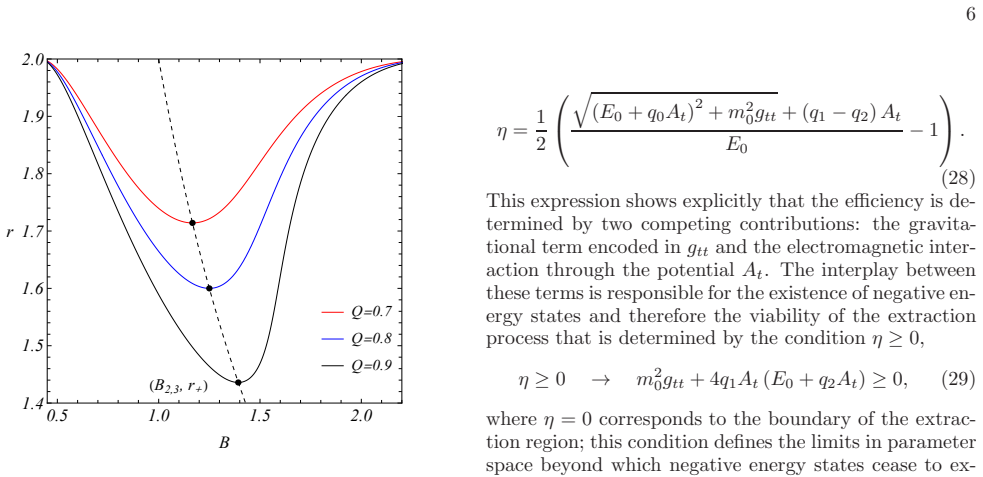
for a static and spherically symmetric BH, that is, Eq. (14) does not depend on gtφ . III. MAGNETIZED REISSNER-NORDSTR ¨OM BH For completeness in this section we review some re- sults on the Penrose process for the magnetized Reissner- Nordstr¨ om (RN) BH. This spacetime describes an ax- isymmetric magnetized RN BH, that in coordinates ( t, r, θ, φ) is gi...
-
[2]
9 such that r∗ > r +. (a) For q1 = 0 . 12 and q2 = 0 . 15, the efficiency two disconnected intervals of positive efficien cy separated by a forbidden band where the extraction is not allowed. (b) For q1 = − 0. 12 and q2 = 0 . 15, one of the region with negative efficiency disappears as a consequence of non real solutions for B according to the condition Eq. (47...
-
[3]
Boundary conditions and B as a control parameter The transition between disconnected and connected extraction regions can be characterized by the extrema of the magnetic field. Eq. (39) and its implicit derivative with respect to B (imposing dr/dB = 0), constitute the system of equations m2 0gtt + 4q1At (E0 + q2At) = 0 m2 0gtt,B + 4q1At,B (E0 + 2q2At) = 0 ...
-
[4]
Dependence of critical charges on the break-up point To further characterize the structure of the extraction region, we analyze configurations where the boundary defined by m2 0gtt + 4q1At (E0 + q2At) = 0 , becomes extrema with respect to the radial coordinate. This is achieved by imposing the conditions m2 0gtt,r + 4q1At,r (E0 + 2q2At) = 0 , (52) where the...
work page 2024
-
[5]
R. Penrose and R. M. Floyd, Extraction of Rotational Energy from a Black Hole, Nat. Phys. Sci. 229, 177 (1971)
work page 1971
-
[6]
R. P. Kerr, Gravitational Field of a Spinning Mass as an Example of Algebraically Special Metrics, Phys. Rev. Lett. 11, 237 (1963)
work page 1963
-
[7]
The Kerr spacetime: A brief introduction
M. Visser, The Kerr spacetime: A Brief introduction, in Kerr Fest: Black Holes in Astrophysics, General Relativ- ity and Quantum Gravity (2007) arXiv:0706.0622
work page internal anchor Pith review Pith/arXiv arXiv 2007
-
[8]
Christodoulou, Reversible Transformations of a Charged Black Hole, Phys
D. Christodoulou, Reversible Transformations of a Charged Black Hole, Phys. Rev. D 4, 3552 (1971)
work page 1971
-
[9]
G. Denardo and R. Ruffini, On the energetics of Reissner Nordstr¨ om geometries, Phys. Lett. B 45, 259 (1973)
work page 1973
-
[10]
Dadhich, The Penrose Process of Energy Extraction in Electrodynamics, ICTP Preprint, IC-80/98 (1980)
N. Dadhich, The Penrose Process of Energy Extraction in Electrodynamics, ICTP Preprint, IC-80/98 (1980)
work page 1980
-
[11]
D. Feiteira, J. P. S. Lemos and O. B. Zaslavskii, Penrose process in Reissner-Nordstr¨ om-AdS black hole space- times: Black hole energy factories and black hole bombs, Phys. Rev. D 109, 064065, (2024)
work page 2024
-
[12]
L. T. Sanches and M. Richartz, Energy extraction from non-coalescing black hole binaries, Phys. Rev. D 104, 124025 (2021)
work page 2021
-
[13]
A. Baez, N. Breton and I Cabrera-Munguia, Energy ex- traction in electrostatic extreme binary black holes, Phys . Rev. D 106, 124042 (2022)
work page 2022
-
[14]
R. D. Blandford and R. L. Znajek, Electromagnetic ex- traction of energy from Kerr black holes, Mon. Not. R. Astron. Soc., 179, 433-456 (1977)
work page 1977
-
[15]
L. Comisso and F. A. Asenjo, Magnetic reconnection as mechanism for energy extraction from rotating black holes, Phys. Rev. D 103, 023014 (2021)
work page 2021
-
[16]
G. W. Gibbons, A. H. Mujtaba and C. N. Pope, Er- goregions in magnetized black holes spacetimes, Class. Quantum Grav. 30, 125008 (2013)
work page 2013
-
[17]
Schnittman, The collisional Penrose process, Gen
J. Schnittman, The collisional Penrose process, Gen. R el- ativ. Gravit. 50, 77 (2018). 16
work page 2018
-
[18]
M. Ba˜ nados, J. Silk and S. M. West, Kerr Black Holes as Particle Accelerators to Arbitrarily High Energy, Phys. Rev. D 103, 111102 (2009)
work page 2009
-
[19]
Z. Stuchl ´ ık, M. Koloˇ s, and A. Tursunov, Penrose process: Its variants and astrophysical applications, Universe 7 (2021)
work page 2021
-
[20]
Z. Stuchl ´ ık, M. Koloˇ s, and A. Tursunov, Possible signa- ture of the magnetic fields related to quasi-periodic os- cillations observed in microquasars, Eur. Phys. J. C 77, 860 (2017)
work page 2017
-
[21]
M. Koloˇ s, Z. Stuchl ´ ık, and A. Tursunov, Quasihar- monic oscillatory motion of charged particles around a Schwarzschild black hole immersed in a uniform mag- netic field, Classical and Quantum Gravity 32, 165009 (2015)
work page 2015
-
[22]
M. Koloˇ s, Z. Stuchl ´ ık, and A. Tursunov, Light escape cones in local reference frames of kerr-de sitter black hole spacetimes and related black hole shadows, Eur. Phys. J. C 78, 180 (2018)
work page 2018
-
[23]
M. Koloˇ s, A. Tursunov and Z. Stuchl ´ ık, Radiative Pen- rose process: Energy gain by a single radiating charged particle in the ergosphere of rotating black hole, Phys. Rev. D 103, 024021 (2021)
work page 2021
-
[24]
M. Bhat, S. Dhurandhar, and N. Dadhich, Energetics of the Kerr-Newman black hole by the penrose process, J. Astrophys. Astron. 6, 85 (1985)
work page 1985
-
[25]
A. Tursunov, B. Juraev, Z. Stuchl ´ ık, and M. Koloˇ s, Elec- tric Penrose process: High-energy acceleration of ionized particles by nonrotating weakly charged black hole, Phys. Rev. D 104, 084099 (2021)
work page 2021
-
[26]
A. Tursunov, Z. Stuchl ´ ık, M. Koloˇ s, N. Dadhich and B. Ahmedov, Supermassive Black Holes as Possible Sources of Ultrahigh-energy Cosmic Rays, Astrophys. J. 895, 1 (2020)
work page 2020
-
[27]
A. Baez, N. Breton and I. Cabrera-Munguia , Energy ex- traction from a Reissner-Nordstr¨ om–de Sitter black hole, Phys. Rev. D 110, 064065 (2024)
work page 2024
-
[28]
S. Parthasarathy, S. M. Wagh, S. V. Dhurandhar, and N. Dadhich, High Efficiency of the Penrose Process of Energy Extraction from Rotating Black Holes Immersed in Electromagnetic Fields, Astrophys. J. 307, 38 (1986)
work page 1986
-
[29]
S. M. Wagh, S. V. Dhurandhar, and N. Dadhich, Revival of the Penrose Process for Astrophysical Applications, Astrophys. J. 290, 12 (1985)
work page 1985
-
[30]
S. M. Wagh and N. Dadhich, The energetics of black holes in electromagnetic fields by the Penrose process, Phys. Rept. 183, 137 (1989)
work page 1989
-
[31]
S. Shaymatov, B. Narzilloev, A. Abdujabbarov and C. Bambi, Charged particle motion around a magne- tized Reissner-Nordstr¨ om black hole, Phys. Rev. D 103, 124066 (2021)
work page 2021
-
[32]
S. Shaymatov, P. Sheoran, R. Becerril, U. Nucamendi, and B. Ahmedov, Efficiency of Penrose process in spacetime of axially symmetric magnetized Reissner- Nordstr¨ om black hole, Phys. Rev. D106, 024039 (2022)
work page 2022
- [33]
-
[34]
J. M. Bardeen, W. H. Press and S. A. Teukolsky, Ro- tating black holes: Locally nonrotating frames, energy extraction, and scalar synchrotron radiation, Astrophys. J. 178, 347 (1972)
work page 1972
-
[35]
R. M. Wald, Energy limits on the Penrose process, As- trophys. J. 191, 231 (1974)
work page 1974
-
[36]
A. A. Starobinsky, Amplification of waves during reflec- tion from a rotating black hole, J. Exp. Theor. Phys. 37, 28 (1973)
work page 1973
-
[37]
S. A. Teukolsky and W. H. Press, Perturbations of a ro- tating black hole. III. Interaction of the hole with gravita - tional and electromagnetic radiation, Astrophys. J. 193, 443 (1974)
work page 1974
- [38]
-
[39]
S. Bhattacharya, Kerr-de Sitter spacetime, Penrose pr o- cess, and the generalized area theorem, Phys, Rev. D 97, 084049 (2018)
work page 2018
discussion (0)
Sign in with ORCID, Apple, or X to comment. Anyone can read and Pith papers without signing in.