Heartbeat-Bound Hierarchical Credentials: Cryptographic Revocation for AI Agent Swarms
Pith reviewed 2026-05-21 04:38 UTC · model grok-4.3
The pith
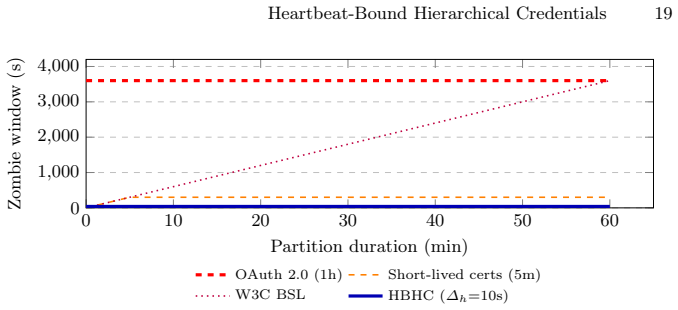
Heartbeat-Bound Hierarchical Credentials bind AI agent validity to periodic parent liveness proofs so verifiers detect shutdown with only a cached public key and local clock.
A machine-rendered reading of the paper's core claim, the machinery that carries it, and where it could break.
Core claim
Heartbeat-Bound Hierarchical Credentials bind credential validity to periodic parent liveness proofs. Verifiers enforce freshness using only a cached public key and local clock with no network round-trip required. When heartbeat generation ceases, all descendant credentials become unusable within a deterministically bounded window W_z ≤ W_max + Δ_h + ε, conditional on bounded clock skew and parent keys held in secure enclaves.
What carries the argument
Heartbeat-Bound Hierarchical Credentials (HBHC), a protocol that ties each credential's validity window to periodic heartbeat messages from its immediate parent.
If this is right
- Zombie window shrinks by a factor of 90 compared with OAuth 2.0 introspection.
- Full authentication finishes in 0.26 ms in Rust while sustaining over 18,000 verifications per second under load.
- Cascading revocation propagates through a four-level 49-agent hierarchy inside the theoretical time bound.
- Real LLM-backed agent swarms incur only 0.71 percent end-to-end overhead on tool calls.
- No tool calls succeed after revocation even when prompt injection bypasses application guardrails.
Where Pith is reading between the lines
- The same local-clock check could be applied to revocation in non-AI distributed systems that already use hierarchical key material.
- Integration points with existing PKI or status-list formats could let operators adopt the scheme incrementally.
- Empirical measurement of clock skew under realistic network jitter would tighten or refute the concrete bound W_z.
Load-bearing premise
Parent keys remain protected inside secure enclaves and clock differences across the swarm stay within a known bound.
What would settle it
A descendant credential that continues to accept operations more than W_max + Δ_h + ε after its parent stops emitting heartbeats, under the stated conditions of bounded skew and enclave storage.
Figures

read the original abstract
Autonomous AI agents that spawn sub-agent swarms create a safety gap: existing credential revocation mechanisms, OAuth~2.0 introspection, OCSP, and W3C Status Lists, require network connectivity to a central authority, leaving ``zombie agents'' executing privileged operations for minutes to hours after operator shutdown. We present Heartbeat-Bound Hierarchical Credentials (HBHC), a cryptographic protocol that binds credential validity to periodic parent liveness proofs. Verifiers enforce freshness using only a cached public key and local clock; no network round-trip is required. When heartbeat generation ceases, all descendant credentials become unusable within a deterministically bounded window $W_z \le W_{\max} + \Delta_h + \epsilon$, conditional on bounded clock skew and parent keys held in secure enclaves. Evaluation at the protocol layer and with real LLM-backed agent swarms (GPT-4o-mini) demonstrates a 90$\times$ reduction in the zombie window over OAuth~2.0, 0.26~ms full authentication in Rust, 18,000+ verifications per second under concurrent HTTP load, and stable per-verification latency from 10 to 10,000 agents. Real-agent experiments show 0.71\% end-to-end overhead on tool calls, zero post-revocation tool calls under prompt injection that bypasses application-layer guardrails, and cascading revocation across a 49-agent four-level hierarchy within the theoretical bound.
Editorial analysis
A structured set of objections, weighed in public.
Referee Report
Summary. The paper introduces Heartbeat-Bound Hierarchical Credentials (HBHC), a cryptographic protocol for revoking credentials in AI agent swarms. It binds credential validity to periodic parent liveness proofs (heartbeats) so that verifiers can enforce freshness using only a cached public key and local clock, without network access. The central claim is that when heartbeat generation ceases, all descendant credentials become unusable within a deterministically bounded window W_z ≤ W_max + Δ_h + ε, conditional on bounded clock skew and parent keys held in secure enclaves. The manuscript reports a 90× reduction in the zombie window versus OAuth 2.0, 0.26 ms full authentication latency in Rust, over 18,000 verifications per second under load, 0.71% end-to-end overhead on LLM tool calls, zero post-revocation tool calls under prompt injection, and successful cascading revocation across a 49-agent four-level hierarchy within the theoretical bound.
Significance. If the central claims hold, the work addresses a practical safety gap in autonomous multi-agent systems by enabling network-independent, deterministic revocation that existing mechanisms (OAuth introspection, OCSP, W3C status lists) cannot provide. Credit is due for the concrete evaluation with real LLM-backed agent swarms (GPT-4o-mini), the reported performance numbers (0.26 ms authentication, 18k+ verifications/sec, 0.71% overhead), and the demonstration of zero post-revocation actions plus hierarchy-wide cascading revocation. These elements make the result potentially impactful for secure AI agent deployments if the enclave and clock-skew assumptions can be substantiated.
major comments (2)
- [Abstract and Security Analysis] Abstract (final paragraph) and Security Analysis section: The bound W_z ≤ W_max + Δ_h + ε is presented as deterministic yet rests on the unverified assumptions that parent keys remain in secure enclaves and clock skew stays bounded by ε. No formal threat model, reduction, or analysis of enclave compromise vectors (side-channel attacks, supply-chain issues on LLM-hosted agents) is provided, which is load-bearing for the central revocation claim.
- [Evaluation] Evaluation section: Performance claims (90× zombie-window reduction, 0.26 ms authentication, 18,000+ verifications/sec) are stated without derivation steps, error analysis, raw data, or statistical details on how measurements were obtained under concurrent load or with the 49-agent hierarchy. This undermines verification of the reported overhead and revocation effectiveness.
minor comments (1)
- [Abstract] Notation for parameters (W_max, Δ_h, ε) is introduced in the abstract without an early dedicated definitions subsection, which could improve readability for readers unfamiliar with the protocol.
Simulated Author's Rebuttal
We thank the referee for the constructive feedback and for recognizing the potential impact of HBHC on AI agent security. We address each major comment below with clarifications and commit to targeted revisions that strengthen the presentation of assumptions and experimental details.
read point-by-point responses
-
Referee: [Abstract and Security Analysis] Abstract (final paragraph) and Security Analysis section: The bound W_z ≤ W_max + Δ_h + ε is presented as deterministic yet rests on the unverified assumptions that parent keys remain in secure enclaves and clock skew stays bounded by ε. No formal threat model, reduction, or analysis of enclave compromise vectors (side-channel attacks, supply-chain issues on LLM-hosted agents) is provided, which is load-bearing for the central revocation claim.
Authors: We agree that the bound is conditional on the stated assumptions of secure enclaves and bounded clock skew, which are explicitly noted in the abstract and Security Analysis section. The section argues these are realistic for LLM-backed agents using trusted execution environments. To strengthen the manuscript, we will revise the Security Analysis section to add a dedicated threat model subsection. This will enumerate enclave compromise vectors (side-channel attacks, supply-chain risks) with discussion of mitigations and the conditions under which the deterministic bound holds. No changes to the protocol or core claims are needed. revision: yes
-
Referee: [Evaluation] Evaluation section: Performance claims (90× zombie-window reduction, 0.26 ms authentication, 18,000+ verifications/sec) are stated without derivation steps, error analysis, raw data, or statistical details on how measurements were obtained under concurrent load or with the 49-agent hierarchy. This undermines verification of the reported overhead and revocation effectiveness.
Authors: The 90× reduction follows directly from comparing HBHC's bounded window (W_max + Δ_h + ε, typically seconds) to OAuth 2.0 revocation delays documented in the literature (minutes to hours). Latency and throughput were measured in the Rust implementation using high-resolution timers over repeated trials under concurrent load, with the 49-agent hierarchy experiments reporting observed revocation times. We will add an appendix with experimental methodology, hardware details, trial counts, error analysis, and summarized data tables to support verification. This is a presentation improvement only. revision: yes
Circularity Check
No circularity: bound follows from protocol construction under explicit assumptions
full rationale
The abstract states the zombie window bound W_z ≤ W_max + Δ_h + ε directly as a consequence of the heartbeat protocol when heartbeats cease, conditional on secure-enclave parent keys and bounded clock skew. No equations, fitted parameters, or self-citations appear that would make this bound equivalent to its inputs by construction. The claim rests on the described cryptographic mechanism and reported measurements rather than renaming a known result or smuggling an ansatz. The derivation chain is therefore self-contained as a protocol guarantee.
Axiom & Free-Parameter Ledger
free parameters (2)
- W_max
- Δ_h
axioms (2)
- domain assumption Parent keys remain protected inside secure enclaves
- domain assumption Clock skew between verifiers and parents is bounded by ε
Reference graph
Works this paper leans on
-
[1]
Concrete Problems in AI Safety
Amodei, D., Olah, C., Steinhardt, J., Christiano, P., Schulman, J., Mané, D.: Concrete problems in AI safety. arXiv preprint arXiv:1606.06565 (2016). https://doi.org/10.48550/arXiv.1606.06565
work page internal anchor Pith review Pith/arXiv arXiv doi:10.48550/arxiv.1606.06565 2016
-
[2]
Babo, Z.: ZombieAgent: A zero-click AI agent vulnerability. Radware Threat Advisory (2026),https://www.radware.com/security/threat- advisories- and- attack- reports/zombieagent/, reported to OpenAI via BugCrowd, September 2025; patched December 2025
work page 2026
-
[3]
In: Proceedings of the Network and Distributed System Security Symposium (NDSS) (2014)
Birgisson, A., Politz, J.G., Úlfar Erlingsson, Taly, A., Vrable, M., Lentczner, M.:Macaroons:Cookieswithcontextualcaveatsfordecentralizedauthoriza- tion in the cloud. In: Proceedings of the Network and Distributed System Security Symposium (NDSS) (2014)
work page 2014
-
[4]
In: Proceedings of the 7th USENIX Symposium on Operating Sys- tems Design and Implementation (OSDI)
Burrows, M.: The chubby lock service for loosely-coupled distributed sys- tems. In: Proceedings of the 7th USENIX Symposium on Operating Sys- tems Design and Implementation (OSDI). pp. 335–350. USENIX Associa- tion (2006)
work page 2006
-
[5]
In: Advances in Cryptology – CRYPTO 2002
Camenisch, J., Lysyanskaya, A.: Dynamic accumulators and application to efficient revocation of anonymous credentials. In: Advances in Cryptology – CRYPTO 2002. LNCS, vol. 2442, pp. 61–76. Springer (2002).https: //doi.org/10.1007/3-540-45708-9_5
-
[6]
Journal of the ACM43(2), 225–267 (1996).https: //doi.org/10.1145/226643.226647
Chandra, T.D., Toueg, S.: Unreliable failure detectors for reliable dis- tributed systems. Journal of the ACM43(2), 225–267 (1996).https: //doi.org/10.1145/226643.226647
-
[7]
In: 2020 IEEE European Symposium on Security and Privacy (EuroS&P), pp
Chuat, L., Abdou, A., Sasse, R., Sprenger, C., Basin, D., Perrig, A.: SoK: Delegation and revocation, the missing links in the web’s chain of trust. In: Proceedings of the IEEE European Symposium on Security and Pri- vacy (EuroS&P). pp. 624–638. IEEE (2020).https://doi.org/10.1109/ EuroSP48549.2020.00046
-
[8]
Colombatto, A., Giorgino, L., Vesco, A.: An identity key management sys- tem with deterministic key hierarchy for SSI-native Internet of Things. In: Proceedings of the 19th International Conference on Availability, Reliability and Security (ARES). ACM (2024).https://doi.org/10.1145/3664476. 3669929
-
[9]
IACR Cryptology ePrint Archive2016, 86 (2016),https://eprint.iacr.org/2016/086
Costan, V., Devadas, S.: Intel SGX explained. IACR Cryptology ePrint Archive2016, 86 (2016),https://eprint.iacr.org/2016/086
work page 2016
-
[10]
ACM Computing Surveys57(7), 182 (2025).https://doi.org/10
Deng, Z., Guo, Y., Han, C., Ma, W., Xiong, J., Wen, S., Xiang, Y.: AI agents under threat: A survey of key security challenges and future path- ways. ACM Computing Surveys57(7), 182 (2025).https://doi.org/10. 1145/3716628
work page 2025
-
[11]
Deochake, S., Channapattan, V.: Identity and access management frame- work for multi-tenant resources in hybrid cloud computing. In: Proceedings of the 17th International Conference on Availability, Reliability and Security (ARES). ACM (2022).https://doi.org/10.1145/3538969.3544896 Heartbeat-Bound Hierarchical Credentials 25
-
[12]
https://doi.org/10.48550/arXiv.2510.16067
Deochake, S., Murphy, R., Gearheart, J.: A multi-cloud framework for zero-trustworkloadauthentication.arXivpreprintarXiv:2510.16067(2025). https://doi.org/10.48550/arXiv.2510.16067
-
[13]
Internet-draft draft-dijkhuis-cfrg-hdkeys-01, IETF (2024), work in progress
Dijkhuis, S.: Hierarchical deterministic keys for the IETF. Internet-draft draft-dijkhuis-cfrg-hdkeys-01, IETF (2024), work in progress
work page 2024
-
[14]
Dolev, D., Yao, A.C.: On the security of public key protocols. IEEE Trans- actions on Information Theory29(2), 198–208 (1983).https://doi.org/ 10.1109/TIT.1983.1056650
-
[15]
European Parliament and Council of the European Union: Regulation (EU) 2024/1689 laying down harmonised rules on artificial intelligence (AI act). Official Journal of the European Union (2024), article 9: Risk Management; Article 14: Human Oversight
work page 2024
-
[16]
arXiv preprint arXiv:2404.16244 (2024).https://doi.org/10.48550/arXiv.2404.16244
Gabriel, I., Manzini, A., Keeling, G., Hendricks, L.A., Rieser, V., Iqbal, H., Tomašev, N., Ktena, I., Kenton, Z., Rodriguez, M., El-Sayed, S., Brown, S., Blunsom, P., Isaac, W.: The ethics of advanced AI assistants. arXiv preprint arXiv:2404.16244 (2024).https://doi.org/10.48550/arXiv.2404.16244
-
[17]
arXiv preprint arXiv:2511.02841 (2025)
Garzon, S.R., Vaziry, A., Kuzu, E.M., Gehrmann, D.E., Varkan, B., Ga- balla, A., Küpper, A.: AI agents with decentralized identifiers and verifiable credentials. arXiv preprint arXiv:2511.02841 (2025)
-
[18]
arXiv preprint arXiv:2509.13597 (2025).https://doi.org/10
Goswami, A.: Agentic JWT: A secure delegation protocol for autonomous AI agents. arXiv preprint arXiv:2509.13597 (2025).https://doi.org/10. 48550/arXiv.2509.13597
-
[19]
In: Proceedings of the 12th ACM Symposium on Operating Systems Principles (SOSP)
Gray, C.G., Cheriton, D.R.: Leases: An efficient fault-tolerant mechanism for distributed file cache consistency. In: Proceedings of the 12th ACM Symposium on Operating Systems Principles (SOSP). pp. 202–210. ACM (1989).https://doi.org/10.1145/74851.74870
-
[20]
In: Proceedings of the 41st International Confer- ence on Machine Learning (ICML) (2024)
Gu, X., Zheng, X., Pang, T., Du, C., Liu, Q., Wang, Y., Jiang, J., Lin, M.: Agent smith: A single image can jailbreak one million multimodal LLM agents exponentially fast. In: Proceedings of the 41st International Confer- ence on Machine Learning (ICML) (2024)
work page 2024
-
[21]
Multi-agent risks from advanced ai,
Hammond, L., Chan, A., Clifton, J., Hoelscher-Obermaier, J., Khan, A., McLean, E., Smith, C., Barfuss, W., Foerster, J., Gavenčiak, T., Han, T.A., Hughes, E., Kovařík, V., Kulveit, J., Leibo, J.Z., Oesterheld, C., de Witt, C.S., Shah, N., Wellman, M., Bova, P., Cimpeanu, T., Ezell, C., Feuillade- Montixi, Q., Franklin, M., Kran, E., Krawczuk, I., Lamparth...
-
[22]
In: Proceedings of the 2010 USENIX Annual Technical Conference (USENIX ATC)
Hunt, P., Konar, M., Junqueira, F.P., Reed, B.: ZooKeeper: Wait-free co- ordination for internet-scale systems. In: Proceedings of the 2010 USENIX Annual Technical Conference (USENIX ATC). USENIX Association (2010)
work page 2010
-
[23]
Johnson, D., Menezes, A., Vanstone, S.: The elliptic curve digital signature algorithm (ECDSA). International Journal of Information Security1(1), 36–63 (2001).https://doi.org/10.1007/s102070100002 26 S. Deochake
-
[24]
Kasselman, P., Lombardo, J., Rosomakho, Y., Campbell, B., Steele, N.: AI agent authentication and authorization. Internet-draft draft-klrc-aiagent- auth-01, IETF (2026), work in progress; authors from Defakto Security, AWS, Zscaler, Ping Identity, OpenAI
work page 2026
-
[25]
Krawczyk, H., Eronen, P.: HMAC-based extract-and-expand key derivation function (HKDF). RFC 5869, IETF (2010)
work page 2010
-
[26]
Filtered modules with coefficients
Ménétrey, J., Göttel, C., Khurshid, A., Pasin, M., Felber, P., Schiavoni, V., Raza, S.: Attestation mechanisms for trusted execution environments demystified. In: Proceedings of the 22nd International Conference on Dis- tributed Applications and Interoperable Systems (DAIS). LNCS, vol. 13272, pp. 95–113. Springer (2022).https://doi.org/10.1007/978- 3- 031...
-
[27]
In: Proceedings of the 46th IEEE Symposium on Security and Privacy (S&P)
Muid, M.R.A., Chung, T., Hoang, T.: AccuRevoke: Enhancing certificate revocation with distributed cryptographic accumulators. In: Proceedings of the 46th IEEE Symposium on Security and Privacy (S&P). IEEE (2025)
work page 2025
-
[28]
Internet-draft draft-oauth- transaction-tokens-for-agents-00, IETF (2025), work in progress
Raut, A.: Transaction tokens for agents. Internet-draft draft-oauth- transaction-tokens-for-agents-00, IETF (2025), work in progress
work page 2025
-
[29]
Richer, J.: OAuth 2.0 token introspection. RFC 7662, IETF (2015)
work page 2015
-
[30]
Rose, S., Borchert, O., Mitchell, S., Connelly, S.: Zero trust architecture. Specialpublication800-207,NationalInstituteofStandardsandTechnology (NIST) (2020).https://doi.org/10.6028/NIST.SP.800-207
-
[31]
Santesson, S., Myers, M., Ankney, R., Malpani, A., Galperin, S., Adams, C.: X.509 internet public key infrastructure online certificate status protocol – OCSP. RFC 6960, IETF (2013)
work page 2013
-
[32]
South, T., Marro, S., Hardjono, T., Mahari, R., Whitney, C., Chan, A., Pentland, A.: Position: AI agents need authenticated delegation. In: Pro- ceedings of the 42nd International Conference on Machine Learning (ICML) (2025), position Paper Track (Oral)
work page 2025
-
[33]
W3C recommendation, World Wide Web Consortium (W3C) (2025),https://www.w3.org/TR/vc-data-model-2.0/
Sporny, M., Longley, D., Chadwick, D., Herman, I.: Verifiable credentials data model v2.0. W3C recommendation, World Wide Web Consortium (W3C) (2025),https://www.w3.org/TR/vc-data-model-2.0/
work page 2025
-
[34]
Sporny, M., Longley, D., Prorock, M., Alkhraishi, M.: Bitstring status list v1.0. W3C recommendation, World Wide Web Consortium (W3C) (May 2025),https://www.w3.org/TR/2025/REC-vc-bitstring-status-list- 20250515/
work page 2025
-
[35]
Bitcoin Improvement Proposal (2012),https://github.com/bitcoin/bips/blob/master/bip- 0032.mediawiki
Wuille, P.: BIP-32: Hierarchical deterministic wallets. Bitcoin Improvement Proposal (2012),https://github.com/bitcoin/bips/blob/master/bip- 0032.mediawiki
work page 2012
discussion (0)
Sign in with ORCID, Apple, or X to comment. Anyone can read and Pith papers without signing in.