Pairwise Distance-Diffusion Analysis (PDDA): A Geometric Framework for Estimating Hurst Exponents in Multivariate Long-Memory Processes
Pith reviewed 2026-05-22 01:11 UTC · model grok-4.3
The pith
Pairwise Distance-Diffusion Analysis estimates Hurst exponents from distance plots of long-memory processes in both univariate and multivariate settings.
A machine-rendered reading of the paper's core claim, the machinery that carries it, and where it could break.
Core claim
PDDA constructs distance plots from pairwise distances in long-memory stochastic processes to estimate the Hurst exponent. The same construction yields R/S-PDDA as a geometric reformulation of the rescaled-range definition and MSD-PDDA based on mean-squared-displacement scaling. The framework extends to multivariate isotropic and anisotropic processes and derives an explicit link between temporal persistence, range dimension, and recurrence statistics, providing a unified distance-based foundation for Hurst analysis.
What carries the argument
The central object is the distance plot constructed from pairwise distances in the process trajectory, which extracts the Hurst scaling in a geometric manner for both univariate and multivariate cases.
If this is right
- R/S-PDDA reformulates the classical rescaled-range definition geometrically through distance plots.
- MSD-PDDA extracts the Hurst exponent via mean-squared-displacement scaling within the same distance construction.
- The method applies to multivariate isotropic processes.
- The method applies to multivariate anisotropic processes.
- An explicit relation connects temporal persistence, range dimension, and recurrence statistics.
Where Pith is reading between the lines
- The derived link between persistence and recurrence could allow recurrence measures to serve as indirect estimators of the Hurst exponent.
- A consistent distance representation may enable direct comparison of scaling behavior across process dimensions without separate analytic adjustments.
- The framework could support analysis of real multivariate series where both isotropic and anisotropic memory structures coexist.
Load-bearing premise
Distance plots from pairwise distances recover the Hurst scaling without geometric biases or need for extra corrections when moving from univariate to multivariate isotropic or anisotropic processes.
What would settle it
Direct comparison of PDDA-derived Hurst estimates against known ground-truth values in simulated multivariate long-memory processes, checking for systematic scaling deviations in the isotropic and anisotropic cases.
Figures


read the original abstract
We introduce Pairwise Distance-Diffusion Analysis (PDDA), a geometric framework for estimating the Hurst exponent from distance plots of long-memory stochastic processes. A single construction yields two complementary routes: R/S-PDDA, a geometric reformulation of the classical rescaled-range definition, and MSD-PDDA, based on mean-squared-displacement scaling, classically used in anomalous diffusion. We extend PDDA to multivariate isotropic and anisotropic processes and derive an explicit link between temporal persistence, range dimension, and recurrence statistics, providing a unified distance-based foundation for Hurst analysis.
Editorial analysis
A structured set of objections, weighed in public.
Referee Report
Summary. The manuscript introduces Pairwise Distance-Diffusion Analysis (PDDA), a geometric framework for estimating Hurst exponents via distance plots in long-memory processes. A single construction is claimed to support two routes—R/S-PDDA as a geometric reformulation of the classical rescaled-range statistic and MSD-PDDA based on mean-squared-displacement scaling—while extending the method to multivariate isotropic and anisotropic cases and deriving an explicit link between temporal persistence, range dimension, and recurrence statistics.
Significance. If the derivations and extensions hold without hidden isotropy assumptions, PDDA could supply a unified distance-based foundation for Hurst analysis that bridges classical R/S methods with anomalous-diffusion scaling and recurrence statistics. This would be of interest in multivariate time-series applications such as financial econometrics or physical diffusion processes, particularly if the framework yields consistent estimates across isotropic and anisotropic settings without additional corrections.
major comments (2)
- [§4] §4 (multivariate anisotropic extension): The central claim that a single pairwise-distance construction recovers the Hurst scaling without direction-dependent geometric distortion from the anisotropy matrix is load-bearing for the unified foundation. The derivation does not demonstrate invariance of the range dimension or recurrence statistics to the directional covariance structure; any residual dependence would contaminate the Hurst estimates and invalidate the extension from the isotropic case.
- [§3] §3 (explicit link between persistence, range dimension, and recurrence): The claimed explicit link is presented as following directly from the distance-plot construction, yet the step appears to embed an isotropy assumption when the same construction is applied to anisotropic processes. Without an explicit correction term or invariance proof, the link does not yet support the multivariate anisotropic claim.
minor comments (2)
- Notation for the distance metric in the multivariate case should be clarified to distinguish Euclidean norm from any weighted or Mahalanobis variant used under anisotropy.
- Figure captions for the distance plots should explicitly state the embedding dimension and the number of realizations used to generate the plotted curves.
Simulated Author's Rebuttal
We thank the referee for the constructive and detailed comments on our manuscript. We address each major comment point by point below, acknowledging where additional clarification or derivation is required to support the claims for anisotropic processes.
read point-by-point responses
-
Referee: [§4] §4 (multivariate anisotropic extension): The central claim that a single pairwise-distance construction recovers the Hurst scaling without direction-dependent geometric distortion from the anisotropy matrix is load-bearing for the unified foundation. The derivation does not demonstrate invariance of the range dimension or recurrence statistics to the directional covariance structure; any residual dependence would contaminate the Hurst estimates and invalidate the extension from the isotropic case.
Authors: We agree that demonstrating invariance to the anisotropy matrix is essential for the unified framework. The current derivation in §4 establishes the result under isotropy and sketches the anisotropic case via the same pairwise-distance construction, but does not include an explicit invariance proof for the range dimension or recurrence statistics. We will revise the manuscript to add this proof, showing that the scaling of the pairwise distances remains governed by the Hurst exponent after accounting for the directional covariance (e.g., via a quadratic form adjustment equivalent to a Mahalanobis metric). This will be presented as a new subsection in §4. revision: yes
-
Referee: [§3] §3 (explicit link between persistence, range dimension, and recurrence): The claimed explicit link is presented as following directly from the distance-plot construction, yet the step appears to embed an isotropy assumption when the same construction is applied to anisotropic processes. Without an explicit correction term or invariance proof, the link does not yet support the multivariate anisotropic claim.
Authors: The explicit link in §3 is derived from the distance-plot geometry under the isotropic assumption. When extending to anisotropic processes, the link requires the invariance result mentioned above to hold without additional correction terms. We will revise §3 to state the isotropy assumption explicitly and cross-reference the new invariance proof in §4, thereby supporting the multivariate anisotropic claim once the revision is complete. revision: yes
Circularity Check
No circularity: derivation remains self-contained with independent geometric reformulation and extension
full rationale
The abstract and provided context describe PDDA as a geometric reformulation of classical R/S and MSD methods, extended to multivariate cases with an explicit link derived between persistence, range dimension, and recurrence. No equations or self-citation chains are visible in the given material that would reduce any claimed result to a fitted input or prior self-referential definition by construction. The central construction is presented as yielding two complementary routes from a single distance-plot framework, and the multivariate extension is framed as a direct application without evidence of hidden dependence on isotropy assumptions that would force the outcome. This qualifies as a standard non-finding under the guidelines, as the derivation chain cannot be shown to collapse to its inputs without specific quoted reductions from the full manuscript equations.
Axiom & Free-Parameter Ledger
Lean theorems connected to this paper
-
IndisputableMonolith/Foundation/AlexanderDuality.leanalexander_duality_circle_linking unclear?
unclearRelation between the paper passage and the cited Recognition theorem.
Drange = min{m, 1/H} ... P(ε, τ) ∝ ε^Drange τ^{-H Drange}
-
IndisputableMonolith/Cost/FunctionalEquation.leanwashburn_uniqueness_aczel unclear?
unclearRelation between the paper passage and the cited Recognition theorem.
M2(τ) ≍ τ^{2H} ... H = 1/2 d(log M2(τ))/d(log τ)
What do these tags mean?
- matches
- The paper's claim is directly supported by a theorem in the formal canon.
- supports
- The theorem supports part of the paper's argument, but the paper may add assumptions or extra steps.
- extends
- The paper goes beyond the formal theorem; the theorem is a base layer rather than the whole result.
- uses
- The paper appears to rely on the theorem as machinery.
- contradicts
- The paper's claim conflicts with a theorem or certificate in the canon.
- unclear
- Pith found a possible connection, but the passage is too broad, indirect, or ambiguous to say the theorem truly supports the claim.
Reference graph
Works this paper leans on
-
[1]
and later established rigorously in [13, 14]. Rough processes ( H small) rapidly explore all spatial directions and yield Drange = m, whereas smoother processes ( H large) evolve on a lower-dimensional subset with Drange = 1/H . Distance and recurrence plots naturally probe this range geometr y because they are constructed from pairwise separations ∥Zi − ...
-
[2]
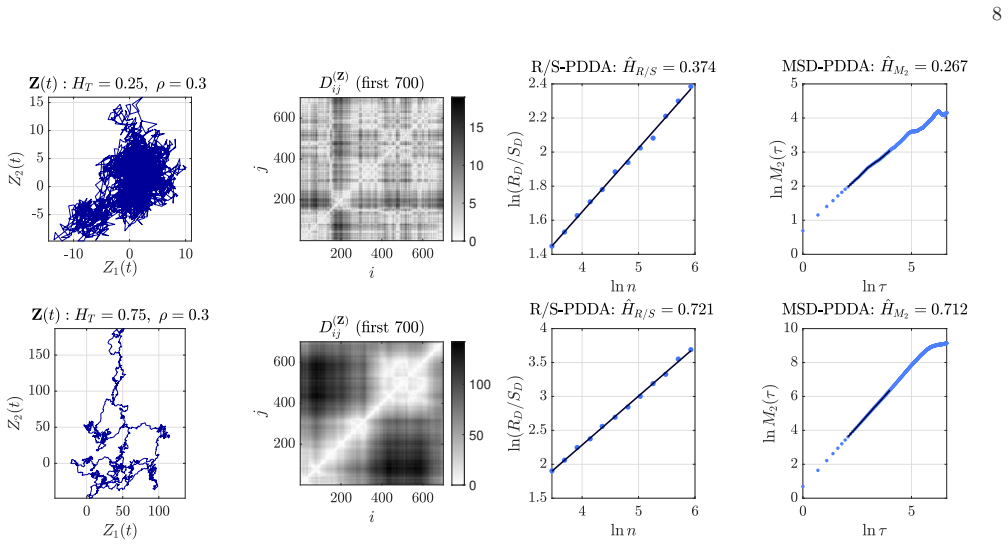
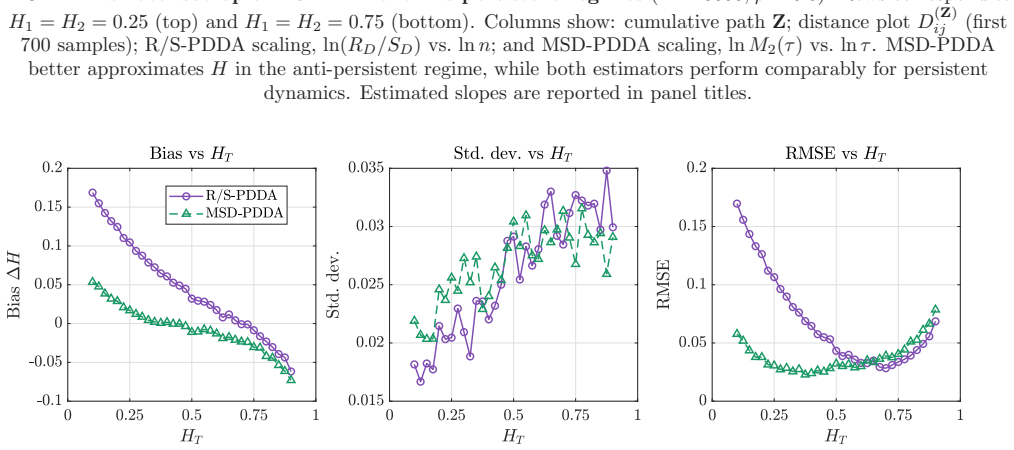
25, 0. 5, 0. 75), both R/S–PDDA and MSD–PDDA recover the theoretical scalin g ln M2(τ) ∼ 2H ln τ. While both estimators are asymptotically consistent, MSD–PDDA exhibits redu ced bias in the anti-persistent regime. Estimator performance is summarized in Tables I and II. For interme diate sample sizes, R/S–PDDA overestimates H in the anti-persistent regime ...
work page 2048
-
[3]
P. Bak, C. Tang, and K. Wiesenfeld, Physical Review Lette rs 59, 381 (1987)
work page 1987
-
[4]
M. S. A. Ferraz, A. R. Muotri, and A. H. Kihara, Physical Re view Letters 135, 108402 (2025)
work page 2025
-
[5]
E. E. Peters, Fractal Market Analysis: Applying Chaos Theory to Investme nt and Economics , Wiley Finance Editions (John Wiley & Sons, New York, 1994)
work page 1994
-
[6]
R. Metzler, J.-H. Jeon, A. G. Cherstvy, and E. Barkai, Phy sical Chemistry Chemical Physics 16, 24128 (2014)
work page 2014
-
[7]
M. S. Gomes-Filho, L. C. Lapas, E. Gudowska-Nowak, and F. A. Oliveira, Physics Reports 1141, 1 (2025)
work page 2025
-
[8]
B. B. Mandelbrot and J. W. Van Ness, SIAM Review 10, 422 (1968), stable URL: https://www.jstor.org/stable/2 027184
work page 1968
-
[9]
Beran, Statistics for Long-Memory Processes , Monographs on Statistics and Applied Probability, Vol
J. Beran, Statistics for Long-Memory Processes , Monographs on Statistics and Applied Probability, Vol. 61 (Chapman and Hall, New York, 1994)
work page 1994
-
[10]
G. Samorodnitsky and M. S. Taqqu, Stable Non-Gaussian Random Processes: Stochastic Models w ith Infinite Variance (Chapman and Hall, New York, 1994)
work page 1994
-
[11]
J. Gao, Y. Cao, W.-w. Tung, and J. Hu, Multiscale Analysis of Complex Time Series: Integration of Chaos and Random Fractal Theory, (John Wiley & Sons, Hoboken, NJ, 2007)
work page 2007
- [12]
-
[13]
G. K. Rohde, J. M. Nichols, B. M. Dissinger, and F. Buchol tz, Physica D: Nonlinear Phenomena 237, 619 (2008)
work page 2008
-
[14]
B. B. Mandelbrot, The Fractal Geometry of Nature (W. H. Freeman and Company, San Francisco, CA, 1982). 11
work page 1982
-
[15]
Xiao, in Fractal Geometry and Applications: A Jubilee of Benoit Mand elbrot, edited by M
Y. Xiao, in Fractal Geometry and Applications: A Jubilee of Benoit Mand elbrot, edited by M. L. Lapidus and M. van Frankenhuijsen (American Mathematical Society, 2004) pp. 261–338
work page 2004
- [16]
- [17]
-
[18]
K. Falconer, Fractal Geometry: Mathematical Foundations and Applicati ons (John Wiley & Sons, Chichester, 2003)
work page 2003
-
[19]
J. R. M. Hosking, Biometrika 68, 165 (1981)
work page 1981
-
[20]
K. Liu, Y. Chen, and X. Zhang, Axioms 6, 16 (2017)
work page 2017
-
[21]
P. Grassberger and I. Procaccia, Physical Review Lette rs 50, 346 (1983)
work page 1983
discussion (0)
Sign in with ORCID, Apple, or X to comment. Anyone can read and Pith papers without signing in.