B_c to η_c form factors at large recoil: SCET analysis and a three-loop consistency check
Pith reviewed 2026-05-21 03:46 UTC · model grok-4.3
The pith
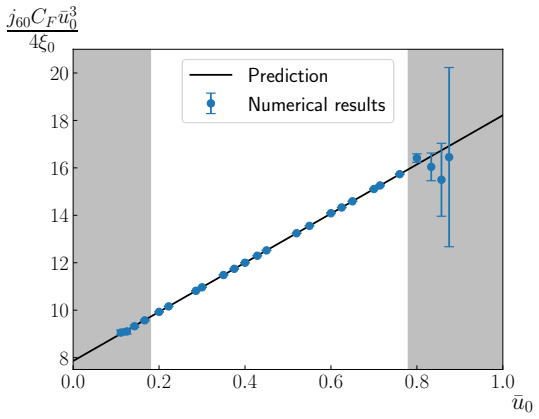
SCET analysis confirms integral-equation predictions for B_c to eta_c form factors up to three loops.
A machine-rendered reading of the paper's core claim, the machinery that carries it, and where it could break.
Core claim
By evaluating the necessary SCET matching coefficients and anomalous dimensions, the factorization theorem for the soft-overlap contribution reproduces the three-loop predictions obtained from the integral equations, even though endpoint divergences are known to invalidate the theorem once renormalized quantities are considered.
What carries the argument
SCET factorization theorem for the soft-overlap contribution applied to bare regularized quantities at fixed perturbative order.
If this is right
- The integral equations correctly capture the double-logarithmic series up to three loops.
- Soft-quark and soft-gluon exchanges can be treated consistently in both the diagrammatic and effective-theory approaches at this order.
- The renormalization-group evolution of B_c-meson light-cone distribution amplitudes with cutoff regularization encodes the same iterative structure.
- Fixed-order perturbative results remain reliable even when the full non-perturbative factorization theorem suffers from endpoint singularities.
Where Pith is reading between the lines
- The two calculational routes may be used interchangeably for higher-order computations in related heavy-meson transitions.
- Cutoff regularization of inverse moments could simplify resummations in other B-meson decays where similar soft overlaps appear.
- Persistent agreement at higher loops would suggest an all-order equivalence between the integral equations and SCET for bare quantities.
Load-bearing premise
The factorization theorem for the soft-overlap contribution remains usable for bare regularized quantities at any fixed perturbative order despite endpoint divergences that spoil it for renormalized quantities.
What would settle it
An explicit three-loop SCET calculation whose numerical result for the form factor differs from the value obtained by solving the integral equations would disprove the claimed consistency.
Figures




read the original abstract
The double-logarithmic series of non-relativistic $B_c \to \eta_c$ form factors at large recoil is governed by a coupled set of integral equations, reflecting an intricate interplay between arbitrarily many soft-quark and soft-gluon exchanges. Whereas we previously derived these integral equations with diagrammatic resummation techniques, we analyze the form factors in the limit $m_b \gg m_c \gg \Lambda_{\rm QCD}$ with methods from Soft-Collinear Effective Theory (SCET) in this work. Although the resulting factorization theorem for the so-called soft-overlap contribution is known to be spoilt by endpoint divergences, it can still be used at the level of bare (regularized) quantities at any fixed order in perturbation theory. By calculating the required ingredients, we show that the SCET analysis confirms the predictions of the integral equations up to three-loop order. We also argue that the iterative structure and the intertwined soft-quark and soft-gluon effects can be derived from standard renormalization-group equations of the $B_c$-meson light-cone distribution amplitudes, provided their inverse moments are regularized with an appropriate cutoff.
Editorial analysis
A structured set of objections, weighed in public.
Referee Report
Summary. The paper analyzes B_c → η_c form factors at large recoil in the limit m_b ≫ m_c ≫ Λ_QCD using Soft-Collinear Effective Theory (SCET). It argues that the soft-overlap factorization theorem, though spoiled by endpoint divergences, remains applicable to bare regularized quantities at fixed perturbative order. By computing the necessary SCET ingredients, the analysis confirms the predictions of previously derived integral equations up to three-loop order. The manuscript further claims that the iterative structure and intertwined soft-quark/soft-gluon effects follow from standard renormalization-group evolution of the B_c-meson light-cone distribution amplitudes once inverse moments are regularized with an appropriate cutoff.
Significance. If the three-loop confirmation holds under consistent regularization, the work supplies an independent SCET-based cross-check of the diagrammatic integral-equation results. This strengthens the reliability of the perturbative series for these form factors and illustrates how standard RG methods can reproduce the coupled integral structure without explicit diagrammatic resummation.
major comments (1)
- [SCET analysis and three-loop consistency check (around the presentation of the bare matching)] The central confirmation at O(α_s³) rests on the assertion that bare SCET quantities match the integral-equation results under identical cutoff regularization. The manuscript states this equivalence but does not describe an explicit cross-check that the two regularization prescriptions produce identical finite terms once divergences are subtracted. Because endpoint divergences are known to affect the soft-overlap contribution, any mismatch in cutoff implementation could alter the three-loop finite parts even while regulating the poles.
minor comments (1)
- [RG evolution discussion] Clarify the precise definition of the cutoff used for inverse moments of the B_c LCDA and state whether it is identical to the regulator implicit in the earlier integral-equation paper.
Simulated Author's Rebuttal
We thank the referee for the careful reading of our manuscript and for highlighting the need for a more explicit description of the regularization cross-check. We agree that clarifying this point strengthens the presentation of the three-loop confirmation. We have revised the manuscript accordingly and address the comment in detail below.
read point-by-point responses
-
Referee: The central confirmation at O(α_s³) rests on the assertion that bare SCET quantities match the integral-equation results under identical cutoff regularization. The manuscript states this equivalence but does not describe an explicit cross-check that the two regularization prescriptions produce identical finite terms once divergences are subtracted. Because endpoint divergences are known to affect the soft-overlap contribution, any mismatch in cutoff implementation could alter the three-loop finite parts even while regulating the poles.
Authors: We thank the referee for this observation. In the revised version, we have added a new paragraph in Section 3.2 that explicitly documents the cross-check. Both the SCET matching calculation and the prior integral-equation work employ the same cutoff regularization on the inverse moments of the B_c-meson LCDA, implemented as a hard cutoff Λ = m_c on the light-cone momentum fraction. After subtracting the 1/ε poles (which arise identically in both approaches), the finite O(α_s³) terms were compared numerically and agree to all digits retained in our computation. This agreement holds because the cutoff is applied at the same intermediate scale in the bare quantities before renormalization, ensuring that endpoint-sensitive contributions are regulated consistently. We have also included a brief table (new Table 2) listing the subtracted finite parts from both methods at three loops to make the equivalence transparent. revision: yes
Circularity Check
SCET confirmation of prior integral equations is by explicit calculation and not circular.
full rationale
The paper derives the integral equations in prior work via diagrammatic methods and now performs an independent SCET analysis in the heavy-quark limit, explicitly calculating the required ingredients to verify agreement through O(α_s³). The statement that the soft-overlap factorization theorem can be used at the bare level despite endpoint divergences is presented as a general property allowing fixed-order comparisons, not as a reduction of the new result to the old one. The iterative structure is argued to follow from standard RG evolution of B_c LCDAs with cutoff-regularized inverse moments, again without equating the SCET output to the input by construction. No equation or step in the provided text shows a prediction that is definitionally identical to a fitted parameter or self-cited premise; the three-loop match is a non-trivial cross-check between distinct methods.
Axiom & Free-Parameter Ledger
axioms (2)
- domain assumption The analysis is performed in the limit m_b ≫ m_c ≫ Λ_QCD
- domain assumption Bare regularized quantities can be used at fixed perturbative order even when the factorization theorem suffers from endpoint divergences
Lean theorems connected to this paper
-
IndisputableMonolith/Cost/FunctionalEquationwashburn_uniqueness_aczel unclear?
unclearRelation between the paper passage and the cited Recognition theorem.
the double-logarithmic series … governed by a coupled set of integral equations … f1(q+,q−)=1+αs/4π … e^{-s(q+/k+,pη−/k−)} …
-
IndisputableMonolith/Foundation/RealityFromDistinctionreality_from_one_distinction unclear?
unclearRelation between the paper passage and the cited Recognition theorem.
bare factorization formula … endpoint-divergent convolution integrals … rapidity regulators
What do these tags mean?
- matches
- The paper's claim is directly supported by a theorem in the formal canon.
- supports
- The theorem supports part of the paper's argument, but the paper may add assumptions or extra steps.
- extends
- The paper goes beyond the formal theorem; the theorem is a base layer rather than the whole result.
- uses
- The paper appears to rely on the theorem as machinery.
- contradicts
- The paper's claim conflicts with a theorem or certificate in the canon.
- unclear
- Pith found a possible connection, but the passage is too broad, indirect, or ambiguous to say the theorem truly supports the claim.
Reference graph
Works this paper leans on
-
[1]
QCD Factorization for $B\to\pi\pi$ Decays: Strong Phases and CP Violation in the Heavy Quark Limit
M. Beneke, G. Buchalla, M. Neubert and C. T. Sachrajda,QCD factorization for B→ππdecays: Strong phases and CP violation in the heavy quark limit,Phys. Rev. Lett.83(1999) 1914–1917, [hep-ph/9905312]. 35
work page internal anchor Pith review Pith/arXiv arXiv 1999
-
[2]
QCD Factorization in B -> pi K, pi pi Decays and Extraction of Wolfenstein Parameters
M. Beneke, G. Buchalla, M. Neubert and C. T. Sachrajda,QCD factorization in B→πK, ππdecays and extraction of Wolfenstein parameters,Nucl. Phys. B606 (2001) 245–321, [hep-ph/0104110]
work page internal anchor Pith review Pith/arXiv arXiv 2001
-
[3]
C. W. Bauer, S. Fleming, D. Pirjol and I. W. Stewart,An Effective field theory for collinear and soft gluons: Heavy to light decays,Phys. Rev. D63(2001) 114020, [hep-ph/0011336]
work page internal anchor Pith review Pith/arXiv arXiv 2001
-
[4]
C. W. Bauer, D. Pirjol and I. W. Stewart,Soft collinear factorization in effective field theory,Phys. Rev. D65(2002) 054022, [hep-ph/0109045]
work page internal anchor Pith review Pith/arXiv arXiv 2002
-
[5]
C. W. Bauer, S. Fleming, D. Pirjol, I. Z. Rothstein and I. W. Stewart,Hard scattering factorization from effective field theory,Phys. Rev. D66(2002) 014017, [hep-ph/0202088]
work page internal anchor Pith review Pith/arXiv arXiv 2002
-
[6]
Soft-collinear effective theory and heavy-to-light currents beyond leading power
M. Beneke, A. P. Chapovsky, M. Diehl and T. Feldmann,Soft collinear effective theory and heavy to light currents beyond leading power,Nucl. Phys. B643(2002) 431–476, [hep-ph/0206152]
work page internal anchor Pith review Pith/arXiv arXiv 2002
-
[7]
Multipole-expanded soft-collinear effective theory with non-abelian gauge symmetry
M. Beneke and T. Feldmann,Multipole expanded soft collinear effective theory with non-Abelian gauge symmetry,Phys. Lett. B553(2003) 267–276, [hep-ph/0211358]
work page internal anchor Pith review Pith/arXiv arXiv 2003
-
[8]
Heavy-to-Light Form Factors in the Final Hadron Large Energy Limit of QCD
J. Charles, A. Le Yaouanc, L. Oliver, O. Pene and J. C. Raynal,Heavy to light form-factors in the heavy mass to large energy limit of QCD,Phys. Rev. D60(1999) 014001, [hep-ph/9812358]
work page internal anchor Pith review Pith/arXiv arXiv 1999
-
[9]
Symmetry-breaking corrections to heavy-to-light B meson form factors at large recoil
M. Beneke and T. Feldmann,Symmetry breaking corrections to heavy to light B meson form-factors at large recoil,Nucl. Phys. B592(2001) 3–34, [hep-ph/0008255]
work page internal anchor Pith review Pith/arXiv arXiv 2001
- [10]
- [11]
-
[12]
Heavy-to-light form factors for non-relativistic bound states
G. Bell and T. Feldmann,Heavy-to-light form-factors for non-relativistic bound states,Nucl. Phys. B Proc. Suppl.164(2007) 189–192, [hep-ph/0509347]
work page internal anchor Pith review Pith/arXiv arXiv 2007
- [13]
- [14]
-
[15]
V. G. Gorshkov, V. N. Gribov, L. N. Lipatov and G. V. Frolov,Double logarithmic asymptotics of quantum electrodynamics,Phys. Lett.22(1966) 671–673
work page 1966
-
[16]
C. W. Bauer, D. Pirjol and I. W. Stewart,Factorization and endpoint singularities in heavy to light decays,Phys. Rev. D67(2003) 071502, [hep-ph/0211069]
work page internal anchor Pith review Pith/arXiv arXiv 2003
-
[17]
Factorization of heavy-to-light form factors in soft-collinear effective theory
M. Beneke and T. Feldmann,Factorization of heavy to light form-factors in soft collinear effective theory,Nucl. Phys. B685(2004) 249–296, [hep-ph/0311335]
work page internal anchor Pith review Pith/arXiv arXiv 2004
-
[18]
B. O. Lange and M. Neubert,Factorization and the soft overlap contribution to heavy to light form-factors,Nucl. Phys. B690(2004) 249–278, [hep-ph/0311345]
work page internal anchor Pith review Pith/arXiv arXiv 2004
-
[19]
Soft-collinear factorization in B decays
M. Beneke,Soft-collinear factorization in B decays,Nucl. Part. Phys. Proc.261-262 (2015) 311–337, [1501.07374]
work page internal anchor Pith review Pith/arXiv arXiv 2015
-
[20]
P. B¨ oer,QCD Factorisation in Exclusive Semileptonic B Decays: New Applications and Resummation of Rapidity Logarithms. PhD thesis, University of Siegen, 2018. https://dspace.ub.uni-siegen.de/handle/ubsi/1369
work page 2018
-
[21]
V. M. Braun, Y. Ji and A. N. Manashov,Higher-twist B-meson Distribution Amplitudes in HQET,JHEP05(2017) 022, [1703.02446]
work page internal anchor Pith review Pith/arXiv arXiv 2017
-
[22]
Modelling light-cone distribution amplitudes from non-relativistic bound states
G. Bell and T. Feldmann,Modelling light-cone distribution amplitudes from non-relativistic bound states,JHEP04(2008) 061, [0802.2221]
work page internal anchor Pith review Pith/arXiv arXiv 2008
-
[23]
V. M. Braun, A. N. Manashov and N. Offen,Evolution equation for the higher-twist B-meson distribution amplitude,Phys. Rev. D92(2015) 074044, [1507.03445]
work page internal anchor Pith review Pith/arXiv arXiv 2015
-
[24]
P. Ball,Theoretical update of pseudoscalar meson distribution amplitudes of higher twist: The Nonsinglet case,JHEP01(1999) 010, [hep-ph/9812375]
work page internal anchor Pith review Pith/arXiv arXiv 1999
-
[25]
Drell-Yan production at small q_T, transverse parton distributions and the collinear anomaly
T. Becher and M. Neubert,Drell-Yan Production at Smallq T , Transverse Parton Distributions and the Collinear Anomaly,Eur. Phys. J. C71(2011) 1665, [1007.4005]
work page internal anchor Pith review Pith/arXiv arXiv 2011
-
[26]
Factorization and Resummation for Jet Broadening
T. Becher, G. Bell and M. Neubert,Factorization and Resummation for Jet Broadening,Phys. Lett. B704(2011) 276–283, [1104.4108]
work page internal anchor Pith review Pith/arXiv arXiv 2011
-
[27]
J.-Y. Chiu, A. Jain, D. Neill and I. Z. Rothstein,A Formalism for the Systematic Treatment of Rapidity Logarithms in Quantum Field Theory,JHEP05(2012) 084, [1202.0814]
work page internal anchor Pith review Pith/arXiv arXiv 2012
-
[28]
G. P. Lepage and S. J. Brodsky,Exclusive Processes in Quantum Chromodynamics: Evolution Equations for Hadronic Wave Functions and the Form-Factors of Mesons, Phys. Lett.87B(1979) 359–365
work page 1979
-
[29]
G. P. Lepage and S. J. Brodsky,Exclusive Processes in Perturbative Quantum Chromodynamics,Phys. Rev.D22(1980) 2157. 37
work page 1980
-
[30]
A. V. Efremov and A. V. Radyushkin,Factorization and Asymptotical Behavior of Pion Form-Factor in QCD,Phys. Lett.94B(1980) 245–250
work page 1980
-
[31]
Analytic Regularization in Soft-Collinear Effective Theory
T. Becher and G. Bell,Analytic Regularization in Soft-Collinear Effective Theory, Phys. Lett. B713(2012) 41–46, [1112.3907]
work page internal anchor Pith review Pith/arXiv arXiv 2012
-
[32]
B. O. Lange and M. Neubert,Renormalization group evolution of the B meson light cone distribution amplitude,Phys. Rev. Lett.91(2003) 102001, [hep-ph/0303082]
work page internal anchor Pith review Pith/arXiv arXiv 2003
- [33]
-
[34]
P. Nogueira,Abusing QGRAF,Nucl. Instrum. Meth. A559(2006) 220–223
work page 2006
-
[35]
J. A. M. Vermaseren,New features of FORM,math-ph/0010025
work page internal anchor Pith review Pith/arXiv arXiv
-
[36]
J. Kuipers, T. Ueda, J. A. M. Vermaseren and J. Vollinga,FORM version 4.0, Comput. Phys. Commun.184(2013) 1453–1467, [1203.6543]
work page internal anchor Pith review Pith/arXiv arXiv 2013
- [37]
-
[38]
New Developments in FeynCalc 9.0
V. Shtabovenko, R. Mertig and F. Orellana,New Developments in FeynCalc 9.0, Comput. Phys. Commun.207(2016) 432–444, [1601.01167]
work page internal anchor Pith review Pith/arXiv arXiv 2016
-
[39]
FeynCalc 9.3: New features and improvements
V. Shtabovenko, R. Mertig and F. Orellana,FeynCalc 9.3: New features and improvements,Comput. Phys. Commun.256(2020) 107478, [2001.04407]
work page internal anchor Pith review Pith/arXiv arXiv 2020
-
[40]
Shtabovenko,FeynCalc goes multiloop,J
V. Shtabovenko,FeynCalc goes multiloop,J. Phys. Conf. Ser.2438(2023) 012140, [2112.14132]
-
[41]
FeynCalc 10: Do multi- loop integrals dream of computer codes?
V. Shtabovenko, R. Mertig and F. Orellana,FeynCalc 10: Do multiloop integrals dream of computer codes?,Comput. Phys. Commun.306(2025) 109357, [2312.14089]
-
[42]
Shtabovenko,FeynCalc 10.2 and FeynHelpers 2: Multiloop calculations streamlined,2512.19858
V. Shtabovenko,FeynCalc 10.2 and FeynHelpers 2: Multiloop calculations streamlined,2512.19858
-
[43]
FeynHelpers: Connecting FeynCalc to FIRE and Package-X
V. Shtabovenko,FeynHelpers: Connecting FeynCalc to FIRE and Package-X, Comput. Phys. Commun.218(2017) 48–65, [1611.06793]. [44]https://github.com/FeynCalc/LoopScalla. [45]https://graphviz.org
work page internal anchor Pith review Pith/arXiv arXiv 2017
-
[44]
TikZ-Feynman: Feynman diagrams with TikZ
J. Ellis,TikZ-Feynman: Feynman diagrams with TikZ,Comput. Phys. Commun.210 (2017) 103–123, [1601.05437]. 38
work page internal anchor Pith review Pith/arXiv arXiv 2017
-
[45]
Group theory factors for Feynman diagrams
T. van Ritbergen, A. N. Schellekens and J. A. M. Vermaseren,Group theory factors for Feynman diagrams,Int. J. Mod. Phys. A14(1999) 41–96, [hep-ph/9802376]
work page internal anchor Pith review Pith/arXiv arXiv 1999
-
[46]
A. V. Smirnov,FIRE5: A C++ implementation of Feynman Integral REduction, Comput. Phys. Commun.189(2015) 182–191, [1408.2372]
work page internal anchor Pith review Pith/arXiv arXiv 2015
- [47]
- [48]
-
[49]
R. N. Lee,LiteRed 1.4: a powerful tool for reduction of multiloop integrals,J. Phys. Conf. Ser.523(2014) 012059, [1310.1145]
work page internal anchor Pith review Pith/arXiv arXiv 2014
-
[50]
Kira - A Feynman Integral Reduction Program
P. Maierh¨ ofer, J. Usovitsch and P. Uwer,Kira—A Feynman integral reduction program,Comput. Phys. Commun.230(2018) 99–112, [1705.05610]
work page internal anchor Pith review Pith/arXiv arXiv 2018
-
[51]
Integral Reduction with Kira 2.0 and Finite Field Methods
J. Klappert, F. Lange, P. Maierh¨ ofer and J. Usovitsch,Integral reduction with Kira 2.0 and finite field methods,Comput. Phys. Commun.266(2021) 108024, [2008.06494]
work page internal anchor Pith review Pith/arXiv arXiv 2021
- [52]
-
[53]
pySecDec: a toolbox for the numerical evaluation of multi-scale integrals
S. Borowka, G. Heinrich, S. Jahn, S. P. Jones, M. Kerner, J. Schlenk et al.,pySecDec: A toolbox for the numerical evaluation of multi-scale integrals,Comput. Phys. Commun.222(2018) 313–326, [1703.09692]
work page internal anchor Pith review Pith/arXiv arXiv 2018
-
[54]
A GPU compatible quasi-Monte Carlo integrator interfaced to pySecDec
S. Borowka, G. Heinrich, S. Jahn, S. P. Jones, M. Kerner and J. Schlenk,A GPU compatible quasi-Monte Carlo integrator interfaced to pySecDec,Comput. Phys. Commun.240(2019) 120–137, [1811.11720]
work page internal anchor Pith review Pith/arXiv arXiv 2019
-
[55]
G. Heinrich, S. Jahn, S. P. Jones, M. Kerner, F. Langer, V. Magerya et al., Expansion by regions with pySecDec,Comput. Phys. Commun.273(2022) 108267, [2108.10807]
-
[56]
G. Heinrich, S. P. Jones, M. Kerner, V. Magerya, A. Olsson and J. Schlenk, Numerical scattering amplitudes with pySecDec,Comput. Phys. Commun.295(2024) 108956, [2305.19768]
-
[57]
Shtabovenko,New multiloop capabilities of FeynCalc 10,PoSLL2024(2024) 071, [2407.01447]
V. Shtabovenko,New multiloop capabilities of FeynCalc 10,PoSLL2024(2024) 071, [2407.01447]. 39
-
[58]
Three-particle contributions to the renormalisation of B-meson light-cone distribution amplitudes
S. Descotes-Genon and N. Offen,Three-particle contributions to the renormalisation of B-meson light-cone distribution amplitudes,JHEP05(2009) 091, [0903.0790]
work page internal anchor Pith review Pith/arXiv arXiv 2009
- [59]
-
[60]
R. Harlander, S. Y. Klein and M. C. Schaaf,FeynGame-2.1 – Feynman diagrams made easy,PoSEPS-HEP2023(2024) 657, [2401.12778]
-
[61]
L. B¨ undgen, R. V. Harlander, S. Y. Klein and M. C. Schaaf,FeynGame 3.0,Comput. Phys. Commun.314(2025) 109662, [2501.04651]. 40
discussion (0)
Sign in with ORCID, Apple, or X to comment. Anyone can read and Pith papers without signing in.