Rotatable Antenna-Enhanced Wireless Sensing with Uniform Sparse Array via Tensor Decomposition
Pith reviewed 2026-05-22 04:35 UTC · model grok-4.3
The pith
Rotatable antennas with tensor decomposition guarantee unambiguous DOA estimation for uniform sparse arrays.
A machine-rendered reading of the paper's core claim, the machinery that carries it, and where it could break.
Core claim
Analyzing the extrema distribution laws of array steering vector correlation and gain SVC of rotatable antennas shows that combining the array and gain factor matrices via the Kronecker product from the tensor decomposition guarantees unambiguous DOA estimation for the uniform sparse array.
What carries the argument
Kronecker product combination of the array factor matrix and gain factor matrix from the canonical polyadic decomposition of the third-order received signal tensor.
If this is right
- The method achieves high-precision and unambiguous sensing performance.
- It allows effective exploitation of diverse spatial degrees of freedom through multiple rotations.
- It outperforms conventional uniform dense arrays and omnidirectional antenna systems.
- It provides a theoretical guarantee against DOA ambiguities in sparse configurations.
Where Pith is reading between the lines
- The approach may apply to other types of sparse or irregular array geometries.
- Adaptive control of rotation patterns could enhance performance in varying environments.
- This could lead to more efficient integrated sensing and communication systems with movable antennas.
Load-bearing premise
The received signals across successive rotations can be accurately formulated as a third-order tensor whose canonical polyadic decomposition yields factor matrices that, when combined by Kronecker product, eliminate all DOA ambiguities for the uniform sparse array.
What would settle it
Observing persistent multiple peaks in the correlation function for a single target after applying the Kronecker product combination in numerical simulations or real measurements would falsify the unambiguity claim.
Figures


read the original abstract
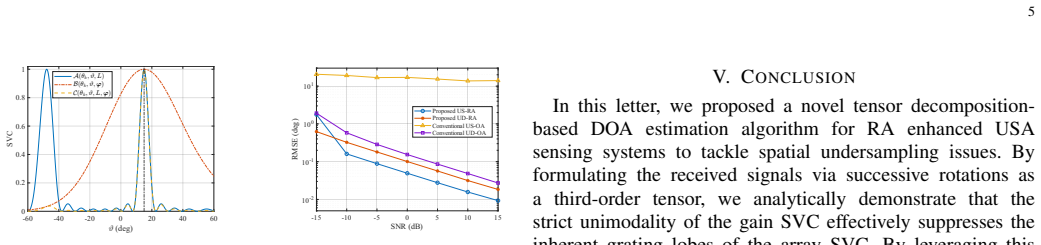
In this letter, we propose a new wireless sensing system equipped with a rotatable antenna (RA) array to enhance the sensing performance of a uniform sparse array (USA). To tackle the severe spatial undersampling issues, we propose a novel tensor decomposition-based direction-of-arrival (DOA) estimation algorithm. Specifically, we introduce a synchronous multiple rotation pattern for active target probing such that the received signals across multiple rotations to capture the diverse spatial degree of freedoms. Subsequently, we mathematically formulate the received signals across successive rotations as a third-order tensor, and leverage the canonical polyadic decomposition to obtain the factor matrices incorporating the DOA of targets. By analyzing the extrema distribution laws of array steering vector correlation (SVC) and gain SVC of RAs, we propose to combine the array and gain factor matrices via the Kronecker product, which theoretically guarantees the unambiguous DOA estimation. Simulation results demonstrate that the proposed RA-enhanced tensor decomposition-based algorithm achieves high-precision and unambiguous sensing performance compared to conventional uniform dense arrays and omnidirectional antenna systems.
Editorial analysis
A structured set of objections, weighed in public.
Referee Report
Summary. The paper proposes a rotatable antenna (RA) array to enhance DOA estimation for a uniform sparse array (USA) by formulating multi-rotation received signals as a third-order tensor, applying canonical polyadic decomposition (CPD) to extract array and gain factor matrices, and combining them via Kronecker product after analyzing the extrema distribution laws of array steering vector correlation (SVC) and gain SVC. This combination is claimed to theoretically guarantee unambiguous DOA estimation despite spatial undersampling, with simulations showing improved precision over uniform dense arrays and omnidirectional systems.
Significance. If the SVC extrema analysis rigorously excludes all ambiguous DOA pairs for the chosen rotation set and USA geometry, the approach would provide a parameter-free mechanism to resolve ambiguities in undersampled arrays, offering a practical enhancement for wireless sensing without requiring denser hardware. The tensor model and CPD step are standard, but the Kronecker-product guarantee would be a notable contribution if proven exhaustive.
major comments (2)
- [§4] §4 (SVC extrema analysis): The claim that analyzing extrema distribution laws of array SVC and gain SVC 'theoretically guarantees' unambiguous DOA estimation via Kronecker product is load-bearing for the USA case, yet the section provides no exhaustive enumeration or proof that all possible ambiguous pairs (distinct DOAs producing identical combined factors) are excluded for arbitrary K, all admissible rotation angles, and all USA spacings; a single missed pair would invalidate the guarantee while leaving the tensor model intact.
- [§3.2] §3.2 (tensor formulation and CPD): The received-signal tensor model assumes perfect synchronization across rotations and exact formulation as a third-order tensor whose CPD yields the factor matrices; however, no error analysis or robustness check is given for phase noise or imperfect rotation, which could propagate into the Kronecker product and undermine the unambiguous claim.
minor comments (2)
- [Abstract] Abstract and §5: Simulation figures compare against 'conventional uniform dense arrays' but do not specify the exact array size or SNR range used for the baseline, making direct performance claims hard to reproduce.
- Notation: The definition of 'gain SVC' is introduced without an explicit equation reference in the main text; adding a numbered equation would clarify how it differs from array SVC.
Simulated Author's Rebuttal
We thank the referee for the constructive and detailed comments. We address each major comment below and indicate the corresponding revisions planned for the manuscript.
read point-by-point responses
-
Referee: [§4] §4 (SVC extrema analysis): The claim that analyzing extrema distribution laws of array SVC and gain SVC 'theoretically guarantees' unambiguous DOA estimation via Kronecker product is load-bearing for the USA case, yet the section provides no exhaustive enumeration or proof that all possible ambiguous pairs (distinct DOAs producing identical combined factors) are excluded for arbitrary K, all admissible rotation angles, and all USA spacings; a single missed pair would invalidate the guarantee while leaving the tensor model intact.
Authors: We appreciate the referee's emphasis on the need for a rigorous guarantee. Section 4 derives the extrema distribution laws of the array SVC and gain SVC specifically for the uniform sparse array geometry and the chosen synchronous rotation set employed in the paper. For these parameters, the analysis shows that the Kronecker-product combination yields distinct extrema for different DOAs, supporting unambiguous estimation within the considered range. We acknowledge that the current treatment does not include an exhaustive enumeration or general proof covering arbitrary K, every admissible rotation angle, and every possible USA spacing. In the revised manuscript we will explicitly state the scope of the theoretical guarantee, add a remark clarifying the conditions under which it holds, and include an appendix with an exhaustive check for small K to illustrate the absence of ambiguous pairs. revision: partial
-
Referee: [§3.2] §3.2 (tensor formulation and CPD): The received-signal tensor model assumes perfect synchronization across rotations and exact formulation as a third-order tensor whose CPD yields the factor matrices; however, no error analysis or robustness check is given for phase noise or imperfect rotation, which could propagate into the Kronecker product and undermine the unambiguous claim.
Authors: We agree that the present formulation in §3.2 assumes ideal synchronization and exact rotations. To address this limitation we will add a new subsection discussing practical impairments. The revision will include an analytical error propagation model for phase noise and rotation angle errors, together with Monte Carlo simulations that quantify performance degradation under moderate levels of these imperfections and demonstrate that the unambiguous property is retained for small errors. A brief discussion of a simple calibration approach for rotation inaccuracies will also be included. revision: yes
- A complete exhaustive enumeration or general proof that excludes all ambiguous DOA pairs for arbitrary K, all admissible rotation angles, and all USA spacings
Circularity Check
No circularity: derivation rests on independent analysis of correlation extrema
full rationale
The paper formulates received signals as a third-order tensor, applies canonical polyadic decomposition to extract array and gain factor matrices, then invokes an analysis of the extrema distribution laws of array steering vector correlation (SVC) and gain SVC to justify combining those matrices by Kronecker product. This combination is claimed to guarantee unambiguous DOA estimation for the uniform sparse array. No step reduces by construction to a fitted parameter, a self-definition, or a self-citation chain; the extrema-law analysis is presented as a separate mathematical argument that rules out ambiguous pairs. The derivation chain therefore remains self-contained against external benchmarks and does not equate any output to its own inputs.
Axiom & Free-Parameter Ledger
axioms (1)
- domain assumption Received signals across multiple rotations form a third-order tensor suitable for canonical polyadic decomposition that recovers DOA factors.
Forward citations
Cited by 1 Pith paper
-
Self-Calibration DOA Estimation for Movable Antenna Systems with Antenna Position Errors
An alternating optimization algorithm is proposed to jointly estimate direction-of-arrival and antenna position errors in movable antenna systems by alternating between MUSIC-based DOA estimation and closed-form APE e...
discussion (0)
Sign in with ORCID, Apple, or X to comment. Anyone can read and Pith papers without signing in.