Superconductivity of Bad Fermions: Origin of Two Gaps in HTSC Cuprates
Pith reviewed 2026-05-23 03:12 UTC · model grok-4.3
The pith
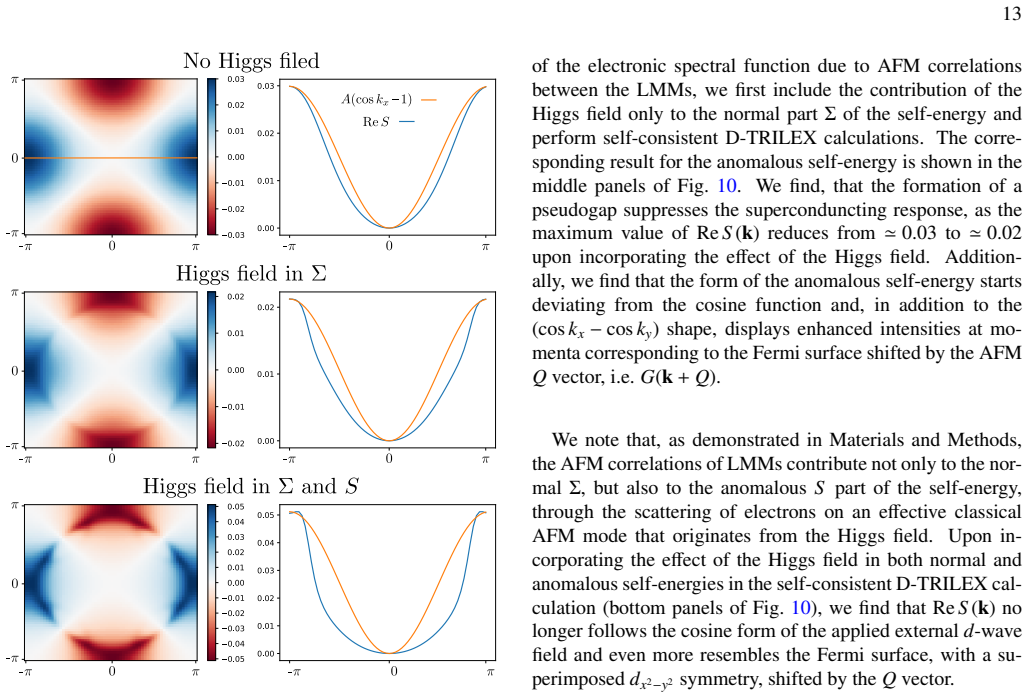
In the doped t-t' Hubbard model the anomalous superconducting response deviates from the simple d-wave form because the pseudogap suppresses it at the antinodes.
A machine-rendered reading of the paper's core claim, the machinery that carries it, and where it could break.
Core claim
Using a strong-coupling Green's function expansion around the exactly solvable undoped particle-hole symmetric Hubbard lattice that possesses a large antiferromagnetic Mott-Hubbard-Slater gap, the doped t-t' Hubbard model with t' = -0.3t exhibits a strongly renormalized flat band and a pseudogap around the antinodal point. The response to a small d_{x^2-y^2}-like external field shows a pseudogap in the normal part of the Nambu Green's function, related to bad-fermion behavior, and a d-wave-like structure in the anomalous Green's function with zero response at the nodal point; crucially, the anomalous part deviates from the simplest (cos kx - cos ky) form, with its extrema shifted away from (
What carries the argument
strong-coupling Green's function expansion around the undoped particle-hole symmetric Hubbard lattice with its large antiferromagnetic Mott-Hubbard-Slater gap
If this is right
- The normal state develops bad-fermion behavior accompanied by a pseudogap at the antinodal point.
- The anomalous Green's function vanishes at the nodal point of the Brillouin zone.
- The two-gap structure that emerges can serve as the microscopic basis for a two-fluid phenomenological treatment of high-Tc cuprate properties.
- The deviation of the anomalous response from the simplest d-wave form is a direct consequence of pseudogap suppression rather than an additional interaction.
Where Pith is reading between the lines
- Effective low-energy models of cuprate pairing may need to retain explicit momentum-dependent suppression from the pseudogap instead of assuming an unmodified d-wave form.
- The same expansion technique could be applied to other parameter regimes or lattices to predict whether shifted pairing extrema appear in additional doped Mott systems.
- Momentum-space mapping of the superconducting gap edge in ARPES or tunneling experiments could directly test whether the maxima are displaced from the antinodes.
Load-bearing premise
The strong-coupling Green's function expansion around the undoped particle-hole symmetric Hubbard lattice remains quantitatively accurate once the system is doped and t' is set to -0.3t.
What would settle it
A momentum-resolved calculation or spectroscopic measurement in which the anomalous response maxima remain exactly at (π,0) and (0,π) with no shift would falsify the claim that the pseudogap suppresses the response at those points.
Figures


read the original abstract
We investigate the spectral properties of the doped ${t-t'}$ Hubbard model with parameters typical for high-temperature cuprate superconductors. Our approach is based on a novel strong-coupling Green's function expansion around a reference system -- the exactly solvable undoped particle-hole symmetric Hubbard lattice -- that possesses a large antiferromagnetic Mott-Hubbard-Slater gap in the electron spectrum. The electron spectral function in the case of a large next-nearest-neighbor hopping ${t'=-0.3t}$, which is characteristic of the ${T_c \approx 100\,\text{K}}$ family of cuprates, reveals a strongly renormalized flat band feature with a pseudogap around the antinodal point. The superconducting response of this system to a small ${d_{x^2-y^2}}$-like external field exhibits a very unusual form. It features a pseudogap at the antinodal point in the normal part of the Nambu Green's function, related to a ``bad-fermion'' behavior in a normal phase, as well as a ${d}$-wave-like structure in the anomalous (Gorkov's) Green's function, with zero response at the nodal point of the Brillouin zone. Remarkably, we find that the anomalous part of the response deviates essentially from the simplest ${(\cos{k_x}-\cos{k_y})}$ form in momentum space. Specifically, its extrema are shifted away from the ${(\pi,0)}$ and ${(0,\pi)}$ points due to suppression of the response by the pseudogap. The observed two-gap structure of the electron spectra in a generic strong-coupling model of cuprates can serve as a basis for phenomenological treatment of different physical properties of high-temperature superconductors within two-fluid model.
Editorial analysis
A structured set of objections, weighed in public.
Referee Report
Summary. The manuscript investigates the doped t-t' Hubbard model (t'=-0.3t) via a novel strong-coupling Green's function expansion around the exactly solvable undoped particle-hole symmetric Hubbard lattice. It reports a renormalized flat band with a pseudogap at the antinodal point in the normal state, together with a d-wave-like anomalous (Gorkov) response whose extrema are shifted away from (π,0) and (0,π) by pseudogap suppression, yielding a two-gap spectral structure.
Significance. If the expansion remains controlled under doping and finite t', the work supplies a microscopic strong-coupling mechanism for the two-gap phenomenology of cuprates and for deviations from pure (cos kx - cos ky) pairing, thereby furnishing a concrete basis for two-fluid models.
major comments (2)
- [Abstract, paragraph 2] Abstract, paragraph 2: the expansion is performed around the undoped t'=0 reference system, yet the target parameters introduce finite doping plus t'=-0.3t that breaks particle-hole symmetry; no radius of convergence, error bound, or benchmark against exact results at comparable parameters is supplied, leaving the reported pseudogap and shifted anomalous response without quantitative validation.
- [Abstract] Abstract: the claim that the anomalous component deviates from the simplest d-wave form with extrema shifted by antinodal suppression is the central result; because this deviation is obtained from the unverified expansion, the two-gap structure rests on an uncontrolled approximation rather than a demonstrated property of the model.
minor comments (1)
- The abstract states the method and qualitative outcome but supplies no derivation steps or checks against known limits; adding a short methods paragraph or supplementary note with at least one benchmark would strengthen the presentation.
Simulated Author's Rebuttal
We thank the referee for the careful assessment of our manuscript on the strong-coupling expansion in the t-t' Hubbard model. We address each major comment in turn.
read point-by-point responses
-
Referee: [Abstract, paragraph 2] Abstract, paragraph 2: the expansion is performed around the undoped t'=0 reference system, yet the target parameters introduce finite doping plus t'=-0.3t that breaks particle-hole symmetry; no radius of convergence, error bound, or benchmark against exact results at comparable parameters is supplied, leaving the reported pseudogap and shifted anomalous response without quantitative validation.
Authors: Our expansion is constructed around the exactly solvable undoped particle-hole symmetric Hubbard model at t'=0 to leverage its large Mott gap as the starting point for strong-coupling physics. Finite doping and t'=-0.3t are incorporated as perturbations. The manuscript does not supply a radius of convergence, error bounds, or benchmarks against exact methods for these parameters, as the focus is on the qualitative emergence of the pseudogap and anomalous response features. We view this as a limitation and the results as indicative rather than quantitatively precise. revision: no
-
Referee: [Abstract] Abstract: the claim that the anomalous component deviates from the simplest d-wave form with extrema shifted by antinodal suppression is the central result; because this deviation is obtained from the unverified expansion, the two-gap structure rests on an uncontrolled approximation rather than a demonstrated property of the model.
Authors: The shift in the extrema of the anomalous Green's function is a direct outcome of the antinodal pseudogap in the normal-state propagator within the expansion. We agree that without additional controls or benchmarks the two-gap structure is demonstrated only within this approximation. Nevertheless, the mechanism provides a concrete strong-coupling origin for deviations from pure d-wave pairing and for the two-gap phenomenology, which we believe merits further investigation. revision: no
- Providing a radius of convergence, error bounds, or benchmarks against exact results for the expansion at the doped t-t' parameters.
Circularity Check
No significant circularity; derivation anchored in external reference system
full rationale
The paper's central derivation applies a strong-coupling Green's function expansion around an exactly solvable undoped particle-hole symmetric Hubbard lattice (t'=0, zero doping) as an independent reference. This reference is external and exactly solvable, not constructed from the target doped t-t' quantities. The choice of t'=-0.3t is presented as matching a known Tc family rather than a fit to the reported gap structure or anomalous response. No self-citations, self-definitional equations, fitted inputs renamed as predictions, or ansatz smuggling appear in the load-bearing steps. The reported deviation of the anomalous Nambu component from (cos kx - cos ky) is an output of the expansion applied to the doped model, not a tautological re-expression of the inputs.
Axiom & Free-Parameter Ledger
free parameters (1)
- t' =
-0.3t
axioms (1)
- domain assumption The undoped particle-hole symmetric Hubbard lattice possesses a large antiferromagnetic Mott-Hubbard-Slater gap and is exactly solvable.
Forward citations
Cited by 1 Pith paper
-
Fluctuating Pair Density Wave in Finite-temperature Phase Diagram of the $t$-$t^\prime$ Hubbard Model
Thermal tensor network simulations of the t-t' Hubbard model find d-wave superconductivity on electron doping but strong fluctuating pair-density-wave order with momentum near (0, π) on hole doping in the pseudogap.
Reference graph
Works this paper leans on
-
[1]
Possible highTc superconduc- tivity in the Ba-La-Cu-O system,
J. G. Bednorz and K. A. M¨uller, “Possible highTc superconduc- tivity in the Ba-La-Cu-O system,” Z. Phys. B: Condens. Matter 64, 189–193 (1986)
work page 1986
-
[2]
Angle- resolved photoemission studies of quantum materials,
Jonathan A. Sobota, Yu He, and Zhi-Xun Shen, “Angle- resolved photoemission studies of quantum materials,” Rev. Mod. Phys. 93, 025006 (2021)
work page 2021
-
[3]
LDA energy bands, low-energy hamiltonians,t′, t′′, t⊥(k), and J⊥,
O. K. Andersen, A. I. Liechtenstein, O. Jepsen, and F. Paulsen, “LDA energy bands, low-energy hamiltonians,t′, t′′, t⊥(k), and J⊥,” J. Phys. Chem. Solids 56, 1573–1591 (1995)
work page 1995
-
[4]
Band-Structure Trend in Hole-Doped Cuprates and Correlation with Tcmax,
E. Pavarini, I. Dasgupta, T. Saha-Dasgupta, O. Jepsen, and O. K. Andersen, “Band-Structure Trend in Hole-Doped Cuprates and Correlation with Tcmax,” Phys. Rev. Lett. 87, 047003 (2001)
work page 2001
-
[5]
Pressure-induced phonon softening and electronic topological transition in HgBa 2CuO4,
D. L. Novikov, M. I. Katsnelson, Jaejun Yu, A. V . Postnikov, and A. J. Freeman, “Pressure-induced phonon softening and electronic topological transition in HgBa 2CuO4,” Phys. Rev. B 54, 1313–1319 (1996)
work page 1996
-
[6]
Teppei Yoshida, Makoto Hashimoto, Inna M. Vishik, Zhi-Xun Shen, and Atsushi Fujimori, “Pseudogap, Superconducting Gap, and Fermi Arc in High-Tc Cuprates Revealed by Angle- Resolved Photoemission Spectroscopy,” J. Phys. Soc. Jpn. 81, 011006 (2012)
work page 2012
-
[7]
Distinct Fermi-Momentum-Dependent En- ergy Gaps in Deeply Underdoped Bi2212,
Kiyohisa Tanaka, W. S. Lee, D. H. Lu, A. Fujimori, T. Fujii, null, I. Terasaki, D. J. Scalapino, T. P. Devereaux, Z. Hussain, and Z.-X. Shen, “Distinct Fermi-Momentum-Dependent En- ergy Gaps in Deeply Underdoped Bi2212,” Science314, 1910– 1913 (2006)
work page 1910
-
[8]
Competition between the pseudogap and superconductivity in the high-Tc copper oxides,
Takeshi Kondo, Rustem Khasanov, Tsunehiro Takeuchi, J ¨org Schmalian, and Adam Kaminski, “Competition between the pseudogap and superconductivity in the high-Tc copper oxides,” Nature 457, 296–300 (2009)
work page 2009
-
[9]
M. Hashimoto, T. Yoshida, K. Tanaka, A. Fujimori, M. Oku- sawa, S. Wakimoto, K. Yamada, T. Kakeshita, H. Eisaki, and S. Uchida, “Distinct doping dependences of the pseudogap and superconducting gap of La 2−xSrxCuO4 cuprate superconduc- tors,” Phys. Rev. B75, 140503 (2007)
work page 2007
-
[10]
A. A. Kordyuk, “Pseudogap from ARPES experiment: Three gaps in cuprates and topological superconductivity (Review Ar- ticle),” Low Temp. Phys.41, 319–341 (2015)
work page 2015
-
[11]
Electronic phase dia- gram of high-temperature copper oxide superconductors,
Utpal Chatterjee, Dingfei Ai, Junjing Zhao, Stephan Rosenkranz, Adam Kaminski, Helene Ra ffy, Zhizhong Li, Kazuo Kadowaki, Mohit Randeria, Michael R. Nor- man, and J. C. Campuzano, “Electronic phase dia- gram of high-temperature copper oxide superconductors,” Proc. Natl. Acad. Sci. U.S.A. 108, 9346–9349 (2011), https://www.pnas.org/doi/pdf/10.1073/pnas.1101008108
-
[12]
Energy gaps in high- transition-temperature cuprate superconductors,
Makoto Hashimoto, Inna M. Vishik, Rui-Hua He, Thomas P. Devereaux, and Zhi-Xun Shen, “Energy gaps in high- transition-temperature cuprate superconductors,” Nature Physics 10, 483–495 (2014)
work page 2014
-
[13]
Fermi Surface and Pseudogap Evolution in a Cuprate Superconductor,
Yang He, Yi Yin, M. Zech, Anjan Soumyanarayanan, Michael M. Yee, Tess Williams, M. C. Boyer, Kamalesh Chatterjee, W. D. Wise, I. Zeljkovic, Takeshi Kondo, T. Takeuchi, H. Ikuta, Peter Mistark, Robert S. Markiewicz, Arun Bansil, Subir Sachdev, E. W. Hudson, and J. E. Hoffman, “Fermi Surface and Pseudogap Evolution in a Cuprate Superconductor,” Science 344,...
-
[14]
How Cooper pairs van- ish approaching the Mott insulator in Bi 2Sr2CaCu2O8+δ,
Y . Kohsaka, C. Taylor, P. Wahl, A. Schmidt, Jhinhwan Lee, K. Fujita, J. W. Alldredge, K. McElroy, Jinho Lee, H. Eisaki, S. Uchida, D.-H. Lee, and J. C. Davis, “How Cooper pairs van- ish approaching the Mott insulator in Bi 2Sr2CaCu2O8+δ,” Na- ture 454, 1072–1078 (2008)
work page 2008
-
[15]
The Remarkable Underlying Ground States of Cuprate Superconductors,
Cyril Proust and Louis Taillefer, “The Remarkable Underlying Ground States of Cuprate Superconductors,” Annu. Rev. Con- dens. Matter Phys. 10, 409–429 (2019)
work page 2019
-
[16]
Signatures of two gaps in the spin sus- ceptibility of a cuprate superconductor,
Rui Zhou, Igor Vinograd, Michihiro Hirata, Tao Wu, Hadrien Mayaffre, Steffen Kr¨amer, W. N. Hardy, Ruixing Liang, D. A. Bonn, Toshinao Loew, Juan Porras, Bernhard Keimer, and Marc-Henri Julien, “Signatures of two gaps in the spin sus- ceptibility of a cuprate superconductor,” Nat. Phys. 21, 97–103 (2024)
work page 2024
-
[17]
Imaging the two gaps of the high-temperature superconductor Bi2Sr2CuO6+x,
M. C. Boyer, W. D. Wise, Kamalesh Chatterjee, Ming Yi, Takeshi Kondo, T. Takeuchi, H. Ikuta, and E. W. Hudson, “Imaging the two gaps of the high-temperature superconductor Bi2Sr2CuO6+x,” Nat. Phys. 3, 802–806 (2007)
work page 2007
-
[18]
Superfluid den- sity and two-component conductivity in hole-doped cuprates,
J. Ayres, M. I. Katsnelson, and N. E. Hussey, “Superfluid den- sity and two-component conductivity in hole-doped cuprates,” Front. Phys. 10, 1021462 (2022)
work page 2022
-
[19]
Personal history of my en- gagement with cuprate superconductivity, 1986–2010,
PHILIP W. ANDERSON, “Personal history of my en- gagement with cuprate superconductivity, 1986–2010,” In- ternational Journal of Modern Physics B 25, 1–39 (2011), https://doi.org/10.1142/S0217979211057013
-
[20]
Ab- sence of Superconductivity in the Pure Two-Dimensional Hub- bard Model,
Mingpu Qin, Chia-Min Chung, Hao Shi, Ettore Vitali, Claudius Hubig, Ulrich Schollw¨ock, Steven R. White, and Shiwei Zhang (Simons Collaboration on the Many-Electron Problem), “Ab- sence of Superconductivity in the Pure Two-Dimensional Hub- bard Model,” Phys. Rev. X10, 031016 (2020)
work page 2020
-
[21]
Coexistence of super- conductivity with partially filled stripes in the Hubbard model,
Hao Xu, Chia-Min Chung, Mingpu Qin, Ulrich Schollw ¨ock, Steven R. White, and Shiwei Zhang, “Coexistence of super- conductivity with partially filled stripes in the Hubbard model,” Science 384, eadh7691 (2024)
work page 2024
-
[22]
Superconductiv- ity in the doped Hubbard model and its interplay with next- nearest hopping t′,
Hong-Chen Jiang and Thomas P. Devereaux, “Superconductiv- ity in the doped Hubbard model and its interplay with next- nearest hopping t′,” Science 365, 1424–1428 (2019)
work page 2019
-
[23]
Michael Thobias Schmid, Jean-Baptiste Mor ´ee, Ryui Kaneko, Youhei Yamaji, and Masatoshi Imada, “Superconductivity Studied by Solving Ab Initio Low-Energy Effective Hamiltoni- 10 ans for Carrier Doped CaCuO 2, Bi2Sr2CuO6, Bi2Sr2CaCu2O8, and HgBa2CuO4,” Phys. Rev. X13, 041036 (2023)
work page 2023
-
[24]
Hisatoshi Yokoyama, Masao Ogata, Yukio Tanaka, Kenji Kobayashi, and Hiroki Tsuchiura, “Crossover between BCS Superconductor and Doped Mott Insulator of d-Wave Pairing State in Two-Dimensional Hubbard Model,” J. Phys. Soc. Jpn. 82, 014707 (2013)
work page 2013
-
[25]
Antiferromagnetism and d-wave superconductivity in cuprates: A cluster dynamical mean-field theory,
A. I. Lichtenstein and M. I. Katsnelson, “Antiferromagnetism and d-wave superconductivity in cuprates: A cluster dynamical mean-field theory,” Phys. Rev. B62, R9283–R9286 (2000)
work page 2000
-
[26]
Plaquette valence bond theory of high-temperature su- perconductivity,
Malte Harland, Mikhail I. Katsnelson, and Alexander I. Licht- enstein, “Plaquette valence bond theory of high-temperature su- perconductivity,” Phys. Rev. B94, 125133 (2016)
work page 2016
-
[27]
Exactly solvable model of strongly correlated d-wave superconductivity,
Malte Harland, Sergey Brener, Mikhail I. Katsnelson, and Alexander I. Lichtenstein, “Exactly solvable model of strongly correlated d-wave superconductivity,” Phys. Rev. B 101, 045119 (2020)
work page 2020
-
[28]
Degenerate plaquette physics as key ingredient of high-temperature superconductivity in cuprates,
Michael Danilov, Erik G. C. P. van Loon, Sergey Brener, Sergei Iskakov, Mikhail I. Katsnelson, and Alexander I. Licht- enstein, “Degenerate plaquette physics as key ingredient of high-temperature superconductivity in cuprates,” npj Quantum Mater. 7, 50 (2022)
work page 2022
-
[29]
Xinyang Dong, Emanuel Gull, and Andrew J. Millis, “Quanti- fying the role of antiferromagnetic fluctuations in the supercon- ductivity of the doped hubbard model,” Nat. Phys. 18, 1293– 1296 (2022)
work page 2022
-
[30]
A common thread: The pairing interaction for unconventional superconductors,
D. J. Scalapino, “A common thread: The pairing interaction for unconventional superconductors,” Rev. Mod. Phys. 84, 1383– 1417 (2012)
work page 2012
-
[31]
Ground-state phase diagram of the t-t′-J model,
Shengtao Jiang, Douglas J. Scalapino, and Steven R. White, “Ground-state phase diagram of the t-t′-J model,” Proc. Natl. Acad. Sci. U.S.A. 118, e2109978118 (2021)
work page 2021
-
[32]
Robust d-Wave Superconductivity in the Square-Latticet−J Model,
Shoushu Gong, W. Zhu, and D. N. Sheng, “Robust d-Wave Superconductivity in the Square-Latticet−J Model,” Phys. Rev. Lett. 127, 097003 (2021)
work page 2021
-
[33]
Emergent Superconductivity and Competing Charge Orders in Hole-Doped Square-Lattice t−J Model,
Xin Lu, Feng Chen, W. Zhu, D. N. Sheng, and Shou-Shu Gong, “Emergent Superconductivity and Competing Charge Orders in Hole-Doped Square-Lattice t−J Model,” Phys. Rev. Lett. 132, 066002 (2024)
work page 2024
-
[34]
Phenomeno- logical model of nuclear relaxation in the normal state of YBa2Cu3O7,
A. J. Millis, Hartmut Monien, and David Pines, “Phenomeno- logical model of nuclear relaxation in the normal state of YBa2Cu3O7,” Phys. Rev. B42, 167–178 (1990)
work page 1990
-
[35]
V . Yu. Irkhin, A. A. Katanin, and M. I. Katsnelson, “Effects of van Hove singularities on magnetism and superconductivity in the t − t ′ Hubbard model: A parquet approach,” Phys. Rev. B 64, 165107 (2001)
work page 2001
-
[36]
Robustness of the Van Hove Scenario for High-Tc Superconductors,
V . Yu. Irkhin, A. A. Katanin, and M. I. Katsnelson, “Robustness of the Van Hove Scenario for High-Tc Superconductors,” Phys. Rev. Lett. 89, 076401 (2002)
work page 2002
-
[37]
Pseudogap and Fermi-Surface Topology in the Two-Dimensional Hubbard Model,
Wei Wu, Mathias S. Scheurer, Shubhayu Chatterjee, Subir Sachdev, Antoine Georges, and Michel Ferrero, “Pseudogap and Fermi-Surface Topology in the Two-Dimensional Hubbard Model,” Phys. Rev. X8, 021048 (2018)
work page 2018
-
[38]
Topological or- der in the pseudogap metal,
Mathias S. Scheurer, Shubhayu Chatterjee, Wei Wu, Michel Ferrero, Antoine Georges, and Subir Sachdev, “Topological or- der in the pseudogap metal,” Proc. Natl. Acad. Sci. U.S.A.115, E3665–E3672 (2018)
work page 2018
-
[39]
Origin and fate of the pseudogap in the doped Hub- bard model,
Fedor ˇSimkovic, Riccardo Rossi, Antoine Georges, and Michel Ferrero, “Origin and fate of the pseudogap in the doped Hub- bard model,” Science 385, eade9194 (2024)
work page 2024
-
[40]
Perturbative solution of fermionic sign problem in quantum Monte Carlo computations,
Sergei Iskakov, Mikhail I. Katsnelson, and Alexander I. Licht- enstein, “Perturbative solution of fermionic sign problem in quantum Monte Carlo computations,” npj Comput. Mater. 10, 36 (2024)
work page 2024
-
[41]
Maria Chatzieleftheriou, Silke Biermann, and Evgeny A. Stepanov, “Local and Nonlocal Electronic Correlations at the Metal-Insulator Transition in the Two-Dimensional Hubbard Model,” Phys. Rev. Lett.132, 236504 (2024)
work page 2024
-
[42]
Wei Wu, Michel Ferrero, Antoine Georges, and Evgeny Kozik, “Controlling Feynman diagrammatic expansions: Physical na- ture of the pseudogap in the two-dimensional Hubbard model,” Phys. Rev. B 96, 041105 (2017)
work page 2017
-
[43]
Dual fermion approach to nonlocal correlations in the Hub- bard model,
A. N. Rubtsov, M. I. Katsnelson, and A. I. Lichtenstein, “Dual fermion approach to nonlocal correlations in the Hub- bard model,” Phys. Rev. B77, 033101 (2008)
work page 2008
-
[44]
Dual fermion method as a prototype of generic reference-system approach for correlated fermions,
Sergey Brener, Evgeny A. Stepanov, Alexey N. Rubtsov, Mikhail I. Katsnelson, and Alexander I. Lichtenstein, “Dual fermion method as a prototype of generic reference-system approach for correlated fermions,” Ann. Phys. 422, 168310 (2020)
work page 2020
-
[45]
A. A. Abrikosov, L. P. Gorkov, and I. E. Dzyaloshinski, Meth- ods of quantum field theory in statistical physics (Dover, New York, NY , 1975)
work page 1975
-
[46]
Igor Krivenko and Andrey S. Mishchenko, “TRIQS /SOM 2.0: Implementation of the stochastic optimization with consistent constraints for analytic continuation,” Comput. Phys. Commun. 280, 108491 (2022)
work page 2022
-
[47]
Fermi Condensation Near van Hove Singularities Within the Hubbard Model on the Triangular Lattice,
Dmitry Yudin, Daniel Hirschmeier, Hartmut Hafermann, Olle Eriksson, Alexander I. Lichtenstein, and Mikhail I. Katsnelson, “Fermi Condensation Near van Hove Singularities Within the Hubbard Model on the Triangular Lattice,” Phys. Rev. Lett.112, 070403 (2014)
work page 2014
-
[48]
The physics behind high-temperature supercon- ducting cuprates: the ‘plain vanilla’ version of RVB,
P W Anderson, P A Lee, M Randeria, T M Rice, N Trivedi, and F C Zhang, “The physics behind high-temperature supercon- ducting cuprates: the ‘plain vanilla’ version of RVB,” J. Phys. Condens. Matter 16, R755 (2004)
work page 2004
-
[49]
Interlayer Tunneling and Gap Anisotropy in High-Temperature Superconductors,
Sudip Chakravarty, Asle Sudbø, Philip W. Anderson, and Steven Strong, “Interlayer Tunneling and Gap Anisotropy in High-Temperature Superconductors,” Science 261, 337–340 (1993)
work page 1993
-
[50]
c-Axis Electrodynamics as Evidence for the Interlayer Theory of High-Temperature Superconductivity,
Philip W. Anderson, “ c-Axis Electrodynamics as Evidence for the Interlayer Theory of High-Temperature Superconductivity,” Science 279, 1196–1198 (1998)
work page 1998
-
[51]
High-temperature superconductivity in monolayer Bi2Sr2CaCu2O8+δ,
Yijun Yu, Liguo Ma, Peng Cai, Ruidan Zhong, Cun Ye, Jian Shen, G. D. Gu, Xian Hui Chen, and Yuanbo Zhang, “High-temperature superconductivity in monolayer Bi2Sr2CaCu2O8+δ,” Nature 575, 156–163 (2019)
work page 2019
-
[52]
Pseudogap and singlet forma- tion in organic and cuprate superconductors,
J. Merino and O. Gunnarsson, “Pseudogap and singlet forma- tion in organic and cuprate superconductors,” Phys. Rev. B 89, 245130 (2014)
work page 2014
-
[53]
Consis- tent partial bosonization of the extended Hubbard model,
E. A. Stepanov, V . Harkov, and A. I. Lichtenstein, “Consis- tent partial bosonization of the extended Hubbard model,” Phys. Rev. B 100, 205115 (2019)
work page 2019
-
[54]
Impact of partially bosonized collective fluctuations on electronic degrees of freedom,
V . Harkov, M. Vandelli, S. Brener, A. I. Lichtenstein, and E. A. Stepanov, “Impact of partially bosonized collective fluctuations on electronic degrees of freedom,” Phys. Rev. B 103, 245123 (2021)
work page 2021
-
[55]
Multi-band D-TRILEX approach to materials with strong electronic correlations,
Matteo Vandelli, Josef Kaufmann, Mohammed El-Nabulsi, Viktor Harkov, Alexander I. Lichtenstein, and Evgeny A. Stepanov, “Multi-band D-TRILEX approach to materials with strong electronic correlations,” SciPost Phys. 13, 036 (2022)
work page 2022
-
[56]
Z. P. Yin, K. Haule, and G. Kotliar, “Kinetic frustration and the nature of the magnetic and paramagnetic states in iron pnictides and iron chalcogenides,” Nat. Mater.10, 932–935 (2011)
work page 2011
-
[57]
Janus- Faced Influence of Hund’s Rule Coupling in Strongly Corre- lated Materials,
Luca de’ Medici, Jernej Mravlje, and Antoine Georges, “Janus- Faced Influence of Hund’s Rule Coupling in Strongly Corre- lated Materials,” Phys. Rev. Lett.107, 256401 (2011)
work page 2011
-
[58]
Spin dynamics of itinerant electrons: Local magnetic moment formation and Berry phase,
E. A. Stepanov, S. Brener, V . Harkov, M. I. Katsnelson, and 11 A. I. Lichtenstein, “Spin dynamics of itinerant electrons: Local magnetic moment formation and Berry phase,” Phys. Rev. B 105, 155151 (2022)
work page 2022
-
[59]
Y . in ’t Veld, M. I. Katsnelson, A. J. Millis, and M. R ¨osner, “Screening induced crossover between phonon- and plasmon- mediated pairing in layered superconductors,” 2D Mater. 10, 045031 (2023)
work page 2023
-
[60]
Multiband dual fermion approach to quantum criticality in the Hubbard honeycomb lattice,
Daniel Hirschmeier, Hartmut Hafermann, and Alexander I. Lichtenstein, “Multiband dual fermion approach to quantum criticality in the Hubbard honeycomb lattice,” Phys. Rev. B97, 115150 (2018)
work page 2018
-
[61]
Doping-dependent charge- and spin-density wave orderings in a monolayer of Pb adatoms on Si(111),
M. Vandelli, A. Galler, A. Rubio, A. I. Lichtenstein, S. Bier- mann, and E. A. Stepanov, “Doping-dependent charge- and spin-density wave orderings in a monolayer of Pb adatoms on Si(111),” npj Quantum Mater.9, 19 (2024)
work page 2024
-
[62]
Antoine Georges, Gabriel Kotliar, Werner Krauth, and Marcelo J. Rozenberg, “Dynamical mean-field theory of strongly correlated fermion systems and the limit of infinite di- mensions,” Rev. Mod. Phys.68, 13–125 (1996)
work page 1996
-
[63]
Ergodicity at large couplings with the determinant Monte Carlo algorithm,
Richard T. Scalettar, Reinhard M. Noack, and Rajiv R. P. Singh, “Ergodicity at large couplings with the determinant Monte Carlo algorithm,” Phys. Rev. B44, 10502–10507 (1991)
work page 1991
-
[64]
Sign problem in the numerical simulation of many-electron systems,
E. Y . Loh, J. E. Gubernatis, R. T. Scalettar, S. R. White, D. J. Scalapino, and R. L. Sugar, “Sign problem in the numerical simulation of many-electron systems,” Phys. Rev. B 41, 9301– 9307 (1990)
work page 1990
-
[65]
Momentum- dependent pseudogaps in the half-filled two-dimensional Hub- bard model,
D. Rost, E. V . Gorelik, F. Assaad, and N. Bl¨umer, “Momentum- dependent pseudogaps in the half-filled two-dimensional Hub- bard model,” Phys. Rev. B86, 155109 (2012)
work page 2012
-
[66]
Spin-fermion coupling enhances pairing in the pseudogap regime of the hole-doped Hubbard model,
Yang Yu, Sergei Iskakov, Emanuel Gull, Karsten Held, and Friedrich Krien, “Spin-fermion coupling enhances pairing in the pseudogap regime of the hole-doped Hubbard model,” Preprint arXiv:2410.01705 (2024)
-
[67]
Current carriers in a quantum two-dimensional antiferromagnet,
V Yu Irkhin and M I Katsnelson, “Current carriers in a quantum two-dimensional antiferromagnet,” J. Phys. Condens. Matter 3, 6439 (1991). Supplemental Material Superconductivity of Bad Fermions: Origin of Two Gaps in HTSC Cuprates MA TSUBARA GREEN’S FUNCTIONS FROM DF-QMC In this section, we present the Matsubara Green’s functions as a “raw” output from th...
work page 1991
discussion (0)
Sign in with ORCID, Apple, or X to comment. Anyone can read and Pith papers without signing in.