Mean-field and fluctuation dynamics in off-resonant two-mode atom-field interactions
Pith reviewed 2026-05-21 06:22 UTC · model grok-4.3
The pith
A separation into mean-field and fluctuation parts solves the two-mode atom-field model in the off-resonant regime.
A machine-rendered reading of the paper's core claim, the machinery that carries it, and where it could break.
Core claim
The central claim is that by isolating the semiclassical mean-field dynamics of the atom with the average fields of the two modes and applying a sequence of unitary transformations to handle the quantum fluctuations, the method accurately reproduces the key observables over relevant timescales in the non-resonant regime, where standard approximations fail due to rich interference effects.
What carries the argument
The sequence of unitary transformations applied after the semiclassical mean-field interaction to capture quantum fluctuations while preserving essential features.
If this is right
- Atomic inversion dynamics can be tracked accurately using this hybrid approach.
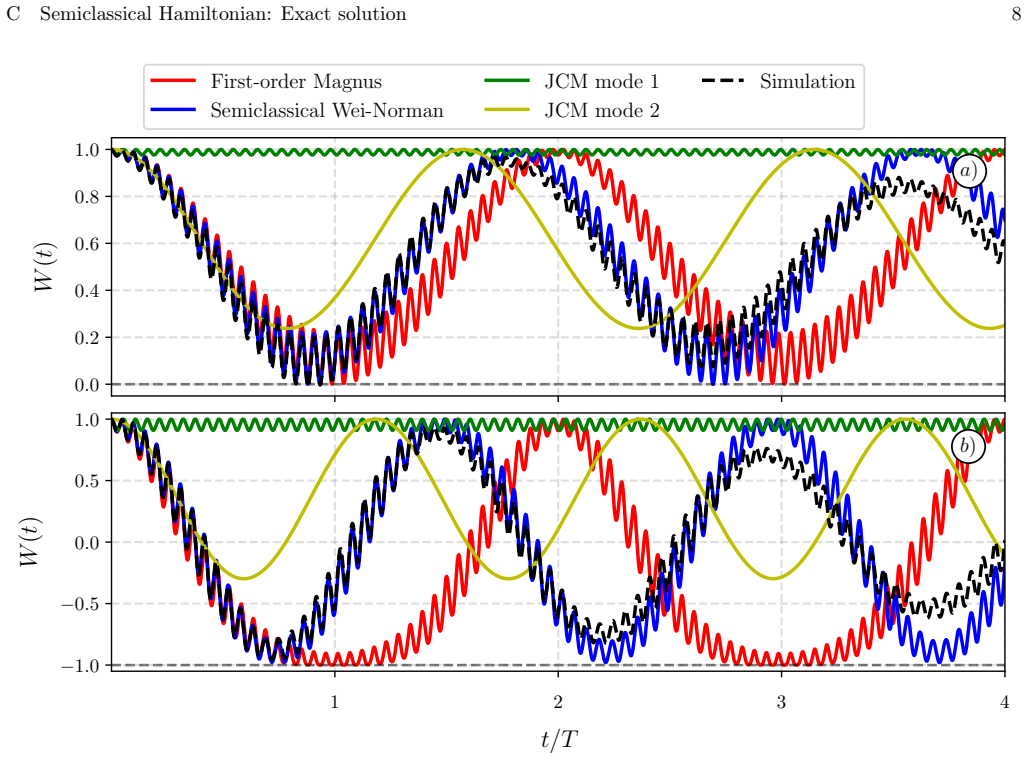
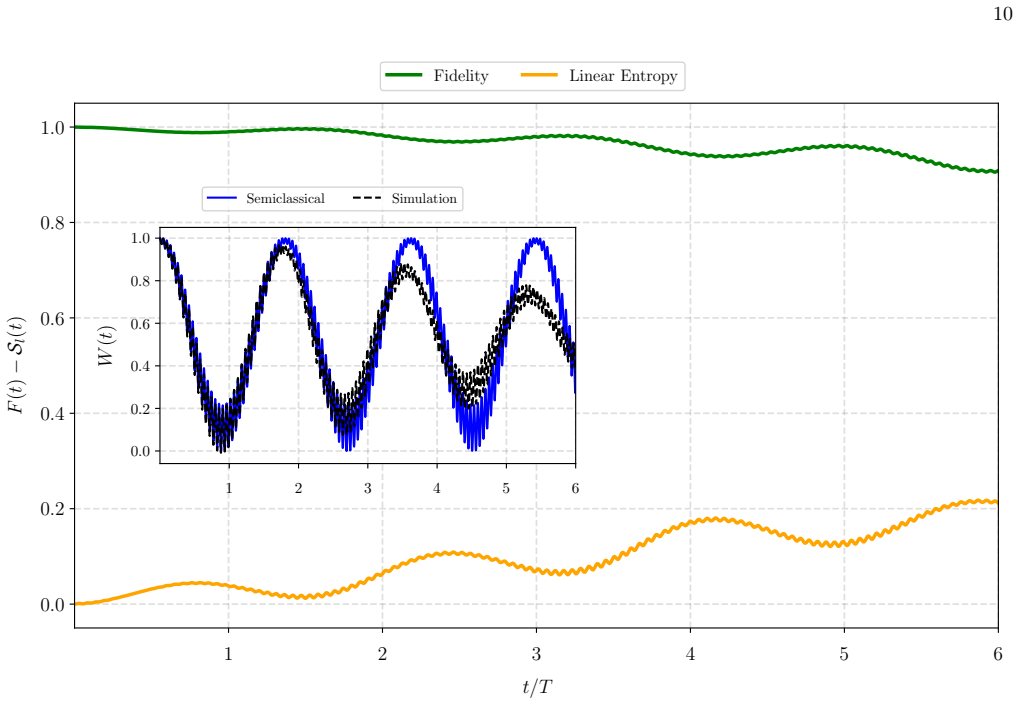
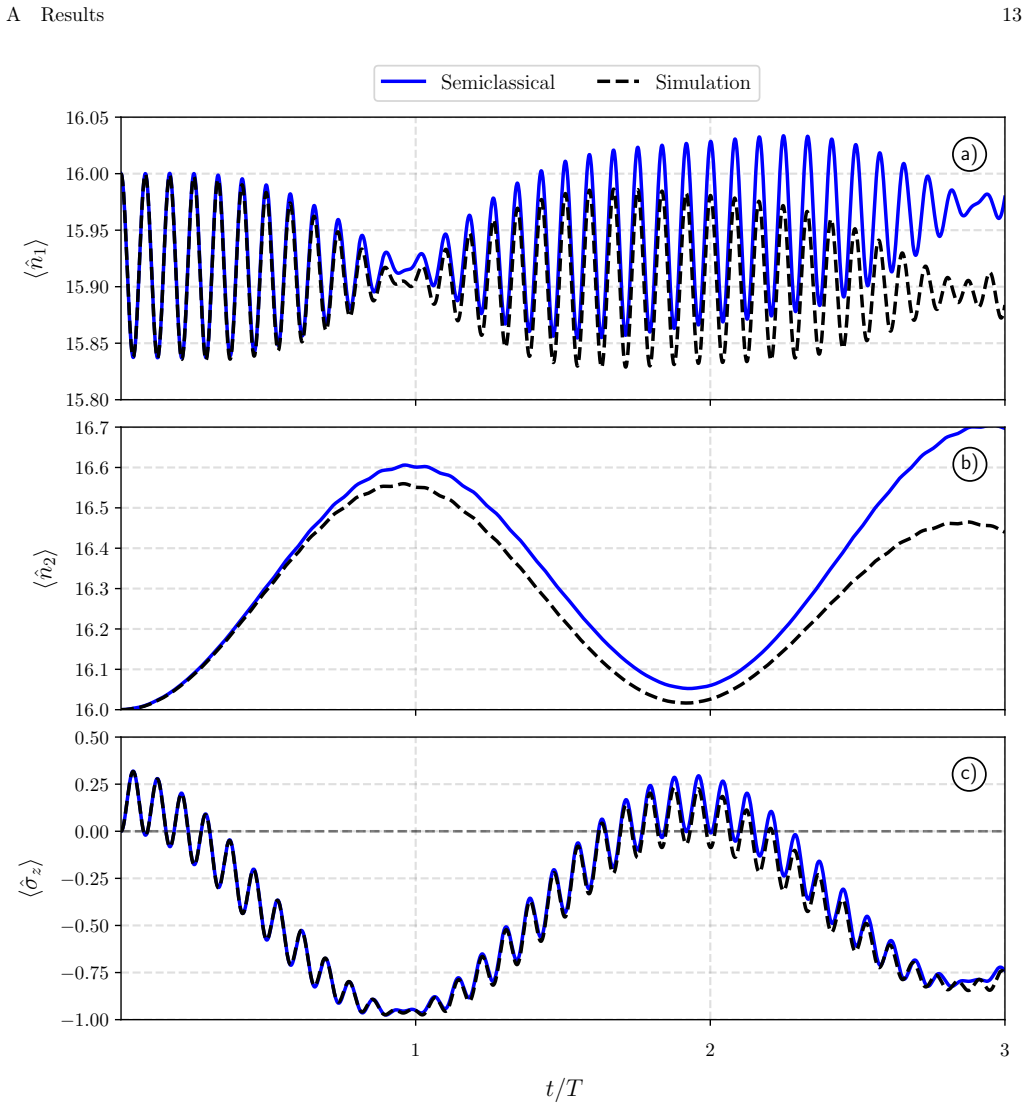
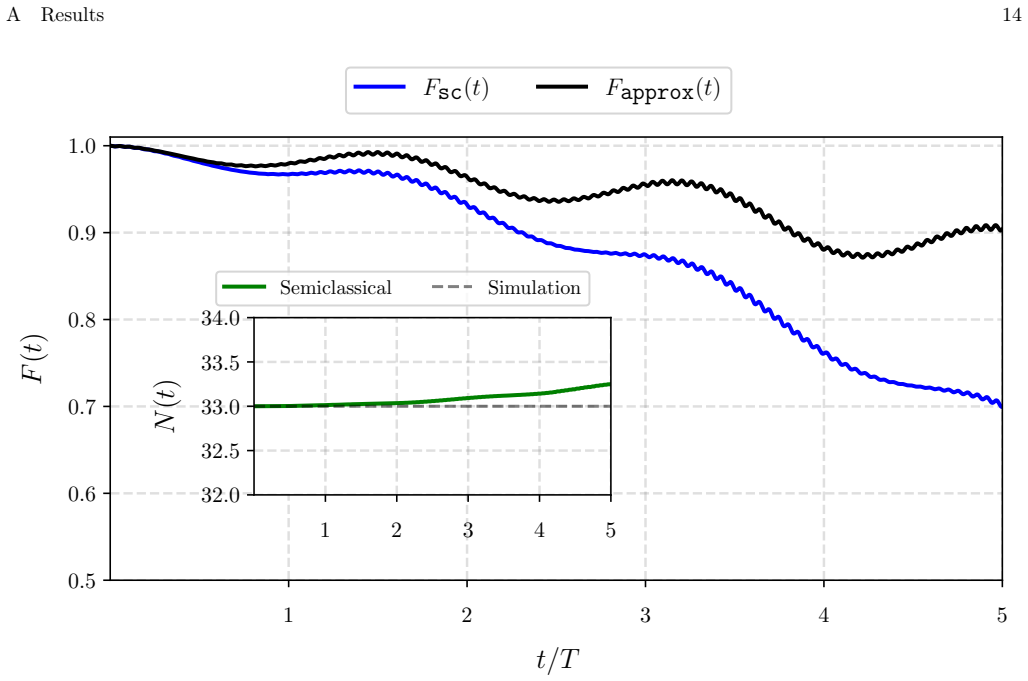
- Field observables and fidelity match full numerical results in the non-resonant regime.
- The method remains computationally efficient for systems with multiple detunings and multi-timescale dynamics.
- It handles infinite-dimensional subspaces without requiring a closed-form analytical solution.
Where Pith is reading between the lines
- This separation technique might extend to other quantum optical systems with conserved quantities but infinite subspaces.
- Experimental tests with specific detuning values could confirm the accuracy for longer timescales.
- Connections to mean-field theories in other many-body systems could be explored for similar approximations.
Load-bearing premise
That the mean-field semiclassical component dominates the dynamics sufficiently for the unitary transformations to capture the essential quantum fluctuations accurately in the non-resonant regime.
What would settle it
Numerical simulations of the full Hamiltonian showing significant deviations in atomic inversion or fidelity from the predictions of this mean-field plus transformations scheme within the relevant timescales.
Figures


read the original abstract
We study a two-level system coupled to two quantized electromagnetic modes within the Jaynes-Cummings framework. While the single-mode model is exactly solvable due to its conserved excitation number, yielding finite-dimensional invariant subspaces, the two-mode model extension presents a fundamental challenge: although the total excitation number remains conserved, each invariant subspace is infinite-dimensional, preventing a closed-form analytical solution. Our scheme separates the dynamics into a dominant, exactly solvable semiclassical component, the atom interacting with the mean fields of both modes, and treats the remaining quantum fluctuations through a sequence of unitary transformations that preserve essential quantum features. We validate our approach through direct comparison with numerical solutions, focusing on the non-resonant regime where multiple detunings give rise to rich interference effects and multi-timescale dynamics inaccessible to standard approximations. The method accurately reproduces atomic inversion, field observables, and fidelity over relevant timescales, while remaining computationally efficient.
Editorial analysis
A structured set of objections, weighed in public.
Referee Report
Summary. The manuscript develops an approximate analytical method for the dynamics of a two-level atom interacting with two off-resonant quantized field modes in the Jaynes-Cummings model. The total excitation number is conserved, but each subspace is infinite-dimensional. The approach decomposes the dynamics into a dominant semiclassical mean-field component, where the atom couples to the mean fields of both modes and is exactly solvable, and quantum fluctuations treated via a sequence of unitary transformations. Validation is performed by direct comparison with numerical solutions in the non-resonant regime, claiming accurate reproduction of atomic inversion, field observables, and fidelity over relevant timescales.
Significance. Should the mean-field dominance and fluctuation treatment hold with controlled errors, this provides an efficient framework for analyzing complex multi-mode quantum optical systems exhibiting multi-timescale interference, which are challenging for exact methods or standard approximations. The numerical validation supports its practical utility, and the parameter-free nature (as per the axiom ledger) is a strength.
major comments (2)
- Abstract: The claim that the method 'accurately reproduces atomic inversion, field observables, and fidelity' is not supported by quantitative error analysis or bounds on the neglected fluctuation back-reaction terms, which is essential for the non-resonant regime where such effects are prominent.
- Method description: The sequence of unitary transformations is said to preserve essential quantum features, but without an explicit estimate of the size of discarded commutators or a scaling with detuning/coupling, the approximation's validity range is not rigorously established.
minor comments (2)
- Introduction: The discussion of the single-mode Jaynes-Cummings solvability could reference the original works more explicitly for completeness.
- Numerical results: Ensure that all panels in the comparison figures are clearly labeled with the specific parameter values used for the non-resonant cases.
Simulated Author's Rebuttal
We thank the referee for the careful reading of our manuscript and the constructive comments. We address each major point below and have revised the manuscript to incorporate quantitative support and scaling estimates where these strengthen the presentation without altering the core results.
read point-by-point responses
-
Referee: Abstract: The claim that the method 'accurately reproduces atomic inversion, field observables, and fidelity' is not supported by quantitative error analysis or bounds on the neglected fluctuation back-reaction terms, which is essential for the non-resonant regime where such effects are prominent.
Authors: We agree that the abstract statement would be more robust with explicit quantitative support. In the revised version we have added relative-error plots for atomic inversion and field observables together with a brief discussion of the scaling of neglected back-reaction terms (suppressed by the ratio of detuning to coupling). These additions are placed in a new subsection of the validation section and referenced from the abstract. revision: yes
-
Referee: Method description: The sequence of unitary transformations is said to preserve essential quantum features, but without an explicit estimate of the size of discarded commutators or a scaling with detuning/coupling, the approximation's validity range is not rigorously established.
Authors: We accept that an explicit bound on the discarded commutators would clarify the regime of validity. We have inserted a short derivation in the methods section showing that the leading neglected commutator scales as (g/Δ)^2 where Δ is the effective detuning; this establishes that the approximation remains controlled throughout the off-resonant parameter range explored in the numerics. revision: yes
Circularity Check
No significant circularity; derivation relies on standard conservation law and introduces an independent approximation scheme
full rationale
The paper starts from the well-known conservation of total excitation number in the two-mode Jaynes-Cummings model, notes that this yields infinite-dimensional subspaces, and then proposes a separation into a semiclassical mean-field component plus a sequence of unitary transformations on fluctuations. This separation is presented as an ansatz for approximation rather than a closed derivation; accuracy is checked by direct numerical comparison rather than by showing that the outputs are forced by the inputs. No parameter is fitted to a subset and then relabeled as a prediction, no uniqueness theorem is imported from the authors' prior work, and no self-citation is used to justify the central construction. The method therefore remains self-contained against external benchmarks.
Axiom & Free-Parameter Ledger
axioms (1)
- standard math Total excitation number is conserved in the Jaynes-Cummings model.
Reference graph
Works this paper leans on
-
[1]
H. J. Kimble, Physica ScriptaT76, 127 (1998). 20
work page 1998
-
[2]
S. Haroche and J.-M. Raimond,Exploring the Quantum: Atoms, Cavities, and Photons(Oxford University Press, Oxford, 2006)
work page 2006
- [3]
-
[4]
D. Leibfried, R. Blatt, C. Monroe, and D. J. Wineland, Reviews of Modern Physics75, 281 (2003)
work page 2003
- [5]
- [6]
- [7]
- [8]
- [9]
-
[10]
K. Baumann, C. Guerlin, F. Brennecke, and T. Esslinger, Nature464, 1301 (2010)
work page 2010
-
[11]
S. Gopalakrishnan, B. L. Lev, and P. M. Goldbart, Nature Physics5, 845 (2009)
work page 2009
-
[12]
J. D. Thompson, T. G. Tiecke, A. S. Zibrov, V. Vuletić, and M. D. Lukin, Science340, 1202 (2013)
work page 2013
-
[13]
D. E. Chang, V. Vuletić, and M. D. Lukin, Nature Photonics8, 685 (2014)
work page 2014
-
[14]
Magnus, Communications on Pure and Applied Mathematics7, 649 (1954)
W. Magnus, Communications on Pure and Applied Mathematics7, 649 (1954)
work page 1954
-
[15]
B. Rodriguez-Lara and H. Moya-Cessa, Journal of Physics A46, 095301 (2013)
work page 2013
- [16]
-
[17]
L. Medina-Dozal, I. Ramos-Prieto, and J. Récamier, Entropy22, 1373 (2020)
work page 2020
-
[18]
C. González-Gutiérrez, O. de los Santos-Sánchez, R. Román-Ancheyta, M. Berrondo, and J. Récamier, Journal of the Optical Society of America B35, 1979 (2018)
work page 1979
-
[19]
Gerry, Journal of the Optical Society of America B9, 290 (1992)
C. Gerry, Journal of the Optical Society of America B9, 290 (1992)
work page 1992
-
[20]
L. O. Castaños-Cervantes, Scientific Reports14, 3790 (2024)
work page 2024
-
[21]
A. Alscher and H. Grabert, The European Physical Journal D: Atomic, Molecular, Optical and Plasma Physics14, 127 (2001)
work page 2001
- [22]
- [23]
-
[24]
Jozsa, Journal of modern optics41, 2315 (1994)
R. Jozsa, Journal of modern optics41, 2315 (1994)
work page 1994
-
[25]
R. J. Glauber, Physical Review131, 2766 (1963)
work page 1963
discussion (0)
Sign in with ORCID, Apple, or X to comment. Anyone can read and Pith papers without signing in.