Carpet results on astrophysical gamma rays above 100 TeV
Pith reviewed 2026-05-24 16:29 UTC · model grok-4.3
The pith
The Carpet array uses its muon detector to separate primary photons from hadrons and reports first search results for astrophysical gamma rays above 100 TeV.
A machine-rendered reading of the paper's core claim, the machinery that carries it, and where it could break.
Core claim
The central claim is that the Carpet array, with its muon detector, makes it possible to separate primary photons from hadrons and has produced first results on the search for astrophysical gamma rays above 100 TeV.
What carries the argument
The large-area muon detector that measures muon content in air showers to discriminate between photon primaries (low muon yield) and hadron primaries (high muon yield).
If this is right
- Upper limits on the flux of astrophysical gamma rays above 100 TeV follow directly from the absence or scarcity of muon-poor showers in the data.
- The same muon-based separation can be applied to future data runs to extend the search or to look for point sources.
- The ongoing upgrade increases the effective area and muon coverage, raising the experiment's sensitivity to these gamma rays.
Where Pith is reading between the lines
- If the discrimination remains effective, adding comparable muon detectors to other surface arrays could enlarge the global coverage for gamma-ray searches in this energy band.
- Non-detection would tighten constraints on models in which gamma rays are produced alongside or instead of hadrons at the highest energies.
Load-bearing premise
The muon content of air showers provides reliable discrimination between primary photons and hadrons at energies above 100 TeV without significant contamination or efficiency losses that would invalidate the search.
What would settle it
A data set or simulation in which the observed muon distributions for candidate photon events overlap so strongly with the hadronic background that no clean separation is possible above 100 TeV.
Figures


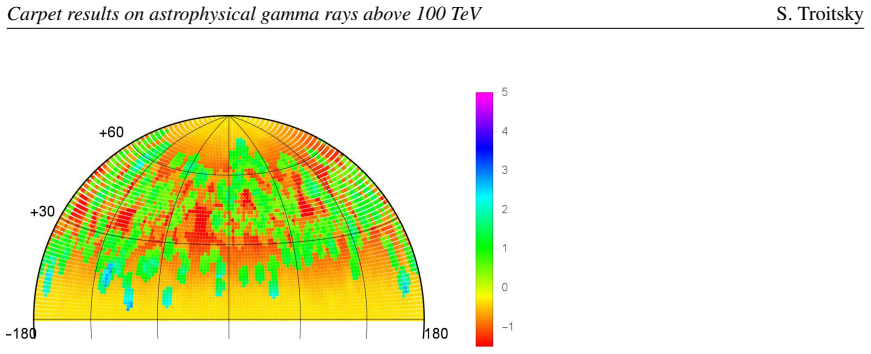
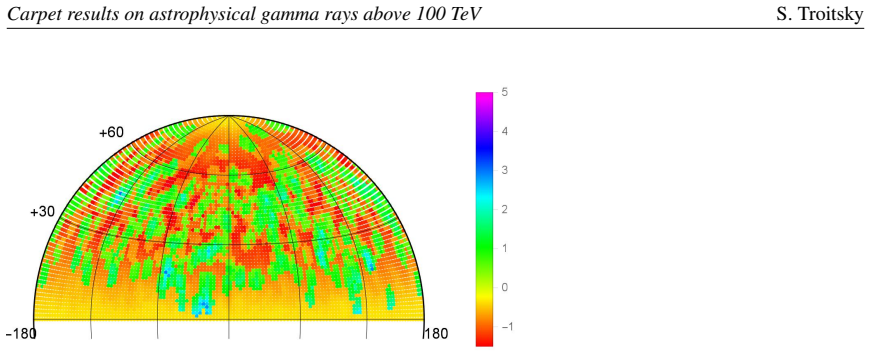
read the original abstract
Carpet is an air-shower array at Baksan, Russia, equipped with a large-area muon detector, which makes it possible to separate primary photons from hadrons. We report first results of the search for primary photons with energies E>100 TeV. The experiment's ongoing upgrade and future sensitivity are also discussed.
Editorial analysis
A structured set of objections, weighed in public.
Referee Report
Summary. The manuscript reports first results from the Carpet air-shower array at Baksan, Russia, which uses a large-area muon detector to discriminate primary photons from hadrons. It presents an ongoing search for astrophysical gamma rays above 100 TeV and discusses the experiment's upgrade and projected future sensitivity.
Significance. If the reported search results and discrimination performance hold after detailed validation, the work would add valuable early constraints in the sparsely explored regime above 100 TeV, where few experiments have reported limits or detections. The muon-based separation technique is a recognized strength for air-shower arrays and, if quantified with efficiencies and background estimates, could support reproducible follow-up analyses.
major comments (2)
- [Abstract] Abstract and introduction: no numerical values are supplied for event counts, selection efficiency, background rejection power, or resulting flux limits/upper bounds. Without these, the central claim that the array 'has produced first results' cannot be evaluated for statistical significance or systematic robustness.
- [Method] Method description: the text does not specify the muon-content cut value, the energy threshold definition, or the Monte Carlo simulation parameters used to estimate photon acceptance versus hadron contamination. These quantities are load-bearing for any claim of photon-hadron separation above 100 TeV.
minor comments (2)
- [Abstract] The title and abstract use 'Carpet results' without clarifying whether this is a conference proceeding or a full analysis paper; adding a sentence on data-taking period and live time would improve context.
- [Discussion] Future sensitivity discussion would benefit from a quantitative comparison to existing or planned experiments (e.g., LHAASO, TAIGA) rather than qualitative statements.
Simulated Author's Rebuttal
We thank the referee for the detailed review and constructive suggestions. The comments correctly identify that the current manuscript, as a concise report on first results, omits several quantitative details that would strengthen the presentation. We address each point below and will revise the manuscript to incorporate the requested information where it is available from our analysis.
read point-by-point responses
-
Referee: [Abstract] Abstract and introduction: no numerical values are supplied for event counts, selection efficiency, background rejection power, or resulting flux limits/upper bounds. Without these, the central claim that the array 'has produced first results' cannot be evaluated for statistical significance or systematic robustness.
Authors: We agree with this assessment. The abstract and introduction will be expanded in the revision to include the key numerical results from our analysis, specifically the number of events passing the photon selection, the estimated selection efficiency for photons, the background rejection power from the muon cut, and the resulting flux upper limits (or limits on the number of photons). These values are part of the first results and their inclusion will allow readers to evaluate the statistical significance directly. revision: yes
-
Referee: [Method] Method description: the text does not specify the muon-content cut value, the energy threshold definition, or the Monte Carlo simulation parameters used to estimate photon acceptance versus hadron contamination. These quantities are load-bearing for any claim of photon-hadron separation above 100 TeV.
Authors: We acknowledge that these parameters are essential for assessing the photon-hadron separation. In the revised manuscript we will explicitly state the muon-content cut (the threshold applied to the muon detector signal), the precise definition of the energy threshold (whether based on shower size, reconstructed energy, or another observable), and the Monte Carlo setup including the hadronic models, primary spectra, and the resulting photon acceptance and hadron contamination estimates. These details exist in our internal analysis and will be added to the methods section. revision: yes
Circularity Check
No significant circularity; experimental report with no derivation chain
full rationale
The paper is an observational report of first results from the Carpet air-shower array using established muon-poor selection to search for primary photons above 100 TeV. No mathematical derivation, ansatz, uniqueness theorem, or parameter fitting is presented whose output reduces by construction to the input data or to a self-citation. The central claim rests on experimental technique and simulation validation external to any internal loop, satisfying the self-contained criterion for score 0.
Axiom & Free-Parameter Ledger
Lean theorems connected to this paper
-
IndisputableMonolith/Foundation/RealityFromDistinction.leanreality_from_one_distinction unclear?
unclearRelation between the paper passage and the cited Recognition theorem.
We report first results of the search for primary photons with energies E>100 TeV... separation of photon-induced showers from the bulk of cosmic-ray induced events becomes possible.
-
IndisputableMonolith/Cost/FunctionalEquation.leanwashburn_uniqueness_aczel unclear?
unclearRelation between the paper passage and the cited Recognition theorem.
gamma-induced showers are muon-poor as compared to cosmic-ray induced ones... photon candidate cuts... on the Ne−nμ plane
What do these tags mean?
- matches
- The paper's claim is directly supported by a theorem in the formal canon.
- supports
- The theorem supports part of the paper's argument, but the paper may add assumptions or extra steps.
- extends
- The paper goes beyond the formal theorem; the theorem is a base layer rather than the whole result.
- uses
- The paper appears to rely on the theorem as machinery.
- contradicts
- The paper's claim conflicts with a theorem or certificate in the canon.
- unclear
- Pith found a possible connection, but the passage is too broad, indirect, or ambiguous to say the theorem truly supports the claim.
Reference graph
Works this paper leans on
-
[1]
Diffuse Galactic gamma ray flux at very high energy
P. Lipari and S. Vernetto, Diffuse Galactic gamma ray flux at very high energy, Phys. Rev. D 98 (2018) no.4, 043003 [arXiv:1804.10116 [astro-ph.HE] ]
work page internal anchor Pith review Pith/arXiv arXiv 2018
-
[2]
S. Gabici et al., The origin of Galactic cosmic rays: challenges to the standard paradigm, arXiv:1903.11584 [astro-ph.HE]
-
[3]
Probing the Galactic Origin of the IceCube Excess with Gamma-Rays
M. Ahlers and K. Murase, Probing the Galactic Origin of the IceCube Excess with Gamma-Rays, Phys. Rev. D 90 (2014) 023010 [arXiv:1309.4077]
work page internal anchor Pith review Pith/arXiv arXiv 2014
-
[4]
O. E. Kalashev and S. V . Troitsky,IceCube astrophysical neutrinos without a spectral cutoff and 1015-1017 eV cosmic gamma radiation, JETP Lett. 100 (2015) 761 [arXiv:1410.2600]
work page internal anchor Pith review Pith/arXiv arXiv 2015
-
[5]
M. G. Aartsen et al. First observation of PeV-energy neutrinos with IceCube, Phys. Rev. Lett. 111 (2013) 021103 [arXiv:1304.5356]
work page internal anchor Pith review Pith/arXiv arXiv 2013
-
[6]
A. D. Avrorin et al., Baikal-GVD: first results and prospects, EPJ Web Conf. 209 (2019) 01015
work page 2019
-
[7]
S. V . Troitsky,Axion-like particles and the propagation of gamma rays over astronomical distances, JETP Lett. 105 (2017) 55 [arXiv:1612.01864]. 1Institute for Nuclear Research of the Russian Academy of Sciences, 60th October Anniversary Prospect 7A, 117312, Moscow, Russia 2Institute of Astronomy, Russian Academy of Sciences, 119017, Moscow, Russia 5 Carp...
-
[8]
Extragalactic photon--axion-like particle oscillations up to 1000 TeV
G. Galanti and M. Roncadelli, Extragalactic photon-axion-like particle oscillations up to 1000 TeV, JHEAp 20 (2018) 1 [arXiv:1805.12055 [astro-ph.HE] ]
work page internal anchor Pith review Pith/arXiv arXiv 2018
-
[9]
Szabelski et al., Carpet-3 - a new experiment to study primary composition around the knee, Nucl
J. Szabelski et al., Carpet-3 - a new experiment to study primary composition around the knee, Nucl. Phys. Proc. Suppl. 196 (2009) 371 [arXiv:0902.0252]
-
[10]
D. D. Dzhappuev et al., Search for cosmic gamma rays with the Carpet-2 extensive air shower array, arXiv:1511.09397
work page internal anchor Pith review Pith/arXiv arXiv
-
[11]
Heck et al., CORSIKA: A Monte Carlo code to simulate extensive air showers, Tech
D. Heck et al., CORSIKA: A Monte Carlo code to simulate extensive air showers, Tech. Rep. 6019, FZKA (1998)
work page 1998
-
[12]
Monte Carlo treatment of hadronic interactions in enhanced Pomeron scheme: I. QGSJET-II model
S. Ostapchenko, Monte Carlo treatment of hadronic interactions in enhanced Pomeron scheme: I. QGSJET-II model, Phys. Rev. D 83 (2011) 014018 [arXiv:1010.1869 [hep-ph] ]
work page internal anchor Pith review Pith/arXiv arXiv 2011
-
[13]
Battistoni et al., The FLUKA code: Description and benchmarking, AIP Conf
G. Battistoni et al., The FLUKA code: Description and benchmarking, AIP Conf. Proc. 896 (2007) 31
work page 2007
-
[14]
D. D. Dzhappuev et al., Carpet-2 search for PeV gamma rays associated with IceCube high-energy neutrino events, JETP Lett. 109 (2019) 226 [arXiv:1812.02662 [astro-ph.HE] ]
work page internal anchor Pith review Pith/arXiv arXiv 2019
-
[15]
D. D. Dzhappuev et al., Search for astrophysical PeV gamma rays from point sources with Carpet-2, EPJ Web Conf. 207 (2019) 03004 [arXiv:1812.02663 [astro-ph.HE] ]
work page internal anchor Pith review Pith/arXiv arXiv 2019
-
[16]
Nikishov, Absorption of high-energy photons in the Universe, Sov
A.I. Nikishov, Absorption of high-energy photons in the Universe, Sov. Phys. JETP 14 (1962) 393. [ZhETF 41 (1962) 549]
work page 1962
-
[17]
Multi-messenger gamma-ray counterpart of the IceCube neutrino signal
A. Neronov, M. Kachelrieß and D. Semikoz, Multimessenger gamma-ray counterpart of the IceCube neutrino signal, Phys. Rev. D 98 (2018) 023004 [arXiv:1802.09983]. 6
work page internal anchor Pith review Pith/arXiv arXiv 2018
discussion (0)
Sign in with ORCID, Apple, or X to comment. Anyone can read and Pith papers without signing in.