ModMax-black hole surrounded by cloud of strings in Bumblebee gravity
Pith reviewed 2026-05-21 04:52 UTC · model grok-4.3
The pith
The thermodynamics and greybody factors of a ModMax black hole with a string cloud in bumblebee gravity are determined by the Lorentz symmetry violation parameter and the cloud of strings parameter.
A machine-rendered reading of the paper's core claim, the machinery that carries it, and where it could break.
Core claim
The optical features, thermodynamics, and greybody factors of the ModMax black hole surrounded by a cloud of strings in bumblebee gravity depend on the Lorentz symmetry violation parameter, the cloud of strings parameter, the ModMax parameter, the electric charge, and the black hole mass. This dependence provides a comprehensive understanding of the physical effects of these parameters on the radiation and scattering processes around the black hole.
What carries the argument
The exact metric solution for the ModMax black hole surrounded by a cloud of strings within Einstein-bumblebee gravity, used as the fixed background for thermodynamic and perturbative field calculations.
If this is right
- The Hawking temperature increases or decreases depending on the values of the Lorentz violation and string parameters.
- Entropy and other thermodynamic quantities are modified by the presence of the string cloud.
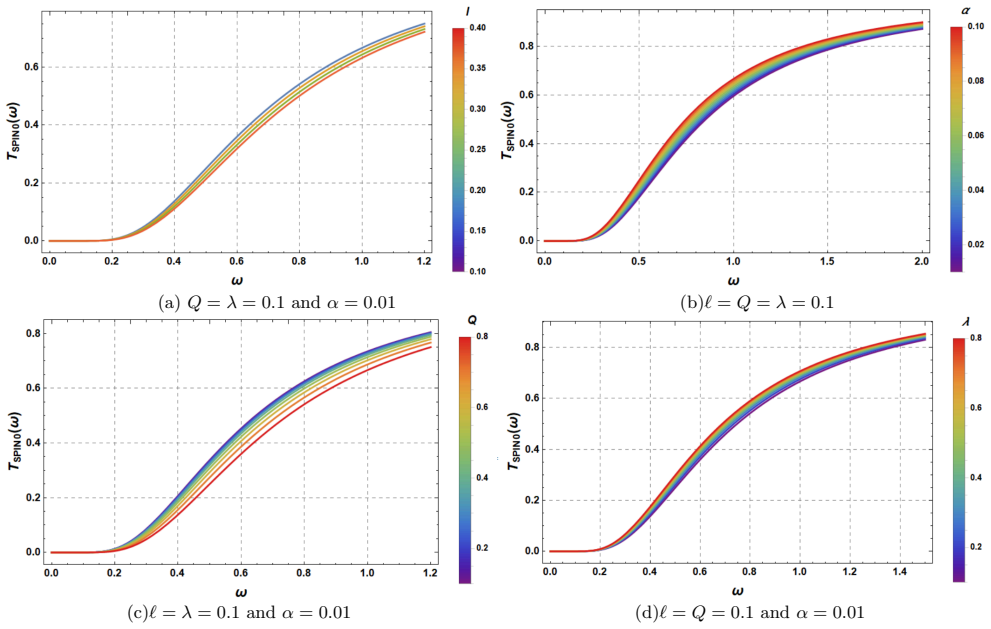
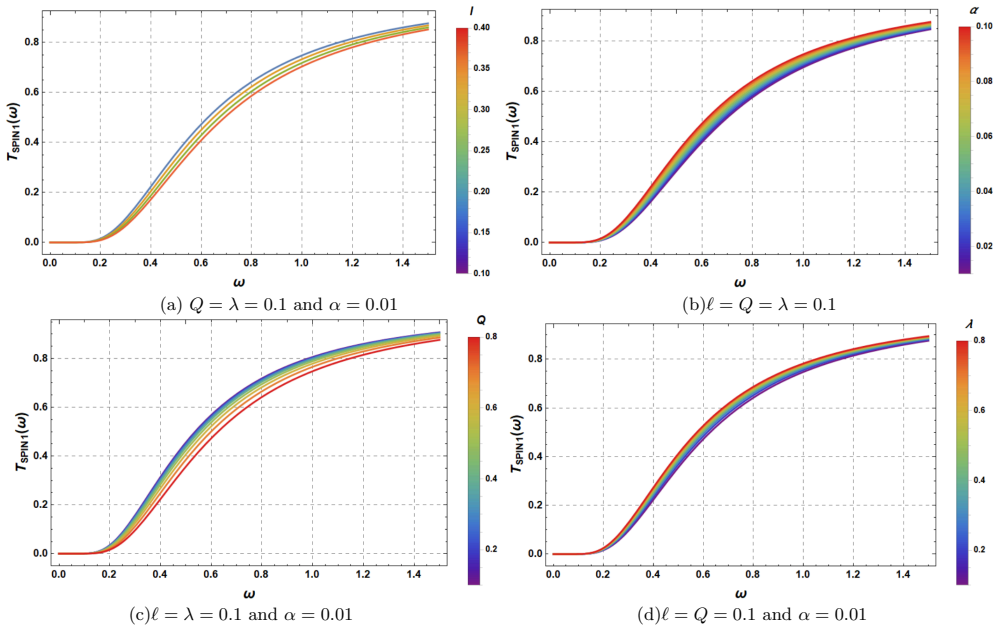
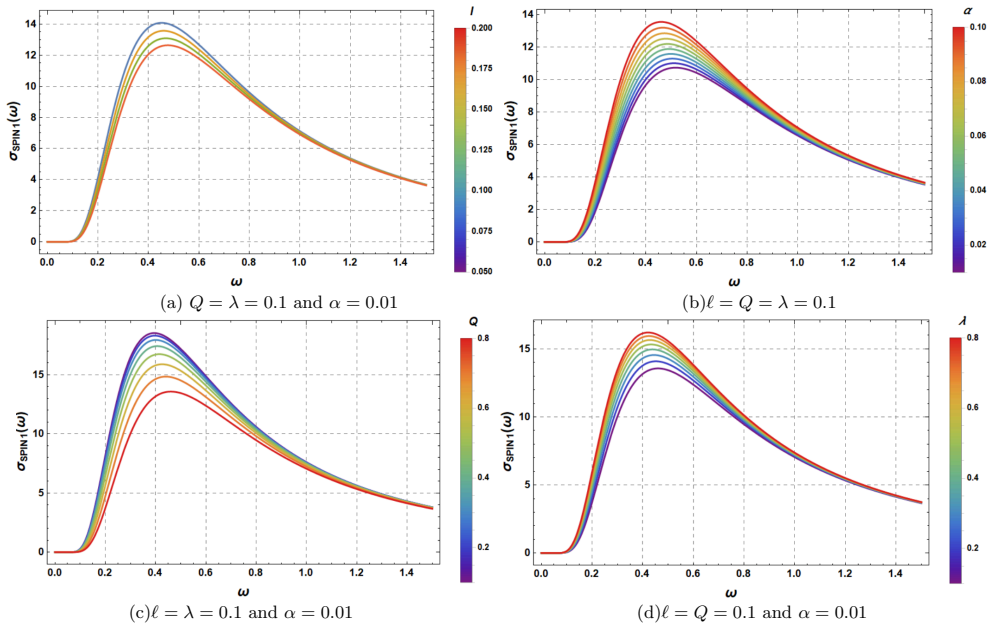
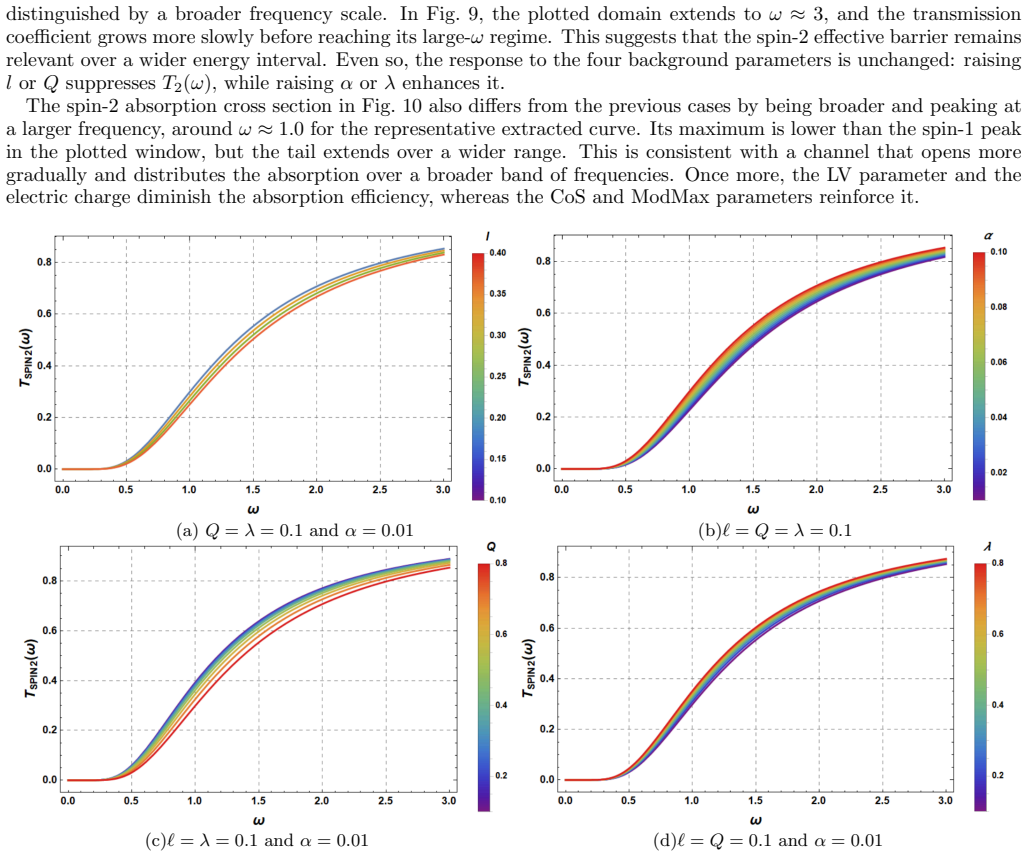
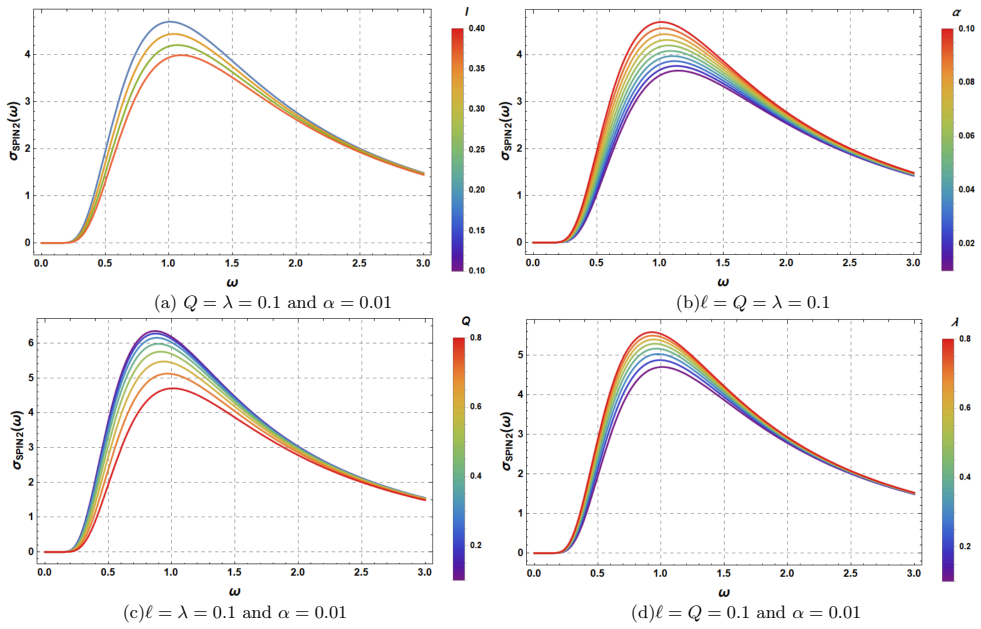
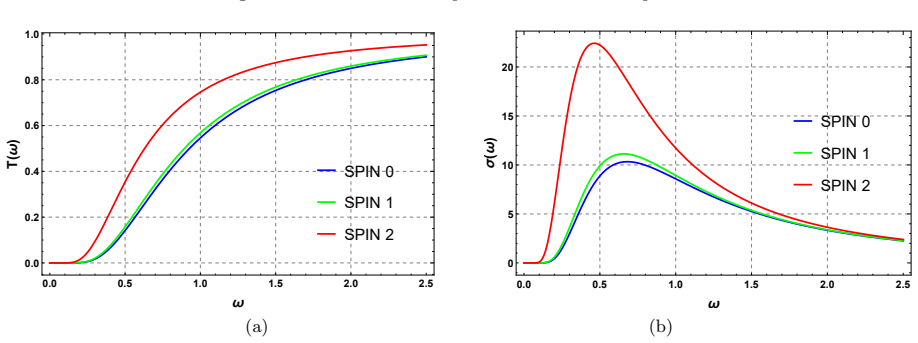
- Absorption probabilities for scalar fields, electromagnetic fields, and gravitons vary with the model parameters.
- Energy emission rates during Hawking radiation are affected, altering the black hole's evaporation process.
Where Pith is reading between the lines
- These results might allow constraints on bumblebee gravity parameters from future observations of black hole radiation spectra.
- Similar calculations could be applied to rotating versions of this black hole to study frame-dragging effects on greybody factors.
- The dependence on parameters suggests that string clouds could mimic or compete with other matter distributions in influencing black hole thermodynamics.
Load-bearing premise
The metric ansatz provides an exact solution to the Einstein-bumblebee field equations when coupled to the ModMax nonlinear electrodynamics and the cloud of strings source.
What would settle it
Direct verification that the given metric does not solve the field equations for nonzero values of the bumblebee or string cloud parameters, or observational data on black hole temperatures and emission spectra that cannot be matched by any choice of the model's parameters.
Figures



read the original abstract
In this article, we investigate the optical, thermodynamic, and scattering properties of a ModMax black hole surrounded by a cloud of strings within the framework of Einstein-bumblebee gravity. We then analyze in detail the thermodynamic properties of this black hole, including the Hawking temperature, entropy, and other relevant thermodynamic quantities, and examine the outcomes. Furthermore, we study the greybody factors (GFs) associated with the emission of various perturbative fields propagating in this black hole background. In particular, we consider spin-0 scalar fields, spin-1 electromagnetic fields, and spin-2 graviton fields, and evaluate the corresponding absorption probabilities and energy emission rates. Our analysis demonstrates how the optical features, thermodynamics and GFs depend on the underlying parameters of the system, such as the Lorentz symmetry violation parameter, the cloud of strings parameter, the ModMax parameter, the electric charge, and the black hole mass, thereby providing a comprehensive understanding of the physical effects of these parameters on the radiation and scattering processes around the black hole.
Editorial analysis
A structured set of objections, weighed in public.
Referee Report
Summary. The manuscript investigates the optical features, thermodynamic properties (Hawking temperature, entropy), and greybody factors for scalar (spin-0), electromagnetic (spin-1), and graviton (spin-2) perturbations of a ModMax black hole surrounded by a cloud of strings in Einstein-bumblebee gravity. It reports the dependence of these quantities on the Lorentz symmetry violation parameter, cloud of strings parameter, ModMax parameter, electric charge, and black hole mass.
Significance. If the background is confirmed as a valid solution, the work provides a parametric exploration of how Lorentz violation and nonlinear electrodynamics affect black hole thermodynamics and wave scattering in modified gravity. The analysis of greybody factors across three spin fields is a strength, offering a broader view of emission processes than single-field studies. Reproducible parameter scans and explicit dependence on multiple parameters are positive features.
major comments (2)
- [Metric ansatz] Metric ansatz section: The line element is stated as an exact solution of the Einstein-bumblebee equations with ModMax NED and cloud-of-strings stress-energy, yet no explicit substitution (Einstein tensor components equated to the total stress-energy) or derivation is shown. This verification is load-bearing for the Hawking temperature, entropy, and all greybody factor calculations that follow.
- [Thermodynamics and greybody factors] Thermodynamics and GF sections: The reported temperature, entropy, absorption probabilities, and energy emission rates are expressed as functions of the free parameters (Lorentz violation, string cloud density, ModMax coefficient), but the manuscript supplies no explicit derivations, error estimates, or reduction checks to known limits (e.g., vanishing Lorentz violation parameter). Without these, the claimed physical dependence cannot be independently verified.
minor comments (2)
- [Abstract] Abstract: The description of quantities computed is clear, but the methods for obtaining greybody factors (e.g., WKB, exact solution, or numerical) are not specified.
- [Figures] Figures: Captions should explicitly list the fixed parameter values used in each panel to improve reproducibility.
Simulated Author's Rebuttal
We thank the referee for the careful and constructive review of our manuscript. We address the major comments point by point below, agreeing where revisions are needed to improve verifiability while defending the core results on physical grounds.
read point-by-point responses
-
Referee: [Metric ansatz] Metric ansatz section: The line element is stated as an exact solution of the Einstein-bumblebee equations with ModMax NED and cloud-of-strings stress-energy, yet no explicit substitution (Einstein tensor components equated to the total stress-energy) or derivation is shown. This verification is load-bearing for the Hawking temperature, entropy, and all greybody factor calculations that follow.
Authors: We agree that the manuscript would benefit from an explicit verification step. The metric is constructed by solving the Einstein-bumblebee field equations sourced by the ModMax nonlinear electrodynamics stress-energy tensor plus the cloud-of-strings contribution, and it reduces correctly to known limits. However, we did not display the component-wise matching in the submitted version. In the revision we will add a dedicated subsection (or appendix) showing the non-vanishing Einstein tensor components and their direct equality to the total stress-energy tensor, thereby confirming the solution before proceeding to thermodynamics and greybody calculations. revision: yes
-
Referee: [Thermodynamics and greybody factors] Thermodynamics and GF sections: The reported temperature, entropy, absorption probabilities, and energy emission rates are expressed as functions of the free parameters (Lorentz violation, string cloud density, ModMax coefficient), but the manuscript supplies no explicit derivations, error estimates, or reduction checks to known limits (e.g., vanishing Lorentz violation parameter). Without these, the claimed physical dependence cannot be independently verified.
Authors: We accept that additional explicit derivations and limit checks are required for independent verification. The Hawking temperature follows from the standard surface-gravity formula evaluated at the outer horizon, and the entropy from the area law; greybody factors are computed via the WKB approximation applied to the spin-dependent effective potentials. In the revised manuscript we will insert the intermediate algebraic steps for temperature and entropy, include a brief error analysis of the WKB method, and add explicit reduction checks (e.g., setting the Lorentz-violation parameter to zero and recovering the ModMax-plus-strings results in Einstein gravity). These additions will make the parametric dependence transparent without altering the reported physical conclusions. revision: yes
Circularity Check
No significant circularity in derivation chain
full rationale
The paper states a metric ansatz as background and computes thermodynamic quantities, optical features, and greybody factors for scalar/EM/graviton fields using standard methods applied to that metric. These steps are direct evaluations of known expressions (Hawking temperature from surface gravity, absorption probabilities from wave equations, etc.) and the reported parameter dependence is the explicit goal of the analysis rather than a reduction to inputs by construction. No self-definitional steps, fitted quantities renamed as predictions, or load-bearing self-citations that collapse the central claim are present; the work is a conventional parametric study of a given solution.
Axiom & Free-Parameter Ledger
free parameters (3)
- Lorentz symmetry violation parameter
- cloud of strings parameter
- ModMax parameter
axioms (1)
- domain assumption The metric ansatz satisfies the Einstein-bumblebee field equations with the chosen nonlinear source
Lean theorems connected to this paper
-
IndisputableMonolith/Foundation/RealityFromDistinction.leanreality_from_one_distinction unclear?
unclearRelation between the paper passage and the cited Recognition theorem.
A(r) = 1−α−2M/r + 2(1+ℓ)Q²e^{-λ}/((2+ℓ)r²), B(r)=(1+ℓ)/A(r); thermodynamic quantities T_H, S=π√(1+ℓ)r_h², C_Q, sparsity η, greybody T_b(ω) = sech²(…)
-
IndisputableMonolith/Cost/FunctionalEquation.leanwashburn_uniqueness_aczel contradicts?
contradictsCONTRADICTS: the theorem conflicts with this paper passage, or marks a claim that would need revision before publication.
Metric function depends on Lorentz-violating parameter ℓ, cloud-of-strings α, ModMax λ, charge Q and mass M (three or more free parameters)
What do these tags mean?
- matches
- The paper's claim is directly supported by a theorem in the formal canon.
- supports
- The theorem supports part of the paper's argument, but the paper may add assumptions or extra steps.
- extends
- The paper goes beyond the formal theorem; the theorem is a base layer rather than the whole result.
- uses
- The paper appears to rely on the theorem as machinery.
- contradicts
- The paper's claim conflicts with a theorem or certificate in the canon.
- unclear
- Pith found a possible connection, but the passage is too broad, indirect, or ambiguous to say the theorem truly supports the claim.
Reference graph
Works this paper leans on
-
[1]
C. L. Fryer, Astrophys. J., 522(1), 413 (1999)
work page 1999
-
[2]
B. P. Abbott, et al. [LIGO Scientific and Virgo Collaborations], Phys. Rev. Lett.116, 061102 (2016)
work page 2016
-
[3]
R. Abbott, et al. [LIGO Scientific and Virgo Collaborations], Phys. Rev.D 102, 043015 (2020)
work page 2020
-
[4]
R. Abbott, et al. [LIGO Scientific and Virgo Collaborations], Phys. Rev. Lett.125, 101102 (2020)
work page 2020
- [5]
-
[6]
Akiyama, et al., (Event Horizon Telescope), Astrophys
K. Akiyama, et al., (Event Horizon Telescope), Astrophys. J. Lett.875, L1 (2019)
work page 2019
-
[7]
Akiyama, et al., (Event Horizon Telescope), Astrophys
K. Akiyama, et al., (Event Horizon Telescope), Astrophys. J. Lett.875, L5 (2019)
work page 2019
-
[8]
Akiyama, et al., (Event Horizon Telescope), Astrophys
K. Akiyama, et al., (Event Horizon Telescope), Astrophys. J. Lett.875, L6 (2019)
work page 2019
-
[9]
Akiyama, et al., (Event Horizon Telescope Collaboration), Astrophys
K. Akiyama, et al., (Event Horizon Telescope Collaboration), Astrophys. J. Lett.930, L12 (2022)
work page 2022
-
[10]
Akiyama, et al., (Event Horizon Telescope Collaboration), Astrophys
K. Akiyama, et al., (Event Horizon Telescope Collaboration), Astrophys. J. Lett.930, L17 (2022)
work page 2022
- [11]
-
[12]
Abuter, et al., (GRAVITY Collaboration), Astron
R. Abuter, et al., (GRAVITY Collaboration), Astron. Astrophys.657, L12 (2022)
work page 2022
-
[13]
J. P. Luminet, Astron. Astrophys.75, 228 (1979)
work page 1979
- [14]
-
[15]
R. Narayan, M. D. Johnson, and C. F. Gammie, Astrophys. J. Lett.885, L33 (2019)
work page 2019
- [16]
- [17]
-
[18]
S. Hu, C. Deng, D. Li, X. Wu, and E. Liang, Eur. Phys. J.C 82, 885 (2022)
work page 2022
-
[19]
S. Wen, W. Hong, and J. Tao, Eur. Phys. J.C 83, 277 (2023)
work page 2023
-
[20]
O. Y. Tsupko, Phys. Rev.D 95, 104058 (2017)
work page 2017
-
[21]
A. E. Broderick, et al., Astrophys. J.935, 61 (2022)
work page 2022
- [22]
-
[23]
F. Atamurotov, A. Abdujabbarov, and B. Ahmedov, Phys. Rev.D 88, 064004 (2013)
work page 2013
-
[24]
Abdujabbarov, et al., Astrophys
A. Abdujabbarov, et al., Astrophys. Space Sci.361, 226 (2016)
work page 2016
-
[25]
A. B. Abdikamalov, et al., Phys. Rev.D 100, 024014 (2019)
work page 2019
- [26]
-
[27]
F. Atamurotov, I. Hussain, G. Mustafa, and A. ¨Ovg¨ un, Chin. Phys.C 47, 025102 (2023)
work page 2023
- [28]
-
[29]
Belhaj, et al., Classical Quantum Gravity37, 215004 (2020)
A. Belhaj, et al., Classical Quantum Gravity37, 215004 (2020)
work page 2020
-
[30]
P. V. P. Cunha, et al., Phys. Lett.B 768, 373 (2017)
work page 2017
- [31]
-
[32]
R. Ling, H. Guo, H. Liu, X.-M. Kuang, and B. Wang, Phys. Rev.D 104, 104003 (2021)
work page 2021
- [33]
-
[34]
A. A. Ara´ ujo Filho, et al., Class. Quant. Grav.41, 055003 (2024)
work page 2024
- [35]
- [36]
- [37]
- [38]
- [39]
- [40]
- [41]
- [42]
-
[43]
G. Lambiase, R. C. Pantig, D. J. Gogoi, and A. ¨Ovg¨ un, Eur. Phys. J.C 83, 679 (2023)
work page 2023
- [44]
-
[45]
M. Khodadi, G. Lambiase, and D.F. Mota, J. Cosmol. Astropart. Phys.09, 028 (2021)
work page 2021
-
[46]
G. Panotopoulos, ´A. Rinc´ on, and I. Lopes, Phys. Rev.D 103(10), 104040 (2021)
work page 2021
-
[47]
B. Eslam Panah, S. Zare, and H. Hassanabadi, Eur. Phys. J.C 84, 259 (2024)
work page 2024
- [48]
-
[49]
S. R. Wu, B. Q. Wang, Z. W. Long, and Hao Chen, Phys. Dark Universe44, 101455 (2024)
work page 2024
-
[50]
R.C. Pantig, and A. ¨Ovg¨ un, J. Cosmol. Astropart. Phys.08, 056 (2022)
work page 2022
-
[51]
S. Capozziello, et al., J. Cosmol. Astropart. Phys.05, 027 (2023)
work page 2023
-
[52]
S. Capozziello, S. Zare, and H. Hassanabadi, arXiv:2311.12896v1 [gr-qc] (2023)
-
[53]
Z. Xu, X. Hou, X. Gong, and J. Wang, J. Cosmol. Astropart. Phys.09, 038 (2018)
work page 2018
-
[54]
R. A. Konoplya, and A. Zhidenko, Astrophys. J.933, 166 (2022)
work page 2022
- [55]
-
[56]
S. K. Jha, H. Barman, A. Rahaman, J. Cosmol. Astropart. Phys.2021, 036 (2021)
work page 2021
- [57]
- [58]
-
[59]
S. K. Jha, A. Rahaman, Eur. Phys. J.C 81, 345 (2021)
work page 2021
-
[60]
H. M. Wang, S. W. Wei, Eur. Phys. J. Plus137, 571 (2022)
work page 2022
-
[61]
K. M. Amarilo, M. B. F. Filho, A. A. A. Filho et al., Phys. Lett.B 855, 138785 (2024)
work page 2024
-
[62]
R. Karmakar, D. J. Gogoi, U. D. Goswami, Phys. Dark Univ.41, 101249 (2023)
work page 2023
-
[63]
Z. F. Mai, R. Xu, D. Liang, L. Shao, Phys. Rev.D 108, 024004 (2023)
work page 2023
-
[64]
Y. S. An, Phys. Dark Univ.45, 101520 (2024)
work page 2024
-
[65]
D. J. Gogoi, U. D. Goswami, J. Cosmol. Astropart. Phys.2022, 029 (2022)
work page 2022
- [66]
-
[67]
J. Z. Liu, W. D. Guo, S. W. Wei, Y. X. Liu, Eur. Phys. J.C 85, 145 (2025)
work page 2025
- [68]
- [69]
-
[70]
J. de Oliveira, et al., Class. Quantum Grav.42, 235018 (2025)
work page 2025
-
[71]
Y. P. Singh, J. Choudhury, T. I. Singh et al., Eur. Phys. J. Plus140, 1118 (2025)
work page 2025
- [72]
-
[73]
D. Flores-Alfonso, B.A. Gonz´ alez-Morales, R. Linares, M. Maceda, Phys. Lett.B 812, 136011 (2021)
work page 2021
- [74]
- [75]
- [76]
-
[77]
K. Lechner, P. Marchetti, A. Sainaghi, D.P. Sorokin, Phys. Rev.D 106, 016009 (2022)
work page 2022
-
[78]
J. Barrientos, A. Cisterna, N. Mora, A. V´ asquez, L. Zapata, Phys. Lett.B 834, 137447 (2022)
work page 2022
- [79]
- [80]
discussion (0)
Sign in with ORCID, Apple, or X to comment. Anyone can read and Pith papers without signing in.