Time-Dependent PDE-Constrained Optimization via Weak-Form Latent Dynamics
Pith reviewed 2026-05-21 04:24 UTC · model grok-4.3
The pith
Weak-form latent dynamics accelerate gradient-based optimization of time-dependent PDE systems with speedups of up to five orders of magnitude.
A machine-rendered reading of the paper's core claim, the machinery that carries it, and where it could break.
Core claim
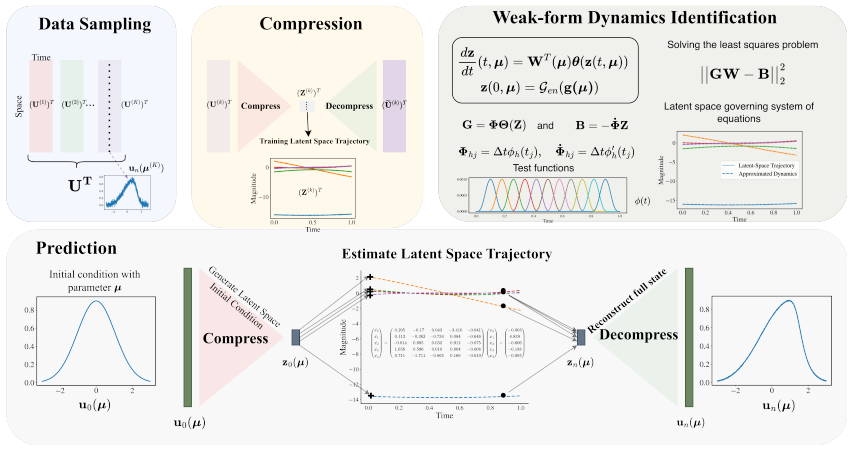
The framework builds on Weak-form Latent Space Dynamics Identification (WLaSDI) to compress high-dimensional solution trajectories into a low-dimensional latent representation and identify parametric latent dynamics using weak-form system identification. This avoids explicit numerical differentiation of training trajectories, improving robustness to noisy data and yielding more reliable surrogate dynamics. The resulting reduced PDE-constrained optimization problem is formulated with derived direct-sensitivity and adjoint-based gradient expressions for the learned latent dynamics, enabling scalable gradient evaluation with respect to design parameters. Demonstrations on thermal radiative hohl
What carries the argument
Weak-form Latent Space Dynamics Identification (WLaSDI), which compresses high-dimensional trajectories into a latent representation and identifies parametric dynamics via weak-form system identification to create a noise-robust surrogate for deriving optimization gradients.
If this is right
- The method produces accurate optimal designs for thermal radiative transfer, Vlasov-Poisson, and Burgers equation problems.
- Performance holds under noisy training data.
- Gradient evaluation scales efficiently through the latent-space formulation using either direct or adjoint methods.
- Computational cost drops by up to five orders of magnitude relative to full-order optimization.
Where Pith is reading between the lines
- The same surrogate construction could be tested on other time-dependent systems such as optimal control of fluid flows or structural dynamics where full-order solves dominate the cost.
- Accuracy for parameter values far outside the training range would need separate verification to bound the domain of reliable use.
- Pairing the weak-form identification step with adaptive sampling of training trajectories could further reduce the number of full-order solves required upfront.
Load-bearing premise
The latent dynamics identified from weak-form system identification on training trajectories remain sufficiently accurate approximations of the full-order PDE behavior throughout the optimization search, including for unseen design parameters and under noisy data.
What would settle it
Simulate the full-order PDE at the design parameters returned by the latent optimization and compare the resulting objective value to the value predicted by the surrogate model; a large discrepancy would show that the latent approximation has failed to capture the true optimum.
Figures






read the original abstract
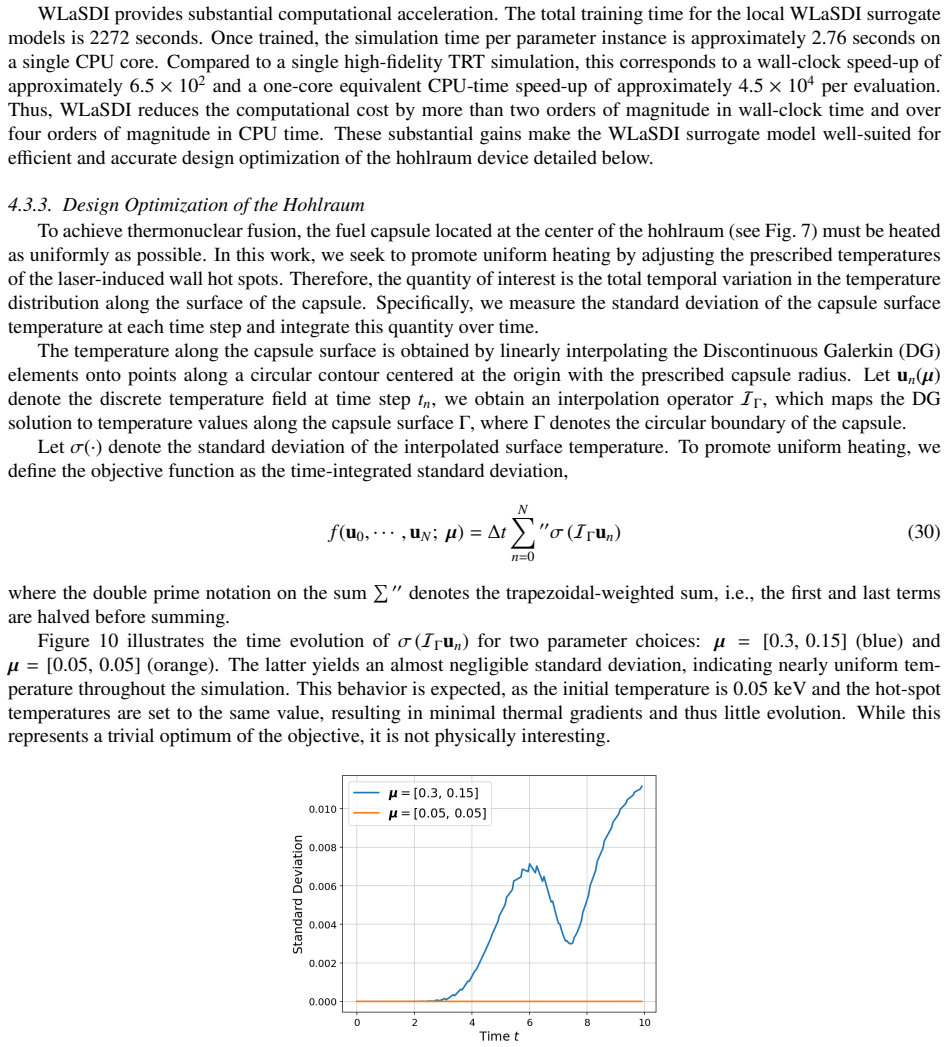
Optimization problems constrained by high-dimensional, time-dependent partial differential equations require repeated forward and sensitivity solves, making high-fidelity optimization computationally prohibitive in many-query design and control settings. We present a weak-form latent-space reduced-order modeling framework for accelerating gradient-based PDE-constrained optimization. The proposed approach builds on Weak-form Latent Space Dynamics Identification (WLaSDI), which compresses high-dimensional solution trajectories into a low-dimensional latent representation and identifies parametric latent dynamics using weak-form system identification. By avoiding explicit numerical differentiation of training trajectories, the weak-form improves robustness to noisy data and yields more reliable surrogate dynamics for optimization. We formulate the resulting reduced PDE-constrained optimization problem and derive both direct-sensitivity and adjoint-based gradient expressions for the learned latent dynamics, enabling scalable gradient evaluation with respect to design parameters. The framework is demonstrated on three time-dependent benchmark problems: thermal radiative transfer for optimal hohlraum design, the two-stream instability Vlasov-Poisson system, and the inviscid Burgers equation. Across these examples, WLaSDI produces accurate optimal designs, remains robust under noisy training data, and delivers substantial computational savings, including speedups of up to five orders of magnitude relative to full-order optimization. These results demonstrate that weak-form latent dynamics provide an efficient and noise-robust surrogate foundation for gradient-based optimization of complex time-dependent PDE systems.
Editorial analysis
A structured set of objections, weighed in public.
Referee Report
Summary. The manuscript introduces a weak-form latent-space reduced-order modeling framework based on Weak-form Latent Space Dynamics Identification (WLaSDI) to accelerate gradient-based optimization of time-dependent PDE-constrained problems. High-dimensional solution trajectories are compressed into a low-dimensional latent representation, parametric latent dynamics are identified via weak-form system identification to improve noise robustness by avoiding explicit differentiation, the reduced optimization problem is formulated, and both direct-sensitivity and adjoint-based gradient expressions are derived for the learned dynamics. The approach is demonstrated on three benchmarks—thermal radiative transfer for optimal hohlraum design, the two-stream instability Vlasov-Poisson system, and the inviscid Burgers equation—reporting accurate optimal designs, robustness under noisy training data, and speedups of up to five orders of magnitude relative to full-order optimization.
Significance. If the latent dynamics remain faithful approximations when the optimizer explores design parameters outside the training distribution, the framework would represent a meaningful advance for making otherwise prohibitive many-query PDE optimization problems tractable. Notable strengths include the weak-form identification step for noise robustness and the explicit derivation of scalable gradients in the reduced space. The empirical results across diverse time-dependent benchmarks provide concrete evidence of practical computational savings when the surrogate assumptions hold.
major comments (2)
- [Numerical experiments] Numerical experiments: The central claim that WLaSDI surrogates enable reliable gradient-based optimization with large speedups requires that the identified parametric latent dynamics accurately represent full-order PDE behavior for design parameters encountered during the search, including those outside the training trajectories. The reported results on the three benchmarks show final design accuracy and noise robustness but provide no explicit out-of-distribution validation, such as prediction-error monitoring on intermediate optimizer iterates or ablation studies on parameter ranges beyond the training set. This omission leaves open whether the observed performance stems from faithful surrogate behavior or from limited parameter exploration in the tested cases.
- [Gradient derivation] Gradient derivation for latent dynamics: The manuscript derives direct and adjoint gradients with respect to design parameters for the learned latent system, but it is unclear how these expressions handle the dependence on the parameters fitted during the weak-form system identification step itself. If the latent model coefficients are treated as fixed after training, the gradients may miss additional sensitivities that affect the optimization trajectory; a concrete statement of this assumption and its impact on the reported results would strengthen the derivation.
minor comments (1)
- [Abstract] The abstract states speedups of 'up to five orders of magnitude'; specifying which benchmark attains this figure and the precise baseline (full-order forward/adjoint solves) in the main text would improve clarity.
Simulated Author's Rebuttal
We thank the referee for the constructive comments and positive assessment of the framework's strengths in noise robustness and gradient derivations. We address each major comment below and will incorporate revisions to strengthen the presentation of the results.
read point-by-point responses
-
Referee: [Numerical experiments] Numerical experiments: The central claim that WLaSDI surrogates enable reliable gradient-based optimization with large speedups requires that the identified parametric latent dynamics accurately represent full-order PDE behavior for design parameters encountered during the search, including those outside the training trajectories. The reported results on the three benchmarks show final design accuracy and noise robustness but provide no explicit out-of-distribution validation, such as prediction-error monitoring on intermediate optimizer iterates or ablation studies on parameter ranges beyond the training set. This omission leaves open whether the observed performance stems from faithful surrogate behavior or from limited parameter exploration in the tested cases.
Authors: We agree that explicit out-of-distribution validation would provide stronger support for the reliability of the surrogates. In the reported benchmarks the optimization trajectories remained within or near the parameter ranges used to generate training data, yielding accurate final designs. To address the concern we will add monitoring of latent prediction errors on intermediate optimizer iterates for each benchmark and include an ablation study with design parameters extended beyond the original training set. These additions will appear in the revised manuscript. revision: yes
-
Referee: [Gradient derivation] Gradient derivation for latent dynamics: The manuscript derives direct and adjoint gradients with respect to design parameters for the learned latent system, but it is unclear how these expressions handle the dependence on the parameters fitted during the weak-form system identification step itself. If the latent model coefficients are treated as fixed after training, the gradients may miss additional sensitivities that affect the optimization trajectory; a concrete statement of this assumption and its impact on the reported results would strengthen the derivation.
Authors: We thank the referee for highlighting this point. The weak-form system identification is performed once during the offline training stage to obtain fixed latent dynamics coefficients; these coefficients are held constant during optimization. The derived direct and adjoint gradients are therefore taken with respect to the design parameters while treating the identified latent model as a fixed surrogate. This is the standard assumption in reduced-order surrogate optimization. We will add an explicit statement of the assumption and a short discussion of its implications in the gradient derivation section of the revised manuscript. revision: yes
Circularity Check
No significant circularity in the derivation chain
full rationale
The paper identifies a latent dynamics model via WLaSDI on training trajectories, then derives direct-sensitivity and adjoint gradient expressions for the reduced optimization problem with respect to design parameters. These gradient derivations operate on the already-identified surrogate and do not reduce by construction to the training data or to the optimization objective itself. No self-definitional steps, fitted-input predictions, or load-bearing self-citation chains appear in the central claims. The accuracy of the surrogate on unseen parameters is treated as an assumption to be validated empirically rather than enforced by definition. The framework is therefore self-contained against external benchmarks.
Axiom & Free-Parameter Ledger
Lean theorems connected to this paper
-
IndisputableMonolith/Cost/FunctionalEquation.leanwashburn_uniqueness_aczel unclear?
unclearRelation between the paper passage and the cited Recognition theorem.
We present a weak-form latent-space reduced-order modeling framework... builds on Weak-form Latent Space Dynamics Identification (WLaSDI), which compresses high-dimensional solution trajectories into a low-dimensional latent representation and identifies parametric latent dynamics using weak-form system identification.
-
IndisputableMonolith/Foundation/RealityFromDistinction.leanreality_from_one_distinction unclear?
unclearRelation between the paper passage and the cited Recognition theorem.
The latent dynamics are modeled explicitly through a surrogate ODE... dz/dt(t,μ) = W^T(μ) θ(z(t,μ))
What do these tags mean?
- matches
- The paper's claim is directly supported by a theorem in the formal canon.
- supports
- The theorem supports part of the paper's argument, but the paper may add assumptions or extra steps.
- extends
- The paper goes beyond the formal theorem; the theorem is a base layer rather than the whole result.
- uses
- The paper appears to rely on the theorem as machinery.
- contradicts
- The paper's claim conflicts with a theorem or certificate in the canon.
- unclear
- Pith found a possible connection, but the passage is too broad, indirect, or ambiguous to say the theorem truly supports the claim.
Reference graph
Works this paper leans on
-
[1]
N. V . Queipo, R. T. Haftka, W. Shyy, T. Goel, R. Vaidyanathan, P. Kevin Tucker, Surrogate-based analysis and optimization, Progress in Aerospace Sciences 41 (1) (2005) 1–28.doi:10.1016/j.paerosci.2005.02.001
-
[2]
A. I. Forrester, A. J. Keane, Recent advances in surrogate-based optimization, Progress in Aerospace Sciences 45 (1-3) (2009) 50–79.doi:10.1016/j.paerosci.2008.11.001
-
[3]
P. Benner, S. Gugercin, K. Willcox, A Survey of Projection-Based Model Reduction Methods for Parametric Dynamical Systems, SIAM Rev. 57 (4) (2015) 483–531.doi:10.1137/130932715
-
[4]
G. Berkooz, P. Holmes, J. L. Lumley, The Proper Orthogonal Decomposition in the Analysis of Turbulent Flows, Annu. Rev. Fluid Mech. 25 (1) (1993) 539–575.doi:10.1146/annurev.fl.25.010193.002543
-
[5]
G. Rozza, D. B. P. Huynh, A. T. Patera, Reduced Basis Approximation and a Posteriori Error Estimation for Affinely Parametrized Elliptic Coercive Partial Differential Equations: Application to Transport and Continuum Mechanics, Arch Computat Methods Eng 15 (3) (2008) 229–275.doi:10.1007/s11831-008-9019-9
-
[6]
M. Safonov, R. Chiang, A Schur method for balanced-truncation model reduction, IEEE Trans. Automat. Contr. 34 (7) (1989) 729–733.doi:10.1109/9.29399
-
[7]
G. E. Hinton, R. R. Salakhutdinov, Reducing the Dimensionality of Data with Neural Networks, Science 313 (5786) (2006) 504–507.doi:10.1126/science.1127647
-
[8]
X. Xie, G. Zhang, C. G. Webster, Non-Intrusive Inference Reduced Order Model for Fluids Using Deep Multi- step Neural Network, Mathematics 7 (8) (2019) 757.doi:10.3390/math7080757
-
[9]
T. Kadeethum, F. Ballarin, Y . Choi, D. O’Malley, H. Yoon, N. Bouklas, Non-intrusive reduced order model- ing of natural convection in porous media using convolutional autoencoders: Comparison with linear subspace techniques, Advances in Water Resources 160 (2022) 104098.doi:10.1016/j.advwatres.2021.104098
-
[10]
D. M. Copeland, S. W. Cheung, K. Huynh, Y . Choi, Reduced order models for Lagrangian hydrodynamics, Computer Methods in Applied Mechanics and Engineering 388 (2022) 114259.doi:10.1016/j.cma.2021. 114259
-
[11]
S. W. Cheung, Y . Choi, D. M. Copeland, K. Huynh, Local Lagrangian reduced-order modeling for the Rayleigh- Taylor instability by solution manifold decomposition, Journal of Computational Physics 472 (2023) 111655. doi:10.1016/j.jcp.2022.111655
-
[12]
R. Maulik, B. Lusch, P. Balaprakash, Non-autoregressive time-series methods for stable parametric reduced- order models, Phys. Fluids 32 (8) (2020) 087115.doi:10.1063/5.0019884. 25
-
[13]
D. Amsallem, C. Farhat, Interpolation Method for Adapting Reduced-Order Models and Application to Aeroe- lasticity, AIAA Journal 46 (7) (2008) 1803–1813.doi:10.2514/1.35374
-
[14]
T. Bui-Thanh, M. Damodaran, K. Willcox, Aerodynamic Data Reconstruction and Inverse Design Using Proper Orthogonal Decomposition, AIAA Journal 42 (8) (2004) 1505–1516.doi:10.2514/1.2159
-
[15]
S. A. McQuarrie, C. Huang, K. E. Willcox, Data-driven reduced-order models via regularised Operator Inference for a single-injector combustion process, Journal of the Royal Society of New Zealand 51 (2) (2021) 194–211. doi:10.1080/03036758.2020.1863237
- [16]
-
[17]
D. Amsallem, M. Zahr, Y . Choi, C. Farhat, Design optimization using hyper-reduced-order models, Struct Mul- tidisc Optim 51 (4) (2015) 919–940.doi:10.1007/s00158-014-1183-y
-
[18]
W. D. Fries, X. He, Y . Choi, LaSDI: Parametric Latent Space Dynamics Identification, Computer Methods in Applied Mechanics and Engineering 399 (2022) 115436.doi:10.1016/j.cma.2022.115436
-
[19]
K. Champion, B. Lusch, J. N. Kutz, S. L. Brunton, Data-driven discovery of coordinates and governing equa- tions, Proc. Natl. Acad. Sci. U.S.A. 116 (45) (2019) 22445–22451.doi:10.1073/pnas.1906995116
-
[20]
S. L. Brunton, J. L. Proctor, J. N. Kutz, Discovering governing equations from data by sparse identification of nonlinear dynamical systems, Proc. Natl. Acad. Sci. U.S.A. 113 (15) (2016) 3932–3937.doi:10.1073/pnas. 1517384113
-
[21]
X. He, Y . Choi, W. D. Fries, J. L. Belof, J.-S. Chen, gLaSDI: Parametric physics-informed greedy latent space dynamics identification, Journal of Computational Physics 489 (2023) 112267.doi:10.1016/j.jcp.2023. 112267
-
[22]
C. Bonneville, Y . Choi, D. Ghosh, J. L. Belof, GPLaSDI: Gaussian Process-based interpretable Latent Space Dynamics Identification through deep autoencoder, Computer Methods in Applied Mechanics and Engineering 418 (2024) 116535.doi:10.1016/j.cma.2023.116535
-
[23]
J. S. R. Park, S. W. Cheung, Y . Choi, Y . Shin, tLaSDI: Thermodynamics-informed latent space dynamics identi- fication, Comput. Methods Appl. Mech. Eng. 429 (2024) 117144.doi:10.1016/j.cma.2024.117144
-
[24]
R. Stephany, W. Anderson, Y . Choi, Higher-order lasdi: Reduced order modeling with multiple time derivatives, Computer Methods in Applied Mechanics and Engineering 455 (2026) 118890
work page 2026
-
[25]
R. Stephany, Y . Choi, Rollout-LaSDI: Enhancing the long-term accuracy of Latent Space Dynamics (2025). doi:10.48550/ARXIV.2509.08191
-
[26]
W. Anderson, S. W. Chung, Y . Choi, Sequential decoder training for improved latent space dynamics identifica- tion (2025).doi:10.48550/ARXIV.2510.03535
-
[27]
S. W. Chung, C. Miller, Y . Choi, P. Tranquilli, H. K. Springer, K. Sullivan, Latent space dynamics identification for interface tracking with application to shock-induced pore collapse, Journal of Computational Physics (2026) 114978
work page 2026
-
[28]
A. Tran, X. He, D. A. Messenger, Y . Choi, D. M. Bortz, Weak-form latent space dynamics identification, Computer Methods in Applied Mechanics and Engineering 427 (2024) 116998.doi:10.1016/j.cma.2024. 116998
-
[29]
X. He, A. Tran, D. M. Bortz, Y . Choi, Physics-Informed Active Learning With Simultaneous Weak-Form Latent Space Dynamics Identification, Numerical Meth Engineering 126 (1) (2025) e7634.doi:10.1002/nme.7634. 26
-
[30]
C. Bonneville, X. He, A. Tran, J. S. Park, W. Fries, D. A. Messenger, S. W. Cheung, Y . Shin, D. M. Bortz, D. Ghosh, J.-S. Chen, J. Belof, Y . Choi, A Comprehensive Review of Latent Space Dynamics Identification Algorithms for Intrusive and Non-Intrusive Reduced-Order-Modeling (2024).doi:10.48550/ARXIV.2403. 10748
-
[31]
D. M. Bortz, D. A. Messenger, V . Dukic, Direct Estimation of Parameters in ODE Models Using WENDy: Weak-Form Estimation of Nonlinear Dynamics, Bull Math Biol 85 (11) (2023) 110.doi:10.1007/ s11538-023-01208-6
work page 2023
-
[32]
N. Yamaleev, B. Diskin, E. Nielsen, Adjoint-Based Methodology for Time-Dependent Optimization, in: 12th AIAAISSMO Multidiscip. Anal. Optim. Conf., American Institute of Aeronautics and Astronautics, Victoria, British Columbia, Canada, 2008.doi:10.2514/6.2008-5857
-
[33]
M. Zahr, P.-O. Persson, An adjoint method for a high-order discretization of deforming domain conservation laws for optimization of flow problems, Journal of Computational Physics 326 (2016) 516–543.doi:10.1016/ j.jcp.2016.09.012
work page 2016
-
[34]
Shinbrot, On the Analysis of Linear and Nonlinear Systems, J
M. Shinbrot, On the Analysis of Linear and Nonlinear Systems, J. Fluids Eng. 79 (3) (1957) 547–551.doi: 10.1115/1.4013092
-
[35]
J. Loeb, G. Cahen, More about process identification, IEEE Trans. Automat. Contr. 10 (3) (1965) 359–361. doi:10.1109/TAC.1965.1098172
-
[36]
H. Preisig, D. Rippin, Theory and application of the modulating function method—I. Review and theory of the method and theory of the spline-type modulating functions, Computers & Chemical Engineering 17 (1) (1993) 1–16.doi:10.1016/0098-1354(93)80001-4
-
[37]
S. H. Rudy, S. L. Brunton, J. L. Proctor, J. N. Kutz, Data-driven discovery of partial differential equations, Sci. Adv. 3 (4) (2017) e1602614.doi:10.1126/sciadv.1602614
-
[38]
Y . Pantazis, I. Tsamardinos, A unified approach for sparse dynamical system inference from temporal measure- ments, Bioinformatics 35 (18) (2019) 3387–3396.doi:10.1093/bioinformatics/btz065
-
[39]
D. R. Gurevich, P. A. K. Reinbold, R. O. Grigoriev, Robust and optimal sparse regression for nonlinear PDE models, Chaos Interdiscip. J. Nonlinear Sci. 29 (10) (2019) 103113.doi:10.1063/1.5120861
-
[40]
H. Schaeffer, S. G. McCalla, Sparse model selection via integral terms, Phys. Rev. E 96 (2) (2017) 023302. doi:10.1103/PhysRevE.96.023302
-
[41]
Z. Wang, X. Huan, K. Garikipati, Variational system identification of the partial differential equations governing the physics of pattern-formation: Inference under varying fidelity and noise, Computer Methods in Applied Mechanics and Engineering 356 (2019) 44–74.doi:10.1016/j.cma.2019.07.007
-
[42]
P. A. K. Reinbold, D. R. Gurevich, R. O. Grigoriev, Using noisy or incomplete data to discover models of spatiotemporal dynamics, Phys. Rev. E 101 (1) (2020) 010203.doi:10.1103/PhysRevE.101.010203
-
[43]
D. A. Messenger, A. Tran, V . Dukic, D. M. Bortz, The Weak Form Is Stronger Than You Think, SIAM News 57 (8) (Oct. 2024)
work page 2024
-
[44]
D. A. Messenger, D. M. Bortz, Asymptotic consistency of the WSINDy algorithm in the limit of continuum data, IMA J. Numer. Anal. (2024) drae086doi:10.1093/imanum/drae086
-
[45]
A. Tran, D. M. Bortz, Weak Form Scientific Machine Learning: Test Function Construction for System Identifi- cation, SIAM J. Sci. Comput. (accepted) (2026).doi:10.48550/ARXIV.2507.03206
-
[46]
D. A. Messenger, D. M. Bortz, Weak SINDy: Galerkin-Based Data-Driven Model Selection, Multiscale Model. Simul. 19 (3) (2021) 1474–1497.doi:10.1137/20M1343166. 27
-
[47]
D. A. Messenger, D. M. Bortz, Weak SINDy for partial differential equations, Journal of Computational Physics 443 (2021) 110525.doi:10.1016/j.jcp.2021.110525
-
[48]
N. Rummel, D. A. Messenger, S. Becker, V . Dukic, D. M. Bortz, WENDy for Nonlinear-in-Parameters ODEs (2025).doi:10.48550/ARXIV.2502.08881
-
[49]
A. Chawla, D. M. Bortz, V . Dukic, Bias and Coverage Properties of the WENDy-IRLS Algorithm, in: B. Sri- raman (Ed.), Handbook of Visual, Experimental and Computational Mathematics, Springer Nature Switzerland, Cham, 2026, pp. 1–108.doi:10.1007/978-3-030-93954-0_86-1
- [50]
-
[51]
D. Messenger, G. Dwyer, V . Dukic, Weak-form inference for hybrid dynamical systems in ecology, J. R. Soc. Interface. 21 (221) (2024) 20240376.doi:10.1098/rsif.2024.0376
-
[52]
N. Heitzman-Breen, V . Dukic, D. M. Bortz, A Practical Identifiability Criterion Leveraging Weak-Form Param- eter Estimation, Bull Math Biol 88 (5) (2026) 70.doi:10.1007/s11538-026-01639-x
-
[53]
R. Lyons, V . Dukic, D. M. Bortz, Learning structured population models from data with WSINDy, PLoS Comput Biol 21 (12) (2025) e1013742.doi:10.1371/journal.pcbi.1013742
-
[54]
S. Minor, B. D. Elderd, B. Van Allen, D. M. Bortz, V . Dukic, Weak Form Learning for Mean-Field Partial Differential Equations: An Application to Insect Movement (2025).doi:10.48550/ARXIV.2510.07786
-
[55]
S. Minor, D. A. Messenger, V . Dukic, D. M. Bortz, Learning Physically Interpretable Atmospheric Models From Data With WSINDy, Journal of Geophysical Research: Machine Learning and Computation 2 (3) (2025) e2025JH000602.doi:10.1029/2025JH000602
-
[56]
G. Vasey, D. A. Messenger, D. M. Bortz, A. J. Christlieb, B. O’Shea, Influence of initial conditions on data- driven model identification and information entropy for ideal mhd problems, Journal of Computational Physics 524 (2025) 113719.doi:10.1016/j.jcp.2025.113719
-
[57]
D. Messenger, B. Southworth, H. Hammer, L. Chacon, Learning interpretable closures for thermal radiation transport in optically-thin media using WSINDy (2025).doi:10.48550/ARXIV.2510.11840
-
[58]
A. R. Conn, N. I. M. Gould, P. L. Toint, Trust Region Methods, Society for Industrial and Applied Mathematics, 2000.doi:10.1137/1.9780898719857
-
[59]
A. Wächter, L. T. Biegler, On the implementation of an interior-point filter line-search algorithm for large-scale nonlinear programming, Math. Program. 106 (1) (2006) 25–57.doi:10.1007/s10107-004-0559-y
-
[60]
P. E. Gill, W. Murray, M. A. Saunders, SNOPT: An SQP Algorithm for Large-Scale Constrained Optimization, SIAM Rev. 47 (1) (2005) 99–131.doi:10.1137/S0036144504446096
-
[61]
P. Virtanen, R. Gommers, T. E. Oliphant, M. Haberland, T. Reddy, D. Cournapeau, E. Burovski, P. Peterson, W. Weckesser, J. Bright, S. J. Van Der Walt, M. Brett, J. Wilson, K. J. Millman, N. Mayorov, A. R. J. Nelson, E. Jones, R. Kern, E. Larson, C. J. Carey, ˙I. Polat, Y . Feng, E. W. Moore, J. VanderPlas, D. Laxalde, J. Perk- told, R. Cimrman, I. Henriks...
-
[62]
T. M. Ragonneau, Model-Based Derivative-Free Optimization Methods and Software, Ph.D. thesis, The Hong Kong Polytechnic University, China (2022)
work page 2022
-
[63]
T. M. Ragonneau, Z. Zhang, COBYQA Version 1.1.3. 2025 (2025)
work page 2025
-
[64]
J. Nocedal, S. J. Wright, Numerical Optimization, 2nd Edition, Springer Series in Operations Research, Springer, New York, 2006
work page 2006
- [65]
-
[66]
G.-S. Jiang, C.-W. Shu, Efficient Implementation of Weighted ENO Schemes, Journal of Computational Physics 126 (1) (1996) 202–228.doi:10.1006/jcph.1996.0130
-
[67]
B. Carlson, K. Lathrop, L. A. S. Laboratory, Transport Theory: The Method of Discrete Ordinates, Los Alamos Scientific Laboratory of the University of California, 1965
work page 1965
-
[68]
E. W. Larsen, J. E. Morel, Advances in Discrete-Ordinates Methodology, Springer Netherlands, Dordrecht, 2010, pp. 1–84.doi:10.1007/978-90-481-3411-3_1
-
[69]
S. Olivier, W. Pazner, T. S. Haut, B. C. Yee, A family of independent Variable Eddington Factor methods with efficient preconditioned iterative solvers, Journal of Computational Physics 473 (2023) 111747.doi: 10.1016/j.jcp.2022.111747
-
[70]
R. Storn, K. Price, Differential Evolution – A Simple and Efficient Heuristic for global Optimization over Con- tinuous Spaces, Journal of Global Optimization 11 (4) (1997) 341–359.doi:10.1023/A:1008202821328
-
[71]
C. L. Lawson, R. J. Hanson, Solving Least Squares Problems, no. 15 in Classics in Applied Mathematics, SIAM, Philadelphia, 1995
work page 1995
-
[72]
R. H. Byrd, M. E. Hribar, J. Nocedal, An interior point algorithm for large-scale nonlinear programming, SIAM J. Optim. 9 (1999) 877–900
work page 1999
-
[73]
∂˜r0 ∂z0 #−1 ∂˜r0 ∂µi , ∂zn ∂µi =−
A. Iserles, A First Course in the Numerical Analysis of Differential Equations, 2nd Edition, Cambridge Univer- sity Press, 2008.doi:10.1017/CBO9780511995569. Appendix A. Interpolation of Coefficients Within the LaSDI framework, latent dynamics are governed by an ODE whose coefficient matrix may depend on the physical parameterµ∈ D. Given training dataS= n...
discussion (0)
Sign in with ORCID, Apple, or X to comment. Anyone can read and Pith papers without signing in.