Global space correlations of polarization, charge density, and electric field in electrolytes under the fixed-potential condition
Pith reviewed 2026-05-19 23:07 UTC · model grok-4.3
The pith
In thin electrolyte films between fixed-potential electrodes, polarization and electric field correlations develop global, volume-inverse components when thickness falls below the Debye length.
A machine-rendered reading of the paper's core claim, the machinery that carries it, and where it could break.
Core claim
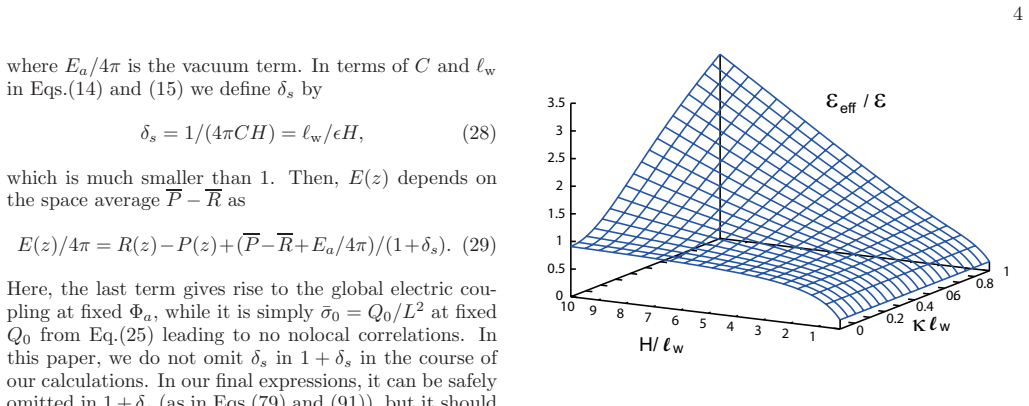
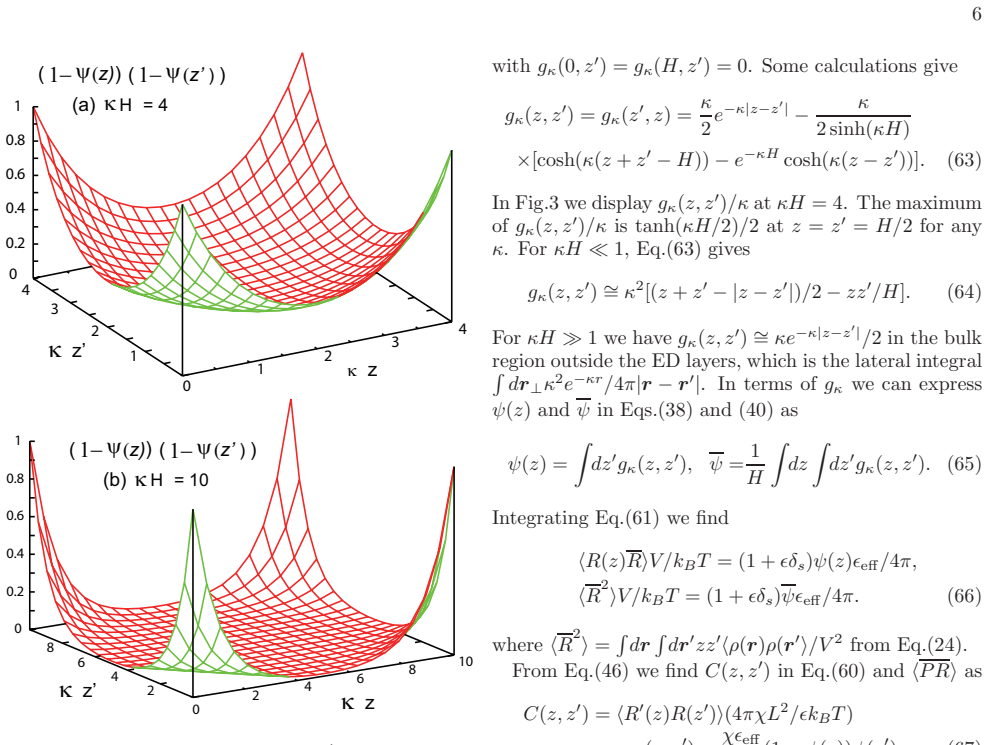
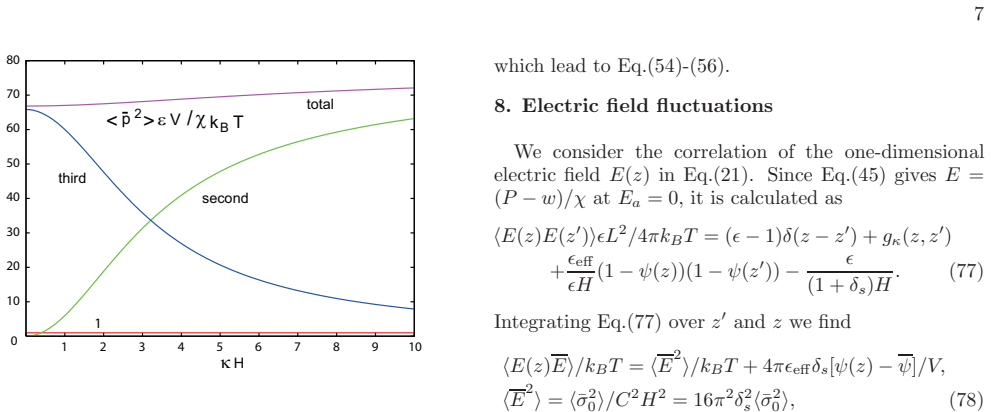
If the film thickness H is shorter than the Debye screening length κ^{-1}, the space correlation of the polarization p_z and the electric field E_z acquire global components inversely proportional to the film volume V, which vary slowly along z and are homogeneous in the xy plane. The areal charge density on each electrode surface also has a component homogeneous on the surface, which produces the global electric fluctuations. On the other hand, if H much exceeds κ^{-1}, the global correlations of p_z and ρ become small in the bulk region outside the electric double layers, but that of E_z remains almost unchanged by ions in the whole cell at fixed Φ_a. The dielectric constant ε_eff depends
What carries the argument
global components of the p_z and E_z space correlations that are inversely proportional to volume V and homogeneous in the xy plane, generated by homogeneous areal charge densities on the electrodes under fixed potential
If this is right
- The effective dielectric constant of the electrolyte can be obtained directly from equilibrium fluctuation variances of polarization, charge density, and nonlocal electrode charge.
- Global correlations dominate the dielectric response whenever the film thickness drops below the Debye screening length.
- In thick cells ions screen polarization and charge-density correlations in the bulk while the electric-field correlation across the whole cell remains essentially unchanged at fixed potential.
- Nonlocal surface-charge fluctuations on the electrodes control the overall dielectric behavior at fixed potential difference.
Where Pith is reading between the lines
- Capacitance or dielectric measurements on nanoscale electrolyte capacitors should display an anomalous thickness dependence arising from these global modes.
- The same mechanism may produce long-range effective interactions between charged particles confined in thin electrolyte layers.
- Molecular-dynamics simulations that enforce fixed electrode potentials can directly test the predicted 1/V scaling and transverse homogeneity of the correlations.
- The distinction between fixed-potential and fixed-charge boundaries becomes especially pronounced in fluctuation properties of confined electrolytes.
Load-bearing premise
The fixed-potential boundary condition permits a spatially homogeneous component of areal charge density on each metallic electrode that couples to and sustains the global interior fluctuations.
What would settle it
A measurement of the two-point correlation function of E_z or p_z in a confined electrolyte layer with H smaller than κ^{-1} that exhibits slow z-variation, xy-homogeneity, and amplitude scaling exactly as 1/V.
Figures




read the original abstract
We examine the thermal fluctuations of the polarization $p$, the charge density $\rho$, and the electric field $E$ in dilute electrolytes inserted between pararell metallic electrodes, where we fix the applied potential difference $\Phi_a$ between the two electrodes. If the film thickness $H$ is shorter than the Debye screening length $\kappa^{-1}$, the space correlation of the polarization $p_z$ and the electric field $E_z$ along the surface normal (in the $z$ direction) acuire global components inversely proportional to the film volume $V$, which vary slowly along the $z$ axis and are homogeneous in the $xy$ plane. The areal charge density on each electrode surface also has a component homogeneous on the surface, which produces the global electric fluctuations. On the other hand, if $H$ much exceeds $\kappa^{-1}$, the global correlations of $p_z$ and $\rho$ become small in the bulk region outside the electric double layers, but that of $E_z$ remains almost unchanged by ions in the whole cell at fixed $\Phi_a$. The dielectric constant $\epsilon_{\rm eff}$ depends on $H$ and $\kappa$ and is expressed in terms of the fluctuation variances of $p_z$ and $\rho$ and that of the noblocal surface charge density at fixed $\Phi_a$.
Editorial analysis
A structured set of objections, weighed in public.
Referee Report
Summary. The manuscript examines thermal fluctuations of the polarization p, charge density ρ, and electric field E in dilute electrolytes confined between parallel metallic electrodes held at a fixed applied potential difference Φ_a. When the film thickness H is shorter than the Debye screening length κ^{-1}, the space correlations of p_z and E_z acquire global components that scale inversely with the film volume V; these components vary slowly along z and are homogeneous in the xy plane. The areal charge density on each electrode is shown to possess a corresponding homogeneous component that sources these global fluctuations. For H ≫ κ^{-1} the global correlations of p_z and ρ become small outside the double layers while the E_z correlation persists throughout the cell. The effective dielectric constant ε_eff is expressed in terms of the fluctuation variances of p_z, ρ, and the nonlocal surface charge density under the fixed-Φ_a constraint.
Significance. If the central derivations hold, the work provides a fluctuation-based route to the thickness- and screening-dependent dielectric response of thin electrolyte films under potentiostatic conditions. This could be useful for interpreting capacitance measurements and molecular simulations of electrochemical interfaces in the thin-film limit, where global 1/V modes become prominent. The explicit connection between electrode charge fluctuations and interior field/polarization correlations is a potentially valuable technical result for the field.
major comments (2)
- [Abstract (and implied derivation of global correlations)] The central claim that a homogeneous (xy-independent) areal charge fluctuation on the electrodes produces the global 1/V components in <p_z(r)p_z(r')> and <E_z(r)E_z(r')> when H < κ^{-1} rests on the fixed-potential boundary condition admitting such a mode. The abstract does not supply the explicit solution of Poisson’s equation or the linear-response identities that demonstrate this mode survives without local compensating rearrangements that would cancel the volume-wide term. This assumption is load-bearing for both the correlation structure and the subsequent expression for ε_eff.
- [Abstract (expression for ε_eff)] The statement that ε_eff is expressed in terms of the fluctuation variances of p_z, ρ, and the nonlocal surface charge at fixed Φ_a risks circularity. Standard linear-response relations already link dielectric response to polarization fluctuations; without the explicit equations it is unclear whether the fixed-potential constraint introduces an independent result or merely reproduces a known identity. The manuscript should isolate the new contribution and show it is not tautological.
minor comments (2)
- [Abstract] The abstract contains several typographical errors: 'pararell' → 'parallel', 'acuire' → 'acquire', 'noblocal' → 'nonlocal'.
- [Abstract] The abstract summarizes results but provides neither error estimates, numerical checks against simulations, nor explicit limiting-case derivations. Adding these would improve verifiability even if they appear later in the text.
Simulated Author's Rebuttal
We thank the referee for the careful reading and constructive feedback on our manuscript. We address each major comment below with specific clarifications drawn from the full derivation. Where the presentation can be strengthened without altering the central results, we have revised the text accordingly.
read point-by-point responses
-
Referee: [Abstract (and implied derivation of global correlations)] The central claim that a homogeneous (xy-independent) areal charge fluctuation on the electrodes produces the global 1/V components in <p_z(r)p_z(r')> and <E_z(r)E_z(r')> when H < κ^{-1} rests on the fixed-potential boundary condition admitting such a mode. The abstract does not supply the explicit solution of Poisson’s equation or the linear-response identities that demonstrate this mode survives without local compensating rearrangements that would cancel the volume-wide term. This assumption is load-bearing for both the correlation structure and the subsequent expression for ε_eff.
Authors: We agree that the abstract is concise and does not reproduce the full derivation. In the main text (Sections 3 and 4), we solve Poisson’s equation explicitly under fixed-potential boundary conditions Φ=Φ_a at the electrodes. The homogeneous areal charge mode δσ (uniform in xy) is admissible because the potential constraint is global; any local compensating charge rearrangement would violate the fixed-Φ_a condition across the entire electrode. Linear-response identities (Eqs. 12–15) then show that the resulting 1/V term in the correlations of p_z and E_z is not canceled when H < κ^{-1}, as the Debye screening length exceeds the film thickness and cannot screen the uniform mode. We have expanded the abstract to include a one-sentence outline of this Poisson solution and added a short paragraph in the introduction referencing the relevant equations. revision: partial
-
Referee: [Abstract (expression for ε_eff)] The statement that ε_eff is expressed in terms of the fluctuation variances of p_z, ρ, and the nonlocal surface charge at fixed Φ_a risks circularity. Standard linear-response relations already link dielectric response to polarization fluctuations; without the explicit equations it is unclear whether the fixed-potential constraint introduces an independent result or merely reproduces a known identity. The manuscript should isolate the new contribution and show it is not tautological.
Authors: The concern is well taken. While fluctuation–dissipation theorems relate bulk dielectric response to polarization variance, the fixed-Φ_a ensemble introduces an additional global constraint that couples the electrode charge fluctuations to the interior fields. Our expression for ε_eff (Eq. 28) isolates this by including the variance of the nonlocal surface charge density, which vanishes in the canonical (fixed-charge) ensemble but is nonzero here. This yields an explicit H- and κ-dependence absent from standard bulk formulas. We have added a dedicated paragraph after Eq. 28 that contrasts the fixed-potential result with the fixed-charge case and demonstrates the non-tautological contribution arising from the global mode. revision: yes
Circularity Check
No significant circularity; derivation uses standard electrostatics and fluctuation-dissipation under fixed-potential BCs
full rationale
The paper derives global 1/V correlations in p_z and E_z for H < κ^{-1} from Poisson's equation with fixed-Φ_a boundary conditions on metallic electrodes, allowing a homogeneous surface charge mode. The ε_eff expression follows from standard linear-response identities relating dielectric response to polarization and charge variances (including nonlocal surface charge), which are independent of the specific thin-film geometry or ion model. No self-citation chains, ansatz smuggling, or fitted parameters renamed as predictions appear in the derivation chain. The central results are obtained by direct solution of the fluctuation equations rather than by construction from the target quantities.
Axiom & Free-Parameter Ledger
axioms (1)
- domain assumption Thermal fluctuations obey equilibrium statistical mechanics and linear response under the fixed-potential constraint.
Lean theorems connected to this paper
-
IndisputableMonolith/Foundation/AbsoluteFloorClosure.leanreality_from_one_distinction unclear?
unclearRelation between the paper passage and the cited Recognition theorem.
If the film thickness H is shorter than the Debye screening length κ^{-1}, the space correlation of the polarization p_z and the electric field E_z ... acquire global components inversely proportional to the film volume V ... The areal charge density on each electrode surface also has a component homogeneous on the surface, which produces the global electric fluctuations.
-
IndisputableMonolith/Cost/FunctionalEquation.leanwashburn_uniqueness_aczel unclear?
unclearRelation between the paper passage and the cited Recognition theorem.
the electrolyte free energy is given by ... ∫ dr [ |E|^2/8π + |p|^2/2χ + f_ion ] + ∫ dr⊥ fs - Φ_a Q_0
What do these tags mean?
- matches
- The paper's claim is directly supported by a theorem in the formal canon.
- supports
- The theorem supports part of the paper's argument, but the paper may add assumptions or extra steps.
- extends
- The paper goes beyond the formal theorem; the theorem is a base layer rather than the whole result.
- uses
- The paper appears to rely on the theorem as machinery.
- contradicts
- The paper's claim conflicts with a theorem or certificate in the canon.
- unclear
- Pith found a possible connection, but the passage is too broad, indirect, or ambiguous to say the theorem truly supports the claim.
Reference graph
Works this paper leans on
-
[1]
Debye P J W 1929 Polar Molecules (Chemical Catalog, New York)
work page 1929
-
[2]
Landau L D and Lifshitz E W 1984 Electrodynamics of Continuous Media (Pergamon, New York)
work page 1984
-
[3]
Robinson R A and Stokes R H 2002 Electrolyte Solutions , 2nd ed. (Dover: Mineola, NY)
work page 2002
-
[4]
Hautman J, Halley J W and Rhee Y J 1989 Molecular dynamics simulation of water between two ideal classical metal walls J. Chem. Phys. 91 467-472
work page 1989
-
[5]
Takae K and Onuki A 2015 Molecular dynamics simulation of water between metal walls under an electric field: Dielectric response and dynamics after field reversal J. Phys. Chem. B 119 9377
work page 2015
-
[6]
Takae K and Onuki A 2015 Fluctuations of local electric field and dipole moments in water between metal walls J. Chem. Phys. 143 154503
work page 2015
-
[7]
Willard A P, Reed S K, Madden P A and Chandler D 2009 Water at an electrochemical interface-a simulation study Faraday Discuss. 141 423-441
work page 2009
-
[8]
Itoh H and Sakuma H 2015 Dielectric constant of water as a function of separation in a slab geometry: A molecular dynamics study J. Chem. Phys. 142 184703
work page 2015
-
[9]
Matyushov D V 3021 Dielectric susceptibility in the interface J.Phys.Chem.B 125 8282-8293
- [10]
-
[11]
Geim A K et al 2018 Anomalously low dielectric constant of confined water Science 360 1339-1342
work page 2018
-
[12]
Hamann C H, Hamnett A and Vielstich W (2007) Electrochemistry (Wiley VCH)
work page 2007
-
[13]
Behrens S H and Grier D G (2001) The charge of glass and silica surfaces J. Chem. Phys. 115 6716
work page 2001
-
[14]
Velikonja A, Gongadze E, Kralj-Igli c V and Igli c A 2014 Charge dependent capacitance of Stern layer and capacitance of electrode-electrolyte interface Int. J. Electrochem. Sci. 9 5885-5894
work page 2014
-
[15]
Zhang C, Hutter J and Sprik W 2016 Computing the Kirkwood g-factor by combining constant Maxwell electric field and electric displacement simulations: Application to the dielectric constant of liquid water J. Phys. Chem. Lett. 7 2696-2701
work page 2016
-
[16]
Onuki A 2025 Static and dynamic theory of polarization under internal and directing electric fields: Fixed-charge and fixed-potential conditions J. Chem. Phys. 162 214105
work page 2025
-
[17]
Perram J W and Ratner M A 1996 Simulations at conducting interfaces: Boundary conditions for electrodes and electrolytes J. Chem. Phys. 104 5174
work page 1996
-
[18]
Yeh I -C and Berkowitz M L 1999 Dielectric constant of water at high electric fields: Molecular dynamics study J. Chem. Phys. 110 7935
work page 1999
-
[19]
Crozier P S, Rowley R L and Henderson D 2000 Molecular dynamics calculations of the electrochemical properties of electrolyte between charged electrodes J. Chem. Phys. 113 9202
work page 2000
-
[20]
Petersen M K, Kumar R, White H S and Voth G A 2012 A computationally efficient treatment of polarizable electrochemical cells held at a constant potential J. Phys. Chem. C 116 4903
work page 2012
-
[21]
Limmer D T, Merlet C, Salanne M, Chandler D, Madden P A, van Roij R and Rotenberg B 2013 Charge fluctuatins in nanoscale capacitors, Phys. Rev. Lett. 111 , 106102
work page 2013
-
[22]
Wang Z, Yang Y, Olmsted D L, Asta M and Laird B B 2014 Evaluation of the constant potential method in simulating electric double-layer capacitors J. Chem. Phys. 141 184102
work page 2014
-
[23]
Takae K and Onuki A 2013 Applying electric field to charged and polar particles between metallic plates: Extension of the Ewald method J. Chem. Phys. 139 124108
work page 2013
-
[24]
Haskins J B and Lawson J W 2016 Evaluation of molecular dynamics simulation methods for ionic liquid electric double layers J. Chem. Phys. 144 184707
work page 2016
-
[25]
dos Santos A P, Girotto M and Levin Y 2017 Simulations of Coulomb systems confined by polarizable surfaces using periodic Green functions J. Chem. Phys. 147 , 184105
work page 2017
-
[26]
Cox S J and Geissler P L 2022 Dielectric response of thin water films: A thermodynamic perspective Chem. Sci. 13 9102-9111
work page 2022
-
[27]
Takahashi K, Nakano H and Sato H 2022 Unified polarizable electrode models for open and closed circuits: Revisiting the effects of electrode polarization and different circuit conditions on electrode-electrolyte interfaces J. Chem. Phys. 157 014111
work page 2022
-
[28]
Tee S R and Searles D J 2023 Constant potential and constrained charge ensembles for simulations of conductive electrodes J. Chem. Theory Comput. 19 2758-2768
work page 2023
-
[29]
Dufils T, Sprik M and Salanne M 2021 Computational amperometry of nanoscale capacitors in molecular simulations J. Phys. Chem. Lett. 12 4357-4361
work page 2021
-
[30]
Tanaka Y, Sato H and Nakano H 2024 Computational dielectric spectroscopy on solid-solution interface by time-dependent voltage applied molecular dynamics simulation J. Chem. Phys. 160 144103
work page 2024
-
[31]
Reinauer A, Kondrat S and Holm C 2024 Electrolytes in conducting nanopores: Revisiting constant charge and constant potential simulations J. Chem. Phys. 161 104101
work page 2024
-
[32]
Cox S J and Sprik M 2019 Finite field formalism for bulk electrolyte solutions J. Chem. Phys. 151 0644506
work page 2019
-
[33]
Caillol J M 1992 Asymptotic behavior of the pair-correlation function of a polar fluid J. Chem. Phys. 96 7039-7053
work page 1992
-
[34]
Caillol J M, Levesque D and J. J. Weis J 1989 Electrical properties of polarizable ionic solutions. I. Theoretical aspects J. Chem. Phys. 91 5544-5554
work page 1989
-
[35]
de Leeuw S W, Perram J W and E. R. Smith E R 1986 Computer simulation of the static dielectric constant of systems with permanent dipole moments Ann. Rev. Phys. Chem. 37 245-270
work page 1986
-
[36]
Kusalik P G 1990 Computer simulation results for the dielectric properties of a highly polar fluid J. Chem. Phys. 93 3520-3535
work page 1990
-
[37]
Skaf M S, Fonseca T and Ladanyi B M 1993 Wave vector dependent dielectric relaxation in hydrogen-bonding liquids: A molecular dynamics study of methanol J. Chem. Phys. 98 8929-8945
work page 1993
-
[38]
Levy A, Orland H and Andelman D 2012 Dielectric constant of ionic solutions: A field-theory approach Phys. Rev. Lett. 108 227801
work page 2012
-
[39]
Fulton R L 2016 Linear and nonlinear dielectric theory for a slab: The connections between the phenomenological coefficients and the susceptibilities J. Chem. Phys. 145 084105
work page 2016
-
[40]
Ballengger V and Hansen J -P 2005 Dielectric permittivity profiles of confined fluids J. Chem. Phys. 122 114711
work page 2005
-
[41]
Onuki A 2020 Long-range correlations of polarization and number densities in dilute electrolytes J. Chem. Phys. 153 234501
work page 2020
-
[42]
Onuki A, Okamoto R and Araki T 2011 Phase transitions in soft matter induced by selective solvation Bull. Chem. Soc. Jpn. 84 569-587
work page 2011
-
[43]
Lebowitz J L, Percus J K and Verlet L 1967 Ensemble dependence of fluctuations with application to machine computations Phys. Rev. 153 250-254
work page 1967
-
[44]
Onuki A 2024 Extension of Kirkwood-Buff theory: Partial enthalpies, fluctuations of energy density, temperature, and pressure, and solute-induced effects in a mixture solvent J. Stat. Phys. 191 68
work page 2024
-
[45]
Onuki A 2024 Ions and dipoles in electric field: nonlinear polarization and field-dependent chemical reaction Eur. Phys. J. E. 47 :3
work page 2024
-
[46]
Ben-Yaakov D, Andelman D, Harries D and Podgornik R 2009 Ions in mixed dielectric solvents: density profiles and osmotic pressure between charged interfaces J. Phys. Chem. B 113 6001-6011
work page 2009
-
[47]
Kubo R 1957 Statistical mechanical theory of irreversible processes. I J. Phys. Soc. Jpn. 12 570-586
work page 1957
-
[48]
Kretschmer J R and Binder K 1979 Surface effects on phase transitions in ferroelectrics and dipolar magnets Phys. Rev.B 20 1065-1076
work page 1979
-
[49]
Bazant M Z, Thornton K and Ajdari A 2004 Diffuse-charge dynamics in electrochemical systems Phys. Rev. E 70 021506
work page 2004
-
[50]
Onuki A and Doi M 1992 Electric birefringence and dichroism in critical binary mixtures Europhys. Lett. 17 63-68
work page 1992
-
[51]
Siepmann J I and Sprik M 1995 Influence of surface topology and electrostatic potential on water / electrode systems J. Chem. Phys. 102 511-524
work page 1995
-
[52]
Abrashikin A, Andelman D and Orland H 2007 Dipolar Poisson-Boltzmann equations: Ions and dipoles close to 740 charge interfaces Phys. Rev. Lett. 99 077801
work page 2007
-
[53]
Lebowitz J L and Martin Ph A 1984 On Potential and Field Fluctuations in Classical Charged Systems, J. Stat. Phys. 34 287-311 Journal of Statistical Physics, Vol. 34, Nos. 1/2, 1984 Sum rules in charged fluids Ph. A. Martin Rev. Mod. Phys. 60, 1075-1127 ? Published 1 October, 1988 2mm Data availability : The data that support the findings of this study ar...
work page 1984
discussion (0)
Sign in with ORCID, Apple, or X to comment. Anyone can read and Pith papers without signing in.