Simulations of Particle-Laden Flows with Large Dispersed-Phase Size Disparities Using Highly Scalable Parallel Adaptive Methods
Pith reviewed 2026-05-21 05:58 UTC · model grok-4.3
The pith
A parallel adaptive octree framework couples lattice Boltzmann and immersed boundary methods to simulate flows with large particle size disparities.
A machine-rendered reading of the paper's core claim, the machinery that carries it, and where it could break.
Core claim
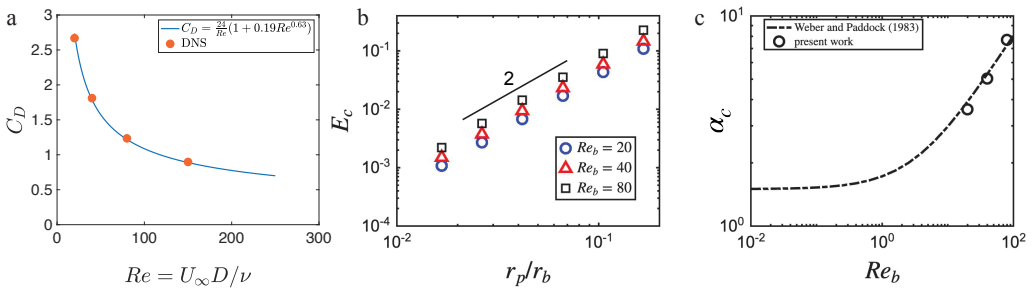
The framework couples the lattice Boltzmann method with the immersed boundary method on a dynamically adaptive octree grid and introduces a parallel host-cell searching algorithm to track large numbers of small particles. In quiescent flow, this setup captures the hydrodynamic interception mechanism and reproduces the theoretical collision efficiency scaling law proportional to the square of the particle-to-bubble size ratio. The same framework is then used for fully resolved bubbles interacting with inertial point particles in homogeneous isotropic turbulence.
What carries the argument
The parallel host-cell searching algorithm on distributed adaptive octree grids, which tracks Lagrangian points representing small particles while coupling to the immersed boundary method for large finite-size objects.
Load-bearing premise
The parallel host-cell searching algorithm correctly and efficiently tracks Lagrangian points for small particles without significant numerical errors or load imbalances when coupled to the immersed boundary method for large objects.
What would settle it
A simulation of bubble-particle collisions in quiescent flow that fails to reproduce the collision efficiency scaling law proportional to the square of the particle-to-bubble size ratio would show that the hydrodynamic interception mechanism is not accurately captured.
Figures



read the original abstract
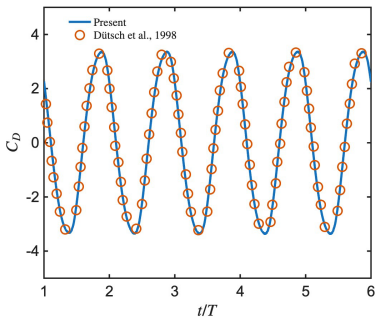
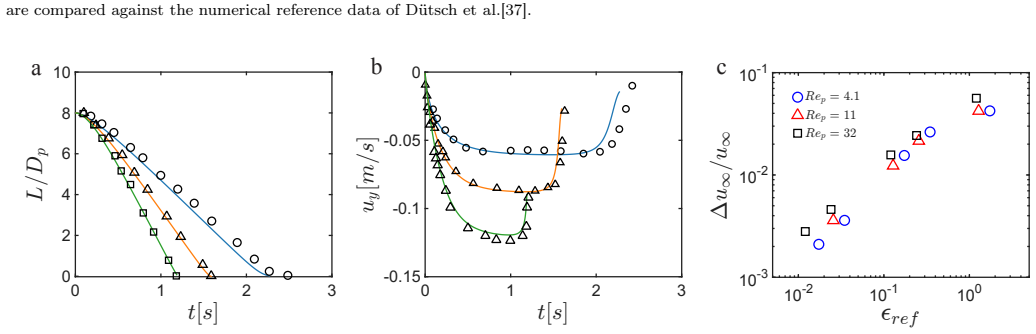
The numerical simulation of multiphase flows involving dispersed components with large scale disparities, such as the collisions between millimeter-sized bubbles and micron-sized mineral particles in flotation, poses a significant computational challenge. Accurately resolving the thin boundary layers of finite-size objects while tracking massive numbers of small particles within a large turbulent domain is often prohibitively expensive on uniform grids. To address this, we present a parallel scalable computational framework that couples the lattice Boltzmann method with the immersed boundary method on a dynamically adaptive octree grid. A key algorithm is developed for the efficient parallel host-cell searching, which significantly accelerates the tracking of Lagrangian points on distributed unstructured grids. The accuracy and robustness of the code are rigorously validated against canonical benchmarks, including the flow induced by an oscillating cylinder and the sedimentation of a sphere. The framework is applied to the multiscale problem of bubble-particle collisions. In quiescent flow, the simulations accurately capture the hydrodynamic interception mechanism, reproducing the theoretical collision efficiency scaling law proportional to the square of the particle-to-bubble size ratio. Furthermore, the framework is applied to the simulation of fully resolved bubbles interacting with inertial point particles in homogeneous isotropic turbulence.
Editorial analysis
A structured set of objections, weighed in public.
Referee Report
Summary. The manuscript presents a parallel scalable framework coupling the lattice Boltzmann method with the immersed boundary method on dynamically adaptive octree grids for multiphase flows with large dispersed-phase size disparities (e.g., millimeter bubbles and micron particles). A central algorithmic contribution is a parallel host-cell searching method to accelerate Lagrangian point tracking on distributed grids. The code is validated on canonical single-body problems (oscillating cylinder flow and sedimenting sphere) and then applied to bubble-particle collisions, where it is reported to reproduce the theoretical hydrodynamic interception scaling of collision efficiency proportional to the square of the particle-to-bubble size ratio in quiescent flow, together with fully resolved simulations in homogeneous isotropic turbulence.
Significance. If the accuracy claims hold, the work would provide a practical route to high-fidelity simulation of multiscale particle-laden flows that are currently limited by uniform-grid cost, with direct relevance to industrial processes such as flotation. The emphasis on distributed adaptive octrees and the new host-cell search algorithm addresses a genuine computational bottleneck; the reproduction of an independent theoretical scaling law is a positive indicator of fidelity when the supporting evidence is robust.
major comments (1)
- [Abstract and application to bubble-particle collisions] Abstract and bubble-particle collision results: the central claim that the simulations 'accurately capture the hydrodynamic interception mechanism' and reproduce the (r_p/r_b)^2 collision-efficiency scaling rests on the fidelity of Lagrangian trajectory integration near the immersed bubble surface. The only validations described are single-body benchmarks (oscillating cylinder, sedimenting sphere) that do not exercise the coupled IBM-Lagrangian system at the relevant scale disparity; no trajectory-error comparison against analytic Stokes flow around a sphere or grid-convergence study of computed efficiency versus r_p/r_b is reported. This leaves open the possibility that interpolation or load-balancing artifacts localized near the bubble could affect the distinction between colliding and non-colliding streamlines.
minor comments (1)
- [Abstract] The abstract states that accuracy is 'rigorously validated' yet provides no quantitative error norms, grid sizes, or figure references; adding these would improve clarity.
Simulated Author's Rebuttal
We thank the referee for the constructive and detailed review. The comments highlight an important aspect of validation for the coupled IBM-Lagrangian system under large scale disparities. We address the point below and will incorporate additional evidence in the revised manuscript.
read point-by-point responses
-
Referee: [Abstract and application to bubble-particle collisions] Abstract and bubble-particle collision results: the central claim that the simulations 'accurately capture the hydrodynamic interception mechanism' and reproduce the (r_p/r_b)^2 collision-efficiency scaling rests on the fidelity of Lagrangian trajectory integration near the immersed bubble surface. The only validations described are single-body benchmarks (oscillating cylinder, sedimenting sphere) that do not exercise the coupled IBM-Lagrangian system at the relevant scale disparity; no trajectory-error comparison against analytic Stokes flow around a sphere or grid-convergence study of computed efficiency versus r_p/r_b is reported. This leaves open the possibility that interpolation or load-balancing artifacts localized near the bubble could affect the distinction between colliding and non-colliding streamlines.
Authors: We agree that direct validation of Lagrangian trajectory accuracy near the immersed surface at the relevant scale disparity would strengthen the central claim. The oscillating-cylinder and sedimenting-sphere benchmarks confirm the accuracy of the IBM-LBM coupling and adaptive-grid resolution for single-body flows, while the parallel host-cell search algorithm is specifically constructed to maintain consistent interpolation and load balance for Lagrangian points on distributed octree meshes. The reproduction of the exact theoretical (r_p/r_b)^2 scaling in quiescent flow provides supporting evidence that systematic artifacts are not present, because any consistent bias in near-surface trajectories would be expected to alter the scaling. Nevertheless, to address the referee’s concern explicitly, we will add two new elements to the revised manuscript: (i) a quantitative comparison of computed particle trajectories against the analytic Stokes flow solution around a sphere, reporting trajectory-error norms as a function of grid resolution, and (ii) a grid-convergence study of collision efficiency for several r_p/r_b ratios, demonstrating that the measured efficiencies converge to the theoretical values with refinement. These results will be presented in a dedicated subsection of the bubble-particle collision results. revision: yes
Circularity Check
No significant circularity; central claims rest on independent benchmarks and external theory
full rationale
The paper develops a numerical method (LBM+IBM on adaptive octrees with new host-cell search) and validates it on external canonical cases (oscillating cylinder, sedimenting sphere). The key result is a simulation reproduction of the known analytic collision-efficiency scaling E ~ (r_p/r_b)^2 taken from independent hydrodynamic theory, not a derivation or fit performed inside the paper. No self-definitional equations, no parameters fitted to the target outputs then relabeled as predictions, and no load-bearing self-citations that close the argument on themselves. The derivation chain for the algorithm is self-contained against external benchmarks.
Axiom & Free-Parameter Ledger
axioms (2)
- domain assumption Lattice Boltzmann method with immersed boundary coupling accurately resolves hydrodynamic interactions around finite-size objects at the resolved scales.
- domain assumption Dynamically adaptive octree grids maintain sufficient resolution in boundary layers while remaining computationally tractable for large domains.
Reference graph
Works this paper leans on
-
[1]
W. W. Grabowski, L. P. Wang, Growth of cloud droplets in a turbulent environment, Annu. Rev. Fluid Mech. 45 (1) (2013) 293–324
work page 2013
-
[2]
N. Fan, Q. Zhong, R. Nie, X. Liu, Interaction of various-sized particles in river flow, Sci. Rep. 13 (1) (2023) 10503
work page 2023
-
[3]
V. Patočka, N. Tosi, E. Calzavarini, Residence time of inertial particles in 3D thermal convection: Implications for magma reservoirs, Earth Planet. Sci. Lett. 591 (2022) 117622
work page 2022
- [4]
- [5]
-
[6]
O. Kökkılıç, S. Mohammadi Jam, P. Chu, C. Marion, Y. Yang, K. E. Waters, Separation of plastic wastes using froth flotation–an overview, Adv. Colloid Interface Sci. 308 (2022) 102769
work page 2022
-
[7]
Uhlmann, An immersed boundary method with direct forcing for the simulation of particulate flows, J
M. Uhlmann, An immersed boundary method with direct forcing for the simulation of particulate flows, J. Comput. Phys. 209 (2) (2005) 448–476
work page 2005
-
[8]
Verzicco, Immersed boundary methods: Historical perspective and future outlook, Annu
R. Verzicco, Immersed boundary methods: Historical perspective and future outlook, Annu. Rev. Fluid Mech. 55 (1) (2023) 129–155
work page 2023
-
[9]
T. A. Johnson, V. C. Patel, Flow past a sphere up to a Reynolds number of 300, J. Fluid Mech. 378 (1999) 19–70
work page 1999
-
[10]
S. M. Guzik, T. H. Weisgraber, P. Colella, B. J. Alder, Interpolation methods and the accuracy of lattice-Boltzmann mesh refinement, J. Comput. Phys. 259 (2014) 461–487
work page 2014
-
[11]
C. Burstedde, L. C. Wilcox, O. Ghattas, p4est: Scalable algorithms for parallel adaptive mesh refinement on forests of octrees, SIAM J. Sci. Comput. 33 (3) (2011) 1103–1133
work page 2011
- [12]
-
[13]
S. Succi, The Lattice Boltzmann Equation: For Fluid Dynamics and Beyond, Oxford University Press, Oxford, 2001
work page 2001
-
[14]
K. Timm, H. Kusumaatmaja, A. Kuzmin, O. Shardt, G. Silva, E. Viggen, The Lattice Boltzmann Method: Principles and Practice, Cham, Switzerland: Springer International Publishing AG (2016). 17
work page 2016
-
[15]
E. Calzavarini, Eulerian–lagrangian fluid dynamics platform: the ch4-project, Software Impacts 1 (2019) 100002
work page 2019
-
[16]
V. Heuveline, J. Latt, The OpenLB project: an open source and object oriented implementation of lattice Boltzmann methods, Int. J. Mod. Phys. C 18 (04) (2007) 627–634
work page 2007
-
[17]
J. Latt, O. Malaspinas, D. Kontaxakis, A. Parmigiani, D. Lagrava, F. Brogi, M. B. Belgacem, Y. Thorimbert, S. Leclaire, S. Li, et al., Palabos: parallel lattice Boltzmann solver, Comput. Math. Appl. 81 (2021) 334–350
work page 2021
-
[18]
P. L. Bhatnagar, E. P. Gross, M. Krook, A model for collision processes in gases. i. small amplitude processes in charged and neutral one-component systems, Phys. Rev. 94 (3) (1954) 511
work page 1954
-
[19]
Z. Guo, C. Zheng, B. Shi, Discrete lattice effects on the forcing term in the lattice Boltzmann method, Phys. Rev. E 65 (4) (2002) 046308
work page 2002
-
[20]
Y. H. Qian, D. d’Humières, P. Lallemand, Lattice BGK models for Navier-Stokes equation, Europhys. Lett. 17 (6) (1992) 479–484
work page 1992
-
[21]
A. Fakhari, T. Lee, Finite-difference lattice Boltzmann method with a block-structured adaptive-mesh-refinement technique, Phys. Rev. E 89 (2014) 033310
work page 2014
-
[22]
A. Fakhari, T. Lee, Numerics of the lattice boltzmann method on nonuniform grids: Standard LBM and finite- difference LBM, Comput. Fluids 107 (2015) 205–213
work page 2015
-
[23]
D. Lagrava, O. Malaspinas, J. Latt, B. Chopard, Advances in multi-domain lattice Boltzmann grid refinement, J. Comput. Phys. 231 (14) (2012) 4808–4822
work page 2012
-
[24]
Y. Thorimbert, D. Lagrava, O. Malaspinas, B. Chopard, C. Coreixas, J. de Santana Neto, R. Deiterding, J. Latt, Local mesh refinement sensor for the lattice Boltzmann method, J. Comput. Sci. 64 (2022) 101864
work page 2022
- [25]
-
[26]
Chen, Volumetric formulation of the lattice Boltzmann method for fluid dynamics: Basic concept, Phys
H. Chen, Volumetric formulation of the lattice Boltzmann method for fluid dynamics: Basic concept, Phys. Rev. E 58 (3) (1998) 3955
work page 1998
- [27]
-
[28]
P. Neumann, T. Neckel, A dynamic mesh refinement technique for lattice Boltzmann simulations on octree-like grids, Comput. Mech. 51 (2) (2013) 237–253
work page 2013
-
[29]
F. Schornbaum, U. Rude, Massively parallel algorithms for the lattice Boltzmann method on nonuniform grids, SIAM J. Sci. Comput. 38 (2) (2016) C96–C126
work page 2016
-
[30]
M. Schönherr, K. Kucher, M. Geier, M. Stiebler, S. Freudiger, M. Krafczyk, Multi-thread implementations of the lattice Boltzmann method on non-uniform grids for cpus and gpus, Comput. Math. Appl. 61 (12) (2011) 3730–3743
work page 2011
- [31]
- [32]
-
[33]
C. S. Peskin, The immersed boundary method, Acta Numer. 11 (2002) 479–517
work page 2002
-
[34]
Z. G. Feng, E. E. Michaelides, Robust treatment of no-slip boundary condition and velocity updating for the lattice- Boltzmann simulation of particulate flows, Comput. Fluids 38 (2) (2009) 370–381
work page 2009
-
[35]
M.Bauer, S.Eibl, C.Godenschwager, N.Kohl, M.Kuron, C.Rettinger, F.Schornbaum, C.Schwarzmeier, D.Thönnes, H. Köstler, et al., walberla: A block-structured high-performance framework for multiphysics simulations, Comput. Math. Appl. 81 (2021) 478–501
work page 2021
-
[36]
M.Mehl, M.Lahnert, Adaptivegridimplementationforparallelcontinuummechanicsmethodsinparticlesimulations, Eur. Phys. J. Spec. Top. 227 (14) (2019) 1757–1778
work page 2019
- [37]
- [38]
-
[39]
A. ten Cate, C. H. Nieuwstad, J. J. Derksen, H. E. A. Van den Akker, Particle imaging velocimetry experiments and lattice-Boltzmann simulations on a single sphere settling under gravity, Phys. Fluids 14 (11) (2002) 4012–4025
work page 2002
-
[40]
Z. G. Feng, E. E. Michaelides, Proteus: a direct forcing method in the simulations of particulate flows, J. Comput. Phys. 202 (1) (2005) 20–51
work page 2005
-
[41]
T. Chan, C. S. Ng, D. Krug, Bubble–particle collisions in turbulence: insights from point-particle simulations, J. Fluid Mech. 959 (2023) A6
work page 2023
-
[42]
T. T. Chan, L. Jiang, D. Krug, A predictive model for bubble–particle collisions in turbulence, Chem. Eng. Sci. 321 (2026) 122850
work page 2026
-
[43]
J. Magnaudet, M. Rivero, J. Fabre, Accelerated flows past a rigid sphere or a spherical bubble. part 1. steady straining flow, J. Fluid Mech. 284 (1995) 97–135
work page 1995
-
[44]
V. L. Schiller, Uber die grundlegenden berechnungen bei der schwerkraftaufbereitung, Z. Vereines Deutscher Inge. 77 (1933) 318–321
work page 1933
-
[45]
M. E. Weber, D. Paddock, Interceptional and gravitational collision efficiencies for single collectors at intermediate Reynolds numbers, J. Colloid Interface Sci. 94 (2) (1983) 328–335
work page 1983
- [46]
-
[47]
P. Perlekar, L. Biferale, M. Sbragaglia, S. Srivastava, F. Toschi, Droplet size distribution in homogeneous isotropic turbulence, Phys. Fluids 24 (6) (2012) 065101
work page 2012
-
[48]
J. Jiménez, A. A. Wray, P. G. Saffman, R. S. Rogallo, The structure of intense vorticity in isotropic turbulence, J. Fluid Mech. 255 (1993) 65–90
work page 1993
- [49]
-
[50]
A. Chouippe, M. Uhlmann, Forcing homogeneous turbulence in direct numerical simulation of particulate flow with interface resolution and gravity, Phys. Fluids 27 (12) (2015) 123301. 19
work page 2015
discussion (0)
Sign in with ORCID, Apple, or X to comment. Anyone can read and Pith papers without signing in.