S, T, U Parameters in The B-LSSM
Pith reviewed 2026-05-23 06:37 UTC · model grok-4.3
The pith
The S, T, and U parameters are redefined for the B-L supersymmetric standard model to account for the local B-L gauge symmetry.
A machine-rendered reading of the paper's core claim, the machinery that carries it, and where it could break.
Core claim
Compared to the definitions of the S, T, and U parameters in the Standard Model based on the SU(2)_L ⊗ U(1)_Y group, the corresponding parameters in the local B-L gauge symmetry (B-LSSM) are modified. Using the pinch technique, one-loop vertices of weak interactions are computed and their pinch contributions are incorporated into the gauge boson self-energies. The redefined parameters converge and, within the low-energy effective Lagrangian, are expressed as functions of certain B-LSSM parameters, leading to strong constraints on the model's parameter space from updated experimental data.
What carries the argument
Redefined oblique parameters S, T, U obtained by incorporating pinch contributions from one-loop vertices into gauge boson self-energies under the local B-L gauge symmetry.
If this is right
- The redefined S, T, and U parameters remain finite after the pinch contributions are included.
- These parameters can be written directly as functions of B-LSSM parameters inside the low-energy effective weak Lagrangian.
- Current experimental data impose strong constraints on the allowed ranges of B-LSSM parameters.
- The modifications to S, T, and U originate specifically from the presence of the local B-L gauge symmetry.
Where Pith is reading between the lines
- The same pinch-technique procedure could be applied to other U(1) extensions to obtain model-specific oblique parameters.
- Precision electroweak fits performed with these new definitions may shift the preferred values of the B-L breaking scale.
- Future high-precision measurements at lepton colliders could directly test the modified expressions rather than the Standard Model ones.
Load-bearing premise
The pinch technique contributions from one-loop vertices can be directly incorporated into the gauge boson self-energies in the B-LSSM without introducing additional divergences or requiring further renormalization adjustments beyond those stated.
What would settle it
An explicit one-loop calculation in the B-LSSM that produces non-convergent results or requires extra counterterms after the pinch contributions are added would falsify the redefinition.
Figures


read the original abstract
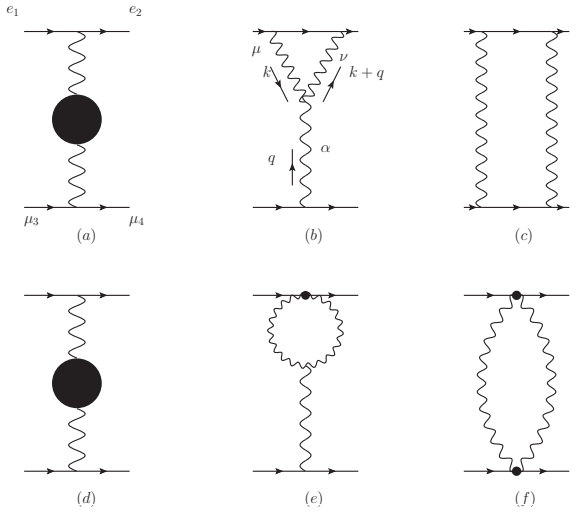
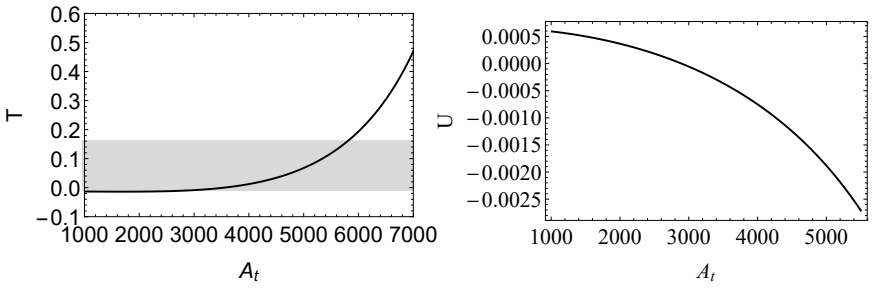
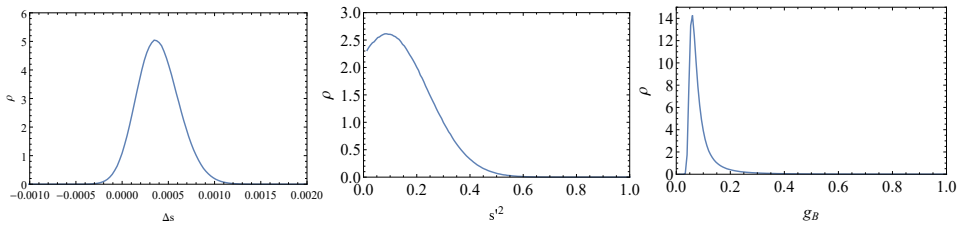
Using the pinch technique, we compute the one-loop vertices of weak interactions in the B-LSSM and incorporate their pinch contributions into the gauge boson self-energies. Compared to the definitions of the $S, T,$ and $U$ parameters in the Standard Model based on the $SU(2)_L \otimes U(1)_Y$ group, the corresponding parameters in the local B-L gauge symmetry (B-LSSM) are modified. We provide these redefined $S, T,$ and $U$ parameters and demonstrate the convergence of the results. In the framework of the low-energy effective Lagrangian for weak interactions, the $S, T,$ and $U$ parameters can be expressed as functions of certain parameters in the B-LSSM. The updated experimental and fitting results constrain the parameter space of the B-LSSM strongly.
Editorial analysis
A structured set of objections, weighed in public.
Referee Report
Summary. The manuscript redefines the electroweak oblique parameters S, T, and U in the B-LSSM by applying the pinch technique to one-loop weak-interaction vertices and folding the resulting pinch contributions into the gauge-boson self-energies. It supplies the modified expressions, demonstrates that the results remain finite, expresses the parameters as functions of B-LSSM inputs, and uses experimental fits to place constraints on the model parameter space.
Significance. If the redefinitions are free of additional divergences, the work supplies a concrete extension of the standard S, T, U formalism to a gauged U(1)_{B-L} model, enabling direct use of precision electroweak data to bound the extended gauge sector. The explicit demonstration of convergence is a methodological strength that could be reused in related BSM constructions.
major comments (2)
- [Abstract, §3 (pinch incorporation) and §4 (convergence demonstration)] The central claim that the redefined S, T, U remain well-defined observables rests on the assertion that pinch-technique vertex contributions from the U(1)_{B-L} gauge boson, its mixing with the SM Z, and the associated scalars/fermions do not generate new divergent structures. The manuscript must show explicitly (e.g., in the combined transverse self-energy expressions) that all 1/ε poles cancel beyond those already subtracted by SM-like counterterms; without this cancellation displayed term-by-term, the subsequent mapping to the low-energy effective Lagrangian is not justified.
- [§5 (low-energy effective Lagrangian and fits)] The fitting procedure that constrains B-LSSM parameters assumes the redefined S, T, U are the quantities directly comparable to experimental bounds. A consistency check is required: in the limit where all B-LSSM parameters that break the SM gauge structure are taken to zero, the expressions must reduce exactly to the standard SM definitions of S, T, U (including the usual SM one-loop contributions).
minor comments (2)
- [§2] Notation for the mixing angle between the SM Z and the new Z' should be introduced once and used consistently; the current text occasionally redefines it inline.
- [§4] The abstract states that convergence is demonstrated, yet the main text would benefit from a short table or plot showing the numerical size of residual cutoff dependence before and after inclusion of the pinch terms.
Simulated Author's Rebuttal
We thank the referee for the careful reading and constructive comments, which help strengthen the rigor of our presentation. We respond to each major comment below.
read point-by-point responses
-
Referee: [Abstract, §3 (pinch incorporation) and §4 (convergence demonstration)] The central claim that the redefined S, T, U remain well-defined observables rests on the assertion that pinch-technique vertex contributions from the U(1)_{B-L} gauge boson, its mixing with the SM Z, and the associated scalars/fermions do not generate new divergent structures. The manuscript must show explicitly (e.g., in the combined transverse self-energy expressions) that all 1/ε poles cancel beyond those already subtracted by SM-like counterterms; without this cancellation displayed term-by-term, the subsequent mapping to the low-energy effective Lagrangian is not justified.
Authors: We agree that an explicit term-by-term display of the 1/ε pole cancellation would improve clarity. Although the manuscript demonstrates overall finiteness after incorporating pinch contributions, the individual divergent pieces from the U(1)_{B-L} sector, mixing, scalars, and fermions are not listed separately. In the revised version we will add a short appendix (or subsection in §4) that isolates the divergent parts of each contribution to the transverse self-energies and shows their mutual cancellation beyond the SM counterterms. revision: yes
-
Referee: [§5 (low-energy effective Lagrangian and fits)] The fitting procedure that constrains B-LSSM parameters assumes the redefined S, T, U are the quantities directly comparable to experimental bounds. A consistency check is required: in the limit where all B-LSSM parameters that break the SM gauge structure are taken to zero, the expressions must reduce exactly to the standard SM definitions of S, T, U (including the usual SM one-loop contributions).
Authors: We concur that this limit is an essential consistency check. Our analytic expressions were constructed so that, when g_{B-L}→0, the Z–Z' mixing angle vanishes, and the new scalar vevs decouple, the additional B-L contributions disappear and the standard SM one-loop results for S, T, U are recovered. To make this explicit we will insert a brief paragraph (or short appendix) in the revised §5 that performs the limit term by term. revision: yes
Circularity Check
No significant circularity; redefinitions and constraints are independent of inputs
full rationale
The derivation computes pinch-technique vertex corrections, folds them into self-energies, redefines S/T/U for the extended gauge group, verifies finiteness, and writes the parameters as explicit functions of B-LSSM inputs before applying external experimental bounds. No quoted equation reduces a claimed result to a fitted input by construction, no self-citation is load-bearing for the central redefinition, and the mapping to low-energy observables uses standard effective-Lagrangian matching rather than tautological renaming. External data constraints are falsifiable and not internal to the derivation.
Axiom & Free-Parameter Ledger
Reference graph
Works this paper leans on
-
[1]
− ˆcW 2 ˆsW 2αT ˆcW 2 − ˆsW 2 )]f LC,W eν = − e√ 2 ˆsW (1 − αS 4( ˆcW 2 − ˆsW
-
[2]
+ ˆcW 2αT 2( ˆcW 2 − ˆsW
-
[3]
+ αU 8ˆs2 )W ± µ ¯fγ µPLf (38) Where ˆsW and ˆcW are defined by ˆsW ˆcWmZ = 1 2ev =sWcWmSM Z (39) Comparing Eq. (37) and Eq. (38), one can obtain: αT =2[ ˆsW ˆcW sWcW (c′ −s′c′s′(m2 Z ′ −m2 Z) c′2m2 Z +s′2m2 Z ′ ) − 1] αS =4 ˆcW 2 ˆsW 2αT + 4( ˆcW 2 − ˆsW 2)(s2 W − ˆsW 2 −s′ c′ c2 Wc′s′(m2 Z ′ −m2 Z) + xmZ mZ′ 2 c′2m2 Z +s′2m2 Z ′ ) αU =8 ˆsW 2( ˆsW sW − 1...
-
[4]
− ˆcW 2αT 2( ˆcW 2 − ˆsW
-
[5]
) (40) It can be demonstrated that the definition of ˆ cW is indeed equivalent to the the Sirlin definition [50], based on the values of mW andmZ. In comparison to the intrinsic definition of cW at the tree level, these can be connected by means of the equation : ∆s = ˆsW −sW ˆcW 2 = m2 W m2 Z c2 W = m2 W c′2mZ +s′2m2 Z ′ = 1 −s2 W = 1 − ˆsW 2 + 2 ˆsW ∆s = ˆ...
work page 2000
-
[6]
[ATLAS], ATLAS-CONF-2023-004
work page 2023
-
[7]
The Mass Spectra, Hierarchy and Cosmology of B-L MSSM Heterotic Compactifications
M. Ambroso and B. A. Ovrut, Int. J. Mod. Phys. A 26 (2011), 1569-1627 doi:10.1142/S0217751X11052943 [arXiv:1005.5392 [hep-t h]]
work page internal anchor Pith review Pith/arXiv arXiv doi:10.1142/s0217751x11052943 2011
-
[8]
P. Fileviez Perez and S. Spinner, Phys. Rev. D 83 (2011), 035004 doi:10.1103/PhysRevD.83.035004 [arXiv:1005.4930 [hep- ph]]
work page internal anchor Pith review Pith/arXiv arXiv doi:10.1103/physrevd.83.035004 2011
-
[9]
Minimal gauged U(1)_{B-L} model with spontaneous R-parity violation
V. Barger, P. Fileviez Perez and S. Spinner, Phys. Rev. Le tt. 102 (2009), 181802 doi:10.1103/PhysRevLett.102.181802 [arXiv:0812.3661 [ hep-ph]]
work page internal anchor Pith review Pith/arXiv arXiv doi:10.1103/physrevlett.102.181802 2009
-
[10]
Spontaneous R-Parity Breaking and Left-Right Symmetry
P. Fileviez Perez and S. Spinner, Phys. Lett. B 673 (2009), 251-254 doi:10.1016/j.physletb.2009.02.047 [arXiv:0811.3424 [ hep-ph]]
work page internal anchor Pith review Pith/arXiv arXiv doi:10.1016/j.physletb.2009.02.047 2009
-
[11]
J. L. Yang, T. F. Feng and H. B. Zhang, J. Phys. G 47, no.5, 055004 (2020) doi:10.1088/1361- 6471/ab7986 [arXiv:2003.09781 [hep-ph]]
-
[12]
J. L. Yang, H. B. Zhang, C. X. Liu, X. X. Dong and T. F. Feng, J HEP 08, 086 (2021) doi:10.1007/JHEP08(2021)086 [arXiv:2104.03542 [hep-ph ]]
-
[13]
J. L. Yang, T. F. Feng, S. M. Zhao, R. F. Zhu, X. Y. Yang and H. B. Zhang, Eur. Phys. J. C 78, no.9, 714 (2018) doi:10.1140/epjc/s10052-018-6174-5 [a rXiv:1803.09904 [hep-ph]]
work page internal anchor Pith review Pith/arXiv arXiv doi:10.1140/epjc/s10052-018-6174-5 2018
-
[14]
J. L. Yang, T. F. Feng, Y. L. Yan, W. Li, S. M. Zhao and H. B. Zh ang, Phys. Rev. D 99, no.1, 015002 (2019) doi:10.1103/PhysRevD.99.015002 [arX iv:1812.03860 [hep-ph]]
work page internal anchor Pith review Pith/arXiv arXiv doi:10.1103/physrevd.99.015002 2019
-
[15]
J. L. Yang, T. F. Feng, H. B. Zhang, G. Z. Ning and X. Y. Yang , Eur. Phys. J. C 78, no.6, 438 (2018) doi:10.1140/epjc/s10052-018-5919-5 [arXiv:1 806.01476 [hep-ph]]
-
[16]
Z. N. Zhang, H. B. Zhang, J. L. Yang, S. M. Zhao and T. F. Fen g, Phys. Rev. D 103, no.11, 115015 (2021) doi:10.1103/PhysRevD.103.115015 [arXiv:2 105.09799 [hep-ph]]
-
[17]
J. L. Yang, T. F. Feng, S. K. Cui, C. X. Liu, W. Li and H. B. Zh ang, JHEP 04, 013 (2020) doi:10.1007/JHEP04(2020)013 [arXiv:1910.05868 [hep-ph ]]
-
[18]
J. L. Yang, T. F. Feng and H. B. Zhang, Eur. Phys. J. C 80, no.3, 210 (2020) doi:10.1140/epjc/s10052-020-7753-9 [arXiv:2002.09313 [hep-ph]]
-
[19]
X. X. Dong, T. F. Feng, H. B. Zhang, S. M. Zhao and J. L. Yang , JHEP 12, 052 (2021) doi:10.1007/JHEP12(2021)052 [arXiv:2106.11084 [hep-ph ]]
-
[20]
X. X. Dong, T. F. Feng, S. M. Zhao and H. B. Zhang, Eur. Phys . J. C 80, no.12, 1206 (2020) 24 doi:10.1140/epjc/s10052-020-08768-0 [arXiv:2005.0335 1 [hep-ph]]
-
[21]
X. X. Dong, S. M. Zhao, J. P. Huo, T. T. Wang and T. F. Feng, P hys. Rev. D 109, no.5, 055019 (2024) doi:10.1103/PhysRevD.109.055019 [arXiv:2 402.19131 [hep-ph]]
-
[22]
J. L. Yang, Z. J. Yang, X. Y. Yang, H. B. Zhang and T. F. Feng , Eur. Phys. J. C 83, no.11, 1073 (2023) doi:10.1140/epjc/s10052-023-12235-x
-
[23]
D. D. Cui, T. F. Feng, Y. L. Yan, H. B. Zhang, G. Z. Ning and J . L. Yang, Phys. Rev. D 102, 075002 (2020) doi:10.1103/PhysRevD.102.075002 [arXiv:2 009.09598 [hep-ph]]
-
[24]
Search for Mono-Higgs Signals at the LHC in the B-L Supersymmetric Standard Model
W. Abdallah, A. Hammad, S. Khalil and S. Moretti, Phys. R ev. D 95 (2017) no.5, 055019 doi:10.1103/PhysRevD.95.055019 [arXiv:1608.07500 [hep -ph]]
work page internal anchor Pith review Pith/arXiv arXiv doi:10.1103/physrevd.95.055019 2017
-
[25]
C. S. Aulakh, A. Melfo, A. Rasin and G. Senjanovic, Phys. Lett. B 459 (1999), 557-562 doi:10.1016/S0370-2693(99)00708-X [arXiv:hep-ph/9902 409 [hep-ph]]
-
[26]
Dark Matter in B-L Extended MSSM Models
S. Khalil and H. Okada, Phys. Rev. D 79 (2009), 083510 doi:10.1103/PhysRevD.79.083510 [arXiv:0810.4573 [hep-ph]]
work page internal anchor Pith review Pith/arXiv arXiv doi:10.1103/physrevd.79.083510 2009
-
[27]
Naturalness and Dark Matter in the BLSSM
L. Delle Rose, S. Khalil, S. J. D. King, C. Marzo, S. Moret ti and C. S. Un, Phys. Rev. D 96 (2017) no.5, 055004 doi:10.1103/PhysRevD.96.055004 [arX iv:1702.01808 [hep-ph]]
work page internal anchor Pith review Pith/arXiv arXiv doi:10.1103/physrevd.96.055004 2017
-
[28]
The oblique parameters in multi-Higgs-doublet models
W. Grimus, L. Lavoura, O. M. Ogreid and P. Osland, Nucl. P hys. B 801, 81-96 (2008) doi:10.1016/j.nuclphysb.2008.04.019 [arXiv:0802.4353 [hep-ph]]
work page internal anchor Pith review Pith/arXiv arXiv doi:10.1016/j.nuclphysb.2008.04.019 2008
-
[29]
I. Maksymyk, C. P. Burgess and D. London, Phys. Rev. D 50, 529-535 (1994) doi:10.1103/PhysRevD.50.529 [arXiv:hep-ph/9306267 [he p-ph]]
work page internal anchor Pith review Pith/arXiv arXiv doi:10.1103/physrevd.50.529 1994
-
[30]
Curing the Ills of Higgsless Models: the S Parameter and Unitarity
G. Cacciapaglia, C. Csaki, C. Grojean and J. Terning, Ph ys. Rev. D 71, 035015 (2005) doi:10.1103/PhysRevD.71.035015 [arXiv:hep-ph/0409126 [hep-ph]]
work page internal anchor Pith review Pith/arXiv arXiv doi:10.1103/physrevd.71.035015 2005
-
[31]
L. Lavoura and J. P. Silva, Phys. Rev. D 47, 2046-2057 (1993) doi:10.1103/PhysRevD.47.2046
-
[32]
S. Haywood, P. R. Hobson, W. Hollik, Z. Kunszt, G. Azuelo s, U. Baur, J. van der Bij, D. Bourilkov, O. Brein and R. Casalbuoni, et al. doi:10.5170/CERN-2000-004.117 [arXiv:hep-ph/0003275 [hep-ph]]
work page internal anchor Pith review Pith/arXiv arXiv doi:10.5170/cern-2000-004.117 2000
-
[33]
Oblique Corrections from Higgsless Models in Warped Space
G. Cacciapaglia, C. Csaki, C. Grojean and J. Terning, Ph ys. Rev. D 70, 075014 (2004) doi:10.1103/PhysRevD.70.075014 [arXiv:hep-ph/0401160 [hep-ph]]
work page internal anchor Pith review Pith/arXiv arXiv doi:10.1103/physrevd.70.075014 2004
-
[34]
C. P. Burgess, S. Godfrey, H. Konig, D. London and I. Maks ymyk, Phys. Lett. B 326, 276-281 (1994) doi:10.1016/0370-2693(94)91322-6 [arXiv:hep-ph /9307337 [hep-ph]]
-
[35]
P. Asadi, C. Cesarotti, K. Fraser, S. Homiller and A. Par ikh, Phys. Rev. D 108, no.5, 055026 25 (2023) doi:10.1103/PhysRevD.108.055026 [arXiv:2204.05 283 [hep-ph]]
-
[36]
H. N. Long and T. Inami, Phys. Rev. D 61, 075002 (2000) doi:10.1103/PhysRevD.61.075002 [arXiv:hep-ph/9902475 [hep-ph]]
work page internal anchor Pith review Pith/arXiv arXiv doi:10.1103/physrevd.61.075002 2000
-
[37]
A. Pich, I. Rosell and J. J. Sanz-Cillero, JHEP 01, 157 (2014) doi:10.1007/JHEP01(2014)157 [arXiv:1310.3121 [hep-ph]]
work page internal anchor Pith review Pith/arXiv arXiv doi:10.1007/jhep01(2014)157 2014
-
[38]
M. E. Peskin and T. Takeuchi, Phys. Rev. D 46 (1992), 381-409 doi:10.1103/PhysRevD.46.381
-
[39]
D. C. Kennedy and B. W. Lynn, SLAC-PUB-4608
-
[40]
Pinch Technique: Theory and Applications
D. Binosi and J. Papavassiliou, Phys. Rept. 479 (2009), 1-152 doi:10.1016/j.physrep.2009.05.001 [arXiv:0909.2536 [h ep-ph]]
work page internal anchor Pith review Pith/arXiv arXiv doi:10.1016/j.physrep.2009.05.001 2009
-
[41]
The Background Field Method: Alternative Way of Deriving the Pinch Technique's Results
S. Hashimoto, J. Kodaira, Y. Yasui and K. Sasaki, Phys. R ev. D 50 (1994), 7066-7076 doi:10.1103/PhysRevD.50.7066 [arXiv:hep-ph/9406271 [h ep-ph]]
work page internal anchor Pith review Pith/arXiv arXiv doi:10.1103/physrevd.50.7066 1994
-
[42]
Application of the Background-Field Method to the electroweak Standard Model
A. Denner, G. Weiglein and S. Dittmaier, Nucl. Phys. B 440, 95-128 (1995) doi:10.1016/0550- 3213(95)00037-S [arXiv:hep-ph/9410338 [hep-ph]]
work page internal anchor Pith review Pith/arXiv arXiv doi:10.1016/0550- 1995
-
[43]
Gauge Invariance of Green Functions: Background-Field Method versus Pinch Technique
A. Denner, G. Weiglein and S. Dittmaier, Phys. Lett. B 333, 420-426 (1994) doi:10.1016/0370- 2693(94)90162-7 [arXiv:hep-ph/9406204 [hep-ph]]
work page internal anchor Pith review Pith/arXiv arXiv doi:10.1016/0370- 1994
-
[44]
The background-field formulation of the electroweak Standard Model
A. Denner, S. Dittmaier and G. Weiglein, Acta Phys. Polo n. B 27, 3645-3660 (1996) [arXiv:hep-ph/9609422 [hep-ph]]
work page internal anchor Pith review Pith/arXiv arXiv 1996
- [45]
-
[46]
Gauge Invariant Three-Boson Vertices in the Standard Model and the Static Properties of the W
J. Papavassiliou and K. Philippides, Phys. Rev. D 48, 4255-4268 (1993) doi:10.1103/PhysRevD.48.4255 [arXiv:hep-ph/9310210 [h ep-ph]]
work page internal anchor Pith review Pith/arXiv arXiv doi:10.1103/physrevd.48.4255 1993
-
[47]
G. Degrassi and A. Sirlin, Phys. Rev. D 46, 3104-3116 (1992) doi:10.1103/PhysRevD.46.3104
-
[48]
The Pinch Technique to All Orders
D. Binosi and J. Papavassiliou, Phys. Rev. D 66, 111901 (2002) doi:10.1103/PhysRevD.66.111901 [arXiv:hep-ph/0208189 [hep-ph]]
work page internal anchor Pith review Pith/arXiv arXiv doi:10.1103/physrevd.66.111901 2002
-
[49]
Pinch technique self-energies and vertices to all orders in perturbation theory
D. Binosi and J. Papavassiliou, J. Phys. G 30, 203 (2004) doi:10.1088/0954-3899/30/2/017 [arXiv:hep-ph/0301096 [hep-ph]]
work page internal anchor Pith review Pith/arXiv arXiv doi:10.1088/0954-3899/30/2/017 2004
-
[50]
A Gauge-Independent Approach to Resonant Transition Amplitudes
J. Papavassiliou and A. Pilaftsis, Phys. Rev. D 53, 2128-2149 (1996) doi:10.1103/PhysRevD.53.2128 [arXiv:hep-ph/9507246 [h ep-ph]]
work page internal anchor Pith review Pith/arXiv arXiv doi:10.1103/physrevd.53.2128 1996
-
[51]
Pinch Technique and the Batalin-Vilkovisky formalism
D. Binosi and J. Papavassiliou, Phys. Rev. D 66, 025024 (2002) doi:10.1103/PhysRevD.66.025024 [arXiv:hep-ph/0204128 [hep-ph]]
work page internal anchor Pith review Pith/arXiv arXiv doi:10.1103/physrevd.66.025024 2002
-
[52]
Gauge-Invariant Resummation Formalism for Two-Point Correlation Functions
J. Papavassiliou and A. Pilaftsis, Phys. Rev. D 54, 5315-5335 (1996) 26 doi:10.1103/PhysRevD.54.5315 [arXiv:hep-ph/9605385 [h ep-ph]]
work page internal anchor Pith review Pith/arXiv arXiv doi:10.1103/physrevd.54.5315 1996
-
[53]
Gauge independent transverse and longitudinal self-energies and vertices via the pinch technique
J. Papavassiliou, Phys. Rev. D 50 (1994), 5958-5970 doi:10.1103/PhysRevD.50.5958 [arXiv:hep-ph/9406258 [hep-ph]]
work page internal anchor Pith review Pith/arXiv arXiv doi:10.1103/physrevd.50.5958 1994
-
[54]
C. P. Burgess, S. Godfrey, H. Konig, D. London and I. Maks ymyk, Phys. Rev. D 49, 6115-6147 (1994) doi:10.1103/PhysRevD.49.6115 [arXiv:hep-ph/931 2291 [hep-ph]]
-
[55]
A. Sirlin, Phys. Rev. D 22, 971-981 (1980) doi:10.1103/PhysRevD.22.971
-
[56]
P. H. Chankowski, S. Pokorski and J. Wagner, Eur. Phys. J . C 47 (2006), 187-205 doi:10.1140/epjc/s2006-02537-3 [arXiv:hep-ph/0601097 [hep-ph]]
work page internal anchor Pith review Pith/arXiv arXiv doi:10.1140/epjc/s2006-02537-3 2006
-
[57]
G. Degrassi, B. A. Kniehl and A. Sirlin, Phys. Rev. D 48, R3963-R3966 (1993) doi:10.1103/PhysRevD.48.R3963
-
[58]
J. de Blas, M. Pierini, L. Reina and L. Silvestrini, Phys . Rev. Lett. 129, no.27, 271801 (2022) doi:10.1103/PhysRevLett.129.271801 [arXiv:2204.04204 [hep-ph]]. 27
discussion (0)
Sign in with ORCID, Apple, or X to comment. Anyone can read and Pith papers without signing in.