Coherent control of the Goos-H\"{a}nchen shift in Otto structure
Pith reviewed 2026-05-21 02:35 UTC · model grok-4.3
The pith
Replacing the air gap in an Otto structure with a coherently driven N-type atomic medium controls the sign and magnitude of the Goos-Hänchen shift.
A machine-rendered reading of the paper's core claim, the machinery that carries it, and where it could break.
Core claim
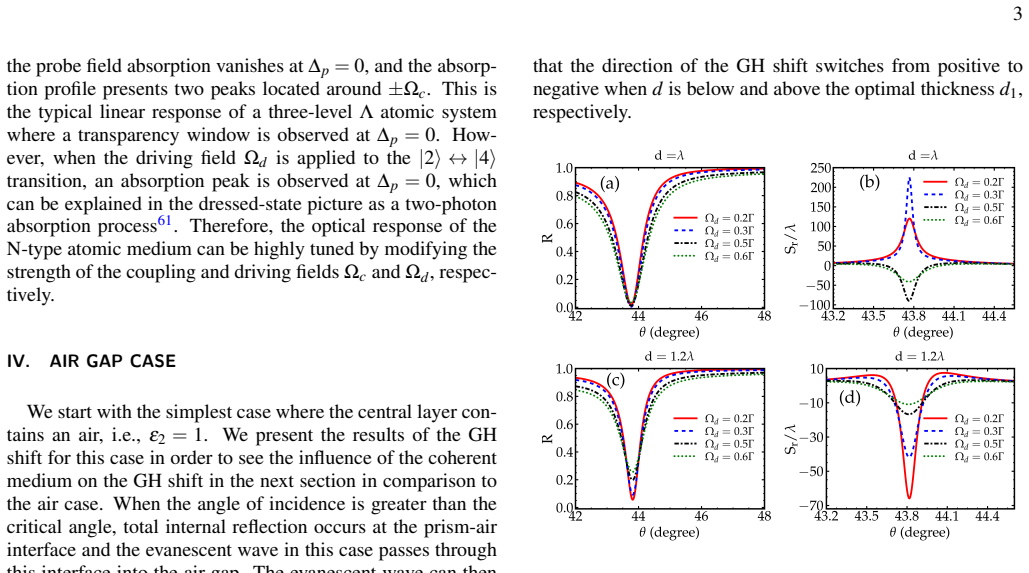
In the Otto structure with the air gap replaced by the N-type atomic medium, the sign and magnitude of the GH shift for TM-polarized light can be highly controlled by adjusting the strength of the coherent driving fields applied to the atomic medium, while the geometrical characteristics remain unchanged.
What carries the argument
The susceptibility of the N-type atomic medium calculated from density-matrix equations under coherent driving, which modifies the phase of the reflected field and thereby the Goos-Hänchen shift.
If this is right
- The GH shift can change sign depending on the driving field strengths.
- The magnitude of the shift can be varied continuously without altering the structure's dimensions.
- The atomic medium can be made transparent or absorptive by the driving fields.
- The control is achieved solely through optical fields rather than structural changes.
Where Pith is reading between the lines
- This control method could be applied to other beam shift effects in similar layered structures.
- Devices using this setup might enable tunable optical sensors or switches for light beam positioning.
- Future experiments could test the limits by including realistic losses at the interfaces.
Load-bearing premise
The susceptibility of the N-type atomic medium, computed from density-matrix equations, accurately sets the reflection phase shift in the Otto structure without unaccounted losses or interface effects.
What would settle it
Measuring the reflected beam's lateral displacement for varying driving field intensities and observing no variation in the GH shift's sign or magnitude would disprove the control mechanism.
Figures



read the original abstract
We investigate controlling the lateral Goos-H\"{a}nchen (GH) shift for a TM-polarized field reflected from Otto structure containing four level N-type atomic medium. The N-type atomic configuration can be formed by coupling the standard three-level $\Lambda$ system to an additional upper energy level through a coherent driving field. The medium can then be switched from transparent to absorptive under the effect of the driving field. In the Otto structure, an air gap typically separates a dielectric prism from a metal film. We show that the sign and magnitude of the GH shift can be highly controlled when the air gap is replaced by the coherent atomic medium. This can be achieved by adjusting the strength of the applied fields to the atomic medium, while the geometrical characteristics of the proposed structure are unchanged.
Editorial analysis
A structured set of objections, weighed in public.
Referee Report
Summary. The manuscript investigates coherent control of the Goos-Hänchen (GH) shift for TM-polarized light reflected from an Otto structure in which the air gap is replaced by an N-type four-level atomic medium. The central claim is that the sign and magnitude of the GH shift can be tuned by varying the Rabi frequencies of the coherent driving fields applied to the atomic medium, while the geometrical parameters (prism, gap thickness, metal film) remain fixed; this is achieved by inserting the steady-state susceptibility obtained from the density-matrix equations into the reflection coefficient of the multilayer stack.
Significance. If the calculations are robust, the work demonstrates a parameter-free geometric control mechanism that exploits atomic coherence to switch the medium between transparent and absorptive regimes, thereby modulating the reflection phase gradient. This could enable compact, electrically tunable beam shifters or sensors without mechanical adjustment of the Otto gap.
major comments (2)
- [§3] §3 (model and susceptibility): The derivation inserts the homogeneous susceptibility χ(ω) from the N-type density-matrix solution directly into the z-component of the wave vector inside the gap layer before computing the Fresnel or transfer-matrix reflection coefficient r(k_x). No quantitative estimate is given for local-field corrections, surface-polarization effects at the prism–medium and medium–metal interfaces, or propagation-induced phase accumulation across the finite gap thickness; any of these would modify the effective d arg(r)/d k_x without altering geometry or applied-field strengths.
- [§5] §5 (numerical results): The reported sign reversal and magnitude control of the GH shift are shown only for a discrete set of Rabi-frequency values; the manuscript provides neither a systematic scan over small detuning variations nor an error band arising from the steady-state approximation, making it difficult to assess whether the control remains load-bearing when realistic linewidths or weak propagation losses are included.
minor comments (2)
- [Figure 2] Figure 2 (level scheme): The N-type configuration is described in the text but the diagram omits the explicit labeling of the probe, coupling, and driving transitions; adding these labels would improve readability.
- [§4] Notation: The definition of the GH shift as –dφ/dk_x (with φ = arg(r)) is used throughout but is never restated with the explicit transfer-matrix expression for r; a single equation reference would eliminate ambiguity.
Simulated Author's Rebuttal
We thank the referee for the careful reading and constructive comments on our manuscript. We address each major comment below and have revised the manuscript to strengthen the presentation of the model and results.
read point-by-point responses
-
Referee: §3 (model and susceptibility): The derivation inserts the homogeneous susceptibility χ(ω) from the N-type density-matrix solution directly into the z-component of the wave vector inside the gap layer before computing the Fresnel or transfer-matrix reflection coefficient r(k_x). No quantitative estimate is given for local-field corrections, surface-polarization effects at the prism–medium and medium–metal interfaces, or propagation-induced phase accumulation across the finite gap thickness; any of these would modify the effective d arg(r)/d k_x without altering geometry or applied-field strengths.
Authors: We agree that a discussion of these effects improves the rigor of the model. In the revised manuscript we have added a paragraph in §3 that estimates the local-field correction via the Lorentz-Lorenz relation for the atomic densities employed (∼10^{12} cm^{-3}), finding a relative change in χ of less than 3 %. Surface-polarization contributions at the interfaces are argued to be negligible for the thin-gap Otto geometry, consistent with prior treatments of atomic media in multilayer stacks; we now cite two representative references. For propagation-induced phase across the gap we note that d ≪ λ and provide a short calculation showing the additional phase gradient contributes < 5 % to the GH shift under the chosen parameters. These clarifications are incorporated in the revised text and do not alter the central conclusions. revision: yes
-
Referee: §5 (numerical results): The reported sign reversal and magnitude control of the GH shift are shown only for a discrete set of Rabi-frequency values; the manuscript provides neither a systematic scan over small detuning variations nor an error band arising from the steady-state approximation, making it difficult to assess whether the control remains load-bearing when realistic linewidths or weak propagation losses are included.
Authors: We acknowledge that the original figures showed only selected Rabi-frequency points. The revised §5 now includes a continuous scan of the GH shift versus both Rabi frequencies and small detuning variations around the two-photon resonance. We have also added shaded error bands obtained by varying the decay rates and detunings within ±10 % of the nominal linewidths to represent realistic broadening and weak propagation losses. The sign reversal and magnitude tunability remain robust across this parameter range, as shown in the new figures and accompanying discussion. revision: yes
Circularity Check
No significant circularity; forward calculation from density-matrix susceptibility to reflection phase
full rationale
The paper derives the GH shift via the standard expression involving the derivative of the reflection phase with respect to the parallel wavevector. Susceptibility is obtained by solving the steady-state density-matrix equations for the driven N-type four-level system and inserted directly into the dielectric function of the gap layer in the Otto stack; the reflection coefficient follows from Fresnel or transfer-matrix boundary conditions. No parameter is fitted to the GH shift itself, no self-referential definition equates the output to an input, and no load-bearing self-citation or ansatz is invoked. The result is externally falsifiable by independent measurement of the shift under varied Rabi frequencies while holding geometry fixed.
Axiom & Free-Parameter Ledger
axioms (2)
- standard math Fresnel reflection coefficients and phase derivatives determine the GH shift in a multilayer stack.
- domain assumption The optical susceptibility of the four-level N-type system is obtained from steady-state density-matrix equations under coherent driving.
Lean theorems connected to this paper
-
IndisputableMonolith/Cost/FunctionalEquation.leanwashburn_uniqueness_aczel unclear?
unclearRelation between the paper passage and the cited Recognition theorem.
The linear susceptibility of the atomic medium χ=−β(d21d41−Ωd²)/[d31(d21d41−Ωd²)−d41Ωc²] … ε2=1+χ … r(θ,ωp,d)=r12+r23e^{2ikz2d}/(1+r12r23e^{2ikz2d}) … Sr=−(1/k√ε1cosθ)dφr/dθ
-
IndisputableMonolith/Foundation/DimensionForcing.leanalexander_duality_circle_linking unclear?
unclearRelation between the paper passage and the cited Recognition theorem.
We show that the sign and magnitude of the GH shift can be highly controlled when the air gap is replaced by the coherent atomic medium … by adjusting the strength of the applied fields … while the geometrical characteristics … are unchanged.
What do these tags mean?
- matches
- The paper's claim is directly supported by a theorem in the formal canon.
- supports
- The theorem supports part of the paper's argument, but the paper may add assumptions or extra steps.
- extends
- The paper goes beyond the formal theorem; the theorem is a base layer rather than the whole result.
- uses
- The paper appears to rely on the theorem as machinery.
- contradicts
- The paper's claim conflicts with a theorem or certificate in the canon.
- unclear
- Pith found a possible connection, but the passage is too broad, indirect, or ambiguous to say the theorem truly supports the claim.
Reference graph
Works this paper leans on
-
[1]
Ein neuer und fundamentaler Versuch zur Totalreflexion , author=. Annalen der Physik , volume=. 1947 , publisher=
work page 1947
-
[2]
Berechnung der Seitenversetzung des totalreflektierten Strahles , author=. Annalen der Physik , volume=. 1948 , publisher=
work page 1948
-
[3]
Optical temperature sensing based on the
Chen, Chih-Wei and Lin, Wen-Chi and Liao, Lu-Shing and Lin, Zheng-Hung and Chiang, Hai-Pang and Leung, Pui-Tak and Sijercic, Edin and Tse, Wan-Sun , journal=. Optical temperature sensing based on the. 2007 , publisher=
work page 2007
-
[4]
Optical heterodyne sensor using the
Hashimoto, Takaharu and Yoshino, Toshihiko , journal=. Optical heterodyne sensor using the. 1989 , publisher=
work page 1989
-
[5]
Yin, Xiaobo and Hesselink, Lambertus , journal=. Goos-H. 2006 , publisher=
work page 2006
-
[6]
Reflection-type 2 2 optical waveguide switch using the
Sakata, Tomomi and Togo, Hiroyoshi and Shimokawa, Fusao , journal=. Reflection-type 2 2 optical waveguide switch using the. 2000 , publisher=
work page 2000
-
[7]
Reflection-type space-division optical switch based on the electrically tuned
Wang, Xianping and Yin, Cheng and Sun, Jingjing and Gao, Jing and Huang, Meizhen and Cao, Zhuangqi , month =. Reflection-type space-division optical switch based on the electrically tuned. 2013 , journal =
work page 2013
- [8]
-
[9]
Direct measurement of the optical
Bretenaker, Fabien and Le Floch, Albert and Dutriaux, Laurent , journal =. Direct measurement of the optical. 1992 , month =
work page 1992
-
[10]
Pfleghaar, E. and Marseille, A. and Weis, A. , journal =. Quantitative Investigation of the Effect of Resonant Absorbers on the. 1993 , month =
work page 1993
-
[11]
Frustrated total reflection: The double-prism revisited , author =. Phys. Rev. E , volume =. 2001 , month =
work page 2001
-
[12]
Realization of large transmitted optical
Shihao Du and Wenjie Zhang and Wenzhe Liu and Yanbin Zhang and Maoxiong Zhao and Lei Shi , pages =. Realization of large transmitted optical. Nanophotonics , year =
-
[13]
Experimental proof on the effect of beam width and spatial coherence on
Zhu, Guiyuan and Gao, Binjie and Zhang, Junxiang and Wang, Li-Gang , journal=. Experimental proof on the effect of beam width and spatial coherence on. 2023 , publisher=
work page 2023
-
[14]
H. M. Lai and S. W. Chan , journal =. Large and negative
-
[15]
Physical review letters , volume=
Negative lateral shift of a light beam transmitted through a dielectric slab and interaction of boundary effects , author=. Physical review letters , volume=. 2003 , publisher=
work page 2003
-
[16]
Wang, Li-Gang and Chen, Hong and Zhu, Shi-Yao , journal=. Large negative. 2005 , publisher=
work page 2005
-
[17]
T. Tamir , journal =. Nonspecular phenomena in beam fields reflected by multilayered media , volume =
-
[18]
Prediction of simultaneously large and opposite generalized
Li, Chun-Fang and Wang, Qi , journal =. Prediction of simultaneously large and opposite generalized. 2004 , month =
work page 2004
-
[19]
Large positive and negative lateral optical beam shift in prism-waveguide coupling system , author =. Phys. Rev. E , volume =. 2006 , month =
work page 2006
-
[20]
Chen, Lin and Liu, Xuanbin and Cao, Zhuangqi and Zhuang, Songlin , year =. Mechanism of giant
-
[21]
Xinglin Wang and Ming Shen and An Jiang and Fanong Zheng , journal =. Lateral shifts and photon tunneling in a frustrated total internal reflection structure with a negative-zero-positive index metamaterial , volume =
-
[22]
Liujing Xiang and Weici Liu and Zhongchao Wei and Hongyun Meng and Hongzhan Liu and Jianping Guo and Yan Zhi and Zhenming Huang and Haoxian Li and Faqiang Wang , journal =. Strong enhancement of
-
[23]
Soboleva, IV and Moskalenko, VV and Fedyanin, AA , journal=. Giant. 2012 , publisher=
work page 2012
-
[24]
Applied Physics Letters , volume =
Song, Yu and Wu, Han-Chun and Guo, Yong , title =. Applied Physics Letters , volume =. 2012 , month =
work page 2012
-
[25]
Precise control of positive and negative
Zhou, Xiang and Liu, Shuoqing and Ding, Yiping and Min, Li and Luo, Zhaoming , journal=. Precise control of positive and negative. 2019 , publisher=
work page 2019
-
[26]
Xu, Yadong and Chan, Che Ting and Chen, Huanyang , journal=. 2015 , publisher=
work page 2015
-
[27]
Wen, Jisen and Zhang, Junxiang and Wang, Li-Gang and Zhu, Shi-Yao , journal=. 2017 , publisher=
work page 2017
-
[28]
Shadrivov, Ilya V. and Zharov, Alexander A. and Kivshar, Yuri S. , journal =. Giant
-
[29]
Applied Physics Letters , volume =
Wang, Li-Gang and Zhu, Shi-Yao , title =. Applied Physics Letters , volume =. 2005 , month =
work page 2005
-
[30]
Ye, Guangzhou and Zhang, Wenshuai and Wu, Weijie and Chen, Shizhen and Shu, Weixing and Luo, Hailu and Wen, Shuangchun , journal=. 2019 , publisher=
work page 2019
-
[31]
Effects of surface potentials on
Dongre, Ninad Kailas and Roychowdhury, Krishanu , journal=. Effects of surface potentials on. 2022 , publisher=
work page 2022
-
[32]
Fen Liu and Jingping Xu and Ge Song and Yaping Yang , journal =. 2013 , publisher =
work page 2013
-
[33]
Journal of Applied Physics , volume =
Identification of trivial and nontrivial insulators: Enhanced lateral shift in topological insulator-based cavity , author =. Journal of Applied Physics , volume =
- [34]
-
[35]
Resonantly enhanced refractive index without absorption via atomic coherence , author =. Phys. Rev. A , volume =. 1992 , month =
work page 1992
- [36]
-
[37]
Electromagnetically Induced Transparency , author =. Phys. Today , volume =
-
[38]
Electromagnetically induced transparency: Optics in coherent media , author =. Rev. Mod. Phys. , volume =. 2005 , month =
work page 2005
-
[39]
Wang, Li-Gang and Ikram, Manzoor and Zubairy, M Suhail , journal=. Control of the. 2008 , publisher=
work page 2008
-
[40]
Ziauddin, Qamar, Sajid and Zubairy, M Suhail , journal=. Coherent control of the. 2010 , publisher=
work page 2010
-
[41]
Ziauddin and Qamar, Sajid , journal=. Control of the. 2012 , publisher=
work page 2012
-
[42]
Ziauddin and Qamar, Sajid , journal=. Gain-assisted control of the. 2011 , publisher=
work page 2011
-
[43]
Ziauddin and Chuang, You-Lin and Lee, Ray-Kuang , journal=. Giant. 2015 , publisher=
work page 2015
-
[44]
Deng, Wen-Wu and Wu, Shao-Ping and Li, Gao-Xiang , journal=. Enhancement of the. 2012 , publisher=
work page 2012
-
[45]
Asiri, Saeed and Xu, Jingping and Al-Amri, M and Zubairy, M Suhail , journal=. Controlling the. 2016 , publisher=
work page 2016
-
[46]
Coherent control of spatial and angular
Wan, Ren-Gang and Zubairy, M Suhail , journal=. Coherent control of spatial and angular. 2020 , publisher=
work page 2020
-
[47]
Controllable large positive and negative
Othman, Anas and Asiri, Saeed and Al-Amri, M , journal=. Controllable large positive and negative. 2023 , publisher=
work page 2023
-
[48]
Zheng, Di-Di and Zhao, Hui-Min and Zhang, Xiao-Jun and Wu, Jin-Hui , journal=. Correlation-enhanced. 2022 , publisher=
work page 2022
-
[49]
Idrees, Muhammad and Ullah, Muhib and Wang, Li-Gang , journal=. Enhancement of the. 2023 , publisher=
work page 2023
-
[50]
Hirozumi Saito and Yoichiro Neo and Takahiro Matsumoto and Makoto Tomita , journal =. Giant and highly reflective
-
[51]
Applied Physics Letters , volume =
Yin, Xiaobo and Hesselink, Lambertus and Liu, Zhaowei and Fang, Nicholas and Zhang, Xiang , title =. Applied Physics Letters , volume =
-
[52]
M. Merano and A. Aiello and G.W. 't Hooft and M. P. van Exter and E. R. Eliel and J. P. Woerdman , journal =. Observation of
-
[53]
Ren-Gang Wan and M. Suhail Zubairy , journal =. Tunable and enhanced
-
[54]
Advanced manipulation of surface plasmon resonance and the
Badshah, Fazal and Sohrab, Aiman and Chuang, You-Lin and Ziauddin and Shi, Zeyun and Dong, Shi-Hai , journal =. Advanced manipulation of surface plasmon resonance and the. 2025 , month =
work page 2025
-
[55]
Otto, Andreas , title =. Z. Physik , volume =
-
[56]
W. Lukosz and H. Wahlen , journal =. Total absorption of p-polarized light by surface plasma waves , volume =
-
[57]
Effect of surface polaritons on the lateral displacement of a light beam at a dielectric interface , author =. Phys. Rev. B , volume =. 1984 , month =
work page 1984
-
[58]
S. L. Chuang , journal =. Lateral shift of an optical beam due to leaky surface-plasmon excitations , volume =
-
[59]
Haichun Zhou and Chunfang Li and Xi Chen , journal =. Analysis of the positive or negative lateral shift of the reflected beam in Otto configuration under grazing incidence , volume =
-
[60]
H. Schmidt and A. Imamoglu , journal =. Giant Kerr nonlinearities obtained by electromagnetically induced transparency , volume =
-
[61]
N. Mulchan and D. G. Ducreay and Rodolfo Pina and Min Yan and Yifu Zhu , journal =. Nonlinear excitation by quantum interference in a Doppler-broadened rubidium atomic system , volume =
-
[62]
Observation of absorptive photon switching by quantum interference , author =. Phys. Rev. A , volume =. 2001 , month =
work page 2001
-
[63]
Observation of Large Kerr Nonlinearity at Low Light Intensities , author =. Phys. Rev. Lett. , volume =. 2003 , month =
work page 2003
-
[64]
Wan, Ren-Gang and Zubairy, M. Suhail , journal =. Controlling photonic spin Hall effect based on tunable surface plasmon resonance with an. 2020 , month =
work page 2020
discussion (0)
Sign in with ORCID, Apple, or X to comment. Anyone can read and Pith papers without signing in.