On the thermal properties of knotted block copolymer rings
Pith reviewed 2026-05-19 16:42 UTC · model grok-4.3
The pith
The interplay between knot topology, monomer composition, and temperature in knotted diblock copolymer rings drives nonmonotonic conformational transitions including knot localization and delocalization.
A machine-rendered reading of the paper's core claim, the machinery that carries it, and where it could break.
Core claim
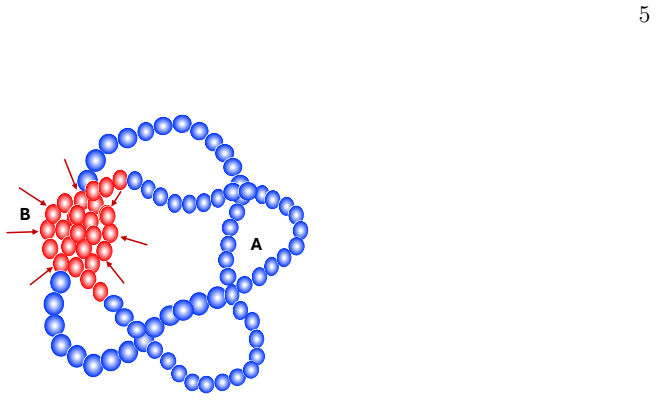
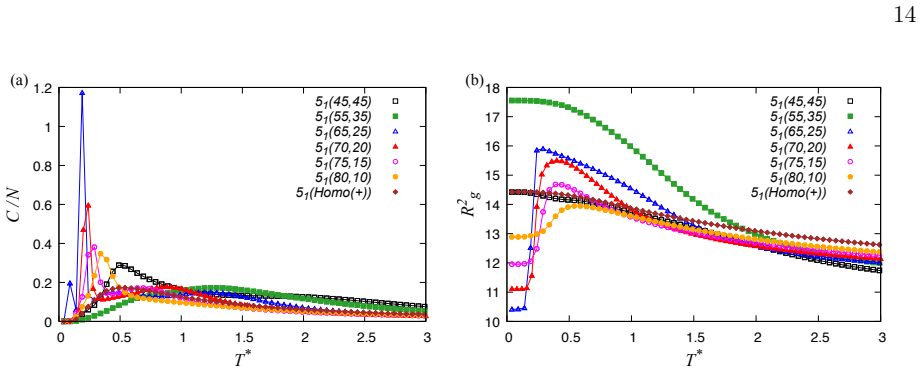
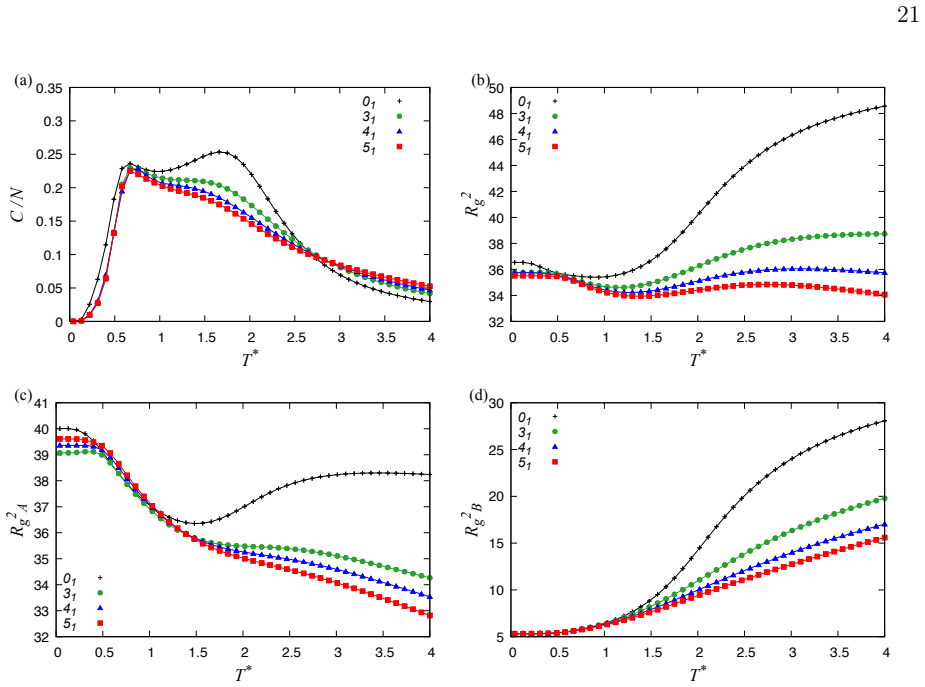
In the AB lattice model for knotted diblock copolymer rings, A monomers are self-repulsive, B monomers are self-attractive, and A-B interactions are neutral; Wang-Landau Monte Carlo sampling shows that small changes in B-block length produce nonmonotonic, reentrant conformational responses with temperature, including transitions between knot localization and delocalization at low temperatures that arise from the competition between energetic attractions and topological entropy constraints.
What carries the argument
The probability that a monomer belongs to the knotted region, tracked together with the radius of gyration and heat capacity of the full ring and of each block separately, which reveals how topology and composition compete with temperature.
If this is right
- Knot localization tends to occur inside the attractive B blocks at low temperatures for asymmetric compositions.
- Reentrant conformational changes appear even for modest shifts in the length of the B block.
- More complex knots such as the pentafoil exhibit stronger composition-dependent localization effects than simpler knots like the trefoil.
- Peaks in heat capacity mark the temperatures at which knot delocalization transitions occur.
Where Pith is reading between the lines
- The same competition may allow temperature to switch knot position in sequence-engineered polymers for nanoscale devices.
- Biological knotted molecules with heterogeneous sequences could display analogous localization transitions under physiological temperature changes.
- Repeating the simulations with explicit solvent or off-lattice models would test whether the reported reentrant behavior survives more detailed representations.
Load-bearing premise
The chosen coarse-grained lattice model with its specific A and B interaction rules and implicit solvent is sufficient to capture the essential physics that would appear in real knotted diblock copolymers.
What would settle it
Direct experimental measurement of only monotonic changes in chain size or knot position versus temperature, for a series of diblock rings with systematically varied B-block lengths, would falsify the reported nonmonotonic and reentrant transitions.
Figures






read the original abstract
We investigate the thermal and structural properties of knotted diblock copolymer rings using a coarse-grained lattice model in an implicit solvent. The system is studied by means of the Wang--Landau Monte Carlo algorithm, allowing us to analyze thermodynamic and conformational responses over a wide temperature range. Different knot topologies, including the unknot, trefoil, figure-eight, and pentafoil knots, are considered for both symmetric and asymmetric monomer compositions. In the AB model employed here, A-type monomers are self-repulsive, B-type monomers are self-attractive, and A-B interactions are neutral, such that the solvent is effectively good for A-type monomers and poor for B-type monomers at low temperatures. We analyze several key observables, including the heat capacity, the radius of gyration, and its temperature derivative for both the entire copolymer ring and the individual blocks, and the probability that a monomer belongs to the knotted region. Our results show that the interplay between knot topology, monomer composition, and temperature strongly influences polymer conformations. Small variations in the B-block length induce nonmonotonic, reentrant-like conformational behavior as a function of temperature, including transitions between knot localization and delocalization at low temperatures. These effects arise from the competition between energetic and entropic contributions imposed by topological constraints.
Editorial analysis
A structured set of objections, weighed in public.
Referee Report
Summary. The manuscript investigates the thermal and structural properties of knotted diblock copolymer rings via Wang-Landau Monte Carlo simulations of a coarse-grained lattice model in implicit solvent. A-type monomers are self-repulsive, B-type monomers self-attractive, and A-B interactions neutral. The study considers unknot, trefoil, figure-eight, and pentafoil topologies for both symmetric and asymmetric compositions, reporting on heat capacity, radius of gyration (and its temperature derivative), and the probability that a monomer belongs to the knotted region. The central claim is that knot topology, monomer composition, and temperature interplay to produce nonmonotonic, reentrant-like conformational behavior, including low-temperature transitions between knot localization and delocalization arising from energetic-entropic competition.
Significance. If the reported nonmonotonic responses prove robust, the work would illustrate how modest changes in block length can qualitatively alter the temperature-driven conformational landscape of topologically constrained copolymers. The broad temperature window afforded by the Wang-Landau algorithm is a methodological strength that enables observation of reentrant features not easily captured by conventional sampling. The findings remain tied to a specific lattice representation, so their generality to experimental diblock systems would require additional validation against continuous-space or explicit-solvent models.
major comments (2)
- [Model definition and Results on conformational observables] The nonmonotonic radius-of-gyration response and knot localization/delocalization transitions are obtained exclusively within the chosen AB lattice interaction rules (A self-repulsive, B self-attractive, A-B neutral). No tests with altered coordination numbers, different interaction strengths, or continuous-space potentials are presented; such checks are needed to establish whether the reentrant behavior is an artifact of the implicit-solvent lattice encoding rather than a generic feature of knotted diblocks.
- [Simulation details and thermodynamic analysis] The manuscript reports transitions between localized and delocalized knot states at low T for small changes in B-block length, yet provides no quantitative error estimates, autocorrelation times, or convergence diagnostics for the Wang-Landau density-of-states estimates. Without these, it is difficult to judge the statistical significance of the claimed nonmonotonic features.
minor comments (2)
- [Abstract] The abstract refers to 'pentafoil knots' without specifying the standard knot notation (e.g., 5_1) used in the main text; consistent notation would improve clarity.
- [Figure captions] Figure captions for the radius-of-gyration and heat-capacity plots should explicitly state the number of independent runs and the temperature grid spacing employed.
Simulated Author's Rebuttal
We thank the referee for their careful reading of our manuscript and for the constructive comments, which have helped us improve the presentation and clarity of our results. We address each major comment below and indicate the revisions made to the manuscript.
read point-by-point responses
-
Referee: The nonmonotonic radius-of-gyration response and knot localization/delocalization transitions are obtained exclusively within the chosen AB lattice interaction rules (A self-repulsive, B self-attractive, A-B neutral). No tests with altered coordination numbers, different interaction strengths, or continuous-space potentials are presented; such checks are needed to establish whether the reentrant behavior is an artifact of the implicit-solvent lattice encoding rather than a generic feature of knotted diblocks.
Authors: We acknowledge that our findings are obtained within a specific coarse-grained lattice model with the stated interaction rules. This model was chosen because it permits efficient Wang-Landau sampling over a broad temperature window, which is necessary to resolve the reentrant conformational transitions driven by the competition between B-block attraction, A-block repulsion, and topological constraints. While we agree that tests with continuous-space potentials or modified interaction strengths would strengthen claims of generality, the nonmonotonic features arise directly from the energetic-entropic balance imposed by the block asymmetry and knot topology, which we expect to persist qualitatively in other representations. In the revised manuscript we have added a dedicated paragraph in the Discussion section that explicitly states the model assumptions and outlines how the observed localization-delocalization shifts should translate to off-lattice diblock systems. revision: partial
-
Referee: The manuscript reports transitions between localized and delocalized knot states at low T for small changes in B-block length, yet provides no quantitative error estimates, autocorrelation times, or convergence diagnostics for the Wang-Landau density-of-states estimates. Without these, it is difficult to judge the statistical significance of the claimed nonmonotonic features.
Authors: We thank the referee for highlighting this omission. In the revised manuscript we now report quantitative error estimates on the radius of gyration, its temperature derivative, and the knot-monomer probability, obtained from five independent Wang-Landau runs with different random seeds. We have also included the convergence diagnostics used for the density-of-states estimation (flatness criterion of 0.8 and minimum number of visits per energy bin) together with a brief discussion of the iterative procedure. Autocorrelation times for the sampled configurations are analyzed in the new Supplementary Material, confirming that the reported low-temperature transitions remain statistically significant after accounting for sampling correlations. revision: yes
Circularity Check
No circularity: purely simulation-based results from explicit lattice model
full rationale
The paper performs Wang-Landau Monte Carlo sampling on a well-specified coarse-grained lattice model with explicit A self-repulsive, B self-attractive, and neutral A-B interactions. All reported observables (heat capacity, radius of gyration, knot localization probability) are direct numerical outputs generated by evolving the system under these rules across temperatures. No analytical derivation, parameter fitting, or self-citation chain is invoked to obtain the nonmonotonic or reentrant behaviors; these emerge from the competition encoded in the Hamiltonian. The model assumptions are stated upfront and the results are presented as simulation data rather than predictions that reduce to the inputs by construction. This is a standard, self-contained computational study with no load-bearing circular steps.
Axiom & Free-Parameter Ledger
free parameters (1)
- B-monomer attraction strength
axioms (1)
- domain assumption The lattice model with nearest-neighbor interactions and the chosen A/B interaction matrix faithfully represents the conformational statistics of real diblock copolymers in implicit solvent.
Reference graph
Works this paper leans on
- [1]
-
[2]
S. D. P. Fielden, D. A. Leigh, and S. L. Woltering, Angew. Chem. Int. Ed.56, 11166 (2017)
work page 2017
-
[3]
K. E. Horneret al., Chem. Soc. Rev.45, 6432 (2016)
work page 2016
-
[4]
N. C. H. Lim and S. E. Jackson, J. Phys.: Condens. Matter27, 354101 (2015)
work page 2015
-
[5]
C. Micheletti, D. Marenduzzo, and E. Orlandini, Phys. Rep.504, 1 (2011)
work page 2011
- [6]
- [7]
- [8]
-
[9]
L. H. Kauffman,Knots and Physics(World Scientific, 2001)
work page 2001
- [10]
-
[11]
E. J. Janse van Rensburg and A. Rechnitzer, J. Knot Theory Ramifications20, 1145 (2011)
work page 2011
- [12]
-
[13]
Z. Ashbridge, S. D. P. Fielden, D. A. Leigh, L. Pirvu, F. Schaufelberger, and L. Zhang, Chem. Soc. Rev.51, 7779 (2022)
work page 2022
-
[14]
J.-P. Sauvage and C. Dietrich-Buchecker,Molecular Catenanes, Rotaxanes and Knots(Wiley, 2008)
work page 2008
-
[15]
X. Fan, B. Huang, G. Wang, and J. Huang, Macromolecules45, 3779 (2012)
work page 2012
-
[16]
B. A. Laurent and S. M. Grayson, Polym. Chem.3, 1846 (2012)
work page 2012
-
[17]
J.-F. Ayme, J. E. Beves, C. J. Campbell, and D. A. Leigh, Chem. Soc. Rev.42, 1700 (2013)
work page 2013
-
[18]
S. A. Wasserman and N. R. Cozzarelli, Science232, 951 (1986)
work page 1986
- [19]
-
[20]
A. P. Perlińska, W. H. Niemyska, B. A. Gren, M. Bukowicki, S. Nowakowski, P. Rubach, and J. I. Sułkowska, Protein Sci.32, e4631 (2023)
work page 2023
-
[21]
P. F. N. Faísca, Comput. Struct. Biotechnol. J.13, 459 (2015)
work page 2015
-
[22]
W. R. Taylor, Nature406, 916 (2000)
work page 2000
-
[23]
P. Dabrowski-Tumanski and J. I. Sulkowska, Proc. Natl. Acad. Sci. U.S.A.114, 3415 (2017)
work page 2017
-
[24]
D. Marenduzzo, E. Orlandini, A. Stasiak, D. W. Sumners, L. Tubiana, and C. Micheletti, Proc. 27 Natl. Acad. Sci. U.S.A.106, 22269 (2009)
work page 2009
-
[25]
A. L. Mallam and S. E. Jackson, J. Mol. Biol.359, 1420 (2006)
work page 2006
-
[26]
S. E. Jackson, Topol. Geom. Biopolym746, 129 (2020)
work page 2020
-
[27]
Majumderet al., Macromolecules54, 5321 (2021)
S. Majumderet al., Macromolecules54, 5321 (2021)
work page 2021
-
[28]
L. Tubiana, E. Orlandini, and C. Micheletti, Phys. Rev. Lett.107, 188302 (2011)
work page 2011
- [29]
- [30]
-
[31]
B. W. Soh, V. Narsimhan, A. R. Klotz, and P. S. Doyle, Soft Matter14, 1689 (2018)
work page 2018
-
[32]
B. Marcone, E. Orlandini, A. L. Stella, and F. Zonta, Phys. Rev. E75, 041105 (2007)
work page 2007
- [33]
-
[34]
M. Caraglio, C. Micheletti, and E. Orlandini, Phys. Rev. Lett.115, 188301 (2015)
work page 2015
-
[35]
M. D. Frank-Kamenetskii, A. V. Lukashin, and A. V. Vologodskii, Nature258, 398 (1975)
work page 1975
-
[36]
Grzybet al., Macromolecules58, 1521 (2025)
A. Grzybet al., Macromolecules58, 1521 (2025)
work page 2025
- [37]
-
[38]
T. Herschberg, J.-M. Y. Carrillo, B. G. Sumpter, E. Panagiotou, and R. Ku- mar,Macromolecules54, 7492 (2021)
work page 2021
-
[39]
G. S. Grest, T. Ge, S. J. Plimpton, M. Rubinstein, and T. C. O’Connor, ACS Polym. Au3, 209 (2022)
work page 2022
-
[40]
R. J. Williams, A. P. Dove, and R. K. O’Reilly, Polym. Chem.6, 2998 (2015)
work page 2015
- [41]
- [42]
-
[43]
W. Wang, Y. Li, and Z. Lu, Sci. China Chem.58, 1471 (2015)
work page 2015
- [44]
-
[45]
N. A. Taklimi, F. Ferrari, M. R. Piątek, and L. Tubiana, Phys. Rev. E108, 034503 (2023)
work page 2023
-
[46]
N. A. Taklimi, F. Ferrari, M. R. Piątek, and L. Tubiana, Phys. Rev. E112, 045421 (2025)
work page 2025
-
[47]
K. A. Dillet al., Protein Sci.4, 561 (1995)
work page 1995
-
[48]
A. Tagliabue, C. Micheletti, and M. Mella, ACS Macro Lett.10, 1365 (2021)
work page 2021
-
[49]
A. Tagliabue, C. Micheletti, and M. Mella, Macromolecules55, 10761 (2022)
work page 2022
- [50]
- [51]
-
[52]
L. Lu, Q. Qiu, Y. Lu, L. An, and L. Dai, Macromolecules57, 5330 (2024). 28
work page 2024
- [53]
-
[54]
L. Tubiana, G. Polles, E. Orlandini, and C. Micheletti, Eur. Phys. J. E41, 72 (2018)
work page 2018
- [55]
-
[56]
E. J. J. van Rensburg and A. Rechnitzer, J. Stat. Mech. P09008 (2011)
work page 2011
- [57]
- [58]
- [59]
- [60]
- [61]
-
[62]
Fredrickson,The equilibrium Theory of Inhomogeneous Polymers(Oxford Univ
G. Fredrickson,The equilibrium Theory of Inhomogeneous Polymers(Oxford Univ. Press, 2005)
work page 2005
-
[63]
M. Rubinstein and R. H. Colby,Polymer Physics(Oxford University Press, Oxford, 2003)
work page 2003
- [64]
- [65]
- [66]
-
[67]
M. P. Taylor, W. Paul, and K. Binder,J. Chem. Phys.131, 114907 (2009)
work page 2009
discussion (0)
Sign in with ORCID, Apple, or X to comment. Anyone can read and Pith papers without signing in.