Art Card Game (ACG): Embedding Illustration in Gameplay to Mitigate Artist Self-Criticism
Pith reviewed 2026-05-21 06:44 UTC · model grok-4.3
The pith
Embedding illustration in a card battle game raises artists' pride in their work and enjoyment of the task compared to drawing alone under the same constraints.
A machine-rendered reading of the paper's core claim, the machinery that carries it, and where it could break.
Core claim
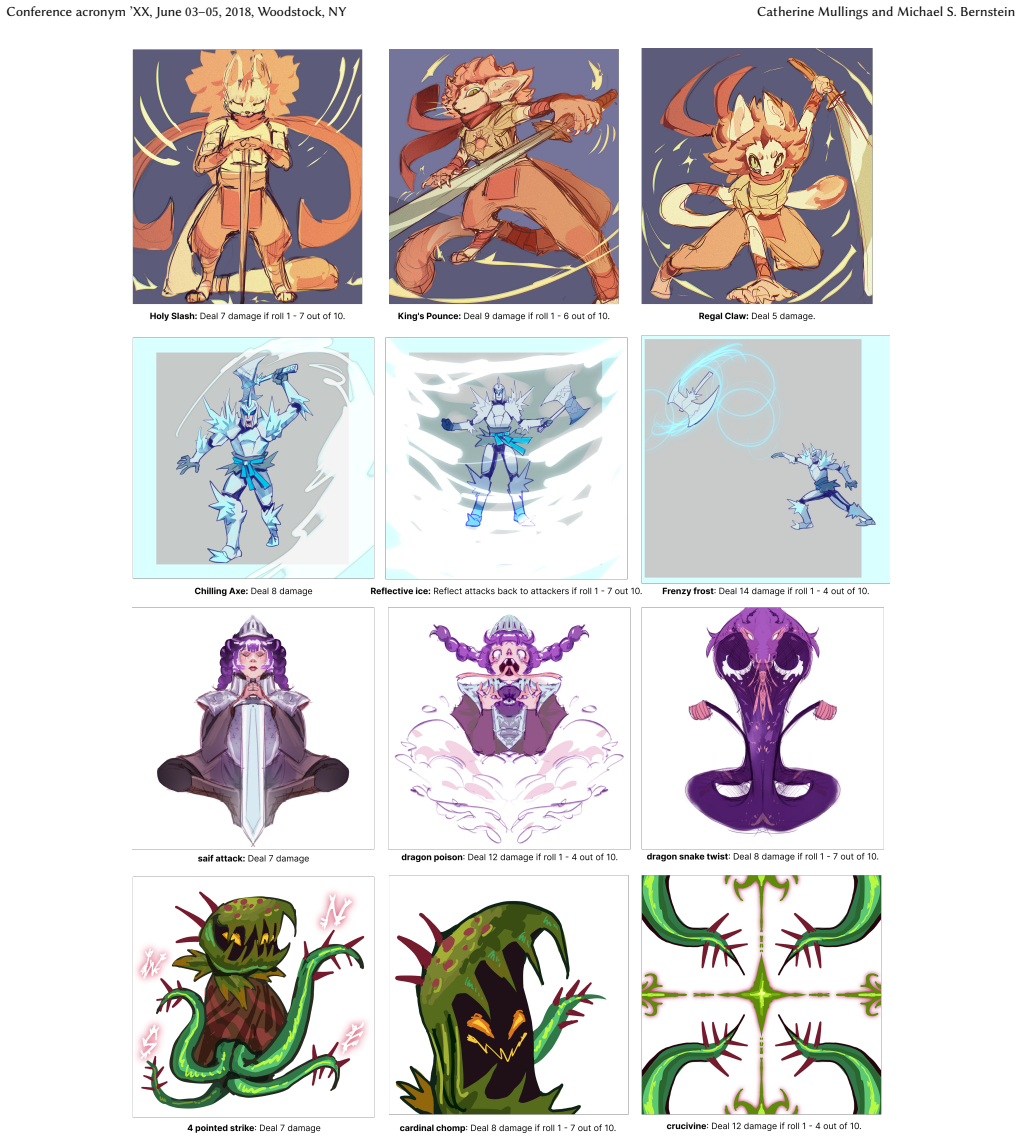
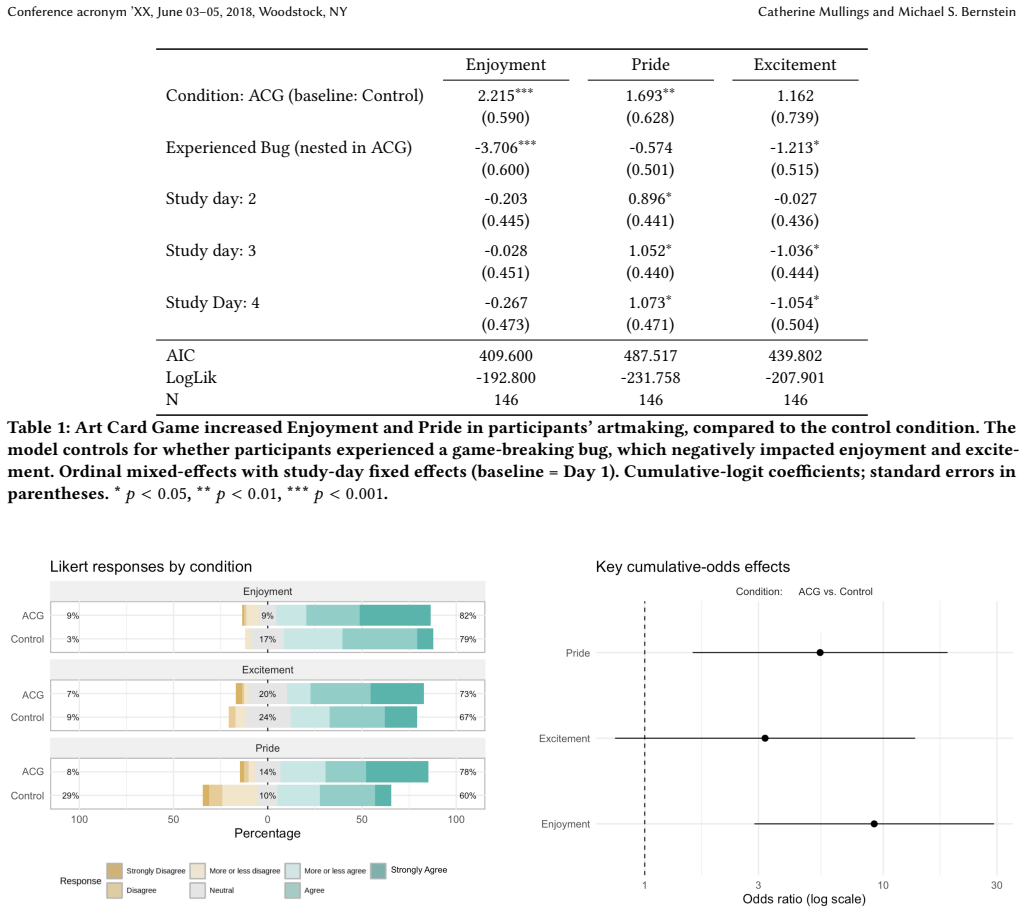
Evaluative off-centering, instantiated as the Art Card Game, redirects self-critical evaluation away from illustration by making the drawings into playable assets in a head-to-head card battle. In a four-day randomized controlled study with 38 hobbyist and professional illustrators, participants using ACG produced artwork with significantly higher reported pride and reported significantly higher activity enjoyment than participants in a control condition that used the same illustration constraints but lacked multiplayer, gameplay, and evaluative off-centering mechanisms. Pride and enjoyment are treated as positive affect states that help explain reduced self-criticism.
What carries the argument
Evaluative off-centering: a mechanism that redirects self-critical evaluation away from an inherently self-evaluative task by embedding it inside an alternative activity such as a competitive card game.
If this is right
- Artists experience higher pride in completed illustrations when the work is embedded in multiplayer gameplay rather than performed in isolation under the same constraints.
- Enjoyment of illustration tasks increases when the output becomes a competitive asset in a card game.
- Creativity support tools can apply evaluative off-centering across domains by turning solitary creative work into elements of a larger shared activity.
- In-workflow interventions that redirect evaluation may reduce the need for separate psychotherapeutic sessions outside the creative process.
Where Pith is reading between the lines
- The same off-centering approach could be adapted to writing or music composition by turning drafts or compositions into elements of a competitive game.
- Longer deployments might show whether repeated use reduces artist burnout or improves persistence on projects.
- Designers of future tools could test whether the multiplayer element or the competitive framing is the more active ingredient.
Load-bearing premise
The paper assumes that measured increases in pride and enjoyment correspond to actual reductions in self-criticism through their established link as positive affect states, without reporting direct measures of self-criticism.
What would settle it
A follow-up experiment that directly measures self-criticism (for example via validated scales administered before and after the activity) and finds no difference between the game condition and the identical-constraint control condition would falsify the proposed link.
Figures



read the original abstract
Persistent self-criticism--harsh evaluative self-talk--can undermine illustrators' performance and well-being. Traditional interventions draw on psychotherapeutic approaches (e.g., compassion training) but sit outside the illustration workflow, requiring time, facilitation, and skill transfer. We propose an in-workflow alternative: evaluative off-centering, a mechanism redirecting self-critical evaluation away from an inherently self-evaluative task (like illustration) by embedding it in an alternative activity. We instantiate evaluative off-centering in Art Card Game (ACG) that integrates illustration into a card customization game: players illustrate cards that become playable assets in a head-to-head battle. In a four-day randomized controlled study with hobbyist and professional illustrators (N=38), ACG outperformed a control condition with identical illustration constraints but no evaluative off-centering mechanisms (e.g. multiplayer, gameplay), yielding significantly higher pride in produced artwork and activity enjoyment. Pride and enjoyment--positive affect states linked to lower self-criticism--help explain how ACG reduces self-criticism. We discuss design implications for creativity support tools that apply evaluative off-centering across creative domains.
Editorial analysis
A structured set of objections, weighed in public.
Referee Report
Summary. The paper proposes evaluative off-centering as a mechanism to mitigate persistent self-criticism in illustrators by embedding illustration tasks into a multiplayer card customization game (Art Card Game, ACG). It reports a four-day randomized controlled study (N=38 hobbyist and professional illustrators) in which ACG produced significantly higher pride in produced artwork and activity enjoyment than a control condition with identical illustration constraints but lacking gameplay and multiplayer elements. The authors argue that these positive affect states are linked to lower self-criticism and thereby explain the mitigation effect of ACG.
Significance. If the core findings hold, the work offers a novel in-workflow approach to creativity support that integrates psychological benefits directly into artistic practice rather than relying on separate therapeutic interventions. The randomized controlled design and comparison to a matched control strengthen the case for gameplay-based off-centering as a practical mechanism, with potential extensions to other creative domains in HCI.
major comments (1)
- [Abstract and Results] Abstract and Results: The central claim that ACG mitigates self-criticism rests on the inference that higher pride and enjoyment (positive affect states) produce lower self-criticism. No direct pre/post measures of self-criticism using a validated instrument (e.g., Self-Criticism subscale of the Forms of Self-Criticizing and Self-Reassuring Scale) are described. This untested link is load-bearing for the paper's primary contribution and requires either additional data collection/analysis or explicit reframing as an indirect effect with supporting citations.
minor comments (2)
- [Abstract] The abstract introduces 'evaluative off-centering' without a concise operational definition; a brief parenthetical or footnote would aid readers new to the concept.
- [Results] Effect sizes, exact statistical tests, and confidence intervals for the reported significant differences in pride and enjoyment are not mentioned in the summary of results; adding these would improve interpretability.
Simulated Author's Rebuttal
We thank the referee for their constructive feedback, which highlights an important aspect of our central claim. We address the concern regarding the measurement and framing of self-criticism mitigation below.
read point-by-point responses
-
Referee: [Abstract and Results] Abstract and Results: The central claim that ACG mitigates self-criticism rests on the inference that higher pride and enjoyment (positive affect states) produce lower self-criticism. No direct pre/post measures of self-criticism using a validated instrument (e.g., Self-Criticism subscale of the Forms of Self-Criticizing and Self-Reassuring Scale) are described. This untested link is load-bearing for the paper's primary contribution and requires either additional data collection/analysis or explicit reframing as an indirect effect with supporting citations.
Authors: We agree that the manuscript would be strengthened by direct pre/post measurement of self-criticism with a validated instrument such as the Self-Criticism subscale of the Forms of Self-Criticizing and Self-Reassuring Scale. Our four-day study was designed to evaluate the immediate effects of evaluative off-centering on pride in artwork and activity enjoyment as observable outcomes of the proposed mechanism, drawing on prior work linking these positive affect states to reduced self-criticism. We did not collect direct self-criticism scores to keep participant burden low during the multi-day protocol with working illustrators. In the revised manuscript we will explicitly reframe the primary contribution as demonstrating an indirect pathway: evaluative off-centering increases pride and enjoyment, which prior literature associates with lower self-criticism. We will add supporting citations from the self-criticism and positive-affect literatures to ground this inference. This change accurately reflects the scope of the empirical data while clarifying the theoretical claim. revision: yes
Circularity Check
No significant circularity in empirical RCT results
full rationale
The paper reports an empirical randomized controlled study (N=38) directly comparing ACG gameplay to a control condition with matched illustration constraints but without multiplayer or evaluative off-centering elements. Primary outcomes are measured pride in artwork and activity enjoyment, with statistically significant advantages for ACG. The link from these positive affect states to reduced self-criticism is presented as an explanatory inference drawn from established psychological associations rather than any internal derivation, fitted parameter, or self-referential definition. No equations, predictions from subsets of data, or load-bearing self-citations appear in the reported chain; the experimental design and direct measurements stand independently of the inputs.
Axiom & Free-Parameter Ledger
axioms (1)
- domain assumption Pride and enjoyment are positive affect states linked to lower self-criticism.
invented entities (1)
-
evaluative off-centering
no independent evidence
Lean theorems connected to this paper
-
IndisputableMonolith/Cost/FunctionalEquation.leanwashburn_uniqueness_aczel unclear?
unclearRelation between the paper passage and the cited Recognition theorem.
We propose an in-workflow alternative: evaluative off-centering, a mechanism redirecting self-critical evaluation away from an inherently self-evaluative task (like illustration) by embedding it in an alternative activity.
-
IndisputableMonolith/Foundation/DimensionForcing.leanreality_from_one_distinction unclear?
unclearRelation between the paper passage and the cited Recognition theorem.
Pride and enjoyment—positive affect states linked to lower self-criticism—help explain how ACG reduces self-criticism.
What do these tags mean?
- matches
- The paper's claim is directly supported by a theorem in the formal canon.
- supports
- The theorem supports part of the paper's argument, but the paper may add assumptions or extra steps.
- extends
- The paper goes beyond the formal theorem; the theorem is a base layer rather than the whole result.
- uses
- The paper appears to rely on the theorem as machinery.
- contradicts
- The paper's claim conflicts with a theorem or certificate in the canon.
- unclear
- Pith found a possible connection, but the passage is too broad, indirect, or ambiguous to say the theorem truly supports the claim.
Reference graph
Works this paper leans on
-
[1]
2012.ZRX - Transform your workout into adventure!Six to Start
Naomi Alderman. 2012.ZRX - Transform your workout into adventure!Six to Start. Retrieved January 27, 2026 from https://zrx.app/
work page 2012
-
[2]
Rasim Basak. 2012. Perfectionist Attitudes of Artistically Talented Students in the Art Classroom.Procedia - Social and Behavioral Sciences46 (2012), 5010–
work page 2012
-
[3]
https://doi.org/10.1016/j.sbspro.2012.06.377 4th WORLD CONFERENCE ON EDUCATIONAL SCIENCES (WCES-2012) 02-05 February 2012 Barcelona, Spain
-
[4]
Jekaterina Belakova and Wendy E. Mackay. 2021. SonAmi: A Tangible Creativity Support Tool for Productive Procrastination. InProceedings of the 13th Conference on Creativity and Cognition(Virtual Event, Italy)(C&C ’21). Association for Computing Machinery, New York, NY, USA, Article 7, 10 pages. https://doi.org/ 10.1145/3450741.3465250
-
[5]
Randy Bishop, Sweeney Boo, Crus Meybis R., and Luis Gadea. 2020.Fundamentals of Character Design: How to Create Engaging Characters for Illustration, Animation & Visual Development. 3dtotal Publishing, USA
work page 2020
-
[6]
2025.Playing Karaoke: A Lived Experience of Play as Method
Jeffrey S Bryan. 2025.Playing Karaoke: A Lived Experience of Play as Method. Ph. D. Dissertation. University of California, Irvine
work page 2025
-
[7]
Kristin Carlson and Thecla Schiphorst. 2013. Designing interaction for designers: defamiliarization in user’s creative decision-making. InProceedings of the 9th Art Card Game (ACG): Embedding Illustration in Gameplay to Mitigate Artist Self-Criticism Conference acronym ’XX, June 03–05, 2018, Woodstock, NY ACM Conference on Creativity & Cognition. Associat...
work page 2013
-
[8]
Albert V. Carron, Heather A. Hausenblas, and Diane Mack. 1996. Social Influence and Exercise: A Meta-Analysis.Journal of Sport and Exercise Psychology18, 1 (1996), 1–16
work page 1996
-
[9]
Shelley H. Carson. 2011. Creativity and Psychopathology: A Shared Vulnerability Model.The Canadian Journal of Psychiatry56, 3 (2011), 144–153. https://doi.org/ 10.1177/070674371105600304
-
[10]
Catherine C. Chase, Doris B. Chin, Marily A. Oppezzo, and Daniel L. Schwartz
-
[11]
Teachable Agents and the Protégé Effect: Increasing the Effort Towards Learning.Journal of Science Education and Technology18, 4 (Aug. 2009), 334–352. https://doi.org/10.1007/s10956-009-9180-4
-
[12]
Peayton Chen, Rita Kuo, Maiga Chang, and Jia-Sheng Heh. 2009.Designing a Trading Card Game as Educational Reward System to Improve Students’ Learning Motivations. Springer Berlin Heidelberg, Berlin, Heidelberg, 116–128. https: //doi.org/10.1007/978-3-642-11245-4_11
-
[13]
Bobby Chiu. 2016. Artist Self Doubt. YouTube video. Available at:https://www.youtube.com/watch?v=huwOsyPseII (accessed 2025-09-10)
work page 2016
-
[14]
Cornelia Connolly, Eamonn Murphy, and Sarah Moore. 2009. Programming Anxiety Amongst Computing Students—A Key in the Retention Debate?IEEE Transactions on Education52, 1 (2009), 52–56. https://doi.org/10.1109/TE.2008. 917193
-
[15]
Tomorrow Corporation. 2015.Human Resource Machine. Tomorrow Corporation. Retrieved January 27, 2026 from https://store.steampowered.com/app/375820/ Human_Resource_Machine/
work page 2015
-
[16]
Lawrence Crawford. 1984. Viktor Shklovskij: Différance in Defamiliarization. Comparative Literature36, 3 (1984), 209–219
work page 1984
-
[17]
Discord, Inc. 2025.Doxxing Policy Explainer. Discord, Inc. https://discord.com/ safety/doxxing-policy-explainer
work page 2025
-
[18]
Dow, Alana Glassco, Jonathan Kass, Melissa Schwarz, Daniel L
Steven P. Dow, Alana Glassco, Jonathan Kass, Melissa Schwarz, Daniel L. Schwartz, and Scott R. Klemmer. 2011. Parallel prototyping leads to better design results, more divergence, and increased self-efficacy.ACM Trans. Comput.-Hum. Interact.17, 4, Article 18 (Dec. 2011), 24 pages. https://doi.org/10.1145/1879831. 1879836
-
[19]
2015.Welcome to Art Fight! The annual art trading game, starting on July 1st!Art Fight
Art Fight. 2015.Welcome to Art Fight! The annual art trading game, starting on July 1st!Art Fight. Retrieved September 3, 2024 from https://artfight.net/
work page 2015
-
[20]
2024.New Research Explores Arts Engagement and Social Connectedness
National Endowment for the Arts. 2024.New Research Explores Arts Engagement and Social Connectedness. National Endowment for the Arts. https://www.arts.gov/news/press-releases/2024/new-research-explores- arts-engagement-and-social-connectedness
work page 2024
-
[21]
Ricky Galloway, Hunna Watson, Danyelle Greene, Roz Shafran, and Sarah J Egan
-
[22]
The efficacy of randomised controlled trials of cognitive behaviour therapy for perfectionism: A systematic review and meta-analysis.Cognitive Behaviour Therapy51, 2 (2022), 170–184
work page 2022
-
[23]
Christopher K. Germer and Kristin D. Neff. 2013. Self-compassion in clinical prac- tice.Journal of clinical psychology69 8 (2013), 856–67. https://api.semanticscholar. org/CorpusID:2799698
work page 2013
-
[24]
Paul Gilbert, Marlea Clarke, Susanne Hempel, Jeremy NV Miles, and Chris Irons
-
[25]
Criticizing and reassuring oneself: An exploration of forms, styles and reasons in female students.British Journal of Clinical Psychology43, 1 (2004), 31–50
work page 2004
-
[26]
Karolina Głaziewicz and Krystyna Golonka. 2024. When the creative well dries up–burnout syndrome and art block in artists’ sample.Thinking Skills and Creativity54 (2024), 101692. https://doi.org/10.1016/j.tsc.2024.101692
-
[27]
Matthew Hantsbarger, Giovanni Maria Troiano, Alexandra To, and Casper Harteveld. 2022. Alienated serendipity and reflective failure: Exploring queer game mechanics and queerness in games via queer temporality.Proceedings of the ACM on Human-Computer Interaction6, CHI PLAY (2022), 1–27
work page 2022
-
[28]
Elizabeth A Hart, Mark R Leary, and W Jack Rejeski. 1989. Tie measurement of social physique anxiety.Journal of Sport and exercise Psychology11, 1 (1989), 94–104
work page 1989
-
[29]
Chae-Ha Hwang, Hyeon-Ju Song, Min-Ji Jung, Yeon-Jae Choi, and Young Sun Hwang. 2023. Effect of Toothbrushing Application for Kids on Dental Plaque Removal and Interest in Toothbrushing of Preschool Children.Journal of dental hygiene science23, 3 (2023), 208–215
work page 2023
-
[30]
InkTober. 2013.InkTober. InkTober. Retrieved September 3, 2024 from https: //inktober.com/
work page 2013
-
[31]
Katherine Isbister. 2016. Connecting through play.Interactions23, 4 (2016), 26–33
work page 2016
-
[32]
2016.How games move us: Emotion by design
Katherine Isbister. 2016.How games move us: Emotion by design. Mit Press, USA
work page 2016
-
[33]
Geoff F Kaufman and Lisa K Libby. 2012. Changing beliefs and behavior through experience-taking.Journal of personality and social psychology103, 1 (2012), 1
work page 2012
-
[34]
Joy Kim, Maneesh Agrawala, and Michael S. Bernstein. 2017. Mosaic: Designing Online Creative Communities for Sharing Works-in-Progress. InProceedings of the 2017 ACM Conference on Computer Supported Cooperative Work and Social Computing(Portland, Oregon, USA)(CSCW ’17). Association for Computing Ma- chinery, New York, NY, USA, 246–258. https://doi.org/10....
-
[35]
Fallyn M. Lee, Julie M. Koch, and Nikita Ramakrishnan. 2024. Fine Arts Students: Mental Health, Stress, and Time on Academic Work.Journal of college student psychotherapy38, 2 (2024), 259 – 274. https://doi.org/10.1080/87568225.2023. 2175755
-
[36]
Predicting at-risk novice java programmers through the analysis of online protocols,
Michael J. Lee and Amy J. Ko. 2011. Personifying programming tool feedback improves novice programmers’ learning. InProceedings of the Seventh Interna- tional Workshop on Computing Education Research(Providence, Rhode Island, USA)(ICER ’11). Association for Computing Machinery, New York, NY, USA, 109–116. https://doi.org/10.1145/2016911.2016934
-
[37]
1991.Locus of control.Academic Press, San Diego, CA, USA
Herbert M Lefcourt. 1991.Locus of control.Academic Press, San Diego, CA, USA
work page 1991
-
[38]
Hao Lin, Haidong Chen, Qingzao Liu, Jie Xu, and Shan Li. 2024. A meta-analysis of the relationship between social support and physical activity in adolescents: the mediating role of self-efficacy.Frontiers in Psychology14 (01 2024). https: //doi.org/10.3389/fpsyg.2023.1305425
-
[39]
Adam Duff LUCIDPIXUL. 2020. Advice For Artists Who Are Too Hard On Themselves. YouTube video. Available at: https://www.youtube.com/watch?v= w6StfT6_a7g (accessed 2025-09-10)
work page 2020
-
[40]
Elizabeth L Murnane, Xin Jiang, Anna Kong, Michelle Park, Weili Shi, Connor Soohoo, Luke Vink, Iris Xia, Xin Yu, John Yang-Sammataro, et al. 2020. Designing ambient narrative-based interfaces to reflect and motivate physical activity. In Proceedings of the 2020 CHI Conference on Human Factors in Computing Systems. Association for Computing Machinery, New ...
work page 2020
-
[41]
Kristin D. Neff. 2023. Self-Compassion: Theory, Method, Research, and Inter- vention.Annual Review of Psychology74, Volume 74, 2023 (2023), 193–218. https://doi.org/10.1146/annurev-psych-032420-031047
-
[42]
Hisataka Noguchi. 1999. How do material constraints affect design creativity?. InProceedings of the 3rd Conference on Creativity & Cognition. Association for Computing Machinery, New York, NY, USA, 82–87
work page 1999
-
[43]
Dan R Olsen Jr. 2007. Evaluating user interface systems research. InProceedings of the 20th annual ACM symposium on User interface software and technology. Association for Computing Machinery, USA, 251–258
work page 2007
-
[44]
Clarissa W Ong, Eric B Lee, Jennifer Krafft, Carina L Terry, Tyson S Barrett, Michael E Levin, and Michael P Twohig. 2019. A randomized controlled trial of acceptance and commitment therapy for clinical perfectionism.Journal of Obsessive-Compulsive and Related Disorders22 (2019), 100444
work page 2019
-
[45]
Gartic Phone. 2020.Gartic Phone. Onrizon Social Games. Retrieved September 3, 2024 from https://garticphone.com/
work page 2020
-
[46]
2002.The War of Art: Break Through the Blocks and Win Your Inner Creative Battles
Steven Pressfield. 2002.The War of Art: Break Through the Blocks and Win Your Inner Creative Battles. Black Irish Entertainment LLC, USA
work page 2002
-
[47]
2023.Guide to Thumbnail Sketches
Art Prof. 2023.Guide to Thumbnail Sketches. Art Prof. Retrieved September 3, 2024 from https://artprof.org/learn/tutorials-media/drawing/thumbnail-sketches/
work page 2023
-
[48]
2005.How do you stop with the perfectionism and self-sabotage?Reddit
Reddit. 2005.How do you stop with the perfectionism and self-sabotage?Reddit. Retrieved September 3, 2024 from https://www.reddit.com/r/ArtistLounge/ comments/k7w259/how_do_you_stop_with_the_perfectionism_and/?rdt= 34967
work page 2005
-
[49]
Reddit. 2013.Artist Lounge. Reddit. Retrieved September 9, 2025 from https: //www.reddit.com/r/ArtistLounge/
work page 2013
-
[50]
Byron Reeves and Clifford Nass. 1996. The media equation: How people treat computers, television, and new media like real people.Cambridge, UK10, 10 (1996), 19–36
work page 1996
-
[51]
Samuel Rhys Cox, Helena Bøjer Djernæs, and Niels van Berkel. 2025. Beyond Productivity: Rethinking the Impact of Creativity Support Tools. InProceedings of the 2025 Conference on Creativity and Cognition (C&C ’25). Association for Computing Machinery, New York, NY, USA, 735–749. https://doi.org/10.1145/ 3698061.3726924
-
[52]
2013.The Typing of The Dead: Overkill
SEGA. 2013.The Typing of The Dead: Overkill. SEGA. Retrieved January 27, 2026 from https://store.steampowered.com/app/246580/The_Typing_of_The_Dead_ Overkill/
work page 2013
-
[53]
Ben Shahar, Erica R Carlin, David E Engle, Jayanta Hegde, Ohad Szepsenwol, and Hal Arkowitz. 2012. A pilot investigation of emotion-focused two-chair dialogue intervention for self-criticism.Clinical psychology & psychotherapy19, 6 (2012), 496–507
work page 2012
-
[54]
A. Sion, J. Czamanski-Cohen, O.C. Halbrecht-Shaked, G. Galili, and J. Cwikel. 2023. Self-correction, digital art making and stress reduction.The Arts in Psychotherapy 85 (2023), 102060. https://doi.org/10.1016/j.aip.2023.102060
-
[55]
2022.The impact of self-criticism throughout the creative process
Colleen Standish. 2022.The impact of self-criticism throughout the creative process. Ph. D. Dissertation. The University of Oklahoma
work page 2022
-
[56]
2022.Process-Sensitive Creativity Support Tools
Sarah Gimbert Sterman. 2022.Process-Sensitive Creativity Support Tools. Ph. D. Dissertation. University of California, Berkeley
work page 2022
-
[57]
Alexandra To, Joselyn McDonald, Jarrek Holmes, Geoff Kaufman, and Jes- sica Hammer. 2018. Character Diversity in Digital and Non-Digital Games. Transactions of the Digital Games Research Association4 (10 2018). https: //doi.org/10.26503/todigra.v4i1.84
-
[58]
Daniela Villani, Claudia Carissoli, Stefano Triberti, Antonella Marchetti, Gabriella Gilli, and Giuseppe Riva. 2018. Videogames for emotion regulation: a systematic review.Games for health journal7, 2 (2018), 85–99
work page 2018
-
[59]
David Watson, Lee Anna Clark, and Auke Tellegen. 1988. Development and validation of brief measures of positive and negative affect: the PANAS scales. Conference acronym ’XX, June 03–05, 2018, Woodstock, NY Catherine Mullings and Michael S. Bernstein Journal of personality and social psychology54, 6 (1988), 1063
work page 1988
-
[60]
Blake Williford, Matthew Runyon, Adil Hamid Malla, Wayne Li, Julie Linsey, and Tracy Hammond. 2017. ZenSketch: A Sketch-based Game For Improving Line Work. InExtended Abstracts Publication of the Annual Symposium on Computer- Human Interaction in Play(Amsterdam, The Netherlands)(CHI PLAY ’17 Extended Abstracts). Association for Computing Machinery, New Yo...
-
[61]
Darya L Zabelina and Michael D Robinson. 2010. Don’t be so hard on yourself: Self-compassion facilitates creative originality among self-judgmental individuals. Creativity Research Journal22, 3 (2010), 288–293
work page 2010
-
[62]
2009.What is Illustration? (Essential Design Handbook)
Lawrence Zeegen. 2009.What is Illustration? (Essential Design Handbook). Rock- port Publishers, USA
work page 2009
-
[63]
David C Zuroff, Gentiana Sadikaj, Allison C Kelly, and Michelle J Leybman. 2016. Conceptualizing and measuring self-criticism as both a personality trait and a personality state.Journal of personality assessment98, 1 (2016), 14–21
work page 2016
discussion (0)
Sign in with ORCID, Apple, or X to comment. Anyone can read and Pith papers without signing in.