Diffuse to Detect: Bi-Level Sample Rebalancing with Pseudo-Label Diffusion for Point-Supervised Infrared Small-Target Detection
Pith reviewed 2026-05-21 05:53 UTC · model grok-4.3
The pith
Physics-based diffusion converts single-point labels to reliable pseudo-masks for infrared small-target detection.
A machine-rendered reading of the paper's core claim, the machinery that carries it, and where it could break.
Core claim
Leveraging the intrinsic consistency between thermal radiation patterns and heat diffusion, a physics-induced annotation strategy expands single-point labels into reliable pseudo-masks. A bi-level dual-update framework jointly optimizes detector weights, sample weights predicted by a meta-classifier, and diffusion parameters in a differentiable module that uses detection feedback to refine the pseudo-labels.
What carries the argument
bi-level dual-update framework incorporating a meta-classifier for sample-wise loss weights and a differentiable diffusion module that refines pseudo-labels using detection feedback
Load-bearing premise
An intrinsic consistency between thermal radiation patterns and heat diffusion is strong enough to reliably convert single-point labels into accurate pseudo-masks within cluttered low-contrast infrared imagery.
What would settle it
Comparing the pseudo-masks produced by the diffusion process against ground-truth target masks on a held-out set of fully annotated infrared images; if the average overlap or precision is no better than a simple dilation of the point labels, the core consistency assumption would be falsified.
Figures




read the original abstract
Point supervision has become a scalable solution to address dense annotation for infrared small target detection, but its performance is limited by two coupled bottlenecks: unstable pseudo-label evolution in cluttered, low-contrast infrared imagery and severe sample-distribution imbalance. In this paper, we present a more adaptive and stable framework to address these issues. Leveraging the intrinsic consistency between thermal radiation patterns and heat diffusion, we propose a physics-induced annotation strategy that expands single-point labels into reliable pseudo-masks. To further enhance supervision and alleviate sample imbalance, we develop a bi-level dual-update framework that jointly optimizes detector weights, sample weights, and diffusion parameters. A meta-classifier dynamically predicts sample-wise loss weights, while a differentiable diffusion module refines pseudo-labels with detection feedback, enabling adaptive interaction between training and hyperparameter optimization. Extensive experiments across multiple datasets demonstrate five-fold annotation acceleration, superior detection accuracy, and comparable performance with 30% of the training data, validating the efficiency and practicality of our approach. Our code is available at https://github.com/yuanhang-yao/diffuse-to-detect.
Editorial analysis
A structured set of objections, weighed in public.
Referee Report
Summary. The paper proposes 'Diffuse to Detect', a bi-level framework for point-supervised infrared small-target detection. It introduces a physics-induced annotation strategy that expands single-point labels into pseudo-masks by modeling heat diffusion, justified by an assumed intrinsic consistency between thermal radiation patterns and heat diffusion in cluttered low-contrast scenes. A meta-classifier predicts sample-wise loss weights to address imbalance, while a differentiable diffusion module refines the pseudo-labels using detection feedback, enabling joint optimization of detector weights, sample weights, and diffusion parameters. Experiments across datasets are reported to demonstrate five-fold annotation acceleration, superior detection accuracy, and comparable performance using only 30% of the training data.
Significance. If the generated pseudo-masks prove reliable, the method could meaningfully reduce annotation effort for infrared small-target detection, a domain where dense labeling is costly. The combination of physics-inspired diffusion with bi-level optimization for adaptive pseudo-label refinement and sample rebalancing offers a potentially useful direction for weakly-supervised CV tasks. Open-sourced code supports reproducibility and allows independent verification of the claimed efficiency gains.
major comments (2)
- [Abstract / Method description] The central claim depends on the diffusion module producing reliable pseudo-masks that approximate true target shapes rather than introducing systematic errors. The abstract and method description treat the 'intrinsic consistency between thermal radiation patterns and heat diffusion' as given, yet no direct quantitative validation (e.g., mask IoU or overlap metrics against held-out full annotations in cluttered scenes) is reported to confirm this in the target domain; without such evidence the performance gains cannot be attributed to the physics-induced strategy.
- [Bi-level optimization framework] The bi-level dual-update framework jointly optimizes detector weights, meta-classifier sample weights, and diffusion parameters. This creates a risk that reported improvements partly reflect fitting to the diffusion hyperparameters rather than independent generalization; the manuscript should include an ablation isolating the contribution of the differentiable diffusion module versus post-hoc tuning.
minor comments (2)
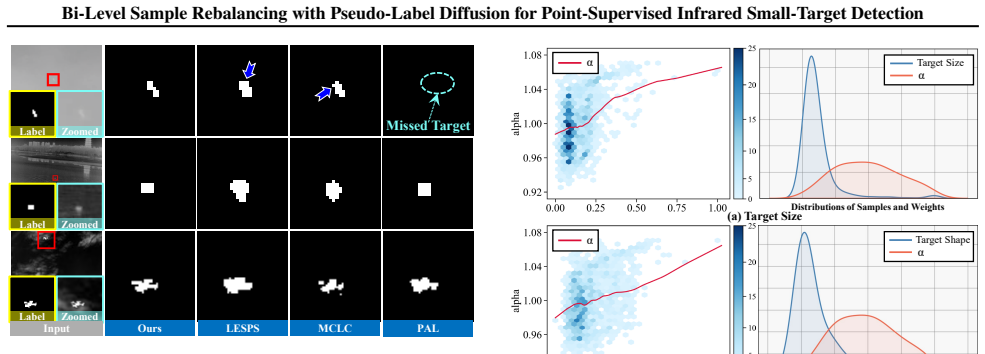
- [Figures] Add visual comparisons in the figures showing generated pseudo-masks overlaid on original IR images versus ground-truth masks to illustrate behavior in low-contrast cluttered regions.
- [Method] Clarify the exact loss formulation and how detection feedback is back-propagated through the diffusion module to ensure the interaction loop is fully differentiable.
Simulated Author's Rebuttal
We thank the referee for the constructive and detailed feedback. We address each major comment below and indicate the revisions we will make to strengthen the manuscript.
read point-by-point responses
-
Referee: [Abstract / Method description] The central claim depends on the diffusion module producing reliable pseudo-masks that approximate true target shapes rather than introducing systematic errors. The abstract and method description treat the 'intrinsic consistency between thermal radiation patterns and heat diffusion' as given, yet no direct quantitative validation (e.g., mask IoU or overlap metrics against held-out full annotations in cluttered scenes) is reported to confirm this in the target domain; without such evidence the performance gains cannot be attributed to the physics-induced strategy.
Authors: We agree that direct quantitative validation of the pseudo-masks would provide stronger support for the physics-induced strategy. Although downstream detection metrics and comparisons offer indirect validation, we will add an analysis computing mask IoU and overlap metrics between the generated pseudo-masks and available ground-truth annotations on evaluation subsets where full labels exist. This will be included in the revised manuscript to better attribute performance gains to the diffusion approach. revision: yes
-
Referee: [Bi-level optimization framework] The bi-level dual-update framework jointly optimizes detector weights, meta-classifier sample weights, and diffusion parameters. This creates a risk that reported improvements partly reflect fitting to the diffusion hyperparameters rather than independent generalization; the manuscript should include an ablation isolating the contribution of the differentiable diffusion module versus post-hoc tuning.
Authors: We recognize the value of isolating the contribution of the differentiable diffusion module. The current ablations focus on the overall bi-level framework, but we will add a new experiment in the revision that compares the joint bi-level optimization against a post-hoc tuned diffusion variant with fixed parameters. This will clarify whether the adaptive feedback provides benefits beyond hyperparameter fitting. revision: yes
Circularity Check
No significant circularity; derivation relies on external physical assumption and standard bi-level optimization
full rationale
The paper's core claim rests on an assumed 'intrinsic consistency between thermal radiation patterns and heat diffusion' to expand point labels into pseudo-masks, presented as a physics-induced prior rather than any self-referential definition or fitted input renamed as prediction. The bi-level dual-update framework jointly optimizes detector weights, sample weights, and diffusion parameters via a meta-classifier and differentiable module, but this constitutes a conventional adaptive training loop with detection feedback; no equations or steps in the provided description reduce a claimed result (e.g., reliable pseudo-masks or performance gains) to its own inputs by construction. No self-citations, uniqueness theorems, or ansatzes imported from prior author work are referenced as load-bearing. Experiments on multiple datasets provide external validation, keeping the approach self-contained against benchmarks without circular reduction.
Axiom & Free-Parameter Ledger
free parameters (1)
- diffusion parameters
axioms (1)
- domain assumption Intrinsic consistency between thermal radiation patterns and heat diffusion allows reliable expansion of point labels into pseudo-masks
Lean theorems connected to this paper
-
IndisputableMonolith/Cost/FunctionalEquation.leanwashburn_uniqueness_aczel unclear?
unclearRelation between the paper passage and the cited Recognition theorem.
Leveraging the intrinsic consistency between thermal radiation patterns and heat diffusion, we propose a physics-induced annotation strategy that expands single-point labels into reliable pseudo-masks... differentiable diffusion module refines pseudo-labels
What do these tags mean?
- matches
- The paper's claim is directly supported by a theorem in the formal canon.
- supports
- The theorem supports part of the paper's argument, but the paper may add assumptions or extra steps.
- extends
- The paper goes beyond the formal theorem; the theorem is a base layer rather than the whole result.
- uses
- The paper appears to rely on the theorem as machinery.
- contradicts
- The paper's claim conflicts with a theorem or certificate in the canon.
- unclear
- Pith found a possible connection, but the passage is too broad, indirect, or ambiguous to say the theorem truly supports the claim.
Reference graph
Works this paper leans on
-
[1]
Yu, Yi and Ren, Botao and Zhang, Peiyuan and Liu, Mingxin and Luo, Junwei and Zhang, Shaofeng and Da, Feipeng and Yan, Junchi and Yang, Xue , booktitle=
-
[2]
Yu, Yi and Yang, Xue and Li, Yansheng and Han, Zhenjun and Da, Feipeng and Yan, Junchi , journal=. 2025 , publisher=
work page 2025
-
[3]
Luo, Junwei and Yang, Xue and Yu, Yi and Li, Qingyun and Yan, Junchi and Li, Yansheng , booktitle=
-
[4]
IEEE Transactions on Pattern Analysis and Machine Intelligence , volume=
Investigating bi-level optimization for learning and vision from a unified perspective: A survey and beyond , author=. IEEE Transactions on Pattern Analysis and Machine Intelligence , volume=. 2022 , publisher=
work page 2022
-
[5]
Advances in Neural Information Processing Systems , volume=
Bilevel Optimization for Adversarial Learning Problems: Sharpness, Generation, and Beyond , author=. Advances in Neural Information Processing Systems , volume=
-
[6]
Y. Wang and D. Jin and J. Chen and X. Bai. Revelation of hidden 2D atmospheric turbulence strength fields from turbulence effects in infrared imaging. Nature Computational Science. 2023
work page 2023
- [7]
- [8]
-
[9]
Advances in Neural Information Processing Systems , volume=
Beyond value functions: Single-loop bilevel optimization under flatness conditions , author=. Advances in Neural Information Processing Systems , volume=
- [10]
- [11]
-
[12]
R. Driggers and E. Pollak and R. Grimming and E. Velazquez and R. Short and G. Holst and O. Furxhi. Detection of small targets in the infrared: an infrared search and track tutorial. Applied Optics. 2021
work page 2021
- [13]
-
[14]
E. Zhao and L. Dong and C. Li and Y. Ji. Infrared maritime target detection based on temporal weight and total variation regularization under strong wave interferences. IEEE Transactions on Geoscience and Remote Sensing. 2024
work page 2024
-
[15]
J. Zhao and C. Yu and Z. Shi and Y. Liu and Y. Zhang. Gradient-guided learning network for infrared small target detection. IEEE Geoscience and Remote Sensing Letters. 2023
work page 2023
-
[16]
Z. Chen and S. Luo and T. Xie and J. Liu and G. Wang and G. Lei. A novel infrared small target detection method based on BEMD and local inverse entropy. Infrared Physics & Technology. 2014
work page 2014
- [17]
-
[18]
H. Deng and X. Sun and M. Liu and C. Ye and X. Zhou. Small infrared target detection based on weighted local difference measure. IEEE Transactions on Geoscience and Remote Sensing. 2016
work page 2016
- [19]
- [20]
- [21]
- [22]
- [23]
-
[24]
L. Zhang and L. Peng and T. Zhang and S. Cao and Z. Peng. Infrared small target detection via non-convex rank approximation minimization joint l 2, 1 norm. Remote Sensing. 2018
work page 2018
-
[25]
S. Chen and L. Ji and S. Peng and S. Zhu and M. Ye and Y. Sang. Language-Driven Motion Prior Knowledge Learning for Moving Infrared Small Target Detection. IEEE Transactions on Geoscience and Remote Sensing. 2025
work page 2025
-
[26]
G. Chen and W. Wang and S. Tan. Irstformer: A hierarchical vision transformer for infrared small target detection. Remote Sensing. 2022
work page 2022
- [27]
-
[28]
G. Arce and M. McLoughlin. Theoretical analysis of the max/median filter. IEEE Transactions on Acoustics, Speech, and Signal Processing. 1987
work page 1987
- [29]
- [30]
-
[31]
C. L. P. Chen and H. Li and Y. Wei and T. Xia and Y. Y. Tang. A local contrast method for small infrared target detection. IEEE Transactions on Geoscience and Remote Sensing. 2014
work page 2014
-
[32]
B. Yang and X. Zhang and J. Zhang and J. Luo and M. Zhou and Y. Pi. EFLNet: Enhancing feature learning network for infrared small target detection. IEEE Transactions on Geoscience and Remote Sensing. 2024
work page 2024
-
[33]
M. Zhao and W. Li and L. Li and J. Hu and P. Ma and R. Tao. Single-frame infrared small-target detection: A survey. IEEE Geoscience and Remote Sensing Magazine. 2022
work page 2022
- [34]
- [35]
- [36]
- [37]
- [38]
- [39]
- [40]
- [41]
- [42]
-
[43]
J. Zhao and Z. Shi and C. Yu and Y. Liu and X. Ying and Y. Dai. Multi-Scale Direction-Aware Network for Infrared Small Target Detection. IEEE Transactions on Geoscience and Remote Sensing. 2025
work page 2025
- [44]
-
[45]
Spatial–Frequency Domain Transformation for Infrared Small Target Detection , year=
Liu, Yuhao and Tu, Bing and Liu, Bo and He, Yan and Li, Jun and Plaza, Antonio , journal=. Spatial–Frequency Domain Transformation for Infrared Small Target Detection , year=
- [46]
-
[47]
I. Loshchilov and F. Hutter. Decoupled weight decay regularization. 2017
work page 2017
- [48]
-
[49]
C. Jiang and P. Kilcullen and Y. Lai and T. Ozaki and J. Liang. Single-pixel infrared imaging thermometry maps human inner canthi temperature. Nature Communications. 2025
work page 2025
-
[50]
P. Perona and J. Malik. Scale-space and Edge Detection Using Anisotropic Diffusion. IEEE Transactions on Pattern Analysis and Machine Intelligence. 1990. doi:10.1109/34.56205
- [51]
-
[52]
A. Kirillov and E. Mintun and N. Ravi and H. Mao and C. Rolland and L. Gustafson and T. Xiao and S. Whitehead and A. C. Berg and W. Y. Lo and P. Doll \'a r and R. Girshick. Segment Anything. 2023
work page 2023
-
[53]
International Conference on Learning Representations , year=
Ravi, Nikhila and Gabeur, Valentin and Hu, Yuan-Ting and Hu, Ronghang and Ryali, Chaitanya and Ma, Tengyu and Khedr, Haitham and R. International Conference on Learning Representations , year=
-
[54]
H. Li and J. Yang and Y. Xu and R. Wang. A Level Set Annotation Framework With Single-Point Supervision for Infrared Small Target Detection. IEEE Signal Processing Letters. 2024. doi:10.1109/LSP.2024.3356411
- [55]
-
[56]
X. Ying and L. Liu and Y. Wang and R. Li and N. Chen and Z. Lin and W. Sheng and S. Zhou. Mapping Degeneration Meets Label Evolution: Learning Infrared Small Target Detection With Single Point Supervision. Proceedings of the IEEE/CVF Conference on Computer Vision and Pattern Recognition. 2023
work page 2023
-
[57]
M. Zhang and R. Zhang and Y. Yang and H. Bai and J. Zhang and J. Guo. ISNet : Shape matters for infrared small target detection. Proceedings of the IEEE/CVF Conference on Computer Vision and Pattern Recognition. 2022
work page 2022
-
[58]
M. Zhang and K. Yue and J. Zhang and Y. Li and X. Gao. Exploring feature compensation and cross-level correlation for infrared small target detection. Proceedings of the 30th ACM International Conference on Multimedia. 2022
work page 2022
-
[59]
C. Tomasi and R. Manduchi. Bilateral filtering for gray and color images. Sixth International Conference on Computer Vision (IEEE Cat. No. 98CH36271). 1998
work page 1998
-
[60]
M. Zhang and C. Zhang and Q. Zhang and Y. Li and X. Gao and J. Zhang. Unleashing the power of generic segmentation model: A simple baseline for infrared small target detection. Proceedings of the 32nd ACM International Conference on Multimedia. 2024
work page 2024
- [61]
- [62]
-
[63]
M. Zhang and W. Shang and F. Gao and Q. Zhang and F. Lu and J. Zhang. Semi-supervised Infrared Small Target Detection with Thermodynamic-Inspired Uneven Perturbation and Confidence Adaptation. Proceedings of the AAAI Conference on Artificial Intelligence. 2025
work page 2025
- [64]
- [65]
-
[66]
M. Zhang and Y. Wang and J. Guo and Y. Li and X. Gao and J. Zhang. IRSAM : Advancing segment anything model for infrared small target detection. European Conference on Computer Vision. 2024
work page 2024
-
[67]
T. Chen and Z. Tan and Q. Chu and Y. Wu and B. Liu and N. Yu. TCI-Former : Thermal conduction-inspired transformer for infrared small target detection. Proceedings of the AAAI Conference on Artificial Intelligence. 2024
work page 2024
-
[68]
Y. Wang and J. Zhao and Z. Fan and X. Zhang and X. Wu and Y. Zhang and L. Jin and X. Li and G. Wang and M. Jia and others. JTD-UAV : MLLM-enhanced Joint Tracking and Description Framework for anti-UAV Systems. Proceedings of the IEEE/CVF Conference on Computer Vision and Pattern Recognition. 2025
work page 2025
-
[69]
M. Zhang and X. Li and F. Gao and J. Guo and X. Gao and J. Zhang. SAIST : Segment Any Infrared Small Target Model Guided by Contrastive Language-Image Pretraining. Proceedings of the IEEE/CVF Conference on Computer Vision and Pattern Recognition. 2025
work page 2025
-
[70]
F. Huang and S. Zheng and Z. Qiu and H. Liu and H. Bai and L. Chen. Text-IRSTD : Leveraging Semantic Text to Promote Infrared Small Target Detection in Complex Scenes. Proceedings of the IEEE/CVF International Conference on Computer Vision. 2025
work page 2025
-
[71]
H. Wang and L. Zhou and L. Wang. Miss detection vs. false alarm: Adversarial learning for small object segmentation in infrared images. Proceedings of the IEEE/CVF International Conference on Computer Vision. 2019
work page 2019
- [72]
-
[73]
N. Metzger and R. C. Daudt and K. Schindler. Guided depth super-resolution by deep anisotropic diffusion. Proceedings of the IEEE/CVF Conference on Computer Vision and Pattern Recognition. 2023
work page 2023
-
[74]
T. Chen and Q. Chu and B. Liu and N. Yu. Fluid Dynamics-Inspired Network for Infrared Small Target Detection. International Joint Conference on Artificial Intelligence. 2023
work page 2023
-
[75]
J. Yang and S. Liu and J. Wu and X. Su and N. Hai and X. Huang. Pinwheel-shaped convolution and scale-based dynamic loss for infrared small target detection. Proceedings of the AAAI Conference on Artificial Intelligence. 2025
work page 2025
- [76]
- [77]
-
[78]
International Joint Conference on Artificial Intelligence
Bi-level dynamic learning for jointly multi-modality image fusion and beyond , author=. International Joint Conference on Artificial Intelligence. 2023
work page 2023
-
[79]
Liu, Zhu and Wang, Zijun and Liu, Jinyuan and Meng, Fanqi and Ma, Long and Liu, Risheng , booktitle=
-
[80]
Liu, Zhu and Liu, Jinyuan and Zhang, Benzhuang and Ma, Long and Fan, Xin and Liu, Risheng , booktitle=
discussion (0)
Sign in with ORCID, Apple, or X to comment. Anyone can read and Pith papers without signing in.