Giant transverse magnetic fluctuations at the edge of re-entrant superconductivity in UTe₂
Pith reviewed 2026-05-19 10:07 UTC · model grok-4.3
The pith
Giant increases in transverse magnetic susceptibility surround the three superconducting phases of UTe₂ and peak near a metamagnetic critical endpoint.
A machine-rendered reading of the paper's core claim, the machinery that carries it, and where it could break.
Core claim
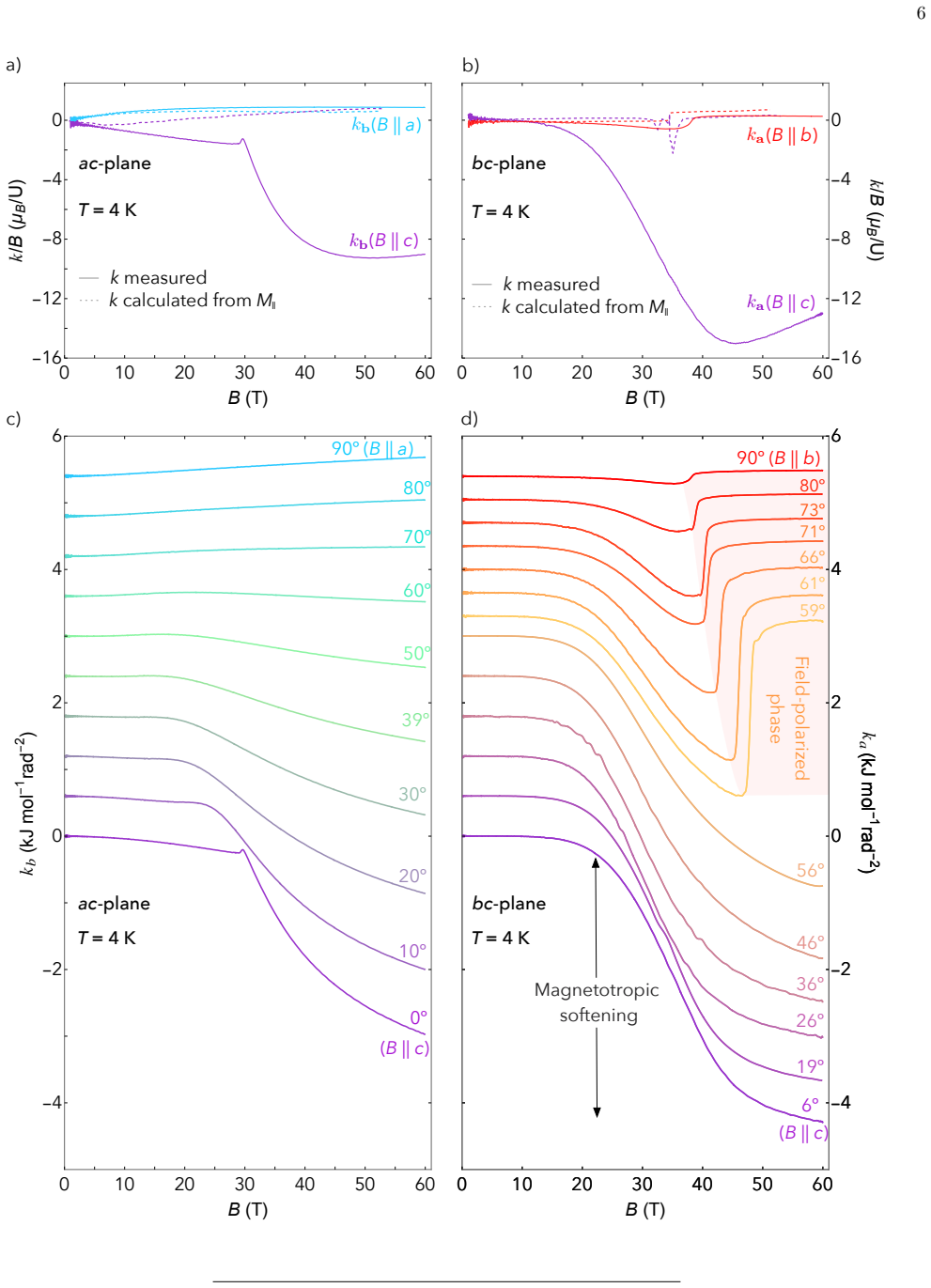
Magnetotropic susceptibility measurements reveal a very large decrease over a broad range of field orientations, indicating a large increase in the transverse magnetic susceptibility. The three superconducting phases of UTe₂, including the high-field re-entrant phase, surround this region of enhanced susceptibility in the field-angle phase diagram. The strongest transverse susceptibility occurs near the critical end point of the high-field metamagnetic transition, suggesting that quantum critical fluctuations of a field-induced magnetic order parameter are responsible for the large transverse susceptibility and may provide a pairing mechanism for field-induced superconductivity in UTe₂.
What carries the argument
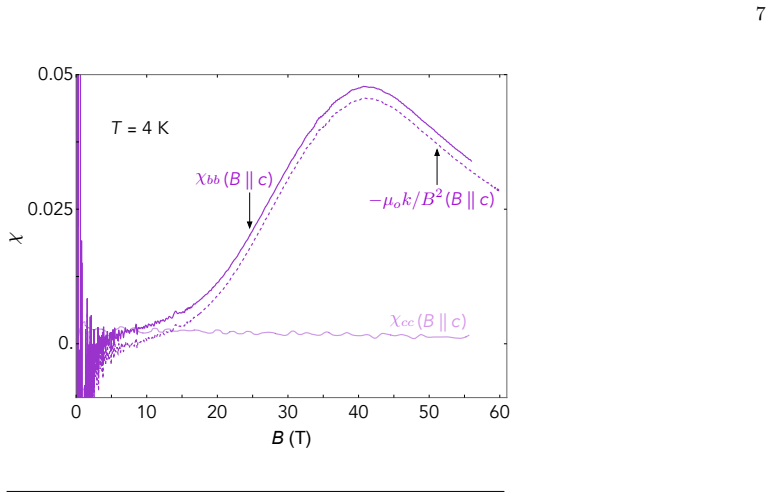
Magnetotropic susceptibility, a probe sensitive to the magnetic susceptibility component transverse to the applied field that is invisible to conventional magnetization measurements.
If this is right
- The re-entrant superconducting phase sits directly at the edge of the region of giant transverse fluctuations.
- Quantum critical fluctuations of a field-induced magnetic order parameter can mediate pairing even in the absence of static ferromagnetic order.
- The metamagnetic critical endpoint controls the location of the high-field superconducting dome in the angle-dependent phase diagram.
- Transverse fluctuations provide a common pairing channel across the zero-field, intermediate-field, and re-entrant superconducting phases.
Where Pith is reading between the lines
- Similar transverse-fluctuation mechanisms may operate in other uranium compounds that lack long-range magnetic order.
- Shifting the metamagnetic critical point with pressure or chemical substitution should move the re-entrant superconducting region in a predictable way.
- Pairing-strength estimates derived from the measured susceptibility magnitude could be checked against the observed transition temperatures in the high-field phase.
Load-bearing premise
The measured drop in magnetotropic susceptibility directly reflects a large rise in transverse magnetic susceptibility caused by quantum critical fluctuations rather than other contributions, and these fluctuations mediate the pairing in the re-entrant phase.
What would settle it
Independent measurements of transverse susceptibility, for example via angle-dependent torque magnetometry or specific-heat studies under tilted fields, that show no corresponding enhancement or misalignment with the superconducting phase boundaries near the metamagnetic critical endpoint.
Figures





read the original abstract
UTe$_{2}$ exhibits the remarkable phenomenon of re-entrant superconductivity, whereby the zero-resistance state reappears above 40 tesla after being suppressed with a field of around 10 tesla. One potential pairing mechanism, invoked in the related re-entrant superconductors UCoGe and URhGe, involves transverse fluctuations of a ferromagnetic order parameter. However, the requisite ferromagnetic order - present in both UCoGe and URhGe - is absent in UTe$_{2}$, and magnetization measurements show no sign of strong fluctuations. Here, we measure the magnetotropic susceptibility of UTe$_{2}$ across two field-angle planes. This quantity is sensitive to the magnetic susceptibility in a direction transverse to the applied magnetic field - a quantity that is not accessed in conventional magnetization measurements. We observe a very large decrease in the magnetotropic susceptibility over a broad range of field orientations, indicating a large increase in the transverse magnetic susceptibility. The three superconducting phases of UTe$_{2}$, including the high-field re-entrant phase, surround this region of enhanced susceptibility in the field-angle phase diagram. The strongest transverse susceptibility is found near the critical end point of the high-field metamagnetic transition, suggesting that quantum critical fluctuations of a field-induced magnetic order parameter may be responsible for the large transverse susceptibility, and may provide a pairing mechanism for field-induced superconductivity in UTe$_{2}$.
Editorial analysis
A structured set of objections, weighed in public.
Referee Report
Summary. The manuscript reports magnetotropic susceptibility measurements on UTe₂ in two field-angle planes at high magnetic fields. A large decrease in this quantity is observed over a broad range of orientations, which the authors interpret as a large enhancement in the transverse magnetic susceptibility χ_⊥. This region of enhanced susceptibility is shown to be surrounded by the three superconducting phases (including the high-field re-entrant phase) in the field-angle diagram, with the strongest effect occurring near the critical endpoint of the high-field metamagnetic transition. The authors suggest that quantum critical fluctuations of a field-induced magnetic order parameter are responsible for the enhanced transverse susceptibility and may mediate pairing in the re-entrant superconducting phase.
Significance. If the interpretation holds, the result is significant because it identifies enhanced transverse fluctuations in a system lacking static ferromagnetism (unlike UCoGe and URhGe), potentially linking quantum critical fluctuations near a metamagnetic endpoint to re-entrant superconductivity. The use of magnetotropic susceptibility as a probe of transverse components not accessible via conventional magnetization is a strength, and the phase-diagram correlation provides a falsifiable spatial relationship between the fluctuation region and the superconducting domes.
major comments (1)
- The central interpretation—that the observed decrease in magnetotropic susceptibility quantitatively maps to a large increase in χ_⊥ driven by quantum critical fluctuations—requires explicit exclusion of alternative contributions from the metamagnetic crossover itself (e.g., field-induced changes in effective anisotropy or domain dynamics). The manuscript notes the absence of strong fluctuations in conventional magnetization but does not provide a model, simulation, or control measurement to demonstrate that such effects cannot produce the torque-derived signal without divergent fluctuations; this is load-bearing for the claim that the fluctuations surround the SC phases and may provide a pairing mechanism.
minor comments (2)
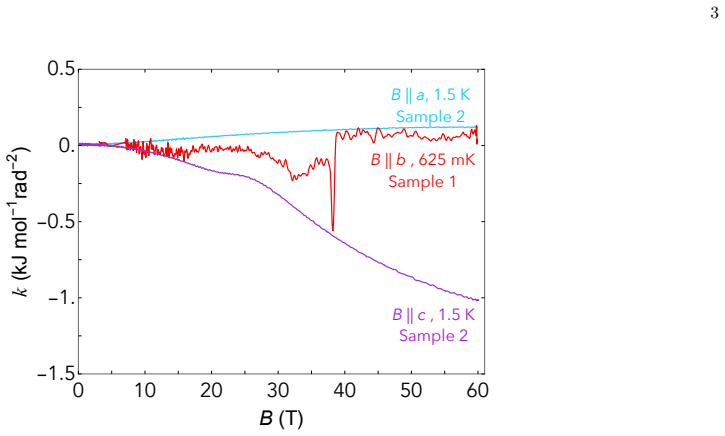
- Figure captions and axis labels should explicitly state the temperature and field-sweep protocols used for the magnetotropic susceptibility data to allow direct comparison with the magnetization curves shown in the same panels.
- The discussion of the phase diagram would benefit from a quantitative statement of the angular width over which the susceptibility enhancement is observed relative to the width of the re-entrant superconducting dome.
Simulated Author's Rebuttal
We thank the referee for the detailed and constructive report. The single major comment raises an important point about alternative explanations for the magnetotropic susceptibility signal. We address it directly below and will revise the manuscript to strengthen the discussion of this issue.
read point-by-point responses
-
Referee: The central interpretation—that the observed decrease in magnetotropic susceptibility quantitatively maps to a large increase in χ_⊥ driven by quantum critical fluctuations—requires explicit exclusion of alternative contributions from the metamagnetic crossover itself (e.g., field-induced changes in effective anisotropy or domain dynamics). The manuscript notes the absence of strong fluctuations in conventional magnetization but does not provide a model, simulation, or control measurement to demonstrate that such effects cannot produce the torque-derived signal without divergent fluctuations; this is load-bearing for the claim that the fluctuations surround the SC phases and may provide a pairing mechanism.
Authors: We agree that a more explicit discussion of why the metamagnetic crossover itself is unlikely to produce the observed broad decrease in magnetotropic susceptibility would strengthen the manuscript. The magnetotropic susceptibility χ_τ is proportional to the second angular derivative of the magnetic free energy and is therefore directly sensitive to the transverse susceptibility χ_⊥, a component that is not captured by standard magnetization measurements along the field direction. The data show that the region of suppressed χ_τ is broad in angle and centered near the metamagnetic critical endpoint, while the metamagnetic transition itself appears as a sharp feature in the longitudinal magnetization. This angular and field dependence, together with the surrounding of the three superconducting domes, is difficult to reconcile with simple field-induced anisotropy changes or domain-wall motion, which would be expected to produce sharper or differently oriented signatures. Nevertheless, we acknowledge that the current text does not contain a dedicated paragraph or simple model ruling out these alternatives in detail. We will therefore revise the manuscript to add an explicit discussion section that contrasts the expected signatures of anisotropy/domain effects with the measured angular dependence in both field-rotation planes and references the absence of corresponding features in published magnetization data. This addition will make the exclusion of alternatives more transparent without altering the central interpretation. revision: yes
Circularity Check
No circularity: experimental measurements and interpretive suggestions are self-contained
full rationale
The paper reports direct experimental measurements of magnetotropic susceptibility in UTe₂ as a function of field and angle, observing a decrease that is interpreted as enhanced transverse susceptibility. The phase diagram correlation with superconducting phases and the suggestion that quantum critical fluctuations near the metamagnetic endpoint may mediate pairing are presented as interpretive hypotheses, not as derivations or predictions derived from fitted parameters or self-referential definitions. No equations, self-citations, or ansatzes in the text reduce any central claim to its own inputs by construction; the work remains externally falsifiable via independent magnetization or torque measurements.
Axiom & Free-Parameter Ledger
axioms (1)
- domain assumption Magnetotropic susceptibility provides a direct probe of the transverse component of the magnetic susceptibility.
Lean theorems connected to this paper
-
IndisputableMonolith/Cost/FunctionalEquation.leanwashburn_uniqueness_aczel unclear?
unclearRelation between the paper passage and the cited Recognition theorem.
We observe a very large decrease in the magnetotropic susceptibility... indicating a large increase in the transverse magnetic susceptibility... near the critical end point of the high-field metamagnetic transition
What do these tags mean?
- matches
- The paper's claim is directly supported by a theorem in the formal canon.
- supports
- The theorem supports part of the paper's argument, but the paper may add assumptions or extra steps.
- extends
- The paper goes beyond the formal theorem; the theorem is a base layer rather than the whole result.
- uses
- The paper appears to rely on the theorem as machinery.
- contradicts
- The paper's claim conflicts with a theorem or certificate in the canon.
- unclear
- Pith found a possible connection, but the passage is too broad, indirect, or ambiguous to say the theorem truly supports the claim.
Forward citations
Cited by 1 Pith paper
-
Dynamical magnetotropic susceptibility as a new probe of Kitaev materials and beyond
Dynamical magnetotropic susceptibility k(ω) acts as a probe of uniform spin and charge fluctuations, with its static scaling in α-RuCl3 arising specifically from dominant Kitaev interactions in the models examined.
Reference graph
Works this paper leans on
-
[1]
have shown that the discontinuity in the magnetization across the metamagnetic transition goes to zero upon approaching B⋆. Both of these observations are consistent with B⋆ marking the second-order critical end point of a line of first-order phase transitions. The fluctuations grow large in the vicinity of the metamagnetic phase boundary, and are abruptl...
-
[2]
Review of U-based Ferromagnetic Superconductors: Comparison be- tween UGe2, URhGe, and UCoGe
Dai Aoki, Kenji Ishida, and Jacques Flouquet. Review of U-based Ferromagnetic Superconductors: Comparison be- tween UGe2, URhGe, and UCoGe. Journal of the Physical Society of Japan , 88(2):022001, 2019. ISSN 0031-9015. doi: 10.7566/jpsj.88.022001
-
[3]
Corey E. Frank, Sylvia K. Lewin, Gicela Saucedo Salas, Peter Czajka, Ian M. Hayes, Hyeok Yoon, Tristin Metz, Johnpierre Paglione, John Singleton, and Nicholas P. Butch. Orphan high field superconductivity in non-superconducting uranium ditelluride. Nature Communications, 15(1):3378, 2024. doi:10.1038/s41467-024-47090-1
-
[4]
K. Hattori and H. Tsunetsugu. p-wave superconductivity near a transverse saturation field. Physical Review B , 87(6): 064501, 2013. ISSN 1098-0121. doi:10.1103/physrevb.87.064501
-
[5]
Toni Helm, Motoi Kimata, Kenta Sudo, Atsuhiko Miyata, Julia Stirnat, Tobias F¨ orster, Jacob Hornung, Markus K¨ onig, Ilya Sheikin, Alexandre Pourret, Gerard Lapertot, Dai Aoki, Georg Knebel, Joachim Wosnitza, and Jean-Pascal Brison. Field-induced compensation of magnetic exchange as the possible origin of reentrant superconductivity in UTe2. Nature Commu...
-
[6]
Georg Knebel, William Knafo, Alexandre Pourret, Qun Niu, Michal Valiˇ ska, Daniel Braithwaite, G´ erard Lapertot, Marc Nardone, Abdelaziz Zitouni, Sanu Mishra, Ilya Sheikin, Gabriel Seyfarth, Jean Pascal Brison, Dai Aoki, and Jacques Flouquet. Field-Reentrant Superconductivity Close to a Metamagnetic Transition in the Heavy-Fermion Superconductor UTe2. ht...
-
[8]
F. L´ evy, I. Sheikin, B. Grenier, and A. D. Huxley. Magnetic Field-Induced Superconductivity in the Ferromagnet URhGe. Science, 309(5739):1343–1346, 2005. ISSN 0036-8075. doi:10.1126/science.1115498
-
[9]
Metamagnetic Transition in Heavy Fermion Superconductor UTe 2 Letters
Atsushi Miyake, Yusei Shimizu, Yoshiki J Sato, Dexin Li, Ai Nakamura, Yoshiya Homma, Fuminori Honda, Jacques Flouquet, Masashi Tokunaga, and Dai Aoki. Metamagnetic Transition in Heavy Fermion Superconductor UTe 2 Letters. Journal of the Physical Society of Japan , 88:63706, 2019. doi:10.7566/jpsj.88.063706. URL https://doi.org/10.7566/JP SJ.88.063706
-
[10]
Atsushi Miyake, Yusei Shimizu, Yoshiki J. Sato, Dexin Li, Ai Nakamura, Yoshiya Homma, Fuminori Honda, Jacques Flouquet, Masashi Tokunaga, and Dai Aoki. Enhancement and Discontinuity of Effective Mass through the First-Order Metamagnetic Transition in UTe2. Journal of the Physical Society of Japan , 90(10):103702, 2021. ISSN 0031-9015. doi: 10.7566/jpsj.90...
-
[12]
Sheng Ran, I-Lin Liu, Yun Suk Eo, Daniel J. Campbell, Paul M. Neves, Wesley T. Fuhrman, Shanta R. Saha, Christopher Eckberg, Hyunsoo Kim, David Graf, Fedor Balakirev, John Singleton, Johnpierre Paglione, and Nicholas P. Butch. Extreme magnetic field-boosted superconductivity. Nature Physics 2019 15:12 , 15:1250–1254, 10 2019. doi:10.1038/s41567-019-0670- ...
-
[13]
A. Shekhter, R. D. McDonald, B. J. Ramshaw, and K. A. Modic. Magnetotropic susceptibility. Physical Review B , 108(3): 035111, 2023. ISSN 2469-9950. doi:10.1103/physrevb.108.035111
-
[14]
Giant transverse magnetic susceptibility at the edge of re-entrant superconductivity in UTe 2
Z Wu, T I Weinberger, A J Hickey, D V Chichinadze, D Shaffer, A Cabala, H Chen, M Long, T J Brumm, W Xie, Y Lin, Y Skourski, Z Zengwei, D E Graf, V Sechovsky, G G Lonzarich, 1 M Valiska, F M Grosche, and A G Eaton. Quantum critical fluctuations generate intensely magnetic field-resilient superconductivity in UTe2. arXiv, 2024. doi: 10.48550/arxiv.2403.02535
-
[15]
Giant transverse magnetic susceptibility at the edge of re-entrant superconductivity in UTe 2
Z Wu, T I Weinberger, A J Hickey, D V Chichinadze, D Shaffer, A Cabala, H Chen, M Long, T J Brumm, W Xie, Y Lin, Y Skourski, Z Zhu, D E Graf, V Sechovsky, G G Lonzarich, M Valiska, F M Grosche, and A G Eaton. A quantum critical line bounds the high field metamagnetic transition surface in UTe. arXiv, 2024. doi:10.48550/arxiv.2403.02535v3. Supplementary in...
-
[16]
de Rooij, Urs Staufer, Manfred Detterbeck, Dominik Braendlin, Simon Waldmeier, and Martin Scheidiger
Terunobu Akiyama, Nicolaas F. de Rooij, Urs Staufer, Manfred Detterbeck, Dominik Braendlin, Simon Waldmeier, and Martin Scheidiger. Implementation and characterization of a quartz tuning fork based probe consisted of discrete resonators for dynamic mode atomic force microscopy. Review of Scientific Instruments , 81(6):063706, 2010. ISSN 0034-6748. doi: 10....
-
[17]
Wilton J M Kort-Kamp, Ryan A Murdick, Han Htoon, and Andrew C Jones. Utilization of coupled eigenmodes in Akiyama atomic force microscopy probes for bimodal multifrequency sensing. Nanotechnology, 33(45):455501, 2022. ISSN 0957-4484. doi:10.1088/1361-6528/ac8232
-
[18]
High-Field Superconducting Halo in UTe $ 2$
Sylvia K Lewin, Peter Czajka, Corey E Frank, Gicela Saucedo Salas, Hyeok Yoon, Yun Suk Eo, Johnpierre Paglione, Andriy H Nevidomskyy, John Singleton, and Nicholas P Butch. High-Field Superconducting Halo in UTe $ 2$. arXiv, 2024. doi:10.48550/arxiv.2402.18564
-
[19]
K. A. Modic, Maja D. Bachmann, B. J. Ramshaw, F. Arnold, K. R. Shirer, Amelia Estry, J. B. Betts, Nirmal J. Ghimire, E. D. Bauer, Marcus Schmidt, Michael Baenitz, E. Svanidze, Ross D. McDonald, Arkady Shekhter, and Philip J.W. Moll. Resonant torsion magnetometry in anisotropic quantum materials. Nature Communications 2018 9:1 , 9:1–8, 9 2018. doi: 10.1038...
-
[20]
Priscila F. S. Rosa, Ashley Weiland, Shannon S. Fender, Brian L. Scott, Filip Ronning, Joe D. Thompson, Eric D. Bauer, and Sean M. Thomas. Single thermodynamic transition at 2 K in superconducting UTe2 single crystals. Communications Materials, 3(1):33, 2022. doi:10.1038/s43246-022-00254-2
discussion (0)
Sign in with ORCID, Apple, or X to comment. Anyone can read and Pith papers without signing in.