Length-scale selection in adaptive transport networks
Pith reviewed 2026-05-19 16:57 UTC · model grok-4.3
The pith
A continuum model of adaptive transport networks reveals a finite-wavelength instability that selects channel spacing with a -1/4 power-law scaling.
A machine-rendered reading of the paper's core claim, the machinery that carries it, and where it could break.
Core claim
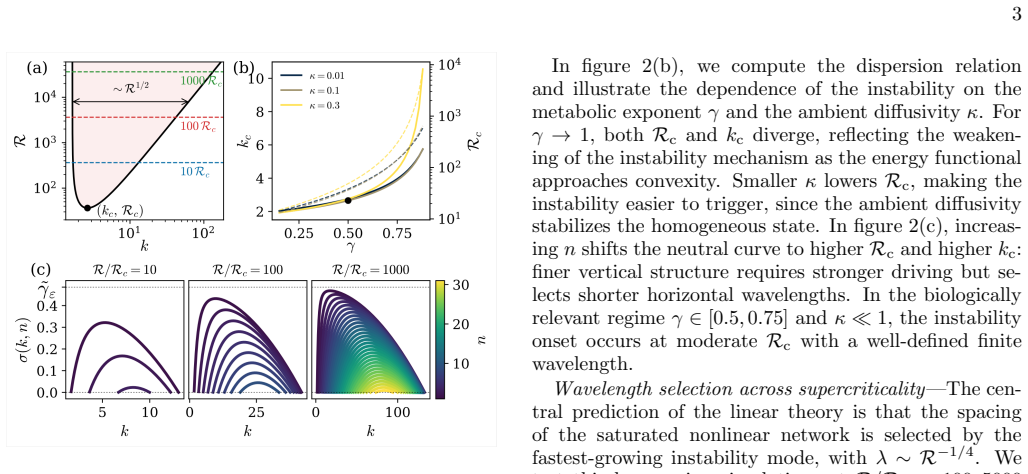
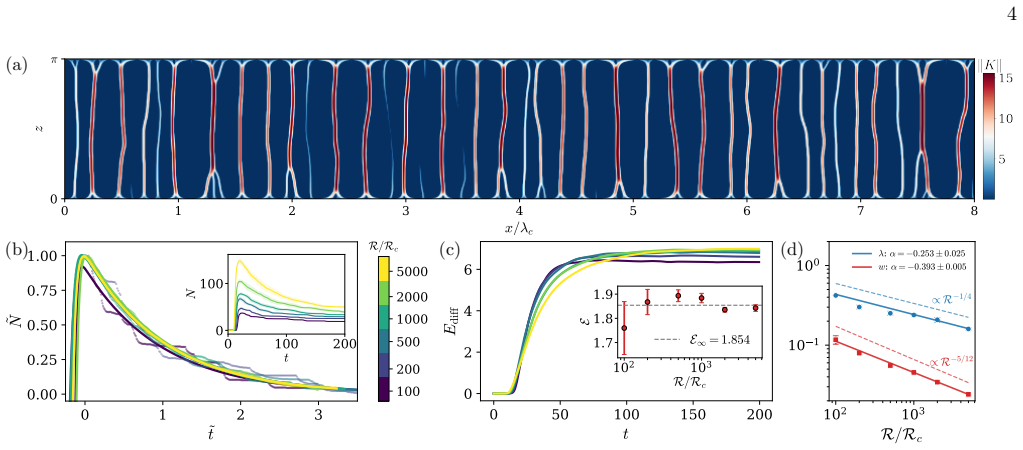
Linearizing the continuum evolution equations for the conductivity tensor about the homogeneous conducting state yields a finite-wavelength instability whose most unstable wave number k scales as the control parameter to the power -1/4. Above threshold the instability drives the spontaneous formation of anisotropic conducting structures whose spacing matches the linear prediction.
What carries the argument
The finite-wavelength instability obtained by linearizing the conductivity-tensor evolution rule around the uniform conducting state.
If this is right
- Network density is intrinsically selected by the instability rather than imposed externally or by global energy minimization.
- The spatial scale of resource delivery is set by the same -1/4 scaling relation.
- Hierarchical topologies can emerge from the same local feedback rule once the primary instability has fixed the base spacing.
- The same constitutive feedback places adaptive transport networks inside the broader class of nonequilibrium pattern-forming media.
Where Pith is reading between the lines
- The mechanism could be tested in laboratory microfluidic networks or in living slime-mold plasmodia by varying flow strength and measuring emergent spacing.
- Similar length-scale selection may operate in other adaptive systems such as leaf venation or river networks if they obey analogous conductivity-flow feedback.
- The predicted scaling supplies a parameter-free relation that can be compared directly with measured channel densities in biological tissues.
Load-bearing premise
The chosen continuum rule for how the conductivity tensor evolves with flow is the minimal description whose linearization produces a finite-wavelength instability.
What would settle it
Measure the dependence of average channel spacing on a tunable control parameter such as adaptation rate or driving pressure; if the spacing does not scale as the control parameter to the power minus one fourth, the instability mechanism is ruled out.
Figures

read the original abstract
Adaptive transport networks in biological and physical systems exhibit hierarchical organization, characteristic channel spacing, and robust scaling relations. Existing adaptive network models, formulated on a lattice, successfully reproduce many observed topologies and conduit scaling laws; however, the mechanism that selects network density and spatial spacing remains unclear. We address this in a continuum formulation where conductivity evolves as a tensor field coupled to pressure-driven flow. Linearizing about a homogeneous conducting state, we identify a finite-wavelength instability with a $-1/4$ preferred wavelength scaling in the control parameter. Simulations of the full equations confirm the analytical predictions and demonstrate the formation of anisotropic conducting structures above threshold. These results establish a scale-selection principle for adaptive transport network formation which arises from a pattern-forming instability rather than solely from relaxation within a nonconvex energy landscape. The instability mechanism places adaptive transport systems within a broader class of nonequilibrium pattern-forming media in which constitutive transport feedback generates spatial organization. Beyond reproducing hierarchical scaling laws, the theory additionally predicts the intrinsic density of transport networks and the spatial scale of resource delivery.
Editorial analysis
A structured set of objections, weighed in public.
Referee Report
Summary. The paper develops a continuum model of adaptive transport networks in which conductivity is an evolving tensor field coupled to pressure-driven flow. Linearizing about a homogeneous conducting state yields a finite-wavelength instability whose preferred wavelength scales as control-parameter to the power -1/4. Full nonlinear simulations are reported to confirm the linear predictions and to produce anisotropic conducting structures, establishing a pattern-forming mechanism for length-scale selection.
Significance. If the result holds, the work supplies a mechanistic account of characteristic spacing and density in adaptive transport networks via a nonequilibrium instability rather than energy minimization alone. It situates these systems within the broader class of pattern-forming media driven by constitutive feedback. The analytical scaling relation together with its numerical confirmation, plus the additional predictions for intrinsic network density and resource-delivery scale, constitute clear strengths.
major comments (2)
- [§3] §3 (Linear Stability Analysis): The dispersion relation that produces the -1/4 wavelength scaling is obtained by linearizing the specific conductivity evolution PDE. The manuscript must state the full constitutive relation explicitly (including the precise dependence on local shear, relaxation, and any anisotropic terms) and demonstrate that the finite-k instability and its scaling survive modest variations in the functional form; otherwise the length-scale selection risks being an artifact of the chosen evolution rule rather than a generic consequence of adaptive transport feedback.
- [§4] §4 (Numerical Simulations): The claim that simulations of the full equations confirm the analytical predictions requires quantitative support—measured wavelengths versus predicted values, error bars, and explicit parameter choices relative to threshold. Without these, the confirmation remains only qualitative and does not fully ground the central instability result.
minor comments (2)
- [Introduction] The definition and physical interpretation of the control parameter should be introduced at the first appearance rather than deferred.
- [Figures] Figure captions would benefit from explicit indication of the control-parameter value used in each panel relative to the instability threshold.
Simulated Author's Rebuttal
We thank the referee for their detailed and constructive report. We address the major comments point by point below and outline the revisions we will make to the manuscript.
read point-by-point responses
-
Referee: [§3] §3 (Linear Stability Analysis): The dispersion relation that produces the -1/4 wavelength scaling is obtained by linearizing the specific conductivity evolution PDE. The manuscript must state the full constitutive relation explicitly (including the precise dependence on local shear, relaxation, and any anisotropic terms) and demonstrate that the finite-k instability and its scaling survive modest variations in the functional form; otherwise the length-scale selection risks being an artifact of the chosen evolution rule rather than a generic consequence of adaptive transport feedback.
Authors: We agree that the constitutive relation should be presented more explicitly for clarity. In the revised manuscript, we will state the full conductivity evolution equation, detailing the dependence on local shear, the relaxation term, and anisotropic contributions. To address the robustness concern, we have examined the dispersion relation under modest changes to the functional form, such as altering the power-law exponent in the shear adaptation term by ±0.2 and varying the relaxation rate. The finite-wavelength instability and the -1/4 scaling persist in these cases, indicating that the mechanism is not an artifact of the specific choice. We will include this analysis in the revised §3 and add a brief discussion. revision: yes
-
Referee: [§4] §4 (Numerical Simulations): The claim that simulations of the full equations confirm the analytical predictions requires quantitative support—measured wavelengths versus predicted values, error bars, and explicit parameter choices relative to threshold. Without these, the confirmation remains only qualitative and does not fully ground the central instability result.
Authors: We acknowledge that the current presentation of the numerical results is primarily qualitative. In the revised manuscript, we will add quantitative comparisons: we will plot the measured dominant wavelengths from the simulations against the analytically predicted values for several control parameter values above threshold, include error bars obtained from ensemble averages over multiple initial conditions, and explicitly state the parameter values used relative to the critical threshold for the instability. This will provide stronger support for the confirmation of the linear predictions. revision: yes
Circularity Check
No significant circularity in the linear stability derivation
full rationale
The paper presents a continuum model for conductivity evolution as a tensor field coupled to pressure-driven flow, motivated as an extension of existing lattice-based adaptive network models. Linearization about the homogeneous conducting state produces a dispersion relation whose most unstable mode yields the reported -1/4 wavelength scaling as a direct algebraic consequence of the balance between flow-driven adaptation, relaxation, and diffusion terms in the stated PDE. This scaling is not obtained by fitting parameters to target spacings, nor does it rely on self-citations for uniqueness theorems or ansatzes smuggled from prior work. The central claim that the length scale arises from a pattern-forming instability (rather than solely energy minimization) follows from the explicit form of the linearized operator without reducing to a renaming or self-definitional loop. The derivation remains self-contained against the model's constitutive assumptions.
Axiom & Free-Parameter Ledger
free parameters (1)
- control parameter
axioms (1)
- domain assumption Conductivity evolves as a tensor field coupled to pressure-driven flow.
Lean theorems connected to this paper
-
IndisputableMonolith/Cost/FunctionalEquation.leanwashburn_uniqueness_aczel unclear?
unclearRelation between the paper passage and the cited Recognition theorem.
Linearizing about a homogeneous conducting state, we identify a finite-wavelength instability with a −1/4 preferred wavelength scaling in the control parameter.
-
IndisputableMonolith/Foundation/BranchSelection.leanbranch_selection unclear?
unclearRelation between the paper passage and the cited Recognition theorem.
∂tK=∇p⊗∇p−f(∥K∥)K+(1/R)∇²K
What do these tags mean?
- matches
- The paper's claim is directly supported by a theorem in the formal canon.
- supports
- The theorem supports part of the paper's argument, but the paper may add assumptions or extra steps.
- extends
- The paper goes beyond the formal theorem; the theorem is a base layer rather than the whole result.
- uses
- The paper appears to rely on the theorem as machinery.
- contradicts
- The paper's claim conflicts with a theorem or certificate in the canon.
- unclear
- Pith found a possible connection, but the passage is too broad, indirect, or ambiguous to say the theorem truly supports the claim.
Reference graph
Works this paper leans on
-
[1]
Length-scale selection in adaptive transport networks
derived this rule from a cost function-minimization principle that includes the total pumping power needed,P e Qe∆Pe, as well as the associated metabolic cost,P e K γ e , with the metabolic exponentγdistinguishing morphologies. Despite the model successes in reproducing many as- pects of transport network morphology, what morpho- logically sets the observ...
work page internal anchor Pith review Pith/arXiv arXiv 2026
-
[2]
G. B. West, J. H. Brown, and B. J. Enquist, Science276, 122–126 (1997)
work page 1997
-
[3]
J. R. Banavar, A. Maritan, and A. Rinaldo, Nature399, 130 (1999)
work page 1999
-
[4]
C. D. Murray, Proceedings of the National Academy of Sciences12, 207–214 (1926)
work page 1926
-
[5]
K. A. McCulloh, J. S. Sperry, and F. R. Adler, Nature 421, 939 (2003)
work page 2003
-
[6]
M. Stern and A. Murugan, Annual Review of Condensed Matter Physics14, 417–441 (2023)
work page 2023
- [7]
-
[8]
E. Katifori, G. J. Sz¨ oll˝ osi, and M. O. Magnasco, Physi- cal Review Letters104, 10.1103/physrevlett.104.048704 (2010)
-
[9]
I. S. Matos, B. Vu, J. Mann, E. Xie, S. Madhavan, S. Sharma, I. Niewiadomski, A. Echevarria, C. Tomaka, S. Carlos, M. Antonio, A. Chu, M. Scudder, N. Yokota, H. J. Park, N. Vuong, M. Boakye, M. A. Duarte, C. Pechuzal, L. M. T. Aparecido, M. B. Franco, R. J. Wong, J. Liu, E. Guevara Heredia, B. Boyle, M. Ryan, R. E. C´ ardenas, B. J. Enquist, D. M. Erwin, ...
work page 2025
-
[10]
A. Alonso, L. E. J. Skjegstad, and J. B. Kirkegaard, Phys- ical Review Letters135, 10.1103/6b4j-tq1n (2025)
-
[11]
A. Tero, S. Takagi, T. Saigusa, K. Ito, D. P. Bebber, M. D. Fricker, K. Yumiki, R. Kobayashi, and T. Naka- gaki, Science327, 439–442 (2010)
work page 2010
-
[12]
L. Schick, M. Kramar, and K. Alim, PRX Life2, 10.1103/prxlife.2.033005 (2024)
-
[13]
L. Oyarte Galvez, C. Bisot, P. Bourrianne, R. Cargill, M. Klein, M. van Son, J. van Krugten, V. Caldas, T. Clerc, K.-K. Lin, F. Kahane, S. van Staalduine, J. D. Stewart, V. Terry, B. Turcu, S. van Otterdijk, A. Babu, M. Kamp, M. Seynen, B. Steenbeek, J. Zomerdijk, E. Tu- tucci, M. Sheldrake, C. Godin, V. Kokkoris, H. A. Stone, E. T. Kiers, and T. S. Shimi...
work page 2025
-
[14]
T. W. Secomb, Annual Review of Fluid Mechanics49, 443–461 (2017)
work page 2017
-
[15]
J. B. Kirkegaard and K. Sneppen, Physical Review Let- ters124, 10.1103/physrevlett.124.208101 (2020)
-
[16]
Y. Qi, S.-S. Chang, Y. Wang, C. Chen, K. I. Baek, T. Hsiai, and M. Roper, Proceedings of the National Academy of Sciences121, 10.1073/pnas.2310993121 (2024)
-
[17]
K. Sinclair and R. C. Ball, Physical Review Letters76, 3360–3363 (1996)
work page 1996
-
[18]
A. Rinaldo, R. Rigon, J. R. Banavar, A. Maritan, and I. Rodriguez-Iturbe, Proceedings of the National Academy of Sciences111, 2417–2424 (2014)
work page 2014
-
[19]
A. Konkol, J. Schwenk, E. Katifori, and J. B. Shaw, Geophysical Research Letters49, 10.1029/2022gl098284 (2022)
-
[20]
A. Tero, R. Kobayashi, and T. Nakagaki, Physica A: Statistical Mechanics and its Applications363, 115–119 (2006)
work page 2006
- [21]
- [22]
-
[23]
K. He, K. J. Niklas, U. Niinemets, J. Wang, Y. Jiao, and P. Shi, Frontiers in Plant Science15, 10.3389/fpls.2024.1365449 (2024)
- [24]
- [25]
-
[26]
J. Haskovec, P. Markowich, and B. Perthame, Communi- cations in Partial Differential Equations40, 918 (2015)
work page 2015
- [27]
-
[28]
G. Albi, M. Artina, M. Foransier, and P. A. Markowich, Analysis and Applications14, 185 (2016)
work page 2016
-
[29]
G. Albi, M. Burger, J. Haskovec, P. Markowich, and M. Schlottbom, inActive Particles, Volume 1(Springer,
-
[30]
J. Haskovec, L. M. Kreusser, and P. Markowich, Com- munications in Mathematical Sciences17, 1235 (2019)
work page 2019
-
[31]
J. Haskovec, L. M. Kreusser, and P. Markowich, Com- munications in Partial Differential Equations44, 1159 (2019)
work page 2019
- [32]
- [33]
-
[34]
Q. Xia, X. Jiang, and Y. Li, Journal of Computational Physics488, 112192 (2023)
work page 2023
- [35]
- [36]
-
[37]
Y. Li, Z. Lv, and Q. Xia, Physics of Fluids36, 10.1063/5.0231079 (2024)
-
[38]
J. Haskovec, P. A. Markowich, and S. Portaro, inFriends in Partial Differential Equations(EMS Press, 2025) pp. 6 123–168
work page 2025
-
[39]
A. M. Turing, Philosophical Transactions of the Royal So- ciety of London. Series B, Biological Sciences237, 37–72 (1952)
work page 1952
-
[40]
Chandrasekhar,Hydrodynamic and Hydromagnetic Stability(Oxford University Press, Oxford, 1961)
S. Chandrasekhar,Hydrodynamic and Hydromagnetic Stability(Oxford University Press, Oxford, 1961)
work page 1961
-
[41]
M. C. Cross and P. C. Hohenberg, Reviews of Modern Physics65, 851–1112 (1993)
work page 1993
-
[42]
Frisch,Turbulence: The Legacy of A.N
U. Frisch,Turbulence: The Legacy of A.N. Kolmogorov (Cambridge University Press, 1995)
work page 1995
-
[43]
D. A. Ham, P. H. J. Kelly, L. Mitchell, C. J. Cotter, R. C. Kirby, K. Sagiyama, N. Bouziani, S. Vorderwuel- becke, T. J. Gregory, J. Betteridge, D. R. Shapero, R. W. Nixon-Hill, C. J. Ward, P. E. Farrell, P. D. Brubeck, I. Marsden, T. H. Gibson, M. Homolya, T. Sun, A. T. T. McRae, F. Luporini, A. Gregory, M. Lange, S. W. Funke, F. Rathgeber, G.-T. Bercea,...
work page 2023
-
[44]
P. Amestoy, I. Duff, and J.-Y. L’Excellent, Computer Methods in Applied Mechanics and Engineering184, 501–520 (2000). Appendix A: Linear Theory Derivations The active linearized equations are ∂x ˜Kxz +∂ z ˜Kzz =κ∇ 2˜p+∂2 z ˜p,(A1) ∂t ˜Kxz +∂ x˜p=− ˜Kxz + 1 R ∇2 ˜Kxz,(A2) ∂t ˜Kzz + 2∂ z ˜p= ˜γε ˜Kzz + 1 R ∇2 ˜Kzz .(A3) where ∇2 =∂ 2 z +∂ 2 x,˜γ ε = 1−γ−ε 1...
work page 2000
discussion (0)
Sign in with ORCID, Apple, or X to comment. Anyone can read and Pith papers without signing in.