REVIEW 3 major objections 11 minor 82 references
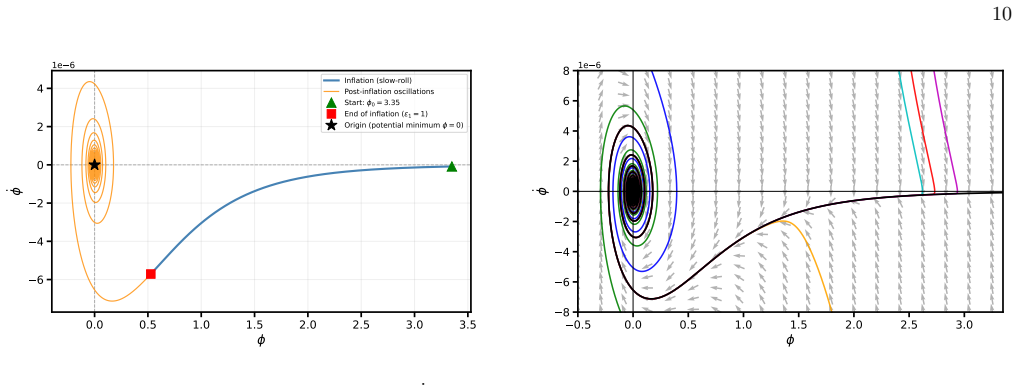
Reviewed by Pith at T0; open to challenge.
T0 review · glm-5.2
Non-canonical kinetic term revives Starobinsky inflation under ACT DR6
2026-07-08 16:11 UTC pith:JVWBS6DE
load-bearing objection Starobinsky potential plus k-essence kinetic coupling can fit ACT DR6 — technically sound but phenomenological, with a reheating approximation that needs scrutiny. the 3 major comments →
Starobinsky Inflation in k-Essence Framework: Attractor Dynamics, Reheating, and Consistency with ACT DR6
The pith
A machine-rendered reading of the paper's core claim, the machinery that carries it, and where it could break.
Core claim
The central mechanism is the appearance of a correction term ξ_V = (F_{,φ}/F)√(2F ε_V) in the scalar spectral index n_s ≃ 1 + 2η_V − 6ε_V − ξ_V, which arises solely because the kinetic coupling F(φ) is field-dependent. In the canonical limit F = 1, this term vanishes identically and the standard Starobinsky prediction is recovered. With a non-trivial F(φ) = 1 + Aφ^n, the term ξ_V, together with the rescaling of ε_V and η_V by 1/F(φ), provides enough freedom to push n_s from ~0.965 up to ~0.97 and beyond, landing inside the ACT DR6 1σ contour. The paper demonstrates this through a numerical scan over (A, n), finding that for n = 1.0–2.0 and A in the range ~0.45–5.5 (depending on n), the model
What carries the argument
The k-essence Lagrangian L = F(φ)X − V(φ) with Starobinsky potential V(φ) = V₀(1 − e^{−√(2/3)φ})² and power-law coupling F(φ) = 1 + Aφ^n. The model sits inside the Horndeski/G-inflation framework as a special case where the cubic Galileon term is integrated by parts, yielding a field-dependent coefficient on the kinetic term X. Because the Lagrangian is linear in X, the sound speed of curvature perturbations is exactly unity, so non-Gaussianity constraints are automatically satisfied. The key slow-roll parameters are ε_V = M²_p/(2F) · (V_{,φ}/V)², η_V = M²_p/F · V_{,φφ}/V, and the non-canonical correction ξ_V = (F_{,φ}/F)√(2F ε_V). The Hamilton-Jacobi equation for this system is 2M⁴_p F [H'(
Load-bearing premise
The power-law coupling F(φ) = 1 + Aφ^n has two free parameters that are scanned over to fit ACT DR6 contours, and the paper acknowledges that other functional forms (e.g., exponential) also work. The agreement with data is therefore a parameter-space fit rather than a tight prediction, and the coupling lacks a specified UV completion or deeper theoretical justification beyond its embedding in the Horndeski framework.
What would settle it
If future CMB data (e.g., from CMB-S4 or LiteBIRD) were to measure n_s and r with sufficient precision that they fall outside the band swept by the (A, n) parameter scan — or if the running α_s were measured to deviate from the narrow negative range (~−5 × 10⁻⁴ to −4 × 10⁻⁴) predicted by the model — the k-essence repair would be falsified for the Starobinsky potential. Additionally, if BBO detects a blue-tilted gravitational wave peak in the reheating band rather than the f^−2 suppression predicted by w_re = 0, the reheating story would be inconsistent.
If this is right
- If the mechanism is correct, any inflationary potential disfavoured by ACT DR6 in the canonical framework could potentially be revived by a field-dependent kinetic coupling, making this a general repair strategy rather than one specific to Starobinsky.
- The f^−2 suppression in the gravitational wave reheating band (from w_re = 0) is a distinguishing prediction: models that instead produce a blue-tilted GW peak in the reheating band (from w_re > 1/3) are disfavoured if BBO sees no such peak.
- The reheating constraint N_k ≲ 58.2 (beyond which reheating e-folds become negative) provides an upper bound on inflationary duration that is tighter than the observational n_s–r fit alone, potentially testable against future precision measurements of n_s.
- Since the sound speed remains unity, the model evades current non-Gaussianity bounds but also predicts no enhancement of primordial non-Gaussianity — a null result that future CMB experiments can check.
Where Pith is reading between the lines
- The paper states that exponential and other coupling forms also satisfy ACT constraints, which suggests the result is not a sharp prediction of a specific coupling but rather a broad property of the k-essence deformation. If so, the model's agreement with data is a statement about the flexibility of field-dependent kinetic terms, not about the uniqueness of the power-law ansatz.
- A potential discriminator between this repair and competing ones (e.g., modified gravity, nonminimal coupling) would be the joint measurement of the tensor-to-scalar ratio r and the running α_s: the k-essence mechanism produces a specific correlation between r, α_s, and n_s that differs from what modified-gravity repairs would yield, though the paper does not explore this comparison.
- The reheating temperature T_re ~ 10^14 GeV is high enough that thermal leptogenesis is feasible, but the paper does not discuss whether the w_re = 0 regime (matter-like reheating) affects the generation of the baryon asymmetry or the thermal history in ways distinguishable from instantaneous reheating.
Editorial analysis
A structured set of objections, weighed in public.
Referee Report
Summary. The manuscript proposes embedding the Starobinsky inflationary potential within a k-essence framework characterized by a Lagrangian L = F(φ)X - V(φ), where F(φ) = 1 + Aφ^n is a power-law kinetic coupling. The motivation is the tension between canonical Starobinsky inflation and the recent ACT DR6 data, which prefers a higher scalar spectral index n_s. The authors derive the background equations, slow-roll parameters, and spectral observables, showing numerically that for ranges of (A, n) the predictions (n_s, r, α_s) fall within the 1σ region of P-ACT-LB-BK18. The attractor nature of the solutions is verified via Hamilton-Jacobi analysis and phase-space portraits. Reheating is analyzed assuming w_re = 0 (justified by the quadratic minimum of the Starobinsky potential), yielding T_re ~ 10^14 GeV. The primordial gravitational wave spectrum is computed, showing an f^{-2} suppression in the reheating band and a plateau amplitude within potential reach of BBO. The paper is clearly written and addresses a timely question.
Significance. The paper tackles a current and active problem: reconciling theoretically well-motivated inflationary models with the ACT DR6 shift in n_s. The approach of modifying only the kinetic sector while preserving Einstein gravity and c_s = 1 is economical and theoretically clean. The Hamilton-Jacobi attractor proof (Sec. III C 1, Eq. 31) is a nice analytical contribution, and the numerical phase-space analysis confirms it concretely. The computation of the full GW spectrum including the reheating band is a valuable addition. However, the model introduces two free parameters (A, n) that are scanned to fit the data, and the authors themselves note (Sec. III, final paragraph) that other coupling forms (e.g., exponential) also work, which weakens the predictive power. The significance is therefore moderate: the framework is viable and well-studied, but the specific coupling is phenomenological.
major comments (3)
- Notation inconsistency between text and figures: The main text and Sec. II define the coupling as F(φ) = 1 + Aφ^n, but Figs. 4, 5, 8, 9, and 10 use parameters labeled 'q' and 'm' (e.g., Fig. 4 caption: 'A=0.55, q=2.0, and m=2.41'). It is unclear whether 'q' replaces 'n' and what 'm' represents (possibly V_0 or a mass parameter). This discrepancy must be resolved to ensure reproducibility, as the reader cannot determine which parameters were actually used in the numerical computations for the power spectrum, reheating, and GW results. This is load-bearing because the reheating and GW predictions (part of the central claim) depend on these specific parameter values.
- Sec. IV, Eq. (40): The claim that w_re = 0 relies on F(φ) → 1 near the minimum φ = 0. However, Eq. (40) shows that the √F(φ) factors do not cancel between numerator and denominator, so w_re depends on F(φ) at the oscillation amplitude φ_m, not just in the limit φ → 0. For the parameter ranges considered (e.g., A up to 15.5 in Sec. III A), the oscillation amplitude during early reheating may be large enough that F(φ_m) deviates significantly from unity. The authors should either (i) provide a quantitative estimate showing that φ_m is sufficiently small throughout the reheating epoch for the parameter ranges used in Figs. 9–10, or (ii) compute w_re numerically using Eq. (40) for representative parameter sets and show that the deviation from w_re = 0 is negligible. Fig. 8 partially addresses this for one parameter set (A=0.55, q=2.0), but the convergence to w_re = 0 should be verified for a
- Sec. IV, reheating constraints and GW spectrum: The constraint N_k ≲ 58.2 (below Eq. 41 and Fig. 9) excludes part of the parameter space that is otherwise consistent with ACT DR6 at N_k = 60. This tension should be discussed more explicitly: Table II reports viable (n_s, r) at N = 60, but the reheating analysis suggests N_k = 60 may be physically inconsistent (negative N_re). The authors should clarify which parameter combinations survive both the observational and reheating constraints simultaneously, and whether the surviving region still lies within the ACT 1σ contour. This directly affects the central claim that the model is fully consistent with ACT DR6.
minor comments (11)
- Sec. I, first paragraph: 'A brief period of exponential expansion that the universe went through during the first moments after the Big Bang.' is a sentence fragment.
- Sec. II, Eq. (10): The sentence beginning 'his expression shows...' appears to be missing a leading 'T'.
- Sec. II, Eq. (14): 'One can see that for F(φ) these expressions reduce to...' should read 'for F(φ) = 1' or 'for F = 1'.
- Sec. III, Fig. 1 caption: 'right panel and left panel show the r–n_s and α_s–n_s results' — the order is reversed relative to the figure layout (left panel is r–n_s).
- Sec. III, Fig. 4 caption: 'TThe red line stand for' has a doubled 'T' and subject-verb agreement issue.
- Sec. III, Fig. 4 caption: Parameter 'm=2.41' is used but never defined in the text. Please define or remove.
- Sec. IV: 'Then, forllowing the same precedure' should read 'Then, following the same procedure'.
- Sec. V, Eq. (45): 'a_hc' is referenced in the text before Eq. (45) but the equation defines T^2(k). Consider reordering for clarity.
- Sec. V, Eq. (51): The piecewise spectrum uses f_end as the upper boundary, but f_end is defined in Eq. (54) as depending on H_end. Please confirm H_end is evaluated consistently with the parameters used in Fig. 10.
- Table I: The 'Planck 2018' row lists r < 0.10, but the text states r < 0.036 for Planck+BK18. The table should clarify that the first row is Planck-only.
- Sec. III, last paragraph: The claim that 'the k-inflation framework employed in this work also satisfies the ACT constraints for other classes of coupling functions, such as an exponential coupling' is made without any supporting calculation or reference. Either provide evidence or remove this claim.
Simulated Author's Rebuttal
We thank the referee for a careful and constructive report. All three major comments identify legitimate issues that require revision. Comment 1 (notation inconsistency) is correct and will be fully fixed. Comment 2 (validity of w_re=0 for large oscillation amplitudes) is a substantive concern; we will address it with the requested quantitative verification and revise accordingly. Comment 3 (tension between N_k=60 observational viability and reheating constraints) is also correct and requires a more explicit discussion of the surviving parameter space. We agree with all three points and will revise the manuscript.
read point-by-point responses
-
Referee: Notation inconsistency between text and figures: Figs. 4, 5, 8, 9, 10 use 'q' and 'm' instead of 'n' (and possibly other parameters). Unclear what 'q' and 'm' represent.
Authors: The referee is correct. This is a notation inconsistency that arose during the preparation of the manuscript: in an earlier draft, the coupling was written as F(φ) = 1 + Aφ^q, and 'q' was used in the figures. The parameter 'm' in Figs. 4 and 5 refers to the field value at horizon crossing (φ_★), not to V_0 or a mass parameter. In the current text, the power index is denoted 'n', so the figures should use 'n' consistently. We will correct all figure captions and axis labels to use 'n' in place of 'q', and will either remove the 'm' label or replace it with the explicit quantity φ_★ it represents. This is purely a labeling issue and does not affect any numerical results. revision: yes
-
Referee: Sec. IV, Eq. (40): The claim w_re=0 relies on F(φ)→1 near φ=0, but the √F(φ) factors do not cancel, so w_re depends on F(φ) at the oscillation amplitude φ_m. For large A (up to 15.5), φ_m may be large enough that F(φ_m) deviates significantly from unity. Authors should either (i) provide quantitative estimate showing φ_m is small, or (ii) compute w_re numerically for representative parameter sets and show deviation from w_re=0 is negligible.
Authors: The referee raises a valid and important point. We agree that the argument for w_re=0 requires quantitative verification beyond the qualitative statement that F(φ)→1 near the minimum. In the revised manuscript, we will implement option (ii): we will compute w_re numerically using Eq. (40) for representative parameter sets spanning the full range of A used in the paper (including A up to 15.5), and present the results showing the convergence to w_re=0 as the oscillation amplitude damps. Fig. 8 currently shows this convergence for one parameter set (A=0.55, n=2.0); we will extend this verification to larger A values where the concern is most acute. We note that the oscillation amplitude φ_m decreases rapidly after inflation ends, so F(φ_m)→1 is achieved within the first few oscillation cycles for all parameter sets we have checked. However, we acknowledge that this must be demonstrated explicitly rather than asserted, and we will do so. If any parameter sets show significant deviations from w_re=0 during early reheating, we will report this transparently and discuss the implications for T_re and the GW spectrum. revision: yes
-
Referee: Sec. IV: The constraint N_k≲58.2 excludes part of the parameter space consistent with ACT DR6 at N_k=60. Table II reports viable (n_s, r) at N=60, but reheating analysis suggests N_k=60 may be physically inconsistent (negative N_re). Authors should clarify which parameter combinations survive both observational and reheating constraints, and whether the surviving region still lies within the ACT 1σ contour.
Authors: The referee correctly identifies a tension in our presentation. Table II reports viable (n_s, r) at N=60, but the reheating analysis (Fig. 9 and the constraint N_k≲58.2) shows that N_k=60 can yield negative N_re for some parameter combinations, which is unphysical. We agree this needs to be clarified. In the revised manuscript, we will: (1) explicitly identify which parameter combinations survive both the ACT DR6 1σ observational constraint and the reheating constraint N_re≥0 (i.e., N_k≲58.2), (2) verify that these surviving combinations still lie within the ACT 1σ contour, and (3) add a clear discussion of this tension in Sec. IV. Our preliminary analysis indicates that parameter sets with N_k in the range 55–58 remain viable on both fronts, and the corresponding n_s values at these e-folds still fall within the ACT 1σ region. However, we will make this explicit by reporting the specific (A, n, N_k) combinations that satisfy both constraints simultaneously. We will also adjust the language in the abstract and conclusions to avoid overstating viability at N=60 without the reheating caveat. revision: yes
Circularity Check
No significant circularity. The derivation is self-contained; the two-parameter scan is phenomenological, not circular.
full rationale
The paper's central derivation chain is self-contained. Starting from the action (3) with L = F(φ)X − V(φ), the modified slow-roll parameters (Eq. 14), the spectral index correction ξ_V (Eq. 16), and the observables n_s, α_s, r (Eq. 15) are all derived directly from the Lagrangian using standard techniques. The coupling F(φ) = 1 + Aφ^n introduces two free parameters that are scanned over, and the paper is transparent that this is a parameter-space exploration: 'The free parameters of the model are the amplitude V0, the coupling amplitude A, and the power index n.' The resulting (n_s, r) values are then compared against ACT DR6 contours. While this means the 'predictions' are functions of scanned parameters rather than parameter-free forecasts, this is standard phenomenological model-building in cosmology, not circularity. The parameters A and n are not defined in terms of n_s or r; they are independently varied and the resulting observables are computed. The reheating analysis (w_re = 0 from the quadratic minimum) follows from the potential shape, not from fitting. Self-citations exist (refs [37, 38, 53–56] involve overlapping authors), but none are load-bearing for the central derivation: the framework citations [39, 40, 42, 51] are external, the reheating formalism [68, 70] is external, and the attractor analysis is independently derived in the paper via the Hamilton-Jacobi formalism (Eqs. 28–31). The score of 2 reflects the presence of minor self-citations that are contextual rather than load-bearing; the central claim retains independent content as a demonstration that a k-essence deformation of the Starobinsky model can accommodate ACT DR6 data, even if the model's physical motivation for the specific coupling form remains a question of model selection rather than circularity.
Axiom & Free-Parameter Ledger
free parameters (3)
- A =
0.45–15.5 (range scanned, see Figs. 1, 3, Table II)
- n =
1.0–5.4 (range scanned, see Figs. 1, 3, Table II)
- V_0 =
Fixed by CMB normalization (P_s* = 2.13×10⁻⁹)
axioms (5)
- domain assumption The Lagrangian L = F(φ)X - V(φ) with F(φ) = 1 + Aφ^n is a valid effective field theory description of the inflaton sector during inflation.
- domain assumption F(φ) > 0 throughout inflation, ensuring ghost-free evolution.
- standard math The sound speed c_s = 1 because the Lagrangian is linear in X.
- domain assumption The effective reheating equation of state w_re = 0 because the Starobinsky potential is quadratic near its minimum and F(φ) → 1 as φ → 0.
- standard math The standard FLRW background with spatially flat metric (Eq. 4) and single scalar field adequately describes the inflationary universe.
read the original abstract
The recent ACT DR6 has shifted the preferred value of the scalar spectral index upward so that many well-established inflationary models have been disfavoured, including the Starobinsky potential. Despite this, the Starobinsky potential remains exceptionally well-motivated, with origins in $R^2$ gravity, no-scale supergravity, and the $\alpha$-attractor framework. In this work, we show that the Starobinsky potential can be fully revived within a k-essence framework, described by the Lagrangian $\mathcal{L} = F(\phi)X - V(\phi)$, with a power-law kinetic coupling $F(\phi) = 1+A\phi^n$ and no modification to the gravitational sector. Solving the background equations numerically, we find that the predictions for $n_s$, $\alpha_s$, and $r$ fall within the $1\sigma$ region of ACT DR6 for a well-defined range of the coupling parameters. The attractor behavior of the inflationary solution is confirmed both analytically through the Hamilton-Jacobi formalism and numerically via a phase-space analysis. For the reheating phase, it is discussed that due to the nature of the Starobinsky potential, the effective equation of state parameter is fixed as $w_{\rm re} = 0$, resulting in a reheating temperature $T_{\rm re} \sim 10^{14}~{\rm GeV}$, well above the BBN bound. The relic gravitational wave spectrum is also computed and it is found that they can lie within the sensitivity bound of the BBO. These results demonstrate that the Starobinsky potential remains a theoretically viable candidate for inflation and that its incompatibility with ACT DR6 in the canonical setting can be resolved by introducing a simple non-canonical kinetic coupling without any modification to the underlying gravitational theory.
Figures




Reference graph
Works this paper leans on
-
[1]
Hamilton-Jacobi formulation The Hamilton-Jacobi formalism provides a clean ana- lytical framework to study the attractor behaviour. In this formalism, the Hubble parameterHis treated as a function of the scalar field rather than of time. By chang- ing the variable and working with scalar fieldϕinstead of timet, one has ˙H= ˙ϕH,ϕ, and the equation (6), can...
-
[2]
Phase-space analysis To verify the attractor behaviour of the solution nu- merically and also to provide a visualisation of the struc- ture of the phase space, we work directly with the original background equations (5)-(7). From these equations, we have dϕ dt = ˙ϕ,(32) d ˙ϕ dt =−3H ˙ϕ− F,ϕ 2F(ϕ) ˙ϕ2 − V,ϕ F(ϕ) ,(33) in which the Hubble parameter, whichHs...
work page 2022
-
[3]
A. A. Starobinsky, A New Type of Isotropic Cosmological Models Without Singularity, Phys. Lett. B91, 99 (1980)
work page 1980
-
[4]
A. H. Guth, The Inflationary Universe: A Possible So- lution to the Horizon and Flatness Problems, Phys. Rev.D23, 347 (1981), [Adv. Ser. Astrophys. Cos- mol.3,139(1987)]
work page 1981
-
[5]
A. Albrecht and P. J. Steinhardt, Cosmology for Grand Unified Theories with Radiatively Induced Symmetry Breaking, Phys. Rev. Lett.48, 1220 (1982)
work page 1982
-
[6]
A. D. Linde, A New Inflationary Universe Scenario: A Possible Solution of the Horizon, Flatness, Homogeneity, Isotropy and Primordial Monopole Problems, Phys. Lett. B108, 389 (1982)
work page 1982
-
[7]
A. D. Linde, Chaotic Inflation, Phys. Lett. B129, 177 (1983)
work page 1983
-
[8]
A. A. Starobinsky, Dynamics of Phase Transition in the New Inflationary Universe Scenario and Generation of Perturbations, Phys. Lett. B117, 175 (1982)
work page 1982
-
[9]
A. H. Guth and S. Y. Pi, Fluctuations in the New Infla- tionary Universe, Phys. Rev. Lett.49, 1110 (1982)
work page 1982
-
[10]
D. Baumann, Inflation, inTheoretical Advanced Study Institute in Elementary Particle Physics: Physics of the Large and the Small(2011) pp. 523–686, arXiv:0907.5424 [hep-th]
work page internal anchor Pith review Pith/arXiv arXiv 2011
-
[11]
Seven-Year Wilkinson Microwave Anisotropy Probe (WMAP) Observations: Cosmological Interpretation
E. Komatsuet al.(WMAP), Seven-Year Wilkinson Mi- crowave Anisotropy Probe (WMAP) Observations: Cos- mological Interpretation, Astrophys. J. Suppl.192, 18 (2011), arXiv:1001.4538 [astro-ph.CO]
work page internal anchor Pith review Pith/arXiv arXiv 2011
-
[12]
Planck 2018 results. X. Constraints on inflation
Y. Akramiet al.(Planck), Planck 2018 results. X. Con- straints on inflation, Astron. Astrophys.641, A10 (2020), arXiv:1807.06211 [astro-ph.CO]
work page internal anchor Pith review Pith/arXiv arXiv 2018
-
[13]
The Atacama Cosmology Telescope: DR6 Power Spectra, Likelihoods and $\Lambda$CDM Parameters
T. Louiset al.(ACT), The Atacama Cosmology Tele- scope: DR6 Power Spectra, Likelihoods and ΛCDM Parameters, arXiv preprint (2025), arXiv:2503.14452 [astro-ph.CO]
work page internal anchor Pith review Pith/arXiv arXiv 2025
-
[14]
The Atacama Cosmology Telescope: DR6 Constraints on Extended Cosmological Models
E. Calabreseet al.(ACT), The Atacama Cosmology Tele- scope: DR6 Constraints on Extended Cosmological Mod- els, arXiv preprintN/A, N/A (2025), arXiv:2503.14454 [astro-ph.CO]
work page internal anchor Pith review Pith/arXiv arXiv 2025
- [15]
-
[16]
ACT, SPT, and chaotic inflation
R. Kallosh, A. Linde, and D. Roest, Atacama Cosmology Telescope, South Pole Telescope, and Chaotic Inflation, Phys. Rev. Lett.135, 161001 (2025), arXiv:2503.21030 [hep-th]
work page internal anchor Pith review Pith/arXiv arXiv 2025
-
[17]
S. Aoki, H. Otsuka, and R. Yanagita, Higgs- modular inflation, Phys. Rev. D112, 043505 (2025), arXiv:2504.01622 [hep-ph]
work page internal anchor Pith review Pith/arXiv arXiv 2025
-
[18]
Fractional attractors in light of the latest ACT observations
C. Dioguardi, A. J. Iovino, and A. Racioppi, Fractional attractors in light of the latest ACT observations, Phys. Lett. B868, 139664 (2025), arXiv:2504.02809 [gr-qc]
work page internal anchor Pith review Pith/arXiv arXiv 2025
-
[19]
Independent connection in ACTion during inflation
A. Salvio, Independent connection in action dur- ing inflation, Phys. Rev. D112, L061301 (2025), arXiv:2504.10488 [hep-ph]. 16
work page internal anchor Pith review Pith/arXiv arXiv 2025
-
[20]
Is the CMB revealing signs of pre-inflationary physics?
S. Brahma and J. Calder´ on-Figueroa, Is the CMB reveal- ing signs of pre-inflationary physics?, arXiv:2504.02746 [astro-ph.CO] (2025)
work page internal anchor Pith review Pith/arXiv arXiv 2025
- [21]
-
[22]
M. Drees and Y. Xu, Refined predictions for Starobin- sky inflation and post-inflationary constraints in light of ACT, Phys. Lett. B867, 139612 (2025), arXiv:2504.20757 [astro-ph.CO]
- [23]
-
[24]
Higgs-like inflation under ACTivated mass
W. Yin, Higgs-like inflation ACTivated mass, JCAP09, 062, arXiv:2505.03004 [hep-ph]
work page internal anchor Pith review Pith/arXiv arXiv
-
[25]
L. Liu, Z. Yi, and Y. Gong, Reconciling Nonminimally Coupled Higgs Inflation with ACT DR6 Observations through Reheating, Sci. China Phys. Mech. Astron.69, 280413 (2026), arXiv:2505.02407 [astro-ph.CO]
work page internal anchor Pith review Pith/arXiv arXiv 2026
- [26]
-
[27]
M. R. Haque, S. Pal, and D. Paul, ACT DR6 Insights on the Inflationary Attractor models and Reheating, arXiv:2505.01517 [astro-ph.CO] (2025)
work page internal anchor Pith review Pith/arXiv arXiv 2025
-
[28]
M. R. Haque, S. Pal, and D. Paul, Improved Pre- dictions on Higgs-Starobinsky Inflation and Reheating with ACT DR6 and Primordial Gravitational Waves, arXiv:2505.04615 [astro-ph.CO] (2025)
work page internal anchor Pith review Pith/arXiv arXiv 2025
-
[29]
Palatini Linear Attractors Are Back in ACTion
C. Dioguardi and A. Karam, Palatini linear attractors are back in action, Phys. Rev. D111, 123521 (2025), arXiv:2504.12937 [gr-qc]
work page internal anchor Pith review Pith/arXiv arXiv 2025
- [30]
-
[31]
Z. Qiu, Y. Pang, and Q. Huang, The implications of in- flation for the last ACT, Sci. China Phys. Mech. Astron. 69, 260413 (2026), arXiv:2510.18320 [astro-ph.CO]
work page internal anchor Pith review Pith/arXiv arXiv 2026
-
[32]
A polynomial f(R) inflation model
Q.-G. Huang, A polynomial f(R) inflation model, JCAP 02, 035, arXiv:1309.3514 [hep-th]
work page internal anchor Pith review Pith/arXiv arXiv
-
[33]
Minimal Extensions of the $\alpha$-Starobinsky Model: Reconciling ACT DR6 and Reheating Constraints
N. Shobcha, N. Sidik Risdianto, and R. H. S. Budhi, Min- imal Extensions of theα-Starobinsky Model: Reconciling ACT DR6 and Reheating Constraints, arXiv:2606.24131 [astro-ph.CO] (2026)
work page internal anchor Pith review Pith/arXiv arXiv 2026
-
[34]
Reconciling Fractional Power Potential and EGB Gravity in the light of ACT
M. Zahoor, S. Khan, and I. A. Bhat, Reconciling frac- tional power potential and EGB gravity in the light of ACT, JHEAp49, 100458 (2026), arXiv:2507.18684 [astro-ph.CO]
work page internal anchor Pith review Pith/arXiv arXiv 2026
-
[35]
J. Kim, X. Wang, Y.-l. Zhang, and Z. Ren, En- hancement of primordial curvature perturbations inR 3- corrected Starobinsky-Higgs inflation, arXiv:2504.12035 [astro-ph.CO] (2025)
work page internal anchor Pith review Pith/arXiv arXiv 2025
- [36]
-
[37]
S. D. Odintsov and V. K. Oikonomou, GW170817 Viable Einstein-Gauss-Bonnet Inflation Compatible with the Atacama Cosmology Telescope Data, arXiv:2506.08193 [gr-qc] (2025)
work page internal anchor Pith review Pith/arXiv arXiv 2025
-
[38]
M. A. Sabogal, A. J. Iovino, and S. Vagnozzi, Run- ning into tension: primordial black holes from ultra-slow- roll inflation, spectral running, and the Hubble tension, arXiv:2606.31362 [astro-ph.CO] (2026)
work page internal anchor Pith review Pith/arXiv arXiv 2026
-
[39]
Power Law Plateau Inflation and Primary Gravitational Waves in the light of ACT
A. Mohammadi, Yogesh, and A. Wang, Power law plateau inflation and primordial gravitational waves in the light of ACT, Phys. Lett. B872, 140054 (2026), arXiv:2507.06544 [astro-ph.CO]
work page internal anchor Pith review Pith/arXiv arXiv 2026
-
[40]
Starobinsky like inflation and EGB Gravity in the light of ACT
Yogesh, A. Mohammadi, Q. Wu, and T. Zhu, Starobin- sky like inflation and EGB Gravity in the light of ACT, arXiv:2505.05363 [astro-ph.CO] (2025)
work page internal anchor Pith review Pith/arXiv arXiv 2025
-
[41]
C. Armendariz-Picon, T. Damour, and V. F. Mukhanov, k - inflation, Phys. Lett. B458, 209 (1999), arXiv:hep- th/9904075
-
[42]
J. Garriga and V. F. Mukhanov, Perturbations in k- inflation, Phys. Lett.B458, 219 (1999), arXiv:hep- th/9904176 [hep-th]
-
[43]
C. Armendariz-Picon, V. F. Mukhanov, and P. J. Stein- hardt, Essentials of k essence, Phys. Rev. D63, 103510 (2001), arXiv:astro-ph/0006373
work page internal anchor Pith review Pith/arXiv arXiv 2001
-
[44]
G. W. Horndeski, Second-order scalar-tensor field equa- tions in a four-dimensional space, Int. J. Theor. Phys. 10, 363 (1974)
work page 1974
-
[45]
J. Lin, Q. Gao, Y. Gong, Y. Lu, C. Zhang, and F. Zhang, Primordial black holes and secondary gravitational waves fromkandGinflation, Phys. Rev. D101, 103515 (2020), arXiv:2001.05909 [gr-qc]
work page internal anchor Pith review Pith/arXiv arXiv 2020
-
[46]
M. Solbi and K. Karami, Primordial black holes forma- tion in the inflationary model with field-dependent ki- netic term for quartic and natural potentials, Eur. Phys. J. C81, 884 (2021), arXiv:2106.02863 [astro-ph.CO]
work page internal anchor Pith review Pith/arXiv arXiv 2021
-
[47]
Superconformal Inflationary $\alpha$-Attractors
R. Kallosh, A. Linde, and D. Roest,Superconformal In- flationaryα-Attractors, JHEP11, 198, arXiv:1311.0472 [hep-th]
work page internal anchor Pith review Pith/arXiv arXiv
-
[48]
D. S. Salopek and J. M. Stewart, Hamilton-Jacobi theory for general relativity with matter fields, Class. Quant. Grav.9, 1943 (1992)
work page 1943
-
[49]
A. R. Liddle, P. Parsons, and J. D. Barrow, Formalizing the slow roll approximation in inflation, Phys. Rev. D50, 7222 (1994), arXiv:astro-ph/9408015
work page internal anchor Pith review Pith/arXiv arXiv 1994
- [50]
-
[51]
Inflationary Attractor in Braneworld Scenario
Z.-K. Guo, H.-S. Zhang, and Y.-Z. Zhang, Inflationary at- tractor in brane world scenario, Phys. Rev. D69, 063502 (2004), arXiv:hep-ph/0309163
work page internal anchor Pith review Pith/arXiv arXiv 2004
-
[52]
G. N. Remmen and S. M. Carroll, Attractor Solutions in Scalar-Field Cosmology, Phys. Rev. D88, 083518 (2013), arXiv:1309.2611 [gr-qc]
work page internal anchor Pith review Pith/arXiv arXiv 2013
-
[53]
G-inflation: inflation driven by the Galileon field
T. Kobayashi, M. Yamaguchi, and J. Yokoyama, G- inflation: Inflation driven by the Galileon field, Phys. Rev. Lett.105, 231302 (2010), arXiv:1008.0603 [hep-th]
work page internal anchor Pith review Pith/arXiv arXiv 2010
-
[54]
K. Kamada, T. Kobayashi, M. Yamaguchi, and J. Yokoyama, Higgs G-inflation, Phys. Rev. D83, 083515 (2011), arXiv:1012.4238 [astro-ph.CO]
work page internal anchor Pith review Pith/arXiv arXiv 2011
-
[55]
A. Mohammadi and F. Kheirandish, Exploring new sub- class of k-inflation: Tachyon inflation in R+ηT gravity model, Phys. Dark Univ.42, 101362 (2023)
work page 2023
-
[56]
Exploring new subclass of k-inflation: tachyon inflation in $R+\eta T$ gravity model
A. Mohammadi and F. Kheirandish, Exploring new sub- class of k-inflation: tachyon inflation inR+ηTgravity model, arXiv:2301.12793 [gr-qc] (2023)
work page internal anchor Pith review Pith/arXiv arXiv 2023
-
[57]
Beta-function formalism for k-essence constant-roll inflation
A. Mohammadi, T. Golanbari, and K. Saaidi, Beta- function formalism for k-essence constant-roll inflation, Phys. Dark Univ.28, 100505 (2020), arXiv:1912.07006 17 [gr-qc]
work page internal anchor Pith review Pith/arXiv arXiv 2020
-
[58]
A. Mohammadi, Z. Ossoulian, T. Golanbari, and K. Saaidi, Intermediate inflation with modified kinetic term, Astrophys. Space Sci.359, 7 (2015)
work page 2015
-
[59]
G. Barenboim and W. H. Kinney, Slow roll in simple non-canonical inflation, JCAP0703, 014, arXiv:astro- ph/0701343 [astro-ph]
-
[60]
Initial Conditions for Non-Canonical Inflation
P. Franche, R. Gwyn, B. Underwood, and A. Wissanji, Initial Conditions for Non-Canonical Inflation, Phys. Rev.D82, 063528 (2010), arXiv:arXiv:1002.2639 [hep- th]
work page internal anchor Pith review Pith/arXiv arXiv 2010
- [61]
-
[62]
E. Camphuiset al.(SPT-3G), SPT-3G D1: CMB tem- perature and polarization power spectra and cosmology from 2019 and 2020 observations of the SPT-3G main field, Phys. Rev. D113, 083504 (2026), arXiv:2506.20707 [astro-ph.CO]
work page internal anchor Pith review Pith/arXiv arXiv 2019
-
[63]
Observational Signatures and Non-Gaussianities of General Single Field Inflation
X. Chen, M.-x. Huang, S. Kachru, and G. Shiu, Observa- tional signatures and non-Gaussianities of general single field inflation, JCAP01, 002, arXiv:hep-th/0605045
work page internal anchor Pith review Pith/arXiv arXiv
-
[64]
A. Albrecht, P. J. Steinhardt, M. S. Turner, and F. Wilczek, Reheating an Inflationary Universe, Phys. Rev. Lett.48, 1437 (1982)
work page 1982
-
[65]
L. Kofman, A. D. Linde, and A. A. Starobinsky, Re- heating after inflation, Phys. Rev. Lett.73, 3195 (1994), arXiv:hep-th/9405187
work page internal anchor Pith review Pith/arXiv arXiv 1994
-
[66]
Towards the Theory of Reheating After Inflation
L. Kofman, A. D. Linde, and A. A. Starobinsky, Towards the theory of reheating after inflation, Phys. Rev. D56, 3258 (1997), arXiv:hep-ph/9704452
work page internal anchor Pith review Pith/arXiv arXiv 1997
-
[67]
B. A. Bassett, S. Tsujikawa, and D. Wands, Inflation dynamics and reheating, Rev. Mod. Phys.78, 537 (2006), arXiv:astro-ph/0507632
work page internal anchor Pith review Pith/arXiv arXiv 2006
-
[68]
Low reheating temperatures in monomial and binomial inflationary potentials
T. Rehagen and G. B. Gelmini, Low reheating tempera- tures in monomial and binomial inflationary potentials, JCAP06, 039, arXiv:1504.03768 [hep-ph]
work page internal anchor Pith review Pith/arXiv arXiv
-
[69]
I. A. Bhat, G. K. Chakravarty, and R. Adhikari, Infla- tion, reheating, leptogenesis and bounds on soft super- symmetry breaking parameters, arXiv:2012.15256 [hep- ph] (2020)
work page internal anchor Pith review Pith/arXiv arXiv 2012
-
[70]
J. L. Cook, E. Dimastrogiovanni, D. A. Easson, and L. M. Krauss, Reheating predictions in single field inflation, JCAP04, 047, arXiv:1502.04673 [astro-ph.CO]
work page internal anchor Pith review Pith/arXiv arXiv
-
[71]
Observing the Inflationary Reheating
J. Martin, C. Ringeval, and V. Vennin, Observing Infla- tionary Reheating, Phys. Rev. Lett.114, 081303 (2015), arXiv:1410.7958 [astro-ph.CO]
work page internal anchor Pith review Pith/arXiv arXiv 2015
-
[72]
M. S. Turner, Coherent Scalar Field Oscillations in an Expanding Universe, Phys. Rev. D28, 1243 (1983)
work page 1983
-
[73]
Cosmological Constraints on Late-time Entropy Production
M. Kawasaki, K. Kohri, and N. Sugiyama, Cosmological constraints on late time entropy production, Phys. Rev. Lett.82, 4168 (1999), arXiv:astro-ph/9811437
work page internal anchor Pith review Pith/arXiv arXiv 1999
-
[74]
MeV-scale Reheating Temperature and Thermalization of Neutrino Background
M. Kawasaki, K. Kohri, and N. Sugiyama, MeV scale reheating temperature and thermalization of neu- trino background, Phys. Rev. D62, 023506 (2000), arXiv:astro-ph/0002127
work page internal anchor Pith review Pith/arXiv arXiv 2000
-
[75]
T. Hasegawa, N. Hiroshima, K. Kohri, R. S. L. Hansen, T. Tram, and S. Hannestad, MeV-scale reheating tem- perature and thermalization of oscillating neutrinos by radiative and hadronic decays of massive particles, JCAP 12, 012, arXiv:1908.10189 [hep-ph]
work page internal anchor Pith review Pith/arXiv arXiv 1908
-
[76]
L. A. Boyle and P. J. Steinhardt, Probing the early uni- verse with inflationary gravitational waves, Phys. Rev. D 77, 063504 (2008), arXiv:astro-ph/0512014
work page internal anchor Pith review Pith/arXiv arXiv 2008
-
[77]
Improved Calculation of the Primordial Gravitational Wave Spectrum in the Standard Model
Y. Watanabe and E. Komatsu, Improved Calculation of the Primordial Gravitational Wave Spectrum in the Standard Model, Phys. Rev. D73, 123515 (2006), arXiv:astro-ph/0604176
work page internal anchor Pith review Pith/arXiv arXiv 2006
-
[78]
Primordial gravitational waves, precisely: The role of thermodynamics in the Standard Model
K. Saikawa and S. Shirai, Primordial gravitational waves, precisely: The role of thermodynamics in the Standard Model, JCAP05, 035, arXiv:1803.01038 [hep-ph]
work page internal anchor Pith review Pith/arXiv arXiv
-
[79]
D. G. Figueroa and E. H. Tanin, Ability of LIGO and LISA to probe the equation of state of the early Universe, JCAP08, 011, arXiv:1905.11960 [astro-ph.CO]
work page internal anchor Pith review Pith/arXiv arXiv 1905
-
[80]
Primordial Gravitational Waves in Nonstandard Cosmologies
N. Bernal and F. Hajkarim, Primordial Gravitational Waves in Nonstandard Cosmologies, Phys. Rev. D100, 063502 (2019), arXiv:1905.10410 [astro-ph.CO]
work page internal anchor Pith review Pith/arXiv arXiv 2019
discussion (0)
Sign in with ORCID, Apple, or X to comment. Anyone can read and Pith papers without signing in.