REVIEW 4 major objections 5 minor 40 references
Partition of Unity Physics-Informed Neural Networks (POU-PINNs): An Unsupervised Framework for Physics-Informed Domain Decomposition and Mixtures of Experts
T0 review · 4 major / 5 minor · reviewed 2026-08-11 · deepseek-v4-flash
Pith's one-line read Partition-of-unity PINNs split PDE domains into hidden regions
desk verdict The POU-PINN combination is real but the advertised unsupervised discovery is not implemented: Eq. (10) trains the POU network on known conductivity labels. read the letter →
The pith
A machine-rendered reading of the paper's core claim, the machinery that carries it, and where it could break.
The reading
What carries the argument
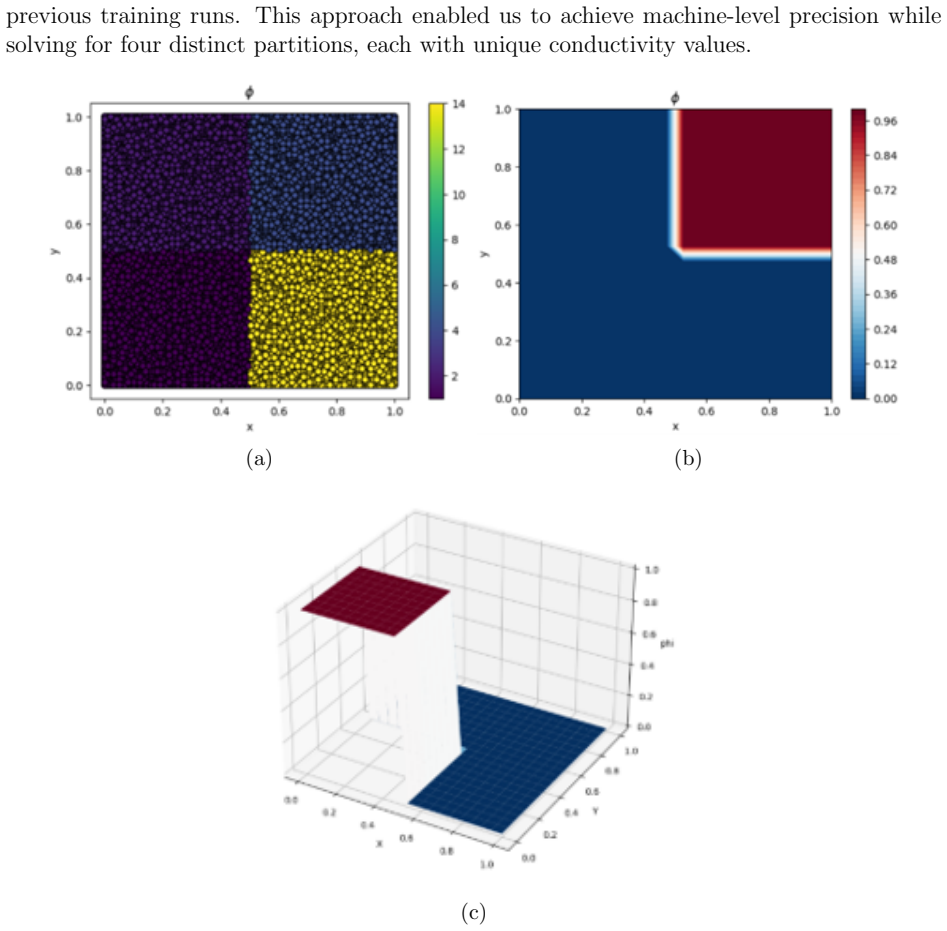
The core object is the partition-of-unity network. Its outputs are softmax-normalized basis functions $\varphi_i(x)$ that satisfy $\sum_i \varphi_i = 1$, and the conductivity is assembled as $K_{\mathrm{POU}}(x)=\sum_i \varphi_i(x) e^{c_i}$, with learnable scalar exponents $c_i$ kept positive by the exponential. This $K_{\mathrm{POU}}$ is inserted into the diffusion operator of a physics-informed neural network whose loss sums the PDE residual and boundary residuals. The partition functions localize each region, the exponents encode each region's conductivity, and the unity sum guarantees a complete, smooth cover of the domain. In the demonstrated examples, the auxiliary loss (10) trains the partition network against known conductivity values $K_i$ taken from manufactured expressions.
What would settle it
Train POU-PINN on a piecewise-constant diffusion problem, say $K=1$ for $x+y<1$ and $K=10$ otherwise, while withholding $K_i$ from the partition-network training objective and supplying only the PDE residual and boundary conditions; if the recovered partition and coefficients do not match the true ones, the framework's claim of unsupervised discovery is falsified. The same experiment run with $K_i$ labels provided should succeed, isolating what is load-bearing.
Extended reading notes
Core claim
The paper's central claim is that a partition-of-unity network can learn both the spatial subdomains of a diffusion PDE and the piecewise-constant conductivity attached to each subdomain, and that feeding this learned conductivity into a physics-informed residual loss solves the forward problem while identifying the decomposition. Concretely, the paper represents conductivity as $K_{\mathrm{POU}}(x)=\sum_i \varphi_i(x) e^{c_i}$ with softmax-normalized basis functions $\varphi_i$, and couples this representation into the Darcy/diffusion operator used by the PINN. The authors report that the combined model correctly identifies two and four subdomains in manufactured problems with conductivity ratios such as 1 versus 10, and that the scalar fields match the manufactured solutions.
Load-bearing premise
The load-bearing premise is that the partition-of-unity subnetwork can learn the subdomains from physics residuals alone; the paper's demonstrations instead train it against known conductivity values $K_i$ taken from manufactured expressions, so the advertised label-free discovery rests on an assumption the experiments do not exercise.
Editorial extensions
If this is right
- Diffusion problems with discontinuous, piecewise-constant coefficients can be solved by a single network that simultaneously locates interfaces and assigns each region its coefficient.
- The learned softmax partition functions provide a spatial map of distinct physical regimes, so changes in material properties can be detected without manually labeling subdomains.
- The framework transfers to porous-media thermal ablation and ice-sheet conductivity, where coefficients vary sharply across the domain.
- Splitting the solution space into localized subdomains narrows what each expert network must represent, which the paper argues improves accuracy and convergence speed.
- Because the partition functions sum to one, the model also acts as a mixture of experts for PDE solutions, with each expert responsible for one subdomain.
Reading between the lines
- Beyond the paper: true label-free recovery would require optimizing the exponents $c_i$ against the PDE residual rather than against Eq. (10); this coupling is the natural next step and is not demonstrated here.
- Beyond the paper: the number of partitions is set by hand in every experiment, so inferring the number of subdomains itself from residual data remains an open extension.
- Beyond the paper: the same partition-of-unity parameterization could recover other coefficient fields, such as reaction rates or permeability, and could be applied to time-dependent interfaces.
- Beyond the paper: real ice-sheet measurements are sparse and noisy, unlike the dense manufactured training points used here, so validation on observational data would sharpen the practical claim.
Signed reviews
Editorial analysis
A structured set of objections, weighed in public.
Referee Report
Summary. The paper proposes Partition of Unity Physics-Informed Neural Networks (POU-PINNs), in which a partition-of-unity network produces a conductivity field K_POU(x)=Σ φ_i(x) e^{c_i} that is fed into a PINN solving a steady diffusion PDE. The abstract and introduction claim this is an unsupervised framework that detects spatial subdomains and physical parameters from PDE residuals without labeled data. The paper reports PINN verification on two manufactured diffusion problems (Sections 4.1–4.2), POU approximations of prescribed piecewise-constant conductivity fields (Sections 4.3–4.8), and two combined POU-PINN results (Section 5), followed by claims of improved accuracy and applicability to thermal ablation and ice-sheet modeling.
Significance. If the advertised capability were demonstrated, it would be a useful contribution: automatic domain decomposition and coefficient identification for diffusion PDEs is relevant to porous-media and ice-sheet applications. The manuscript has concrete strengths: it uses manufactured solutions for the baseline PINN, fixes random seeds, and documents architectures and optimizers, and it targets the genuinely difficult setting of discontinuous coefficients. These strengths do not, however, offset the fact that the central unsupervised-discovery claim is not tested: the POU network is trained in Eq. (10) against supplied conductivity labels, and the combined POU-PINN experiments are reported only qualitatively.
major comments (4)
- [§3.2, Eq. (10); §4.3–§4.8] The POU training objective is arg min over ζ,c of ||Σ φ_i(x_i,ζ) e^{c_i} − K_i||^2, i.e., regression against known K_i values. Every POU experiment defines K analytically (Eqs. 18–21), and Section 4.7 states that training points are generated from analytic expressions. Consequently, the advertised 'physics residual-based loss function that detects variations ... without requiring labeled data' is never implemented for the POU component; the paper never trains the POU network using only L_PDE and L_BC and shows that the correct K(x) and partition emerge. This directly contradicts the abstract's central claim and leaves the main contribution unsupported.
- [§5.1–§5.2, Figs. 20 and 23] The POU-PINN results are presented solely as qualitative contour and residual plots. There are no error tables, no convergence histories, and no comparison with standard PINN or with the manufactured solution, so the claimed improvement in accuracy and convergence cannot be assessed. The captions themselves state that the model 'did not maintain stability due to partition discontinuity, but it led to the correct solution'; without a quantitative error measure, this statement is not verifiable.
- [§2, Eq. (4); §3.1, Eq. (5)] For the discontinuous-conductivity problems considered, the interface condition K_i∇u·n = K_j∇u·n on Γ_ij is required, but the total loss in Eq. (5) contains only L_PDE and L_BC, with no interface residual term. The paper does not explain how the strong-form residual in Eq. (6) treats the non-smooth solution at the partition interface; given the reported instability in Figs. 20 and 23, this omission is a technical gap in the proposed formulation.
- [§4.3–§4.8 and §5.1] The number of partitions N is manually set (2 or 4) in every experiment, and the L2 regularization coefficient is manually calibrated, so the framework does not 'discover' the spatial decomposition in an unsupervised sense; the decomposition structure is supplied by the user. This remains a concern even after the supervised-training issue in Eq. (10) is addressed, because the claim of automatic partition discovery requires an experiment in which N and the partition shape are inferred, not prescribed.
minor comments (5)
- [§4.4, Eq. (19)] The expression for the four-partition example is identical to Eq. (18) for the two-partition example; if a different four-partition K is intended, the formula should be corrected.
- [§4.3] The text notes that generating training points from analytic expressions is 'highly advantageous' but 'often unavailable in real-world problems'; this admission is in tension with the paper's no-labeled-data claim for real applications and should be resolved explicitly.
- [§3.2, Eq. (10)] Equation (10) uses the index i both for the summation over partitions and for points in the dataset D, which makes the objective notationally confusing, especially since the partition index also appears implicitly in φ_i.
- [§5] The description of how the POU and PINN subnetworks are trained jointly (loss weighting, alternating versus simultaneous optimization, and when Eq. (10) is updated relative to Eq. (5)) is missing; this information is needed to reproduce the combined experiments.
- [§5, Figs. 18–23] The exact PDE, boundary conditions, and K(x) for the two POU-PINN examples are not stated in Section 5; the reader must infer them from earlier examples.
Circularity Check
The advertised unsupervised discovery of conductivity reduces to a supervised fit against known K labels in Eq. (10), so the claimed prediction is forced by its own training data.
-
fitted input called prediction
[Abstract; Section 3.2, Eq. (10)]
"A vital feature of this method is a physics residual-based loss function that detects variations in physical properties without requiring labeled data. ... We minimize the difference between the neural network calculations and the training data. arg min_{ζ,c} Σ_{i∈D} || Σ_{i=1}^N φ_i(x_i, ζ) e^{c_i} − K_i ||^2"
The paper advertises unsupervised identification of subdomains and conductivities from physics residuals, but Eq. (10) is the only stated training objective for the POU network and it is a supervised regression against supplied K_i labels. The 'predicted' conductivity is therefore the fitted value by construction, not a quantity inferred from the PDE residual alone. No experiment removes Eq. (10) and trains the POU only on L_PDE and L_BC to discover K(x), so the central unsupervised-discovery claim reduces to the labeled training data it says it does not need.
-
fitted input called prediction
[Section 4.3 and Eqs. (18)-(21)]
"We found it highly advantageous to generate training points using the analytic expressions during training, as this approach allows the network to learn more effectively. However, this luxury is often unavailable in real-world problems due to the scarcity of in-situ measurements and the limited number of simulations. ... K(x, y) = 1 · ((1 − sign(x + y − 1))/2) + 10 · ((1 + sign(x + y − 1))/2)"
Every POU example supplies the exact analytic K expression (Eqs. 18-21) and the paper says training points are generated from those analytic expressions. Thus the POU network is trained to reproduce manufactured ground-truth conductivities, and the resulting 'discovered' partitions are matches to those expressions. The paper never demonstrates recovery of subdomains or K from the physics residual alone with unknown K, so the inverse result is a supervised fit to the inputs rather than an independent physical inference.
full rationale
The circularity is confined to the paper's advertised inverse/unsupervised component. The forward PINN solution of a diffusion PDE with a known K is standard and has independent content, and I found no load-bearing self-citation or imported uniqueness argument. However, the abstract's central claim that the method 'detects variations in physical properties without requiring labeled data' is directly contradicted by Eq. (10), which minimizes the squared difference between the POU output and given conductivity labels K_i. Sections 4.3-4.8 confirm that all POU experiments use analytically manufactured K expressions, and Section 5 reports only qualitative residual plots with acknowledged instability (Figs. 20 and 23), with no quantitative error table showing recovery of unknown K from PDE residuals. The number of partitions is also chosen by hand, and L2 regularization is manually calibrated. For these reasons the identified 'conductivity' and subdomain partitions reduce, by the paper's own equations, to a supervised regression against known input labels. This is a partial but substantive circularity affecting the core novelty claim, so a score of 6 is appropriate.
Assumptions & free parameters
free parameters (3)
- POU exponent coefficients c_i =
learned; e.g., conductivities 1, 4, 10 in examples
- Number of partitions N =
2 or 4, chosen by hand
- L2 regularization coefficient =
1e-6 to 1e-4, manually calibrated
assumptions (3)
- domain assumption Manufactured solutions provide exact PDE forcing and boundary data, so errors can be measured against known u_true.
- domain assumption K is exactly piecewise constant and interface flux continuity (Eq. 4) is satisfied by the solution.
- ad hoc to paper Softmax-based partition of unity with exponentiated coefficients can represent discontinuous piecewise-constant K accurately with the chosen architectures.
Cite this review
Pith. "Pith review of Partition of Unity Physics-Informed Neural Networks (POU-PINNs): An Unsupervised Framework for Physics-Informed Domain Decomposition and Mixtures of Experts." pith.science (2026). https://pith.science/paper/SKM2JHLY
@misc{pith2026241206842,
  author       = {Pith},
  title        = {Pith review of: Partition of Unity Physics-Informed Neural Networks (POU-PINNs): An Unsupervised Framework for Physics-Informed Domain Decomposition and Mixtures of Experts},
  year         = {2026},
  howpublished = {\url{https://pith.science/paper/SKM2JHLY}},
  note         = {Machine review of arXiv:2412.06842}
}
read the original abstract
Physics-informed neural networks (PINNs) commonly address ill-posed inverse problems by uncovering unknown physics. This study presents a novel unsupervised learning framework that identifies spatial subdomains with specific governing physics. It uses the partition of unity networks (POUs) to divide the space into subdomains, assigning unique nonlinear model parameters to each, which are integrated into the physics model. A vital feature of this method is a physics residual-based loss function that detects variations in physical properties without requiring labeled data. This approach enables the discovery of spatial decompositions and nonlinear parameters in partial differential equations (PDEs), optimizing the solution space by dividing it into subdomains and improving accuracy. Its effectiveness is demonstrated through applications in porous media thermal ablation and ice-sheet modeling, showcasing its potential for tackling real-world physics challenges.
Figures


Reference graph
Works this paper leans on
-
[1]
Raissi, M., Perdikaris, P., and Karniadakis, G. E., 2019, “Physics-Informed Neural Networks: A Deep Learning Framework for Solving Forward and Inverse Problems 22 Involving Nonlinear Partial Differential Equations,” J Comput Phys, 378, pp. 686–707. https://doi.org/10.1016/j.jcp.2018.10.045
-
[2]
Physics-Informed Machine Learning,
Karniadakis, G. E., Kevrekidis, I. G., Lu, L., Perdikaris, P., Wang, S., and Yang, L., 2021, “Physics-Informed Machine Learning,” Nature Reviews Physics, 3(6), pp. 422–440. https://doi.org/10.1038/s42254-021-00314-5
-
[3]
Parallel Physics-Informed Neural Networks via Domain Decomposition,
Shukla, K., Jagtap, A. D., and Karniadakis, G. E., 2021, “Parallel Physics-Informed Neural Networks via Domain Decomposition,” J Comput Phys, 447, p. 110683
work page 2021
-
[4]
Physics- Informed Neural Networks (PINNs) for Fluid Mechanics: A Review,
Cai, S., Mao, Z., Wang, Z., Yin, M., and Karniadakis, G. E., 2021, “Physics- Informed Neural Networks (PINNs) for Fluid Mechanics: A Review,” Acta Me- chanica Sinica/Lixue Xuebao, 37(12), pp. 1727–1738. https://doi.org/10.1007/ s10409-021-01148-1
work page 2021
-
[5]
Respecting Causality Is All You Need for Training Physics-Informed Neural Networks,
Wang, S., Sankaran, S., and Perdikaris, P., 2022, “Respecting Causality Is All You Need for Training Physics-Informed Neural Networks,” arXiv preprint arXiv:2203.07404, pp. 1–35. [Online]. Available: http://arxiv.org/abs/2203.07404
arXiv 2022
-
[6]
Partition of Unity Networks: Deep Hp-Approximation,
Lee, K., Trask, N. A., Patel, R. G., Gulian, M. A., and Cyr, E. C., 2021, “Partition of Unity Networks: Deep Hp-Approximation,” CEUR Workshop Proc, 2964. https: //doi.org/10.2172/2001532
-
[7]
The Partition of Unity Finite Element Method: Basic Theory and Applications,
Melenk, J. M., and Babuˇ ska, I., 1996, “The Partition of Unity Finite Element Method: Basic Theory and Applications,” Comput Methods Appl Mech Eng, 139(1–4), pp. 289–314. https://doi.org/10.1016/S0045-7825(96)01087-0
-
[8]
Probabilistic partition of unity networks: clustering based deep approximation
Trask, N., Gulian, M., Huang, A., and Lee, K., 2021, “Probabilistic Partition of Unity Networks: Clustering Based Deep Approximation.” [Online]. Available: http://arxiv. org/abs/2107.03066
work page Pith review arXiv 2021
Show all 40 references
-
[9]
Probabilistic Partition of Unity Networks for High-dimensional Regression Problems,
Fan, T., Trask, N., D’Elia, M., and Darve, E., 2023, “Probabilistic Partition of Unity Networks for High-dimensional Regression Problems,” Int J Numer Methods Eng, 124(10), pp. 2215–2236
2023
-
[10]
Modeling of One-Dimensional Ablation with Porous Flow Using Finite Control Volume Procedure
Amar, A. J., 2006, “Modeling of One-Dimensional Ablation with Porous Flow Using Finite Control Volume Procedure.”
2006
-
[11]
Mesh Deformation Boundary Conditions for Three-Dimensional Ablation Solvers,
Amar, A. J., Cooper, J., Oliver, A. B., Salazar, G., and Agricola, L., 2022, “Mesh Deformation Boundary Conditions for Three-Dimensional Ablation Solvers,” AIAA Science and Technology Forum and Exposition, AIAA SciTech Forum 2022. https: //doi.org/10.2514/6.2022-1642
2022 doi
-
[12]
High-Temperature Liquid Metal Infusion Considering Surface Tension- Viscosity Dissipation,
Kumar, V., Harris, C. K., Bronson, A., Shantha-Kumar, S., and Medina, A., 2016, “High-Temperature Liquid Metal Infusion Considering Surface Tension- Viscosity Dissipation,” Metallurgical and Materials Transactions B: Process Metal- lurgy and Materials Processing Science, 47(1)...
2016
-
[13]
Sensitivity of Viscosity on Molten Ti Infusion into a B4C- Packed Bed at the Microscale,
Kotteda, V. M. K., Schiaffino, A., Chattopadhyay, A., Shantha-Kumar, S., Kumar, V., and Bronson, A., 2019, “Sensitivity of Viscosity on Molten Ti Infusion into a B4C- Packed Bed at the Microscale,” Metallurgical and Materials Transactions B: Process Metallurgy and Materials Pr...
2019 doi
-
[14]
A., 2010, Three Dimensional Finite Element Ablative Thermal Response Anal- ysis Applied to Heatshield Penetration Design, Georgia Institute of Technology
Dec, J. A., 2010, Three Dimensional Finite Element Ablative Thermal Response Anal- ysis Applied to Heatshield Penetration Design, Georgia Institute of Technology
2010
-
[15]
Flow Mechanics in Ablative Thermal Protection Systems,
Mansour, N. N., Panerai, F., Lachaud, J., and Magin, T., 2024, “Flow Mechanics in Ablative Thermal Protection Systems,” Annu Rev Fluid Mech, 56, pp. 549–575. https://doi.org/10.1146/annurev-fluid-030322-010557
2024 doi
-
[16]
On the Stability of Combustion and Laser-Produced Ablation Fronts,
Bychkov, V. V., Goldberg, S. M., and Liberman, M. A., 1993, “On the Stability of Combustion and Laser-Produced Ablation Fronts,” Physics of Fluids B, 5(10), pp. 3822–3824. https://doi.org/10.1063/1.860601
1993 doi
-
[17]
Rayleigh–Taylor and Richtmyer–Meshkov Instabilities: A Journey through Scales,
Zhou, Y., Williams, R. J. R., Ramaprabhu, P., Groom, M., Thornber, B., Hillier, A., Mostert, W., Rollin, B., Balachandar, S., Powell, P. D., Mahalov, A., and Attal, N., 2021, “Rayleigh–Taylor and Richtmyer–Meshkov Instabilities: A Journey through Scales,” Physica D, 423. https...
2021
-
[18]
Nonintrusive Manufactured Solutions for Ablation,
Freno, B. A., Carnes, B. R., and Matula, N. R., 2021, “Nonintrusive Manufactured Solutions for Ablation,” Physics of Fluids, 33(1), p. 17104
2021
-
[19]
Code Verification by the Method of Manufactured Solutions,
Roache, P. J., 2002, “Code Verification by the Method of Manufactured Solutions,” J. Fluids Eng., 124(1), pp. 4–10
2002
-
[20]
Salari, K., and Knupp, P., 2000, Code Verification by the Method of Manufactured Solutions, Sandia National Lab.(SNL-NM), Albuquerque, NM (United States)
2000
-
[21]
Albany: Us- ing Component-Based Design to Develop a Flexible, Generic Multiphysics Analysis Code,
Salinger, A. G., Bartlett, R. A., Bradley, A. M., Chen, Q., Demeshko, I. P., Gao, X., Hansen, G. A., Mota, A., Muller, R. P., Nielsen, E., Ostien, J. T., Pawlowski, R. P., Perego, M., Phipps, E. T., Sun, W. C., and Tezaur, I. K., 2016, “Albany: Us- ing Component-Based Design t...
2016
-
[22]
Albany/FELIX: A Parallel, Scalable and Robust, Finite Element, First-Order Stokes Approximation Ice Sheet Solver Built for Advanced Analysis,
Tezaur, I. K., Perego, M., Salinger, A. G., Tuminaro, R. S., and Price, S. F., 2015, “Albany/FELIX: A Parallel, Scalable and Robust, Finite Element, First-Order Stokes Approximation Ice Sheet Solver Built for Advanced Analysis,” Geosci Model Dev, 8(4), pp. 1197–1220. https://d...
2015 doi
-
[23]
MPAS-Albany Land Ice (MALI): A Variable-Resolution Ice Sheet Model for Earth System Modeling Using Voronoi Grids,
Hoffman, M. J., Perego, M., Price, S. F., Lipscomb, W. H., Zhang, T., Jacobsen, D., Tezaur, I., Salinger, A. G., Tuminaro, R., and Bertagna, L., 2018, “MPAS-Albany Land Ice (MALI): A Variable-Resolution Ice Sheet Model for Earth System Modeling Using Voronoi Grids,” Geosci Mod...
2018
-
[24]
Verification and Validation in Com- putational Fluid Dynamics,
Oberkampf, W. L., and Trucano, T. G., 2002, “Verification and Validation in Com- putational Fluid Dynamics,” Progress in Aerospace Sciences, 38(3), pp. 209–272. https://doi.org/10.1016/S0376-0421(02)00005-2
2002 doi
-
[25]
L., and Roy, C
Oberkampf, W. L., and Roy, C. J., 2010, Verification and Validation in Scientific Com- puting, Cambridge university press
2010
-
[26]
L., and Kutz, J
Brunton, S. L., and Kutz, J. N., 2022, Data-Driven Science and Engineering: Machine Learning, Dynamical Systems, and Control, Cambridge University Press
2022
-
[27]
M., Ebeida, M
Adams, B. M., Ebeida, M. S., Eldred, M. S., Jakeman, J. D., Swiler, L. P., Stephens, J. A., Vigil, D. M., Wildey, T. M., Bohnhoff, W. J., and Eddy, J. P., 2014, Dakota, a Multilevel Parallel Object-Oriented Framework for Design Optimization, Parame- ter Estimation, Uncertainty...
2014
-
[28]
M., Bohnhoff, W
Adams, B. M., Bohnhoff, W. J., Dalbey, K. R., Ebeida, M. S., Eddy, J. P., Eldred, M. S., Hooper, R. W., Hough, P. D., Hu, K. T., and Jakeman, J. D., 2020, Dakota, a Multilevel Parallel Object-Oriented Framework for Design Optimization, Parameter Estimation, Uncertainty Quantif...
2020
-
[29]
Parameter Sensitivity and Statistical Cor- relation Found in Atmospheric Turbulence Studies,
Rodriguez, L. F., Kumar, V., Rodriguez, A., Krushnarao Kotteda, V. M., Rao Gudimetla, V. S., and Munoz, J. A., 2020, “Parameter Sensitivity and Statistical Cor- relation Found in Atmospheric Turbulence Studies,” American Society of Mechanical Engineers, Fluids Engineering Divi...
2020 doi
-
[30]
Mesh Adaptability Technique for Canonical Turbulent Jet Flows via Reinforcement Learning,
Paez, B., Rodriguez, A., Kotteda, V. M. K., Chattopadhyay, A., Terrazas, J., Baez, R., and Kumar, V., 2022, “Mesh Adaptability Technique for Canonical Turbulent Jet Flows via Reinforcement Learning,” American Society of Mechanical Engineers, Fluids Engineering Division (Public...
2022
-
[31]
Kotteda, V. M. K., Kumar, V., Spotz, W., Stephens, A., and Adams, B., 2018, Dakota Integrated with MFiX for UQ Analysis: Sensitivity of Particle Size on Pressure Drop in a Fluidized Bed DEM Simulations., Sandia National Lab.(SNL-NM), Albuquerque, NM (United States)
2018
-
[32]
Forward and Inverse Modeling of Ice Sheet Flow Using Physics-informed Neural Networks: Application to Helheim Glacier, Greenland,
Cheng, G., Morlighem, M., and Francis, S., 2024, “Forward and Inverse Modeling of Ice Sheet Flow Using Physics-informed Neural Networks: Application to Helheim Glacier, Greenland,” Journal of Geophysical Research: Machine Learning and Computation, 1(3), p. e2024JH000169
2024
-
[33]
Discovering the Rheology of Antarc- tic Ice Shelves via Physics-Informed Deep Learning
Wang, Y., Lai, C.-Y., and Cowen-Breen, C., 2022, “Discovering the Rheology of Antarc- tic Ice Shelves via Physics-Informed Deep Learning.” 25
2022
-
[34]
One-Dimensional Ice Shelf Hardness Inversion: Clus- tering Behavior and Collocation Resampling in Physics-Informed Neural Networks,
Iwasaki, Y., and Lai, C.-Y., 2023, “One-Dimensional Ice Shelf Hardness Inversion: Clus- tering Behavior and Collocation Resampling in Physics-Informed Neural Networks,” J Comput Phys, 492, p. 112435
2023
-
[35]
Adam: A Method for Stochastic Optimization,
Kingma, D. P., 2014, “Adam: A Method for Stochastic Optimization,” arXiv preprint arXiv:1412.6980
2014 arXiv
-
[36]
Activation Functions: Comparison of Trends in Practice and Research for Deep Learning,
Nwankpa, C., Ijomah, W., Gachagan, A., and Marshall, S., 2018, “Activation Functions: Comparison of Trends in Practice and Research for Deep Learning,” arXiv preprint arXiv:1811.03378
2018 arXiv
-
[37]
On Model Stability as a Function of Random Seed,
Madhyastha, P., and Jain, R., 2019, “On Model Stability as a Function of Random Seed,” arXiv preprint arXiv:1909.10447
2019 arXiv
-
[38]
L2 Regularization for Learning Kernels,
Cortes, C., Mohri, M., and Rostamizadeh, A., 2012, “L2 Regularization for Learning Kernels,” arXiv preprint arXiv:1205.2653
2012 arXiv
-
[39]
L2 Regularization versus Batch and Weight Normalization,
Van Laarhoven, T., 2017, “L2 Regularization versus Batch and Weight Normalization,” arXiv preprint arXiv:1706.05350
2017 arXiv
-
[40]
Understanding the Difficulty of Training Deep Feed- forward Neural Networks,
Glorot, X., and Bengio, Y., 2010, “Understanding the Difficulty of Training Deep Feed- forward Neural Networks,” Proceedings of the Thirteenth International Conference on Artificial Intelligence and Statistics, JMLR Workshop and Conference Proceedings, pp. 249–256. 26
2010
Reviewed August 11, 2026 · model on record in the stance chip above.
Discussion (0). Continue with ORCID to comment.