Put-call parity is exact as a terminal-payoff identity, yet its market enforcement is path-dependent and capital-using. This paper examines whether physical-measure drift is reflected in the carry gap, defined as the annualized wedge between option-implied and OIS-implied discounting, using SPX and RUT European index options. I derive a drift-preserving extension of the GBM implementation-risk term that adds an (r\mu\tau) component to the standard (r\sigma\sqrt{\tau}) path-risk component. The drift input (\mu) is measured by a lagged rolling-OLS trend proxy and should not be interpreted as an observed expected return. Empirically, the drift term improves both in-sample and leave-one-year-out fit, especially for SPX, consistent with drift-sensitive margin burden in parity enforcement rather than a failure of no-arbitrage.
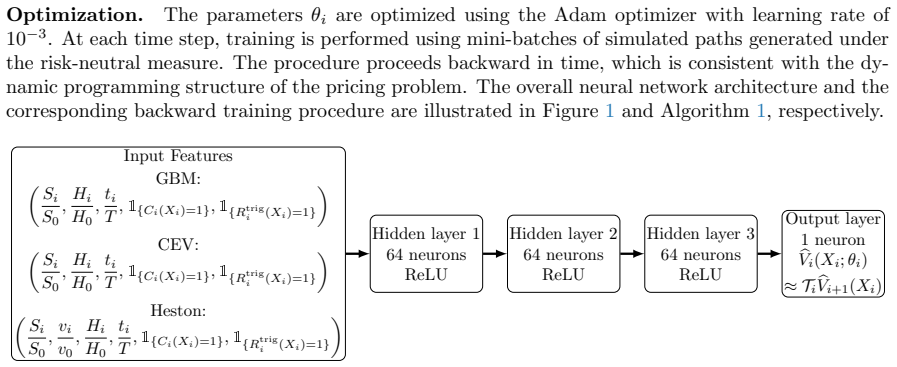
This paper develops a deep learning-based framework for pricing convertible bonds with path-dependent contractual features, namely downward conversion price reset and issuer call clauses under rolling-window trigger rules, which are widespread in the convertible bond market. We formulate the valuation problem as a path-dependent partial differential equation (PPDE), which explicitly captures the dependence of the convertible bond value on the historical path of the underlying asset and the dynamic evolution of the conversion price. We derive consistent PPDE formulations for three canonical underlying dynamics: geometric Brownian motion (GBM), constant elasticity of variance (CEV) and Heston stochastic volatility. We then construct a discrete-time dynamic programming scheme in which conditional expectations are approximated by neural networks, which remains tractable in such high-dimensional path-dependent setting. Empirical tests on China CITIC Bank Convertible Bond show that our framework produces stable and accurate prices and sensitivity patterns across all model specifications. Three key economic insights emerge: 1. Contractual features dominate underlying dynamics in determining convertible bond values. 2. The call provision decreases convertible bonds prices by truncating upside gains. 3. Counterintuitively, despite improving conversion terms, the downward reset provision further decreases the price of convertible bonds by lowering the effective call threshold and making early redemption more likely. The proposed PPDE-deep learning approach provides an efficient, flexible tool for pricing convertible bonds with complex path-dependent structures.
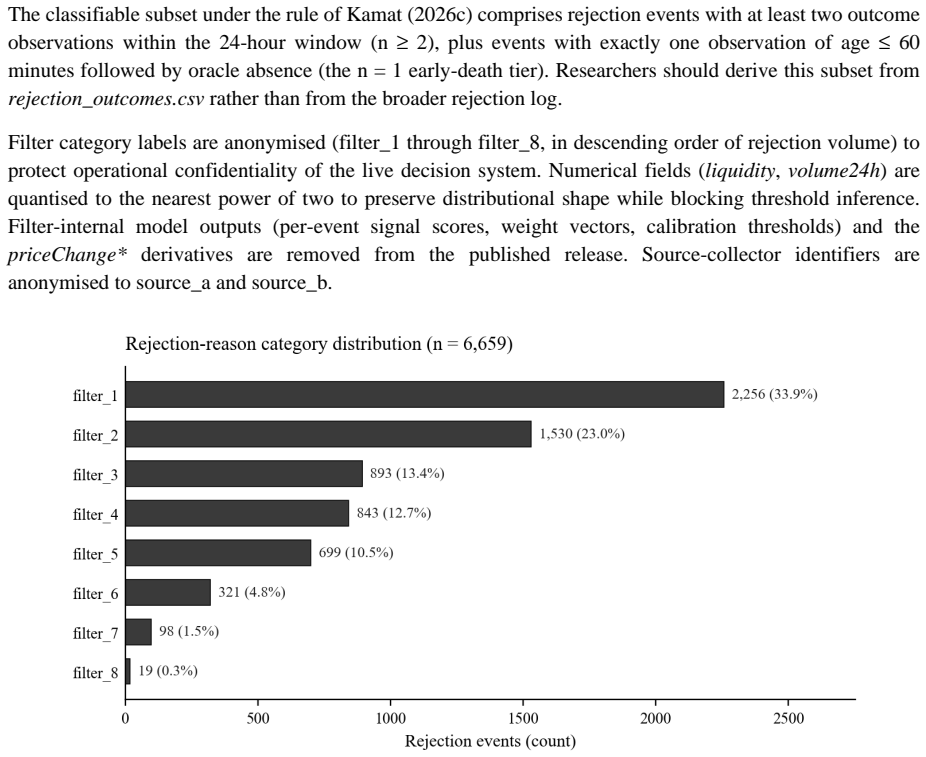
RED-2400 is a public benchmark of algorithmically-rejected trading events from a live Solana decentralized-exchange filter stack. I logged the data continuously between 2026-04-10 and 2026-05-02. The benchmark contains 6,659 rejection events linked to 169,122 post-rejection price and liquidity observations and 1,836 graveyard-tracker snapshots. Outcome labels follow the five-tier classification of Kamat (2026c): saved (windowed), saved (early-death), missed, flat, and unclassifiable. Thresholds use the trough-to-reference and peak-to-reference price ratios within a 24-hour window. Most filter-design datasets cover the accept side only. That gap leaves reject-side outcomes unmeasured and biases filter validation. RED-2400 lets researchers replicate filter-precision claims directly. RED-2400 is the first window in a planned dataset series; subsequent windows will extend the time horizon and enable regime-stratified analysis.
In the geometric model with price and solvency processes, small changes to S keep maximal expected terminal utility close and strategies are
abstractclick to expand
The geometric approach to financial markets with proportional transaction cost prescribes to imbed a specific model (of stock market, of currency market etc.), usually given in a parametric form, into a natural framework defined by the two random processes, S and K. The first one, d-dimensional, models the price evolution of basic securities while the second one, cone-valued, describes the evolution of the solvency set. It happened that the fundamental questions -- no-arbitrage criteria, hedging problems, portfolio optimization -- can be studied in this general setting opening the door to set-valued techniques. In this note we explore, in such a general framework, the stochastic Mayer control problem, consisting in the maximization of the expected utility of the portfolio terminal wealth. We get results on continuity of the optimal value and the optimal control under price approximations in a general multi-asset framework described by the geometric formalism.
Prediction markets cannot exist without market makers, arbitrageurs, and other non-retail liquidity providers, yet the supply-side microstructure of Polymarket-class venues has not been characterized at on-chain pseudonymous-address scale. This paper studies non-retail participation on Polymarket using an empirical run on the PMXT v2 archive over 2026-04-21 through 2026-04-27 (13,356,931 OrderFilled events; 77,204 addresses with five+ fills; 43,116 markets).
We report three findings. First, Polymarket's off-chain CLOB architecture renders address-level quote-lifecycle attribution permanently unavailable: OrderPlaced and OrderCancelled events are off-chain and absent from public archives, so quote-intensity, two-sided-ratio, and posted-spread features cannot be built at address level. We document this as a structural validity-gate failure (G-QUOTE-LIFE universal fail) and restrict analysis to a six-feature fill-side vector. Second, density-based clustering (DBSCAN, fifteen sensitivity configurations) on the fill-side vector produces a single dense cluster with zero noise: fill-side behavior in the empirical window is uni-modal under the six-feature vector, contradicting the pre-registered hypothesis of four-to-five separable archetypes. Third, robust retail vs non-retail separation is achievable through clustering-independent feature-tier stratification: whale-tier, high-frequency-operator, and power-trader tiers jointly hold 81.4% of total notional across 12.6% of addresses.
Address-level market-making and liquidity-provision claims are withdrawn per the G-QUOTE-LIFE failure; spoof-by-non-fill manipulation detection is downgraded to market-level book diagnostics. A privacy-respecting derived-dataset deposit accompanies the paper as Bundle 3 of the PMXT family. Fourth paper in a four-paper programme on event-linked perpetuals and leveraged prediction-market microstructure.
Pre-market conditions mark mornings with drift and afternoons with reversal, yet every tested rule fails after transaction costs and year-by
abstractclick to expand
This paper constructs and validates a composite day-classification system for Micro E-Mini Nasdaq 100 futures (MNQ) using three pre-market observable conditions: first-30-minute return magnitude, overnight gap magnitude, and abnormal opening-bar volume relative to a rolling baseline. Using 947 regular trading days of five-minute data from 2021-2025, we find that classifier-positive days exhibit statistically distinct intraday behavior, including directional morning drift followed by systematic late-session reversal. Despite these descriptive characteristics, all tested directional trading strategies fail institutional validation standards after transaction costs and multi-year consistency requirements are applied. The highest-performing configuration achieves T = 1.46 and mean net +7.80 points but fails year-stability criteria. The primary contribution is the validation of the Volatility-Volume-Gap (VVG) classifier as a descriptive regime-identification framework and the documentation of failed attempts to convert these statistical patterns into deployable trading signals under realistic execution constraints.
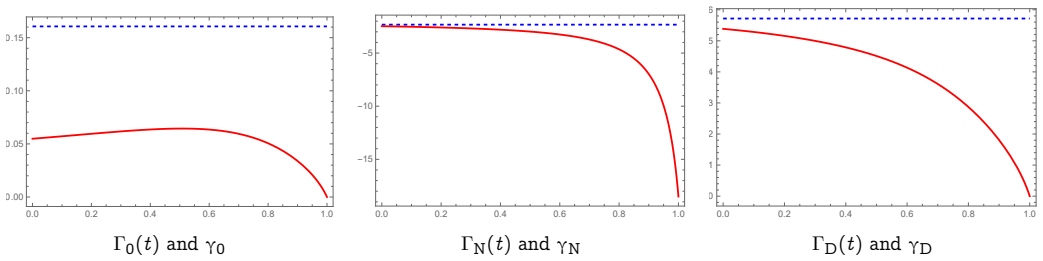
We formulate and solve stochastic control problems that model the core yield-generating strategy of the Ethena protocol, a decentralized finance (DeFi) stablecoin that earns yield by combining a long position in staked Ethereum (stETH) with an equal-sized short position in ETH perpetual futures. The combined position is delta-neutral with respect to the ETH spot price, yet earns carry from two sources: staking rewards on the stETH leg, and funding-rate payments received from long perpetual holders when the perpetual trades at a premium to spot. A key feature of our model is that the control -- the rate of simultaneously buying stETH and shorting the perpetual -- exerts two distinct types of price impact. \textit{Permanent} impact shifts the mid-market prices of both legs, compressing the basis and permanently eroding future funding income. \textit{Temporary} impact reflects execution slippage on each leg. We study both an infinite-horizon discounted problem and a finite-horizon problem in which the protocol maximizes total wealth up to a fixed date $T$, subject to a terminal cost for liquidating any remaining position. In both cases the optimal control is obtained explicitly.
Risk governance is not only about identifying and measuring adverse states of the world. It also asks when an institution is entitled to rely on a risk claim. This paper introduces modal epistemic tools for that second layer of QRM. For a risk proposition $p$, $Kp$ denotes assurance-grade endorsement for certification, audit reliance, board sign-off, or regulatory reporting. By contrast, $Bp$ denotes working commitment: a disciplined action-guiding stance under incomplete assurance.
The framework distinguishes object-level risk claims from stances toward them. It develops crisp and fuzzy modal semantics for assurance, working commitment, live possibility, non-exclusion, hesitation, and epistemic inconsistency. The central diagnostics are \[ p\wedge\neg Kp \qquad\text{and}\qquad p\wedge\neg Bp, \] which identify cases in which a risk is present but lacks the relevant stance. Thus QRM should model not only hazards and losses, but also evidential incompleteness, model risk, validation gaps, and failures of escalation.
Two governance principles motivate the analysis. The Risk Management Principle says that if $p$ is a risk, then the absence of the relevant stance, $p\wedge\neg Mp$, is itself risk-relevant. The Risk Reach Principle says that real and decision-relevant risks should be reachable by the appropriate stance. Their unrestricted combination creates Moorean and Fitch-style collapse pressure: treating $p\wedge\neg Kp$ or $p\wedge\neg Bp$ as ordinary targets of the same stance whose absence they record undermines the diagnostic.
The response is architectural. Object-level risk claims should be separated from meta-level epistemic diagnostics. The latter should be governed through an audit layer that records and controls epistemic gaps. This preserves action and precaution without collapsing risk governance into institutional omniscience.
We show that under mild assumptions, the total value of information to informed traders in the market can be measured by the covariance between price changes and order flow. This covariance captures noise trader losses, which equal informed trader gains when market making is competitive. We estimate the value of information using high frequency data on US equities at about $3.5 million per year for the average stock. The aggregate value of information is about 0.04% of market cap, which is considerably lower than the 0.67% in fees investors pay each year searching for superior returns (French 2008). We discuss potential resolutions for these puzzling findings.
In event-linked markets the two-axis taxonomy shows linear scaling for price manipulation, threshold shifts for outcome manipulation, and a
abstractclick to expand
The introduction of leverage on prediction-market event contracts raises three structurally distinct questions that have not been addressed jointly: how leverage changes manipulation incentives, how it interacts with informed-trading rents, and how regulatory frameworks should respond. This paper develops a theoretical framework for the first two and a synthesis of the existing regulatory landscape for the third. The principal analytical move is a two-axis manipulation taxonomy distinguishing market-price manipulation from real-world outcome manipulation, where the manipulator affects the underlying event itself. Continuous-underlying derivative markets generally do not make outcome manipulation a venue-level payoff channel; event-linked markets do. Within this taxonomy, leverage plays asymmetric roles: it scales market-price manipulation linearly but shifts the cost-benefit threshold for outcome manipulation, and it scales informed-trading rents in three ways (direct multiplication, Sharpe-ratio preservation, detection-cost amortization). Section 7 connects Paper 1's pre-emption and halt-protocol findings (CC-007b, CC-008) to three manipulation channels: pre-emption introduced by the dynamic-margin engine, halt-arbitrage introduced by the resolution-zone halt protocol, and strategic bad-debt-shifting that no engine in Paper 1's framework family addresses. The framework's manipulation-resistance contribution is a re-allocation of attack surface, not a net reduction. The regulatory synthesis covers principal jurisdictions (US, EU, UK, Singapore, offshore) and identifies three regulatory-arbitrage pathways. The paper concludes with 14 recommendations for venue operators, regulatory bodies, and the research community, separated into framework-independent and framework-conditional categories.
Organized by four design axes, each with payoff rules, inheritance maps and test criteria for historical data.
abstractclick to expand
Paper 1 of this research programme develops a resolution-aware risk-design framework for the simplest event-linked perpetual: a contract whose underlying tracks a single binary prediction-market probability through resolution. The instrument class is broader. Variants span conditional probabilities P(A|B), spreads p^A - p^B, weighted baskets sum w_i p^(i), derivatives on variance or entropy of the probability process, contracts on liquidity itself, perpetual-on-expiring-event roll structures, and funding-only derivatives with no settlement. Each variant inherits some framework components from the single-market binary case and requires its own design adaptations. This paper develops a formal taxonomy of seven pure-form canonical variants beyond the probability-index perpetual of Paper 1, organised along four orthogonal design axes: underlying geometry, temporal structure, settlement structure, and venue composition. The list is not exhaustive; combinations are not treated separately. For each variant we provide a precise payoff definition; an inheritance map identifying which Paper 1 components carry over, are modified, or fail; variant-specific design constraints; microstructure properties; empirical evaluability on the PMXT v2 archive; and limitations. Notable findings: the conditional variant admits a candidate non-portability proposition (denominator instability as the conditioning event becomes improbable); the spread variant requires a three-channel decomposition of resolution risk; the volatility/entropy variant avoids random binary terminal-collapse but introduces estimator-convention and entropy-decay issues; the basket variant requires multi-period jump-aware margin whose aggregation is correlation-dependent. The paper is theoretical primarily; it specifies how demonstrative time series can be constructed and provides evaluability criteria to guide future work.
Counterfactual tests on 13k Polymarket archives show standard designs fail on resolution jumps; new framework distinguishes execution risk (
abstractclick to expand
We develop and counterfactually evaluate a resolution-aware risk-design framework (PIRAP) for perpetual futures whose underlying tracks a single binary prediction-market probability through resolution. The framework specifies six components: an index estimator combining mid-price, depth-weighted mid, and time-decayed VWAP; jump-aware tiered margin sized against bounded-event terminal-collapse magnitude; leverage compression schedule contracting toward resolution; resolution-aware funding rule with boundary-aware correction; a multi-stage halt protocol; and an eligibility framework. Two formal non-portability propositions establish that standard basis-only funding paired with continuous-vol static margin fails on bounded-event underlyings. Empirical evaluation uses Polymarket's PMXT v2 archive for 2026-04-21 to 2026-04-27 (13,298-market analysis sample passing adequacy gates from 61,087 ingested; 13,115 resolved within the empirical window for E3). E1 evaluates two pre-registered stylized facts; E2 conducts counterfactual replay across three engine configurations; E3 isolates the resolution-zone protocol's contribution. Results are mixed. Five pre-registered floors: stylized-fact floors (boundary depth asymmetry, terminal-jump magnitude) PASS; welfare-side directional floors (final-hour liquidation -6%, drawdown -5.1% pooled, median PnL +14%) two FAIL one PASS; E3 mechanic floors (final-hour liquidation -80% by halt construction PASS; bad-debt frequency +2.4% FAIL). Three of five materiality floors fail: the framework as specified does not validate deployment, but the empirical record establishes a halt-versus-margin scope distinction (halt addresses execution-channel risk; terminal-jump bad-debt remains margin-side) and documents a pre-emption trade-off constraining the dynamic-margin component. The paper concludes with structural recommendations and explicit non-deployable status.
Unification via innovation extraction shows standard, filtered, and displaced variants each assume a chosen return form.
abstractclick to expand
Historical Simulation (HS) and its extensions form a popular class of methods for estimating Value-at-Risk for portfolios of financial assets based on historical data. In this note, we seek to unify several ideas and models from throughout the literature into a single modeling framework. By explicitly defining a parametric model form for the asset returns and extracting the realized increments of the driving innovation process from historical data, we are able to reproduce the Historical Simulation, filtered Historical Simulation, and displaced Historical Simulation methods. This shows beyond a doubt that these methods need more underlying assumptions than what is often alluded to.
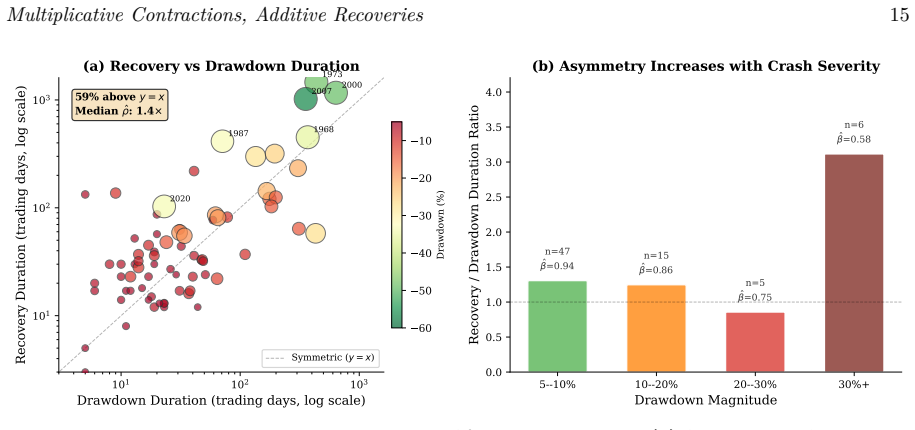
A path-dependent approach shapes portfolio exposure so recovery after losses requires less upside participation than symmetric de-risking.
abstractclick to expand
Volatility is the language in which finance often describes risk, but it is not the language in which institutions experience risk. Allocators live through drawdowns, liquidity needs, spending rules, rebalance decisions, board oversight, and the interval between a prior high-water mark and full recovery. This paper develops a path-dependent framework for asymmetric volatility management. The arithmetic of recovery is nonlinear: after a drawdown of depth $D$, the required gain is $R=\frac{1}{1-D}-1$. Lower volatility can improve geometric compounding through the familiar small-return approximation $g \approx \mu-\frac{1}{2}\sigma^2$, but symmetric de-risking can also impair recovery if it sacrifices too much upside participation. The relevant design problem is therefore not volatility reduction in isolation; it is conditional exposure shaping. Skew engineering is defined here as the portfolio construction discipline of reducing harmful downside participation more than productive upside participation, controlling submergence, and preserving enough recovery participation to sustain compounding under adverse regimes. The resulting Recovery-Efficiency Protocol links drawdown depth, time underwater, recovery burden reduction, and rebound participation into an allocator-facing reporting discipline. Machine learning and AI methods are framed as tools for conditional estimation, regime mapping, robustness testing, and model-risk governance, not as market prediction.
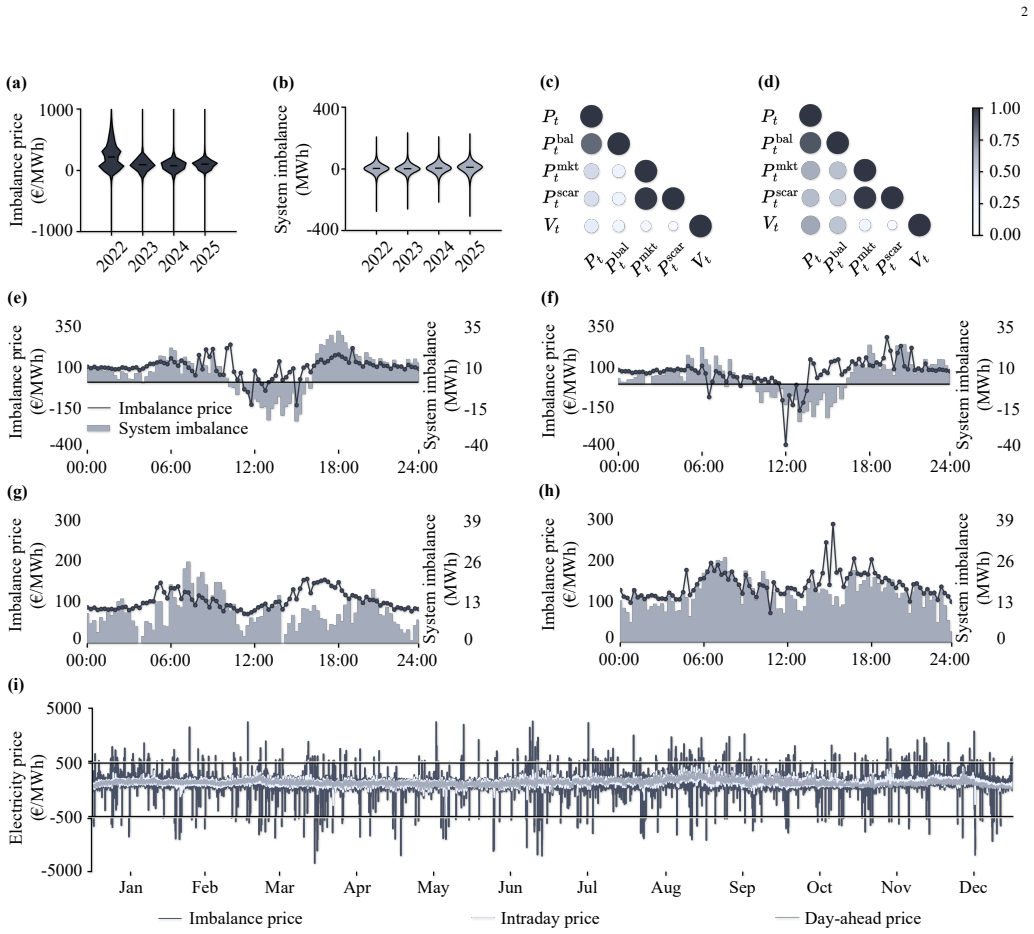
Accurate and efficient imbalance electricity price forecasting is critical for industrial energy trading systems, especially as battery assets and automated bidding pipelines increasingly participate in balancing markets. However, real-time forecasting is complicated by nonlinear market-rule-based price formation, heterogeneous input signals, and incomplete data availability caused by communication delays, publication lags, and measurement outages. This paper proposes a market-rule-informed neural forecasting framework that embeds imbalance price formation rules into the latent space of an expressive neural network. The proposed framework preserves raw signal information while exploiting transparent market-rule priors. We further analyze operational robustness by removing price-component information and characterize how forecasting performance scales with input length and forecasting horizon. Experimental results show that the proposed model achieves competitive forecasting performance with substantially fewer trainable parameters and shorter training time than generic deep learning baselines. Experimental results show that the proposed model achieves competitive forecasting performance with substantially fewer trainable parameters and shorter training time than generic deep learning baselines, demonstrating that market-rule priors and expressive neural networks should be jointly used for accurate and computationally sustainable forecasting in industrial energy trading applications. The implementation is publicly available at https://runyao-yu.github.io/MRINN/.
Dominant investor groups in each market shape how stocks move together beyond fundamentals.
abstractclick to expand
This study investigates how cross-stock information diffusion, driven by both retail and institutional investors, influences excess comovement in the Chinese retail-dominated market and the U.S. institution-dominated market. Using data from 4,533 Chinese stocks and 4,517 U.S. stocks from 2010 to 2022, we identify three key findings. First, the dominant investor group in each market significantly drives excess comovement. Specifically, in China, compared with institution-driven diffusion, retail-driven information diffusion has a notably stronger effect on excess comovement. In contrast, in the U.S., institution-driven diffusion is the primary driver of excess comovement, surpassing the influence of retail-driven diffusion. Second, we identify investors' trading behavior as the underlying mechanism through which information diffusion affects excess comovement. Third, we observe a lead-lag relationship: stocks with faster retail-driven information diffusion exhibit comovement that precedes those with slower diffusion. Based on this finding, we further demonstrate that the predictive power of information diffusion varies across markets. In China, retail-driven diffusion shows strong and persistent predictability for excess comovement, whereas in the U.S., institution-driven diffusion exhibits similarly robust predictive capacity.
Firms with higher disclosure see less early selling of winners, outweighing any extra holding of losers and lowering the overall bias.
abstractclick to expand
The disposition effect describes investors' irrational behavior of selling profitable assets too soon while holding onto losing assets for too long. This study examines the impact of transparency at the firm level on the disposition effect of individual investors who hold that company's stock. Our results show that an increase in corporate transparency significantly reduces the disposition effect. Further analysis reveals that for companies with greater transparency, when the held stock is profitable, investors' confidence in holding it increases, leading to a reduced bias toward selling profitable stocks. When the stock is held at a loss, investors' confidence in holding it weakens, but they often perceive the loss as temporary and maintain confidence in the company's long-term prospects, thus exacerbating the bias toward holding losing stocks. The effect of increased transparency on the selling behavior of profitable stocks is greater than its effect on the selling behavior of losing stocks. Overall, an increase in corporate transparency significantly reduces the disposition effect.
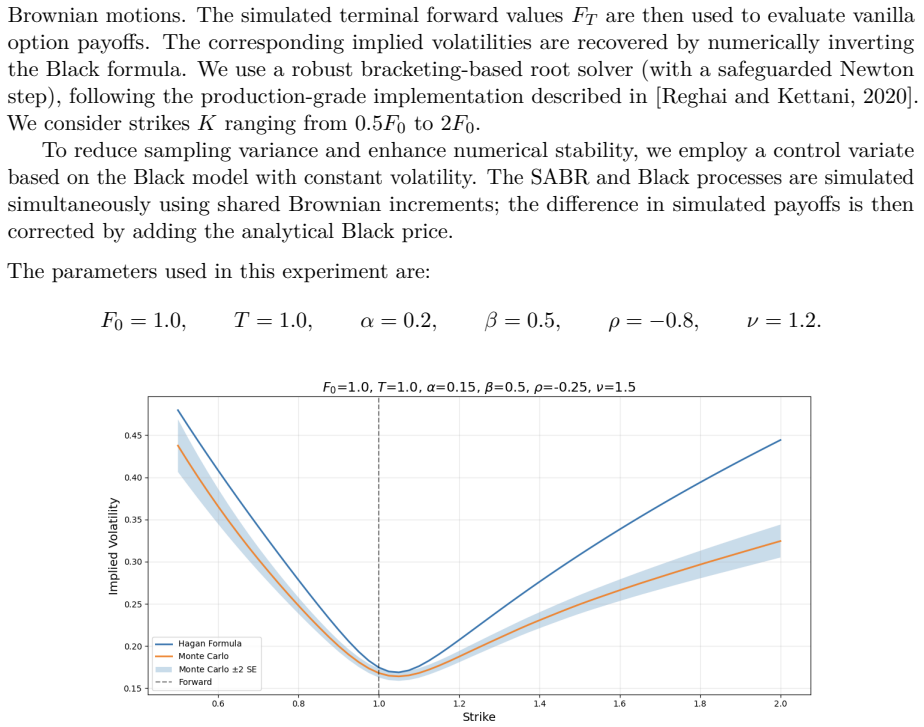
This paper proposes a hybrid methodology to improve the approximation of SABR (Stochastic Alpha Beta Rho) implied volatility by combining analytical structure with machine learning. The approach augments the neural-network input representation with geometric features derived from the stochastic differential equations of the SABR model. Unlike approaches that fully replace analytical formulas with black-box models, the proposed framework preserves the analytical backbone of the model. The hybridization operates along two complementary dimensions. First, geometry-aware variables reflecting intrinsic properties of the SABR dynamics are used as structured inputs to the network. Second, the neural network is trained to learn the residual error relative to Hagan's closed-form approximation rather than implied volatility directly. The resulting model acts as a structured residual correction to the analytical formula, retaining interpretability while capturing higher-order effects that are not included in the asymptotic expansion. Numerical experiments conducted over realistic parameter domains, as well as stressed environments, show that the method improves accuracy and robustness compared with both analytical approximations and standard neural-network approaches. Because the correction remains lightweight and structurally consistent with the underlying model, the framework is well suited for real-time pricing and calibration in practical trading environments.
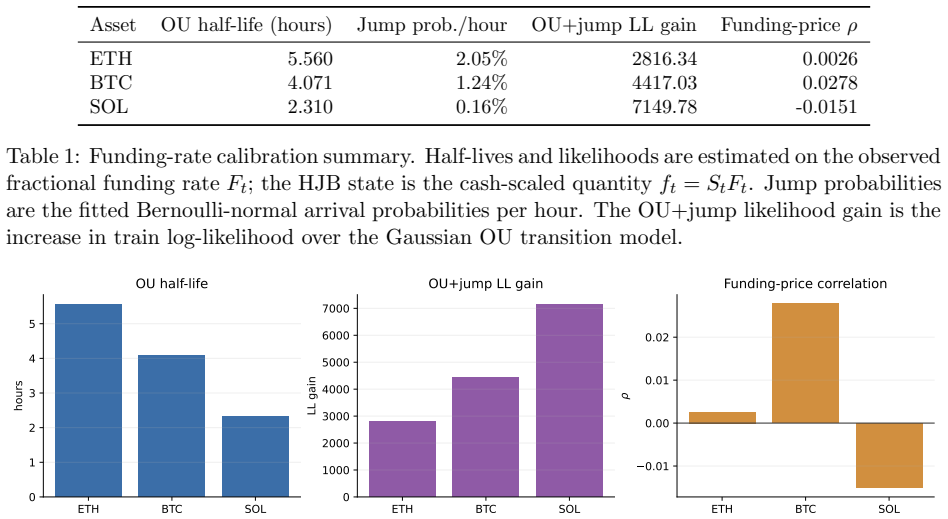
This paper studies optimal liquidity provision for perpetual contracts when the funding rate is a stochastic state variable. The core extension to classical market making is the coupling between inventory and funding payments: inventory creates both mark-to-market exposure and a state-dependent funding cash flow. A reduced inventory-funding control problem is formulated, solved with a monotone finite-difference Hamilton-Jacobi-Bellman scheme, and bid and ask quote offsets are recovered from discrete inventory value differences. Funding is calibrated on Hyperliquid ETH, BTC, and SOL perpetual data. Gaussian OU funding is retained as a tractable diffusion baseline, while OU-plus-jump diagnostics document the heavy-tailed funding innovations that should enter a future extension. In 100-seed holdout simulations under two official-fill proxy calibrations, the funding-aware HJB improves mean ETH/BTC performance while lowering inventory RMS relative to classical Avellaneda-Stoikov. SOL gains are positive versus unscaled AS but are not a Pareto improvement once a risk-scaled AS diagnostic is included.
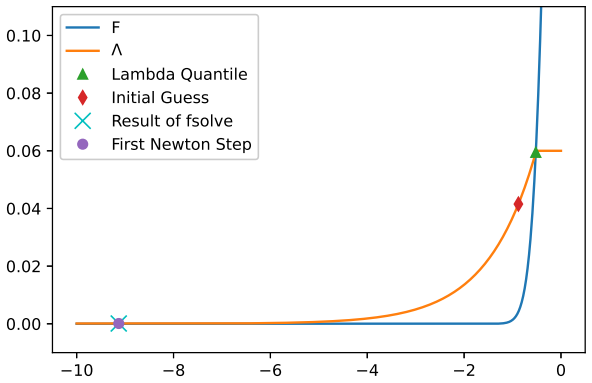
Lambda quantiles, originally introduced as lambda value at risk, generalise the classical value at risk by allowing for a variable confidence level. This work presents efficient algorithms for computing lambda quantiles and demonstrates their application in portfolio optimisation. We first develop a robust algorithm, {\Lambda}-Newton-Bis, that combines Newton's method with a bisection strategy to ensure global convergence. The algorithm handles potential discontinuities and achieves local quadratic convergence under standard regularity assumptions. To address cases with multiple roots, we also propose an interval analysis approach. We then demonstrate the algorithm's computational efficiency and practical relevance within a portfolio optimization framework. To this end, we develop two alternative solution methods that incorporate the {\Lambda}-Newton-Bis procedure. Numerical experiments confirm the algorithm's convergence properties and highlight its computational advantages in optimization tasks based on lambda quantiles.
The irrational behavior of investors selling profitable assets too early while holding onto losing assets for too long is known as the disposition effect. Due to the development of the Internet, the information environment for individual investors has been greatly improved. As an important source of information for individual investors, whether social media can improve investors' behavioral biases and return to rational expectations is a question worth studying. Based on the post data and actual trading data of the social investment platform Xueqiu.com, this paper studies the impact of social media information on the disposition effect of individual investors. The research results show that social media information can significantly reduce the disposition effect. Furthermore, it is through negative information that social media information reduces the disposition effect. When presented with negative information, individual investors will gradually become more rational in adjusting their positions. At the individual level, factors such as investment experience, users followed, region, and gender can all influence the effectiveness of the information acquired by individual investors in reducing the disposition effect.
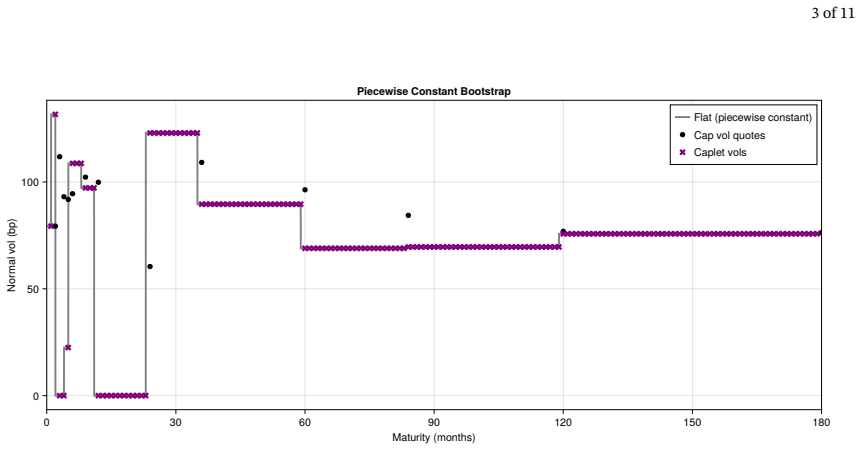
We study exact and near exact extraction of caplet volatilities from market cap quotes and identify why some common choices produce extreme oscillations or negative vols. Interpolation scheme and node placement are shown to be the primary drivers of instability, which can be amplified by isolated bad quotes. We propose practical, production ready remedies: continuous flat-linear and C1 flat-smooth kernels that preserve bootstrap equivalence, midpoint node placement with a global solver, positivity enforcement via an exponential reparametrization or Hyman non-negative C1 splines. We also introduce simple data quality checks. Numerical experiments demonstrate substantially reduced oscillations, robust positive caplet curves, and negligible repricing error, delivering a fast and stable caplet stripping workflow suitable for real-world use.
We study permissionless spot--perpetual basis trading in decentralized finance as a collateral control problem. The strategy holds spot inventory, hedges directional exposure with a short perpetual, and allocates capital between spot inventory and derivative margin under on-chain liquidity and execution frictions.
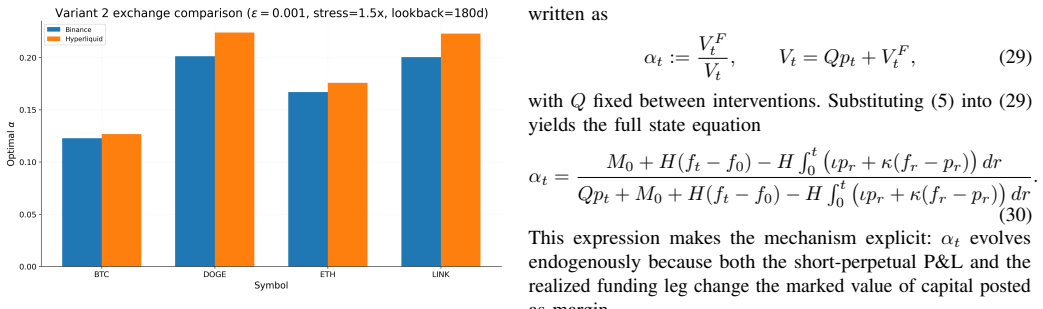
The paper delivers three results. First, it solves a static control problem for the collateral share and shows that the risk-constrained formulation provides a more robust operating benchmark relative to the economic optimum. In comparative calibration, the required collateral rises monotonically under volatility stress. The collateral is the lowest for BTC and increases significantly for long tail assets such as LINK and DOGE. Second, the paper derives an asymmetric dynamic extension in which the lower boundary of intervention is solvency driven, and the upper boundary is determined by a trade-off between carry-loss and the cost of rebalancing. Monte Carlo simulation shows that the lower boundary remains structurally relevant, whereas meaningful interior upper triggers survive mainly in the regimes with high carry and low costs. Third, the paper validates an execution-aware implementation with live routed execution and historical backtests. The execution layer shows that the realized wedges are significant, but become worse in the case of selling the basis. This justifies a minimum effective rebalancing size and a positive execution buffer. The historical validation shows that in the case of a fixed control rule the realized performance is predominantly explained by the funding environment.
This research establishes ESG as a state dependent insurance mechanism against equity crashes by addressing the decoupling of unconditional alpha from tail risk resilience. By validating market stress regimes as distinct economic states through a drawdown-based truncation rule, the study demonstrates that high ESG ratings materially reduce the incidence of discrete crash events during systemic drawdowns. To address the selection bias and high-dimensional confounding inherent in traditional linear frameworks, we implement Double Machine Learning as a structural deconfounding layer. Unlike simple predictive modeling, the Double Machine Learning framework utilizes machine learning to handle complex nuisance parameters, allowing us to isolate the asymmetric treatment effects of ESG across different market states. Distributional analysis reveals the underlying mechanism as ESG specifically attenuates the severity of realized tail losses at the most adverse quantiles instead of shifting the entire return distribution. Confirmed by structural estimates, this protection functions as priced insurance that incurs performance drags during stable periods while providing critical resilience when tail risks are most acute.
947 days of five-minute bars show gross edges capped below two-point round-trip costs for all fourteen signal families tested
abstractclick to expand
This paper tests whether intraday momentum signals derived from open-high-low-close-volume (OHLCV) data produce a statistically significant trading edge in Micro E-mini Nasdaq 100 futures (MNQ) under realistic execution constraints. Using 947 trading days of five-minute data (2021-2025), fourteen signal families are evaluated, including opening range breakouts, gap strategies, volume signals, cross-session momentum, liquidity grabs, volatility-conditioned classifiers, and news-driven strategies. All signals are assessed using strict institutional criteria: out-of-sample walk-forward validation, minimum T-statistic of 2.0, at least 30 trades, positive net return after a fixed two-point round-trip cost, and multi-year stability. No signal satisfies all criteria simultaneously. The gross edge available to next-bar-open execution is constrained to approximately 0.07-1.50 points per trade, insufficient to overcome transaction costs. A gap-continuation signal achieves T = 3.23 and +14.52 points but fails minimum sample requirements (N = 22). Two validated signals from a separate research program are included as positive controls, confirming the methodology detects genuine edge when present. The primary contribution is a reproducible falsification framework and a documented null result, highlighting structural limits of OHLCV-based intraday strategies.
Cross-maturity premium differences define a waiting time modeled with deadline diffusions and recovered via daily filters plus infill asympt
abstractclick to expand
This paper introduces a new market-implied object, Time to Transition (TtT), extracted from the difference between two selected nodes of the greenium term structure. TtT is defined as the latent waiting time until this cross-maturity greenium difference vanishes, meaning that the greenium becomes equal across the two selected maturities. We develop an inference theory for this object. To model TtT, we introduce two tractable stochastic frameworks: the Regulatory Deadline-Constrained Model, in which the transition date is fixed, and a switching extension, in which alternative transition dates capture heterogeneous perceived deadlines across economic agents. The paper combines two layers of analysis. On a fixed daily grid, a deadline-constrained diffusion provides a tractable benchmark through an exact Gaussian bridge likelihood, while the switching extension preserves tractability through regime-specific bridge densities and filtering recursions. Under a fixed-horizon infill scheme, the same framework yields a structural identification result for the regime-wise diffusion parameters, with full or partial consistency depending on the observed region. The paper therefore contributes both a new inferential object, market-implied transition timing based on cross-maturity differences in the greenium term structure, and a two-layer inference framework: finite-sample filtering provides an operational monitoring tool, while fixed-horizon infill asymptotics specify when the regime-wise diffusion parameters carrying information about competing transition dates can be consistently estimated.
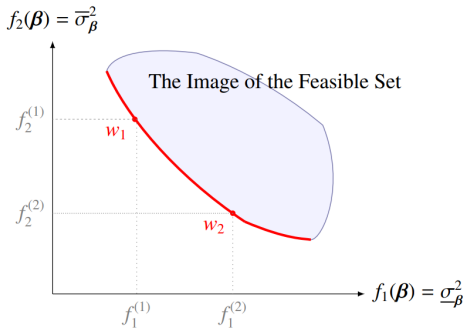
In this paper, we investigate a portfolio investment problem under volatility uncertainty and short-sale constraints market via sublinear expectation which is used to model volatility uncertainty. We assume the stocks admit volatility uncertainty. Thus the related portfolio has upper variance (maximum risk) and lower variance (minimum risk). By introducing a risk factor $w$ to conduct coupled modeling of the maximum and minimum risks, a simplified Sublinear Expectation Mean-Uncertainty Variance (SLE-MUV) model is constructed. Theoretically, we show that the Pareto frontier of the SLE-MUV model is a continuous convex curve, and its optimal solution can be expressed as a polynomial analytical expression with respect to the risk factor $w$. Empirically, we systematically test the practical performance of the SLE-MUV model and conduct comparative analysis with the traditional Mean-Variance (MV) model as the benchmark based on three sets of samples -- simulated generated data, data of the US stock market and the A-share market. The empirical results show that the SLE-MUV model can significantly improving the risk-adjusted return of the investment portfolio.
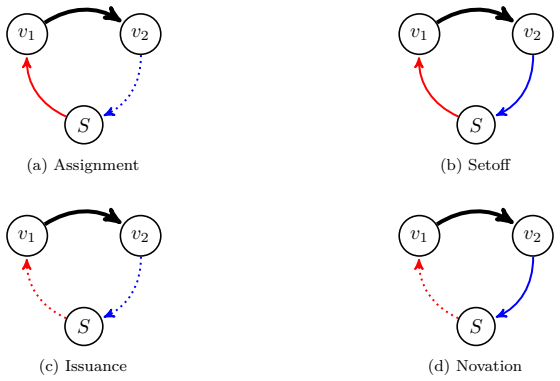
Current post-trade clearing systems rely almost exclusively on cash or cash-like collateral, leaving vast reserves of short-term liquidity embedded in trade credit outside formal settlement infrastructures. A key barrier to integrating this liquidity is the near-universal dependence of clearing services on novation, which imposes institutional overhead that restricts accessibility and limits the range of obligations that can be brought into settlement.
This paper introduces the Cycles Protocol: a distributed, multilateral clearing mechanism based on double-entry accounting and atomic cycle execution that maximizes balance sheet compression. Unlike novation-based clearing, Cycles does not redistribute counterparty risk; it can thus be applied generally to existing financial networks, without any change in counterparty relations, allowing it to complement existing clearing systems and Central Counterparties (CCPs).
By representing commitments as edges on a unified directed graph, Cycles surfaces liquidity hiding within existing network structure. We focus here on two applications of Cycles to deepening secondary market liquidity: first, as a compression layer between existing clearing participants and CCPs; and second, as a means to incorporate the liquidity of the trade credit network into formal settlement, extending market clearing beyond financial obligations and into real-economy financing.
Account skill tests, insider heuristics and per-market leakage scores each filter a different dimension and gain precision when stacked.
abstractclick to expand
April 2026 saw notable methodological convergence in the academic study of informed trading on decentralized prediction markets. Three approaches surfaced almost simultaneously: Mitts and Ofir (2026) apply a composite screen to over 210,000 wallet-market pairs; Gomez-Cram et al. (2026) apply an event-level sign-randomization test to Polymarket's complete transaction history, classifying 3.14% of accounts as "skilled winners" and separately flagging 1,950 accounts as "insiders" via a lifecycle heuristic; Nechepurenko (2026) develops the Information Leakage Score (ILS) framework, which quantifies per-market information front-loading at an article-derived public-event timestamp. This paper provides a methodological comparison. The central claim is that these are three distinct layers of detection, not competing methods on a single layer. Sign-randomization is best understood as an account-level test of persistent directional skill conditional on opportunity selection -- not a direct test of insider trading, and not a per-market measure. The heuristic insider flag is separate from the skill classifier, applies to a population the classifier excludes by design, and has unknown precision. The Polymarket sample pools politics, sports, crypto, and other categories with different information technologies, so a platform-wide "skilled winner" classification is mechanism-ambiguous. The January 2026 U.S.-Venezuela operation cluster, where the DOJ indictment of Master Sergeant Gannon Van Dyke provides a rare external enforcement benchmark, illustrates how the layers stack: lifecycle heuristics identify suspicious accounts; legal investigation addresses non-public-information possession; per-market scoring would quantify how much information was leaked into each contract. A combined pipeline gains in precision because each layer filters a different dimension.
Test on largest Polymarket insider cluster shows the extension distinguishes pre-event signals from resolution proxies
abstractclick to expand
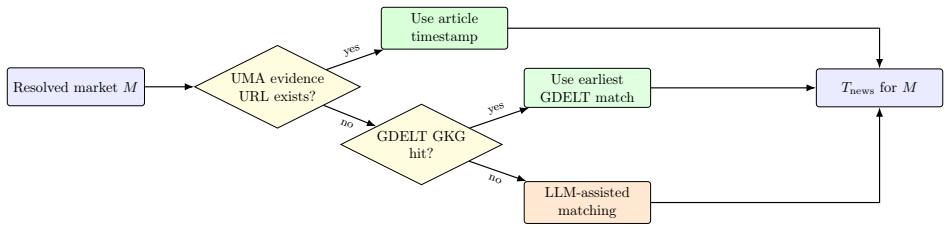
This paper reports an end-to-end empirical evaluation of the deadline-Information Leakage Score (ILS-dl) extension introduced in the companion methodology paper. The deadline-ILS extends the original ILS to deadline-resolved prediction-market contracts, the dominant structural form of publicly documented insider trading on Polymarket. We anchor the evaluation in the 2026 U.S.-Iran conflict cluster of the ForesightFlow Insider Cases (FFIC) inventory, the largest documented deadline cluster. The evaluation has four parts: per-category exponential-hazard estimation, a single-case ILS-dl computation, cross-market wallet analysis, and methodological refinements.
Hazard-rate estimation produces an adequate exponential fit for military-geopolitics markets (KS p = 0.609, half-life 2.3 days) and a preliminary fit for corporate-disclosure markets (n = 5). The regulatory-decision category is rejected as bimodal (p = 0.013). On the largest applicable FFIC contract ("US forces enter Iran by April 30," $269M volume), the article-derived public-event timestamp yields ILS-dl = +0.113 versus a resolution-anchored proxy value of -0.331: a 0.444 shift in magnitude on opposite sides of zero, demonstrating that the extension distinguishes signal from proxy artefact. Pre-event drift is mild, and short-window variants (30-min, 2-hour) are exactly zero. Cross-market wallet analysis identifies 332 wallets active in both major Iran-cluster markets, but the available trade history covers only the resolution-settlement window.
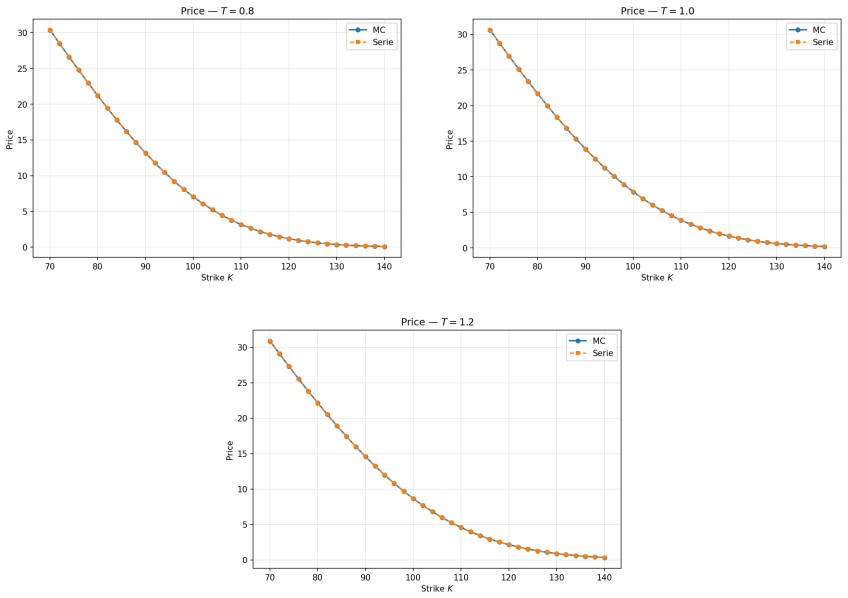
It is well-known that, in the Bachelier model, when asset prices and volatilities are uncorrelated, the implied volatility coincides with the fair value of the volatility swap. In this paper, via classical It\^o calculus and Taylor expansions, we write the price for out-of-the-money (OTM) and in-the-money (ITM) options as an expansion with respect to the moneyness, where the coefficients are related to the negative (non-integer) powers of the future mean volatility. As an a application, we use it as a control variate to reduce the variance of Monte Carlo option prices in the correlated case.
Ensemble on 67k launches reaches AP 0.037 on blind test, beats logistic regression and zero-shot LLMs while following market cycles.
abstractclick to expand
Structured launch signals on Product Hunt contain statistically significant predictive information for Series A funding outcomes. We construct PHBench from 67,292 featured Product Hunt posts spanning 2019-2025, linked to Crunchbase funding records via deterministic domain matching, identifying 528 verified Series A raises within 18 months of launch (positive rate: 0.78%). Our best-performing model, a three-component ensemble (ENS_avg, ENS_ISO, XGB) selected by validation F0.5, achieves F0.5 = 0.097 and AP = 0.037 (95% CI: 0.024-0.072; 4.7x lift over random) on the private held-out test set (103 positives). A paired bootstrap confirms a statistically credible advantage over the logistic regression baseline (AP delta: +0.013, 95% CI: [0.004, 0.039], p < 0.001; F0.5 delta: +0.056, 95% CI: [0.006, 0.122], p = 0.016). Validation-set metrics (F0.5 = 0.284, AP = 0.126) reflect best-of-144 selection bias on 53 positives and are reported for benchmark reproducibility only.
We further evaluate three zero-shot Gemini models (Gemini 2.5 Flash, Gemini 3 Flash, and Gemini 3.1 Pro) in an anonymized numerical setting. The best LLM achieves AP = 0.034 (Gemini 3 Flash), below the LR baseline AP of 0.044. Notably, the most capable Gemini variant (Gemini 3.1 Pro, AP = 0.023) performs worst -- an unexpected pattern that warrants further investigation across providers and prompting strategies. Both ML and LLM models show the same temporal performance decay tracking the 2020-2021 funding boom and subsequent contraction, confirming the dataset captures genuine market structure rather than noise.
PHBench provides a reproducible framework comprising public training, validation, and blind test splits; 61 engineered features; a five-metric evaluation harness; and a public leaderboard at https://phbench.com. All code, baseline models, and anonymized dataset splits are publicly available.
Portfolio optimization is constrained by linear assumptions and insufficient integration of multi-modal information in traditional models. This paper proposes a cross-modal BERT-driven Actor-Critic framework SBCA for multi-asset portfolio optimization to address the deficiencies of existing deep reinforcement learning DRL methods in fusing price data and financial text sentiment, as well as lacking practical trading constraints. The framework adopts a cross-modal gated fusion mechanism to adaptively integrate price time-series features and text semantic features, embeds downside risk and turnover penalty constraints into the reward function, and constructs a complete empirical system for validation. Experiments on 11-year U.S. stock multi-asset datasets show that SBCA outperforms equal weight, buy-and-hold and market benchmark strategies in portfolio value, annual return, Sharpe ratio and maximum drawdown. Ablation studies verify the complementary enhancement of Actor-Critic mechanism and cross-modal fusion module. Cost sensitivity analysis confirms the model's robustness under varying transaction costs. SBCA provides an effective and interpretable end-to-end solution for dynamic quantitative portfolio decision-making.
Probabilistic distortions persist along simplicial histories even when start and end states are identical.
abstractclick to expand
We introduce a transport cohomological framework for categorical filtrations. Given a contravariant filtration $F:\mathcal T^{op}\to\mathbf{Prob}$ on a small category \(\mathcal T\), conditional expectation induces transport operators between local probabilistic states. Using the simplicial structure of the nerve \(N_\bullet(\mathcal T)\), we construct simplex-local cochain complexes associated with parametrized simplices and study their transport cohomology. The resulting framework naturally produces loop effects and holonomy structures. In particular, transport around closed simplicial histories may generate nontrivial probabilistic distortions, even when the initial and terminal objects coincide. The associated holonomy operators encode global transport effects between probabilistic states and detect obstructions generated by loop transport. This leads to the notion of homological arbitrage, understood as a global transport phenomenon emerging from probabilistic distortion along loops. From this viewpoint, the essential source of loop effects is the probabilistic distortion generated by transport around closed simplicial histories. The present framework is structurally analogous to parallel transport and holonomy in differential geometry, providing a geometric viewpoint on categorical filtrations and probabilistic transport structures.
After β-gauge normalization, 1-cochains capture consistent gains no price process can generate and cohomological holonomy isolates the loop-
abstractclick to expand
We introduce a transport cohomological framework for categorical filtrations. Given a contravariant filtration $F:\mathcal T^{op}\to\mathbf{Prob}$ on a small category \(\mathcal T\), conditional expectation induces transport operators between local probabilistic states. Using the simplicial structure of the nerve \(N_\bullet(\mathcal T)\), we construct simplex-local cochain complexes associated with parametrized simplices and study their transport cohomology. The resulting framework naturally produces loop effects and holonomy structures. In particular, transport around closed simplicial histories may generate nontrivial probabilistic distortions, even when the initial and terminal objects coincide. The associated holonomy operators encode global transport effects between probabilistic states and detect obstructions generated by loop transport. This leads to the notion of homological arbitrage, understood as a global transport phenomenon emerging from probabilistic distortion along loops. From this viewpoint, the essential source of loop effects is the probabilistic distortion generated by transport around closed simplicial histories. The present framework is structurally analogous to parallel transport and holonomy in differential geometry, providing a geometric viewpoint on categorical filtrations and probabilistic transport structures.
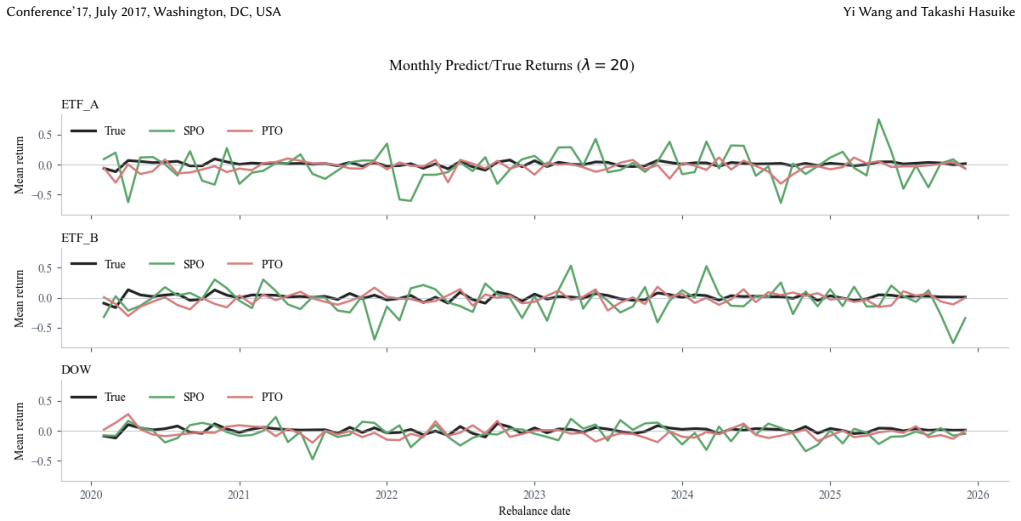
Decision-focused learning (DFL) is attractive for portfolio optimization because it trains predictors according to downstream decision quality rather than prediction accuracy alone. However, SPO(Smart, Predict then Optimize surrogate)-based DFL may produce inflated return signals and unstable portfolio reallocations. This study provides a KKT-based interpretation showing that portfolio decisions can be viewed as ranking over risk- and transaction-cost-adjusted marginal scores. Empirically, we examine prediction inflation and excessive turnover in SPO-trained portfolios, and evaluate clipping, min-max rescaling, and partial portfolio adjustment as practical stabilization mechanisms. The results suggest that realistic output constraints and portfolio-level turnover control improve the implementability of SPO-based portfolio strategies.
ForesightFlow is an Information Leakage Score (ILS) framework for detecting informed trading on decentralized prediction markets. For an event-resolved binary market, the score quantifies the fraction of the terminal information move priced in before the public news event. Three operational scope conditions (edge effect, non-trivial total move, anchor sensitivity) are stated as preconditions for interpretation. The score admits a Murphy-decomposition reading that connects label generation to the proper-scoring-rule literature.
A pilot empirical evaluation surfaces three findings. First, a resolution-anchored proxy for the public-event timestamp does not separate event-resolved markets from a matched control population (Mann-Whitney p = 1e-6, separation reversed), demonstrating that proxy quality is itself a binding constraint. Second, the article-derived timestamp on a single high-stakes case shifts the score by 0.444 in magnitude relative to the proxy and lies on the opposite side of zero. Third, an audit of the publicly documented Polymarket insider record reveals that documented cases are systematically deadline-resolved, falling outside the original ILS scope (0 of 24 FFIC inventory markets satisfied original scope conditions).
This last finding motivates a deadline-ILS extension introduced in Section 7, anchored at the public-event timestamp rather than the news timestamp, and equipped with a per-category exponential hazard baseline for the time-to-event distribution. The extension closes the gap between the methodology and the population in which insider trading has been empirically documented. An end-to-end evaluation of the extension on the 2026 U.S.-Iran conflict cluster is reported in a companion paper. We release the FFIC inventory, the resolution-typology classification of the 911,237-market corpus, and all code at github.com/ForesightFlow.
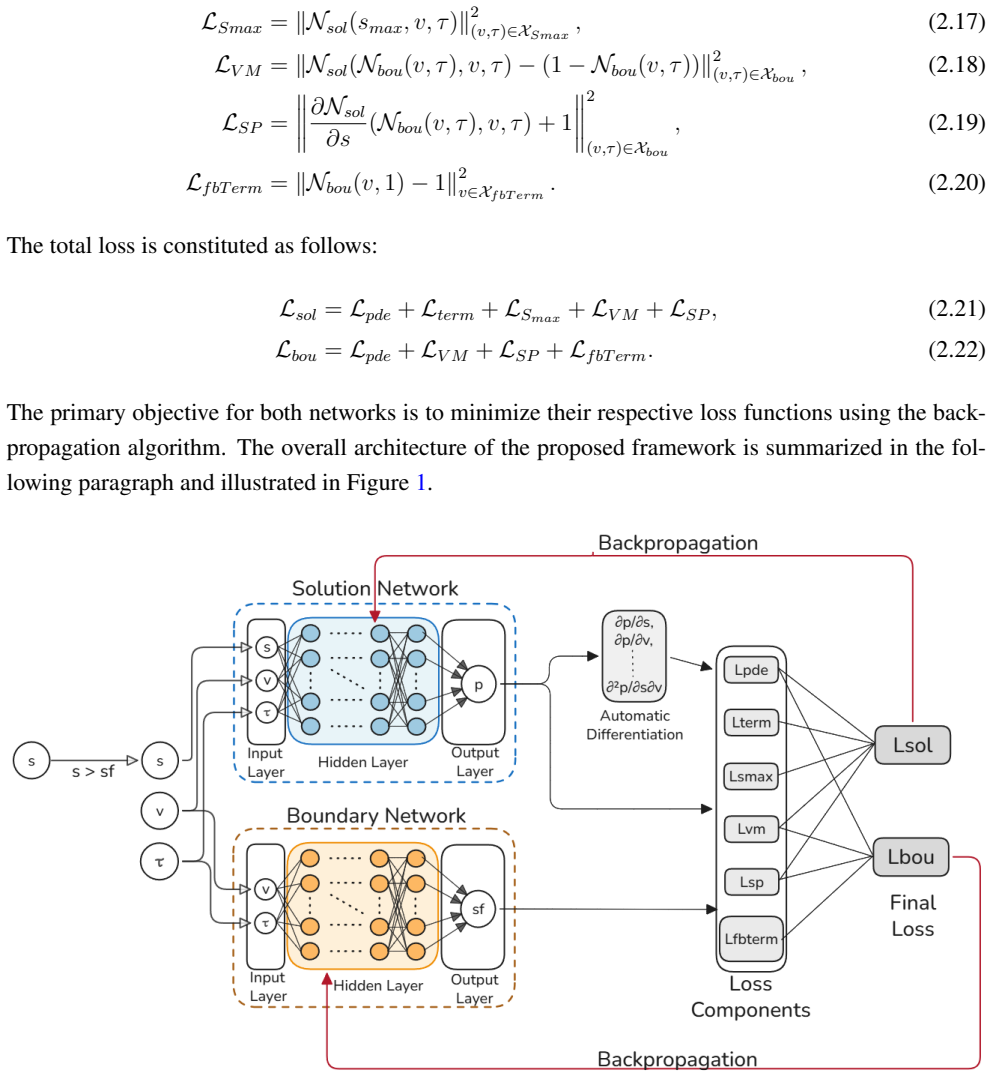
In American options, the early exercise feature allows the option to be exercised at any time prior to expiration. However, this flexibility introduces a challenge: the pricing model must value the option while simultaneously determining an unknown, time-varying exercise boundary. The Heston model is one of the most popular ways to model real market behavior because it allows volatility to change over time. However, unlike European options, there is no closed-form solution for American options under the Heston model, so we have to use numerical methods. In this paper, we propose a novel approach to solving the stochastic Heston partial differential equation for American options, using coupled physics-informed neural networks (PINNs) to predict both the option price and the free boundary, while employing curriculum learning and adaptive resampling to stabilize model training. Our work builds on recent deep learning methods but introduces a more effective training strategy to address the limitations of these approaches. The numerical results demonstrate the effectiveness of the proposed learning framework, providing a robust and efficient alternative to pricing American options, enabling rapid inference and accurate estimation under stochastic volatility.
Population-scale test shows resolution ambiguity blocks analysis of nearly all markets and shifts focus to clearer rules.
abstractclick to expand
We carry the deadline-resolved Information Leakage Score (ILS-dl) framework of Nechepurenko (2026a, 2026b) from a single-case proof of concept to a population-scale evaluation across 12,708 Polymarket markets, October 2020 to April 2026. We frame the paper as a scope-discovery study: scaling reveals that the framework's effective domain is materially narrower than initial framing suggested, and the principal obstacle is not score computation but resolution semantics.
We report four findings. First, only 88 of 12,708 candidate markets (0.7%) yield computable ILS-dl values; only 1 of 32 markets in the ForesightFlow Insider Cases (FFIC) inventory is in scope, and 14 of 32 FFIC markets are flagged unclassifiable due to genuine resolution-criterion ambiguity. Second, only 12 of the 88 computed markets (13.6%) satisfy anchor-sensitivity, and an independent-second-pass T_event validation reaches 57.8% exact-date agreement, below the 90% ex-ante criterion. Third, raw ILS-dl medians are negative across all six (sub-bucket by period) cells, but a hazard-decay baseline correction we introduce yields a heterogeneous result: regulatory_formal post-2024 shifts to near-zero (-0.21 to -0.02), while regulatory_announcement post-2024 retains a 95% bootstrap CI entirely below zero. Fourth, the constant-hazard exponential of Nechepurenko (2026b) is rejected in favor of Weibull on the pooled post-2024 cell, but a per-subcategory check confirms the preference reflects category mixture rather than within-cell duration dependence.
The implication is that detection of informed flow requires methodological refinement on the resolution-typology and score-baseline axes, not only on the score-computation axis where prior work concentrated.
In this research, starting from a widely accepted definition of risk, we support the idea that risk reduction is a more realistic objective than risk minimization, which represents a theoretical utopia. Furthermore, significant risk reduction can be achieved without relying on risk measurement and risk minimization. To this end, we propose a generalization of the numerical rank and the condition number of a matrix, specifically the return matrix in this application. This generalization considers the entire matrix spectrum instead of focusing only on the smallest eigenvalue, as the condition number does. The approach directly provides an order among a finite number of risky scenarios. Risk reduction is obtained by identifying the riskiest scenarios and reducing investment exposures corresponding to them. The validity of this theoretical proposal is supported by a comprehensive experiment performed on real data. The capacity of the proposed approach to effectively reduce risk is proven by measuring the variability of out-of-sample returns for benchmark portfolios-constructed by minimizing standard risk measures-compared to the strategy of reducing exposure in high-risk scenarios. Finally, preventing large losses with limited active management-thereby controlling the impact of transaction costs-not only reduces risk but also preserves the average return and, consequently, the portfolio's Sharpe ratio.
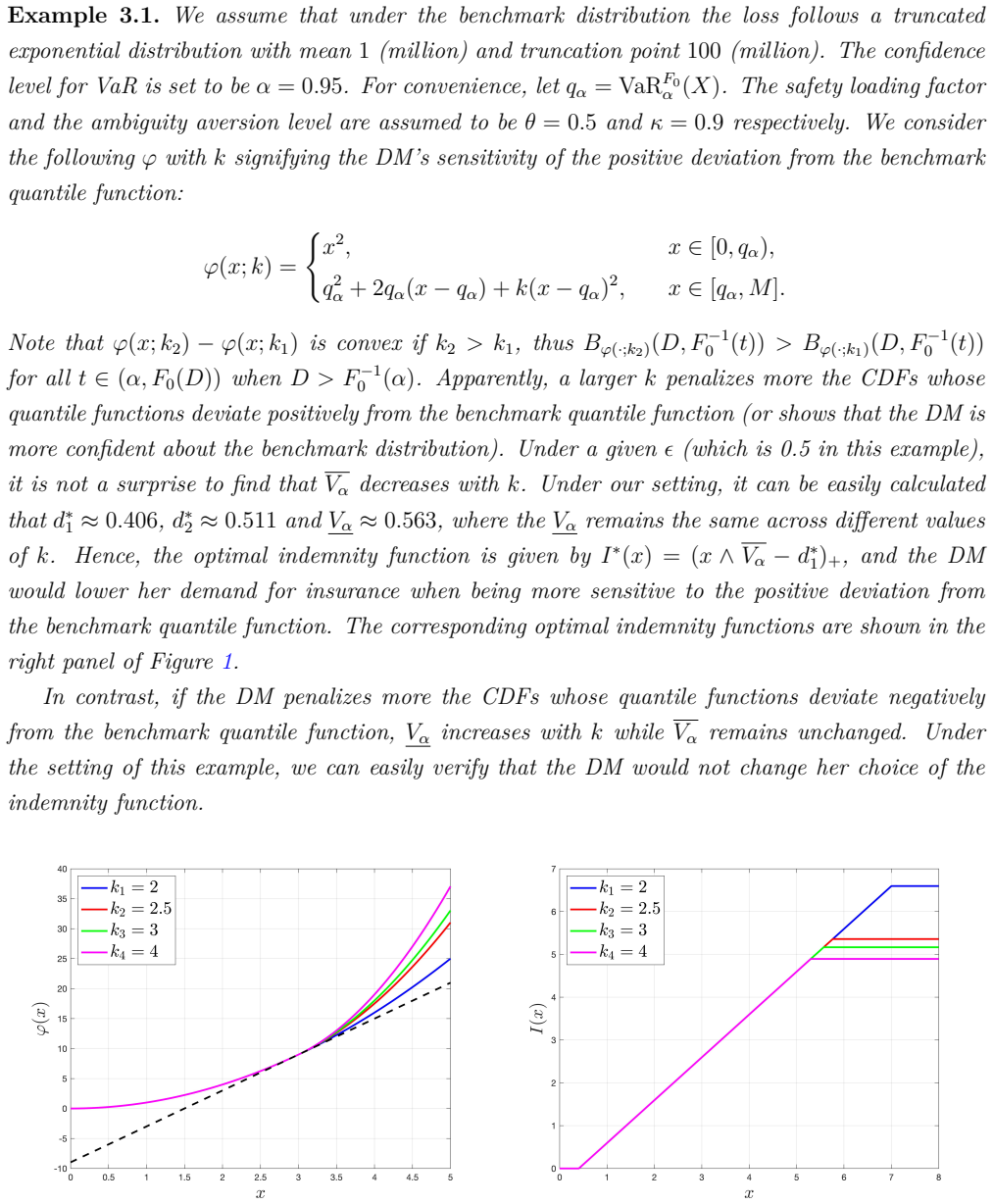
This paper investigates two optimal insurance contracting problems under distributional uncertainty from the perspective of a potential policyholder, utilizing a Bregman-Wasserstein (BW) ball to characterize the ambiguity set of loss distributions. Unlike the $p$-Wasserstein distance, BW divergence enables asymmetric penalization of deviations from the benchmark distribution. The first problem examines an insurance demand model where the policyholder adopts an $\alpha$-maxmin preference with Value-at-Risk (VaR). We derive the optimal indemnity function in closed form and study, both analytically and numerically, how the asymmetry inherent in BW divergence influences the optimal indemnity structure. The second problem employs a robust optimization framework, where the policyholder aims to secure robust insurance indemnity by minimizing the worst-case convex distortion risk measure while adhering to a guaranteed VaR constraint. In this context, we provide explicit characterizations of both the optimal indemnity and the worst-case distribution in closed form through a combined approach using the Lagrangian method and modification arguments. To illustrate the practical implications of our theoretical findings, we include a concrete example based on Tail Value-at-Risk (TVaR).
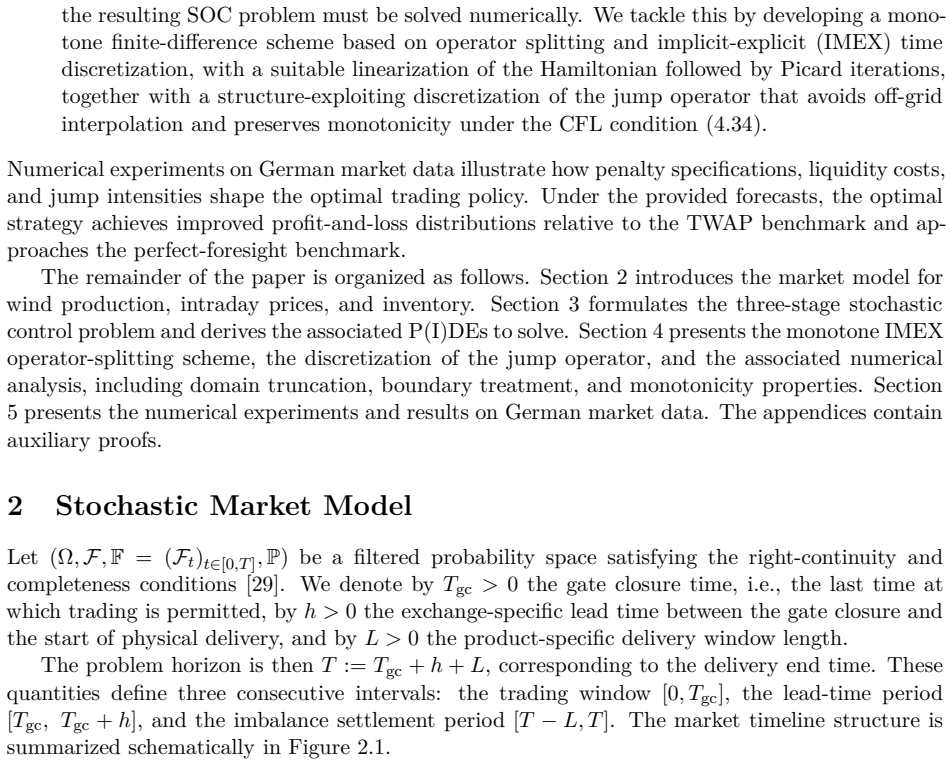
The rapid growth of weather-dependent renewable generation increases price volatility and imbalance penalty risk in power markets, creating the need for advanced quantitative trading strategies. We develop a data-driven continuous-time stochastic optimal control framework for intraday electricity trading using stochastic differential equations with drift terms ensuring mean reversion to deterministic forecast trajectories. Production follows a Jacobi diffusion, while prices follow an asymmetric jump-diffusion to reflect the heavy-tailed behavior observed in intraday markets. The framework accounts for realistic market features by incorporating gate closure and energy-based imbalance settlement over the delivery window, where the path-dependent imbalance cost is handled by state augmentation to preserve the Markovian structure. The value function is characterized via the dynamic programming principle by a three-stage sequence of two linear Kolmogorov backward equations and a nonlinear Hamilton-Jacobi-Bellman partial integro-differential equation. To solve this problem efficiently, we propose a monotone IMEX finite-difference scheme with operator splitting, semi-implicit linearization, and a differential formulation for the jump operator. Numerical experiments based on German market data indicate that, under the provided forecasts, the computed strategy outperforms the TWAP benchmark and approaches the perfect-foresight benchmark. Sensitivity experiments further show how jump intensity, delivery-window length, and trading horizon affect the trading policy and the resulting profit-and-loss distribution.
Multi-year liquidation analysis shows modest impact, while long dormancy points to non-selling outcomes that support scarcity.
abstractclick to expand
Renewed public attention on the identity of Bitcoin's pseudonymous creator has sharpened focus on the Satoshi overhang, commonly framed as a tail risk for bitcoin. This paper argues that the mechanical downside of a disposition is bounded well below the existential-loss framing, and that the terminal states most consistent with sixteen years of holder behavior are nonbearish for bitcoin's effective supply. The approximately 1.148 million BTC Patoshi position is analyzed on two tracks. For a purely wealth-maximizing holder, a three-scenario quantitative analysis (Appendix A) shows that bitcoin's current market depth is sufficient to absorb a patient multi-year liquidation at a cumulative price impact in the mid-single-digit to mid-double-digit percent range relative to counterfactual, with the central scenario clustering near 10 percent. The paper maps a decision space rather than identifying a unique modal outcome, assuming a holder whose profile is consistent with the sixteen-year record. Preference sets consistent with the record, including ideological non-intervention, privacy above all, satisficing, and myth preservation, favor continued dormancy terminating in a cryptographically enforced nonrecovery or destruction arrangement; preference sets favoring adversarial or wealth-maximizing action are possible but less supported. Across the plausible region of the decision space, the bear case is bounded and the terminal states most consistent with observed behavior are neutral to slightly positive for bitcoin's effective supply.
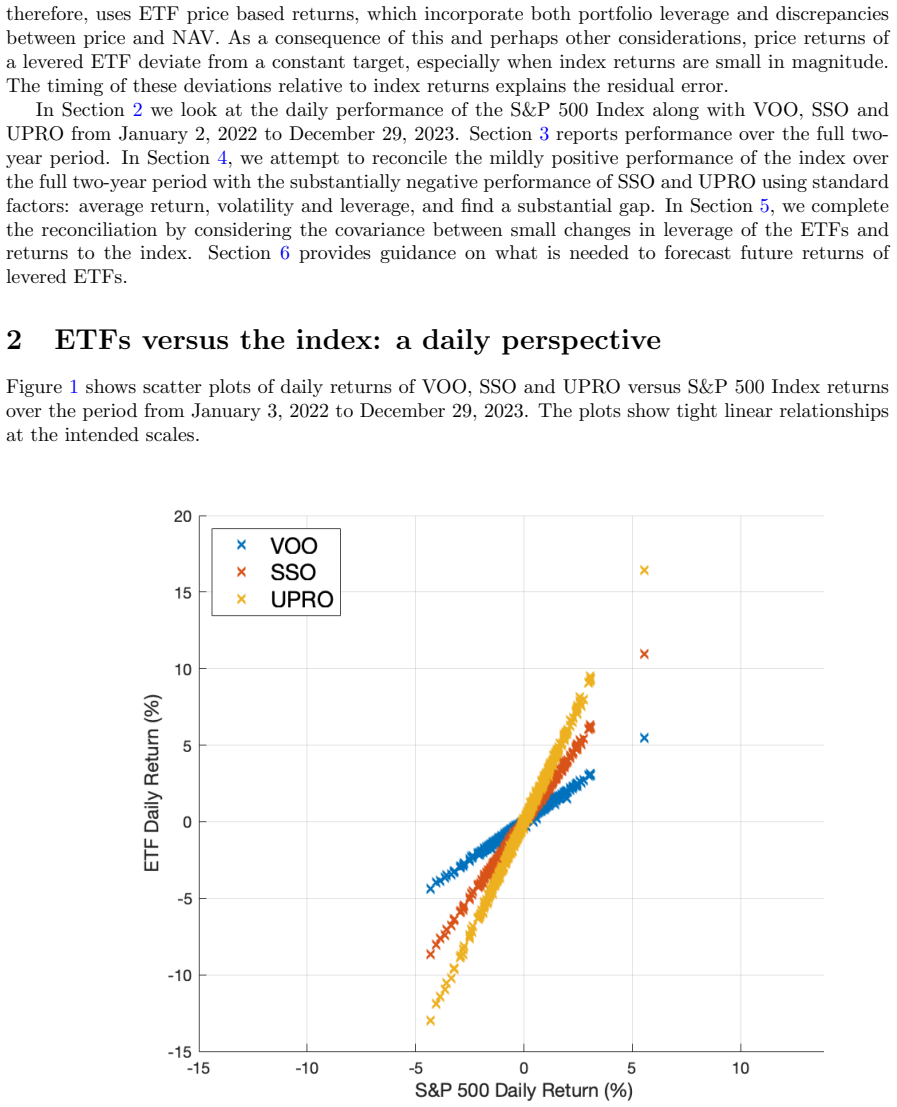
Counterintuitively, the S&P 500 Index rose between January 1, 2022, and December 29, 2023, while exchange-traded funds (ETFs) seeking to deliver 2x and 3x daily returns of the index delivered substantially negative returns. Roughly two-thirds of the difference between the returns of the index and the levered ETFs can be attributed to compounding and volatility. The remaining difference is explained by the covariance between the ETFs' deviations from constant leverage and the index's return.
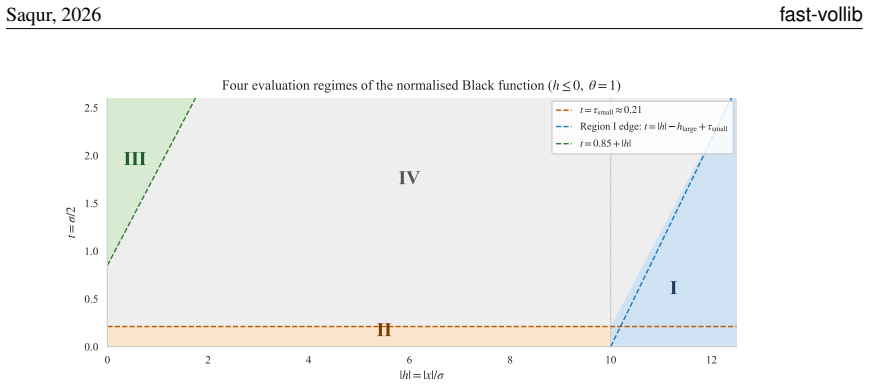
We present fast-vollib, an open-source Python library that provides high-performance European option pricing, implied volatility (IV) computation, and Greeks under the Black-76, Black-Scholes, and Black-Scholes-Merton models. The library is designed as a drop-in alternative to the de-facto-standard py_vollib and py_vollib_vectorized packages, with pluggable PyTorch and JAX execution backends, a CUDA fused-kernel Triton contribution for batched IV workloads, and a compatibility-first public API. In addition to a vectorized Halley-method IV solver, fast-vollib ships an experimental, fully-vectorized implementation of J\"ackel's "Let's Be Rational" (LBR) algorithm with NumPy/Numba, torch.compile, JAX, and Triton single-pass GPU kernels for batched option chains. This note announces the library and describes its public API surface, with source, documentation, and packaging artifacts available at: GitHub (https://github.com/raeidsaqur/fast-vollib), Docs (https://raeidsaqur.github.io/fast-vollib/), PyPI (https://pypi.org/project/fast-vollib/).
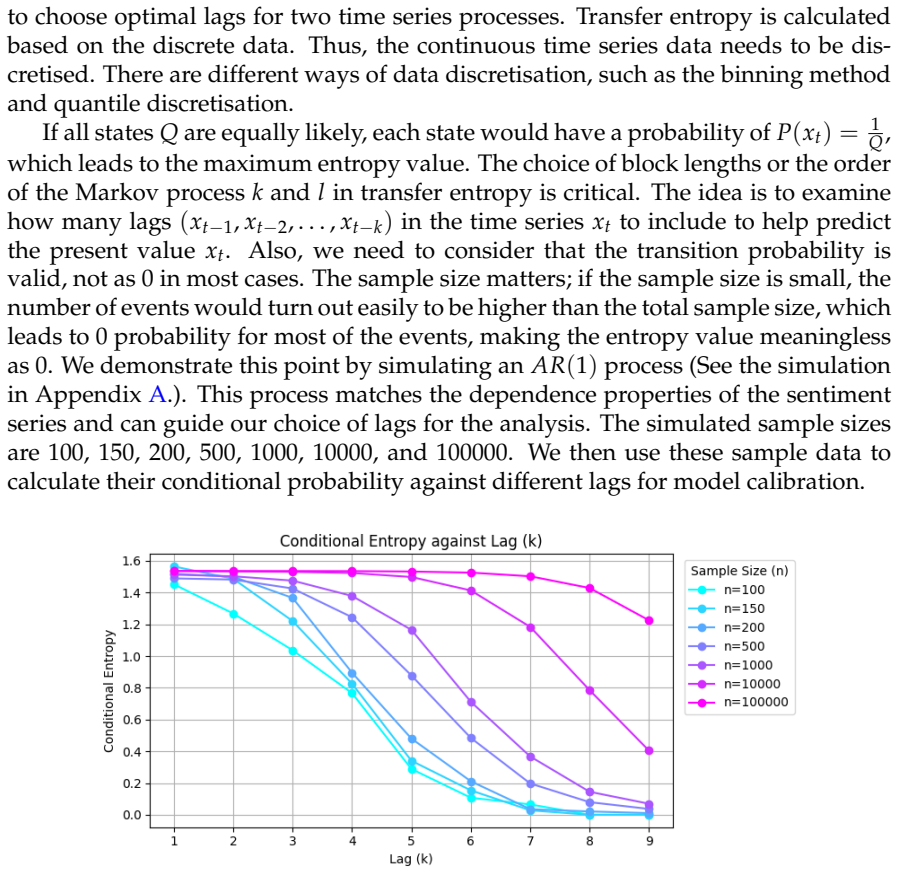
Investor sentiment reflects the collective attitude of investors towards the asset, whether positive, negative or neutral. Market information, such as news and relevant social media posts, plays a significant role in shaping investor sentiment, which influences investment decisions accordingly. The sentiment for one single company may spill over to other relevant companies which are in the same industry. The information spillover network pattern between news and social media may also differ, as they are two different media sources. In this study, we introduce a network-based transfer entropy method to measure and compare the information transmission of news and social media sentiment across the technology companies. We examine whether and to what extent sentiment information from one company can transfer to other companies, and how different the spillover effect is for news and social media. The result signifies a stronger intensity of news information flow among the tech companies after COVID-19. We also highlight the companies which act as information hubs in the sentiment network. Furthermore, we identify the companies which lead the strongest information flow chain. Overall, this study provides a novel perspective in modelling sentiment spillover under two different media sources, and we find that news and social media show a different information transmission pattern during the studied period.
LLM agents are promising tools for empirical discovery, but their flexibility can also turn discovery into uncontrolled search. We study how to use agents under a reproducible protocol through cryptocurrency factor discovery. Our framework casts the task as sequential hypothesis search: an agent reads an append-only experiment trace, proposes falsifiable factor hypotheses, and maps them to executable recipes, while a deterministic engine enforces fixed data splits, selection gates, transaction costs, and portfolio tests. Candidate actions are restricted to a point-in-time factor DSL, making both successful and failed hypotheses auditable. A ridge-combined portfolio trained only on 2020--2022 data achieves a 44.55% annualized return and Sharpe ratio of 1.55 in the 2024--2026 pure out-of-sample period after a 5 basis point one-way trading cost.
We introduce the Local Occupied Volatility (LOV) model that sits between Dupire's local volatility and fully path-dependent dynamics. By design, the LOV model ensures automatic calibration to European vanilla options, while offering the flexibility to capture stylized facts of volatility or fit additional instruments. This is achieved by tuning the occupation sensitivity function that quantifies the effect of path-dependent shocks on volatility. We validate the model through the joint American-European calibration of options chain on non-dividend paying stocks.
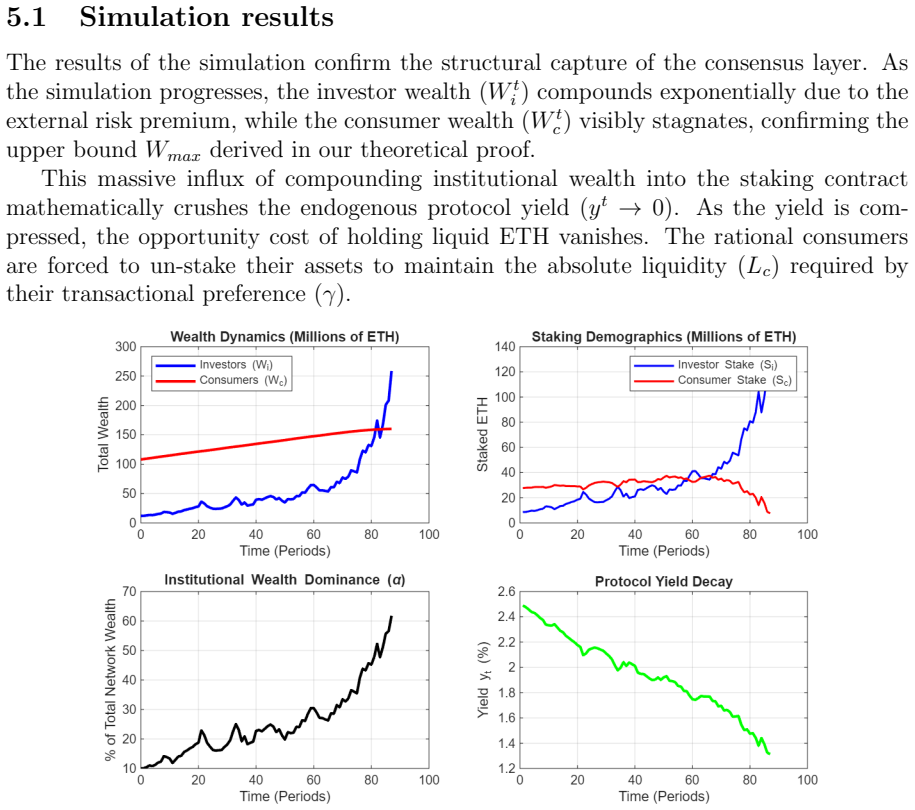
This paper introduces a heterogeneous macroeconomic model of a Proof-of-Stake (PoS) network to analyze the long-term centralizing effects of external traditional finance (TradFi) yields. We model a continuum of rational actors divided into two distinct classes: investors, who optimize portfolios between staking and external variance-dominated investments, and consumers, who balance staking yields against the transactional utility of holding liquid assets. By employing a quasi-linear utility function to model consumer behavior, we derive a cubic polynomial that strictly defines the unique macroeconomic equilibrium of the coupled network. The model demonstrates that, at scale, external macroeconomic factors force the complete institutional capture of the PoS consensus layer. Because investors have access to external risk premiums, their wealth compounds exponentially, leading to massive capital inflows that crush the protocol's internal staking yield to effectively zero. We show that as the yield is crushed, consumer wealth becomes strictly upper-bounded. Ultimately, consumers are forced to cease staking entirely and hold all remaining wealth in liquid form to satisfy their transactional constraints.
Traditional moving average convergence divergence (MACD) trading rules are often constrained by signal lag and susceptibility to false signals. To address these limitations, this study develops a volume-price-adjusted MACD (VP-MACD) framework that incorporates volume, volatility, and intraday price structure into the conventional indicator, and introduces a sensitivity parameter to allow earlier trade entry and improve responsiveness to market movements. Using the S&P 500, Nasdaq-100, and Dow Jones Industrial Average as representative U.S. equity indices, the model is calibrated over historical records from 2018 to 2022 and evaluated out of sample over 2023 to February 2026. The results indicate that the proposed framework generally delivers better economic performance than the baseline MACD strategy in terms of profitability, risk-adjusted return, and downside-risk control, while generating fewer but more selective trading signals. These findings suggest that incorporating additional market information into technical trading rules may enhance signal quality in U.S. equity index markets.
Connectedness measures quantify aggregate risk spillovers but obscure the local interaction patterns that generate systemic risk. We develop a motif-based framework that first extracts multiscale backbones from quantile connectedness networks and then identifies directed triadic motifs whose frequencies exceed randomization baselines. To distinguish how assets' sectoral identities shape local spillover structures, we introduce colored motifs under sector partitions of increasing granularity. Using orbit positions that capture each node's structural role within directed triadic motifs, we construct portfolio strategies that exploit an asset's place in the spillover architecture. Applying the framework to 39 commodity and equity futures across lower, median, and upper conditional quantiles, we find that motif-based portfolios outperform minimum correlation and minimum connectedness benchmarks on risk-adjusted returns. We further show that in tail networks, assets with greater orbit-position diversity tend to act as net spillover transmitters rather than receivers, establishing positional diversity as a tail-specific marker of systemic influence. These findings demonstrate that local triadic topology carries portfolio-relevant information that aggregate connectedness measures miss.
Persistent shifts in term-structure dynamics undermine the stability of single-regime models in long samples. We develop an arbitrage-free regime-switching generalized CIR (RS-GCIR) model that jointly prices the Chinese government bond (CGB) curve and corporate bond curves. To capture the systematic transmission from interest-rate conditions to credit spreads, we structure the model into two blocks and price corporate bonds conditional on the prevailing rate regime. The rate block features a two-state RS-GCIR short-rate process estimated from CGB zero-coupon curves, while the credit block embeds CIR-type credit factors in an intensity-based framework for rating migration and default. We implement a block-recursive Unscented Kalman Filter (UKF) procedure--filtering the rate block first and the credit block next--using weekly data from 2014--2025, a period that begins with the onset of China's modern corporate default cycle. We identify two persistent rate regimes with distinct level--volatility profiles. Relative to single-regime benchmarks, regime switching improves joint curve fit, delivers economically interpretable filtered regime probabilities, and sharpens the decomposition of corporate yields into discounting and credit compensation.
Unrestricted mean-variance-skewness-kurtosis portfolio optimization can capture asymmetry and tail risk, but sample-moment formulations become computationally impractical when the asset universe is large: they produce dense nonconvex quartic objectives with prohibitive coskewness and cokurtosis tensors and anisotropic, ill-conditioned level sets. We develop a structure-exploiting algorithm based on Yau's affine-normal descent that follows affine-normal directions of the current level set while working directly with the return matrix. The method avoids explicit higher-order tensors and exploits the quartic structure for exact sample oracles, derivative evaluation, and exact line search. We also provide theory for the reduced simplex formulation, including regularity and convexity conditions that separate data-map geometry from investor preference coefficients. Computational results show a clear implementation split: a direct configuration is effective on the standard small benchmark, whereas a preconditioned conjugate-gradient configuration with stall recovery becomes the preferred large-scale implementation by the upper end of the hundreds and remains competitive as the asset universe moves into the thousands. On a 5-minute A-share panel with 5,440 stocks, the method makes direct full-universe comparisons with exact mean-variance portfolios feasible and shows on the baseline split that the incremental value of higher moments is strongest at moderate return targets.
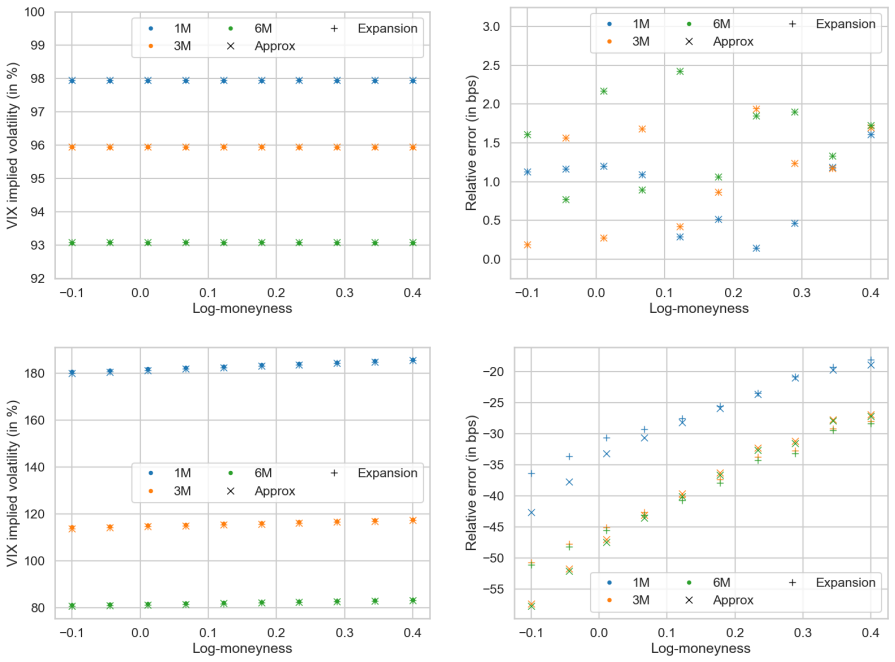
We develop closed-form expansions for the implied volatility of VIX options within the class of forward variance models. Our approach builds on weak-approximation techniques for VIX option prices and yields explicit implied volatility expansions with computable correction terms. The resulting formulas enable fast and accurate calibration without requiring numerical root-finding. We illustrate the performance of the proposed expansions in both standard and rough Bergomi-type models, as well as in mixed specifications, and demonstrate their accuracy through numerical experiments.
For a sequence of binary bets, the Kelly criterion provides a closed-form solution that maximizes the expected growth rate of wealth. In contrast, when multiple bets are placed simultaneously (e.g., in portfolio allocation or prediction markets), the optimal Kelly strategy generally requires numerical optimization over a joint outcome space. A naive formulation scales exponentially in the number of bets, requiring $O(2^N)$ time and memory for $N$ simultaneous wagers, which restricts existing methods to small problem sizes.
We present two complementary methods that dramatically extend the scale of multivariate Kelly problems that can be solved. First, in the case of independent bets, we introduce an integral transform formulation that eliminates explicit enumeration of outcomes, reducing the computational complexity of evaluating the objective from $O(2^N)$ to $O(N)$. Combined with numerically stable quadrature, this enables accurate solutions for problems involving hundreds of bets. Second, we develop a decomposition-based approach that constructs and solves carefully chosen subproblems, yielding feasible lower bounds and infeasible upper bounds on the optimal growth rate. This provides a practical mechanism for quantifying worst-case suboptimality as a function of subproblem size.
Together, these methods make it possible to study the large-$N$ regime of the multivariate Kelly problem. Using synthetic data inspired by prediction markets, we show that the relationship between subproblem size and solution accuracy follows a simple and highly regular scaling law. In particular, the shortfall ratio between the lower and upper bounds is well-approximated by a sigmoid function of the relative subproblem size, with parameters that can be predicted from low-dimensional summary statistics of the problem.
This paper observes that the Black--Scholes call price can be written as the survival probability of an inverse Gaussian distribution, equivalently as a probability in variance space. Inverting this representation yields an analytically explicit formula for implied volatility in terms of the corresponding inverse Gaussian quantile function, with volatility on the left-hand side and only observable option inputs on the right-hand side. Numerical tests recover implied volatility to machine precision and, in a controlled setting, show the formula to be faster than a state-of-the-art benchmark.
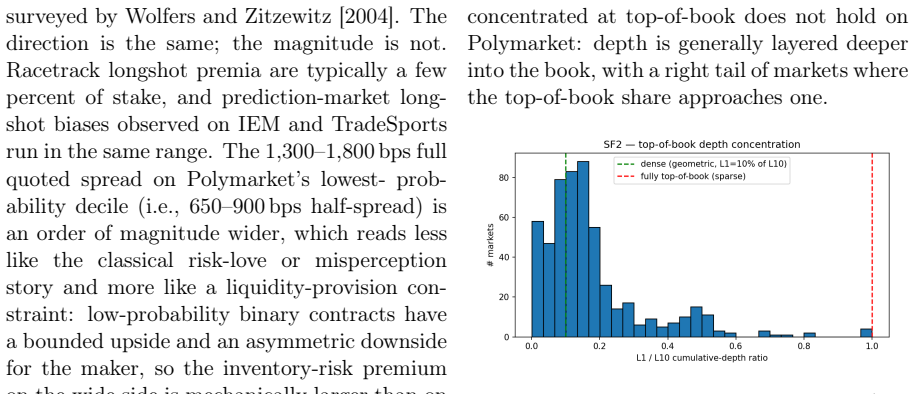
We study the microstructure of Polymarket, the largest on-chain prediction market, using a continuous tick-level archive of the public WebSocket order-book feed (30 billion events over 52 days) joined to the authoritative on-chain trade record. On a pre-registered stratified panel of 600 markets we report eight stylized facts: a longshot spread premium; a depth-concentration profile closer to a uniform geometric grid than to the top-of-book pattern often assumed for prediction markets; a null block-clock alignment effect; broad maker-wallet diversity with a concentrated tail; category-conditional differences in effective spread; a sub-50 ms median archive-ingestion delay with a multi-second tail; a self-counterparty wash share with median 1% and a 22% upper tail, well below the network-classifier benchmarks of Cong et al. (2023) for unregulated cryptocurrency token exchanges (a sanity bound, not an apples-to-apples reference, since the venues face different wash incentives); and a depth decay near resolution with a within-category slope of 0.55 on log seconds-to-close (t=3.85). The paper also contributes a measurement result: trade direction inferred from Polymarket's public order-book feed agrees with on-chain ground truth only ~59% of the time (panel mean 0.615, 95% CI [0.58, 0.65]), barely above the 50% chance baseline. On the comparable subset of the top-100 panel, the effective half-spread changes sign between feed- and on-chain directions on 67% of markets in a first 7-day window and 50% in a second non-overlapping window, with Kyle's lambda flipping on 60% and 43% respectively; neither window recovers the on-chain sign at anything close to the ~80% rate that Lee-Ready achieves on equity venues. Microstructure work on Polymarket therefore needs to source trade direction from on-chain OrderFilled events; we release a replication package that performs the join.
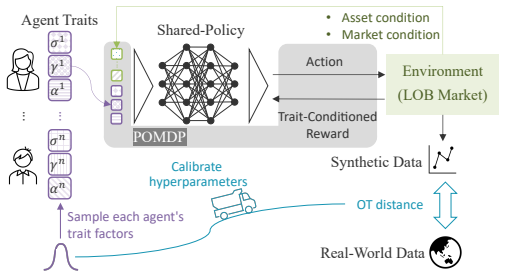
Agent-based models provide a constructive approach to studying emergent dynamics in life-like systems composed of interacting, adaptive agents. Financial markets serve as a canonical example of such systems, where collective price dynamics arise from individual decision-making. In this modeling tradition, investor behavior has typically been captured by two distinct mechanisms -- learning and heterogeneous preferences -- which have been explored as separate paradigms in prior studies. However, the impact of their joint modeling on the resulting collective dynamics remains largely unexplored. We develop a multi-agent reinforcement learning framework in which agents endowed with heterogeneous risk aversion, time discounting, and information access learn trading strategies interactively within an artificial market. The experiment reveals that (i) learning under heterogeneous preferences drives agents to develop functionally differentiated strategies through interaction, rather than trait-specific rules, resulting in role specialization, and (ii) the interactions by the differentiated agents are essential for the emergence of realistic market dynamics such as fat-tailed price fluctuations and volatility clustering. Overall, this study demonstrates that the joint design of heterogeneous preferences and learning mechanisms enables the synthesis of an artificial market in which adaptive interactions drive the self-organization of a market ecology, providing a computational realization of the Adaptive Market Hypothesis.
Hierarchical Risk Parity (De Pardo) and the Schur-complement generalization of Cotton are among the most widely adopted regularised portfolio construction methods, yet both are signal-blind: they solve only the minimum-variance problem and cannot accommodate an arbitrary expected-return forecast. This paper introduces three methods that incorporate alpha signals into hierarchical and regularised portfolio construction.
HRP-$\mu$ is a hierarchical allocator that accepts an arbitrary signal $\mu$ and nests standard HRP when $\gamma = 0$ and $\mu=\mathbf{1}$. It preserves the tree-based structure of HRP while extending it beyond the minimum-variance setting. HRP-$\Sigma\mu$ strengthens this construction by replacing inverse-variance representatives with recursive local mean-variance optima, thereby using richer within-cluster covariance information at the same $O(N^2)$ asymptotic cost.
CRISP (Correlation-Regularised Iterative Shrinkage Portfolios) is an iterative solver for $P_\gamma w = \mu$ with $P_\gamma = (1-\gamma)\operatorname{diag}(\Sigma) + \gamma \Sigma$, so that $\gamma$ interpolates between a diagonal portfolio rule and full Markowitz. At convergence, CRISP is Markowitz applied to a variance-preserving shrunk covariance-diagonal variances unchanged, off-diagonal correlations shrunk-with $\gamma$ tuned for out-of-sample Sharpe rather than covariance-estimation loss.
In Monte Carlo experiments across multiple covariance regimes and estimation ratios, HRP-$\mu$ and HRP-$\Sigma\mu$ both outperform plain HRP with HRP-$\Sigma\mu$ consistently improving on HRP-$\mu$. CRISP at intermediate $\gamma$ is the dominant method in both regimes, outperforming HRP, Cotton, Ledoit-Wolf shrinkage, direct Markowitz, and the signal-aware hierarchical methods.
Asynchronous event-driven markets lack a unique continuous clock, implying incompleteness beyond standard models and needing operational-to-
abstractclick to expand
Financial markets are often modelled as if time were unique and continuous across assets and markets. Financial markets are however asynchronous, order flow is event-driven, and waiting times between events are often random. Many of the most influential formulations of financial market models presuppose a unique global calendar time and advocate for this or that preferred single latent continuous-time price system. Here we critically contrast these assumptions with event-time, renewal, point-process, and order-flow descriptions. We revisit no-arbitrage, no-dynamic-arbitrage, and risk-neutral option pricing in settings where the market is represented as a discrete event system and where the continuum limit of a discrete-time random walk need not be unique. The central suggestion is then that such non-uniqueness points to a more foundational form of market incompleteness than is usually emphasized. This highlights the importance of operational time at the level of decision making but reminds market practitioners that managing risk itself often requires reconciling operational time with a global calendar time. At these longer time scales forms of effective or average completeness may still emerge at lower frequencies and remain useful for portfolio construction and risk management, even if high-frequency hedging and execution expose a clock mismatch between trading, pricing, and longer-horizon allocation.
We test a regime-conditional functional-form restriction on aggregate risk-exposure dynamics implied by VaR-constrained intermediary models: exposures contract multiplicatively when capital constraints bind and grow additively (level-independent) when slack. The contraction half follows from binding VaR constraints (Brunnermeier and Pedersen 2009; Adrian and Shin 2010; He and Krishnamurthy 2013). The additive-rebuild prediction is derived under constant-rate capital replenishment; we test the joint restriction on FINRA monthly margin debt (1997-2026).
Two findings. First, regime-interacted regression of detrended margin growth on lagged level (T=350 months) yields calm slope -0.040 (p=0.082, additive) and stress slope -0.205 (p<0.001, multiplicative); Wald test on regime x level interaction rejects equal dependence (p=0.0016). Second, the restriction implies drawdown-recovery duration ratio increases with crash depth. On 73 S&P 500 episodes (1950-2026), Cox model gives depth coefficient -13.75 (p<10^{-7}): 75% lower recovery hazard per 10pp deeper drawdown. Continuous-depth regression yields beta=1.22 (p=0.047); beta=1.59 (p<0.001) excluding 1980-82 Volcker. Median duration ratio for crashes >30% is 3.1x; replicates across eight other equity indices. Calibrated Heston, Markov-switching, and block bootstrap nulls match price-level duration asymmetry but lack an exposure state variable, so cannot speak to the regime-conditional flip on direct exposures.
We do not claim the exposure test identifies the intermediary mechanism: FINRA margin debt is a noisy proxy. We claim only that the regime-conditional functional form is a sharper target than return-level moments alone, and confirming it on margin debt is consistent with -- not proof of -- the constrained-intermediary mechanism. A companion test on CFTC weekly speculative positioning is left for future work (Sections 5.2 and F).
We propose a Gaussian-copula-based framework that learns deal-level dependence directly from observed joint success frequencies across founder, geography, and market attributes. Holding marginal deal success probabilities fixed, deal-level correlation preserves expected portfolio outcomes but shifts the portfolio distribution toward heavier right tails and higher kurtosis. In portfolio simulations, correlation reduces the probability of modest success counts while sharply amplifying extreme upside outcomes, especially in structurally concentrated portfolios. Our findings suggest that extreme venture capital outcomes may partly reflect correlation-induced tail amplification rather than solely higher average deal quality, with potential implications for portfolio construction and risk management. We note that the observed dataset reflects selected deals with observable outcomes, which inflates apparent success rates relative to the true population base rate; however, the core finding that correlation reshapes the distributional shape while leaving the mean unchanged is structurally robust to the level of marginal success probabilities.
Nonlinear effects from firm data like trading frictions raise forecast accuracy and boost valuation and portfolio results.
abstractclick to expand
We demonstrate that machine learning methods provide a powerful framework for modelling conditional asymmetric risk. Using a large cross-section of US stocks and a comprehensive set of firm characteristics, we show that allowing for nonlinearities significantly increases the out-of-sample performance across a wide range of asymmetric beta measures and forecasting horizons. Trading frictions, followed by characteristics related to intangibles, momentum and growth, emerge as the most important drivers of future risk dynamics. Reconstructing CAPM beta from forecasts of asymmetric beta components indicates that a more granular decomposition of systematic risk yields a more accurate representation of market beta. We also find that incorporating conditional beta forecasts into discounted cash flow models that account for the term structure of betas enhances equity valuation accuracy. Finally, we show that the statistical outperformance of conditional betas translates into economically significant benefits for market-neutral portfolio investors.
We study the problem of optimal portfolio selection under stochastic volatility within a continuous time reinforcement learning framework with portfolio constraints. Exploration is modeled through entropy-regularized relaxed controls, where the investor selects probability distributions over admissible portfolio allocations rather than deterministic strategies. Using dynamic programming arguments, we derive the associated entropy-regularized Hamilton-Jacobi-Bellman equation, whose Hamiltonian involves optimization over probability measures supported on a compact control set. We show that the optimal exploratory policy takes the form of a truncated Gaussian distribution characterized by spatial derivatives of the solution of the resulting nonlinear quasilinear parabolic partial differential equation. Under suitable structural conditions on the model coefficients, we prove the existence of classical solutions to this nonlinear HJB equation for the value function. We then establish a verification theorem and analyze the policy-improvement structure induced by the entropy-regularized Hamiltonian, showing how the resulting sequence of PDEs provides a continuous-time interpretation of actor-critic learning dynamics. Finally, our PDE analysis with a semi-closed form of optimal value and optimal policy enables the design of an implementable reinforcement learning algorithm by recasting the optimal problem in a martingale framework.
The emergence of Concentrated Liquidity Market Makers (CLMMs) has made liquidity provision on decentralized exchanges an active and risk-sensitive task. However, the standalone profitability of liquidity provision remains unclear for liquidity providers (LPs) who neither hedge their inventory risk nor receive off-pool profits. This paper studies the actual outcomes of LP activity using historical transaction-level data from WETH/USD liquidity pools on the Base chain across the Uniswap, Aerodrome, PancakeSwap and SushiSwap protocols. We propose a methodology for reconstructing LP PnL dynamics from on-chain events and introduce an original metric that captures both the terminal state of LP capital and its path over time. Based on this framework, we estimate the share of successful LPs, classify their behavior and develop a taxonomy of 15 position types as structural components of PnL. We further identify a distinct class of multi-LPs operating across several pools and show that the dominant profitable position configurations are concentrated around the current pool price. The results show that only about one out of six LPs avoids losses in the selected market segment, raising an open question about the true economic motives of LP participation. Evidence also suggests that successful LPs often close positions before the full range is traversed, making observed behavior closer to profit-target-based strategies.
Predicting future operational risk losses gives rise to a significant challenge due to the heterogeneous and time-dependent structures present in real-world data. Furthermore, stress test exercises require examining the relationship with operational losses. To capture such relationship, we propose to use an extension of Hidden Markov Models to multivariate observations. This model introduces a third auxiliary variable designed to accommodate the economic covariates in the time-series data. We detail the unique aspects of operational risk data and describe how model calibration is achieved via the Expectation-Maximization (EM) algorithm. Additionally, we provide the calibration results for the various risk-event types and analyze the relevance of the inclusion of the macroeconomic covariates.
We investigate the optimal execution of contracts that are used in merger\&acquisition deals. We consider cash-settled and physically delivered contracts between a broker and a counterpart. Contracts are linear (total returns swaps), nonlinear (collar contracts) or Asian type (TWAP based contracts). We derive the optimal execution strategy and the optimal fee through indifference utility arguments allowing for linear market effects of trades. We show that linear cash-settled contracts are more expensive and more exposed to manipulation/statistical arbitrages by the broker. Also nonlinear and Asian type contracts are exposed to these phenomena.
Biodiversity loss is accelerating at an unprecedented pace, threatening ecosystem stability, economic resilience, and human well-being, with billions required to reverse current trends. Against this backdrop, biodiversity finance has emerged as a rapidly expanding but highly fragmented field spanning ecology, economics, finance, accounting, and policy. However, it remains emerging and complex, with the majority of relevant knowledge being produced in non-finance journals. This study employs quantitative bibliometric analysis to examine a corpus of 189,456 references underlying 3,998 articles related to biodiversity and finance. The analysis identifies eight primary research streams within the field that concern (1) strategic and financial approaches in global biodiversity conservation, (2) the impact and implementation of payments for environmental services (PES) in developing countries, (3) neoliberal influences and implications in environmental conservation, (4) biodiversity offsets and conservation, (5) ecosystem services and biodiversity, (6) integrating conservation and community interests in biodiversity management, (7) balancing agricultural intensification with biodiversity conservation, and (8) global and corporate biodiversity reporting. The characteristics of each research stream and its prevalent publications are outlined, alongside an analysis of their temporal evolution and the degree of information exchange among the research streams. The findings provide a structured map of the intellectual architecture of biodiversity finance, document pronounced silos between economically-oriented and critical/political-economy research streams, and translate these patterns into a focused research agenda and implications for policymakers, financial institutions, and corporate actors.
Frozen large language model (LLM) checkpoints extract information from pre-cutoff public text that is associated with future fundamentals and equity returns beyond standard contemporaneous valuation measures. Because each frozen checkpoint has a fixed knowledge cutoff, it can be interpreted as a compressed representation of publicly available textual information at a given point in time. We treat twelve OpenAI snapshots spanning 2021-2025 as time-stamped summaries of the public textual record and extract a sector-neutral LLM outlook score for roughly 7,000 U.S. equities per cross-section. The outlook score is positively associated with analyst revisions, target-price changes and one-month cross-sectional returns in both Fama-MacBeth regressions and pooled panels with model fixed effects (t = 6.02), after direct controls for market-implied valuation and standard factors. Predictability broadly increases with the return horizon, despite a non-monotonic intermediate dip, and, in the pooled panel, is stronger for firms with high analyst coverage, consistent with the view that the bottleneck is not investor inattention but the cost of aggregating dispersed qualitative information across many documents.
We study OTC bond market making on a size ladder with quadratic inventory penalty and a running target on the dealer's size-weighted hit ratio within a stochastic optimal control approach. We demonstrate that the corresponding reduced Hamilton-Jacobi-Bellman (HJB) equation remains separable by dualizing the hit ratio target term and provides the exact optimal controls through the inverse of the fill-probability function and the Hamiltonian derivative. We then focus on the quadratic approximation \'a la Bergault et al., which yields a Riccati equation for the inventory curvature while retaining the exact quote map. In its linearized form, this approximation produces explicit quote decompositions into riskless spread, inventory-risk correction, and hit-ratio correction. The formulation is general and applies to multi-bond, multi-client-tier scenarios, with special cases obtained by restricting the targeted tiers, their bond coverage, and their associated targets.
Stochastic-clock models gain fast semi-analytic corrections for return-volatility correlation while keeping one-dimensional transforms for v
abstractclick to expand
Barrier derivatives depend on extrema and first-passage events and are therefore highly sensitive to volatility dynamics -- especially to the instantaneous return-volatility correlation $\rho$, often called ``leverage''. This sensitivity makes accurate and fast pricing under realistic stochastic-volatility specifications difficult: two-dimensional PDE solvers are expensive inside calibration loops, while Monte Carlo methods converge slowly when barrier hits are rare and discretely monitored. In equity markets in particular, the pronounced implied-volatility skew motivates factoring in a negative return-volatility correlation. We study a class of continuous-path stochastic-clock volatility models in which the log-price is represented as a Brownian motion run on a random increasing clock. In the baseline independent-clock case (\rho=0), a broad family of barrier-relevant objects-maximum distributions, survival probabilities, and killed joint laws-reduces to one-dimensional quantities determined by the Laplace transform of the terminal clock. This yields transform-only pricing formulas for single- and double-barrier contracts that are fast and numerically stable once the clock transform is available, notably for affine and quadratic clocks. To incorporate leverage without forfeiting tractability, we develop a systematic small-\rho expansion around the \rho=0 backbone. The expansion produces a hierarchy of forced problems whose forcing terms are semi-analytic and computable from baseline barrier objects. We provide two implementable leverage-correction routes\,: forced PDEs and a Duhamel-type Monte Carlo representation, and we show how Pad{\'e} acceleration can extend practical accuracy to equity-like correlations. Calibration then proceeds by\,: (i) fitting clock parameters from vanillas using only one-dimensional transforms, (ii) precomputing the \rho=0 barrier backbone once, and (iii) iterating on \rho (and any remaining parameters) using the fast semi-analytic corrections-optionally Pad{\'e}-accelerated-inside a standard least-squares loop.
While decentralized prediction markets like Polymarket have gained significant traction, their market microstructure and high-frequency pricing efficiency remain underexplored. This paper conducts a systematic empirical analysis of algorithmic arbitrage within Polymarket's NBA game markets. By reconstructing continuous market states from over 75 million limit order book snapshots across 173 games, we evaluate the frequency, duration, and profitability of both single-market and combinatorial arbitrage opportunities. Our findings demonstrate profound microstructural efficiency. Single-market anomalies are exceedingly rare, yielding only 7 executable in-game episodes that persist for a median duration of just 3.6 seconds. Combinatorial inefficiencies are more frequent, producing 290 active episodes overwhelmingly concentrated in the final minutes of live play. While combinatorial execution yields a statistically meaningful median return of 101 basis points, we find that the theoretical "Middle" jackpot is never empirically realized. Furthermore, execution is severely bottlenecked by shallow order book depth, with 76.9\% of combinatorial opportunities constrained to an average executable size of just 14.8 shares. Ultimately, while executable mispricings exist, they are structurally bounded by liquidity, confining risk-free extraction strictly to the retail scale.
This study strengthens the foundations of multi-venue market modeling by attempting an independent replication of Wah and Wellman's 2016 model of latency arbitrage in a fragmented market. We find that faithful replication is hindered by missing implementation details in the original paper and limited quantitative reporting. We demonstrate that increasing the number of simulation runs beyond the original design allows for the creation of bootstrap confidence intervals to support rigorous tests of quantitative alignment, compensating for lacking distributional information (e.g. variance). We also demonstrate that increased complexity across the modeled scenarios corresponds with increased difficulty aligning to the original results. We draw on a codebase released by the original authors in connection with a later paper to recover additional implementation details; however, we reject quantitative alignment between that codebase and the published results. Combining information from the paper and the released code, we achieve relational equivalence for most metrics but reject quantitative alignment for model settings where latency is non-zero. We show that many of the qualitative takeaways from the original paper on the effects of market fragmentation and latency arbitrage are sensitive to the specifics of a `greedy strategy' extension given to the zero-intelligence (ZI) trader agents. Under an alternative interpretation of this strategy, we find that market fragmentation decreases execution times in all experiments and increases trader welfare in most experiments. Finally, to facilitate future replication, critique, and extension, we provide an ODD (Overview, Design concepts, Details) protocol for our implementations of the model.
Put-call parity is a risk-neutral identity, but enforcing it is path-dependent and capital-using. I study the carry gap, the annualized wedge between option-implied and OIS discount factors, in SPX and RUT options. Because parity enforcement ties up scarce capital, its opportunity cost may reflect outside investment opportunities. Adding low-frequency global asset-return components to an OIS-based baseline improves in-sample and leave-one-year-out out-of-sample R^2, with gains robust to broad-dollar neutralization, alternative asset blocks, and nested horizon selection. The evidence indicates reduced-form P-Q alignment: the carry gap is not empirically separable from physical-measure outside-option proxies, rather than behaving as a purely OIS-contained wedge.
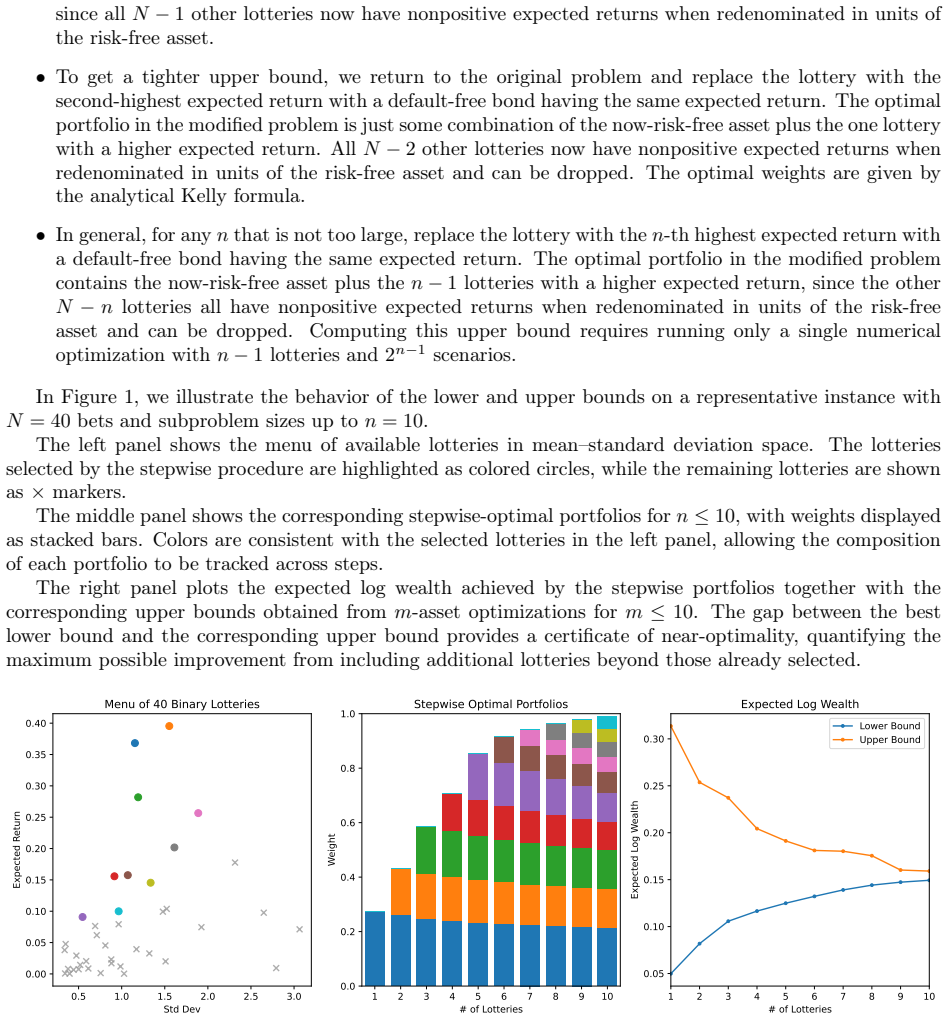
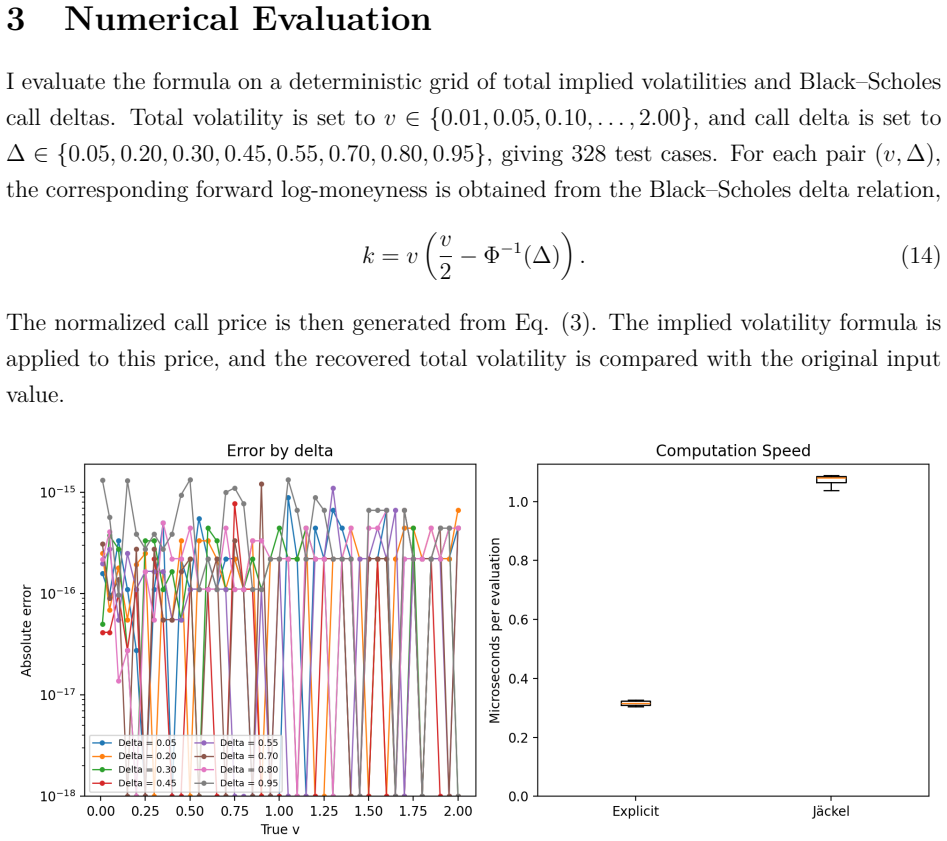
Put-call parity is a terminal-payoff identity; quoted residuals against traded futures are near zero. Yet enforcing parity is path-dependent, exposing arbitrageurs to daily settlement, margin, and finite capital. Using minute-level NBBO data on S&P 500 and Russell 2000 options, I extract option-implied discount factors, compare them with the OIS curve, and construct an annualized carry gap. A reduced-form specification centered on a volatility times sqrt(tau) path-risk term links the carry gap to implementation risk, trading frictions, and financial conditions, with coefficient signs stable across leave-one-year-out validation. The carry gap is an implementation wedge invisible in price space but systematic in carry space.