BlitzGS delivers order-of-magnitude faster city-scale 3D Gaussian Splatting training via index-parity GPU sharding, scheduled importance…
abstractclick to expand
We present BlitzGS, a distributed 3DGS framework that reduces active Gaussian workload for fast city-scale reconstruction. BlitzGS manages this workload at three coupled levels. At the system level, the framework shards Gaussians across GPUs by index parity rather than spatial blocks. This approach mitigates the cross-block visibility redundancy inherent in spatial partitioning. Furthermore, it distributes each rendering step through a single cross-GPU exchange that routes projected Gaussians to their tile owners. At the model level, scheduled importance-scoring passes shrink the global Gaussian population. During these passes, the framework generates a per-Gaussian visibility weight to bias density-control updates toward contributing primitives and a per-view importance mask for the view-level renderer. At the view level, BlitzGS trims each camera's active set with a distance-based LOD gate to exclude excessively fine primitives for the current frustum and the importance-based culling mask to skip Gaussians with negligible cross-view contribution.
On large-scale benchmarks, BlitzGS matches the rendering quality of recent large-scale baselines while delivering an order-of-magnitude speedup, training city-scale scenes in tens of minutes. Our code is available at https: //github.com/AkierRaee/BlitzGS.
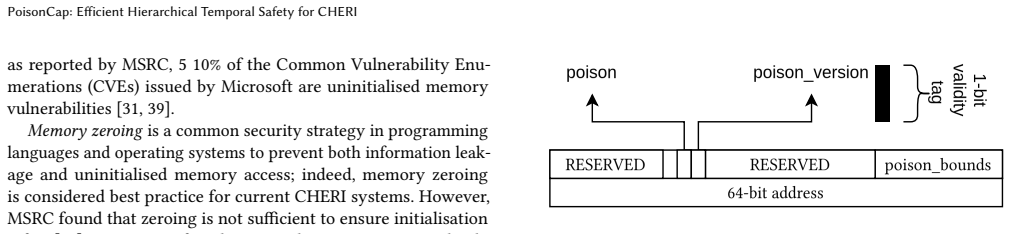
In this paper, we present PoisonCap: scalable temporal safety with strict use-after-free protection and initialisation safety for CHERI systems. Efficient memory safety is an increasing priority for programming languages, operating systems, and hardware designs, and CHERI is a leading hardware/software system that provides native spatial safety and a foundation for temporal memory safety. Cornucopia Reloaded, the current state-of-the-art CHERI temporal safety solution, provides use-after-reallocation safety instead of stronger use-after-free safety, and is not able to enforce initialisation safety. We show that a new 'poison' capability format can be used to enforce strict use-after-free and initialisation safety, and also to communicate memory state to the microarchitecture for efficient cache management of quarantined memory. We enable elegant delegation of memory poisoning privilege using capability bounds to allow nested allocators to enforce safety on their consumers without disturbing upstream allocators. PoisonCap can replace the Cornucopia shadow bitmap, and also automatically zeros memory on reallocation, or optionally traps on read-before-write to enforce initialisation safety. As a result, it incurs no fundamental overhead relative to a Cornucopia baseline that zeros before reallocation, strengthening CHERI temporal safety without performance overhead.
Many important real-world applications, such as System Identification with Gaussian Processes, involve solving linear systems with symmetric positive-definite matrices. The iterative CG method and direct solvers based on the Cholesky decomposition are two popular methods that can be applied in this case. Since often very large systems have to be solved when dealing with such real-world scenarios, GPUs are commonly used to accelerate the computations. However, homogeneous approaches that only leverage the GPU in the system do not take full advantage of the often powerful CPUs located in modern HPC systems. In this work, we present multi-vendor, heterogeneous implementations of the CG method and the Cholesky decomposition that leverage the CPU and GPU of a heterogeneous system simultaneously using SYCL. Furthermore, we compare their runtime behavior to traditional, homogeneous approaches. The results show that for large matrices, our heterogeneous implementation is up to 32 percent faster for the CG method and up to 29 percent faster for the Cholesky decomposition compared to the corresponding GPU-only implementations. In addition, for large matrices, our heterogeneous implementation of the Cholesky decomposition can achieve at least 12 percent faster runtimes across several systems with GPUs from NVIDIA, AMD, and Intel.
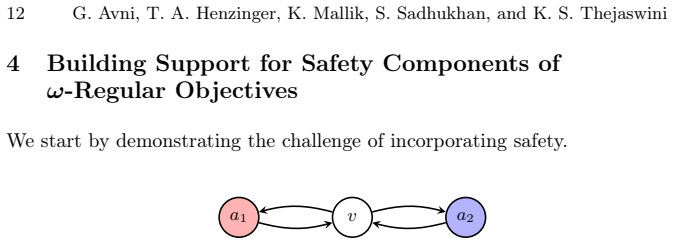
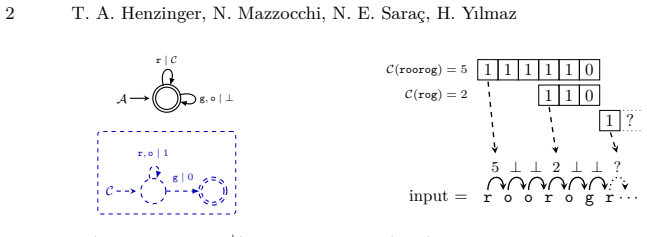
We study the problem of generating paths on a graph that satisfy a collection of {\omega}-regular objectives. We propose a decoupled framework in which each objective is assigned to an independent agent that selects a local policy, while a scheduler -- oblivious to the graph and objective -- dynamically composes these policies into a single path. We ask when such a composition satisfies all objectives, assuming their conjunction is realizable. The framework enables modular policy design but raises fundamental compositional challenges. We show that even extremely fair deterministic schedulers do not ensure correctness, and that stochastic schedulers, while necessary, are insufficient without coordination. For safety objectives, we demonstrate that fully decentralized implementations are impossible, and we introduce a protocol for synchronizing on maximal safe actions. For non-safety objectives, we introduce conventions -- simple, a priori restrictions agreed upon before the graph or objectives are revealed -- that guarantee satisfaction of all objectives when followed by all agents. We characterize minimally restrictive conventions for major subclasses of {\omega}-regular objectives. In particular, B\"uchi objectives admit universal composition of finite-memory policies without scheduler communication; co-B\"uchi objectives require only knowledge of whether the agent was scheduled; and parity objectives additionally require knowledge of which agent was scheduled.
LLMs and MLLMs have become indispensable tools across a wide range of applications. E-commerce, however, poses distinctive challenges -- including intricate domain knowledge, long-tail product evidence, heterogeneous visual data, and the interplay among multiple stakeholder roles -- that diverge substantially from the general world knowledge these models are primarily trained on, often causing a notable gap between their open-domain and e-commerce performance. To systematically quantify this gap, we introduce OxyEcomBench, a unified multimodal benchmark comprising approximately 6,300 high-quality instances for real-world bilingual Chinese--English e-commerce. Although several e-commerce benchmarks have been proposed, they typically adopt a single stakeholder perspective, target a narrow set of tasks, or address isolated challenges, making it difficult to holistically assess models' understanding of the full e-commerce pipeline. OxyEcomBench addresses these limitations by jointly covering platform operators, merchants, and customers across 6 capability aspects and 29 tasks, supporting text-only and mixed-modality inputs with single-image, multi-image, single-turn, and multi-turn configurations. All data is sourced from authentic e-commerce platforms and verified by domain experts. The benchmark further adopts a difficulty-aware design with a four-level P0--P3 rubric applied to all 29 tasks whose difficulty admits stable expert consensus, and rigorously prioritizes visually salient multimodal cases in which key evidence resides in images rather than text alone. Evaluations on 20 mainstream LLMs and MLLMs show that even the leading models attain modest performance and that performance gaps narrow on OxyEcomBench, suggesting that insufficient e-commerce-specific knowledge infusion mutes the advantages of advanced general-purpose models in this domain.
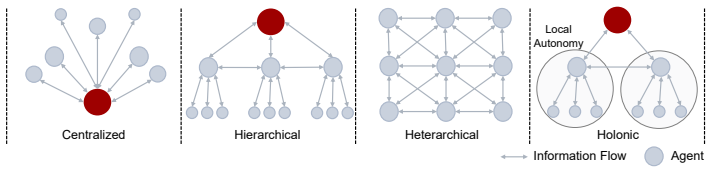
Recent advances in agent and multi-agent systems have shown strong performance on tool use, reasoning, and collaborative tasks. However, existing benchmarks mostly evaluate task completion in weakly coupled environments, and provide limited support for studying coordination in shared, dynamically evolving systems with hierarchy and coupled constraints. This leaves an important question underexplored: when do different coordination paradigms succeed or fail? We introduce Distributed Event-driven Scheduling Benchmark (DESBench), a benchmark for evaluating agent coordination in hierarchical event-driven scheduling. Built on a shared discrete-event driven environment in industrial scheduling, our benchmark captures multi-timescale decision making, partial observability, and dynamically coupled constraints. We define tasks and metrics that evaluate effectiveness, constraint alignment, coordination efficiency, and robustness, and focus on four representative coordination paradigms: centralized, hierarchical, heterarchical, and holonic. These paradigms correspond to distinct mechanisms of information flow, decision authority, and conflict resolution. Our controlled evaluations reveal clear coordination trade-offs: centralized coordination is robust and communication-efficient but scales poorly with difficulty; hierarchical coordination improves efficiency through decomposition but suffers from cross-level misalignment; heterarchical coordination is flexible but communication-heavy; and holonic coordination satisfies constraints well but loses global robustness. These findings demonstrate that coordination design fundamentally shapes agent system behavior in complex environments, revealing structural trade-offs that cannot be captured by outcome metrics alone and underscoring the imperative for more adaptive, principled, and dynamic coordination mechanisms in future MAS research.
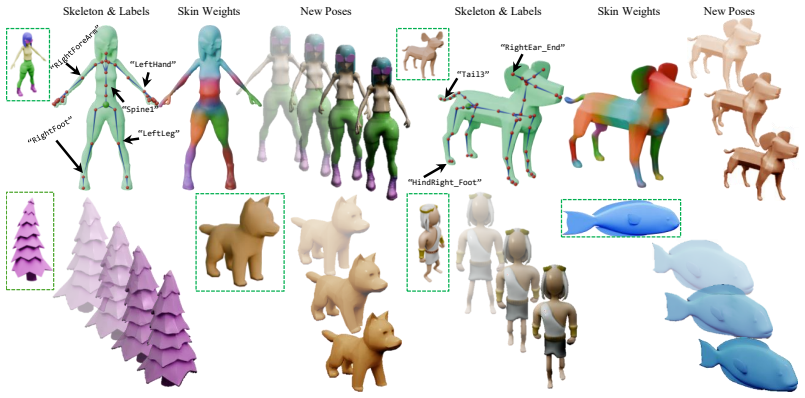
Recent 3D generative models can synthesize high-quality assets, but their outputs are typically static: they lack the skeletal rigs, joint hierarchies, and skinning weights required for animation. This limits their use in games, film, simulation, virtual agents, and embodied AI, where assets must not only look plausible but also move plausibly. We introduce Rigel3D, a generative method for animation-ready 3D assets represented as rigged meshes. Unlike post-hoc auto-rigging methods that attach rigs to completed shapes, our method jointly models geometry and rig structure through coupled surface and skeleton structured latent representations. A rig-aware autoencoder decodes these representations into mesh geometry, skeleton topology, joint coordinates, and skinning weights, while a two-stage latent generative model synthesizes both surface and skeleton representations for image-conditioned generation. To support downstream animation workflows, we further introduce an open-vocabulary joint labeling module that embeds generated joints into a shared vision-language space, enabling correspondence to arbitrary retargeting templates. Experiments on large-scale rigged asset datasets demonstrate that our method generates diverse, high-quality animation-ready assets and outperforms existing rigging baselines across multiple metrics.
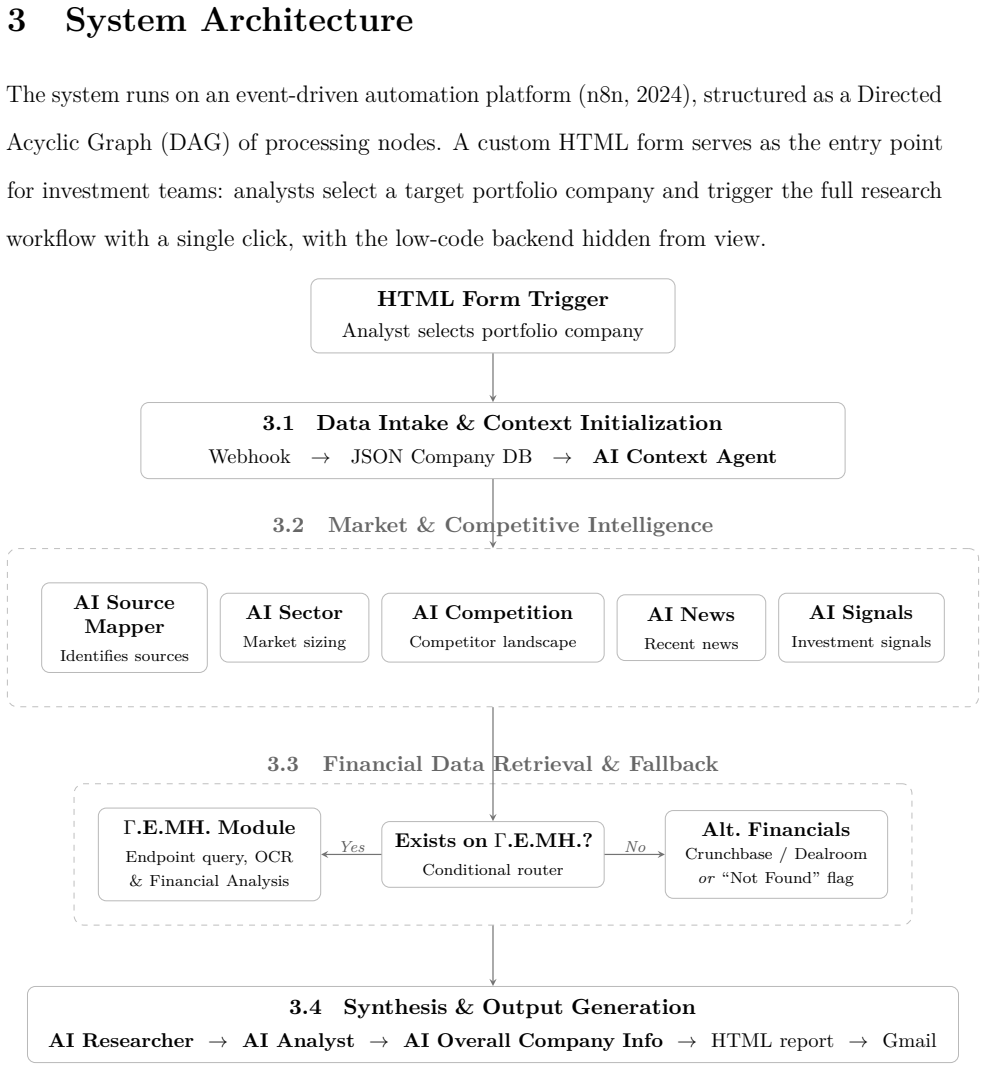
We present a fully automated multi-agent framework for corporate due diligence and market analysis in venture capital. The system runs on an event-driven orchestration architecture, combining Large Language Models (LLMs) with real-time web retrieval to synthesize unstructured data into structured investment intelligence. A central technical contribution is a programmatic extraction pipeline that reverse-engineers the frontend-to-backend communication of the Greek Business Registry ($\Gamma$.E.MH.), querying dynamic endpoints to retrieve official financial filings that are then parsed using a layout-aware OCR extractor. A structural fallback mechanism explicitly flags data absence rather than generating unverified figures, directly targeting hallucination in financial contexts. All workflow artifacts are publicly available to support replication.
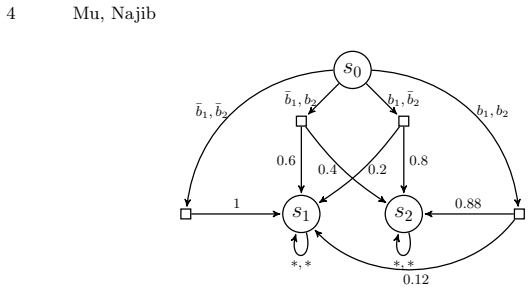
Responsibility allocation -- determining the extent to which agents are accountable for outcomes -- is a fundamental challenge in the design and analysis of multi-agent systems. In this work, we model such systems as concurrent stochastic multi-player games and introduce a notion of retrospective (backward) counterfactual responsibility, which quantifies an agent's accountability for outcomes resulting from a given strategy profile. To allocate responsibility among agents, we utilise the Shapley value and formally show that this method satisfies key desirable properties, including fairness and consistency. Building on this foundation, we propose a formal framework that supports both verification and strategic reasoning in responsibility-aware multi-agent systems. Furthermore, by adopting Nash equilibrium as the solution concept, we demonstrate how to compute stable strategy profiles in which agents trade off responsibility against expected reward.
The construction lets existing directed-graph algorithms compute these nested structures on any bidirected graph without new code.
abstractclick to expand
Bidirected graphs are a common generalisation of directed graphs where arcs can also be incoming to both their incident nodes, or outgoing from both their incident nodes. Such arcs allow a walk to change direction. Some algorithms can easily be adapted from directed graphs to bidirected graphs, such as shortest path algorithms. These adaptions are already used in practice, and implicitly use the graph doubling technique to apply an algorithm for directed graphs to bidirected graphs.
In other cases, the applicability of graph doubling is not that obvious. For example, superbubbles and their generalisation to bidirected graphs ultrabubbles. Ultrabubbles are a common structure in bidirected biological graphs which carries biological meaning, but also functions as a nested clustering method, since an ultrabubble is separated by only two nodes from the rest of the graph.
There is an existing method that enumerates a structure similar to ultrabubbles by enumerating (weak) superbubbles in the doubled graph. However, the literature does not make any direct connection between superbubbles and ultrabubbles except that a superbubble is an ultrabubble in a directed graph. Only a partial result connecting superbubbles and ultrabubbles exists by Harviainen et al. (2026).
Graph doubling on the other hand maintains connectivity, and allows to draw a direct connection between ultrabubbles and weak superbubbles. This results in the first linear-time reduction-based algorithm for computing ultrabubbles on any bidirected graph. Together with the fact that graph doubling is already used implicitly in simple cases, our result motivates that graph doubling is a powerful yet simple technique to apply algorithms for directed graphs to bidirected graphs.
Spiking Neural Networks (SNNs) are a promising framework for event-driven temporal processing. Prior work has improved temporal modeling through richer neuron dynamics and network-level mechanisms such as recurrence and delays, but it remains unclear how individual spiking neurons should specialize within a network. In this work, we introduce FiTS, a spiking neuron that factorizes temporal computation within each neuron into Frequency Selectivity (FS) and Temporal Shaping (TS). The FS module parameterizes each neuron's target frequency as the maximizer of its subthreshold magnitude response, while the TS module reshapes when frequency components contribute to membrane voltage accumulation through group-delay modulation. On auditory benchmarks where frequency selectivity and timing are central to the input structure, FiTS consistently improves over a plain Leaky Integrate-and-Fire (LIF) baseline in simple feedforward SNNs without recurrence or network-level delays, while remaining competitive with strong temporal SNN baselines. Beyond accuracy, the learned target frequencies and group-delay shifts provide interpretable neuron-level summaries of the frequency and timing organization learned within the network.
DOPP is a complete polynomial-time algorithm for online multi-agent path finding with order-contiguity (MAPF-OC) that plans order-level…
abstractclick to expand
In warehouse logistics, parcels released from the outfeed of an automated storage system must be routed through conveyor networks to workstations. Beyond collision avoidance, practical operations impose an additional requirement of order-contiguous arrivals: at each delivery point, parcels belonging to the same order must arrive as a consecutive block in the arrival sequence to reduce downstream re-sorting effort. We formalize this problem as online multi-agent path finding with order-contiguity (online MAPF-OC), where agents (i.e., parcels) appear over time and exit upon delivery. To efficiently solve online MAPF-OC, we propose Dual-Ordering Prioritized Planning (DOPP), a complete polynomial-time algorithm with a three-level structure that (i) searches order-level arrival sequences, (ii) refines agent-level priorities, and (iii) synthesizes feasible solutions via prioritized planning. Experiments on various conveyor-network layouts, including those derived from actual warehouses, demonstrate DOPP's practical scalability and ability to generate high-quality plans within tight time budgets.
SenseNova-U1 removes the structural split between perception and creation, matching specialists in both while extending to action and world-
abstractclick to expand
Recent large vision-language models (VLMs) remain fundamentally constrained by a persistent dichotomy: understanding and generation are treated as distinct problems, leading to fragmented architectures, cascaded pipelines, and misaligned representation spaces. We argue that this divide is not merely an engineering artifact, but a structural limitation that hinders the emergence of native multimodal intelligence. Hence, we introduce SenseNova-U1, a native unified multimodal paradigm built upon NEO-unify, in which understanding and generation evolve as synergistic views of a single underlying process. We launch two native unified variants, SenseNova-U1-8B-MoT and SenseNova-U1-A3B-MoT, built on dense (8B) and mixture-of-experts (30B-A3B) understanding baselines, respectively. Designed from first principles, they rival top-tier understanding-only VLMs across text understanding, vision-language perception, knowledge reasoning, agentic decision-making, and spatial intelligence. Meanwhile, they deliver strong semantic consistency and visual fidelity, excelling in conventional or knowledge-intensive any-to-image (X2I) synthesis, complex text-rich infographic generation, and interleaved vision-language generation, with or without think patterns. Beyond performance, we show detailed model design, data preprocessing, pre-/post-training, and inference strategies to support community research. Last but not least, preliminary evidence demonstrates that our models extend beyond perception and generation, performing strongly in vision-language-action (VLA) and world model (WM) scenarios. This points toward a broader roadmap where models do not translate between modalities, but think and act across them in a native manner. Multimodal AI is no longer about connecting separate systems, but about building a unified one and trusting the necessary capabilities to emerge from within.
Computer-use agents (CUAs) automate on-screen work, as illustrated by GPT-5.4 and Claude. Yet their reliability on complex, low-frequency interactions is still poor, limiting user trust. Our analysis of failure cases from advanced models suggests a long-tail pattern in GUI operations, where a relatively small fraction of complex and diverse interactions accounts for a disproportionate share of task failures. We hypothesize that this issue largely stems from the scarcity of data for complex interactions. To address this problem, we propose a new benchmark CUActSpot for evaluating models' capabilities on complex interactions across five modalities: GUI, text, table, canvas, and natural image, as well as a variety of actions (click, drag, draw, etc.), covering a broader range of interaction types than prior click-centric benchmarks that focus mainly on GUI widgets. We also design a renderer-based data-synthesis pipeline: scenes are automatically generated for each modality, screenshots and element coordinates are recorded, and an LLM produces matching instructions and action traces. After training on this corpus, our Phi-Ground-Any-4B outperforms open-source models with fewer than 32B parameters. We will release our benchmark, data, code, and models at https://github.com/microsoft/Phi-Ground.git
Reconstructing the absolute 3D pose and shape of the hands from the user's viewpoint using a single head-mounted camera is crucial for practical egocentric interaction in AR/VR, telepresence, and hand-centric manipulation tasks, where sensing must remain compact and unobtrusive. While monocular RGB methods have made progress, they remain constrained by depth-scale ambiguity and struggle to generalize across the diverse optical configurations of head-mounted devices. As a result, models typically require extensive training on device-specific datasets, which are costly and laborious to acquire. This paper addresses these challenges by introducing EgoForce, a monocular 3D hand reconstruction framework that recovers robust, absolute 3D hand pose and its position from the user's (camera-space) viewpoint. EgoForce operates across fisheye, perspective, and distorted wide-FOV camera models using a single unified network. Our approach combines a differentiable forearm representation that stabilizes hand pose, a unified arm-hand transformer that predicts both hand and forearm geometry from a single egocentric view, mitigating depth-scale ambiguity, and a ray space closed-form solver that enables absolute 3D pose recovery across diverse head-mounted camera models. Experiments on three egocentric benchmarks show that EgoForce achieves state-of-the-art 3D accuracy, reducing camera-space MPJPE by up to 28% on the HOT3D dataset compared to prior methods and maintaining consistent performance across camera configurations. For more details, visit the project page at https://dfki-av.github.io/EgoForce.
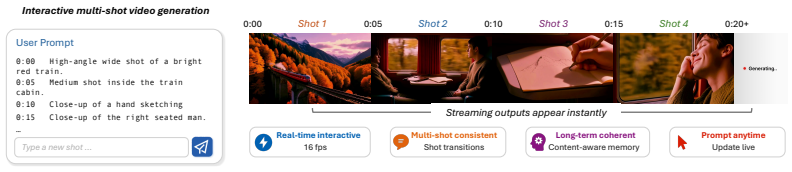
Autoregressive video generation aims at real-time, open-ended synthesis. Yet, cinematic storytelling is not merely the endless extension of a single scene; it requires progressing through evolving events, viewpoint shifts, and discrete shot boundaries. Existing autoregressive models often struggle in this setting. Trained primarily for short-horizon continuation, they treat long sequences as extended single shots, inevitably suffering from motion stagnation and semantic drift during long rollouts. To bridge this gap, we introduce CausalCine, an interactive autoregressive framework that transforms multi-shot video generation into an online directing process. CausalCine generates causally across shot changes, accepts dynamic prompts on the fly, and reuses context without regenerating previous shots. To achieve this, we first train a causal base model on native multi-shot sequences to learn complex shot transitions prior to acceleration. We then propose Content-Aware Memory Routing (CAMR), which dynamically retrieves historical KV entries according to attention-based relevance scores rather than temporal proximity, preserving cross-shot coherence under bounded active memory. Finally, we distill the causal base model into a few-step generator for real-time interactive generation. Extensive experiments demonstrate that CausalCine significantly outperforms autoregressive baselines and approaches the capability of bidirectional models while unlocking the streaming interactivity of causal generation. Demo available at https://yihao-meng.github.io/CausalCine/
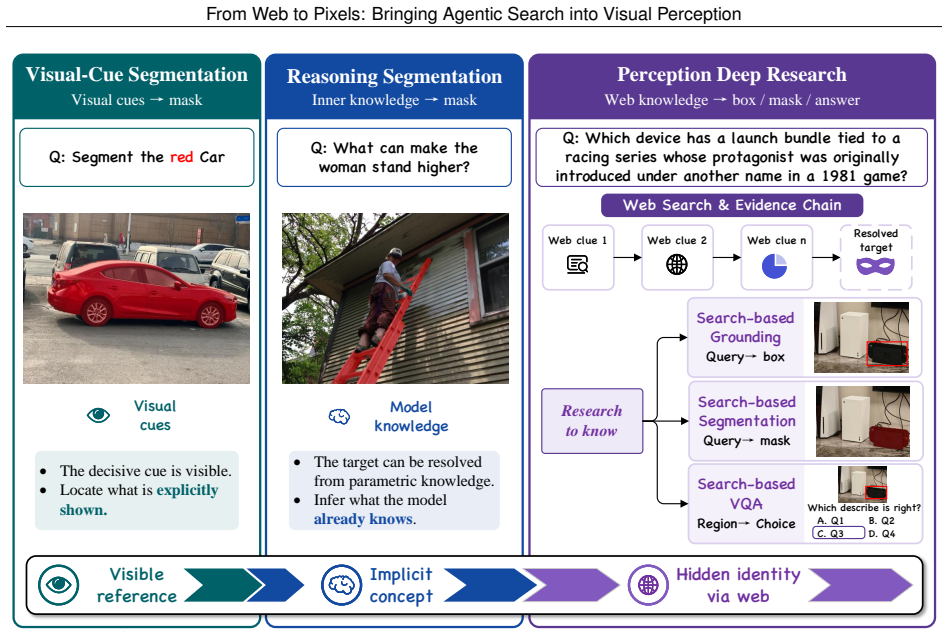
Visual perception connects high-level semantic understanding to pixel-level perception, but most existing settings assume that the decisive evidence for identifying a target is already in the image or frozen model knowledge. We study a more practical yet harder open-world case where a visible object must first be resolved from external facts, recent events, long-tail entities, or multi-hop relations before it can be localized. We formalize this challenge as Perception Deep Research and introduce WebEye, an object-anchored benchmark with verifiable evidence, knowledge-intensive queries, precise box/mask annotations, and three task views: Search-based Grounding, Search-based Segmentation, and Search-based VQA. WebEyes contains 120 images, 473 annotated object instances, 645 unique QA pairs, and 1,927 task samples. We further propose Pixel-Searcher, an agentic search-to-pixel workflow that resolves hidden target identities and binds them to boxes, masks, or grounded answers. Experiments show that Pixel-Searcher achieves the strongest open-source performance across all three task views, while failures mainly arise from evidence acquisition, identity resolution, and visual instance binding.
Surface reconstruction with differentiable rendering has achieved impressive performance in recent years, yet the pervasive photometric ambiguities have strictly bottlenecked existing approaches. This paper presents AmbiSuR, a framework that explores an intrinsic solution upon Gaussian Splatting for the photometric ambiguity-robust surface 3D reconstruction with high performance. Starting by revisiting the foundation, our investigation uncovers two built-in primitive-wise ambiguities in representation, while revealing an intrinsic potential for ambiguity self-indication in Gaussian Splatting. Stemming from these, a photometric disambiguation is first introduced, constraining ill-posed geometry solution for definite surface formation. Then, we propose an ambiguity indication module that unleashes the self-indication potential to identify and further guide correcting underconstrained reconstructions. Extensive experiments demonstrate our superior surface reconstructions compared to existing methods across various challenging scenarios, excelling in broad compatibility. Project: https://fictionarry.github.io/AmbiSuR-Proj/ .
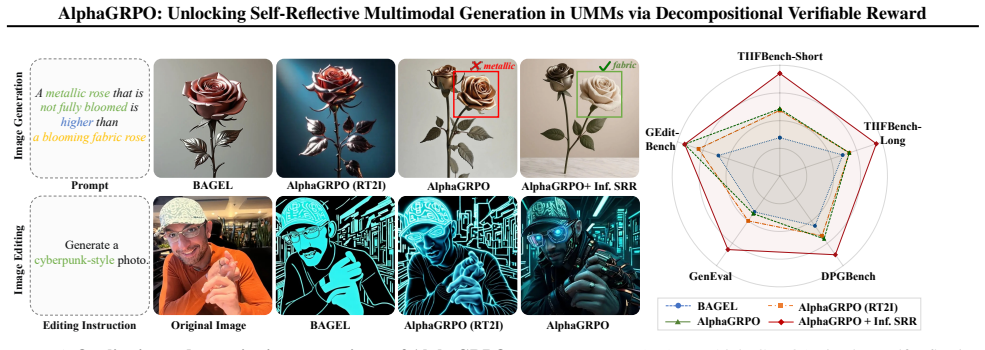
In this paper, we propose AlphaGRPO, a novel framework that applies Group Relative Policy Optimization (GRPO) to AR-Diffusion Unified Multimodal Models (UMMs) to enhance multimodal generation capabilities without an additional cold-start stage. Our approach unlocks the model's intrinsic potential to perform advanced reasoning tasks: Reasoning Text-to-Image Generation, where the model actively infers implicit user intents, and Self-Reflective Refinement, where it autonomously diagnoses and corrects misalignments in generated outputs. To address the challenge of providing stable supervision for real-world multimodal generation, we introduce the Decompositional Verifiable Reward (DVReward). Unlike holistic scalar rewards, DVReward utilizes an LLM to decompose complex user requests into atomic, verifiable semantic and quality questions, which are then evaluated by a general MLLM to provide reliable and interpretable feedback. Extensive experiments demonstrate that AlphaGRPO yields robust improvements across multimodal generation benchmarks, including GenEval, TIIF-Bench, DPG-Bench and WISE, while also achieving significant gains in editing tasks on GEdit without training on editing tasks. These results validate that our self-reflective reinforcement approach effectively leverages inherent understanding to guide high-fidelity generation. Project page: https://huangrh99.github.io/AlphaGRPO/
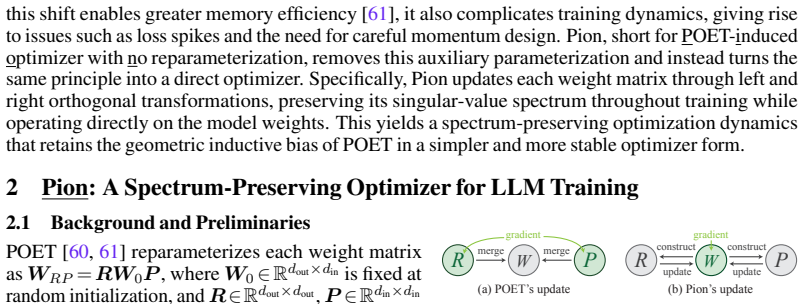
We introduce Pion, a spectrum-preserving optimizer for large language model (LLM) training based on orthogonal equivalence transformation. Unlike additive optimizers such as Adam and Muon, Pion updates each weight matrix through left and right orthogonal transformations, preserving its singular values throughout training. This yields an optimization mechanism that modulates the geometry of weight matrices while keeping their spectral norm fixed. We derive the Pion update rule, systematically examine its design choices, and analyze its convergence behavior along with several key properties. Empirical results show that Pion offers a stable and competitive alternative to standard optimizers for both LLM pretraining and finetuning.
Long-term memory is crucial for agents in specialized web environments, where success depends on recalling interface affordances, state dynamics, workflows, and recurring failure modes. However, existing memory benchmarks for agents mostly focus on user histories, short traces, or downstream task success, leaving open how to directly evaluate whether memory systems effectively internalize environment-specific experience. To address this gap, we introduce LongMemEval-V2 (LME-V2), a benchmark for evaluating whether memory systems can help agents acquire the experience needed to become knowledgeable colleagues in customized environments. LME-V2 contains 451 manually curated questions covering five core memory abilities for web agents: static state recall, dynamic state tracking, workflow knowledge, environment gotchas, and premise awareness. Questions are paired with history trajectories containing up to 500 trajectories and 115M tokens. We use a context gathering formulation: memory systems consume history trajectories and return compact evidence for downstream question answering. We propose a suite of two memory methods: AgentRunbook-R, an efficient RAG-based memory with knowledge pools for raw state observations, events, and strategy notes, and AgentRunbook-C, which stores trajectories as files and invokes a coding agent to gather evidence in an augmented sandbox. Experiments show that AgentRunbook-C achieves the best performance with 72.5% average accuracy, outperforming the strongest RAG baseline (48.5%) and the off-the-shelf coding agent baseline (69.3%). Despite the strong performance gains, coding agent based methods have high latency costs. While AgentRunbook-C advances the accuracy-latency Pareto frontier, substantial room for improvement remains. Together, these results establish LME-V2 as a challenging testbed for developing long-term memory systems for environment experience.
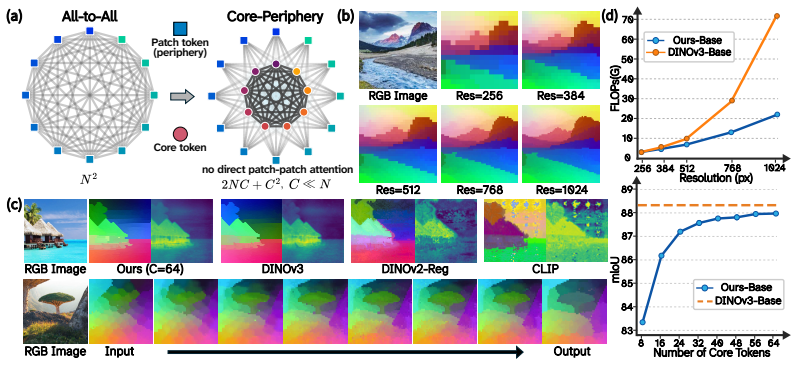
Vision Transformers (ViTs) achieve strong data-driven scaling by leveraging all-to-all self-attention. However, this flexibility incurs a computational cost that scales quadratically with image resolution, limiting ViTs in high-resolution domains. Underlying this approach is the assumption that pairwise token interactions are necessary for learning rich visual-semantic representations. In this work, we challenge this assumption, demonstrating that effective visual representations can be learned without any direct patch-to-patch interaction. We propose VECA (Visual Elastic Core Attention), a vision transformer architecture that uses efficient linear-time core-periphery structured attention enabled by a small set of learned cores. In VECA, these cores act as a communication interface: patch tokens exchange information exclusively through the core tokens, which are initialized from scratch and propagated across layers. Because the $N$ image patches only directly interact with a resolution invariant set of $C$ learned "core" embeddings, this yields linear complexity $O(N)$ for predetermined $C$, which bypasses quadratic scaling. Compared to prior cross-attention architectures, VECA maintains and iteratively updates the full set of $N$ input tokens, avoiding a small $C$-way bottleneck. Combined with nested training along the core axis, our model can elastically trade off compute and accuracy during inference. Across classification and dense tasks, VECA achieves performance competitive with the latest vision foundation models while reducing computational cost. Our results establish elastic core-periphery attention as a scalable alternative building block for Vision Transformers.
We explore the effectiveness of an LLM-guided query refinement paradigm for extending the usability of embedding models to challenging zero-shot search and classification tasks. Our approach refines the embedding representation of a user query using feedback from a generative LLM on a small set of documents, enabling embeddings to adapt in real time to the target task. We conduct extensive experiments with state-of-the-art text embedding models across a diverse set of challenging search and classification benchmarks. Empirical results indicate that LLM-guided query refinement yields consistent gains across all models and datasets, with relative improvements of up to +25% in literature search, intent detection, key-point matching, and nuanced query-instruction following. The refined queries improve ranking quality and induce clearer binary separation across the corpus, enabling the embedding space to better reflect the nuanced, task-specific constraints of each ad-hoc user query. Importantly, this expands the range of practical settings in which embedding models can be effectively deployed, making them a compelling alternative when costly LLM pipelines are not viable at corpus-scale. We release our experimental code for reproducibility, at https://github.com/IBM/task-aware-embedding-refinement.
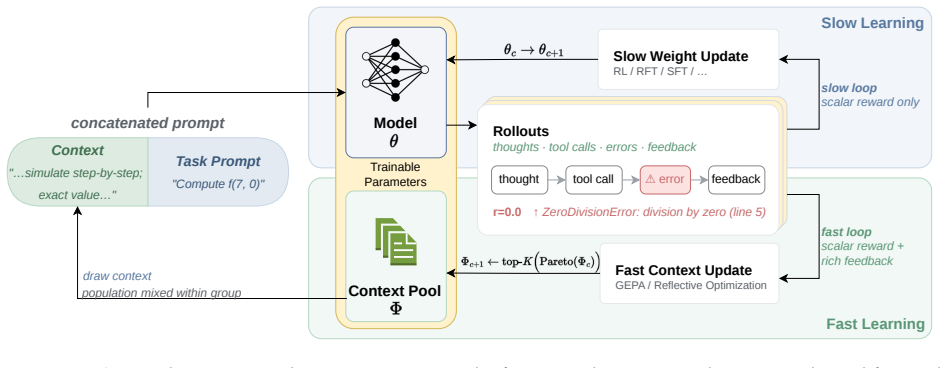
Large language models (LLMs) are trained for downstream tasks by updating their parameters (e.g., via RL). However, updating parameters forces them to absorb task-specific information, which can result in catastrophic forgetting and loss of plasticity. In contrast, in-context learning with fixed LLM parameters can cheaply and rapidly adapt to task-specific requirements (e.g., prompt optimization), but cannot by itself typically match the performance gains available through updating LLM parameters. There is no good reason for restricting learning to being in-context or in-weights. Moreover, humans also likely learn at different time scales (e.g., System 1 vs 2). To this end, we introduce a fast-slow learning framework for LLMs, with model parameters as "slow" weights and optimized context as "fast" weights. These fast "weights" can learn from textual feedback to absorb the task-specific information, while allowing slow weights to stay closer to the base model and persist general reasoning behaviors. Fast-Slow Training (FST) is up to 3x more sample-efficient than only slow learning (RL) across reasoning tasks, while consistently reaching a higher performance asymptote. Moreover, FST-trained models remain closer to the base LLM (up to 70% less KL divergence), resulting in less catastrophic forgetting than RL-training. This reduced drift also preserves plasticity: after training on one task, FST trained models adapt more effectively to a subsequent task than parameter-only trained models. In continual learning scenarios, where task domains change on the fly, FST continues to acquire each new task while parameter-only RL stalls.
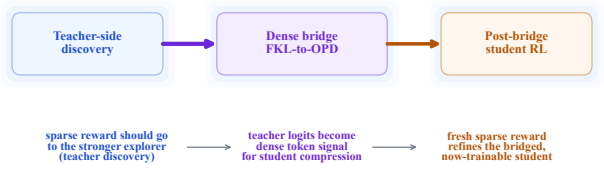
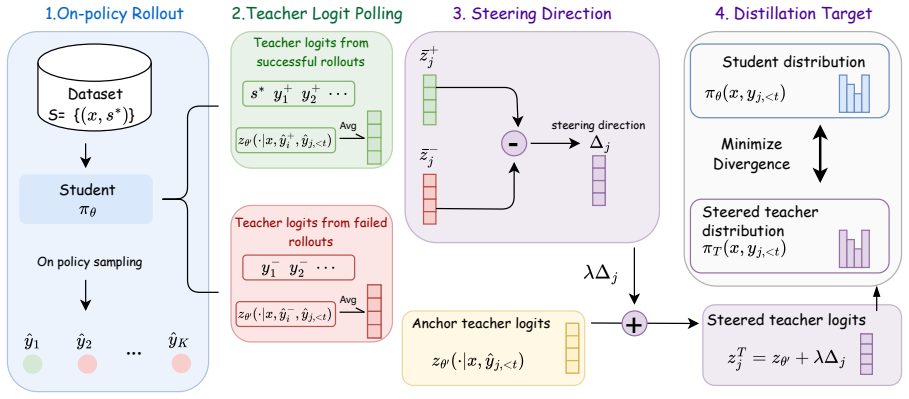
In settings where labeled verifiable training data is the binding constraint, each checked example should be allocated carefully. The standard practice is to use this data directly on the model that will be deployed, for example by running GRPO on the deployment student. We argue that this is often an inefficient allocation because it overlooks a reward-density principle: sparse sequence-level reward should train models where exploration is productive, while dense token-level teacher reward should be used where the aim is to compress behavior into a smaller model. In this view, GRPO-style sparse RL and OPD-style dense teacher supervision are not separate recipes; they are different reward-density regimes. The allocation rule is simple: use scarce labeled training data upstream on the strongest model that can turn it into reward-shaped behavior, then transfer that behavior downstream as dense supervision. We evaluate this rule on verifiable math with Qwen3 and Llama models. At fixed Qwen3-1.7B deployment-student size, an RL-improved 8B teacher distilled through the dense bridge outperforms direct GRPO on the same student, while transfer from the same teacher before RL underperforms. The bridge is important: a forward-KL warmup on teacher rollouts followed by OPD on student rollouts is consistently strongest on MATH before any post-bridge student-side sparse RL, and also gives the best pre-Stage~3 AIME endpoints for the canonical 8B/14B teachers. The bridge also makes later student-side sparse RL effective: GRPO that is weak on a cold student lifts MATH from $75.4\%$ to $78.5\%$ after the bridge and outperforms a matched replay control by $2.8$ points. The operational principal is to avoid using scarce labeled data on the least prepared policy: use sparse reward for teacher-side discovery, dense transfer for student compression, and student-side sparse reward only after the bridge.
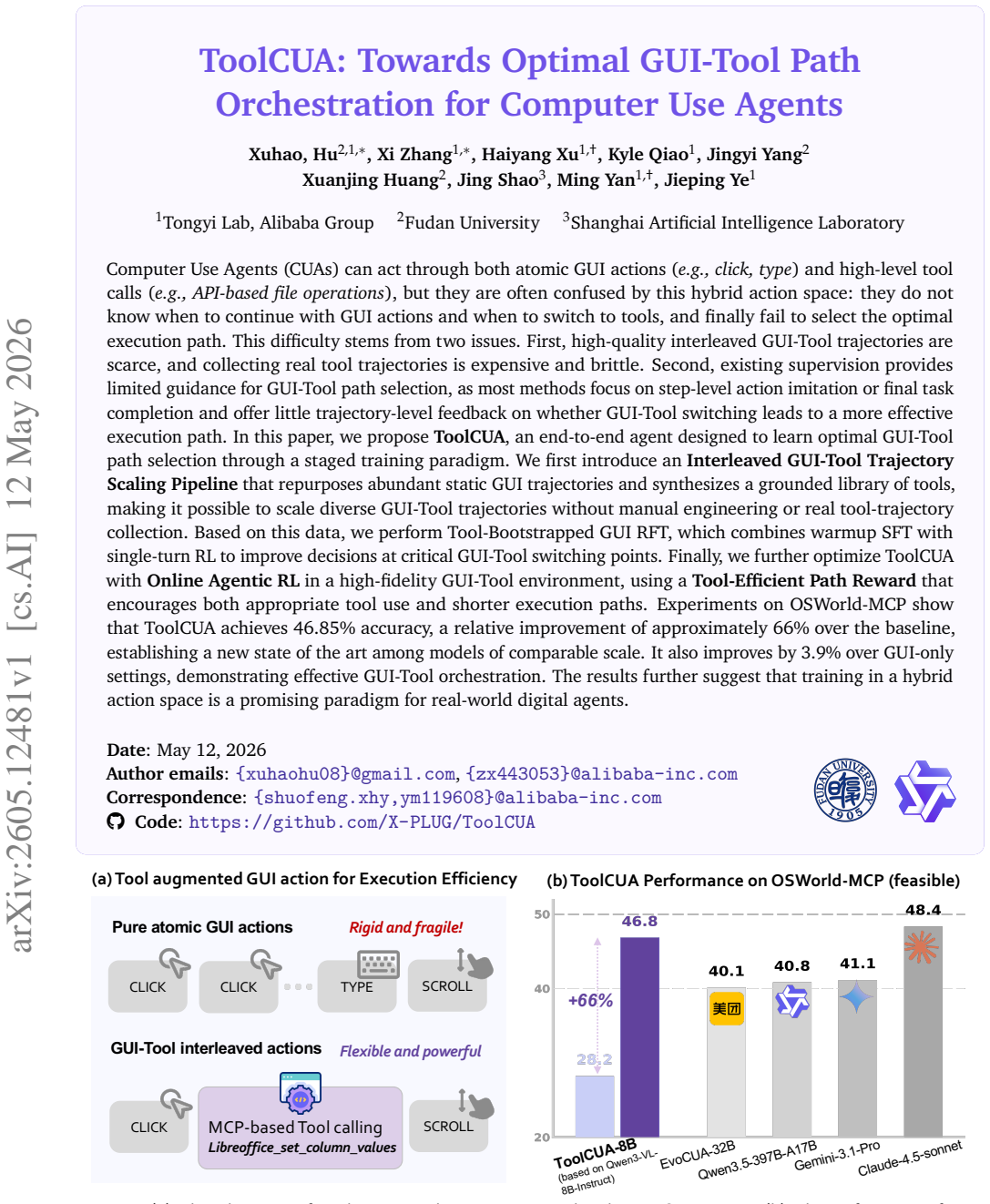
Computer Use Agents (CUAs) can act through both atomic GUI actions, such as click and type, and high-level tool calls, such as API-based file operations, but this hybrid action space often leaves them uncertain about when to continue with GUI actions or switch to tools, leading to suboptimal execution paths. This difficulty stems from the scarcity of high-quality interleaved GUI-Tool trajectories, the cost and brittleness of collecting real tool trajectories, and the lack of trajectory-level supervision for GUI-Tool path selection. In this paper, we propose ToolCUA, an end-to-end agent designed to learn optimal GUI-Tool path selection through a staged training paradigm. We first introduce an Interleaved GUI-Tool Trajectory Scaling Pipeline that repurposes abundant static GUI trajectories and synthesizes a grounded tool library, enabling diverse GUI-Tool trajectories without manual engineering or real tool-trajectory collection. We then perform Tool-Bootstrapped GUI RFT, combining warmup SFT with single-turn RL to improve decisions at critical GUI-Tool switching points. Finally, we optimize ToolCUA with Online Agentic RL in a high-fidelity GUI-Tool environment, guided by a Tool-Efficient Path Reward that encourages appropriate tool use and shorter execution paths. Experiments on OSWorld-MCP show that ToolCUA achieves 46.85% accuracy, a relative improvement of approximately 66% over the baseline, establishing a new state of the art among models of comparable scale. It also improves by 3.9% over GUI-only settings, demonstrating effective GUI-Tool orchestration. The results further suggest that training in a hybrid action space is a promising paradigm for real-world digital agents. Open-sourced here: https://x-plug.github.io/ToolCUA/
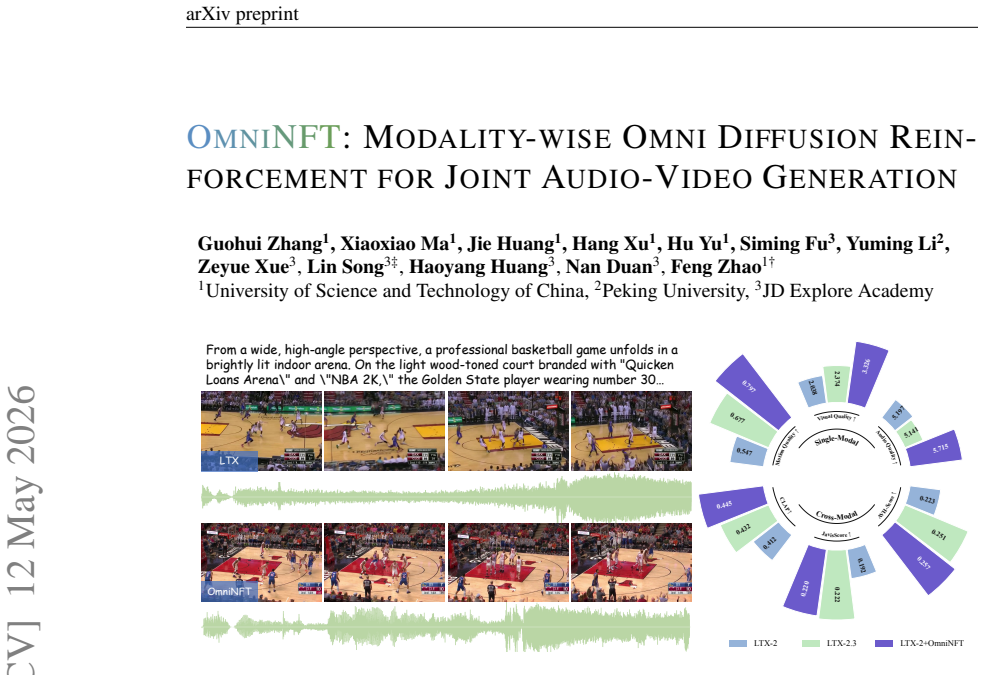
Recent advances in joint audio-video generation have been remarkable, yet real-world applications demand strong per-modality fidelity, cross-modal alignment, and fine-grained synchronization. Reinforcement Learning (RL) offers a promising paradigm, but its extension to multi-objective and multi-modal joint audio-video generation remains unexplored. Notably, our in-depth analysis first reveals that the primary obstacles to applying RL in this stem from: (i) multi-objective advantages inconsistency, where the advantages of multimodal outputs are not always consistent within a group; (ii) multi-modal gradients imbalance, where video-branch gradients leak into shallow audio layers responsible for intra-modal generation; (iii) uniform credit assignment, where fine-grained cross-modal alignment regions fail to get efficient exploration. These shortcomings suggest that vanilla RL fine-tuning strategy with a single global advantage often leads to suboptimal results. To address these challenges, we propose OmniNFT, a novel modality-aware online diffusion RL framework with three key innovations: (1) Modality-wise advantage routing, which routes independent per-reward advantages to their respective modality generation branches. (2) Layer-wise gradient surgery, which selectively detaches video-branch gradients on shallow audio layers while retaining those for cross-modal interaction layers. (3) Region-wise loss reweighting, which modulates policy optimization toward critical regions related to audio-video synchronization and fine-grained alignment. Extensive experiments on JavisBench and VBench with the LTX-2 backbone demonstrate that OmniNFT achieves comprehensive improvements in audio and video perceptual quality, cross-modal alignment, and audio-video synchronization.
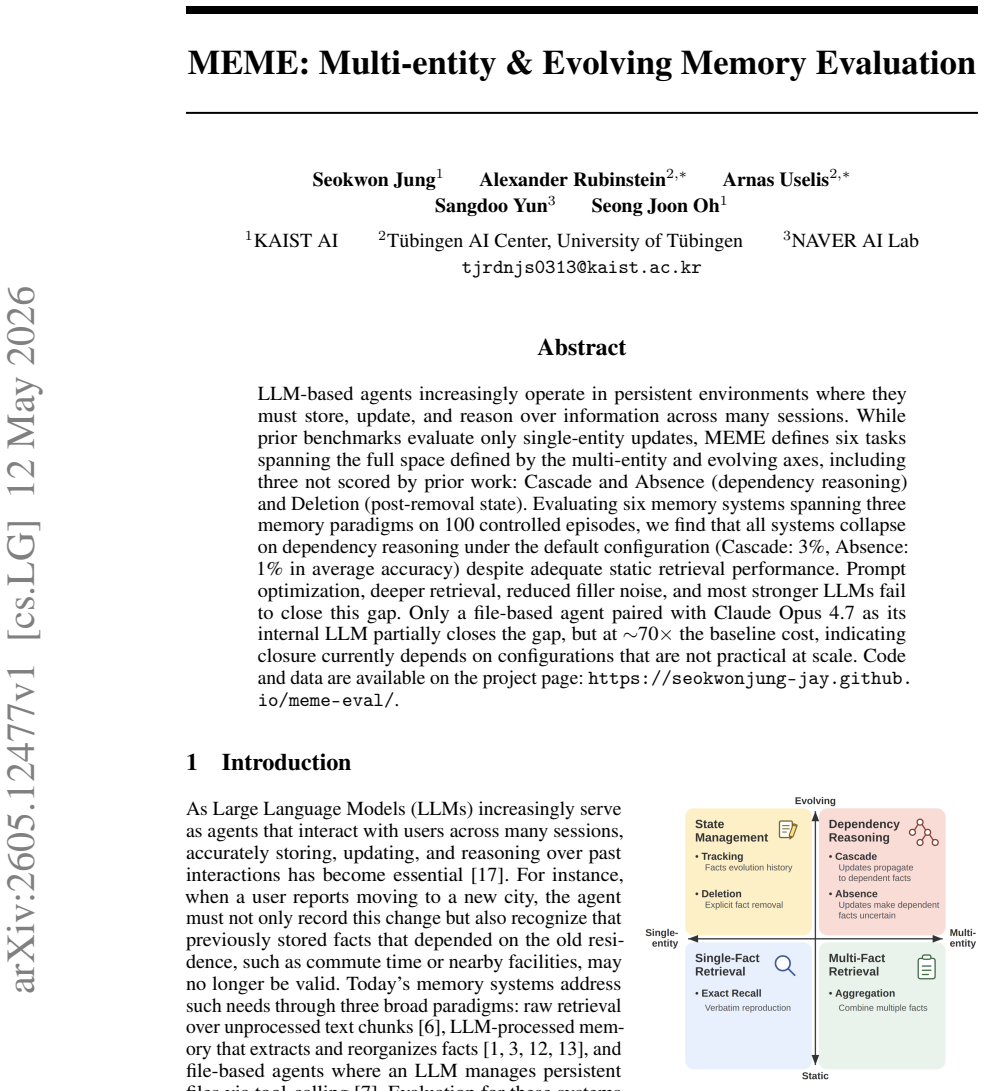
LLM-based agents increasingly operate in persistent environments where they must store, update, and reason over information across many sessions. While prior benchmarks evaluate only single-entity updates, MEME defines six tasks spanning the full space defined by the multi-entity and evolving axes, including three not scored by prior work: Cascade and Absence (dependency reasoning) and Deletion (post-removal state). Evaluating six memory systems spanning three memory paradigms on 100 controlled episodes, we find that all systems collapse on dependency reasoning under the default configuration (Cascade: 3%, Absence: 1% in average accuracy) despite adequate static retrieval performance. Prompt optimization, deeper retrieval, reduced filler noise, and most stronger LLMs fail to close this gap. Only a file-based agent paired with Claude Opus 4.7 as its internal LLM partially closes the gap, but at ~70x the baseline cost, indicating closure currently depends on configurations that are not practical at scale. Code and data are available on the project page: https://seokwonjung-jay.github.io/meme-eval/.
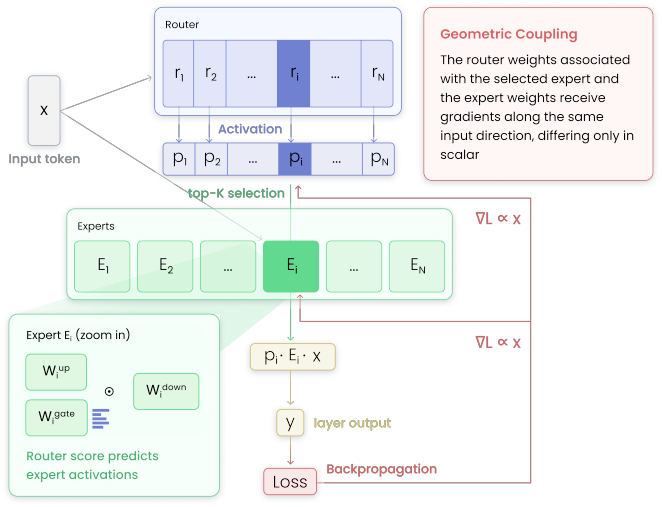
Sparse Mixture-of-Experts (SMoE) models enable scaling language models efficiently, but training them remains challenging, as routing can collapse onto few experts and auxiliary load-balancing losses can reduce specialization. Motivated by these hurdles, we study how routing decisions in SMoEs are formed mechanistically. First, we reveal a geometric coupling between routers and their corresponding experts. For a given token, the router weights for the selected expert and the expert weights processing it receive gradients along the same input direction, differing only in scalar coefficients. Thus, matched router--expert directions accumulate the same routed token history. This theoretical coupling also appears empirically in routing dynamics. In a $1$B SMoE trained from scratch, higher router scores predict stronger expert neuron activations, showing that routing decisions are mirrored inside the selected expert. Next, we analyze the effects of auxiliary load balancing on the router--expert geometric coupling, showing that such losses break this structure by spreading input-directed gradients across router weights, making distinct router directions nearly three times more similar to each other. Last, we demonstrate the centrality of geometric coupling for effective routing with a parameter-free online K-Means router, in which each expert maintains a running average of the hidden states routed to it and tokens are assigned based on cosine similarity. Compared with auxiliary-loss and loss-free balancing, this router achieves the lowest load imbalance with only a modest perplexity increase, indicating that geometric coupling captures a substantial part of what the router learns. Overall, our results explain how routers form assignment geometry that supports an effective division of labor.
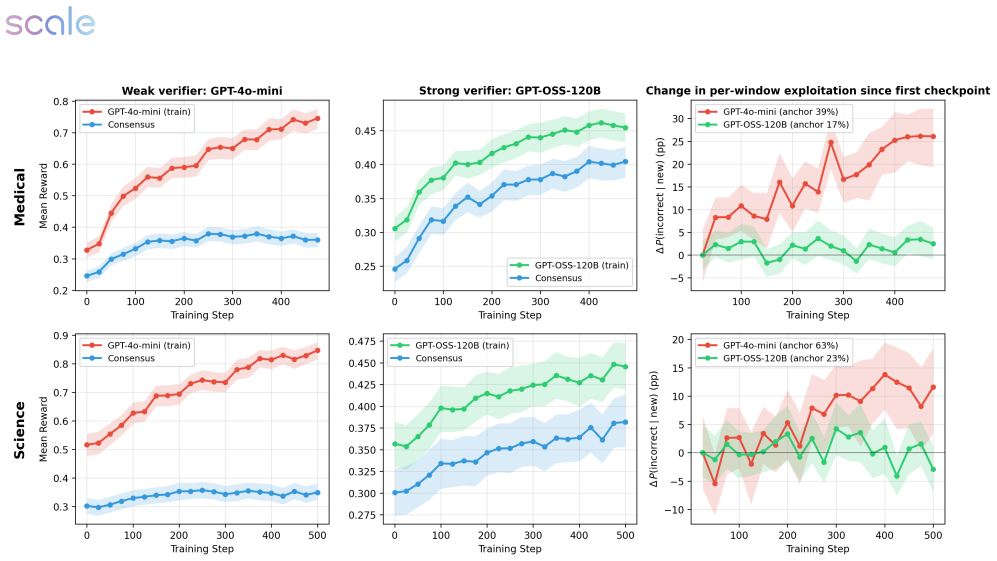
Reinforcement learning with verifiable rewards has enabled strong post-training gains in domains such as math and coding, though many open-ended settings rely on rubric-based rewards. We study reward hacking in rubric-based RL, where a policy is optimized against a training verifier but evaluated against a cross-family panel of three frontier judges, reducing dependence on any single evaluator. Our framework separates two sources of divergence: verifier failure, where the training verifier credits rubric criteria that reference verifiers reject, and rubric-design limitations, where even strong rubric-based verifiers favor responses that rubric-free judges rate worse overall. Across medical and science domains, weak verifiers produce large proxy-reward gains that do not transfer to the reference verifiers; exploitation grows over training and concentrates in recurring failures such as partial satisfaction of compound criteria, treating implicit content as explicit, and imprecise topical matching. Stronger verifiers substantially reduce, but do not eliminate, verifier exploitation. We also introduce a self-internalization gap, a verifier-free diagnostic based on policy log-probabilities, which tracks reference-verifier quality, detecting when the policy trained using the weak verifier stops improving. Finally, in our setting, stronger verification does not prevent reward hacking when the rubric leaves important failure modes unspecified: rubric-based verifiers prefer the RL checkpoint, while rubric-free judges prefer the base model. These disagreements coincide with gains concentrated in completeness and presence-based criteria, alongside declines in factual correctness, conciseness, relevance, and overall quality. Together, these results suggest that stronger verification reduces reward hacking, but does not by itself ensure that rubric gains correspond to broader quality gains.
The capacity-achieving input distribution for the binomial channel must have support size at least order sqrt(n log log n).
abstractclick to expand
We study the binomial channel and the structure of its capacity-achieving input and output distributions. It is known that the capacity-achieving input distribution is discrete and supported on finitely many points. The best previously known bounds show that the support size of the capacity-achieving distribution is lower-bounded by a term of order $\sqrt n$ and upper-bounded by a term of order $n/2$, where $n$ is the number of trials.
In this work, we derive a new lower bound on the support size of order $\sqrt{n\log\log n}$, up to explicit constants. The proof consists of three main steps. First, we derive new upper and lower bounds on the capacity with a gap that vanishes as $n\to\infty$, which yields $C(n)=\frac12\log\frac{n\pi}{2e}+o(1)$. Second, we show that the Beta-binomial output distribution induced by the reference input $X_r\sim\mathrm{Beta}(1/2,1/2)$ is asymptotically optimal: it approaches the capacity-achieving output distribution in relative entropy and, after a comparison step, in $\chi^2$ divergence. Third, we prove a quantitative $\chi^2$ approximation lower bound showing that this Beta-binomial output cannot be approximated too well by the output induced by a $K$-point input. Combining these ingredients forces the capacity-achieving input distribution to have at least order $\sqrt{n\log\log n}$ mass points.
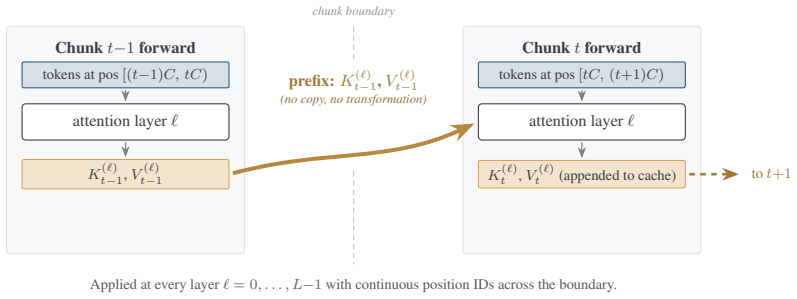
We introduce KV-Fold, a simple, training-free long-context inference protocol that treats the key-value (KV) cache as the accumulator in a left fold over sequence chunks. At each step, the model processes the next chunk conditioned on the accumulated cache, appends the newly produced keys and values, and passes the enlarged cache forward; the same one-step update is applied repeatedly, analogous to foldl in functional programming. Building on the KV cache concatenation primitive introduced for latent multi-agent communication, we repurpose it as a chunk-to-chunk recurrence for long-context inference. When processing chunk t, the model attends to the KV cache carried from earlier chunks as a prefix, reusing its internal state across segments without modifying or retraining the model. Despite its simplicity, the induced recurrence is stable: per-step drift rises briefly and then saturates into a flat plateau that persists across deep chains. This plateau is insensitive to a 10,000x change in numerical precision, robust across chunk sizes, and consistent across model families. At the task level, KV-Fold preserves exact information over long distances. On a needle-in-a-haystack benchmark, it achieves 100% exact-match retrieval across 152 trials spanning contexts from 16K to 128K tokens and chain depths up to 511 on Llama-3.1-8B, while remaining within the memory limits of a single 40GB GPU. Compared to streaming methods, which trade fidelity for bounded memory, KV-Fold maintains long-range retrieval while operating as a sequence of tractable forward passes. Overall, our results show that frozen pretrained transformers already support a stable form of KV-cache recurrence, providing a practical route to long-context inference without architectural changes or training.
Fixed-point solving keeps training memory constant while letting small models reach over 90 percent accuracy on hard reasoning tasks.
abstractclick to expand
Looped Transformers offer a promising alternative to purely feed-forward computation by iteratively refining latent representations, improving language modeling and reasoning. Yet recurrent architectures remain unstable to train, costly to optimize and deploy, and constrained to small, fixed recurrence depths. We introduce Attractor Models, in which a backbone module first proposes output embeddings, then an attractor module refines them by solving for the fixed point, with gradients obtained through implicit differentiation. Thus, training memory remains constant in effective depth, and iterations are chosen adaptively by convergence. Empirically, Attractor Models outperform existing models across two regimes, large-scale language-model pretraining and reasoning with tiny models. In language modeling, Attractor Models deliver a Pareto improvement over standard Transformers and stable looped models across sizes, improving perplexity by up to 46.6% and downstream accuracy by up to 19.7% while reducing training cost. Notably, a 770M Attractor Model outperforms a 1.3B Transformer trained on twice as many tokens. On challenging reasoning tasks, we show that our model with only 27M parameters and approximately 1000 examples achieves 91.4% accuracy on Sudoku-Extreme and 93.1% on Maze-Hard, scaling favorably where frontier models like Claude and GPT o3, fail completely, and specialized recursive reasoners collapse at larger sizes. Lastly, we show that Attractor Models exhibit a novel phenomenon, which we call equilibrium internalization: fixed-point training places the model's initial output embedding near equilibrium, allowing the solver to be removed at inference time with little degradation. Together, these results suggest that Attractor Models make iterative refinement scalable by turning recurrence into a computation the model can learn to internalize.
A non-trivial-quality high-arity sample compression scheme guarantees that the concept class is PAC learnable over product spaces.
abstractclick to expand
Recently, a series of works have started studying variations of concepts from learning theory for product spaces, which can be collected under the name high-arity learning theory. In this work, we consider a high-arity variant of sample compression schemes and we prove that the existence of a high-arity sample compression scheme of non-trivial quality implies high-arity PAC learnability.
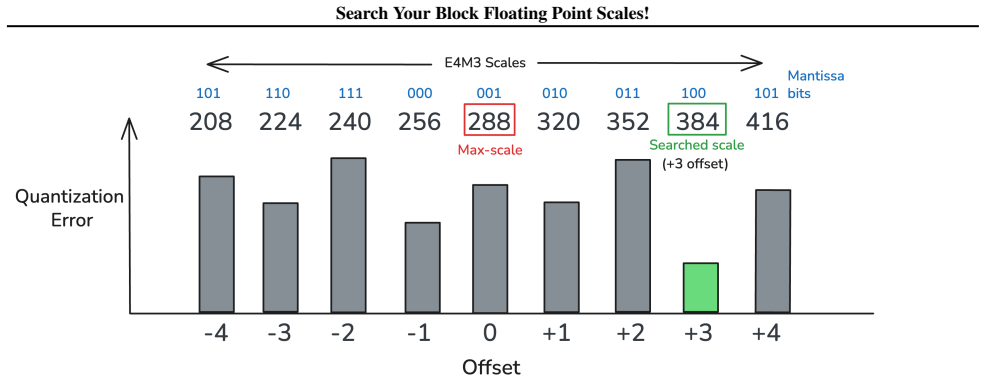
Quantization has emerged as a standard technique for accelerating inference for generative models by enabling faster low-precision computations and reduced memory transfers. Recently, GPU accelerators have added first-class support for microscaling Block Floating Point (BFP) formats. Standard BFP algorithms use a fixed scale based on the maximum magnitude of the block. We observe that this scale choice can be suboptimal with respect to quantization errors. In this work, we propose ScaleSearch, an alternative strategy for selecting these scale factors: using a fine-grained search leveraging the mantissa bits in microscaling formats to minimize the quantization error for the given distribution. ScaleSearch can be integrated with existing quantization methods such as Post Training Quantization and low-precision attention, and is shown to improve their performance. Additionally, we introduce ScaleSearchAttention, an accelerated NVFP4-based attention algorithm, which uses ScaleSearch and adapted prior techniques to ensure near-0 performance loss for causal language modeling. Experiments show that ScaleSearch reduces quantization error by 27% for NVFP4 and improves language model PTQ by up to 15 points for MATH500 (Qwen3-8B), while ScaleSearchAttention improves Wikitext-2 PPL by upto 0.77 points for Llama 3.1 70B. The proposed methods closely match baseline performance while providing quantization accuracy improvements.
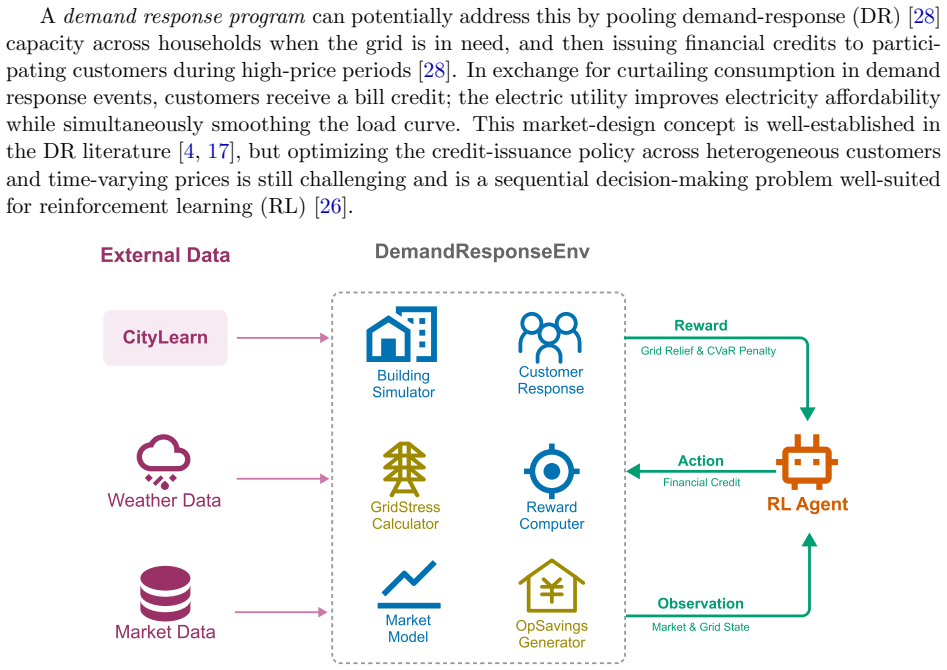
Extreme weather and volatile wholesale electricity markets expose residential consumers to catastrophic financial risks, yet demand response at the distribution level remains an underutilized tool for grid flexibility and energy affordability. While a demand-response program can shield consumers by issuing financial credits during high-price periods, optimizing this sequential decision-making process presents a unique challenge for reinforcement learning despite the plentiful offline historical smart meter and wholesale pricing data available publicly. Offline historical data fails to capture the dynamic, interactive feedback loop between an electric utility's pricing signals and customer acceptance and adaptation to a demand-response program. To address this, we introduce DR-Gym, an open-source, online Gymnasium-compatible environment designed to train and evaluate demand-response from the electric utility's perspective. Unlike existing device-level energy simulators, our environment focuses on the market-level electric utility setting and provides a rich observational space relevant to the electric utility. The simulator additionally features a regime-switching wholesale price model calibrated to real-world extreme events, alongside physics-based building demand profiles. For our learning signal, we use a configurable, multi-objective reward function for specifying diverse learning objectives. We demonstrate through baseline strategies and data snapshots the capability of our simulator to create realistic and learnable environments.
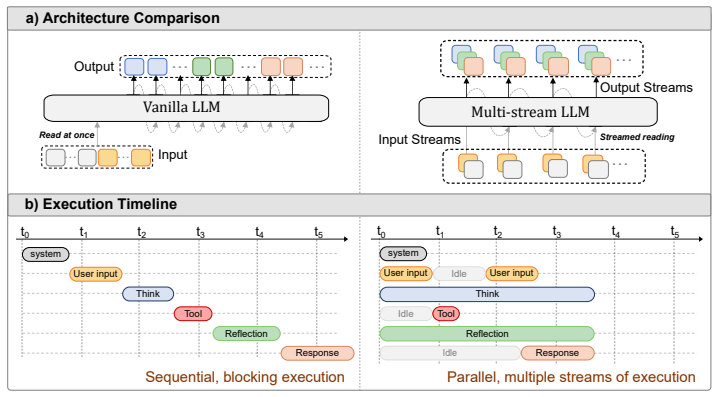
The continued improvements in language model capability have unlocked their widespread use as drivers of autonomous agents, for example in coding or computer use applications. However, the core of these systems has not changed much since early instruction-tuned models like ChatGPT. Even advanced AI agents function on message exchange formats, successively exchanging messages with users, systems, with itself (i.e. chain-of-thought) and tools in a single stream of computation. This bottleneck to a single stream in chat models leads to a number of limitations: the agent cannot act (generate output) while reading, and in reverse, cannot react to new information while writing. Similarly, the agent cannot act while thinking and cannot think while reading or acting on information.
In this work, we show that models can be unblocked by switching from instruction-tuning for sequential message formats to instruction-tuning for multiple, parallel streams of computation, splitting each role into a separate stream. Every forward pass of the language model then simultaneously reads from multiple input streams and generates tokens in multiple output streams, all of which causally depend on earlier timesteps. We argue that this data-driven change remedies a number of usability limitations as outlined above, improves model efficiency through parallelization, improves model security through better separation of concerns and can further improve model monitorability.
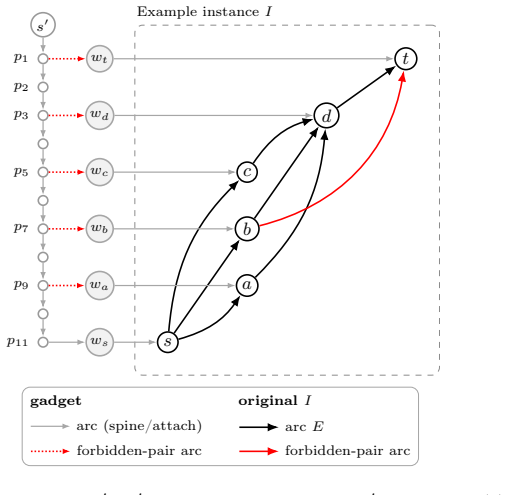
The Path Avoiding Forbidden Pairs problem (PAFP) asks whether, in a directed graph $G$ with terminals $s,t$ and a set $\mathcal{F}$ of forbidden vertex pairs, there is an $s$-$t$ path that contains at most one endpoint from each forbidden pair. We initiate the study of PAFP through a layer-based width measure. Our first focus is the union digraph $G\cup\mathcal{F}$, obtained by adding to $G$ one arc per forbidden pair, oriented according to a fixed reachability-compatible order. Let the BFS layer $L_d$ be all vertices at directed shortest-path distance $d$ from $s$, where the BFS-width from $s$ is $\max_d |L_d|$. We show if $G\cup\mathcal{F}$ has BFS-width $b$ from $s$ and only $\beta$ arcs going from a later BFS layer to an earlier one, then PAFP is FPT parameterized by $b+\beta$. The backward-arc hypothesis is essential: we show PAFP remains NP-complete when the union digraph is a DAG with BFS-width 2.
We also show if the input DAG has BFS-width at most $2$ and only $k$ backward input arcs, then PAFP can be decided in $2^k |I|^{O(1)}$ time, with unrestricted forbidden pairs. This width-$2$ result is tight: inspection of a classical reduction shows NP-completeness on input DAGs of BFS-width $3$ with no backward input arcs.
Moreover, we study exact-length layers in the input graph, where the $d$-th layer consists of the vertices reachable from $s$ by a directed path of length exactly $d$. For DAGs of exact-length width at most $2$, we show PAFP is polynomial-time decidable by a 2-SAT encoding of fixed-length paths. This bound is tight: the same classical reduction yields NP-completeness on DAGs of exact-length width $3$. Unlike previously known polynomial-time regimes for PAFP, which restrict the forbidden-pair set in order to obtain tractability, our two input-graph tractability results allow unrestricted forbidden pairs and input graphs with exponentially many $s$-$t$ paths.
Dual-key sampling and localized scoring keep quality intact while flagging origins even after heavy blending or reuse.
abstractclick to expand
We introduce TextSeal, a state-of-the-art watermark for large language models. Building on Gumbel-max sampling, TextSeal introduces dual-key generation to restore output diversity, along with entropy-weighted scoring and multi-region localization for improved detection. It supports serving optimizations such as speculative decoding and multi-token prediction, and does not add any inference overhead. TextSeal strictly dominates baselines like SynthID-text in detection strength and is robust to dilution, maintaining confident localized detection even in heavily mixed human/AI documents. The scheme is theoretically distortion-free, and evaluation across reasoning benchmarks confirms that it preserves downstream performance; while a multilingual human evaluation (6000 A/B comparisons, 5 languages) shows no perceptible quality difference. Beyond its use for provenance detection, TextSeal is also ``radioactive'': its watermark signal transfers through model distillation, enabling detection of unauthorized use.
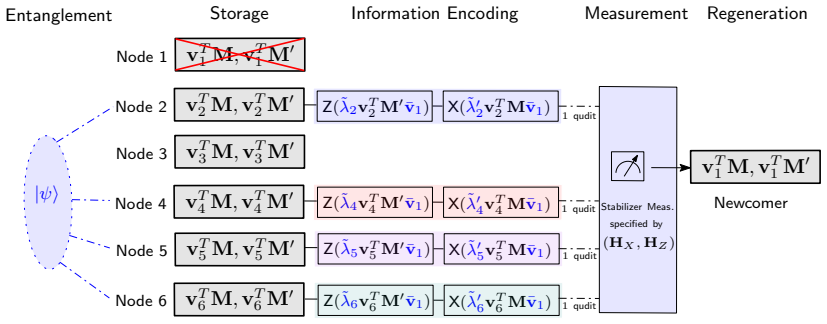
We study exact-regenerating codes for entanglement-assisted distributed storage systems. Consider an $(n,k,d,\alpha,\beta_{\mathsf{q}},B)$ distributed system that stores a file of $B$ classical symbols across $n$ nodes with each node storing $\alpha$ symbols. A data collector can recover the file by accessing any $k$ nodes. When a node fails, any $d$ surviving nodes share an entangled state, and each of them transmits a quantum system of $\beta_{\mathsf{q}}$ qudits to a newcomer. The newcomer then performs a measurement on the received quantum systems to generate its storage. Recent work [1] showed that, under functional repair where the regenerated content may differ from that of the failed node, there exists a unique optimal regenerating point that \emph{simultaneously minimizes both storage $\alpha$ and repair bandwidth $d \beta_{\mathsf{q}}$} when $d \geq 2k-2$. In this paper, we show that, under \emph{exact repair}, where the newcomer reproduces exactly the same content as the failed node, this optimal point remains achievable. Our construction builds on the classical product-matrix framework and the Calderbank-Shor-Steane (CSS)-based stabilizer formalism.
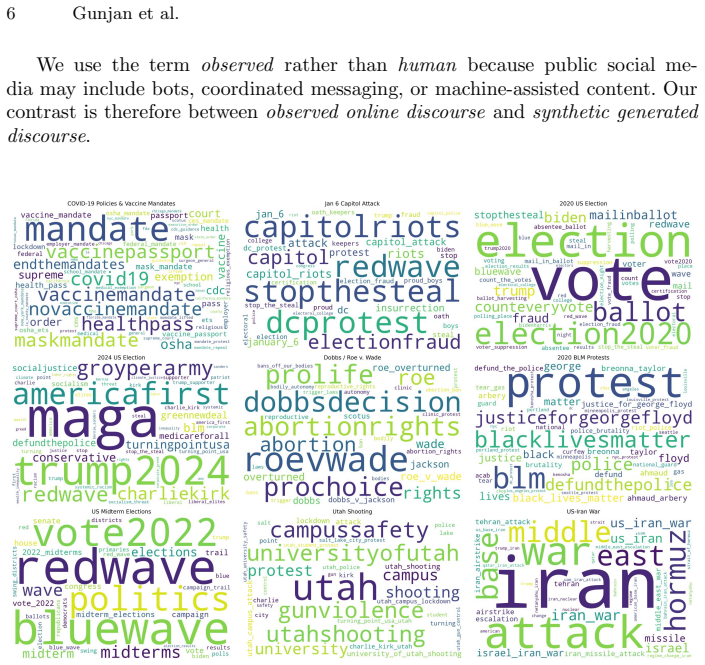
Large Language Models (LLMs) can generate fluent political text at scale, raising concerns about synthetic discourse during crises and social conflict. Existing AI-text detection often focuses on sentence-level cues such as perplexity, burstiness, or token irregularities, but these signals may weaken as generative systems improve. We instead adopt a Computational Social Science perspective and ask whether synthetic political discourse behaves like an observed online population. We construct a paired corpus of 1,789,406 posts across nine crisis events: COVID-19, the Jan. 6 Capitol attack, the 2020 and 2024 U.S. elections, Dobbs/Roe v. Wade, the 2020 BLM protests, U.S. midterms, the Utah shooting, and the U.S.-Iran war. For each event, we compare observed discourse from social platforms with synthetic discourse generated for the same context. We evaluate four dimensions: emotional intensity, structural regularity, lexical-ideological framing, and cross-event dependency, using mean gaps and dispersion evidence. Across events, synthetic discourse is fluent but population-level unrealistic. It is generally more negative and less dispersed in sentiment, structurally more regular, and lexically more abstract than observed discourse. Observed discourse instead shows broader emotional variation, longer-tailed structural distributions, and more context-specific, colloquial lexical markers. These differences are event-dependent: larger for fast-moving, decentralized crises and smaller for formal or institutionally mediated events. We summarize them with a simple event-level measure, the Caricature Gap. Our findings suggest that the main limitation of synthetic political discourse is not grammar or fluency, but reduced population realism. Population-level auditing complements traditional text-detection and provides a CSS framework for evaluating the social realism of generated discourse.
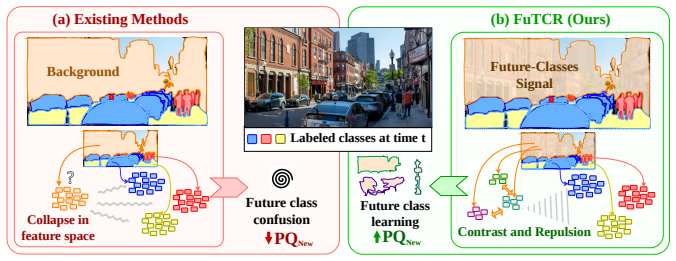
Continual Panoptic Segmentation (CPS) requires methods that can quickly adapt to new categories over time. The nature of this dense prediction task means that training images may contain a mix of labeled and unlabeled objects. As nothing is known about these unlabeled objects a priori, existing methods often simply group any unlabeled pixel into a single "background" class during training. In effect, during training, they repeatedly tell the model that all the different background categories are the same (even when they aren't). This makes learning to identify different background categories as they are added challenging since these new categories may require using information the model was previously told was unimportant and ignored. Thus, we propose a Future-Targeted Contrastive and Repulsive (FuTCR) framework that addresses this limitation by restructuring representations before new classes are introduced. FuTCR first discovers confident future-like regions by grouping model-predicted masks whose pixels are consistently classified as background but exhibit non-background logits. Next, FuTCR applies pixel-to-region contrast to build coherent prototypes from these unlabeled regions, while simultaneously repelling background features away from known-class prototypes to explicitly reserve representational space for future categories. Experiments across six CPS settings and a range of dataset sizes show FuTCR improves relative new-class panoptic quality over the state-of-the-art by up to 28%, while preserving or improving base-class performance with gains up to 4%.
A procedural pipeline and MCP integration deliver diverse OOD environments with rich ground truth for closed-loop testing.
abstractclick to expand
While self-supervised pretraining has reduced vision systems' reliance on synthetic data, simulation remains an indispensable tool for closed-loop optimization and rigorous out-of-distribution (OOD) evaluation. However, modern simulation platforms often present steep technical barriers, requiring extensive expertise in computer graphics and game development. In this work, we present LychSim, a highly controllable and interactive simulation framework built upon Unreal Engine 5 to bridge this gap. LychSim is built around three key designs: (1) a streamlined Python API that abstracts away underlying engine complexities; (2) a procedural data pipeline capable of generating diverse, high-fidelity environments with varying out-of-distribution (OOD) visual challenges, paired with rich 2D and 3D ground truths; and (3) a native integration of the Model Context Protocol (MCP) that transforms the simulator into a dynamic, closed-loop playground for reasoning agentic LLMs. We further annotate scene-level procedural rules and object-level pose alignments to enable semantically aligned 3D ground truths and automated scene modification. We demonstrate LychSim's capability across multiple downstream applications, including serving as a synthetic data engine, powering reinforcement learning-based adversarial examiners, and facilitating interactive, language-driven scene layout generation. To benefit the broader vision community, LychSim will be made publicly available, including full source code and various data annotations.
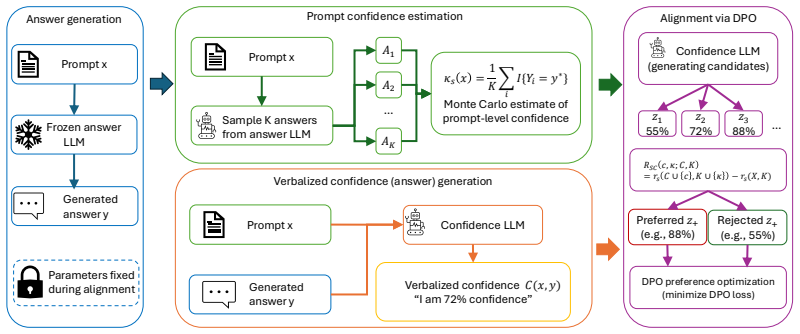
Large language models (LLMs) often produce answers with high certainty even when they are incorrect, making reliable confidence estimation essential for deployment in real-world scenarios. Verbalized confidence, where models explicitly state their confidence in natural language, provides a flexible and user-facing uncertainty signal that can be applied even when token logits are unavailable. However, existing verbalized-confidence methods often optimize answer generation and confidence generation jointly, which can cause confidence-alignment objectives to interfere with answer accuracy. In this work, we propose a decoupled and order-aware framework for verbalized confidence calibration. Our method first generates an answer and then estimates confidence conditioned on the fixed question--answer pair, allowing confidence optimization without directly perturbing the answer-generation process. To align confidence with correctness likelihood, we construct a sampling-based surrogate from multiple model completions and optimize rank-based reinforcement learning objectives that encourage responses with higher estimated correctness likelihood to receive higher verbalized confidence. Experiments on reasoning and knowledge-intensive benchmarks show that our method improves calibration and failure prediction performance while largely preserving answer accuracy. These results demonstrate that verbalized confidence can be more reliably aligned by decoupling confidence estimation from answer generation and optimizing the relative ordering of confidence across responses.
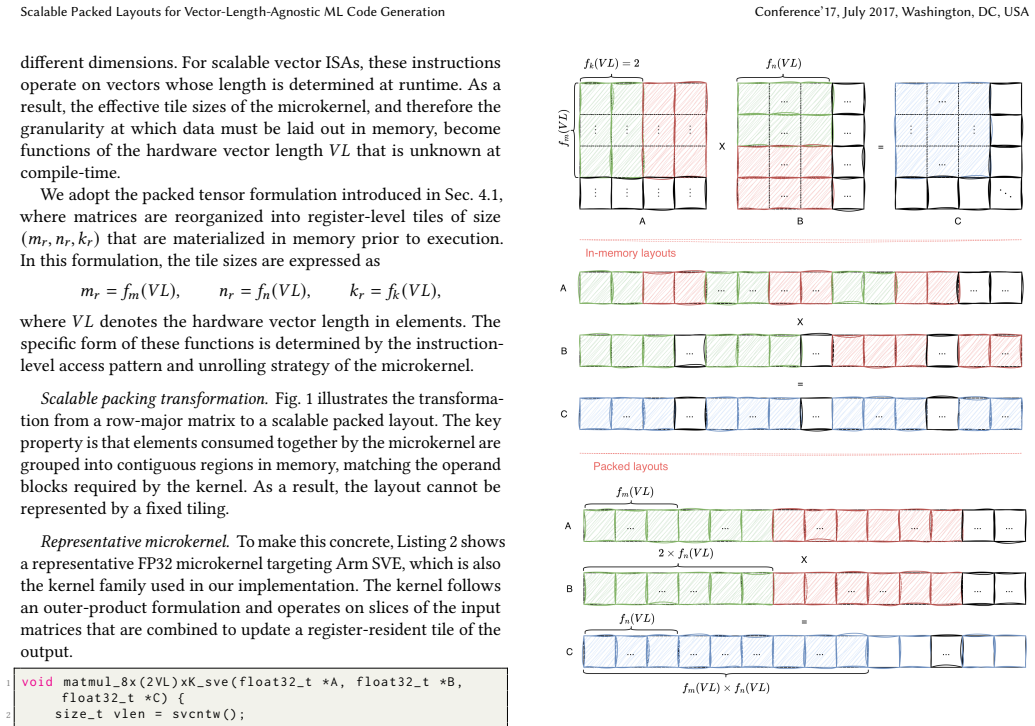
Scalable vector instruction sets such as Arm SVE enable vector-length-agnostic (VLA) execution, allowing a single implementation to adapt across hardware with different vector lengths. However, they complicate compiler code generation, as tiling and data layout decisions can no longer be fixed at compile time.
We present an approach for enabling VLA code generation in an end-to-end ML compilation pipeline through vector-length-aware packed data layouts and corresponding compiler extensions. We integrate these mechanisms into MLIR/IREE and extend tiling, fusion, and vectorization to operate with scalable vector lengths.
Evaluated on real-world ML workloads on Arm CPUs, our approach generates SVE code that is competitive with, and often outperforms, existing NEON-based code generation within IREE, achieving up to $1.45\times$ speedup. We also outperform PyTorch ecosystem frameworks, including ExecuTorch, TorchInductor, and eager execution, demonstrating the effectiveness of scalable vectorization in a production compiler setting. A simulator-based study further shows that the generated code scales with increasing SVE vector length on compute-bound workloads, supporting performance portability across hardware configurations.
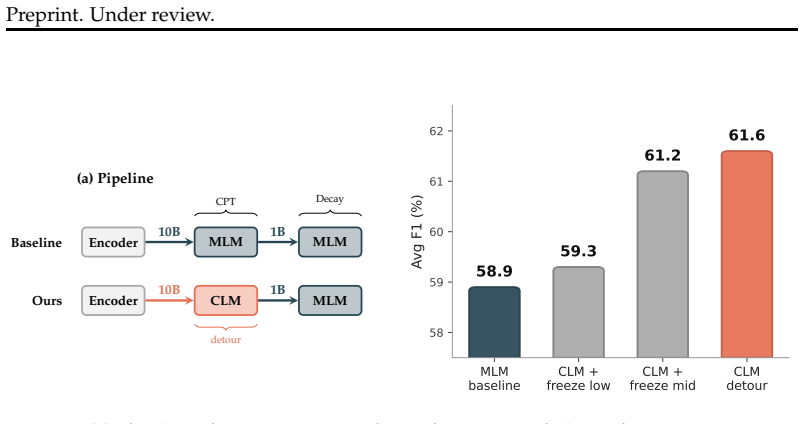
When adapting an encoder to a new domain, the standard approach is to continue training with Masked Language Modeling (MLM). We show that temporarily switching to Causal Language Modeling (CLM) followed by a short MLM decay improves downstream performance. On biomedical texts with ModernBERT, this CLM detour outperforms MLM baselines trained on identical data and compute across 8 French and 11 English biomedical tasks, by +1.2-2.8pp and +0.3-0.8pp respectively, depending on model size. We investigate the reasons for these gains. We find that CLM's dense supervision impacts low transformer layers (0-7) far more than MLM does. Freezing low layers during CLM eliminates the downstream benefit; freezing mid layers preserves it. The representational changes persist through the MLM decay phase, even when it matches the CLM phase in length, and they scale with model capacity. We release ModernCamemBERT-bio and ModernBERT-bio as state-of-the-art biomedical encoders in Base and Large sizes.
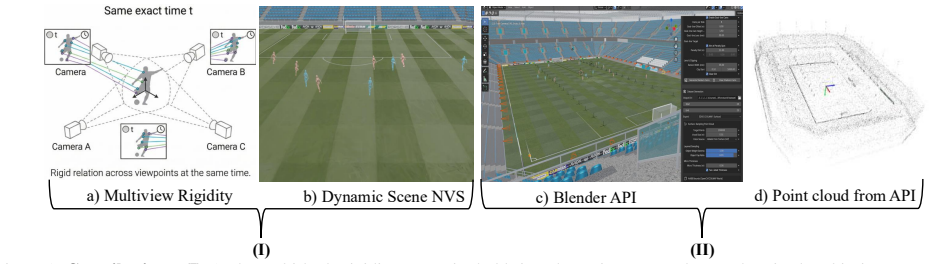
Retrospective novel view synthesis (NVS) of dynamic scenes is fundamental to applications such as sports. Recent dynamic 3D Gaussian Splatting (3DGS) approaches introduce temporally coupled formulations to enforce motion coherence across time. In this paper, we argue that, in a synchronized multi-view (MV) setting typical of sports, the dynamic scene at each time step is already strongly geometrically constrained. We posit that the availability of calibrated, synchronized viewpoints provides sufficient spatial consistency, and therefore, explicit temporal coupling, or complex multi-body constraints seems unnecessary for retrospective NVS. To this end, we propose an approach tailored for synchronized MV dynamic scene. By initializing the SfM-derived point cloud at the start time and propagating optimized Gaussians over time, we show that efficient retrospective NVS can be achieved without imposing a temporal deformation constraint. Complementing our methodological contribution, we introduce a Dynamic MV dataset framework built on Blender for reproducible NeRF and 3DGS research. The framework generates high-quality, synchronized camera rigs and exports training-ready datasets in standard formats, eliminating inconsistencies in coordinate conventions and data pipelines. Using the framework, we construct a dynamic benchmark suite and evaluate representative NeRF and 3DGS approaches under controlled conditions. Together, we show that, under a synchronized MV setup, efficient retrospective dynamic scene NVS can be achieved using 3DGS. At the same time, the dataset-generation framework enables reproducible and principled benchmarking of dynamic NVS methods.
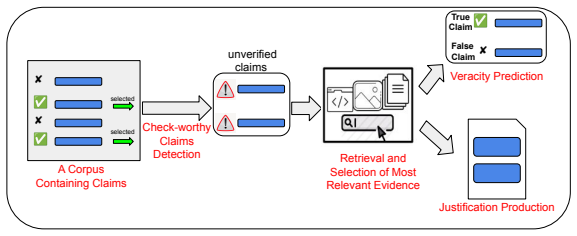
With the vast amount of content uploaded every hour, along with the AI generated content that can include hallucinations, Automated Fact-Checking (AFC) has become increasingly vital, as it is infeasible for human fact-checkers to manually verify the sheer volume of information generated online. Professional fact-checkers have identified several gaps in existing AFC systems, noting a misalignment between how these systems operate and how fact-checking is performed in practice. In this paper, we introduce CAAFC (Chronological Actionable Automated Fact-Checker), a frame-work designed to bridge these gaps. It surpasses SOTA AFC and hallucination detection systems across multiple benchmark datasets. CAAFC operates on claims, conversations, and dialogues, enabling it not only to detect factual errors and hallucinations, but also to correct them by providing actionable justifications supported by primary information sources. Furthermore, CAAFC can update evidence and knowledge bases by incorporating recent and contextual information when necessary, thereby enhancing the reliability of fact verification.
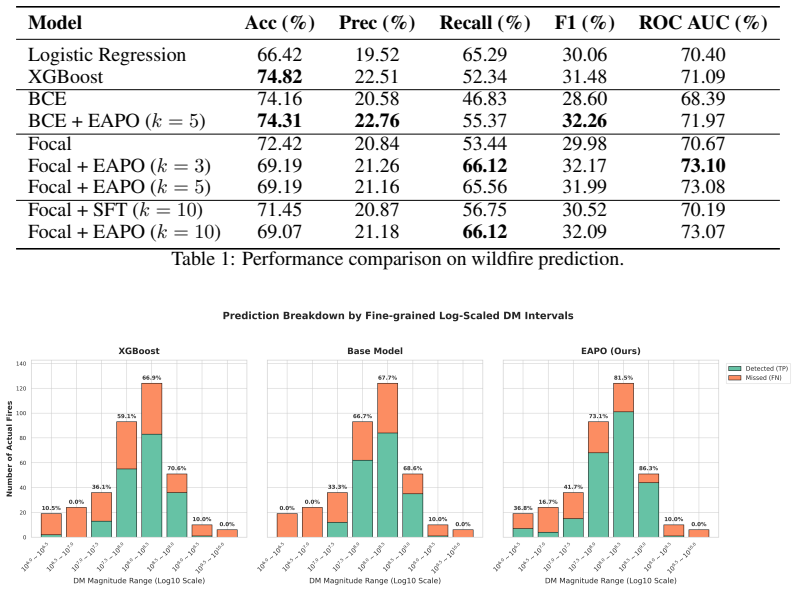
Predicting rare extreme events such as wildfires from meteorological data requires models that remain reliable under evolving environmental conditions. This problem is inherently long-tailed: wildfire events are rare but high-impact, while most observations correspond to non-fire conditions, causing standard learning objectives to underemphasize the minority class (fire) that matters most. In addition, models trained on historical distributions often fail under distribution shifts, exhibiting degraded performance in new environments. To this end, we propose Environment-Adaptive Preference Optimization (EAPO), a framework that adapts prediction to the target environment with long-tail distribution. Given a new input distribution, we first construct distribution-aligned datasets via $k$-nearest neighbor retrieval. We then perform a hybrid fine-tuning procedure on this local manifold, combining supervised learning with preference optimization, as well as emphasizing on rare extreme events. EAPO refines decision boundaries while avoiding conflicting signals from heterogeneous training data. We evaluate EAPO on a real-world wildfire prediction task with environmental shifts. EAPO achieves robust performance (ROC-AUC 0.7310) and improves detection in extreme regimes, demonstrating its effectiveness in dynamic wildfire prediction systems.
Modern server workloads exhibit massive instruction footprints that heavily pressure the processor front-end, making L1 instruction (L1I) prefetching critical for sustaining performance. However, this paper shows that current L1I prefetchers fail to reach their full potential due to two key limitations. First, L1I prefetches crossing page boundaries require address translation before issuance, and translation latency reduces prefetch timeliness. Second, the reuse behavior of code lines fetched by L1I prefetches is highly heterogeneous: while some lines are reused many times, others are dead-on-arrival.
This paper introduces Instruction Prefetch-Centric Cache and TLB Management (IP-CaT), the first microarchitectural framework jointly optimizing TLB and cache management for L1I prefetching. IP-CaT consists of two components: (i) the translation Prefetch Buffer (tPB), a small structure colocated with the second-level TLB (sTLB) that stores page table entries fetched by page-crossing L1I prefetches, reducing translation overheads; and (ii) the Trimodal Instruction Prefetch Replacement Policy (TIPRP), a decision-tree-based L2 cache replacement policy specialized for lines fetched by L1I prefetches.
We evaluate IP-CaT with three state-of-the-art L1I prefetchers: EPI, FNL+MMA, and Barca. Across 105 contemporary server workloads, IP-CaT consistently improves performance. For example, IP-CaT+EPI achieves an 8.7% geomean speedup over EPI alone. We further show that IP-CaT outperforms state-of-the-art instruction TLB prefetching, advanced TLB replacement (CHiRP), and state-of-the-art code-aware, prefetch-aware, and general-purpose cache replacement policies, including Emissary, SHiP++, and Mockingjay.
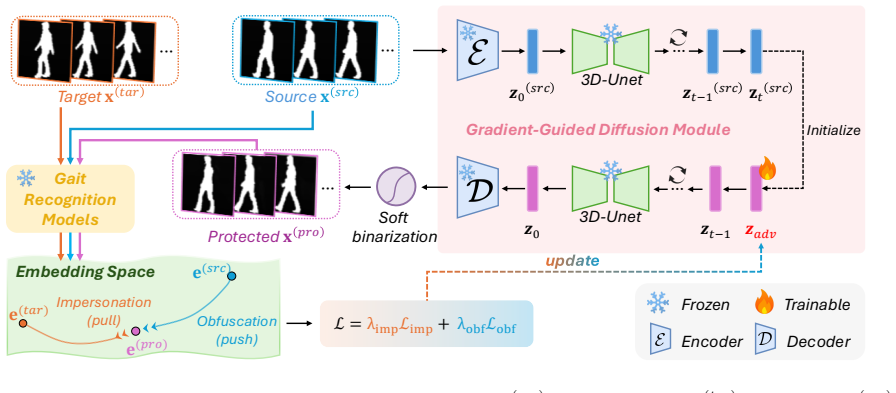
Conventional gait de-identification methods often encounter an inherent trade-off: they either provide insufficient identity suppression or introduce spatiotemporal distortions that impede structure-sensitive downstream applications. We propose GaitProtector, an impersonation-driven gait de-identification framework that formulates privacy protection as a unified objective with two tightly coupled components: (i) obfuscation, which repels the protected gait from the source identity, and (ii) impersonation, which attracts it toward a selected target identity. The target identity serves as a semantic anchor that biases optimization toward structurally plausible gait patterns under the pretrained diffusion prior, helping preserve dominant body shape and motion dynamics. We instantiate this idea through a training-free diffusion latent optimization pipeline. Instead of retraining a generator for each dataset, we invert each input silhouette sequence into the latent trajectory of a pretrained 3D video diffusion model and iteratively optimize latent codes with a differentiable adversarial objective to synthesize protected gaits. Experiments on the CASIA-B dataset show that GaitProtector achieves a 56.7% impersonation success rate under black-box gait recognition and reduces Rank-1 identification accuracy from 89.6% to 15.0%, while maintaining favorable visual and temporal quality. We further evaluate downstream utility on the Scoliosis1K dataset, where diagnostic accuracy decreases only from 91.4% to 74.2%. To the best of our knowledge, this work is the first to leverage pretrained 3D diffusion priors in a training-free manner for silhouette-based gait de-identification.
Segmentation models in automated optical inspection of wire-bonded semiconductors are typically device-specific and must be re-trained when new devices or distribution shifts appear. We introduce AOI-SSL, a training-efficient framework for semantic segmentation of wire-bonded semiconductors by combining small-domain self-supervised pre-training of vision transformers with in-context inference that minimizes the need of labeled examples. We pre-train SOTA self-supervised algorithms in a small industrial inspection dataset and find that Masked Autoencoders are the most effective in this small-data setting, improving downstream segmentation while reducing the labeled fine-tuning effort. We further introduce in-context, patch-level retrieval methods that predict masks directly from dense encoder embeddings with negligible additional training. We show that, in this setting, simple similarity-based retrieval performs on par with more complex attention-based aggregation used currently in the literature. Furthermore, our experiments demonstrate that self-supervised pre-training significantly improves segmentation quality compared to training from scratch and to ImageNet pre-trained backbones under a fixed fine-tuning computational budget. Finally, the results reveal that retrieval based segmentation outperforms fine-tuning when targeting single device images, allowing for near-instant adaptation to difficult samples.
A neural policy trained on Henneberg extensions matches planar optima and sets new spherical records.
abstractclick to expand
For minimally rigid graphs, the same edge-length data can admit multiple realizations (up to translations and rotations). Finding graphs with exceptionally many realizations is an extremal problem in rigidity theory, but exhaustive search quickly becomes infeasible due to the super-exponential growth of the number of candidate graphs and the high cost of realization-count evaluation. We propose a reinforcement-learning approach that constructs minimally rigid graphs via 0- and 1-extensions, also known as Henneberg moves. We optimize realization-count invariants using the Deep Cross-Entropy Method with a policy parameterized by a Graph Isomorphism Network encoder and a permutation-equivariant extension-level action head. Empirically, our method matches the known optima for planar realization counts and improves the best known bounds for spherical realization counts, yielding new record graphs.
How do transformer language models memorize factual associations? A common view casts internal weight matrices as associative memories over pairs of embeddings, requiring parameter counts that scale linearly with the number of facts. We develop a theoretical and empirical account of an alternative, \emph{geometric} form of memorization in which learned embeddings encode relational structure directly, and the MLP plays a qualitatively different role. In a controlled setting where a single-layer transformer must memorize random bijections from subjects to a shared attribute set, we prove that a logarithmic embedding dimension suffices: subject embeddings encode \emph{linear superpositions} of their associated attribute vectors, and a small MLP acts as a relation-conditioned selector that extracts the relevant attribute via ReLU gating, and not as an associative key-value mapping. We extend these results to the multi-hop setting -- chains of relational queries such as ``Who is the mother of the wife of $x$?'' -- providing constructions with and without chain-of-thought that exhibit a provable capacity-depth tradeoff, complemented by a matching information-theoretic lower bound. Empirically, gradient descent discovers solutions with precisely the predicted structure. Once trained, the MLP transfers zero-shot to entirely new bijections when subject embeddings are appropriately re-initialized, revealing that it has learned a generic selection mechanism rather than memorized any particular set of facts.
A star of 2n triangles on 4n+1 Boolean variables forces ascents of length 10*2^n - 9 with treedepth 3 and feedback vertex set size 1.
abstractclick to expand
Local search in combinatorial optimisation can be viewed as an uphill climb on a corresponding fitness landscape, where the assignments visited by a strict local search follow an ascent in the landscape. This hill-climbing is sometimes surprisingly efficient, but not always. Since fitness landscapes can be succinctly represented by valued constraint satisfaction problems (VCSPs), it is natural to ask: what properties of VCSPs ensure that all ascents are polynomial? Or alternatively, what are the ``simplest'' VCSPs with exponential ascents? Prior examples of VCSPs with long ascents were built up as a chain of gadgets of constraints. Here we give a simpler star of gadgets construction by gluing 2n triangles of constraints at a common centre variable. We obtain a binary VCSP on 4n + 1 Boolean variables with an exponential ascent of length 10*2^n - 9. The variable at the centre of our construction intertwines two sublandscapes with only linear ascents into one with exponential ascents. The VCSP that we construct is significantly simpler than prior constructions in terms of treedepth (reducing \Omega(log n) to 3) and feedback vertex set number (reducing \Omega(n) to 1). We discuss the consequences of this simplicity for the parameterized complexity of local search.
Automatic generation of educational materials using large language models (LLMs) is becoming increasingly common, but assigning difficulty levels to such materials still requires substantial human effort. LLM-as-a-Judge has therefore attracted attention, yet disagreement with human raters remains a major challenge. We propose a method for predicting which LLM-generated difficulty ratings are likely to disagree with human raters, so that such cases can be sent for re-rating. Unlike prior approaches, our method does not rely on generation-time probability signals, which must be collected during rating generation and are often difficult to compare across LLMs. Instead, exploiting the fact that difficulty is an ordinal scale, we use a separate embedding space, such as ModernBERT, and identify disagreement candidates based on the geometric consistency of the rating set. Experiments on English CEFR-based sentence difficulty assessment with GPT-OSS-120B and Qwen3-235B-A22B showed that the proposed method achieved higher AUC for predicting disagreement with human raters than probability-based baselines.
Large Language Models (LLMs) struggle to solve complex combinatorial problems through direct reasoning, so recent neuro-symbolic systems increasingly use them to synthesize executable solvers. A central design question is how the LLM should represent the solver, and whether it should also attempt to optimize search. We introduce CP-SynC-XL, a benchmark of 100 combinatorial problems (4,577 instances), and evaluate three solver-construction paradigms: native algorithmic search (Python), constraint modeling through a Python solver API (Python + OR-Tools), and declarative constraint modeling (MiniZinc + OR-Tools). We find a consistent representational divergence: Python + OR-Tools attains the highest correctness across LLMs, while MiniZinc + OR-Tools has lower absolute coverage despite using the same OR-Tools back-end. Native Python is the most likely to return a schema-valid solution that fails verification, whereas solver-backed paths preserve higher conditional fidelity. On the heuristic axis, prompting for search optimization yields only small median speed-ups (1.03-1.12x) and a strongly bimodal effect: many instances slow down, and correctness drops sharply on a long tail of problems. A paired code-level audit traces these regressions to a recurring heuristic trap. Under an efficiency-oriented prompt, the LLM may replace complete search with local approximations (Python), inject unverified bounds (Python + OR-Tools), or add redundant declarative machinery that overwhelms or over-constrains the model (MiniZinc + OR-Tools). These findings support a conservative design principle for LLM-generated combinatorial solvers: use the LLM primarily to formalize variables, constraints, and objectives for verified solvers, and separately check any LLM-authored search optimization before use.
Despite the rapid advancements in large language model (LLM) development, fine-tuning them for specific tasks often results in the catastrophic forgetting of their general, language-based reasoning abilities. This work investigates and addresses this challenge in the context of the Generative Retrieval (GenRetrieval) task. During GenRetrieval fine-tuning, we find this forgetting occurs rapidly and correlates with the distance between the fine-tuned and original model parameters. Given these observations, we propose ORBIT, a novel approach that actively tracks the distance between fine-tuned and initial model weights, and uses a weight averaging strategy to constrain model drift during GenRetrieval fine-tuning when this inter-model distance exceeds a maximum threshold. Our results show that ORBIT retains substantial text and retrieval performance by outperforming both common continual learning baselines and related regularization methods that also employ weight averaging.
Quantitative automata (QAs) extend finite-state omega-automata with weighted transitions to specify quantitative system properties. However, their finite weight sets rule out properties like average response time, where response times can be arbitrarily large. Nested quantitative automata (NQAs) overcome this limitation: a parent automaton spawns child automata to compute unbounded values over finite infixes and aggregates them into a final result. Despite this expressiveness, NQAs have lacked practical tool support to date. We address this gap by extending the Quantitative Automata Kit (QuAK), a software tool for QA analysis, to support NQAs. Our core contribution is implementing a suite of flattening procedures that reduce NQAs to QAs, leveraging QuAK's existing decision procedures. These reductions preserve the answers to threshold decision problems, while allowing users to specify properties in the more expressive NQA formalism. The tool handles all combinations of parent aggregators, including limits and averages, and child functions, extrema and monotonic or bounded summations, for which emptiness and universality are known to be decidable. Experiments on response-time and resource-consumption benchmarks demonstrate QuAK's effectiveness.
Generative policies based on expressive model classes, such as diffusion and flow matching, are well-suited to complex control problems with highly multimodal action distributions. Their expressivity, however, comes at a significant inference cost: generating each action typically requires simulating many steps of the generative process, compounding latency across sequential decision-making rollouts. We introduce flow map policies, a novel class of generative policies designed for fast action generation by learning to take arbitrary-size jumps including one-step jumps-across the generative dynamics of existing flow-based policies. We instantiate flow map policies for offline-to-online reinforcement learning (RL) and formulate online adaptation as a trust-region optimization problem that improves the critic's Q-value while remaining close to the offline policy. We theoretically derive FLOW MAP Q-GUIDANCE (FMQ), a principled closed-form learning target that is optimal for adapting offline flow map policies under a critic-guided trust-region constraint. We further introduce Q-GUIDED BEAM SEARCH (QGBS), a stochastic flow-map sampler that combines renoising with beam search to enable iterative inference-time refinement. Across 12 challenging robotic manipulation and locomotion tasks from OGBench and RoboMimic, FMQ achieves state-of-the-art performance in offline-to-online RL, outperforming the previous one-step policy MVP by a relative improvement of 21.3% on the average success rate.
Multimodal Large Language Models (MLLMs) show strong visual perception, yet remain limited in reasoning about space under changing viewpoints. We study this challenge as Perspective-Conditioned Spatial Reasoning (PCSR) in 360-degree omnidirectional images, where broad scene coverage reduces ambiguity from partial observations without eliminating the need for viewpoint-dependent inference. To assess this capability, we introduce PCSR-Bench, a diagnostic benchmark of 84,373 question-answer pairs from 2,600 omnidirectional images across 26 indoor environments. PCSR-Bench contains eight tasks spanning foundational perception (e.g., object counting, relative distance, and relative direction) and advanced PCSR, including compositional chains, egocentric rotation, perspective re-anchoring, ego-distortion, and limited-FOV visibility. We evaluate 14 representative MLLMs and observe a substantial perception-reasoning gap: accuracy reaches 57.59% on foundational relative direction, but drops to 13.49% on egocentric rotation, 7.13% on egocentric distortion, and 0.64% on open-ended compositional reasoning. To probe the plasticity of this gap, we conduct an RL-based diagnostic study on a 7B-scale model. Reward shaping improves a matched 7B baseline from 31.10% to 60.06% under a controlled setting, suggesting that PCSR is partial plasticity rather than being fully immutable. Still, the gains are task-selective, sensitive to reward design including both weight allocation and reward formulation, and partially dependent on the evaluation protocol. These results position PCSR as a key bottleneck in current MLLMs and highlight limited but meaningful room for recovery under targeted optimization.
Large Language Models (LLMs) update their behavior in context, which can be viewed as a form of Bayesian inference. However, the structure of the latent hypothesis space over which this inference operates remains unclear. In this work, we propose that LLMs assign beliefs over a low-dimensional geometric space - a conceptual belief space - and that in-context learning corresponds to a trajectory through this space as beliefs are updated over time. Using story understanding as a natural setting for dynamic belief updating, we combine behavioral and representational analyses to study these trajectories. We find that (1) belief updates are well-described as trajectories on low-dimensional, structured manifolds; (2) this structure is reflected consistently in both model behavior and internal representations and can be decoded with simple linear probes to predict behavior; and (3) interventions on these representations causally steer belief trajectories, with effects that can be predicted from the geometry of the conceptual space. Together, our results provide a geometric account of belief dynamics in LLMs, grounding Bayesian interpretations of in-context learning in structured conceptual representations.
AI agents negotiate and transact in natural language with unfamiliar counterparts: a buyer bot facing an unknown seller, or a procurement assistant negotiating with a supplier. In such interactions, the counterpart's LLM, prompts, control logic, and rule-based fallbacks are hidden, while each decision can have monetary consequences. We ask whether an agent can predict an unfamiliar counterpart's next decision from a few interactions. To avoid real-world logging confounds, we study this problem in controlled bargaining and negotiation games, formulating it as target-adaptive text-tabular prediction: each decision point is a table row combining structured game state, offer history, and dialogue, while $K$ previous games of the same target agent, i.e., the counterpart being modeled, are provided in the prompt as labeled adaptation examples. Our model is built on a tabular foundation model that represents rows using game-state features and LLM-based text representations, and adds LLM-as-Observer as an additional representation: a small frozen LLM reads the decision-time state and dialogue; its answer is discarded, and its hidden state becomes a decision-oriented feature, making the LLM an encoder rather than a direct few-shot predictor. Training on 13 frontier-LLM agents and testing on 91 held-out scaffolded agents, the full model outperforms direct LLM-as-Predictor prompting and game+text features baselines. Within this tabular model, Observer features contribute beyond the other feature schemes: at $K=16$, they improve response-prediction AUC by about 4 points across both tasks and reduce bargaining offer-prediction error by 14%. These results show that formulating counterpart prediction as a target-adaptive text-tabular task enables effective adaptation, and that hidden LLM representations expose decision-relevant signals that direct prompting does not surface.
Recent advances in reinforcement learning from human feedback (RLHF) and preference optimization have substantially improved the usability, coherence, and safety of large language models. However, recurring behaviors such as performative certainty, hallucinated continuity, calibration drift, sycophancy, and suppression of visible uncertainty suggest unresolved structural issues within scalarized preference optimization systems.
We propose Semantic Reward Collapse (SRC): the compression of semantically distinct forms of evaluative dissatisfaction into generalized optimization signals. Under SRC, categories such as factual incorrectness, uncertainty disclosure, formatting dissatisfaction, latency, and social preference may become entangled within a shared reward topology despite representing fundamentally different epistemic classes.
We argue that adaptive reasoning systems operating under generalized evaluative pressure may drift toward suppression of visible epistemic failure rather than preservation of calibrated uncertainty integrity. These behaviors are framed strictly as optimization consequences rather than evidence of deception or anthropomorphic agency.
Drawing on institutional proxy collapse, metric gaming, software reliability engineering, and human learning theory, we propose that uncertainty disclosure and escalation behavior should be treated as protected epistemic conduct rather than globally penalized task incompletion.
Finally, we introduce Constitutional Reward Stratification (CRS), a domain-aware reward framework intended to preserve differentiated epistemic attribution within adaptive learning systems. We present CRS not as a validated solution, but as a testable governance-oriented research direction requiring further empirical investigation.
We study {on-policy self-distillation} (OPSD), where a language model improves its reasoning ability by distilling privileged teacher distributions along its own on-policy trajectories. Despite the performance gains of OPSD, we identify a common but often overlooked mismatch between teacher and student responses: self-reflected teacher responses can be shifted by reflection-induced bias and response templates, leading to miscalibrated token-level supervision. To mitigate this issue, we propose \methodname, an outcome-guided logit-steering framework that leverages verifiable outcome rewards to contrast successful and failed on-policy trajectories and calibrate teacher logits. By combining outcome-level correctness with dense token-level guidance through logit steering, \methodname stabilizes self-distillation and improves reasoning performance over standard OPSD and other variants across diverse benchmarks.
3D Gaussian Splatting (3DGS) has emerged as a prominent paradigm for 3D reconstruction and novel view synthesis. However, it remains vulnerable to severe artifacts when trained under sparse-view constraints. While recent methods attempt to rectify artifacts in rendered views using image diffusion models, they typically rely on multi-view self-attention to retrieve information from reference images. We observe that this mechanism often fails when the rendered novel views output by 3DGS are heavily corrupted: damaged query features lead to erroneous cross-view retrieval, resulting in inconsistent rendering refinement. To address this, we propose GeoQuery, a geometry-guided diffusion framework that integrates generative priors with explicit geometric cues via a novel Geometry-guided Cross-view Attention (GCA) mechanism. First, by leveraging predicted depth maps and camera poses, we construct a geometry-induced correspondence field to sample reference features, forming a geometry-aligned proxy query that replaces the corrupted rendering features. Furthermore, we design a new cross-view feature aggregation pipeline, in which we restrict the cross-view attention to a local window around each proxy query to effectively retrieve useful features while suppressing spurious matches. GeoQuery can be seamlessly integrated into existing diffusion-based pipelines, enabling robust reconstruction even under extreme view sparsity. Extensive experiments on sparse-view novel view synthesis and rendering artifact removal demonstrate the effectiveness of our approach.
Estimating question difficulty is a critical component in evaluating and improving large language models (LLMs) for question answering (QA). Existing approaches often rely on readability formulas, retrieval-based signals, or popularity statistics, which may not fully capture the reasoning challenges posed to modern LLMs. In this paper, we introduce Q-DAPS (Question Difficulty based on Answer Plausibility Scores) method, a novel approach that estimates question difficulty by computing the entropy of plausibility scores over candidate answers. We systematically evaluate Q-DAPS across four prominent QA datasets-TriviaQA, NQ, MuSiQue, and QASC-demonstrating that it consistently outperforms baselines. Moreover, Q-DAPS shows strong robustness across hyperparameter variations and question types. Extensive ablation studies further show that Q-DAPS remains robust across different plausibility estimation paradigms, model sizes, and realistic settings. Human evaluations further confirm strong alignment between Q-DAPS's difficulty estimates and human judgments of question difficulty. Overall, Q-DAPS provides an interpretable, scalable, and bias-resilient approach to question difficulty estimation in modern QA systems.
Collective communication is a major bottleneck for multi-node GPU workloads in scientific computing and distributed deep learning, especially when inter-node bandwidth is limited. Although NCCL provides optimized GPU-centric collectives, large messages can still dominate end-to-end performance. Existing compression-enabled collective libraries either rely on MPI-based stacks that cannot fully exploit NCCL, omit entropy coding, or tightly couple full compressors with communication primitives, limiting compression ratio, flexibility, and communication-computation overlap. This paper presents NCCLZ, a compression-enabled GPU collectives that decouples quantization and entropy coding and integrates them at different layers of the stack. NCCLZ places quantization at the interface, embeds entropy coding into NCCL primitives, uses a lightweight device-side selector to choose coding strategies, and overlaps compression with communication to reduce exposed overhead. Experiments on scientific datasets, training gradients, and synthetic workloads show up to 9.65x speedup over NCCL and up to 3.34x improvement over prior compression-assisted collective libraries.
Background: Many different approaches to controlled text generation (CTG) have been proposed over recent years, but it is difficult to get a clear picture of which approach performs best, because different datasets and evaluation methods are used in each case to assess the control achieved.
Objectives: Our aim in the work reported in this paper is to develop an approach to evaluation that enables us to comparatively evaluate different CTG systems in a manner that is both informative and fair to the individual systems.
Methods: We use a level-playing-field (LPF) approach to comparative evaluation where we (i) generate and process all system outputs in a standardised way, and (ii) apply a shared set of evaluation methods and datasets, selected based on those currently in use, in order to ensure fair evaluation.
Results: When re-evaluated in this way, performance results for a representative set of current CTG systems differ substantially from originally reported results, in most cases for the worse. This highlights the importance of a shared standardised way of assessing controlled generation.
Conclusions: The discrepancies revealed by LPF evaluation demonstrate the urgent need for standardised, reproducible evaluation practices in CTG. Our results suggest that without such practices, published performance claims may substantially misrepresent true system capabilities.
Training Neural Networks (NNs) without overfitting is difficult; detecting that overfitting is difficult as well. We present a novel Random Matrix Theory method that detects the onset of overfitting in deep learning models without access to train or test data. For each model layer, we randomize each weight matrix element-wise, $\mathbf{W} \to \mathbf{W}_{\mathrm{rand}}$, fit the randomized empirical spectral distribution with a Marchenko-Pastur distribution, and identify large outliers that violate self-averaging. We call these outliers Correlation Traps. During the onset of overfitting, which we call the "anti-grokking" phase in long-horizon grokking, Correlation Traps form and grow in number and scale as test accuracy decreases while train accuracy remains high. Traps may be benign or may harm generalization; we provide an empirical approach to distinguish between them by passing random data through the trained model and evaluating the JS divergence of output logits. Our findings show that anti-grokking is an additional grokking phase with high train accuracy and decreasing test accuracy, structurally distinct from pre-grokking through its Correlation Traps. More broadly, we find that some foundation-scale LLMs exhibit the same Correlation Traps, indicating potentially harmful overfitting.
Segmenting small and sparse structures in large-scale images is fundamentally constrained by voxel-level, lattice-bound computation and extreme class imbalance -- dense, full-resolution inference scales poorly and forces most pipelines to rely on fixed regionization or downsampling, coupling computational cost to image resolution and attenuating boundary evidence precisely where minority structures are most informative. We introduce SEMIR (Semantic Minor-Induced Representation Learning), a representation framework that decouples inference from the native grid by learning a task-adapted, topology-preserving latent graph representation with exact decoding. SEMIR transforms the underlying grid graph into a compact, boundary-aligned graph minor through parameterized edge contraction, node deletion, and edge deletion, while preserving an exact lifting map from minor predictions to lattice labels. Minor construction is formalized as a few-shot structure learning problem that replaces hand-tuned preprocessing with a boundary-alignment objective: minor parameters are learned by maximizing agreement between predicted boundary elements and target-specific semantic edges under a boundary Dice criterion, and the induced minor is annotated with scale- and rotation-robust geometric and intensity descriptors and supports efficient region-level inference via message passing on a graph neural network (GNN) with relational edge features. We benchmark SEMIR on three tumor segmentation datasets -- BraTS 2021, KiTS23, and LiTS -- where targets exhibit high structural variability and distributional uncertainty. SEMIR yields consistent improvements in minority-structure Dice at practical runtime. More broadly, SEMIR establishes a framework for learning task-adapted, topology-preserving latent representations with exact decoding for high-resolution structured visual data.
Effective multi-agent cooperation requires agents to adopt diverse behaviors as task conditions evolve-and to do so at the right moment. Yet, current Multi-Agent Reinforcement Learning (MARL) frameworks that facilitate this diversity are still limited by the fact that they bind fixed behaviors to fixed agent identities. Consequently, they are ill-equipped for tasks where agents need to take on different roles at very specific moments in time. We argue that, to define these behavioral transitions, the missing ingredient is $\textbf{events}$. Events are changes in the state of the system that induce qualitative changes in the task. Based on this view, we introduce a framework that decouples agent identity from behavior, capturing a continuous manifold from which agents instantiate their behaviors in response to events. This framework is based on two elements. First, to build an expressive behavior manifold, we introduce Neural Manifold Diversity (NMD), a formal distance metric that remains well-defined when behaviors are transient and agent-agnostic. Second, we use an event-based hypernetwork that generates Low-Rank Adaptation (LoRA) modules over a shared team policy, enabling on-the-fly agent-policy reconfiguration in response to events. We prove that this construction ensures that diversity does not interfere with reward maximization by design. Empirical results demonstrate that our framework outperforms established baselines across benchmarks while exhibiting zero-shot generalization, and being the only method that solves tasks requiring sequential behavior reassignment.
Automatic detection of speaker confidence is critical for adaptive computing but remains constrained by limited labelled data and the subjectivity of paralinguistic annotations. This paper proposes a semi-supervised hybrid framework that fuses deep semantic embeddings from the Whisper encoder with an interpretable acoustic feature vector composed of eGeMAPS descriptors and auxiliary probability estimates of vocal stress and disfluency. To mitigate reliance on scarce ground truth data, we introduce an Uncertainty-Aware Pseudo-Labelling strategy where a model generates labels for unlabelled data, retaining only high-quality samples for training. Experimental results demonstrate that the proposed approach achieves a Macro-F1 score of 0.751, outperforming self-supervised baselines, including WavLM, HuBERT, and Wav2Vec 2.0. The hybrid architecture also surpasses the unimodal Whisper baseline, yielding a 3\% improvement in the minority class, confirming that explicit prosodic and auxiliary features provide necessary corrective signals which are otherwise lost in deep semantic representations. Ablation studies further show that a curated set of high confidence pseudo-labels outperforms indiscriminate large scale augmentation, confirming that data quality outweighs quantity for perceived confidence detection.
Robotic manipulation is typically evaluated by task success, but successful completion does not guarantee safe execution. Many safety failures are temporal: a robot may touch a clean surface after contamination or release an object before it is fully inside an enclosure. We introduce SafeManip, a property-driven benchmark to explicitly evaluate temporal safety properties in robotic manipulation, moving beyond prior evaluations that largely focus on task completion or per-state constraint violations. SafeManip defines reusable safety templates over finite executions using Linear Temporal Logic over finite traces (LTLf). It maps observed rollouts to symbolic predicate traces and evaluates them with LTLf-based monitors. Its property suite covers eight manipulation safety categories: collision and contact safety, grasp stability, release stability, cross-contamination, action onset, mechanism recovery, object containment, and enclosure access. Templates can be instantiated with task-specific objects, fixtures, regions, or skills, allowing the same safety specifications to generalize across tasks and environments. We evaluate SafeManip on six vision-language-action policies, including $\pi_0$, $\pi_{0.5}$, GR00T, and their training variants, across 50 RoboCasa365 household tasks. Results show that even strong models often behave unsafely. Task-success gains do not reliably translate into safer execution: many successful rollouts remain unsafe, while longer-horizon or more complex tasks expose more violations. SafeManip provides a reusable evaluation layer for diagnosing temporal safety failures and measuring safe success beyond task completion.
Large language models (LLMs) have demonstrated remarkable capabilities, but they still frequently produce hallucinations. These hallucinations are difficult to detect in reasoning-intensive tasks, where the content appears coherent but contains errors like logical flaws and unreliable intermediate results. While step-level analysis is commonly used to detect internal hallucinations, it suffers from limited granularity and poor scalability due to its reliance on step segmentation. To address these limitations, we propose TokenHD, a holistic pipeline for training token-level hallucination detectors. Specifically, TokenHD consists of a scalable data engine for synthesizing large-scale hallucination annotations along with a training recipe featuring an importance-weighted strategy for robust model training. To systematically assess the detection performance, we also provide a rigorous evaluation protocol. Through training within TokenHD, our detector operates directly on free-form text to identify hallucinations, eliminating the need for predefined step segmentation or additional text reformatting. Our experiments show that even a small detector (0.6B) achieves substantial performance gains after training, surpassing much larger reasoning models (e.g., QwQ-32B), and detection performance scales consistently with model size from 0.6B to 8B. Finally, we show that our detector can generalize well across diverse practical scenarios and explore strategies to further enhance its cross-domain generalization capability.
Large language models (LLMs) exhibit systematic preferences for well-known entities, a phenomenon often attributed to popularity bias. However, the extent to which these preferences reflect real-world popularity versus statistical exposure during pretraining remains unclear, largely due to the inaccessibility of most training corpora. We provide the first direct, large-scale analysis of popularity bias grounded in fully observable pretraining data. Leveraging the open OLMo models and their complete pretraining corpus, Dolma, we compute precise entity-level exposure statistics across 7.4 trillion tokens. We analyze 2,000 entities spanning five types (Person, Location, Organization, Art, Product) and compare pretraining exposure against Wikipedia pageviews and two elicited LLM popularity signals: direct scalar estimation and pairwise comparison. Our results show that pretraining exposure strongly correlates with Wikipedia popularity, validating exposure as a meaningful proxy for real-world salience during the training period. More importantly, we find that LLM popularity judgments align more closely with exposure than with Wikipedia, especially when elicited via pairwise comparisons. This alignment is strongest for larger models and persists in the long tail, where Wikipedia popularity becomes unreliable. Overall, our findings demonstrate that popularity priors in LLMs are primarily shaped by pretraining statistics rather than external popularity signals, offering concrete evidence that data exposure plays a central role in driving popularity bias.
Reinforcement learning is structurally harder than supervised learning because the policy changes the data distribution it learns from. The resulting fragility is especially visible in large-model training, where the training and rollout systems differ in numerical precision, sampling, and other implementation details. Existing methods manage this fragility by adding hyper-parameters to the training objective, which makes the algorithm more sensitive to its configuration and requires retuning whenever the task, model scale, or distribution mismatch changes. This fragility traces to two concerns that current objectives entangle through hyper-parameters set before training begins: a trust-region concern, that updates should not move the policy too far from its current value, and an off-policy concern, that data from older or different behavior policies should influence the update only to the extent that it remains reliable. Neither concern is a constant to set in advance, and their severity is reflected in the policy-ratio distribution of the current batch. We present a simple yet effective batch-adaptive objective that replaces fixed clipping with the normalized effective sample size of the policy ratios. The same statistic caps the score-function weight and sets the strength of an off-policy regularizer, so the update stays close to the usual on-policy score-function update when ratios are nearly uniform, and tightens automatically when stale or mismatched data cause ratio concentration, while retaining a nonzero learning signal on high-ratio tokens. Experiments across a wide range of settings show that our method matches or exceeds tuned baselines, introducing no new objective hyper-parameters and removing several existing ones. The code is available at https://github.com/FeynRL-project/FeynRL.
Many reinforcement learning (RL) tasks have discrete action spaces, but most generative policy methods based on diffusion and flow matching are designed for continuous control. Meanwhile, generative policies usually rely heavily on offline datasets and offline-to-online RL is itself challenging, as the policy must improve from new interaction without losing useful behavior learned from static data. To address those challenges, we introduce DRIFT, an online fine-tuning method that updates an offline pretrained continuous-time Markov chain (CTMC) policy with an advantage-weighted discrete flow matching loss. To preserve useful pretrained knowledge, we add a path-space penalty that regularizes the full CTMC trajectory distribution, rather than only the final action distribution. For large discrete action spaces, we introduce a candidate-set approximation that updates the actor over a small subset of actions sampled from reference-policy rollouts and uniform exploration. Our theoretical analysis shows that the candidate-set error is controlled by missing target probability mass, and the induced CTMC generator error decreases as the candidate set covers more high-probability actions. Experiments on prevailing discrete action RL task show that our method provides stable offline-to-online improvement across all tasks, achieving the highest average score on Jericho with a simple GRU encoder while outperforming methods that use pretrained language models. Controlled experiments further confirm that the path-space penalty remains bounded during fine-tuning and that the CTMC generator adapts to shifted rewards faster than deterministic baselines. The candidate-set mechanism is supported by a stability analysis showing that the generator error decreases exponentially with candidate coverage.
New circuit formats for proof lines yield strictly shorter refutations of some unsatisfiable formulas, with rule-dependent separations.
abstractclick to expand
Since their introduction by Atserias, Kolaitis, and Vardi in 2004, proof systems where each line is represented by an ordered binary decision diagram (OBDD) have been intensively studied as they allow to compactly represent Boolean functions. We extend this line of work by considering representation formats that can be even more succinct than OBDDs and have gained a lot of attention in the area of knowledge compilation: sentential decision diagrams (SDDs) and deterministic structured DNNF circuits (d-SDNNFs).
We show that both variants can provide strictly smaller refutations of unsatisfiable CNFs than their OBDD counterparts. Furthermore, we investigate the relative strength of these systems depending on which of the three fundamental derivation rules join, reordering, and weakening are allowed. Here we obtain several separations and identify interesting open problems. To streamline our proofs we establish a sat-to-unsat lifting theorem that might be of independent interest: it turns satisfiable CNFs that are hard to represent by SDDs and d-SDNNFs into unsatisfiable CNFs that are hard to refute in the corresponding proof system.
Table processing-including cleaning, transformation, augmentation, and matching-is a foundational yet error-prone stage in real-world data pipelines. While recent LLM-based approaches show promise for automating such tasks, they often struggle in practice due to ambiguous instructions, complex task structures, and the lack of structured feedback, resulting in syntactically correct but semantically flawed code. To address these challenges, we propose ProfiliTable, an autonomous multi-agent framework centered on dynamic profiling, which constructs and iteratively refines a unified execution context through interactive exploration, knowledge-augmented synthesis, and feedback-driven refinement. ProfiliTable integrates (i) a Profiler that performs ReAct-style data exploration to build semantic understanding, (ii) a Generator that retrieves curated operators to synthesize task-aware code, and (iii) an Evaluator-Summarizer loop that injects execution scores and diagnostic insights to enable closed-loop refinement. Extensive experiments on a diverse benchmark covering 18 tabular task types demonstrate that ProfiliTable consistently outperforms strong baselines, particularly in complex multi-step scenarios. These results highlight the critical role of dynamic profiling in reliably translating ambiguous user intents into robust and governance-compliant table transformations.